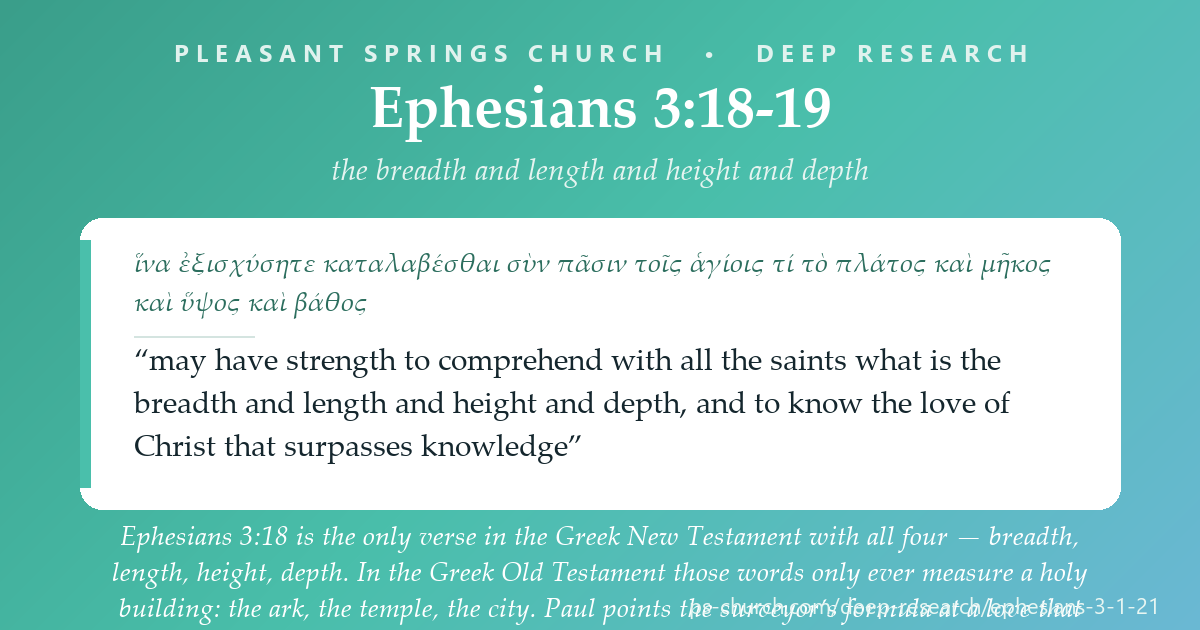
Paul starts a sentence in Ephesians 3:1 and does not finish it. Twelve verses later he starts it again with the same two Greek words — and this time it becomes a prayer: that you would have strength to comprehend, with all the saints, the breadth and length and height and depth. We measured those four words. Ephesians 3:18 is the only verse in the Greek New Testament that carries all four; in the Greek Old Testament held here, no verse does, and six of the seven that carry three are measuring something holy — the ark, Solomon’s temple, Ezekiel’s temple. The four words are the surveyor’s, and what they are set against is a love that surpasses knowledge. This study works Ephesians 3:1–21. See the method →
Ephesians 3:1, 3–6, 8–10, 12, 14–21
Greek NT · ESVVersification. Ephesians is a New Testament book, and the chapter-and-verse numbering used here — SBLGNT via MorphGNT for the Greek, the ESV for the English — agrees exactly. Ephesians 3 has 21 verses in both, and there is no offset anywhere in the letter: nothing on this page needs a second reference. The offset does appear in the Old Testament texts this page cites, and it is printed both ways every time. The clearest case: Ephesians 4:8 quotes Psalm 68:18 in English numbering, which is Psalm 67:19 in the Septuagint, because the Greek Psalter runs one chapter behind the Hebrew from Psalm 9/10 through Psalm 147 and counts most superscriptions as verse 1. The same offset stands behind Psalm 4:5 LXX (= Psalm 4:4 English), Psalm 57:11 LXX (= Psalm 58:10 English) and Psalm 106:8 LXX (= Psalm 107:8 English), all cited on this page with both numbers. The Greek 3 Kingdoms runs its own order through 1 Kings 7, where 7:14 is English 7:27 and 7:39 is English 7:2, and this page prints both. Deuteronomy 5:16, the source of Ephesians 6:2’s seven-word run, is numbered identically in the Hebrew, the Greek and the English.
The Shape of the Passage
Interruption & Resumption — a sequence, not a chiasmEphesians 2 ended with a building: Jew and Gentile joined into “a holy temple in the Lord… a dwelling place for God by the Spirit” (2:21–22). Ephesians 3 explains how Paul came to know that this was God’s plan all along, and then kneels down and prays that the people who are the building would be able to measure something far larger than a building: the love of Christ.
Author
Paul, writing as “the prisoner of Christ Jesus” (3:1). He does not say “the prisoner of Rome,” or “of Nero,” or “of the Jews who seized me in the temple.” He was in chains precisely because he had told Gentiles they could come in (Acts 21:27–29; 22:21–22), and he reads his own chains as belonging to Christ and as being for the Gentiles who are reading the letter. That is why he can turn round at 3:13 and ask them not to lose heart over his sufferings, “which is your glory.”
The sentence that breaks. Ephesians 3:1 begins “For this reason I, Paul…” and stops. No main verb comes. Instead Paul spends twelve verses on the mystery entrusted to him, and only at 3:14 does he begin again with exactly the same two Greek words — Toutou charin — and this time complete the sentence: “I bow my knees before the Father.” This is not sloppiness. It is a man who cannot mention his imprisonment without immediately explaining what he is imprisoned for. The digression is the reason for the prayer.
What “mystery” means here. Mystērion in Paul is not a puzzle, and it is not a secret initiation of the kind the Greek mystery cults sold. It is something God kept and God has now told. The content is stated flatly in 3:6: the Gentiles are fellow heirs, fellow body, fellow partakers. The scandal is not that Gentiles get blessed — the Old Testament said they would — but that they are joined into one body on equal footing without becoming Jews first. And in 3:10 Paul says the point of that single body is cosmic: God is showing his “manifold wisdom” to the rulers and authorities in the heavenly places, and the exhibit is the church.
Audience
Gentile believers in and around Ephesus — people who had every reason to feel second-class in a movement that began in Jerusalem, whose apostle was in prison partly on their account. Paul’s three syn- words in 3:6 are aimed straight at that anxiety: not guests, not associates, not a second tier. Fellow heirs. Fellow body. Fellow partakers.
A prayer for capacity, not information. Notice what Paul does not pray for: not health, not release, not success. He prays that they would be strengthened in the inner being so as to have strength to comprehend (3:16, 18). The love of Christ is not withheld; it is too large. What has to grow is the one doing the measuring. And then he says the quiet thing out loud: the goal is to know a love “that surpasses knowledge” (3:19) — a knowing that never finishes.
“With all the saints.” The comprehending in 3:18 is explicitly plural and corporate: syn pasin tois hagiois. Paul does not expect anyone to take the measure of Christ’s love alone. This is of a piece with 3:10 — it is through the church that the manifold wisdom is displayed — and with 3:21, where the glory is given to God in the church. A private Christianity cannot see the dimensions.
Orient on mystery, stewardship, the powers, and the fullness of God.
Search by topic: mystery, revelation, stewardship / dispensation, principalities and powers, wisdom, fullness, Gentiles.
Which articles are relevant?
- Anchor Bible Dictionary — “Mystery,” “Wisdom,” “Gentiles,” “Principalities and Powers.”
- Dictionary of Paul and His Letters — “Mystery,” “Ephesians, Letter to the,” “Principalities and Powers,” “Fullness,” “Prayer.”
- NIDNTT / TDNT — μυστήριον (mystērion), οἰκονομία (oikonomia), παρρησία (parrēsia), πλήρωμα (plērōma).
- Dictionary of Deities and Demons in the Bible — “Rulers,” “Authorities,” on the heavenly powers of 3:10.
Bibliography surfaced:
- Harold Hoehner (exegetical), Andrew Lincoln (WBC), Peter O’Brien (Pillar), Frank Thielman (BECNT), Clinton Arnold (ZECNT) on Ephesians.
- Chrysostom, Homilies on Ephesians 6–7; John Calvin and John Stott on 3:14–21.
- Beale & Carson, Commentary on the NT Use of the OT (Ephesians); Markus Bockmuehl, Revelation and Mystery in Ancient Judaism and Pauline Christianity.
Where ‘mystery’ came from, and what the Greek Bible measures.
Read mystērion, oikonomia, and the four dimensions against their Greek Old Testament and Second Temple backdrop — and let the screens say where the language actually sits.
Which parallels shed light on religion and worldview?
‘Mystery’ is Daniel’s word. A lexeme screen over the 64 CATSS Greek Old Testament files held here finds 31 occurrences of the mystērion family. Seventeen of them are in Daniel — eight in the Old Greek and nine in the Theodotion text, and all but one of those seventeen sit in Daniel 2, the chapter of Nebuchadnezzar’s dream. Four are in Sirach (22:22; 27:16, 17, 21), where the word means a friend’s confidence betrayed. So the Danielic sense — a secret in the mind of God which God discloses to a man, “there is a God in heaven who reveals mysteries” (Dan 2:28) — is still the dominant one in the Greek Old Testament, and it is still exactly Paul’s usage in 3:3.
⚠️ This paragraph used to end with a claim it can no longer make, and the history matters more than the number. Measured on the 44 files held before 2026-08-30, this screen returned 21 occurrences, all of them in Daniel and Sirach, and the page concluded that the mystery-religion sense — a rite you are initiated into and then must never tell — does not occur in the Greek Old Testament. Exodus, Leviticus, Numbers, Joshua and the deuterocanon reached this shelf on 2026-08-30, taking it to 64 files and 30,637 verse units, and that claim is now false on this corpus. Ten further occurrences came with them, and two are precisely the cult sense: Wisdom of Solomon 14:15, where a grieving father deifies his dead child and “handed on to his dependants μυστήρια καὶ τελετάς” — mysteries and initiation-rites — and Wisdom 14:23, “child-slaying rites or κρύφια μυστήρια,” secret mysteries. The Wisdom of Solomon is a witness, not Scripture — and that is what saves the contrast rather than destroying it. The pagan-cult sense does stand in the Greek library the church read; it never stands in Scripture. Paul is not writing against a sense no Greek-speaking Jew had met. He is writing against one that Wisdom names and condemns.
And the new books open a third sense the 44-file corpus could not show at all: a king’s secret. Tobit 12:7 and 12:11 — μυστήριον βασιλέως καλὸν κρύψαι, “it is good to hide a king’s secret, but to reveal the works of God gloriously” (the pair stands in both the BA and the S recension, so it counts four times in a file-level tally); Judith 2:2, Nebuchadnezzar laying τὸ μυστήριον τῆς βουλῆς αὐτοῦ before his officers; and 2 Maccabees 13:21, Rhodocus betraying τὰ μυστήρια to the enemy. Tobit, Judith and 2 Maccabees are witnesses, not Scripture. Tobit’s line is the striking one, because it is Paul’s own distinction in 3:8–9 almost word for word: a king’s secret is kept, God’s works are published. And Wisdom 6:22 is nearer still — “I will not hide μυστήρια from you, but will trace her out from the beginning of creation and bring her knowledge into the open.” A mystery told in order to publish — which is precisely Paul in 3:8–9.
‘Stewardship’ is Shebna’s word. Oikonomia (3:2, 9) is common in the New Testament — nine occurrences, three of them in Ephesians (1:10; 3:2, 9) — but in the Greek Old Testament held here it occurs exactly twice, and both times in one paragraph: Isaiah 22:19 and 22:21, where Shebna is stripped of the oikonomia over the house and Eliakim is given it. The columns part company here, and we print the one we measured. The Greek of 22:21 reads τὴν στολήν σου… τὸν στέφανόν σου — “your robe… your crown” — where the Hebrew has a robe and a sash; and the Greek of 22:22 gives Eliakim “the glory of David” where the Hebrew gives him “the key of the house of David.” The famous key is not in the column this page screened. The word carries the idea of a household office entrusted to a servant on the master’s behalf. We are not claiming Paul had Isaiah 22 in mind; the run measurement gives no support for that (Eph 3:2 reaches three words against the Greek Old Testament in a tie band of 2, and both hits are in 4 Kingdoms/2 Kings 17:26–27). What the count does show is the register of the word: an administration you hold for someone else.
Length, breadth, height — the formula for measuring a building, and usually a holy one. Screening the four dimension nouns across the Greek Old Testament held here, no verse carries all four — still true at 30,637 verse units — and nine verses carry exactly three — and it is always the same three, length and breadth and height: Genesis 6:15 (the ark); 3 Kingdoms 6:2, 6:20, 7:14 — that is 1 Kings 6:2, 6:20 and 7:27 in English, the house, the inner sanctuary and the ten bronze stands, the Greek of 1 Kings 7 running its own verse order; 2 Chronicles 3:4 (the temple porch); and Ezekiel 40:42 (the tables of the temple of the vision); and — new to this shelf on 2026-08-30 — Exodus 25:10, the ark of the covenant itself, two and a half cubits by one and a half by one and a half. This page predicted that verse before it could measure it. The scope note below used to say that the tabernacle measurements of Exodus 25–27 “are exactly the kind of verse that would add to the seven,” and that the true number in the full Septuagint is higher. Exodus arrived; it does; and it is the ark. Two of the nine do not fit, and we print them as the counter-examples: 3 Kingdoms 7:39 (= 1 Kings 7:2 in English) measures the House of the Forest of Lebanon, a hundred by fifty by thirty cubits, which the Greek introduces one verse after “and Solomon built his own house” (7:38). That is the king’s hall, not a sanctuary. And Judith 1:2 measures the walls of Ecbatana, a pagan capital’s fortifications — Judith is a witness, not Scripture. So seven of the nine measure something holy; one measures a palace and one a fortified pagan city. Seven of the nine also run in the order length → breadth → height, Exodus 25:10 joining that majority. The exceptions are now two, not one: Ezekiel 40:42 begins with breadth, as Ephesians 3:18 does — and so does Judith 1:2. That detail was printed here as a curiosity when it was a single verse; it is weaker now that it is two, one of them a witness measuring a city wall. Word order in a measurement list is weak evidence, and we print it as a curiosity, not an argument.
- Daniel 2:18–30, 47 (OG and Theodotion) — 16 of the 31 mystērion occurrences in the Greek Old Testament held here, and much the largest single block; “a God in heaven who reveals mysteries”: the register of Ephesians 3:3–5 (see Daniel 7).
- Isaiah 22:19, 21 — the only two oikonomia occurrences in the Greek Old Testament held here; the household office given and taken away.
- Genesis 6:15; Exodus 25:10; 1 Kings 6:2, 20; Ezekiel 40:42 — the length-breadth-height formula; in seven of the nine verses a sacred structure is being measured (Exodus 25:10 is the ark of the covenant), in one (3 Kingdoms 7:39 = 1 Kings 7:2) Solomon’s palace hall, and in one (Judith 1:2 — a witness, not Scripture) the walls of Ecbatana (see the ark, the temple).
- Job 11:8–9 (LXX) — “heaven is high… deeper than what is in Hades… longer than the measure of the earth, wider than the sea”: all four dimensions of God’s unsearchableness, but carried by adjectives and comparatives, so the noun screen does not see it (see Zophar’s speech).
- 1QS 3–4; 1QHodayot; 1 Enoch — the Second Temple language of raz, a heavenly secret shown to the elect: witnesses to the era’s vocabulary, not Scripture.
It is worth being exact about what Paul is and is not claiming in 3:5, because the verse has been made to say more than it says in both directions. He is not saying the Old Testament is silent about the Gentiles. It is not silent; it is loud. Abraham was told that in him all the families of the earth would be blessed. The Servant is given as a light to the nations. Isaiah sees Egypt and Assyria worshipping alongside Israel. Paul himself, in Romans 15, stacks four Old Testament quotations on top of each other to prove that Gentile praise was always the plan. So the mystery is not the fact of Gentile inclusion. Nor, at the other extreme, is Paul saying that nobody had any idea — his phrase is comparative: not made known to the sons of men in other generations as it has now been revealed. The word doing the work is that little as. What is new is the manner and the terms: that the two would be made one new humanity, on level ground, in one body, without the Gentiles first becoming Jews and without the Jews ceasing to be Israel. That is what nobody saw coming, and that is what put Paul in chains. He is not announcing a new God or a new plan. He is announcing that the plan had a shape no one had guessed, and that the shape is a single body of former enemies, which God intends to hold up in front of the powers of the air as the demonstration of his wisdom.
Two words Paul apparently coined, and four he refused to attach to a noun.
Every count below is a lexeme screen over the corpora held here — 7,927 verses of the Greek New Testament (SBLGNT via MorphGNT) and 30,637 verse units of Greek Old Testament (CATSS/Rahlfs, 64 files). Matching is on normalised word forms and stems, never on a dictionary’s judgement.
“Mystery” — not a riddle and not a cult secret, but something God kept and God has now told. 26 occurrences in the Greek New Testament, six of them in Ephesians (1:9; 3:3, 4, 9; 5:32; 6:19). In the Greek Old Testament held here it occurs 31 times, 17 of them in Daniel; four in Sirach, four in Wisdom, four in Tobit (two verses in two recensions), one in Judith and one in 2 Maccabees — all of those but Daniel are witnesses, not Scripture.
“Stewardship, administration” — the running of a household on the owner’s behalf (the root of “economy”). 9 occurrences in the Greek New Testament, three in Ephesians; only 2 in the Greek Old Testament held here, both in Isaiah 22 — the office over the house given to Eliakim.
“Fellow heirs · fellow body · fellow partakers” — three syn- compounds in a row. Sixteen words beginning syn-/syg-/sym-/sys- stand in Ephesians (plus the bare preposition syn twice); 3:6 is the only verse carrying three. σύσσωμα occurs once in the whole Greek New Testament and not at all in the Greek Old Testament held here; συμμέτοχος occurs twice, both in Ephesians (3:6; 5:7).
“Less than the least” — a comparative built on a superlative, which is not proper Greek and is the point. One occurrence in the whole Greek New Testament, and none in the Greek Old Testament held here. Paul has broken the grammar to get further down than the language allows.
“Manifold, many-coloured” — used in Greek poetry of embroidery and of a dappled, intricately woven thing. One occurrence in the whole Greek New Testament, and none in the Greek Old Testament held here (the simple poikilos family runs 10 in the New Testament and 53 in the Greek Old Testament — 31 before the 2026-08-30 growth, the tabernacle hangings of Exodus accounting for most of the increase — much of it of woven and embroidered cloth). God’s wisdom is a tapestry, and the church is where the powers see it.
“Father — family” — a play that only works in Greek: every patria is named from the Patēr. Patria is a clan or ancestral line: 3 occurrences in the Greek New Testament (Luke 2:4; Acts 3:25; Ephesians 3:15) and 186 in the Greek Old Testament held here, where it is the standard word for the tribal “fathers’ houses” — 108 before Exodus, Leviticus, Numbers and Joshua reached this shelf on 2026-08-30; the census lists of Numbers are full of it — and 128 of the 186 are the genitive plural πατριῶν of exactly that phrase. Fatherhood is not a metaphor drawn from human families; human families are named after his.
“Breadth · length · height · depth” — Ephesians 3:18 is the only verse in the Greek New Testament carrying all four, and no verse in the Greek Old Testament held here carries all four. Paul supplies no object: the Greek says “what is the breadth and length and height and depth” and stops. Only in the next verse does “the love of Christ” arrive.
How the New Testament fills out mystery, wisdom, and fullness:
- Colossians 1:26–27; 2:2; 4:3 — “the mystery hidden for ages and generations but now revealed… Christ in you, the hope of glory”: the closest twin to Ephesians 3 anywhere (see Colossians 1).
- Romans 16:25–27; 11:25; 1 Corinthians 2:6–10 — the mystery kept secret for long ages now disclosed; “a secret and hidden wisdom of God, which God decreed before the ages for our glory.”
- Daniel 2:18–30, 47 — “there is a God in heaven who reveals mysteries” (2:28): the Greek Old Testament home of the word (see Daniel 7).
- Ephesians 1:23; 4:13; Colossians 1:19; 2:9 — the plērōma chain: the fullness of him who fills all in all; “filled with all the fullness of God” (3:19).
- Romans 8:38–39 — height and depth as cosmic powers that cannot separate us from the love of God in Christ: the same four-dimension instinct in another key (see Romans 8).
The measurement: what Ephesians 3 shares with the Greek Bible, and what it does not.
Every verse of Ephesians was screened against 30,637 verse units of Greek Old Testament held here, and Ephesians 3 was screened against the other 7,906 verses of the Greek New Testament. Contiguous runs of whole normalised word forms, never lemmas. Every run is printed with its tie band — the number of target verses reaching the same depth.
How deep does each chapter of Ephesians reach into the Greek Old Testament?
| chapter | verses | deepest run | tie band | where (Greek OT numbering) |
|---|---|---|---|---|
| Ephesians 1 | 23 | 5 | 1 | 1:9 → Sirach 33:13 |
| Ephesians 2 | 22 | 4 | 2 | 2:13 → Psalm 57:11 LXX (= Ps 58:10 Eng) and Leviticus 14:52, a coincidence (see that study) |
| Ephesians 3 | 21 | 6 | 5 | 3:21 → Tobit 1:4, 13:12, 14:5 — a witness, not Scripture; four more verses tie at four |
| Ephesians 4 | 32 | 4 | 1 | 4:26 → Psalm 4:5 LXX (= Ps 4:4 Eng) — an unmarked quotation |
| Ephesians 5 | 33 | 8 | 1 | 5:31 → Genesis 2:24 (an unflagged but unmistakable quotation) |
| Ephesians 6 | 24 | 7 | 2 | 6:2 → Deuteronomy 5:16 and Exodus 20:12 (a marked quotation; the Exodus half became measurable on 2026-08-30) |
The two deepest verbatim contacts in the whole letter are Ephesians 5:31 at eight words (Genesis 2:24, tie band 1) and Ephesians 6:2 at seven (Deuteronomy 5:16, tie band 1). Both reproduce a named Old Testament text: 6:2 carries a citation formula (“which is the first commandment with a promise”), 5:31 carries none but is unmistakable. Ephesians 3’s ceiling is six, and it belongs to a single verse. 3:21 shares six consecutive words — εἰς πάσας τὰς γενεὰς τοῦ αἰῶνος, “to all the generations of the age” — with Tobit 1:4, 13:12 and 14:5, in a tie band of five once the two Tobit recensions are counted separately. Tobit is a witness, not Scripture. Below that, the chapter reaches four four times — every one a stock phrase, none a quotation: “in your hearts” (3:17, band 4), “breadth and length and” (3:18, band 1), “according to the power” (3:20, band 1), and “to the sons of men” (3:5, band 6).
⚠️ What this paragraph said before, and on what corpus. Measured against the 44 files and 23,061 verse units held before 2026-08-30, this page said in terms that “Ephesians 3 never gets past four,” and it listed 3:21’s “of the age of the ages” as a four with a band of one. Exodus, Leviticus, Numbers, Joshua and the deuterocanon arrived on 2026-08-30, and the ceiling moved from four to six. The scope note below had said this could not happen downward — that a ceiling can only rise when target verses are added — and that is exactly what it did. The four other fours were re-run at 30,637 and every one of them held, band and all. Nothing here was corrected in silence: the old number was right about the old corpus and wrong about the Septuagint.
Two of those deserve a sentence each. The one at 3:5 is the most distinctly Old-Testament-shaped phrase in the chapter — “in your hearts” and “of the age of the ages” are stock Greek Bible idiom too — and it sits — with a certain irony — inside the very sentence saying this was not made known to the sons of men. It matches six Greek Old Testament verses, among them Psalm 106:8 LXX (= Psalm 107:8 in English), “his wonders to the sons of men.”
The one at 3:18 is this page’s best illustration of why a tie band of 1 is not automatically a signal. The four words πλάτος καὶ μῆκος καὶ match exactly one verse in 30,637 — re-run after the corpus grew, and still exactly one, even with the tabernacle and the ark now on the shelf — Old Greek Daniel 9:27, where the city “shall be rebuilt in breadth and length.” A band of one, landing in the middle of the seventy-weeks oracle. It is a coincidence — the words are a builder’s formula — and it is not in Theodotion Daniel at all. We print it because it is a coincidence. A page that gave the band and withheld the reading could have made this look like a discovery.
The counter-example this page has to print.
It would be easy to run the numbers above into a conclusion they do not support — that Ephesians 3 is a chapter with no Old Testament behind it. Eight verses later, the letter itself refutes that reading.
Ephesians 4:8 says “Therefore it says” and then quotes Psalm 68:18 — Psalm 67:19 in the Septuagint’s numbering — “When he ascended on high he led a host of captives, and he gave gifts to men.” It is one of the most discussed citations in Paul, because he says gave where the Greek Psalm says received. And when we measure it against the Greek Old Testament, Ephesians 4:8 scores a run of 2, with a tie band of 37 (26 before the 2026-08-30 growth). A marked, explicit, deliberate quotation of a named Psalm measures two, and shares that depth with thirty-seven other verses. The point the number was making got stronger, not weaker, when the corpus grew.
And the reverse holds too. Ephesians 4:26 — “Be angry and do not sin” — carries no citation formula at all, and reproduces Psalm 4:5 LXX word for word for four words in a tie band of 1. The unmarked quotation measures deeper than the marked one.
So: run depth measures shared wording. It does not measure use, dependence, allusion, or intent. Ephesians 3’s ceiling of four is a real and reportable fact about its vocabulary. It is not evidence that Paul had no Scripture in view when he wrote it — and Ephesians 4:8, sitting eight verses past the end of the chapter, is the proof.
And against the rest of the New Testament?
Screened against the other 7,906 Greek New Testament verses, Ephesians 3 reaches five at most, and only twice: 3:6 shares “in Christ Jesus through the gospel” with 1 Corinthians 4:15 (band 1), and 3:11 shares “Christ Jesus our Lord” with Romans 6:23 and three others (band 4). Both are Pauline formulae, not citations. Seven verses reach four; ten reach three; two reach two. Nothing in the chapter is verbally distinctive against the rest of the New Testament.
The Colossians parallel is a real parallel and a shallow one. Colossians 1:26–27 is universally recognised as the twin of Ephesians 3:9 — the mystery hidden from ages and generations, now revealed. Measured, Ephesians 3:9 reaches three against Colossians 1:26 (“from the ages,” in a band of 11), and Ephesians 3:16 reaches four against Colossians 1:27 (“the riches of the glory”). Two passages can be as close in thought as any two in the New Testament and still barely touch in wording. That is the most useful thing this screen teaches.
- Ephesians 2:19–22 — the temple built of Jew and Gentile: the building Ephesians 3 assumes and then out-measures (see Ephesians 2).
- Colossians 1:24–29 — the same stewardship, the same mystery, the same suffering-for-you: the closest parallel, measuring three (see Colossians 1).
- Acts 21:27–29; 22:21–22; 26:16–18 — why Paul is a prisoner, and the commission behind “the mystery was made known to me by revelation” (see Pentecost).
- Revelation 21:16 — the New Jerusalem measured in length, breadth and height: the same three-word formula, and again a structure (see the city).
- Romans 8:38–39; 11:33–36 — height and depth among the powers; “O the depth of the riches… how unsearchable” (anexichniasta, the same rare word as Ephesians 3:8) (see Romans 8).
Set the two facts side by side and something clicks. First: in the Greek Bible we can search, the words length and breadth and height occur together seven times, and six of the seven are a holy thing being measured — the ark, Solomon's house, its inner sanctuary, its ten bronze stands, the porch of the temple, the tables of the temple Ezekiel is shown. (The seventh is Solomon's own palace hall, and we say so above.) The same three words come back once in the New Testament, for the city that comes down out of heaven. It is a survey formula, and mostly a sacred one. Second: Ephesians 3:18 is the only verse in the Greek New Testament with all four dimension words, and it is the one place where the fourth, depth, is added; and Paul attaches the four to no noun at all. The sentence measures nothing. It just says: breadth, length, height, depth. Now remember what stood one chapter earlier. Paul had just called these people a building — joined together, growing into a holy temple, a dwelling place for God by the Spirit. The letter has a temple in view. And when he kneels to pray for that temple, he does not ask that they measure it. He asks that they be given the strength to take the measure of the love of Christ, and then adds, in the same breath, that it surpasses knowledge. Every other measured thing in the Bible has a number at the end of it. Three hundred cubits. Forty by twenty by twenty-five — that is the Greek of 3 Kingdoms 6:2, where the Hebrew of 1 Kings 6:2 reads sixty by twenty by thirty, and the columns are left to differ. Twelve thousand stadia. This one does not, and cannot, and the prayer is not that we would finish the measuring but that we would be enlarged enough to keep going, together with all the saints. We should not overstate it: nothing in the Greek proves Paul intended a building allusion, and the commentators divide on whether he meant one. But the vocabulary of measuring a sacred structure is what he reached for, and the thing he set it against has no far wall.
The scholarship, and what this page did not and could not check.
The commentators on Ephesians 3; the debate over the four dimensions; and an honest accounting of this page’s limits.
Commentaries & studies:
- Harold W. Hoehner (exegetical), Andrew T. Lincoln (WBC 42), Peter T. O’Brien (Pillar), Frank Thielman (BECNT), Clinton E. Arnold (ZECNT), Ernest Best (ICC) on Ephesians.
- Markus Bockmuehl, Revelation and Mystery in Ancient Judaism and Pauline Christianity; Chrys Caragounis, The Ephesian Mysterion; Benjamin Gladd, Revealing the Mysterion.
- Clinton E. Arnold, Ephesians: Power and Magic (on the rulers and authorities of 3:10 in an Ephesian setting).
- G. K. Beale & D. A. Carson, eds., Commentary on the NT Use of the OT (Ephesians); Bruce Metzger, A Textual Commentary on the Greek New Testament.
- John Chrysostom, Homilies on Ephesians 6–7; John Calvin, Commentary on Ephesians; John Stott, God’s New Society.
Interpretation notes worth keeping:
- The four dimensions have no agreed object. The Greek of 3:18 supplies none. Ancient and modern readers have supplied: the love of Christ (from v.19, the majority view and the one this page follows), the mystery, the wisdom of God, the temple, and — in Origen, Jerome and Augustine — the shape of the cross. All are supplied; none is stated.
- ‘Not made known… as it has now been revealed’ (3:5) is comparative, not absolute. The hōs is doing the work. Reading 3:5 as “the Old Testament said nothing about the Gentiles” runs straight into Romans 15:8–12, where Paul proves the opposite from four Old Testament texts.
- ‘Holy apostles and prophets’ (3:5). Most read the prophets here as New Testament prophets (cf. 2:20; 4:11), not the writing prophets — which is what makes 3:5 a statement about timing rather than a claim of Old Testament silence.
- The rulers and authorities of 3:10 are real and are being shown something. The church is not the audience; the church is the exhibit. Ephesians treats these powers as personal and hostile (2:2; 6:12) and as already under Christ’s feet (1:21–22).
- ‘Filled with all the fullness of God’ (3:19) is a prayer for God’s indwelling presence and moral likeness to fill the church, not a claim that creatures become divine in essence. Read it beside 1:23 and 4:13.
- Doxology as ground of assurance. 3:20’s “according to the power at work within us” ties the prayer’s answer to God’s working, not to the pray-er’s capacity — of a piece with 2:8–10.
What this page could not check, and where it is weakest.
No critical apparatus was consulted. The local text is the SBLGNT via MorphGNT. That edition carries apparatus markers, and in Ephesians 3 twelve of the twenty-one verses are flagged (3:3, 6, 7, 8, 9, 11, 12, 13, 14, 16, 18, 21). The corpus records that a variant exists at those points; it does not record what the competing reading is. So this page can tell you that more than half the chapter has a textual question attached and cannot tell you what any of them are. Two are worth naming from the standard editions, and both affect what a reader sees in an older English Bible: at 3:14 many later manuscripts add “of our Lord Jesus Christ” after “the Father” (hence the KJV), and at 3:9 the Textus Receptus reads koinōnia (“fellowship”) where the critical text reads oikonomia (“stewardship”) — which is the very word this page’s Isaiah 22 note rests on. We did not weigh that evidence. Anyone building on the oikonomia observation should check Metzger first.
The Greek Old Testament held here is now 64 files and 30,637 verse units — the whole CATSS shelf, Rahlfs’s Septuagint entire, including the deuterocanonical books. This page was written against 44 files and 23,061 units, and it named three gaps that bore directly on it. All three closed on 2026-08-30, and all three have now been run. Here is what each one did.
(1) The tabernacle measurements. The page predicted that Exodus 25–27 and 30 “would add to the seven length-breadth-height verses” and that the true number is higher. It was right. Exodus 25:10 — the ark of the covenant — carries length, breadth and height, and Judith 1:2 (a witness, not Scripture) carries all three of the walls of Ecbatana. Seven became nine. The zero did not move: no verse in 30,637 carries all four nouns, and Ephesians 3:18 is still alone in both Testaments.
(2) The Wisdom of Solomon. The page called it “a standing candidate background for Ephesians’ language about wisdom and the armour of God” and said it could not be screened at all. It has now been screened, and the answer is a clean negative. Across all 435 verse units of Wisdom, the deepest contact anywhere in Ephesians is four words, at Ephesians 1:11 against Wisdom 6:4 (κατὰ τὴν βουλὴν τοῦ, “according to the counsel of”), a stock phrase in a band of one. And the armour of God is the sharpest result: Ephesians 6:11–17 and Wisdom 5:17–20 share no two consecutive words. They share exactly two content words in the whole passage — πανοπλίαν (“full armour”) and θώρακα (“breastplate”) — and even where both texts put righteousness in the breastplate, Wisdom writes θώρακα δικαιοσύνην and Paul θώρακα τῆς δικαιοσύνης, so the run breaks at the article. Isaiah 59:17, the shared ancestor of both, scores 1 against Ephesians 6:14 and 6:17 as well. The conceptual parallel is real and the verbal one is not, and this shelf reports the second and does not pretend it is the first.
(3) Exodus 20:12. Ephesians 6:2’s seven-word run was found through Deuteronomy 5:16 alone, because the parallel commandment could not be measured. It can now. Exodus 20:12 reaches the same seven words — τίμα τὸν πατέρα σου καὶ τὴν μητέρα — so the tie band on the letter’s second-deepest contact moves from 1 to 2, and the table above says so. Paul’s marked quotation matches the Decalogue in both of its Greek forms equally well, and this page can no longer say which one he had in front of him.
And one thing the growth did that the old note said it could not. The note argued that none of the gaps could change the Ephesians 3 result, “because that result is a ceiling, and adding target verses can only raise a ceiling, never lower it.” That reasoning was sound, and the ceiling duly rose: Ephesians 3’s maximum went from four to six when Tobit arrived. The figures on this page are now stated over 64 files, and where a number moved, the old one is printed beside it.
The dimension screen is a noun screen, and it has a known blind spot. It matches the stems plat-, mēk-, hyps-, bath-. Job 11:8–9 in Greek names all four dimensions of God’s unsearchableness — high as heaven, deeper than Hades, longer than the earth, wider than the sea — and the screen does not see it, because Job uses adjectives and comparatives and a different noun for breadth (euros). If the question is “does the Greek Old Testament ever measure God in four dimensions,” the honest answer is yes, in Job, and our screen missed it. The finding stands only in the narrow form in which it is stated: the four nouns stand together in one verse nowhere in the corpora held here except Ephesians 3:18. The screen was run twice — once permissively on the bare stems πλατ-, μηκ-, υψ-, βαθ- (which also catches “high” and “deep” as adjectives and verbs), and once strictly on the noun forms alone — and both passes return the same nine verses, the same zero, and the same single New Testament verse — re-run at 64 files on 2026-08-30, where they had returned the same seven at 44. A result that depended on which pass you took would not be reportable.
We did not read the commentaries against the measurement. The works listed above are named as the bibliography a reader should go to; this page’s numbers were derived independently and were not checked against any of them. Where a claim on this page is a commonplace of the commentaries — the interrupted sentence at 3:1/3:14, the patēr/patria wordplay, the coinage of elachistoteros — it is offered as ours-by-measurement, not as ours-by-discovery.
Direction of influence is not asserted anywhere on this page. That Daniel 2 holds seventeen of the twenty-one Greek Old Testament mystērion occurrences is a fact about distribution. It is not a claim that Paul is quoting Daniel, echoing Daniel, or thinking about Daniel — only that the word had a home, and the home was there.
A love with no far wall — and a church the powers are watching.
Name what you learned, why it matters, and one concrete response.
What should we carry away — and do?
- You are not a guest. Three syn- words in one verse: fellow heirs, fellow body, fellow partakers. Paul had to stack them because one was not enough to say “on equal footing.”
- The church is an exhibit. “Through the church the manifold wisdom of God” is shown to the rulers and authorities. An ordinary congregation of unlikely people reconciled to each other is the demonstration God has chosen. That is worth staying for on the hard Sundays.
- The measuring never finishes. Paul prays for strength to comprehend the breadth and length and height and depth, and in the same sentence says the love surpasses knowledge. You will not run out. You are meant not to.
- And it is done together. “With all the saints” is in the text. Nobody takes the measure of this alone.
Step in response: pray Ephesians 3:16–19 this week for one specific person by name — not for their circumstances, but for their capacity: that they would be strengthened in the inner being, that Christ would settle in and dwell in their heart, that they would have the strength to take in how wide and long and high and deep this love is. Then tell them you prayed it. That is 3:18 “with all the saints” in practice.
Ephesians 3:20–21 · to share
Greek NT + ESVEvery Deep Research page traces its passage across the whole sweep — the Old Testament, the Second-Temple world between the testaments (historical witnesses, not Scripture), and the New Testament. Follow the thread:
Pleasant Springs Church — Deep Research
Research method after Michael S. Heiser’s Bible Research Method (examine dictionaries → ancient literature → important words → textual connections → academic publications → share), with the Pleasant Springs “Author & Audience” foundation. Scripture set in the Hebrew, the Greek editions named on each page and the ESV (Old Testament), and the Greek New Testament and the ESV (New Testament), per the practice of Pleasant Springs Church. Ephesians 3:1–21 measured on the corpora held here — 7,927 verses of the Greek New Testament (SBLGNT via MorphGNT, normalised-word column) and 30,637 verse units of Greek Old Testament (CATSS/Rahlfs, 64 files — the whole shelf, Exodus, Leviticus, Numbers, Joshua and the deuterocanon included since 2026-08-30; deuterocanonical hits are labelled witnesses, not Scripture, wherever they are printed). Every run is reported with its tie band. Direction of influence is asserted nowhere. The chapter-by-chapter table, the μυστήριον and οἰκονομία distributions, the four-dimension screen, the Toutou charin count and the ἐκκλησία count are this page’s own measurements; the commentaries named in Stage 5 were not consulted against them. Ephesians 4:8 is printed as the page’s own counter-example: a marked quotation of Psalm 67:19 LXX that measures a run of 2 in a tie band of 37. The structure diagram is labelled a sequence with two verbal frames, not a chiasm, because the rungs do not mirror in content. Research grounded in Hoehner, Lincoln, O’Brien, Thielman, Arnold and Best, with Chrysostom, Calvin and Stott; the four dimensions of 3:18 read with the majority as the love of Christ, with the cross-shape reading of Origen, Jerome and Augustine named and not adopted; 3:5 read as comparative (“not… as it has now been revealed”), not as a claim of Old Testament silence; the rulers and authorities of 3:10 as real, personal and already subject to Christ.
Scripture quotations marked ESV are from the ESV® Bible (The Holy Bible, English Standard Version®), © 2001 by Crossway, a publishing ministry of Good News Publishers. ESV Text Edition: 2016. Used by permission. All rights reserved. The ESV text may not be quoted in any publication made available to the public by a Creative Commons license, and the ESV may not be translated in whole or in part into any other language. www.esv.org
|
Did this study bless you today? 💚 Give to Support PS Church100% of gifts go to the General Fund — thank you. |