A sound like a rushing wind, tongues as of fire, and Galileans speaking the languages of the world — and the crowd “from every nation under heaven” hears, each in his own tongue. It is Babel undone: what once scattered the nations now gathers them around one gospel. Peter reads it from Joel — but changes Joel’s “afterward” to “in the last days”: the age of the Spirit has begun. This study works Acts 2:1–21 — Pentecost — the Spirit poured out on all flesh, and the door thrown open to everyone who calls on the name of the Lord. See the method →
Acts 2:3–6, 17, 21
Greek NT · ESVThe Shape of the Passage
SequenceTen days after the ascension, the enthroned Christ pours out the promised Spirit. Luke tells Pentecost as the reversal of Babel and the inauguration of “the last days,” and Peter reads it straight out of the prophet Joel.
Author
Luke stages Pentecost as a theophany. A sound like “a mighty rushing wind” (pnoē, cognate with pneuma, Spirit), “divided tongues as of fire” resting on each — wind and fire, the ancient signs of God’s presence (Sinai came with fire and a voice, Exod 19). And the miracle is speech: filled with the Spirit, the disciples speak “in other tongues,” and the crowd “from every nation under heaven” hears, each “in his own language” (dialektos — real, native human languages). The timing is deliberate: Pentecost is the Feast of Weeks (Shavuot), the harvest festival fifty days after Passover — and the Spirit falls to begin the harvest of the nations.
Babel reversed. At Babel, God came down and “confused” the one language of a proud humanity, scattering the nations (Gen 11). At Pentecost the crowd is “bewildered” (συνεχύθη, from syncheō — the same root as Babel’s confusion) — but now because the one gospel is understood in every language. Pentecost does not abolish the nations’ tongues; it unites the nations around one message, “the mighty works of God” (2:11). The scattering of Babel begins to be gathered.
Audience
The Jerusalem crowd — devout Jews and proselytes from across the Diaspora — and every later reader. Some are amazed; some mock (“they are filled with new wine”). Peter answers with Scripture: this is what the prophet Joel foretold. The sermon that begins here will run to “God has made him both Lord and Christ” (2:36) and the call to “repent and be baptized” (2:38).
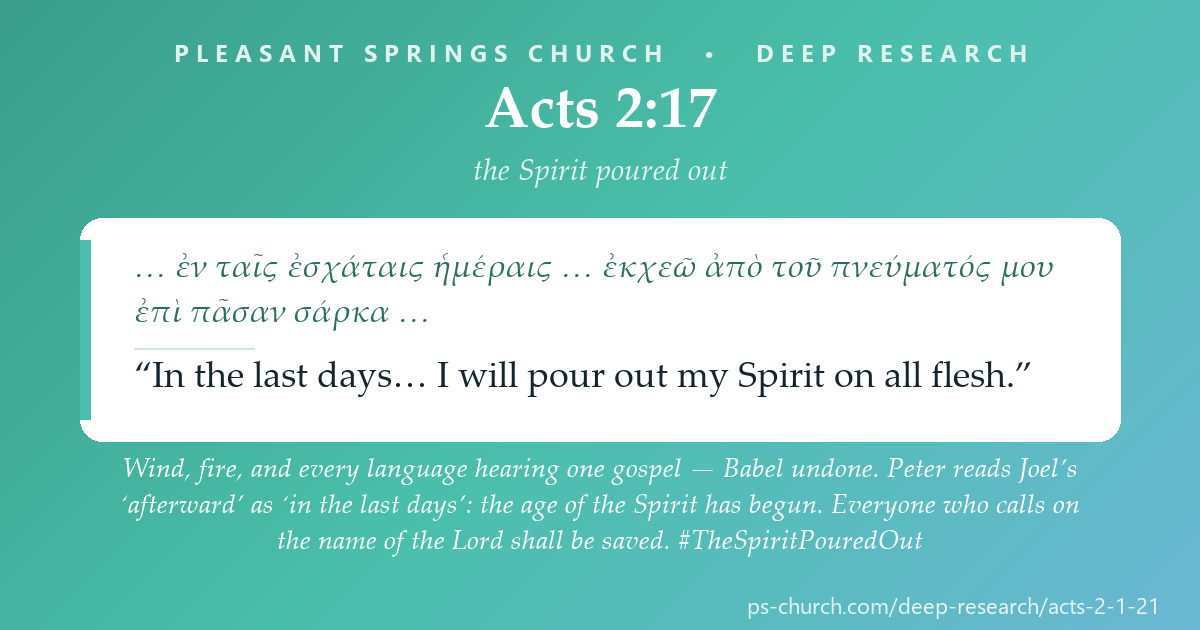
Joel, read as fulfilled. Peter quotes Joel’s promise of the Spirit poured out “on all flesh” — but he makes a pointed change: Joel’s “afterward” becomes “in the last days” (and he adds “God declares”). The point is that the last days have begun: Pentecost is not merely a future promise but its inauguration. The Spirit is lavished across every line that once divided — sons and daughters, young and old, male and female servants all prophesy — and the oracle ends with the door thrown open: “everyone who calls upon the name of the Lord shall be saved.”
Orient on Pentecost, the Holy Spirit, tongues, and the last days.
Search by topic: Pentecost / Feast of Weeks, Holy Spirit, tongues / languages, prophecy, last days / eschatology.
Which articles are relevant?
- Anchor Bible Dictionary — “Pentecost,” “Weeks, Feast of,” “Holy Spirit,” “Tongues.”
- Dictionary of the NT — “Holy Spirit,” “Tongues,” “Pentecost,” “Joel (use of).”
- NIDNTT / TDNT — πνεῦμα (pneuma, Spirit), γλῶσσα (glōssa, tongue/language), ἐκχέω (ekcheō, pour out).
Bibliography surfaced:
- Darrell Bock (ECNT), David Peterson (Pillar), Ben Witherington, C. K. Barrett (ICC), F. F. Bruce, Craig Keener (4 vols.) on Acts.
- Studies of the Acts use of Joel; the Babel/Pentecost typology; the Feast of Weeks background.
- Beale & Carson, Commentary on the NT Use of the OT (Acts).
Babel reversed, the last days begun, and Peter's reading of Joel.
Read the wind-and-fire theophany and the Babel reversal, then watch closely how Peter quotes and adapts Joel.
Which parallels shed light on religion and worldview?
Wind, fire, and Sinai. Pentecost is the Feast of Weeks (Shavuot), and its imagery is charged with the Sinai theophany: at the mountain God came down in fire, with a great sound/voice, and the mountain trembled (Exod 19:16–18; see Sinai). Here the Spirit comes with a rushing wind and tongues of fire. Where Sinai gave the law on tablets of stone, Pentecost writes the Spirit on the heart — the new covenant promised by Jeremiah and Ezekiel (Jer 31:33; Ezek 36:27; see a new heart and a new spirit). The God who spoke at Sinai now indwells his people.
Babel undone. The oldest story of the nations’ division is Babel: humanity, one in speech and proud, is scattered when the Lord “confused their language” (Gen 11:7–9; see Babel). Luke signals the reversal with a single word: the Pentecost crowd is “bewildered” (συνεχύθη, 2:6) — the same root as the “confusion” of Babel — but for the opposite reason. At Babel one language became many and the peoples were scattered; at Pentecost many languages hear one message and the peoples begin to be gathered. Pentecost does not erase the nations or their tongues (they remain, and one day “every nation and tribe and language” stands before the throne, Rev 7:9); it unites them around the gospel.
Peter’s Joel — read the changes. Peter grounds it all in Joel’s prophecy of the Spirit poured out “on all flesh” (Joel 2:28–32; in the Greek Old Testament this is Joel 3:1–5; see the Spirit poured out). But he does not quote flatly — the adaptations are the sermon: (1) Joel’s “afterward” becomes “in the last days” (with “God declares” added) — the eschaton has begun; (2) he adds “my male and female servants” and appends “and they shall prophesy” — a clause not in Joel — underscoring prophecy for all; (3) he heightens the cosmic “wonders” with added “signs” and “above… below.” And he lets the oracle run to its open door: “everyone who calls upon the name of the Lord shall be saved” — which matches Joel exactly, and which the sermon will apply to the risen Jesus (2:36; Rom 10:13). The cosmic signs of Joel (sun to darkness, moon to blood) are not claimed as fulfilled that morning; Pentecost inaugurates the last days, and the great Day still awaits.
- Joel 2:28–32 (Greek Joel 3:1–5) — “I will pour out my Spirit on all flesh… everyone who calls on the name of the Lord shall be saved”: Peter’s text, adapted to “the last days” (see Joel).
- Genesis 11:1–9; Numbers 11:29; Exodus 19:16–18 — Babel scattered; “would that all the Lord’s people were prophets”; Sinai’s fire and voice: the reversal and the theophany (see Babel).
- Ezekiel 36:27; 39:29; Jeremiah 31:33 — “I will put my Spirit within you”; “I will pour out my Spirit… declares the Lord God”; the law written on the heart: the new-covenant Spirit (see Ezekiel 36).
It is worth slowing down over what Peter does with Joel, because it is a masterclass in how the apostles read the Old Testament. He does not simply proof-text; he interprets. The most telling change is the first: Joel wrote that God would pour out his Spirit “afterward” — a vague future — and Peter says “in the last days.” That is not a careless slip but a theological claim: the last days, the age of fulfillment, have arrived, and the proof is the Spirit resting on ordinary Galileans and loosing their tongues in the languages of the world. This is the “already” of the Christian hope — the eschaton inaugurated, not yet consummated. Peter can quote the whole oracle, cosmic signs and all (sun darkened, moon like blood), without claiming those signs happened at nine in the morning on Pentecost, because he understands that he stands at the beginning of the last days, not their end. The great and awesome Day of the Lord is still future; but its dawn has broken, the Spirit is poured out, and the door is open: “everyone who calls upon the name of the Lord shall be saved.” That last line is where the whole sermon is headed — because the “Lord” on whose name the nations now call is the crucified and risen Jesus, whom “God has made both Lord and Christ” (2:36).
The vocabulary of tongues, pouring out, the last days, and calling.
Watch the double sense of “tongues,” the “pour out” verb, the “last days” change, and the universal “everyone who calls.”
“Tongue; language” — deliberately double: the “tongues as of fire” (flame-shaped) and the “other tongues/languages” the disciples speak. Fire = OT theophany (Sinai); “other tongues” = the miracle of speech.
“Language, native speech” — each hearer heard “in his own language.” Luke’s precise term establishes that the Pentecost tongues were real, intelligible human languages understood by the international crowd — the anchor for reading the sign as Babel-reversal.
“To pour out” — the verb of Joel’s promise (“I will pour out my Spirit”) and of Peter’s climax: the ascended Christ “poured out” the Spirit (2:33). Prophetic “pouring” language (Isa 44:3; Ezek 39:29; Zech 12:10): the Spirit lavished, not rationed.
“In the last days” — Peter’s deliberate change from Joel’s “afterward” (meta tauta). The interpretive key: Pentecost inaugurates the eschatological “last days” — the already, not yet the consummation.
“All flesh” — the Spirit poured out across gender, age, and status (sons/daughters, young/old, male/female servants; cf. Num 11:29). In Acts it reaches beyond Israel to “all who are far off” (2:39) and the Gentiles (10:45).
“Everyone who calls” — the universal offer (Joel 2:32). In Joel the “Lord” invoked is YHWH; Peter drives toward Jesus as the exalted Lord (2:36), and Paul makes the identification explicit (Rom 10:9–13). “Calling” = saving faith expressed (cf. 2:38).
How the New Testament fills out Pentecost:
- Acts 2:33, 36–39 — the exalted Christ receives and pours out the Spirit; “God has made him both Lord and Christ”; “repent and be baptized… you will receive the gift of the Holy Spirit”: the sermon’s goal.
- John 7:37–39; 14:16–17, 26; 16:7 — the promise of the Spirit; the Paraclete sent by the Son from the Father: the gift Pentecost fulfills.
- Romans 10:9–13 — “everyone who calls on the name of the Lord will be saved” applied to the risen Jesus: Joel’s YHWH-text and the deity of Christ.
- Acts 10:44–46; 1 Corinthians 12–14; Revelation 7:9 — the Spirit poured out on the Gentiles; the gifts and tongues; every nation and language before the throne: the harvest of the nations.
From Babel and Sinai to the Spirit poured out on all flesh.
Trace the Spirit and the nations from Babel and Joel, through Pentecost, to the gathering of every tongue.
Which cross-references matter?
- Joel 2:28–32; Genesis 11:1–9; Exodus 19 — the Spirit on all flesh; Babel’s scattering; Sinai’s fire: the prophecy, the reversal, the theophany (see Joel, Babel, Sinai).
- Numbers 11:29; Ezekiel 36:27; 39:29; Jeremiah 31:33 — “would that all… were prophets”; “I will put my Spirit within you”; the law on the heart: the new-covenant Spirit (see Ezekiel 36).
- Acts 1:6–11; 2:33 — the power promised at the ascension, now poured out by the enthroned Christ (see the ascension).
- John 20:22; Luke 24:49 — “receive the Holy Spirit”; “clothed with power from on high”: the promise Pentecost fulfills (see the empty tomb).
- Romans 10:13; Revelation 7:9–10 — “everyone who calls… will be saved”; every nation and tongue before the Lamb: the offer and its harvest.
The Pentecost sign is often reduced to a debate about the nature of “tongues,” but Luke’s own emphasis lies elsewhere. He is careful to tell us that the crowd, drawn from “every nation under heaven,” each heard the disciples “in his own language” — the word is dialektos, the native tongue a person was born speaking — and he gives a long list of the nations to make the point unmistakable. This is not unintelligible ecstasy; it is a miracle of communication, and its meaning is written across the whole Bible’s story of the nations. Humanity’s division began at Babel, where a proud people building a tower to make a name for themselves were scattered by the confusing of their speech. Ever since, the nations have been fragmented, unable to understand one another. Pentecost is the beginning of the healing. The Spirit does not undo Babel by giving everyone one language again; he does something better — he makes the one message of “the mighty works of God” intelligible in every language, so that the very diversity that Babel turned into division becomes, in the church, a chorus. The gospel does not flatten the nations into sameness; it gathers them, each in its own tongue, around the crucified and risen Lord. What began that morning in Jerusalem runs straight to the vision of the end, where a multitude “from every nation, from all tribes and peoples and languages” stands before the throne and cries out salvation to God and to the Lamb.
The scholarship on Acts 2:1-21.
The commentators on Pentecost; the studies of the Joel citation, the tongues, and the last-days eschatology.
Commentaries & studies:
- Darrell L. Bock (ECNT), David G. Peterson (Pillar), Ben Witherington III, C. K. Barrett (ICC), F. F. Bruce (NICNT), Craig S. Keener (4 vols.) on Acts.
- Studies of the Acts use of Joel (the “last days” adaptation), the Babel/Pentecost typology, and the Shavuot background.
- Bruce Metzger on the Acts 2:1 (homou) and 2:17–21 citation readings.
Interpretation notes worth keeping:
- Real human languages. Luke’s dialektos (2:6, 8) and the list of nations establish intelligible foreign languages — a sign for the nations. Note the different profile of 1 Cor 12–14 tongues descriptively; do not adjudicate the modern cessationist/continuationist debate here.
- Peter’s adapted Joel is the point. “In the last days” (for Joel’s “afterward”), the added “and they shall prophesy,” and the “signs… above… below” are inspired interpretive adaptations — show the actual text, not a smoothed quotation. (Joel 2:28–32 = Greek Joel 3:1–5.)
- Already / not-yet. The last days are inaugurated at Pentecost; the cosmic signs (2:19–20) point ahead to the consummation and the visible return — no over-realized claim that the final Day has come, and (historic-premil) no date-setting or denial of the still-future return.
- Trinitarian. The exalted Son receives the Spirit from the Father and pours him out (2:33); the Spirit is the divine person given (later “lied to… you have not lied to men but to God,” 5:3–4), not an impersonal force.
- Jesus as the Lord who saves. Joel’s “call on the name of the Lord” (YHWH) is applied to Jesus (2:36; Rom 10:13); the universal offer (“everyone who calls”) is genuine, grounded in Christ’s finished work — not universalism, not a mere honorific “Lord.”
From a scattered world to a Spirit-filled church calling on the Lord.
Name what you learned, why it matters, and one concrete response.
What should we carry away — and do?
- The last days have begun. Pentecost is not a one-off spectacle but the dawn of the age of the Spirit. The Spirit poured out “on all flesh” is the birthright of every believer — the “already” of our hope.
- The gospel gathers the nations. What Babel scattered, Pentecost begins to gather — one message understood in every tongue. The church’s diversity is not a problem to solve but a chorus to God’s glory.
- The door is open to everyone who calls. “Everyone who calls upon the name of the Lord shall be saved” — and the Lord is the risen Jesus. The offer is genuine, and it is for you and for those far off.
Step in response: live as one who belongs to the last days — ask the Spirit for power to witness (Acts 1:8) and step across a “Babel” line this week toward someone of a different language, background, or story, carrying the one message that gathers the nations. And if you have never done so, do the plainest thing the sermon asks: “call upon the name of the Lord” — repent, believe, and be saved.
Acts 2:17 · to share
Greek NT + ESVEvery Deep Research page traces its passage across the whole sweep — the Old Testament, the Second-Temple world between the testaments (historical witnesses, not Scripture), and the New Testament. Follow the thread:
Pleasant Springs Church — Deep Research
Research method after Michael S. Heiser’s Bible Research Method (examine dictionaries → ancient literature → important words → textual connections → academic publications → share), with the Pleasant Springs “Author & Audience” foundation. Scripture set in the Hebrew, the Greek editions named on each page and the ESV (Old Testament), and the Greek New Testament and the ESV (New Testament), per the practice of Pleasant Springs Church. Acts 2:1–21 research grounded in Bock, Peterson, Witherington, Barrett, Bruce, and Keener, with Beale & Carson on the Acts use of the OT; Peter’s Joel citation shown with its actual adaptations (“in the last days” for “afterward,” the added “and they shall prophesy,” the “signs… above… below”; Joel 2:28–32 = Greek Joel 3:1–5); the tongues as real human languages (described, not adjudicated against modern debates); the Babel reversal as the nations gathered not erased; the last days inaugurated (already/not-yet, historic-premillennial, no date-setting); the Spirit as a divine person poured out by the exalted Son (Trinitarian); Joel’s YHWH-name applied to the risen Jesus (2:36; Rom 10:13).
Scripture quotations marked ESV are from the ESV® Bible (The Holy Bible, English Standard Version®), © 2001 by Crossway, a publishing ministry of Good News Publishers. ESV Text Edition: 2016. Used by permission. All rights reserved. The ESV text may not be quoted in any publication made available to the public by a Creative Commons license, and the ESV may not be translated in whole or in part into any other language. www.esv.org
|
Did this study bless you today? 💚 Give to Support PS Church100% of gifts go to the General Fund — thank you. |