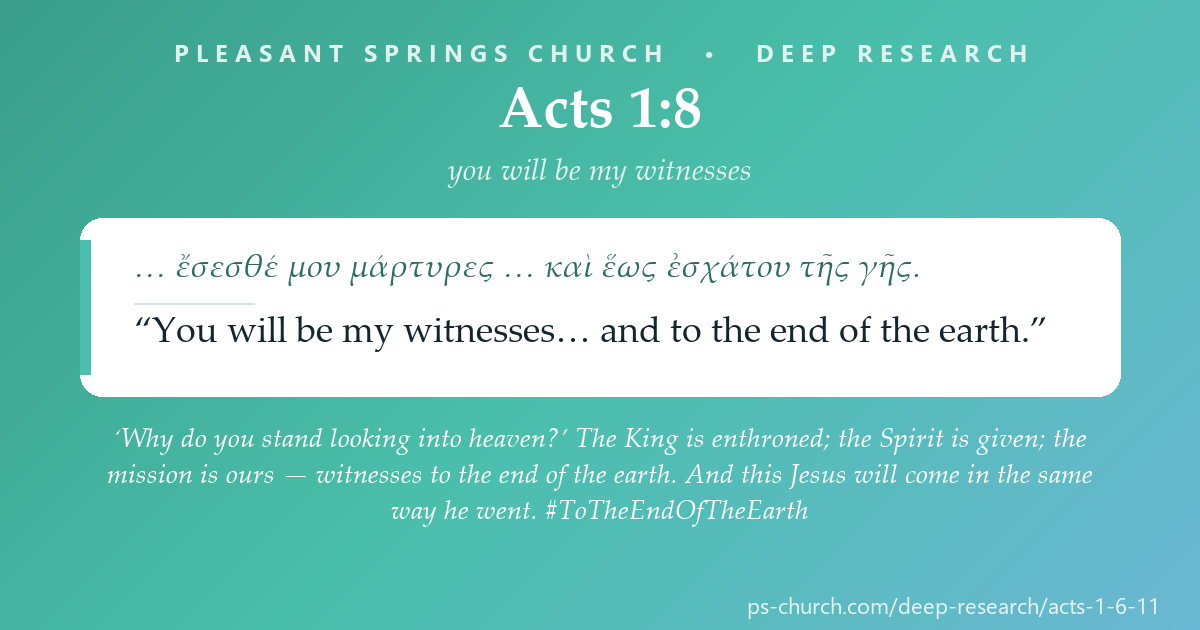
“You will be my witnesses… to the end of the earth.” The disciples ask if now the risen Jesus will restore the kingdom to Israel. He answers not with a date but with a commission and a cloud: the Father sets the times; the Spirit gives the power; and the mission runs to the ends of the earth. Then he is lifted up, enthroned on the cloud of the Son of Man — and the angels promise, “this Jesus will come in the same way as you saw him go.” This study works Acts 1:6–11 — the ascension — the enthroned King, the sent church, and the sure return. See the method →
Acts 1:7–11
Greek NT · ESVThe Shape of the Passage
Parallel panelsLuke opens his second volume where the first ended — with the ascension — and turns it into the launch of the church’s mission. The last question of the disciples about Israel’s kingdom is answered not with a date but with a commission, a promise of power, and a cloud.
Author
Luke frames the ascension as enthronement and sending, not mere farewell. The disciples ask a good question — “Lord, will you at this time restore the kingdom to Israel?” (1:6) — and Jesus does not scold the hope. He redirects its timing (“it is not for you to know times or seasons that the Father has fixed by his own authority,” 1:7) and reveals its present means (“you will receive power when the Holy Spirit has come upon you,” 1:8). Then comes the verse that is the table of contents for the whole book: “you will be my witnesses in Jerusalem and in all Judea and Samaria, and to the end of the earth” — the very path Acts will trace.
Lifted up, and a cloud. “He was lifted up” (epērthē, a divine passive: God raised him), “and a cloud took him.” This is no vague disappearance. The cloud is the cloud of God’s glory that filled the tabernacle and temple (Exod 40:34) and, above all, the cloud on which “one like a son of man” comes to the Ancient of Days to receive “dominion and glory and a kingdom” (Dan 7:13–14). The ascension is Jesus’ enthronement — taken up to be seated at the Father’s right hand (Ps 110:1), from where, at Pentecost, he pours out the Spirit (Acts 2:33).
Audience
The apostles — and a church tempted, then as now, to stand gazing at the sky. The two men in white gently turn them around: “why do you stand looking into heaven?” The risen Lord is enthroned; the task is witness. The kingdom advances not by the sword or by political calculation but by martyria — testimony that costs (the word gives us “martyr”), carried in the Spirit’s power to the ends of the earth.
He will come in the same way. The promise is precise: “this Jesus… will come in the same way as you saw him go” (1:11). The return will be like the departure — bodily, visible, personal, with the clouds (Rev 1:7; 1 Thess 4:16–17). So the church lives between the ascension and the return: the King is enthroned now, the Spirit is given now, the mission is ours now — and the kingdom the disciples longed for is real and future, on the Father’s calendar, not ours.
Orient on the ascension, the kingdom of God, witness/mission, and the second coming.
Search by topic: ascension, kingdom of God, Holy Spirit, witness / mission, parousia (second coming).
Which articles are relevant?
- Anchor Bible Dictionary — “Ascension,” “Kingdom of God,” “Holy Spirit,” “Parousia.”
- Dictionary of the NT / Later NT — “Ascension,” “Kingdom,” “Witness,” “Son of Man.”
- NIDNTT / TDNT — ἀναλαμβάνω (analambanō, take up), μάρτυς (martys, witness), νεφέλη (nephelē, cloud).
Bibliography surfaced:
- Darrell Bock (BECNT/ECNT), David Peterson (Pillar), Ben Witherington, C. K. Barrett (ICC), F. F. Bruce, Craig Keener (4 vols.) on Acts.
- Studies of Luke’s ascension theology and the Acts 1:8 mission-program; N. T. Wright on ascension and enthronement.
- Beale & Carson, Commentary on the NT Use of the OT (Acts).
Enthronement on the clouds, the restored kingdom, and the bodily return.
Read the cloud and the “taken up” against their OT background, then weigh the kingdom question and the promise of return.
Which parallels shed light on religion and worldview?
The cloud of enthronement. When “a cloud took him,” Luke is not describing weather. In the Old Testament the cloud is the vehicle of God’s presence and glory — it filled the tabernacle and the temple (Exod 40:34; 1 Kgs 8:10–11) — and in Daniel’s vision “one like a son of man” comes “with the clouds of heaven” to the Ancient of Days and is given “dominion and glory and a kingdom, that all peoples… should serve him” (Dan 7:13–14; see the Son of Man). Jesus is not simply leaving; he is being enthroned. The ascension is his coronation, and the session at the Father’s right hand (Ps 110:1; see the priest-king) is what makes Pentecost possible: “being… exalted at the right hand of God… he has poured out” the Spirit (Acts 2:33).
‘Restore the kingdom to Israel.’ The disciples’ question was not foolish. The prophets promised the rebuilding of David’s fallen kingdom (Amos 9:11–12; see the fallen booth of David) and the regathering of Israel. Jesus corrects the timing, not the hope: the schedule belongs to the Father (1:7), and the present order of business is Spirit-empowered witness (1:8) that will reach beyond Israel to “all nations” (Amos 9:12; Acts 15:16–17). Scripture holds the kingdom hope for a restored and gathered Israel (Acts 3:21, “the restoration of all things”; Rom 11:25–29, “all Israel will be saved”) without setting dates and without erasing a future for God’s ancient people. The kingdom is inaugurated in the enthroned King and consummated when he returns.
‘In the same way.’ The angels’ promise is carefully worded: “this Jesus… will come in the same way (ὃν τρόπον) as you saw him go into heaven” (1:11). The manner of the return is pinned to the manner of the ascension — a real, bodily, visible coming, with the clouds (Rev 1:7; 1 Thess 4:16–17), not a merely spiritual or invisible “presence.” Fittingly, Jesus ascended from the Mount of Olives (1:12), the very place where the prophet said the Lord’s feet would stand on the day of his coming (Zech 14:4).
- Daniel 7:13–14; Psalm 110:1 — the Son of Man on the clouds given everlasting dominion; “sit at my right hand”: the enthronement the ascension effects (see Daniel 7, Psalm 110).
- Exodus 40:34–35; Isaiah 49:6 — the glory-cloud that filled the tabernacle; the Servant a “light for the nations… to the end of the earth” (the very phrase of Acts 1:8).
- Amos 9:11–12; Zechariah 14:4; 2 Kings 2:9–11 — David’s booth rebuilt for all nations; the Lord’s feet on the Mount of Olives; Elijah “taken up”: the restoration hope, the return, and the ascension pattern (see Amos 9).
Luke has arranged the opening of Acts so that everything the church will be and do flows from the ascension. Notice what Jesus does with the disciples’ question. They ask about the kingdom — will it be restored to Israel, and now? — and Jesus neither dismisses the kingdom nor answers the calendar. He tells them two things instead: the timing is the Father’s business, and their business is witness in the Spirit’s power. Then he is enthroned before their eyes. The cloud that takes him is the Danielic cloud of the Son of Man’s coronation; he goes up to sit at the right hand and to pour out the Spirit that will make the witness possible. So the church is left in a very particular posture: not gazing at the sky, waiting for a date, but sent into the world, armed with the Spirit, telling the story of the risen and reigning Lord. And it is left with a sure hope, not a timetable. The King is already reigning; the Spirit is already given; the mission is already ours — and one day, in the same bodily, visible way that he went, he will come again. Between the ascension and the return, the church does not stand and stare. It witnesses, to the end of the earth.
The vocabulary of witness, power, the cloud, and the return.
Watch the mission-word “witnesses,” the Spirit’s “power,” the cloud of enthronement, and the “in the same way” of the return.
“Witnesses” — the defining vocation of the church in Acts, and the word behind “martyr” (cf. 22:20). The kingdom advances by costly testimony, not the sword. The geography — Jerusalem → Judea/Samaria → the end of the earth — is the outline the book follows.
“Power” — the promised enablement “when the Holy Spirit has come upon you” (fulfilled at Pentecost, Acts 2). Power for witness and mission, not political-national restoration (cf. Luke 24:49, “clothed with power from on high”).
“Times or seasons” — a near-synonymous pair (duration + appointed moment; cf. 1 Thess 5:1) that the Father has fixed “by his own authority.” The anti-date-setting verse: the kingdom-hope is legitimate, but its schedule is the Father’s alone (cf. Mark 13:32).
“He was lifted up… a cloud” — a divine passive (God lifted him) + the glory-cloud (Exod 40:34) and the cloud of the Son of Man’s enthronement (Dan 7:13). The ascension is exaltation and coronation, not mere departure.
“Taken up” — the technical ascension verb, the same word the Greek OT uses of Elijah “taken up” (2 Kgs 2:9–11) and of Christ “taken up in glory” (1 Tim 3:16). Jesus echoes Elijah’s assumption yet surpasses it: he sends the Spirit and will himself return.
“So… in the same way” — an emphatic correlative guaranteeing the return is of the same kind as the ascension: bodily, visible, personal, from and to heaven — not a merely spiritual or invisible coming.
How the New Testament fills out the ascension:
- Luke 24:44–53; Acts 2:33–36 — “clothed with power from on high”; the exalted Christ pours out the Spirit and is made “Lord and Christ”: the ascension and Pentecost joined.
- Psalm 110:1; Ephesians 1:20–22; Hebrews 10:12–13 — seated at the right hand, far above all rule, “waiting until his enemies are made a footstool”: the reigning-yet-waiting King.
- Daniel 7:13–14; Revelation 1:7; 1 Thessalonians 4:16–17 — the Son of Man with the clouds; “he is coming with the clouds”; “caught up… in the clouds”: the bodily, visible return.
- Acts 3:19–21; Romans 11:25–29 — “the restoration of all things”; “all Israel will be saved”: the kingdom-hope held without date-setting or supersessionism.
From the Son of Man on the clouds to the witnesses to the end of the earth.
Trace the enthronement, the mission, and the return through the canon, from Daniel’s vision to the church’s hope.
Which cross-references matter?
- Daniel 7:13–14; Psalm 110:1; Exodus 40:34 — the Son of Man enthroned on the clouds; the session at the right hand; the glory-cloud: the ascension’s meaning (see Daniel 7, Psalm 110).
- Isaiah 49:6; Amos 9:11–12; Acts 13:47; 15:16–17 — the light to the nations “to the end of the earth”; David’s booth rebuilt for all nations: the mission-program of 1:8 (see Amos 9).
- Acts 2:1–21, 33 — the Spirit poured out by the exalted Christ: the power promised in 1:8 (see Pentecost).
- Matthew 28:16–20; Luke 24:44–53 — “all authority… make disciples of all nations… I am with you always”; the ascension blessing: the commission (see the Great Commission).
- Zechariah 14:4; Revelation 1:7; 1 Thessalonians 4:16–17 — the Lord’s feet on Olivet; “coming with the clouds”; “caught up… in the clouds”: the bodily return.
The disciples’ last question in Luke’s two-volume work — “will you at this time restore the kingdom to Israel?” — is often read as one more example of their thick-headedness, as if the whole idea of a kingdom for Israel were a mistake Jesus had to correct. But that reads too much into his answer. Jesus does not say “there will be no kingdom for Israel”; he says “it is not for you to know the times.” The problem is not the hope but the presumption of the schedule — and the assumption that the kingdom’s arrival and the church’s mission are rival concerns. Jesus binds them together: the very Spirit-power that will one day consummate the kingdom is given now for witness, and the witness runs to “the end of the earth,” drawing in the nations exactly as the prophets said the restored kingdom would (Amos 9:11–12). So the ascension does not shelve the kingdom; it inaugurates it in the enthroned King and sets his people to work. The church lives in the “already” of the reigning Christ and the “not yet” of his return, holding a real and future hope for Israel and the nations, and refusing both the despair that says the kingdom is only future and the triumphalism that says it is already fully here. He is coming, in the same way he went. Until then: witnesses.
The scholarship on Acts 1:6-11.
The commentators on the ascension; the studies of the Acts 1:8 program and the second-coming promise.
Commentaries & studies:
- Darrell L. Bock (ECNT), David G. Peterson (Pillar), Ben Witherington III (socio-rhetorical), C. K. Barrett (ICC), F. F. Bruce (NICNT), Craig S. Keener (4 vols.) on Acts.
- N. T. Wright on ascension-as-enthronement; studies of Lukan eschatology and the kingdom.
- Bruce Metzger on the ascension-related variants in Luke 24:51–52 (context).
Interpretation notes worth keeping:
- Enthronement, not disappearance. The divine-passive “lifted up” + the glory-cloud + Ps 110:1 (Acts 2:33–36) mean the ascension is the Son’s bodily exaltation to the Father’s right hand — reigning and pouring out the Spirit, not absent.
- Bodily, visible return. “Will come in the same way” (1:11) pins the manner of the parousia to the manner of the ascension — against a purely-realized or invisible-coming view.
- The kingdom-hope, held rightly. Jesus corrects the timing, not the hope (1:7); hold the future for a restored/gathered Israel (Amos 9; Acts 3:21; Rom 11:25–29) without date-setting and without supersessionism — the historic-premillennial reading.
- Already / not-yet. The kingdom is inaugurated in the enthroned King (Ps 110), not consummated; the church advances by martyria (witness), not by the sword or political conquest.
- Trinitarian. The Father fixes the times (1:7); the exalted Son receives and pours out the Spirit (2:33); the Spirit empowers the witnesses (1:8) — three persons, one saving work.
From gazing at the sky to witnessing to the ends of the earth.
Name what you learned, why it matters, and one concrete response.
What should we carry away — and do?
- The King is enthroned now. The ascension is not Jesus’ absence but his coronation. He reigns at the Father’s right hand and pours out his Spirit — the mission runs under his authority, not our strength.
- Stop gazing; start witnessing. “Why do you stand looking into heaven?” The church’s posture between ascension and return is not sky-watching or date-setting but Spirit-empowered witness, to the end of the earth.
- He will come in the same way. The return is as sure and as bodily as the departure. We live in hope, not anxiety — the timing is the Father’s, the mission is ours.
Step in response: take up your part in the Acts 1:8 mission this week — a “Jerusalem” witness near at hand and a prayer or gift toward the “end of the earth” — and do it as one who serves an enthroned King, leaning on the Spirit’s power rather than your own, and looking for the Lord who “will come in the same way” he went.
Acts 1:8 · to share
Greek NT + ESVEvery Deep Research page traces its passage across the whole sweep — the Old Testament, the Second-Temple world between the testaments (historical witnesses, not Scripture), and the New Testament. Follow the thread:
Pleasant Springs Church — Deep Research
Research method after Michael S. Heiser’s Bible Research Method (examine dictionaries → ancient literature → important words → textual connections → academic publications → share), with the Pleasant Springs “Author & Audience” foundation. Scripture set in the Hebrew, the Greek editions named on each page and the ESV (Old Testament), and the Greek New Testament and the ESV (New Testament), per the practice of Pleasant Springs Church. Acts 1:6–11 research grounded in Bock, Peterson, Witherington, Barrett, Bruce, and Keener, with Beale & Carson on the OT background; the ascension read as the Son’s bodily enthronement (Dan 7:13; Ps 110:1; Acts 2:33) and the return as bodily and visible (“in the same way”); the “restore the kingdom to Israel” question held on the historic-premillennial frame — the kingdom hope affirmed without date-setting (1:7) and without supersessionism (Acts 3:21; Rom 11:25–29); the mission by witness in the Spirit’s power.
Scripture quotations marked ESV are from the ESV® Bible (The Holy Bible, English Standard Version®), © 2001 by Crossway, a publishing ministry of Good News Publishers. ESV Text Edition: 2016. Used by permission. All rights reserved. The ESV text may not be quoted in any publication made available to the public by a Creative Commons license, and the ESV may not be translated in whole or in part into any other language. www.esv.org
|
Did this study bless you today? 💚 Give to Support PS Church100% of gifts go to the General Fund — thank you. |