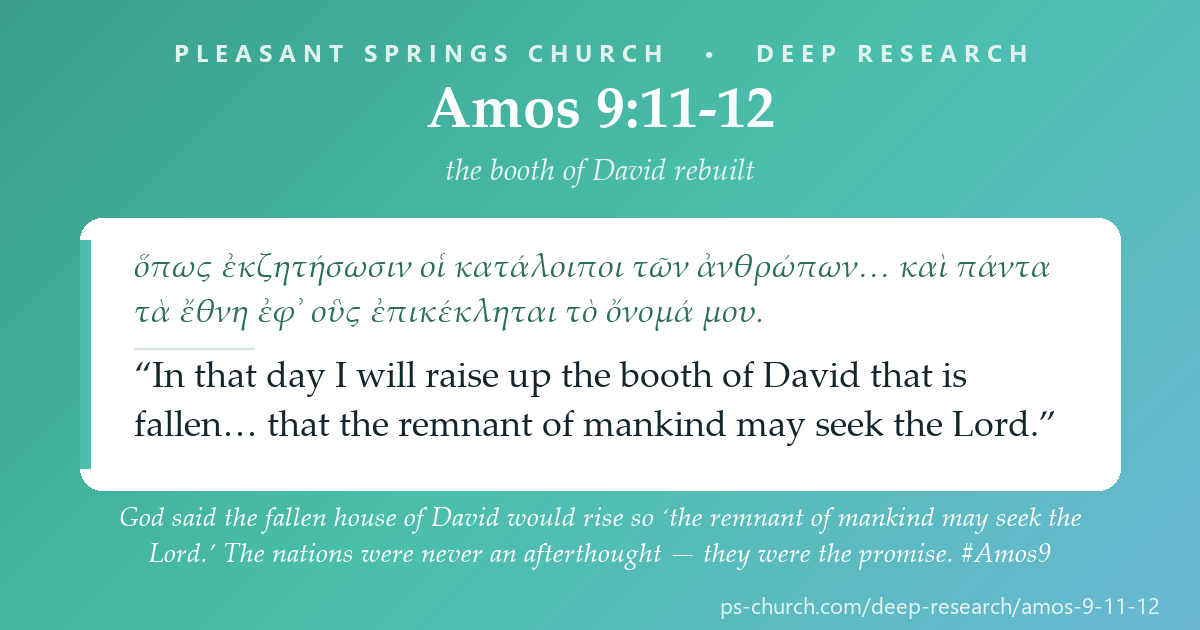
In that day I will raise up the booth of David that is fallen.” After eight chapters of judgment, Amos ends in hope: the collapsed royal house of David — a dynasty reduced to a lean-to — will be rebuilt, and the nations gathered in. The verse carries a famous Hebrew/Greek difference (“possess…Edom” / “the remnant of mankind…seek”), and it became the text by which James, at the Jerusalem Council, proved God always meant to welcome the Gentiles (Acts 15). This study works Amos 9:11–12 from the fallen booth to the open door. See the method →
Amos 9:11–12 (same numbering in MT, LXX & English)
Hebrew · LXX · ESVThe Shape of the Passage
InclusioAmos, a shepherd of Tekoa, prophesied to the prosperous, complacent northern kingdom under Jeroboam II (8th c. BC). His book is mostly judgment — but it ends (9:11–15) with a promise of a rebuilt Davidic kingdom and an ingathering of the nations, the verse James would later cite at the Jerusalem Council. See the Davidic covenant behind it in 2 Samuel 7.
Author
Amos — “no prophet… but a herdsman and a dresser of sycamore figs” (7:14) — is called from Judah to prophesy against the northern kingdom of Israel in a time of wealth and injustice. Nearly his whole book is judgment: the roar of the Lord against oppression, false worship, and false security. Yet the last word is restoration. When the northern house has fallen, God will “raise up the booth of David that is fallen” — not the northern monarchy, but the Davidic house of Judah, rebuilt “as in the days of old.”
A booth, not a temple. The word is sukkah — a humble shelter, the kind thrown up at harvest or the Feast of Booths — a picture of the Davidic dynasty reduced to a leaning hut and then raised again. The horizon is a restored kingdom of David that draws in “all the nations who are called by my name.” Whatever Israel had done to the poor and to God, the promise to David would stand.
Audience
Amos’ first hearers were a nation certain it was safe. To them the fall of the “booth” was a warning — the house would come down — and the rebuilding was hope past the ruin. To later readers the promise became a seed of messianic expectation: the son of David who would restore the kingdom and gather the peoples.
How it was read. The Qumran community read “the booth of David that is fallen” of a coming Davidic deliverer (Damascus Document; 4QFlorilegium). And at the Jerusalem Council, when the question was whether Gentiles could belong to the Messiah without becoming Jews, James reached for this text — in its Greek form — as proof that God had always intended to gather “the remnant of mankind” and “all the Gentiles who are called by my name” (Acts 15:16–18).
Orient on the booth of David, the remnant, Edom, and the Gentiles.
Search by topic: Amos, booth/tent of David, remnant, Edom, Gentiles, Jerusalem Council.
Which articles are relevant?
- Anchor Bible Dictionary — “Amos,” “David, City of / House of,” “Edom,” “Remnant,” “Gentiles.”
- Dictionary of the OT: Prophets — “Amos, Book of,” “Remnant,” “Nations,” “Restoration.”
- NIDOTTE / TDOT — סֻכָּה (sukkâ, booth), יָרַשׁ (yāraš, possess), דָּרַשׁ (dāraš, seek), שְׁאֵרִית (šəʾērîṯ, remnant).
Bibliography surfaced:
- Shalom M. Paul (Hermeneia), Jörg Jeremias (OTL), Andersen & Freedman (Anchor Yale), M. Daniel Carroll R. (NICOT) on Amos.
- Studies of James’ use of Amos 9 at the Council: Richard Bauckham; Craig Keener (Acts); C. K. Barrett (ICC).
- W. Edward Glenny, Finding Meaning in the Text (the Septuagint of Amos); Beale & Carson, NT Use of the OT.
The booth of David, the Hebrew/Greek divergence, and the Council’s decision.
Read the “booth” as the Davidic house, weigh the two readings honestly, then follow the text to the Jerusalem Council.
Which parallels shed light on religion and worldview?
The booth of David. A sukkah is a temporary shelter — branches and cloth, a harvest hut. To call the royal house a “booth” is to picture a dynasty collapsed to a lean-to. Its rebuilding “as in the days of old” is the promise that the throne of David — seemingly finished — will rise again. This is dynastic and messianic language (see 2 Samuel 7), not a rebuilding of the wilderness Tabernacle, even though the Greek word for the booth, σκηνή, can also mean “tabernacle.”
Two honest readings. Verse 12 is famous for a Hebrew/Greek difference. The Masoretic Hebrew reads “that they may possess the remnant of Edom” — Israel repossessing an old enemy. The Septuagint reads “that the remnant of mankind may seek” — the standard Greek leaves the object of “seek” unstated, and Acts 15:17 supplies “the Lord” — the nations turning to God. The difference is remarkably small: “Edom” (אֱדוֹם) and “mankind” (אָדָם) share the same consonantal root and differ only in the vowels the earliest text did not write; and “possess” (yireshu, from yarash) differs from “seek” (yidreshu, from darash) by a single letter, yod for dalet. Neither is an “error”: both are legitimate readings of an unpointed text, and the Greek draws out a universal hope already latent in the Hebrew — Edom often standing, in the prophets, for the hostile nations as a whole.
- 2 Samuel 7:12–16; Isaiah 11:1–10; Jeremiah 12:15; Hosea 3:5 — the Davidic throne, the shoot from Jesse, God’s “I will return” and “afterward” of restoration (echoed in the Council’s citation).
- Damascus Document (CD-A 7) & 4QFlorilegium (4Q174) (Dead Sea Scrolls — Second-Temple witnesses, not Scripture) — both read “the booth of David that is fallen” of a coming Davidic figure, confirming an early Davidic (not cultic) reading.
- The Septuagint of Amos — “that the remnant of mankind may seek…”: the Greek text James quotes; note the standard LXX leaves the object of “seek” unstated, and Acts 15:17 supplies “the Lord.”
- Edom as a cipher (Isa 34; 63:1–6; Obadiah) — the near enemy standing for the nations under judgment, easing the distance between “Edom” and “mankind.”
At the Jerusalem Council (Acts 15) the church faced its first great question: must a Gentile become a Jew — be circumcised and keep the law of Moses — to belong to the Messiah? After Peter and Paul told what God had done among the nations, James rose and settled it from Scripture: “With this the words of the prophets agree, as it is written: ‘After this I will return, and I will rebuild the tent of David that has fallen… that the remnant of mankind may seek the Lord, and all the Gentiles who are called by my name’” (Acts 15:16–18). James quotes the Greek form of Amos 9:11–12 — “mankind… seek the Lord,” not “possess… Edom” — and opens it with words drawn from Jeremiah 12:15 (“I will return”), so the citation is a composite, a chain of prophetic promise. His point: the rebuilding of David’s house was always meant to end in the nations seeking God. The Gentiles streaming into the church do not overturn the Scriptures; they fulfill them. So the Council laid no yoke of circumcision on them — the fallen booth of David, raised in the risen Son of David, has room for all the peoples called by his name. A note of care: the New Testament’s inspired use here (Gentile inclusion now) does not cancel the fuller restoration the prophets still hold out; the ‘already’ of Acts and the ‘not yet’ of the coming kingdom are held together, not collapsed into one system.
The vocabulary of the booth, the two readings, and the nations.
Watch the single-letter and single-vowel differences that open Amos’ hope to all mankind.
“Booth” — a temporary shelter of branches (as at the Feast of Booths). The fallen booth of David = the collapsed Davidic dynasty, not the wilderness Tabernacle (mishkan). The Greek renders it σκηνή.
“Possess, take possession of” — the Hebrew reading: Israel possessing “the remnant of Edom.” Differs from darash (“seek”) by one letter.
“Seek” — the reading behind the Greek ἐκζητήσωσιν: “that the remnant of mankind may seek.” The form James quotes at Acts 15:17.
“Edom” (the near enemy) / “mankind” (humanity) — the same consonantal root, read with different vowels. The Hebrew hears Edom; the Greek hears all mankind.
“Called by my name” — an idiom of ownership: those over whom God’s name is proclaimed are his. James’ hinge for welcoming “all the Gentiles who are called by my name.”
How the New Testament reuses Amos 9:
- Acts 15:16–18 — James at the Jerusalem Council: the tent of David rebuilt so “the remnant of mankind may seek the Lord” (the LXX form, opened with Jer 12:15).
- Romans 15:9–12 — Paul’s catena on the nations praising God, climaxing in “the root of Jesse… in him will the Gentiles hope” (Isa 11:10).
- Luke 1:32–33; Acts 2:29–36 — the throne of David given to Jesus; the risen Christ enthroned as the son of David (see Psalm 110).
- Revelation 21:24–26 — the nations walking by the light of the Lamb’s city: the ingathering complete.
From the fallen booth to the nations gathered in the son of David.
Trace the Davidic hope from the covenant through the prophets into the Council and the new creation.
Which cross-references matter?
- 2 Samuel 7:12–16; Isaiah 9:6–7; Micah 5:2–5 — the everlasting Davidic throne and the ruler from Bethlehem (see 2 Samuel 7, Isaiah 9, Micah 5).
- Genesis 12:3; Isaiah 2:2–4; 56:6–8 — all nations blessed in Abraham; the peoples streaming to the mountain of the Lord.
- Amos 9:13–15 — the fuller restoration: mountains dripping wine, the people replanted “never again to be uprooted”: the hope the prophets still hold out.
- Acts 15:16–18; Romans 15:9–12 — the Gentiles gathered now, fulfilling the prophets.
- Psalm 110; Revelation 21–22 — the son of David enthroned; the nations in his city.
James’ citation is a small masterpiece of scriptural reasoning. He does not proof-text; he weaves. The opening “After this I will return” is not in Amos — it is drawn from Jeremiah 12:15 (and the “afterward” of Hosea 3:5), signaling a chain of prophetic promise about God restoring his people and gathering the nations. The body follows the Septuagint of Amos 9:11–12, whose “that the remnant of mankind may seek the Lord” states plainly what the Hebrew’s “possess the remnant of Edom… and all the nations called by my name” already implied — that God’s claim reaches the peoples. On that basis James rules that Gentiles need not be circumcised: they are the nations “called by my name,” entering the rebuilt house of David through the Messiah. Scholars debate how much weight rests on the Greek wording versus the Hebrew’s own universal note; either way, the Council’s decision stands on the prophets’ own hope. And the fuller picture is not lost: Amos’ closing verses (9:13–15) still stretch toward a consummation the church awaits — the ‘already’ of the ingathered Gentiles and the ‘not yet’ of the kingdom in its fullness.
The scholarship on Amos 9 and its use in Acts.
The commentators on Amos; the studies of the Septuagint text and James’ citation.
Commentaries & studies:
- Shalom M. Paul (Hermeneia), Jörg Jeremias (OTL), Francis I. Andersen & David Noel Freedman (Anchor Yale), M. Daniel Carroll R. (NICOT), Billy K. Smith & Frank Page (NAC) on Amos.
- Richard Bauckham, “James and the Jerusalem Church”; Craig S. Keener, Acts (vol. 3); C. K. Barrett, Acts (ICC).
- W. Edward Glenny, Finding Meaning in the Text: … the Septuagint of Amos; Beale & Carson, eds., Commentary on the NT Use of the OT.
Interpretation notes worth keeping:
- No versification offset. Amos 9:11–12 is the same reference in MT, LXX, and English; the divergence is in the wording of v.12, not the numbering. (The Acts 15:16–18 numbers are Luke’s citation framing.)
- Both readings honest. MT “possess…Edom” and LXX “mankind…seek” both render an unpointed consonantal text; the Greek is not a mistake but an interpretive drawing-out. James’ inspired use rests on it.
- A composite citation. Acts 15:16 opens with Jeremiah 12:15 (“I will return”), then follows the LXX of Amos — a chain of prophets, not a flat quotation.
- Booth = dynasty. The sukkah of David is the Davidic house/kingdom, not the Mosaic Tabernacle; guard against a cultic misreading.
From the fallen booth to the open door for the nations.
Name what you learned, why it matters, and one concrete response.
What should we carry away — and do?
- God rebuilds what has fallen. The royal house was a collapsed booth; God raised it in the risen son of David. No ruin in your life is beyond his “I will raise up.”
- The nations were always the plan. Gentile inclusion is not a detour but the prophets’ own hope. If you are a Gentile Christian, you are “the remnant of mankind” who came to seek the Lord.
- Scripture settles the church’s hardest questions. The Council did not follow the loudest voice but the word of the prophets. So should we.
Step in response: take one “fallen booth” — a broken relationship, a collapsed hope, a shamed past — and pray Amos’ promise over it: “I will raise up… and rebuild.” Then, because the door stands open to all peoples, welcome someone the world would keep out, as God has welcomed you.
Acts 15:17 · to share
Greek + ESVEvery Deep Research page traces its passage across the whole sweep — the Old Testament, the Second-Temple world between the testaments (historical witnesses, not Scripture), and the New Testament. Follow the thread:
Pleasant Springs Church — Deep Research
Research method after Michael S. Heiser’s Bible Research Method (examine dictionaries → ancient literature → important words → textual connections → academic publications → share), with the Pleasant Springs “Author & Audience” foundation. Scripture set in the Hebrew, the Greek editions named on each page and the ESV (Old Testament), and the Greek New Testament and the ESV (New Testament), per the practice of Pleasant Springs Church. Amos 9:11–12 research grounded in Paul, Jeremias, Andersen & Freedman, and Carroll R., with Bauckham, Keener, and Glenny on James’ use of the Septuagint; the Damascus Document and 4QFlorilegium as Second-Temple witnesses.
Scripture quotations marked ESV are from the ESV® Bible (The Holy Bible, English Standard Version®), © 2001 by Crossway, a publishing ministry of Good News Publishers. ESV Text Edition: 2016. Used by permission. All rights reserved. The ESV text may not be quoted in any publication made available to the public by a Creative Commons license, and the ESV may not be translated in whole or in part into any other language. www.esv.org
|
Did this study bless you today? 💚 Give to Support PS Church100% of gifts go to the General Fund — thank you. |