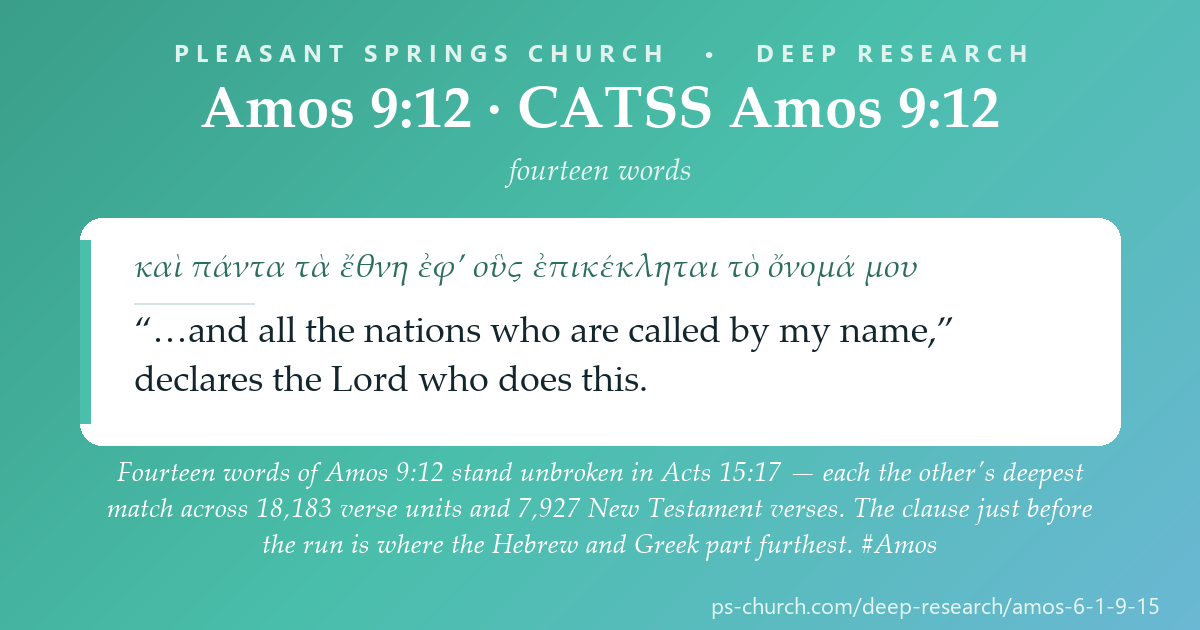
The deepest run anywhere in Amos is fourteen words, and it sits on the one verse of the book where the Hebrew and the Greek column do not say the same thing. CATSS Amos 9:12 against Acts 15:17 — and each is the other's single deepest match, checked both ways across all 30,348 screened CATSS verse units and all 7,927 New Testament verses. The fourteen-word string stands in exactly one unit of the first and one verse of the second. Yet in the Hebrew of that verse Israel possesses the remnant of Edom, and in the Greek row the remnant of mankind seeks — two different subjects doing two different things. The run begins after that difference and never touches it. A measurement of shared wording can be at its strongest exactly where the columns are furthest apart, and this is what that looks like. See the method →
Amos 6:1–9:15 (selections)
Hebrew · Greek (CATSS, Rahlfs’ Septuaginta) · ESV⚠️ And the deepest run in the book sits on its least agreed verse. Fourteen words of CATSS Amos 9:12 stand unbroken in Acts 15:17. In the Hebrew of that verse Israel possesses the remnant of Edom; in the Greek row the remnant of mankind seeks. The run begins after that difference and never touches it.
The Shape of the Passage
Sequence — two woes, five visions, and a last word7:10–17 is the only prose narrative in Amos, and it interrupts the visions. Three visions, then Amaziah, then two more. Whatever that arrangement is doing, it puts the question who sent you? in the middle of the sequence where Amos is being shown things.
Author
7:14 is the most argued sentence in the book, and the Hebrew has no verb in it. לֹא־נָבִיא אָנֹכִי — not-a-prophet I. Whether that means I am not or I was not is a decision every translation has to make. The CATSS Greek row makes it: οὐκ ἤμην προφήτης, past tense. That is what the row reads; it settles nothing about the Hebrew.
And the trades named differ. The Hebrew has בוֹקֵר, a herdsman; the row has αἰπόλος, a goatherd.
Audience
Amaziah names the real audience problem. “The land is not able to bear all his words” — and the objection is jurisdictional: Bethel is the king’s sanctuary, so a Judean has no standing there.
By 9:11–12 the address has left Israel entirely. The last oracle reaches past the northern kingdom to all the nations who are called by my name — and it is those two verses that the Jerusalem Council in Acts 15 stands nearest to among all 30,348 screened verse units on this disk.
Orient on the visions, Bethel, and the booth of David.
Search by topic: Amos, book of; vision reports, prophetic; Bethel; Amaziah; booth (sukkah) of David; Jerusalem Council; Edom in the prophets.
Which articles are relevant?
- Anchor Bible Dictionary — “Amos, Book of,” “Bethel,” “Amaziah,” “Edom,” “Vision.”
- Dictionary of the OT: Prophets (IVP) — “Amos: Book of,” “Visions,” “Prophecy and Society,” “Remnant.”
- Dictionary of NT Use of the OT (Beale & Carson) — on Acts 15:16–18.
- NIDOTTE — אֲנָךְ, סֻכָּה, יָרַשׁ, קֵץ.
The numbering needs no table here either
Amos carries no Hebrew/English verse offset at any point, so every reference on this page means the same thing in all three columns. Masoretic, CATSS and ESV all run 15 / 16 / 15 / 13 / 27 / 14 / 17 / 14 / 15 — 146 verses. Verified from content, not assumed. Of the twelve Minor Prophets, seven carry an offset somewhere and five do not; Amos is one of the five.
Fourteen words, and where they begin.
Amos 9:11–12 and Acts 15:16–17, checked from both ends
Two consecutive CATSS rows against two consecutive New Testament verses, and each pair is a maximum in both directions.
| pair | run | deepest partner for the row, of 7,927 NT verses | deepest partner for the verse, of 30,348 screened CATSS units |
|---|---|---|---|
| Amos 9:11 & Acts 15:16 | 6 | Acts 15:16, alone | Amos 9:11, alone |
| Amos 9:12 & Acts 15:17 | 14 | Acts 15:17, alone | Amos 9:12, alone |
The fourteen words: καὶ πάντα τὰ ἔθνη ἐφ' οὓς ἐπικέκληται τὸ ὄνομά μου ἐπ' αὐτούς λέγει κύριος — standing in exactly one of the 30,348 screened CATSS verse units and one of the 7,927 New Testament verses.
⚠️ But the rarity is complete by word five, not word fourteen.
| string | CATSS units, 44 files | CATSS units, all 64 held · screened | NT verses |
|---|---|---|---|
| καὶ πάντα | 206 | 295 · 291 screened | 19 |
| καὶ πάντα τά | 118 | 174 · 171 screened | 9 |
| καὶ πάντα τὰ ἔθνη | 3 | 6 | 1 |
| καὶ πάντα τὰ ἔθνη ἐπί | 1 | 1 | 1 |
⚠️ The two shallow rows carry two numbers because the Odes came off the screen on 30 August 2026, and the old values are printed rather than replaced. Four καὶ πάντα rows and three καὶ πάντα τά rows were canticles, so the held column reads 295 and 174 and the screened column reads 291 and 171. The two rows that matter do not move at all: the four-word string still stands in six units and the five-word string in one, and none of those seven is in the Odes.
Only at word five does the string go unique on both sides. The other ten words are what makes the run long, not what makes it rare, and the page says so rather than letting the length imply more than it earns.
⚠️ THIS PARAGRAPH SAID ‘WORD FOUR’ AND GAVE THE COUNTS AS 167 AND 90. ALL THREE WERE STALE, AND THE OLD READING IS PRINTED RATHER THAN QUIETLY REPLACED. Those figures were measured over the 35-file corpus this page was written on, and on that corpus καὶ πάντα τὰ ἔθνη genuinely did stand in one CATSS unit and one New Testament verse. They were not re-run when Isaiah, Jeremiah, Lamentations, Ezekiel and both Greek Daniels landed on 19 August 2026 — the ‘fifteen pairs’ figure a few lines above was re-run and these were missed — and by then the four-word count was already 3. Over all 64 files it is 6: Amos 9:12, Daniel Old Greek 7:14 (the OG column, not Theodotion — this shelf names which Greek Daniel it means every time), Isaiah 40:17, Joshua B 24:18 (the B recension; A and B are never merged here), and — as witnesses, not Scripture — Tobit 14:6 in both the BA and the S recension.
And one of those six is worth naming rather than counting. Tobit 14:6 is a witness and not Scripture, and in the S recension it reads καὶ πάντα τὰ ἔθνη τὰ ἐν ὅλῃ τῇ γῇ πάντες ἐπιστρέψουσιν καὶ φοβηθήσονται τὸν θεὸν ἀληθινῶς — and all the nations in the whole earth, all of them, will turn and will fear God truly. That is the Jerusalem Council’s conclusion, in a Second-Temple book, in four of the same words — and this shelf could not see it until 30 August 2026. ⚠️ What it is not: it is not a source, not a citation, and not evidence that anyone in Acts 15 had Tobit in mind. Four words is four words. What it shows is that the phrase Acts 15:17 reaches for was current, which is a thing the page could not previously have said in either direction.
⚠️ Fourteen is the deepest run in Amos and not on this disk. The same screen run over all 30,348 screened verse units against all 7,927 New Testament verses finds fifteen pairs deeper than fourteen, topped by CATSS Isaiah 6:10 against Matthew 13:15 and Acts 28:27 at 24 — a tie band of two — then CATSS Jeremiah 38:34 (MT/ESV 31:34) against Hebrews 8:11 at 23, four pairs at 20, and Joel 3:1 (MT 3:1 · ESV 2:28) against Acts 2:17 at 19. Exactly six pairs sit at fourteen, of which this is one. The boundary of a book is doing work in any sentence with “deepest” in it.
⚠️ THOSE TWO FIGURES READ SEVENTEEN AND SEVEN FOR PART OF 30 AUGUST 2026, AND THE PAGE PRINTS BOTH NUMBERS RATHER THAN SWAPPING ONE FOR THE OTHER. THE SEVENTEEN AND THE SEVEN WERE AN ARTEFACT, THIS PAGE CAUGHT IT, AND ON THAT EVIDENCE THE ODES CAME OFF THE SCREENING CORPUS FOR THE WHOLE SHELF.
| corpus | units | this page’s normaliser | cross-edition normaliser | ||
|---|---|---|---|---|---|
| >14 | =14 | >14 | =14 | ||
| 44 CATSS files (the figure published until 2026-08-30) | 23,061 | 15 | 6 | 20 | 6 |
| 64 CATSS files, everything held | 30,637 | 17 | 7 | 22 | 7 |
| 64 files, less the Odes — what a screen now sees, and the published figure | 30,348 | 15 | 6 | 20 | 6 |
⚠️ The census is run twice because this shelf has two Greek normalisers, and the page had better say which one its published figure used. The left pair of columns is the plain normaliser — lowercase, accents and breathings dropped, final sigma folded — which is what produced the 15 and the 6 printed here originally. The right pair adds the two editions’ own spelling equivalences (οὐ / οὐκ / οὐχ, ἐκ / ἐξ, the movable nu), without which a shared run stops dead at the first negative or the first ἐξ. Under the cross-edition fold four more pairs clear fourteen — Jeremiah 38:32 against Hebrews 8:9, Isaiah 54:1 against Galatians 4:27, Deuteronomy 6:5 against Mark 12:30, and two more Deuteronomy 30 rows against Mark 12:30 — so the honest reading of the published 15 is that it is a plain-normaliser figure and understates the census. ⚠️ That is a pre-existing inconsistency on this page, not something the corpus growth caused, and it is disclosed here rather than tidied away.
⚠️ And it does not touch the finding, which is the point of running it both ways. Both normalisers move by exactly the same amount when the corpus grows — two pairs above fourteen and one at fourteen — and under both, all three are the same three Odes rows. Strip the Odes and both columns return to their 44-file values exactly.
★ AND ON 30 AUGUST 2026 THE SHELF STRIPPED THEM PERMANENTLY. THE BOTTOM ROW OF THAT TABLE IS NOW THE PUBLISHED FIGURE, AND THIS PAGE IS WHY. The Odes stay on disk — they are real manuscript data and a real part of the Greek Psalter’s transmission — and they are excluded from anything this shelf calls ‘the Greek Old Testament’ for the purpose of a screen, for the two reasons set out just below and just above: Ode 9 is Luke 1 and Ode 13 is Luke 2, and ten more are second copies of passages the corpus already holds — Ode 1 = Exodus 15, 2 = Deuteronomy 32, 3 = 1 Samuel 2, 4 = Habakkuk 3, 5 = Isaiah 26, 6 = Jonah 2, 7 and 8 = Daniel (Th) 3, 10 = Isaiah 5, 11 = Isaiah 38, so a verse standing once in Habakkuk appeared to stand twice and every tie band touching a canticle was doubled. The shelf HOLDS 30,637 verse units in 64 files and a screen SEES 30,348, the difference being exactly the 289 Odes units, and every sentence on this page now uses whichever of the two it means.
All three new pairs come out of one file, and that file is not an Old Testament witness at all. The Odes are a liturgical appendix bound after the Greek Psalter, and among the canticles they collect are the ones from Luke’s first two chapters. So while they were screened the run engine found Odes 9:48 against Luke 1:48 at 18, Odes 9:79 against Luke 1:79 at 16, and Odes 9:68 against Luke 1:68 at 14 — which is Luke matching Luke, filed under a Greek Old Testament shelfmark. They are not evidence of anything, this page counted them as nothing, and since 30 August 2026 the screen does not see them at all. The Odes are a witness, not Scripture, on this shelf, and here they are not even an independent witness.
Set them aside and the answer is exactly what it was: fifteen pairs deeper than fourteen, six pairs at fourteen, one of them Amos 9:12 against Acts 15:17. The twenty files added on 30 August 2026 — Greek Exodus, Leviticus, Numbers, both Joshua recensions and the deuterocanonical books, 7,576 further verse units — produced not one genuine new pair at fourteen or above. That is the more surprising result, and it is the one worth keeping: the deepest verbatim contacts between the two Testaments were already all in view.
⚠️ Two corrections here, and the page prints both rather than swapping the numbers silently. (1) The count was twelve pairs while the shelf held 35 Greek files; Isaiah, Jeremiah, Lamentations, Ezekiel and both Greek Daniels were added on 2026-08-19 and it is now fifteen, with the two deepest pairs on the whole shelf both coming out of the new files. (2) ⚠️ A correction printed here on 2026-08-19 was itself wrong and is withdrawn. It said Deuteronomy 6:5 against Mark 12:30 measured 6 rather than 21, because CATSS reads ἐξ where Mark reads ἐκ. Those are one Greek word spelled for the letter that follows it, and MorphGNT's own normalised column says so; comparing the two editions without that equivalence cut every shared run at the first such word. The pair measures 21, as originally published. It is no longer the shelf's deepest pair, but only because the corpus grew. The earlier wording named Deuteronomy 6:5 against Mark 12:30 at 21 as the top pair, and 21 is correct; what changed is that two deeper pairs came in with the new files. CATSS Deuteronomy 6:5 reads ἐξ ὅλης and Mark 12:30 reads ἐκ ὅλης, so the run breaks at the preposition and the pair measures 21.
Two normalisation steps are load-bearing for this figure. The Greek-letter filter removes the CATSS proper-noun asterisk and the elision apostrophes in ἐφ' and ἐπ' on both sides; and the final-sigma fold matters too — recomputed without it, this pair measures 5 rather than 14. Both steps are applied to both corpora and are stated in the method note below.
Where the fourteen words begin, and what they step over
The run starts at καὶ πάντα τὰ ἔθνη — that is, after the part of the verse where the two Hebrew and Greek columns disagree.
| the opening of 9:12 | |
|---|---|
| Hebrew | לְמַעַן יִירְשׁוּ אֶת־שְׁאֵרִית אֱדוֹם — that they may possess the remnant of Edom |
| CATSS row | ὅπως ἐκζητήσωσιν οἱ κατάλοιποι τῶν ἀνθρώπων — that the remnant of mankind may seek |
| Acts 15:17 | ὅπως ἂν ἐκζητήσωσιν οἱ κατάλοιποι τῶν ἀνθρώπων τὸν κύριον |
Two things differ between the Hebrew and the row: who is acting (Israel, against the remnant of mankind) and what they do (possess, against seek). Acts 15:17 reads with the row. The page reports the three readings and does not order them — which text anyone was working from, and why any of them stands as it does, are not questions these columns settle.
Note also that the run does not cover the disagreement. It begins one clause later, so the fourteen matching words and the point of difference are in the same verse and never overlap.
The rest of the screen across these four chapters
Of the 146 CATSS rows of Amos, the cumulative distribution against all 7,927 New Testament verses is:
| run reached | rows of the 146 |
|---|---|
| 3 or more | 102 |
| 4 or more | 41 |
| 5 or more | 19 |
| 6 or more | 7 |
| 7 to 10 | 0 |
| 11 or more | 2 |
| 14 | 1 |
Nothing in Amos reaches 7, 8, 9 or 10. The two rows above that gap are 5:26, covered in the first Amos study, and 9:12 here. Both of them are places where a speech in Acts stands closer to an Amos row than to any other verse in the corpus — Stephen at Amos 5:25–26, and James at Amos 9:11–12.
What the measurement is, and is not. Contiguous runs of normalised word forms, Greek against Greek, on the files held here: 30,348 screened CATSS verse units across all 64 files — the complete Greek Old Testament as CATSS holds it, with no gaps in it, less the 289 Odes units it does not screen — and 7,927 verses of the SBL Greek New Testament across 27. Both sides lowercased, accents and breathings dropped, final sigma folded, and filtered to Greek letters — the same filter on both corpora. Word forms, never lemmas. It says nothing about which text is prior and nothing about citation.
A word that occurs once, and a pun that does not survive.
אֲנָך — the plumb line
The Hebrew word at 7:7 and 7:8 stands nowhere else in the Hebrew Bible, and the Greek row answers it with a different substance.
| 7:7 wall | 7:7 in his hand | 7:8 answer | 7:8 set among | |
|---|---|---|---|---|
| Hebrew | אֲנָךְ | אֲנָךְ | אֲנָךְ | אֲנָךְ |
| CATSS row | ἀδαμαντίνου | ἀδάμας | ἀδάμαντα | ἀδάμαντα |
Four occurrences in two verses, and the row is consistent across all four. What אֲנָךְ denotes is genuinely uncertain — “plumb line” is the traditional rendering and “tin” is widely argued — and this page has no way to decide it. What it can report is that both columns keep one word for it throughout the vision, and they are not the same word.
The summer fruit and the end
Amos 8:2 turns on two Hebrew words that share their consonants. קָיִץ, summer fruit, and קֵץ, end. The vision shows the first and the sentence announces the second.
In the Greek row the two words are ἄγγος ἰξευτοῦ and τὸ πέρας. A reader of the row sees a fowler’s vessel and then an ending, with no sound linking them. The pairing that carries the verse in one column is not present in the other — which is a statement about what each column contains, not about how either came to contain it.
The same pattern of vision-plus-verdict runs at 7:8, where the answer (אֲנָךְ) is not a pun at all, and the two visions are built differently in the Hebrew as well.
Four more places where the columns name different things
| verse | Hebrew | CATSS Greek row |
|---|---|---|
| 6:1 | הַשַּׁאֲנַנִּים — at ease | τοῖς ἐξουθενοῦσιν — those who despise |
| 6:4 | כָּרִים — lambs | ἐρίφους — kids |
| 7:7 | אֲדֹנָי standing | ἀνήρ — a man standing |
| 9:1 | הַכַּפְתּוֹר — the capital | τὸ ἱλαστήριον |
Each is printed as its file has it. Why any of them stands as it does is not something these columns can settle.
Two speeches in Acts, and the two rows they land on.
Both Amos studies end the same way
Amos produces exactly two runs above six anywhere in the book, and both of them are a speech in Acts standing on an Amos row.
| CATSS row | New Testament verse | run | mutual maximum? | string rarity |
|---|---|---|---|---|
| Amos 5:26 | Acts 7:43 (Stephen) | 11 | yes, both ways | 1 CATSS unit, 1 NT verse |
| Amos 9:12 | Acts 15:17 (James) | 14 | yes, both ways | 1 CATSS unit, 1 NT verse |
Two speeches, two chapters apart in Acts, landing on rows four chapters apart in Amos — and on the 44-file corpus held here, re-checked on 2026-08-19, nothing else in either direction comes within four words. The next-deepest CATSS row for Acts 7:43 is Amos 5:27 at 4, and for Acts 15:17 it is a five-word run, so both mutual maxima survived the arrival of Isaiah, Jeremiah, Lamentations, Ezekiel and both Greek Daniels with their tie bands still at one.
And in both places the Hebrew reads differently from the Greek row. At 5:26 the names are Sikkuth and Kiyyun in one column and Moloch and Raiphan in the other; at 9:12 it is Edom and possess against mankind and seek. The page notes the pattern and does not explain it.
Hebrews 8:8 and the days that are coming
Amos 8:11 and 9:13 both open ἰδοὺ ἡμέραι ἔρχονται λέγει κύριος, and so does Hebrews 8:8. Each returns a run of six.
⚠️ This is the Category A correction on the page: the count of two is now ten. Until 2026-08-19 the shelf held no Jeremiah, and this section said so — that the count of two was a fact about the corpus and would not survive a fuller one. It did not. On the 44-file corpus ἰδοὺ ἡμέραι ἔρχονται λέγει κύριος stands in ten CATSS verse units, and the tie band for Hebrews 8:8 is ten, not two.
| CATSS row | run against Hebrews 8:8 |
|---|---|
| Amos 8:11, Amos 9:13 | 6 |
| Isaiah 39:6 | 6 |
| Jeremiah 7:32, 9:24, 16:14, 19:6, 23:5, 23:7, 28:52 (LXX; 28:52 = MT/ESV 51:52) | 6 |
| Jeremiah 38:31 (LXX; = MT/ESV 31:31) — the verse Hebrews 8:8 is quoting | 3 |
⚠️ And the last row of that table is the finding. Hebrews 8:8 introduces a long quotation of Jeremiah 31, not of Amos — and the contiguous-run screen still does not point at Jeremiah 38:31, because the CATSS row there reads ἰδοὺ ἡμέραι ἔρχονται φησὶν κύριος, with φησίν where Hebrews has λέγει. That one word stops the run at three. All ten of the screen's deepest partners for Hebrews 8:8 are verses Hebrews is not quoting. The measurement finds verbatim contact, not citation, and this is what that distinction costs.
This is the clearest case on the page of depth without distinctiveness — a run of six built entirely from a formula, next to a run of fourteen built from a sentence that occurs once.
Where this page is weakest, and what was not reached.
The limits
Every Greek Old Testament count is scoped to the 30,348 verse units a screen sees — the 64 CATSS files held, less the 289 units of the Odes — and every count on this page has been re-run twice as the shelf grew. On 2026-08-19 Isaiah, Jeremiah, Lamentations, Ezekiel and both Greek Daniels joined the shelf. What changed then: the ἰδοὺ ἡμέραι ἔρχονται λέγει κύριος count went from 2 to 10 and the Hebrews 8:8 tie band from 2 to 10, and the shelf-wide count of pairs deeper than fourteen went from twelve to fifteen. What did not: Amos 9:12 and Acts 15:17 are still each other's single deepest match, tie band one in both directions, and the fourteen words still stand in exactly one CATSS unit and one New Testament verse. On 2026-08-30 the remaining twenty files arrived — Exodus, Leviticus, Numbers, both Joshuas, Tobit, Judith, Wisdom, Baruch, 2–4 Maccabees and the rest — and the page was re-run again; stage 3 prints what moved. The Hebrews 8:8 case still shows exactly how much scope can matter to a rarity figure. Until 2026-09-24 this paragraph still read ‘scoped to 44 Greek Old Testament files’ and listed those books as ‘still not held’; it was missed when they arrived. Re-checked on 2026-09-24 over the 30,348 screened units: the five-word string still stands in ten.
The 9:12 difference is reported and not resolved. That the Hebrew and the Greek row read differently there is visible in the columns. Which is prior, and what produced the difference, are questions with a large literature and none of it was consulted for this page.
And a mutual maximum is not proof of citation. It means no other pair in either corpus shares more consecutive word forms. On this shelf that has already coincided with the expected answer (Acts 7, Acts 15, Acts 2) and failed to (Revelation 5:13 beating Acts 2:19 for Joel 3:3). The measurement is the same in both cases.
What could not be checked at all
No Hebrew or Greek critical apparatus. No Qumran material — there is a fragmentary Amos among the finds, and the Minor Prophets scroll from Nahal Hever bears directly on the Greek of these books; neither was consulted. No Targum, Syriac, Vulgate, Aquila, Symmachus or Theodotion. No text-critical work on Acts 15:17.
And nothing on the meaning of אֲנָךְ. Whether the third vision shows a plumb line, a lump of tin, or something else is a lexical question this page cannot decide, and it reports only what each column has.
Fourteen words, and the clause before them.
The strongest match in the book sits beside its widest difference
Fourteen consecutive words of CATSS Amos 9:12 stand in Acts 15:17 — a string found once in twenty-three thousand Greek Old Testament verse units and once in eight thousand New Testament verses, and each verse is the other’s deepest match in either corpus. Nothing else in Amos comes within three words of it.
And the clause immediately before the run is where the Hebrew and the Greek column part furthest: in one, Israel possesses what is left of Edom; in the other, what is left of mankind seeks. The measurement never touches that clause. It starts just after it.
Both Amos studies end on a speech in Acts standing on an Amos row, and in both places the two Old Testament columns read differently at the very point that matters most — Sikkuth and Kiyyun against Moloch and Raiphan at 5:26, Edom against mankind at 9:12. The page prints all of it and orders none of it.
Sixth study on the Minor Prophets shelf, and the second of two on Amos. Amos is now complete: 146 verses, no verse offset, and two runs above six in the whole book.
Every Deep Research page traces its passage across the whole sweep — the Old Testament, the Second-Temple world between the testaments (historical witnesses, not Scripture), and the New Testament. Follow the thread:
Pleasant Springs Church — Deep Research
Research method after Michael S. Heiser’s Bible Research Method (examine dictionaries → ancient literature → important words → textual connections → academic publications → share), with the Pleasant Springs “Author & Audience” foundation. Scripture set in the Hebrew, the Greek editions named on each page and the ESV (Old Testament), and the Greek New Testament and the ESV (New Testament), per the practice of Pleasant Springs Church. Amos research grounded in Wolff (Joel and Amos, Hermeneia), Paul (Amos, Hermeneia), Andersen & Freedman (Amos, Anchor) and Smith (WBC). Text: Hebrew from the Masoretic text as printed in the editions consulted — Sefaria’s Miqra according to the Masorah; no critical apparatus was consulted for the Hebrew. Greek from Rahlfs’ Septuaginta as digitized by CATSS; Greek New Testament from the SBL edition. The standing caution for this shelf applies: these pages say “the CATSS Greek row reads…” and never call a Greek reading early or late. ✅ VERSE NUMBERING — checked, and clean throughout Amos. Masoretic, CATSS and ESV all run 15 / 16 / 15 / 13 / 27 / 14 / 17 / 14 / 15, 146 verses. Verified against content, not assumed. ⚠️ The run measurement, in full. Greek against Greek. Both sides reduced to plain lowercase letters — accents and breathings dropped, final sigma folded, CATSS beta-code transliterated first — then filtered to Greek letters, the same filter applied to both corpora. Compared as contiguous runs of whole word FORMS, never lemmas. Corpus: 30,348 screened CATSS verse units across 64 .mlxx files — 30,637 held, less the 289 Odes units — and 7,927 verses of the SBL Greek New Testament across 27 files. (This line read ‘30,637 CATSS verse units across 44 .mlxx files’ until 2026-08-30. The unit count was the 64-file figure and the file count was the old one; both are corrected here and neither is hidden.) Exhaustive and deterministic — nothing sampled, so no seed applies. ⚠️ Every maximum is printed with its tie band, checked on both sides. Amos 9:11 / Acts 15:16 at 6 and Amos 9:12 / Acts 15:17 at 14 are tie bands of one in both directions. The fourteen-word string stands in exactly one CATSS verse unit and one New Testament verse. ⚠️ “Deepest” here means deepest in Amos, and the wider screen is printed beside it. The same screen over all 30,348 screened verse units goes deeper elsewhere — Isaiah 6:10 against Matthew 13:15 and Acts 28:27 at 24, CATSS Jeremiah 38:34 (MT/ESV 31:34) against Hebrews 8:11 at 23, Joel 3:1 against Acts 2:17 at 19. Across the 146 Amos rows: 102 reach three or more, 41 four, 19 five, 7 six, none between seven and ten, 2 eleven, 1 fourteen — and that distribution is unmoved by the corpus growth, because it screens Amos against the Greek New Testament, which did not change. ⚠️ THE GREEK OLD TESTAMENT GREW FROM 44 FILES TO 64 ON 30 AUGUST 2026, AND EVERY FIGURE ON THIS PAGE THAT SCREENS AGAINST IT WAS RE-RUN. 7,576 further verse units arrived — Greek Exodus, Leviticus, Numbers, both Joshua recensions and the deuterocanonical books, which this shelf reads as witnesses, not Scripture and labels so wherever one supplies a result. The headline did not move: Amos 9:12 and Acts 15:17 are still each other’s single deepest match at 14, tie band one in both directions. Two figures did move and both are printed with their old values in Stage 2 — the four-word rarity count, which was stale from an earlier fetch as well, and the whole-shelf pair census, whose apparent growth turns out to be the Odes matching Luke against itself. ⚠️ Depth is reported beside rarity, and one case fails. Amos 8:11 and 9:13 each reach 6 against Hebrews 8:8 on the formula ἰδοὺ ἡμέραι ἔρχονται λέγει κύριος. That string stands in only 10 CATSS verse units here — two in Amos, one in Isaiah and seven in Jeremiah — so the tie band for Hebrews 8:8 is 10. That figure read 2 until 2026-08-19, when Jeremiah reached the shelf; the page had already called it an artefact of scope, and it was. Note that CATSS Jeremiah 38:31 (MT/ESV 31:31), the verse Hebrews 8:8 is actually quoting, reads φησὶν κύριος and measures only 3. ⚠️ Direction of influence is never asserted. Nothing here says which text is prior, that anyone quoted, adapted, followed or altered anything, or why any reading stands as it does — including at 9:12 (Edom and possess against mankind and seek), 7:7–8 (plumb line against adamant), 8:2 (summer fruit against fowler’s vessel) and 9:1 (capital against ἱλαστήριον), where the page prints the readings side by side and stops. Typology is handled per the house position: what the text says, what the New Testament itself draws, and what we see from this side of the cross — with the seeing left to the reader.
Scripture quotations marked ESV are from the ESV® Bible (The Holy Bible, English Standard Version®), © 2001 by Crossway, a publishing ministry of Good News Publishers. ESV Text Edition: 2016. Used by permission. All rights reserved. The ESV text may not be quoted in any publication made available to the public by a Creative Commons license, and the ESV may not be translated in whole or in part into any other language. www.esv.org
|
Did this study bless you today? 💚 Give to Support PS Church100% of gifts go to the General Fund — thank you. |