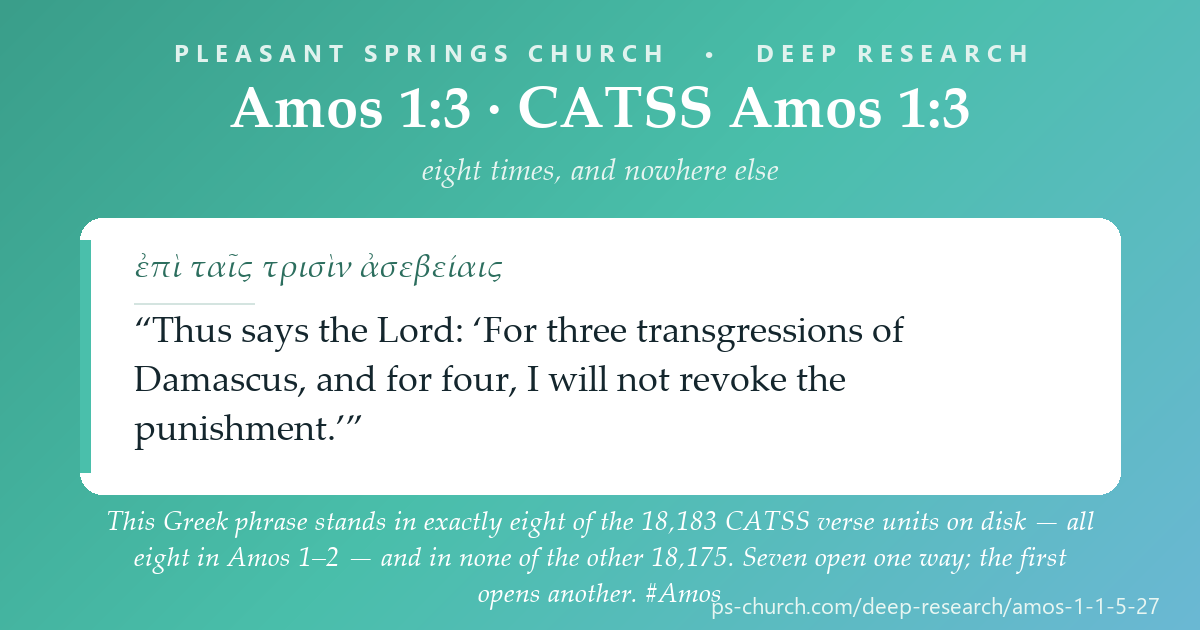
Eight times in two chapters Amos says the same sentence about a different nation. In the Greek column that sentence is ἐπὶ ταῖς τρισὶν ἀσεβείαις, and it stands in exactly eight of the 30,348 screened CATSS verse units — all eight in Amos 1–2 — and in none of the other 30,340. Seven of the eight open τάδε λέγει κύριος; the first opens καὶ εἶπεν κύριος, while the Hebrew opens all eight alike. Then the study ends on two rows that behave quite differently: Amos 5:25 and 5:26 are each the single deepest match Acts 7:42 and 7:43 have among all 30,348 screened verse units, and Acts 7:42 and 7:43 are each the deepest those rows have among all 7,927 New Testament verses — mutual, both ways, the deeper at eleven words. And the line at 5:24, let justice roll down like waters, measures two. See the method →
Amos 1:1–5:27 (selections)
Hebrew · Greek (CATSS, Rahlfs’ Septuaginta) · ESV⚠️ And one Greek phrase holds the first two chapters together. ἐπὶ ταῖς τρισὶν ἀσεβείαις stands in eight CATSS verse units, all eight of them in Amos 1–2, and in none of the other 30,340 screened units. Re-run three times since: on 2026-08-19, after Isaiah, Jeremiah, Lamentations, Ezekiel and both Greek Daniels joined the shelf; on 2026-08-30, after Exodus, Leviticus, Numbers, Joshua and the deuterocanon joined it; and again on 2026-08-30 after the Odes were withdrawn from the screening corpus — still eight, still all in Amos 1–2, every time.
The Shape of the Passage
Sequence — eight oracles, three sermons, and a funeral songAmos is the one prophet who says what he did for a living, and says it twice. 1:1 places him among the sheep-breeders of Tekoa; 7:14 has him deny being a prophet at all — I am a herdsman and a dresser of sycamore figs. Both statements are in the book; what to make of them is not something a word count decides.
Author
A southerner sent north. Tekoa is in Judah; the oracles are aimed at Samaria and Bethel. 1:1 dates the book by Uzziah of Judah and Jeroboam of Israel, and then by something no other prophet uses — two years before the earthquake.
And the Greek row of 1:1 does not say what the Hebrew says. The Hebrew has him seeing עַל־יִשְׂרָאֵל; the row has ὑπὲρ Ιερουσαλημ. The page reports both readings and neither explains the other.
Audience
The eight oracles are a trap built out of agreement. Damascus, Gaza, Tyre, Edom, Ammon, Moab — six foreign nations any Israelite audience would applaud. Then Judah. Then Israel, in exactly the same words, and at three times the length.
By chapter 5 the address has narrowed to the worshippers. “I hate, I despise your feasts” is spoken to people who are keeping them. The complaint of these chapters is not neglected religion but religion running normally.
Orient on the oracle formula, Tekoa, and the day of the Lord.
Search by topic: Amos, book of; oracles against the nations; graded numerical sayings (x / x+1); Tekoa; day of the Lord; Bethel; Sikkuth and Kiyyun.
Which articles are relevant?
- Anchor Bible Dictionary — “Amos, Book of,” “Oracles Against the Nations,” “Tekoa,” “Sakkuth and Kaiwan.”
- Dictionary of the OT: Prophets (IVP) — “Amos: Book of,” “Justice and Righteousness,” “Day of the Lord,” “Numerical Sayings.”
- Dictionary of NT Use of the OT (Beale & Carson) — on Acts 7:42–43 and Acts 15:16–17.
- NIDOTTE — פֶּשַׁע, מִשְׁפָּט, צְדָקָה, סוֹד.
The numbering, for once, needs no table
Amos carries no Hebrew/English verse offset at any point.
| chapter | 1 | 2 | 3 | 4 | 5 | 6 | 7 | 8 | 9 | total |
|---|---|---|---|---|---|---|---|---|---|---|
| Masoretic | 15 | 16 | 15 | 13 | 27 | 14 | 17 | 14 | 15 | 146 |
| CATSS | 15 | 16 | 15 | 13 | 27 | 14 | 17 | 14 | 15 | 146 |
| ESV | 15 | 16 | 15 | 13 | 27 | 14 | 17 | 14 | 15 | 146 |
All three agree, chapter for chapter. Five of the twelve Minor Prophets are like this; the other seven are not, and the two books already on this shelf carried five offsets between them.
One phrase, eight rows, and nothing else on the disk.
The oracle formula, counted
The Greek phrase behind “for three transgressions” was searched across every one of the 30,348 CATSS verse units this shelf screens — 30,637 are held, and the 289-unit difference is the Odes, withdrawn on 30 August 2026 for reasons set out below.
| row | the nation named | opening words of the row |
|---|---|---|
| Amos 1:3 | Damascus | καὶ εἶπεν κύριος |
| Amos 1:6 | Gaza | τάδε λέγει κύριος |
| Amos 1:9 | Tyre | τάδε λέγει κύριος |
| Amos 1:11 | Edom | τάδε λέγει κύριος |
| Amos 1:13 | the sons of Ammon | τάδε λέγει κύριος |
| Amos 2:1 | Moab | τάδε λέγει κύριος |
| Amos 2:4 | the sons of Judah | τάδε λέγει κύριος |
| Amos 2:6 | Israel | τάδε λέγει κύριος |
Eight units carry ἐπὶ ταῖς τρισὶν ἀσεβείαις. The other 30,340 carry it zero times, and so do the 289 Odes units that are held but not screened. In this corpus the wording belongs to two chapters of one book.
⚠️ But the length of that string is not what isolates the eight, and the page should not imply that it is. The two-word run ταῖς τρισίν already stands in exactly the same 8 units and nothing else. Eighteen distinct contiguous runs, of lengths two through six, land on precisely this same set of eight — the longest of them being καὶ ἐπὶ ταῖς τέσσαρσιν οὐκ ἀποστραφήσομαι at six words. The four-word string printed above is one member of that band, not the thing doing the work.
⚠️ That figure has a history, and the page prints the history rather than swapping the number in silence. It was nineteen when first taken, against a 35-file shelf. On 2026-08-19, when Isaiah, Jeremiah, Lamentations, Ezekiel and both Greek Daniels were added, one of the nineteen dropped out: ταῖς τέσσαρσιν also stands in CATSS Ezekiel 46:22 and 46:23, which were not on the disk when the count was first taken — nineteen → eighteen. On 2026-08-30 the shelf grew again, and far more steeply: Exodus, Leviticus, Numbers, Joshua (A and B) and the whole deuterocanon arrived, 44 files → 64, 23,061 verse units → 30,637. The band was re-run over all 30,637 and it did not move: still eighteen, still landing on the eight Amos rows and nothing else, and the four-word string above is still one of them. Then, later the same day, the corpus SHRANK — the 289 units of the Odes were withdrawn from the screening corpus, taking it to 30,348 screened of 30,637 held — and the band was asked a third time. Still eighteen. Same three runs at two words, six at three, five at four, three at five and one at six; same eight rows. The corpus was enlarged by a third and then trimmed, and this figure was untouched by any of it — which is worth more than the number itself, because no band on this shelf has been asked the same question across three corpus changes and answered it the same way three times.
The individual words are not rare in the same proportion: across the 30,348 screened units ἐπί stands in 5,672, ταῖς in 906, τρισίν in 26, τέσσαρσιν in 18 and ἀσεβείαις in 12 — the eight Amos units plus four others.
⚠️ Those five counts are printed with their history, because four of the five moved on 2026-08-30 and one did not. Against the 44-file, 23,061-unit shelf they read ἐπί 4,389, ταῖς 697, τρισίν 24, τέσσαρσιν 18, ἀσεβείαις 11. Against all 30,637 units held they read 5,708, 910, 26, 18 and 12. Against the 30,348 that are actually screened — the Odes withdrawn — they read 5,672, 906, 26, 18 and 12, so two of the five moved again by a handful of units and three did not move at all. The published figures are the screened ones. τέσσαρσιν did not gain a single unit from Exodus, Leviticus, Numbers, Joshua or the entire deuterocanon — a genuinely rare form, and now demonstrably so on a corpus a third larger. The new ἀσεβείαις row is 3 Maccabees 6:10, which is a witness held here for measurement and not Scripture; the other three non-Amos rows are Ezekiel 21:29, Hosea 12:1 and Proverbs 35:3. The four-word string did not move at either enlargement.
And the opening of the first unit differs from the other seven, though neither opening is unusual in itself. Amos 1:3 begins καὶ εἶπεν κύριος; 1:6, 1:9, 1:11, 1:13, 2:1, 2:4 and 2:6 each begin τάδε λέγει κύριος. In the Hebrew all eight open כֹּה אָמַר יְהֹוָה. Across the 30,348 screened units, 133 open καὶ εἶπεν κύριος and 93 open τάδε λέγει κύριος, and within Amos the first of those also opens 1:2 and 7:8. Both columns are printed as their files have them. On the 44-file shelf those two counts were 84 and 92, and the gap between what the enlargement did to each is the point. Greek Exodus, Leviticus and Numbers are narrative and law, where the Lord speaks constantly: they carry fifty further καὶ εἶπεν κύριος openings between them. They carry one further τάδε λέγει κύριος. The prophetic messenger formula stayed a prophetic formula when the Torah arrived, and Amos 1:3 opening with the other one is no less the odd row out than it was. ⚠️ The first of those two counts read 134 for a few hours on 30 August 2026 and now reads 133, because Odes 4:1 — which is Habakkuk 3, a passage this shelf already holds under its own name — opens the same way, and the Odes have since been withdrawn from the screening corpus. That single unit is the whole of the difference, and it was never an independent witness: it is Habakkuk counted twice. The second count, 93, was the same on all three corpora.
Scope, and it is not the scope this page used to have. Counted on the CATSS FORM column (cols 0–24) across the 64 .mlxx files held here — which as of 2026-08-30 include Exodus, Leviticus, Numbers and Joshua (A and B), the four books this caveat used to name as missing, and the deuterocanon besides: Judith, Tobit (BA and S), Wisdom, Baruch, the Letter of Jeremiah, 2–4 Maccabees, Susanna, Bel, Odes and Psalms of Solomon. There is no Greek Old Testament gap left on this disk, so “nowhere else on this disk” is now a much stronger sentence than it was when this page first said it. The negative was also checked on the other side of each row: ταῖς, τρισίν and ἀσεβείαις never appear anywhere past column 29 — parse, lemma or preverb — in any of the 30,637 units held (screened or not), and the string stands in 0 of the 7,927 New Testament verses. ⚠️ The deuterocanonical books are held here as measurement WITNESSES and not as Scripture, exactly as Psalm 151 and Jubilees are on this shelf, and this page names the book every time a hit lands in one. Exhaustive within that scope; nothing sampled.
Amos 5:25–26 and Acts 7:42–43, checked from both ends
Two consecutive CATSS rows, two consecutive New Testament verses, and each pair is a maximum in both directions.
| pair | run | deepest partner for the CATSS row, of 7,927 NT verses | deepest partner for the NT verse, of 30,348 screened CATSS units |
|---|---|---|---|
| Amos 5:25 & Acts 7:42 | 6 | Acts 7:42, alone | Amos 5:25, alone |
| Amos 5:26 & Acts 7:43 | 11 | Acts 7:43, alone | Amos 5:26, alone |
Both strings are unique — and the uniqueness is complete at two words. καὶ ἀνελάβετε τὴν σκηνὴν τοῦ Μολοχ καὶ τὸ ἄστρον τοῦ θεοῦ stands in exactly one of the 30,348 screened CATSS verse units and one of the 7,927 New Testament verses. So does καὶ ἀνελάβετε on its own; so does μὴ σφάγια for the shorter pair. Everything after word two is common material — καί runs to 62,231 CATSS tokens, τοῦ to 10,568, τήν to 7,326. The runs are long; the rarity is carried by their first two words, and the page says so rather than letting the length imply more than it earns.
Nor is six a distinctive depth on its own: five Amos units reach six somewhere in the New Testament (5:25, 8:11, 9:5, 9:11, 9:13), and 289 of the 30,348 screened units reach six or more — a figure with its own history: 233 before the edition’s equivalence table was applied, 244 after it on 23,061 units, 319 on all 30,637 units held, and 289 on the 30,348 that are screened. What is specific to these two pairs is the mutual uniqueness in both directions, not the size of the number.
⚠️ THIRTY ROWS CAME OFF THAT COUNT ON 30 AUGUST 2026, AND TWENTY-FIVE OF THEM WERE LUKE MATCHING LUKE. THE PAGE PRINTS WHAT WAS REMOVED RATHER THAN QUIETLY REPORTING THE SMALLER NUMBER. The 319 was taken against all 64 CATSS files, and those files include the Odes — the fourteen liturgical canticles bound after the Greek Psalter. Two of the fourteen are not Old Testament text at all: Ode 9 is Luke 1 (the Magnificat and the Benedictus) and Ode 13 is Luke 2 (the Nunc Dimittis). So when every Greek Old Testament row was screened against the Greek New Testament, twenty-five Odes rows came back matched to Luke — Odes 9:48 against Luke 1:48 at eighteen consecutive words, 9:79 against Luke 1:79 at sixteen, 9:68 against Luke 1:68 at fourteen, and on down. The instrument was working perfectly and measuring its own text. Nothing was ever quoted from Luke into Luke; the Greek Psalter’s appendix simply carries the Gospel canticles, and a shelfmark is not a witness.
How it was caught: the deepest hits on the whole shelf were read by eye rather than tabulated, and an eighteen-word Old Testament match to Luke 1 is not a result, it is a symptom. The other five removed rows are the same problem in a milder form: Odes 2:21 and 2:43 are Deuteronomy 32, and Ode 4:18 is Habakkuk 3 — passages already held on this shelf under their own names, so counting the canticle counts them twice; Odes 12:1 and 12:15 are the Prayer of Manasseh, which is neither, but the appendix is one book and is treated as one. Ten of the fourteen canticles are second copies of passages already in the corpus (Ode 1 = Exodus 15, 2 = Deuteronomy 32, 3 = 1 Samuel 2, 4 = Habakkuk 3, 5 = Isaiah 26, 6 = Jonah 2, 7 and 8 = Daniel Th 3, 10 = Isaiah 5, 11 = Isaiah 38), which means any tie band touching a canticle was silently doubled. The Odes stay on disk and are out of the screen. The shelf HOLDS 30,637 verse units and SCREENS 30,348. Neither of the two Amos–Acts pairs was affected: Acts 7:42 still finds Amos 5:25 alone and Acts 7:43 still finds Amos 5:26 alone, at six and eleven, band one both ways, on the screened corpus.
Where the shorter run stops is visible in the columns. Amos 5:25 has ἐν τῇ ἐρήμῳ τεσσαράκοντα ἔτη and Acts 7:42 has ἔτη τεσσεράκοντα ἐν τῇ ἐρήμῳ — the same four elements, not in the same sequence, which is where a contiguous-run test must stop.
What the whole screen returns across Amos
All 146 CATSS rows of Amos against all 7,927 verses of the Greek New Testament.
| run reached | rows of the 146 |
|---|---|
| 3 or more | 102 |
| 4 or more | 42 |
| 5 or more | 19 |
| 6 or more | 7 |
| 7 to 10 | 0 |
| 11 or more | 2 |
| 14 | 1 |
There is a clean gap: nothing in Amos reaches 7, 8, 9 or 10. The two rows above the gap are 5:26, in this study, and 9:12, in the next one. The maximum for the whole book is 14, at Amos 9:12 — outside these five chapters, and it is taken up in the second Amos study.
⚠️ Two of these figures were corrected on 2026-08-30, upward, and the reason is printed rather than the number quietly swapped. MorphGNT folds the two spellings of the negative (οὐκ, οὐχ → οὐ), of the preposition (ἐξ → ἐκ) and of the movable nu into a single form in the column measured here; CATSS does not fold any of them. Compared across the two editions without an equivalence, every shared run that reached such a word stopped dead at it. The comparison layer now applies MorphGNT’s own equivalence table — 106 pairs the edition itself declares, read off its text and normalised columns rather than written by hand — to both sides. A fold can only break a run, never invent one, so every figure it touched was too low and every correction runs one way: up. In this table four or more moved from 41 rows to 42 — Amos 9:9 rises from three to four against Romans 1:5, ἐν πᾶσιν τοῖς ἔθνεσιν, in a band of one. Above, the count of CATSS units reaching six or more against the New Testament moved from 233 to 244. Nothing else on this page moved. The maxima at 5:25 (six, band of one), 5:26 (eleven, band of one) and 9:12 (fourteen, band of one) are unchanged, their partners in Acts are unchanged, the mutual uniqueness in both directions is unchanged, 5:24 still reaches two in a two-way tie, 4:12 still reaches three, and the gap between six and eleven is still empty.
What the measurement is, and is not. Contiguous runs of normalised word forms, Greek against Greek, on the files held here: 30,348 screened CATSS verse units of the 30,637 across 64 files, and 7,927 verses of the SBL Greek New Testament across 27. Both sides lowercased, accents and breathings dropped, final sigma folded, and filtered to Greek letters — the same filter on both corpora. Word forms, never lemmas. It says nothing about which text is prior and nothing about citation.
Where the two columns name different things.
Three places in this study where the columns carry different words
| verse | Hebrew | CATSS Greek row |
|---|---|---|
| 1:1 | עַל־יִשְׂרָאֵל — concerning Israel | ὑπὲρ Ιερουσαλημ — concerning Jerusalem |
| 3:7 | סוֹדוֹ — his counsel, his secret | παιδείαν αὐτοῦ — his instruction |
| 4:12 | לִקְרַאת — to meet | ἐπικαλεῖσθαι — to call upon |
| 5:26 | סִכּוּת מַלְכְּכֶם · כִּיּוּן | τὴν σκηνὴν τοῦ Μολοχ · Ραιφαν |
Each is a difference between two columns, printed as each file has it. Why any of them stands as it does is not something these files can settle, and the page does not guess.
Amos 5:24 — the row that reaches two
Against all 7,927 verses of the Greek New Testament its longest run of consecutive identical word forms is two, and even that is a two-way tie.
The New Testament does not cite it, and a word-run screen has no way to register a sentence that has been remembered rather than repeated. Ten Greek words that have shaped a great deal of preaching, and this measurement sees almost nothing. That is a fact about the measurement.
Both columns are worth reading side by side anyway: the Hebrew has נַחַל אֵיתָן, a wadi that does not dry up; the Greek row has χειμάρρους ἄβατος, a torrent no one can cross.
Acts 7, and the word at the end.
Stephen’s speech reaches these two verses and no others in the corpus
Acts 7:42 and 7:43 stand closer to Amos 5:25 and 5:26 than to anything else among the 30,348 screened CATSS verse units on this disk — re-checked three times: on 2026-08-19 with the Major Prophets added, on 2026-08-30 with Exodus, Leviticus, Numbers, Joshua and the whole deuterocanon added, and again on 2026-08-30 with the Odes withdrawn, and both tie bands are still one every time — and the relation holds in the other direction too.
That second re-check is the one worth naming. Stephen’s speech is a Torah speech — Abraham, Joseph, Moses, the burning bush, the golden calf — and until 2026-08-30 the Greek of Exodus, Leviticus and Numbers was simply not on this disk to be screened against. The mutual maximum at 7:42 and 7:43 was measured over a corpus that did not contain the books the speech spends most of its length retelling. It has now been measured over one that does, and it did not move: Acts 7:42’s deepest partner among all 30,348 screened units is still Amos 5:25 alone, and Acts 7:43’s is still Amos 5:26 alone. The finding was right; it is only now that it has been asked the harder question.
That is unusual on this shelf. Most of the well-known connections examined in the Hosea studies returned runs of two to four, and several found their deepest partner somewhere no one proposes as a source. Here the screen and the expected answer agree, twice, consecutively.
And then the last word does not agree
Amos 5:27 ends ἐπέκεινα Δαμασκοῦ. Acts 7:43 ends ἐπέκεινα Βαβυλῶνος.
The Hebrew of 5:27 has לְדַמָּשֶׂק, Damascus, so the Hebrew and the Greek row agree with each other and Acts 7:43 reads otherwise. The page reports the three readings and stops there — which text anyone was working from, and why the word stands as it does, are not questions these columns settle.
It is worth noticing that the difference falls one verse past the end of the eleven-word run, in material the run never reached.
Looking ahead to the second Amos study
The deepest run in the whole book is not in these chapters. It is at Amos 9:12 against Acts 15:17, at fourteen words, and it is again a mutual maximum. The two Amos studies therefore end the same way — on a pair of rows that a speech in Acts stands closer to than to anything else in the corpus.
Where this page is weakest, and what was not reached.
The limits
The eight-row count is now scoped to 64 files, and it has been re-run twice. On 2026-08-19 Isaiah, Jeremiah, Lamentations, Ezekiel and both Greek Daniels were added, and the count did not move; one neighbouring figure did, the band of contiguous runs landing on exactly those eight rows falling from nineteen to eighteen because ταῖς τέσσαρσιν also stands in CATSS Ezekiel 46:22 and 46:23. On 2026-08-30 Exodus, Leviticus, Numbers, Joshua (A and B) and the whole deuterocanon were added — the exact list this paragraph used to print as missing — taking the shelf from 44 files and 23,061 units to 64 files and 30,637 units. Neither figure moved: still eight rows, still all in Amos 1–2, still eighteen runs landing on exactly those eight. Later the same day the corpus went the other way — the 289 units of the Odes were withdrawn from the screening corpus, 30,637 held, 30,348 screened — and both figures were asked a third time. Still eight. Still eighteen.
⚠️ And the sentence this page could not previously say, it can now say. Until 2026-08-30 the honest form of the claim was “nowhere else on this disk”, and this page said so, because twenty CATSS files were absent. There is now no Greek Old Testament file missing from this disk. The eight rows are eight rows of the whole Greek Old Testament as CATSS transmits it — including the deuterocanonical books, which are held here as measurement witnesses and not as Scripture, and which carry the phrase zero times. What still cannot be claimed is anything about a Greek text CATSS does not transmit, or about Greek literature outside the biblical corpora, none of which was searched.
The Amos 5:24 result is a negative and it is scoped twice. Longest contiguous run of identical word forms, on the CATSS FORM column against the MorphGNT normalised-word column (field 6), across all 7,927 New Testament verses. It does not mean the New Testament is unaware of the verse; it means no two consecutive forms beyond a pair line up.
And a phrase count is not an argument about composition. That the formula appears eight times in two chapters and nowhere else here is a fact about distribution. Whether the eight oracles were composed together, and whether the Judah oracle belongs with the rest, are questions this page does not touch.
What could not be checked at all
No Hebrew or Greek critical apparatus. No Qumran material — the Minor Prophets scroll from Nahal Hever bears directly on the Greek of these books and was not consulted, and there is a fragmentary Amos among the Qumran finds. No Targum, Syriac, Vulgate, Aquila, Symmachus or Theodotion. No text-critical work on Acts 7:43, where the manuscript tradition varies at more than one of the points measured above.
And nothing about the history. The date of the earthquake of 1:1, the identity of Sikkuth and Kiyyun, and the eighth-century politics behind the oracles are questions a word count cannot touch.
The trap in the eighth oracle.
Seven nations, and then one more
Damascus. Gaza. Tyre. Edom. Ammon. Moab. Judah. Israel. Eight times the same sentence, and the Greek column lets you count them exactly: eight verse units on this disk carry the phrase, and the other eighteen thousand do not.
An audience in Samaria could nod through six of them. The seventh names the southern kingdom, which is still someone else. The eighth uses the identical words and runs three times as long as any of the others.
And the chapter that follows the funeral song ends on two verses that a sermon in Acts stands nearer to than to any other verse in eighteen thousand — while the row at 5:24, about justice rolling down like water, registers on the same measurement as two words.
Fifth study on the Minor Prophets shelf, and the first of two on Amos. The second takes chapters 6 to 9, and the deepest run in the book.
Every Deep Research page traces its passage across the whole sweep — the Old Testament, the Second-Temple world between the testaments (historical witnesses, not Scripture), and the New Testament. Follow the thread:
Pleasant Springs Church — Deep Research
Research method after Michael S. Heiser’s Bible Research Method (examine dictionaries → ancient literature → important words → textual connections → academic publications → share), with the Pleasant Springs “Author & Audience” foundation. Scripture set in the Hebrew, the Greek editions named on each page and the ESV (Old Testament), and the Greek New Testament and the ESV (New Testament), per the practice of Pleasant Springs Church. Amos research grounded in Wolff (Joel and Amos, Hermeneia), Paul (Amos, Hermeneia), Andersen & Freedman (Amos, Anchor) and Smith (WBC). Text: Hebrew from the Masoretic text as printed in the editions consulted — Sefaria’s Miqra according to the Masorah; no critical apparatus was consulted for the Hebrew. Greek from Rahlfs’ Septuaginta as digitized by CATSS; Greek New Testament from the SBL edition. The standing caution for this shelf applies: these pages say “the CATSS Greek row reads…” and never call a Greek reading early or late. ✅ VERSE NUMBERING — checked, and clean throughout. Masoretic, CATSS and ESV all run 15 / 16 / 15 / 13 / 27 / 14 / 17 / 14 / 15 across Amos, 146 verses, so every reference on this page means the same thing in all three. Verified against content, not assumed. ⚠️ The run measurement, in full. Greek against Greek. Both sides reduced to plain lowercase letters — accents and breathings dropped, final sigma folded, CATSS beta-code transliterated first — and then filtered to Greek letters, the same filter applied to both corpora. Compared as contiguous runs of whole word FORMS, never lemmas. Corpus: 30,348 screened CATSS verse units of the 30,637 held across 64 .mlxx files — the 289-unit difference is the Odes, withdrawn from the screening corpus on 2026-08-30 — and 7,927 verses of the SBL Greek New Testament across 27 files. Exhaustive and deterministic — nothing sampled, so no seed applies. ⚠️ THE CORPUS GREW ON 2026-08-30 AND EVERY GREEK FIGURE ON THIS PAGE WAS RE-RUN. Exodus, Leviticus, Numbers, Joshua (A and B) and the deuterocanon — Judith, Tobit (BA and S), Wisdom, Baruch, the Letter of Jeremiah, 2–4 Maccabees, Susanna, Bel, Odes, Psalms of Solomon — took the Greek Old Testament from 44 files / 23,061 verse units to 64 files / 30,637. What moved, printed rather than swapped: the corpus-wide word counts (ἐπί 4,389→5,708, ταῖς 697→910, τρισίν 24→26, ἀσεβείαις 11→12), the token totals (καί 47,831→62,231, τοῦ 7,993→10,568, τήν 5,094→7,326), the two formula openings (84→134→133 and 92→93→93), and the count of CATSS units reaching six or more against the New Testament (244→319→289). What did NOT move: the eight rows carrying the oracle formula, the eighteen runs landing on exactly those eight, τέσσαρσιν at 18 units, the mutual maxima at Amos 5:25 / Acts 7:42 and Amos 5:26 / Acts 7:43 with both bands still one, and every figure in the 146-row distribution, which is measured against the Greek New Testament and the New Testament did not grow. The deuterocanonical books are held here as measurement witnesses and NOT as Scripture, and the page names the book whenever a hit lands in one — on this page that is 3 Maccabees 6:10, one of the four non-Amos rows carrying ἀσεβείαις. ⚠️ AND THEN THE CORPUS SHRANK AGAIN THE SAME DAY, AND EVERY GREEK FIGURE WAS RE-RUN A SECOND TIME. The Odes — the 289 verse units of liturgical canticles bound after the Greek Psalter — were withdrawn from the screening corpus, so this shelf now HOLDS 30,637 verse units in 64 files and SCREENS 30,348. Two reasons, either sufficient. (1) Ode 9 is Luke 1 and Ode 13 is Luke 2 — the Magnificat, Benedictus and Nunc Dimittis — so screening ‘the Greek Old Testament’ against the Greek New Testament matched Luke to Luke, twenty-five rows of it, headed by Odes 9:48 against Luke 1:48 at eighteen consecutive words. (2) Ten of the fourteen canticles are second copies of passages the shelf already holds (Ode 1 = Exodus 15, 2 = Deuteronomy 32, 3 = 1 Samuel 2, 4 = Habakkuk 3, 5 = Isaiah 26, 6 = Jonah 2, 7 and 8 = Daniel Th 3, 10 = Isaiah 5, 11 = Isaiah 38), so any tie band touching a canticle was doubled for no textual reason. What moved on this page: the corpus-wide word counts (ἐπί 5,708→5,672, ταῖς 910→906), one formula opening (134→133, and the removed unit is Odes 4:1, which is Habakkuk 3 counted twice), and the count of CATSS units reaching six or more against the New Testament (319→289, of which twenty-five removed rows were Ode 9 or Ode 13, i.e. Luke measured against itself). What did NOT move: the eight oracle-formula rows, the eighteen runs landing on exactly those eight, τρισίν at 26 and τέσσαρσιν at 18 and ἀσεβείαις at 12, the second formula opening at 93, the mutual maxima at Amos 5:25 / Acts 7:42 and Amos 5:26 / Acts 7:43 with both bands still one, and the whole 146-row distribution. ⚠️ Every maximum is printed with its tie band, checked on both sides. Amos 5:25 / Acts 7:42 at 6 and Amos 5:26 / Acts 7:43 at 11 are tie bands of one in both directions — the only NT verse reaching that depth against the row, and the only CATSS unit reaching it against the verse. The eleven-word string stands in exactly one CATSS unit and one NT verse. ⚠️ The maxima here are local, and the wider screen is printed beside them. Eleven is the deepest run in Amos 1–5; the deepest in the whole book is 14, at Amos 9:12 against Acts 15:17, outside this study and covered in the next one. Across the 146 rows the cumulative distribution is 102 at three or more, 42 at four, 19 at five, 7 at six, none between seven and ten, 2 at eleven and 1 at fourteen. ⚠️ The negative at 5:24 is scoped twice and published. “Let justice roll down like waters” reaches a longest run of two against all 7,927 New Testament verses, on the CATSS FORM column against the MorphGNT normalised-word column (field 6). It is printed because a screen shown only where it succeeded is an anecdote. ⚠️ Direction of influence is never asserted. Nothing here says which text is prior, that anyone quoted, adapted, followed or altered anything, or why any reading stands as it does — including at 1:1 (Israel / Jerusalem), 5:26 (Sikkuth / Moloch, Kiyyun / Raiphan) and 5:27 against Acts 7:43 (Damascus / Babylon), where the page prints the readings side by side and stops. Typology is handled per the house position: what the text says, what the New Testament itself draws, and what we see from this side of the cross — with the seeing left to the reader.
Scripture quotations marked ESV are from the ESV® Bible (The Holy Bible, English Standard Version®), © 2001 by Crossway, a publishing ministry of Good News Publishers. ESV Text Edition: 2016. Used by permission. All rights reserved. The ESV text may not be quoted in any publication made available to the public by a Creative Commons license, and the ESV may not be translated in whole or in part into any other language. www.esv.org
|
Did this study bless you today? 💚 Give to Support PS Church100% of gifts go to the General Fund — thank you. |