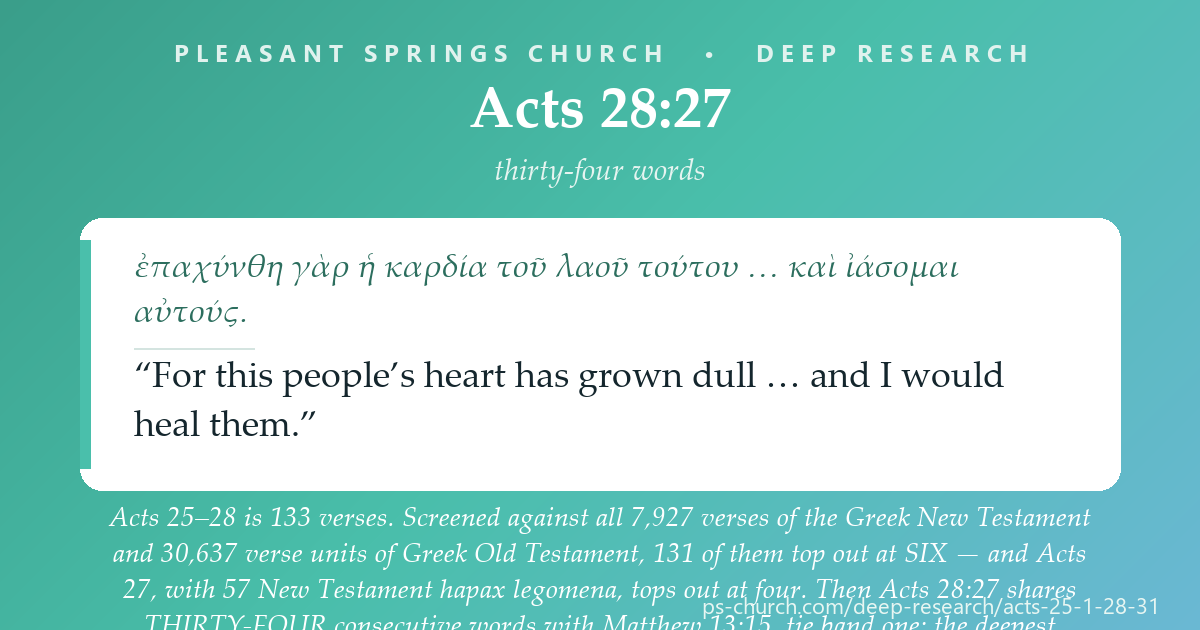
Acts 25–28 is 133 verses of Roman legal procedure, one storm, one snakebite and one apartment. Screened word for word against all 7,927 verses of the Greek New Testament and against 30,348 screened verse units of Greek Old Testament, 131 of those 133 verses top out at six — and the single six is Acts agreeing with Acts, the risen Christ’s own sentence repeated from chapter 9. Acts 27, the longest chapter in the study, tops out at four against both corpora, which is what you would expect of a chapter carrying 57 New Testament hapax legomena, more than any other chapter in the New Testament. Then the last thing Paul says in the book is a quotation, and it goes off the scale. Acts 28:27 shares thirty-four consecutive words with Matthew 13:15, tie band one — the deepest verse-to-verse agreement anywhere in the Greek New Testament. Both of them are quoting Greek Isaiah 6:10, and both of them lack the same single pronoun the Greek Isaiah held here has, which is exactly why the run against Isaiah stops at twenty-four. That is a fact about three printed texts. It is not a claim about who read whom, and this page does not make one. See the method →
Acts 25:1–28:31 (selections)
Greek New Testament (SBLGNT, via MorphGNT) · ESV★ 133 verses. Take two away and nothing here reaches seven. Screened verse by verse against all 7,927 verses of the Greek New Testament and against 30,348 screened verse units of Greek Old Testament (30,637 held in 64 files, less the 289 units of the Odes), 131 of these 133 verses top out at six — and the single six is Acts quoting Acts. Then the closing citation of Isaiah 6:9–10 reaches 13 and 34. Stage 4 gives every run, every tie band, and the counter-examples.
The Shape of the Passage
Inclusio around a sequence — the frame is a verb, the middle is not a chiasmActs names neither its author nor its date, and it does not say what happened to Paul. What it does do, in these four chapters, is put the narrator on the ship. This page reports where the grammar changes and declines to say what the change proves.
Author
The book is anonymous; its longest stretch of first-person narration is here. Counted from the MorphGNT parsing column, Acts carries 110 first-person-plural finite verbs. Twenty of them are in chapters 27 and 28, and the block runs unbroken from ἀνήχθημεν at 27:2 to εἰσήλθομεν at 28:16 — we came into Rome. The last two first-person plurals in the book, at 28:21 and 28:22, are not the narrator at all: they are the Jewish leaders of Rome saying we have received no letters and we desire to hear.
What that establishes and what it does not. It establishes that the text narrates in the first person plural from Caesarea to Rome and then hands the plural over to somebody else and never takes it back. That is a fact about the Greek. Whether the “we” marks an eyewitness, a travel source, a sea-voyage convention or a literary device is an argument this page contributes nothing to. It contributes the location of the seam.
One count offered without a conclusion. Acts 27 carries 57 New Testament hapax legomena — words that occur in exactly one verse of the Greek New Testament. That is more than any other chapter in the New Testament; Luke 3 is second with 53, Hebrews 11 third with 30. A shipwreck narrative full of technical vocabulary is evidence of a writer who knew ships, or of a writer who knew shipwreck narratives, and counting cannot tell you which.
Audience
Inside the passage there are four audiences, and only the last of them is a Jewish community. Porcius Festus, a Roman procurator. Herod Agrippa II and Bernice, a client king and his sister. A ship’s company of soldiers, sailors and prisoners — 276 people, and Paul preaches to none of them; he gives navigational advice, a report of an angel, and a meal. Then the Jewish leaders of Rome, who say they have heard nothing about him.
The book’s own reader is named once, three verses into the previous volume’s prologue at Luke 1:3, and once here in the first verse. Θεόφιλε is addressed at Acts 1:1 and never again. The adjective Festus reaches for at 25:26 — ἀσφαλές, something definite — is the same root as the ἀσφάλεια the prologue of Luke promises Theophilus at Luke 1:4. That is a fact about two words in two books and the page draws no argument from it.
And the last audience is addressed with an oracle about not listening. The verb ἀκούω stands in 85 verses of Acts. Nine are in this study, and five of the nine are in the last sixteen verse units — 28:15, 28:22, 28:26, 28:27, 28:28. The last of them is the last word of Paul’s last speech in the book: αὐτοὶ καὶ ἀκούσονται, they will listen.
Orient on Festus, on Herod Agrippa II, on Roman appeal procedure, on first-century seafaring and on Malta — before touching a single number.
Search by topic: Acts of the Apostles; Festus, Porcius; Agrippa II; Bernice; provocatio and appellatio; Roman Citizenship; Ships and Seafaring; Euraquilo; Malta / Melita; Praetorian Guard; Isaiah, Book of; hapax legomenon.
Which articles are relevant?
- Anchor Bible Dictionary — “Festus, Porcius,” “Agrippa II,” “Bernice,” “Malta,” “Ships and Sailing.”
- Dictionary of New Testament Background (IVP) — “Roman Law and Legal System,” “Citizenship, Roman,” “Travel and Trade,” “Herodian Dynasty.”
- New International Dictionary of NT Theology & Exegesis — ἐπικαλέω, διασῴζω, δεισιδαιμονία, δίκη, παρρησία.
- Commentary on the New Testament Use of the Old Testament, ed. G. K. Beale and D. A. Carson (Baker, 2007) — the Acts chapter, for Isaiah 6:9–10 at Acts 28:26–27 and its relation to the Gospel uses.
- These were not consulted for the measurements below. The measurements were run on the text files named in the footer.
Settle the numbering first — and note what is different about a New Testament page
Every page on this shelf states its versification offset, including the pages where the answer is that there is none. On a New Testament book the answer is stronger than that: there is no second ancient column for the numbers to be offset from. There is no Hebrew Acts and no Septuagint Acts. The two scripture columns here are the Greek New Testament and the ESV, and every chapter-and-verse number on this page means the same verse in both.
The counts are still not identical, and one of the differences is in the last chapter of this study.
| Acts | ch 25 | ch 26 | ch 27 | ch 28 | whole book |
|---|---|---|---|---|---|
| SBLGNT (MorphGNT), counted off disk | 27 | 32 | 44 | 30 | 1,002 |
| Modern English versification, counted off disk | 27 | 32 | 44 | 30 | 1,003 |
| Traditional (King James) numbering | 27 | 32 | 44 | 31 | 1,007 |
Four verse numbers are absent from the SBLGNT text of Acts altogether — 8:37, 15:34, 24:7 and 28:29. That was not read off a list; it was found by walking the MorphGNT file and asking which numbers never appear. 28:29 is in this passage. In the traditional numbering it reads “And when he had said these words, the Jews departed, and had great reasoning among themselves,” and it sits between the announcement to the Gentiles at 28:28 and the two whole years at 28:30. The ESV prints it in a footnote and not in the text; and the modern English edition counted off disk here does not carry it either — its Acts 28 also runs 30 verse units, numbered 1–28, 30, 31, and it omits 8:37, 15:34 and 24:7 as well. What makes that edition’s Acts one unit longer than the SBLGNT’s is a division elsewhere, not an omission here: SBLGNT Acts 19 ends at verse 40 where the English prints 19:41.
⚠️ What this page did not check. No manuscript, apparatus or edition was consulted on why any of those four is absent. The claim here is only that the printed SBLGNT does not carry them and the traditional English numbering does. Whether a verse is ‘original’ is a question about manuscripts, and no manuscript was examined for this page.
A count worth having before Stage 2: how thin the shared vocabulary is here
The four chapters, screened against the rest of the Greek New Testament, and then against the whole Greek Old Testament held here. The number is the longest run of consecutive shared word forms that any verse of the chapter achieves.
| chapter | verses | ceiling vs Greek NT | ceiling vs Greek OT | NT hapax legomena |
|---|---|---|---|---|
| Acts 25 | 27 | 5 | 5 | 11 |
| Acts 26 | 32 | 6 | 5 | 15 |
| Acts 27 | 44 | 4 | 4 | 57 |
| Acts 28 | 30 | 34 | 24 | 23 |
Read the last two columns together. Acts 27 is the longest chapter in the study, and it is the flattest: nothing in it reaches five with anything, in either corpus. It is also, by a distance, the chapter with the most words that occur nowhere else in the New Testament. Those two facts are the same fact. A run is built out of shared word forms, and a chapter written in a vocabulary nobody else uses cannot build long ones. Then Acts 28 does something no other chapter of Acts does.
A Greek proverb in a Hebrew sentence, a goddess on a beach, twin gods on a bow, and one fast day used as a calendar — most of which this page could not measure, and one of which it could.
“To kick against the goads” — what is measured and what is borrowed
Measured: λακτίζω occurs once in the Greek New Testament, at Acts 26:14. Searched across all 30,348 screened verse units of Greek Old Testament, in 64 CATSS files, the simplex does not occur at all; the compound ἀπολακτίζω occurs once — Deuteronomy 32:15, the Song of Moses, ἀπελάκτισεν ὁ ἠγαπημένος, the beloved grew fat and kicked. That is a negative on the files searched, not a statement about the whole Septuagint. κέντρον does occur: six rows, among them Hosea 5:12, Hosea 13:14, Sirach 38:25, 4 Maccabees 14:19 and Psalms of Solomon 16:4. In the New Testament κέντρον stands in four verses: Acts 26:14, 1 Corinthians 15:55 and 15:56, and Revelation 9:10. 1 Corinthians 15:55 is Paul quoting Hosea 13:14 — so the only Old Testament goad Paul ever cites is a goad in the hand of death.
Borrowed, and flagged as borrowed: The standard reference works identify πρὸς κέντρα λακτίζειν as a Greek proverb, quoted in Aeschylus (Agamemnon 1624, Prometheus 323) and Euripides (Bacchae 795), about a beast fighting the ox-goad and hurting only itself. None of those authors is on this disk. That identification is reported from the literature and is not a result of this page.
⚠️ THE COMPOUND COUNT WAS TWO UNTIL 30 AUGUST 2026 AND IS NOW ONE, AND THE PAGE PRINTS WHAT CAME OFF IT RATHER THAN SWAPPING THE NUMBER. The figure originally read “the compound occurs twice, and both are the same line of the Song of Moses — Deuteronomy 32:15 and Odes 2:15”, and the sentence contained its own refutation: Ode 2 IS Deuteronomy 32. The Odes are the fourteen liturgical canticles bound after the Greek Psalter, and ten of the fourteen are second copies of passages the shelf already holds under their own names — Ode 1 = Exodus 15, Ode 2 = Deuteronomy 32, 3 = 1 Samuel 2, 4 = Habakkuk 3, 5 = Isaiah 26, 6 = Jonah 2, 7 and 8 = Daniel Th 3, 10 = Isaiah 5, 11 = Isaiah 38. So the word stood in one verse of the Greek Old Testament and this page reported it standing in two. The Odes were withdrawn from this shelf’s screening corpus on 30 August 2026, taking it from 30,637 verse units to 30,348 screened of 30,637 held, and the count is now one.
The reason the withdrawal happened is not this verse, and it is worth naming, because it is worse. Ode 9 is Luke 1 — the Magnificat and the Benedictus — and Ode 13 is Luke 2, the Nunc Dimittis. So while the Odes were inside ‘the Greek Old Testament’, a screen of the Greek New Testament against the Greek Old Testament matched Odes 9:48 to Luke 1:48 at eighteen consecutive words, 9:79 to Luke 1:79 at sixteen, 9:68 to Luke 1:68 at fourteen, and on down through twenty-five rows. That is Luke matching Luke under an Old Testament shelfmark — a page could have printed it as a Gospel’s deepest Old Testament contact while measuring its own text, and the instrument would have been working perfectly. It was caught by reading the deepest hits on the shelf by eye instead of tabulating them: an eighteen-word Old Testament match to Luke 1 is not a result, it is a symptom. No hit of that kind was ever published on this page — Acts 25–28 never touches the Lukan canticles — and the only figure here that moved is the Deuteronomy doublet above. The Odes stay on disk. They are out of anything this shelf calls the Greek Old Testament.
What the Greek does show without any help: the voice is introduced as speaking τῇ Ἑβραΐδι διαλέκτῳ, and the sentence it speaks is a Greek proverb. The narrative says the words were Hebrew or Aramaic and then reports them in a Greek idiom, in a speech delivered to a Roman governor and a Herodian king. Whether that is translation, adaptation, or the way Luke wrote for the room he was describing, the page does not decide.
A goddess on a beach, twin gods on a bow, and a fast used as a calendar
Measured: δίκη stands in three verses of the Greek New Testament: Acts 28:4, 2 Thessalonians 1:9, Jude 7. Διόσκουροι occurs once, and so does παράσημος, the word for the ship’s figurehead (28:11). βάρβαρος stands in five verses of the New Testament and two are in Acts 28. Σεβαστός stands in three verses of the whole New Testament and all three are inside this study — 25:21 and 25:25 of the emperor, and 27:1 of the cohort. νηστεία stands in five verses; two are in Acts.
Borrowed, and flagged as borrowed: That ἡ δίκη with the article most likely names the goddess Justice, daughter of Zeus, and not an abstraction; that the Dioscuri, Castor and Pollux, were the patrons of sailors and a standard Alexandrian grain-ship emblem; that ἡ νηστεία with the article is the Day of Atonement and therefore places the voyage in late September or October, after which the Mediterranean sailing season was reckoned closed; that Herod Agrippa II ruled a northern tetrarchy under Rome and that Bernice was his sister — all of that is from the reference works, from Josephus, and from Roman sources not held on this disk. The page reports it as background and measures none of it.
Where the background is doing real work, and where it is decoration. Real work: without the Day of Atonement, 27:9 is a vague remark about lateness; with it, the chapter has a date and Paul’s advice has a reason. Our separate study of that dating is at The Fast and the Day of Atonement. Decoration: the Dioscuri. It is a good detail and it changes nothing in the argument, and the page says so rather than making it carry weight.
The one piece of ancient context this page could actually measure
Three ancient Greek texts of Isaiah 6:10 are effectively in play at 28:27, and two of them are New Testament books.
| text | words | the clause that differs | run with Acts 28:27 |
|---|---|---|---|
| CATSS Greek Isaiah 6:10 | 35 | καὶ τοῖς ὠσὶν αὐτῶν βαρέως ἤκουσαν | 24, tie band 1 |
| Matthew 13:15 | 34 | καὶ τοῖς ὠσὶν βαρέως ἤκουσαν | 34, tie band 1 |
| Acts 28:27 | 34 | καὶ τοῖς ὠσὶν βαρέως ἤκουσαν | — |
Ten words agree, then one word is present in Isaiah and absent from both New Testament verses, then twenty-four words agree. That single pronoun is the whole difference across the entire verse, and it is what caps the measured run against Isaiah at 24 instead of 34.
⚠️ And here is the part that has to be said out loud. The CATSS files hold Rahlfs’ printed text and no apparatus. Whether some Greek Isaiah manuscripts also lack αὐτῶν is precisely the question this page cannot answer, because no apparatus, no manuscript and no critical edition of the Septuagint Isaiah was examined for it. If a witness without the pronoun exists, the interesting number changes. The page reports what is on the disk and marks the limit.
Six words that carry these four chapters, and how rare each one actually is.
The active and middle of this verb stand in twenty verses of Acts. In fourteen it means surnamed or call on the name of the Lord. In six it lodges the Roman appeal — 25:11, 25:12, 25:21, 25:25, 26:32, 28:19 — and all six are inside this study. Four of the six take Καίσαρα as their object (25:11, 25:12, 26:32, 28:19); 25:21 takes an infinitive clause and 25:25 takes τὸν Σεβαστόν. Those six are the only occurrences of the Roman appeal formula in the New Testament. The verb Peter quotes from Joel at 2:21 and the verb Ananias uses at 22:16 is the verb Paul uses to invoke the emperor.
Eight verses in the Greek New Testament. Four of the eight fall inside ten verses here — 27:43, 27:44, 28:1, 28:4. A fifth is Acts 23:24, the written order to bring Paul safely through to Felix, which set the journey going. The remaining three are Matthew 14:36, Luke 7:3 and 1 Peter 3:20, where eight souls were brought safely through water. Meanwhile the simple verb σῴζω occurs twice in these chapters, at 27:20 and 27:31, and both times it means not drown.
The lemma σωτήριος stands in five verses of the Greek New Testament: Luke 2:30, Luke 3:6, Acts 28:28, Ephesians 6:17 and Titus 2:11. The neuter substantive — the saving thing, used as a noun — accounts for four of them, and three of those four are Luke or Acts (Luke 2:30, Simeon’s my eyes have seen your salvation; Luke 3:6; Acts 28:28; and Ephesians 6:17 in the genitive). Titus 2:11 is the plain adjective. Acts 28:28 and Luke 3:6 share four words, τὸ σωτήριον τοῦ θεοῦ — and so does Greek Isaiah 40:5, which is what Luke 3:6 is quoting. The first thing the Gospel promises and the last thing Acts announces are the same four words. Run of 4, and the page reports it as a run of 4.
Three verses in the Greek New Testament: Acts 28:4, 2 Thessalonians 1:9, Jude 7. In the two epistles it is a penalty. Here it has the article and a verb of personal agency — ἡ δίκη ζῆν οὐκ εἴασεν, Justice has not permitted him to live. Most modern English versions capitalise it; the Greek carries no capitals and settles nothing. Whichever it is, Luke prints the islanders’ theology without correcting it, and then prints them changing their minds in the opposite direction two verses later.
One occurrence in the Greek New Testament (25:19); the adjective δεισιδαίμων also one (17:22). Both are spoken about or to non-Christians by a speaker managing a room — Paul opening on the Areopagus, Festus briefing a king. The word is literally demon-fearing, and it was already, in the first century, the polite word and the rude word at the same time. Translators must choose; the Greek does not.
One occurrence in the Greek New Testament, and it is the last word of Acts. The adverb belongs to legal and contractual Greek: it is what a lease or a permit says when no one may obstruct you. The book ends on a word that describes the preaching and not the preacher — the man is under guard for two whole years in rented lodging, and the word applied to what comes out of him is the word for unobstructed.
The hapax count, chapter by chapter — and what it costs the measurement
A New Testament hapax legomenon here means a lemma that occurs in exactly one verse of the whole Greek New Testament. Counted off the MorphGNT lemma column.
| chapter | hapax | a few of them |
|---|---|---|
| Acts 25 | 11 | αἰτίωμα, δεισιδαιμονία, ἀκροατήριον, ἀνάκρισις |
| Acts 26 | 15 | δωδεκάφυλον, λακτίζω, παθητός, μανία |
| Acts 27 | 57 | βραδυπλοέω, εὐρακύλων, ὑποζώννυμι, Σύρτις, βολίζω, ὀργυιά, ζευκτηρία, ἀρτέμων, διθάλασσος, ἐκκολυμβάω |
| Acts 28 | 23 | φρύγανον, δυσεντέριον, παράσημος, Διόσκουροι, μίσθωμα, ἀκωλύτως |
Acts 27 has more New Testament hapax legomena than any other chapter in the New Testament. Luke 3 is second with 53, Hebrews 11 third with 30, Romans 16 fourth with 28, Acts 7 and 2 Peter 2 tied fifth with 27. Ten chapters in the New Testament reach twenty-two or more, and five of the ten are chapters of Acts — 27, 7, 20, 28 and 17; Acts 17 ties with 2 Timothy 3 at 22.
Why that matters for every other number on this page. A run is a sequence of shared word forms. A chapter whose vocabulary is unique to itself cannot build long runs with anything, and its low ceiling is a property of its subject matter, not a finding about its theology. Acts 27’s ceiling of four is the least surprising number on this page, and it is printed anyway, because leaving it out would make the thirty-four look like a pattern instead of an exception.
Every run on this page, with its tie band, its scope, and its counter-examples.
The method. Greek against Greek. Both sides are lowercased, accents and breathings dropped, final sigma folded, then filtered to Greek letters — the same filter on both corpora. A run is the longest sequence of consecutive whole word forms, never lemmas, that two verses share. The tie band is how many target verses reach the same maximum. A run of 34 with a band of 1 is a signal; a run of 5 with a band of 5 is a formula. Nothing is sampled, so no seed applies.
The whole result, in one table
Every verse of Acts 25–28 that reaches five against either corpus. There are eight of them out of 133; the table has ten rows because three of the eight reach five against both corpora.
| row | deepest match | run | tie band | flagged as a citation? |
|---|---|---|---|---|
| Acts 28:27 | Matthew 13:15 | 34 | 1 | yes — 28:25 names the Holy Spirit and Isaiah the prophet |
| Acts 28:27 | Greek Isaiah 6:10 | 24 | 1 | yes, same citation |
| Acts 28:26 | Matthew 13:14 and Greek Isaiah 6:9 | 13 | 1 in each corpus | yes, same citation |
| Acts 26:15 | Acts 9:5 | 6 | 1 | no — the book repeating itself |
| Acts 25:15 | Matthew 21:23 and four others | 5 | 5 | no — a title formula |
| Acts 25:15 | Greek 2 Esdras 6:7 | 5 | 2 | no |
| Acts 26:14 | Acts 9:4 / Acts 22:7 | 5 | 2 | no |
| Acts 26:16 | Greek Ezekiel 2:1 | 5 | 1 | no |
| Acts 26:20 | Greek 1 Esdras 6:8 | 5 | 1 | no |
| Acts 28:31 | Luke 8:1 / Luke 9:2 · Philippians 4:23 / Philemon 25 | 5 | 4 | no — two different stock phrases |
The distribution, which is the real result. Against the rest of the Greek New Testament, the 133 rows fall out like this: 2 rows reach 1, 42 reach 2, 66 reach 3, 17 reach 4, 3 reach 5, 1 reaches 6, and then the next two numbers are 13 and 34. Against the Greek Old Testament: 46 reach 2, 67 reach 3, 15 reach 4, 3 reach 5, and then 13 and 24. There is nothing between six and thirteen in either screen.
Scope. The 133 verse units of SBLGNT Acts 25–28, run against (a) the other 7,794 verses of the Greek New Testament and (b) 30,348 screened verse units of the 30,637 held across 64 CATSS Greek files — the 289-unit difference is the Odes, withdrawn on 30 August 2026 (stage 2 says why). The whole Old Testament screen was re-run at 30,348 and the distribution above did not move: same 46 / 67 / 15 / 3, same 13 and 24, same eight rows reaching five, same tie bands on every row printed in the table. Twenty-five of the 133 rows lost a unit or two from very wide bands — Acts 28:24 from 1,250 to 1,245 is the largest — and none of those bands is published. Exhaustive and deterministic.
Caveat. This finds verbatim contact. It does not find allusion. A passage can be steeped in a book it shares no five words with — and Acts 26:18 below is exactly that case.
The thirty-four — and the pronoun that is the whole story
Acts 28:27 and Matthew 13:15 are the same thirty-four words in the same order. Tie band 1: no third verse in the Greek New Testament comes near. It is the deepest verse-to-verse agreement anywhere in the New Testament. The next deepest identical verses are Matthew 25:21 = 25:23 at 25 (two servants in one parable) and Matthew 12:41 = Luke 11:32 at 24. The deepest run between two verses that are not identical is 26 — Matthew 6:24 against Luke 16:13, which Luke opens with one extra word.
Both verses are quoting Greek Isaiah 6:10 — and both diverge from it at exactly one place.
| the clause | words in the verse | |
|---|---|---|
| Greek Isaiah 6:10 | …καὶ τοῖς ὠσὶν αὐτῶν βαρέως ἤκουσαν… | 35 |
| Acts 28:27 | …καὶ τοῖς ὠσὶν βαρέως ἤκουσαν… | 34 |
| Matthew 13:15 | …καὶ τοῖς ὠσὶν βαρέως ἤκουσαν… | 34 |
Ten words, then the gap, then twenty-four words. The run against Isaiah is 24 because of one pronoun; the run against Matthew is 34 because that pronoun is missing from both.
What is measured and what is not. Measured: that these two New Testament verses are identical on normalised forms for their whole length; that no other verse in 7,927 reaches that depth with either of them; that the Greek Isaiah held here has one word neither of them has. Not measured, and not asserted: that Luke read Matthew, that Matthew read Luke, that both used a common testimony collection, or that both used a form of Greek Isaiah that already lacked the pronoun. All four are live proposals in the literature and this page decides between none of them. The identity is a fact; the explanation is an argument, and a word-run screen cannot supply one.
The same result was found from the other end and published first on the Matthew 13:1–58 page, which ran the identical-verse census of the whole Greek New Testament: 19 groups of eight words or more, of which this is the deepest. What is new from the Acts side is the context. On the Matthew side the 34 sits in a chapter full of deep runs. Here it sits at the end of 131 verses whose ceiling is six.
Three counter-examples, printed so the thirty-four is not read as more than it is
1. Acts 26:18 and Isaiah 42. The commission — to open their eyes, that they may turn from darkness to light — is heard as Isaiah 42 by every commentary on the shelf and by most readers. Measured against Greek Isaiah 42:7 the run is 2 (ἀνοῖξαι ὀφθαλμούς); against Isaiah 42:16 it is 3 (εἰς φῶς καί); against Isaiah 61:1 it is 1. The echo is real and the wording is not shared, and those two statements are both true at once. This is the clearest thing on the page about what the measurement cannot do.
2. Acts 27:35 and the Last Supper. Paul takes bread, gives thanks to God before them all, breaks it and begins to eat. It is frequently read as eucharistic. Against Luke 22:19 the run is 3 (καὶ λαβὼν ἄρτον); against Luke 24:30, the Emmaus meal, it is 2; against 1 Corinthians 11:24 it is 1. Three words is what any two accounts of any meal would share. The page reports the number and leaves the reading to the reader.
3. Acts 27:34 and “not a hair of your head.” Against Luke 21:18 the run is 2; against Matthew 10:30 it is 2; against Greek 1 Samuel 14:45, the classic Old Testament form of the oath, it is 2. The idiom is shared and the wording is not.
And one counter-example inside the deep column itself. Acts 25:15 reaches 5 against the Greek New Testament — οἱ ἀρχιερεῖς καὶ οἱ πρεσβύτεροι — with a tie band of 5. Five different verses reach the same maximum. That is a title, not a link, and it is printed at the top of the table beside the runs of 34 and 13 precisely so the tie band is seen doing its job.
The single six, and what it is
Strip out 28:26 and 28:27 and the deepest thing in these four chapters is Acts 26:15 — six words, tie band one, and the partner is Acts 9:5.
Ἐγώ εἰμι Ἰησοῦς ὃν σὺ διώκεις — I am Jesus, whom you are persecuting. Seventeen chapters apart, in the mouth of the same speaker, in the narrator’s voice the first time and in Paul’s own testimony before a king the third. The next run down is 26:14 against Acts 9:4 and Acts 22:7 at five, tie band two — Σαοὺλ Σαούλ, τί με διώκεις.
So the deepest internal agreement in the last four chapters of Acts is Acts quoting Acts, and what it quotes is the one sentence all three tellings guard. The Acts 9 page found the same six from the other side.
Zero and one on this page. Every Greek-side screen here uses the unigram fallback: a row that shares no two-word sequence still scores 1 if any single word matches. So the run of 1 reported for Acts 26:18 against Greek Isaiah 61:1 means they share one word and no pair, not that they share nothing. Two rows in the whole study score 1 against the Greek New Testament, and none scores 0 — there is no verse here that shares no word at all with anything.
Two smaller agreements, with their bands
Acts 26:16 and Greek Ezekiel 2:1 share five words, tie band 1 — στῆθι ἐπὶ τοὺς πόδας σου. It ties with Acts 26:20 against Greek 1 Esdras 6:8 for the deepest thing anything in Acts 26 does against the whole Greek Old Testament. Both Greek Daniels reach 3 with the same verse at Daniel 10:11. Five words with a band of one is worth printing and is not worth calling a citation: there is no formula, and stand on your feet is ordinary Greek.
Acts 28:28 and Luke 3:6 share four words, τὸ σωτήριον τοῦ θεοῦ — and so does Greek Isaiah 40:5, which Luke 3:6 is quoting. Four words is four words. It is reported here because the phrase is the hinge of the whole two-volume argument and because the number is small, which is the point: the strongest thematic link in the passage measures four.
Where this page is weakest, what it could not reach, and what would break it.
The largest hole: one printed edition on each side, and no apparatus
Every number on this page is an agreement between printed texts. The New Testament figures come from the SBL Greek New Testament as digitised by MorphGNT; the Greek Old Testament figures from Rahlfs’ Septuaginta as digitised by CATSS. Neither has a critical apparatus on this disk, and no manuscript was examined.
This bears on the headline finding directly, and the page will not pretend otherwise. The entire difference between a run of 24 and a run of 34 is the presence or absence of αὐτῶν in Greek Isaiah 6:10. If a substantial Greek Isaiah witness lacks that pronoun, the shape of the finding changes: Acts and Matthew would then be agreeing with a form of Isaiah rather than departing from Isaiah together. That question is answered by a Septuagint apparatus, and no Septuagint apparatus was consulted. It is stated here rather than buried because it is the single check most likely to move the result.
And the Western text problem is worse in Acts than anywhere else. Codex Bezae and its allies give a text of Acts roughly a tenth longer, and the chapters of the voyage and of the Roman arrival are among the places where it differs. Acts 28:29 — a verse this page reports as absent — is carried by the Received Text the King James was made from, which is why the King James has it. Which manuscripts carry it, and whether Codex Bezae is even extant at that point, are apparatus questions, and no apparatus was opened for this page. The page reports what the SBLGNT prints and does not adjudicate.
What the “we” count does and does not license
The count is solid; the inference is not the count. The 110 first-person-plural finite verbs of Acts were pulled from the MorphGNT parsing column (person field 1, number field P, mood field I / S / D / O). Twenty of them are in chapters 27–28. Which of those twenty stand inside quoted speech was then determined by reading, not by a program, because the file carries no field for it, and the answer is that eighteen are narration and the two at 28:21 and 28:22 are the Roman Jewish leaders speaking. A reader who disagrees about any one of them should say so.
The interpretation is wide open. Whether the we-sections mark an eyewitness, a source document, a Hellenistic sea-voyage convention or an authorial device is an argument this page contributes nothing to except the location of the seam. It begins at 27:2 and its last narrative instance is 28:16. Anyone who wants to argue from that has to account for both ends.
What could not be checked at all
No Greek critical apparatus on either side. No papyri — P74 carries much of Acts and was not consulted. No Codex Bezae. No patristic citations. No Latin, Syriac or Coptic versions. No Josephus, and Josephus is the principal source for Festus, Agrippa II and Bernice. No Roman legal sources on appellatio. No Aeschylus and no Euripides for the goad proverb. No nautical or papyrological material, and no inscriptions from Malta or Puteoli. No commentary on Acts was read for any figure on this page.
Historical questions the measurement is simply silent on. Why Acts ends where it does; whether Paul was released, tried, or executed; whether the two years are a legal statute of limitations, the limit of the author’s knowledge, or a deliberate close; whether the shipwreck narrative is a report, a source, or a literary set piece; whether Luke and Matthew had any contact at all. Counting shared word-runs cannot decide any of that.
Where this page is thinnest. It rests on one verse. Acts 28:27 is the whole finding, and it is one verse out of 133. It was not cherry-picked — it is the top of an exhaustive screen of every verse in the passage against both corpora — but a page whose headline is a single row is a page that a single textual variant could unsettle, and Stage 5 has now named that variant twice.
One claim that is easy to overstate, and is deliberately not made. It is tempting to write that Acts 25–28 “stops using the Old Testament.” The page will not. Low runs are not silence. Paul’s defence at 26:22 says he is saying nothing but what the prophets and Moses said, and 26:23 argues the resurrection from them; the measurement simply shows he does it without quoting. A book can argue from Scripture continuously and measure four, and this passage does.
Reading list
- C. K. Barrett, A Critical and Exegetical Commentary on the Acts of the Apostles (ICC, 2 vols., 1994–1998).
- Joseph A. Fitzmyer, The Acts of the Apostles (Anchor Bible 31, 1998).
- Craig S. Keener, Acts: An Exegetical Commentary, vol. 4 (2015) — the standard collection of the Roman legal and nautical background this page had to borrow.
- Brian M. Rapske, The Book of Acts and Paul in Roman Custody (1994).
- Craig A. Evans, To See and Not Perceive: Isaiah 6.9–10 in Early Jewish and Christian Interpretation (JSOTSup 64, 1989) — the monograph on precisely the verse this page’s headline turns on.
- Joseph Ziegler, ed., Isaias, Septuaginta: Vetus Testamentum Graecum XIV (Göttingen: Vandenhoeck & Ruprecht, 1939) — the apparatus this page needed and did not have.
- None of these were consulted for the measurements on this page, which were run on the text files named in the footer.
A hearing, a storm, a fire on a beach, and a rented room with the door open.
Six, and then thirty-four
Four chapters. A governor who cannot think what to write. A king who says in a short time and then leaves. Two hundred and seventy-six people on a grain ship in a north-easter, and a prisoner telling the crew to eat. A snake, a fire, a misdiagnosis, and a change of mind. And then a rented apartment in Rome with a soldier attached to it and a stream of visitors coming in.
And underneath it, a measurement that is nearly all low numbers. One hundred and thirty-one of these 133 verses share no more than six consecutive words with anything in either corpus, and the chapter with the storm in it shares no more than four with anything at all. This is the least quotable stretch of prose in the book — because it is the stretch where the church is not preaching in synagogues but answering charges, taking soundings, and gathering firewood.
Then the last thing Paul says is a quotation, and it is the deepest verbatim agreement in the New Testament. Thirty-four words, shared with Matthew 13:15, with nothing else in 7,927 verses coming near. Both of them quoting Isaiah about people who hear and do not understand. Both of them missing the same one word the Greek Isaiah has. The page reports that and stops. It does not say who read whom, it does not say the Septuagint was altered, and it does not say the identity proves anything about the composition of either book.
The oracle is about ears that will not hear. The last clause of the last speech is αὐτοὶ καὶ ἀκούσονται — they will listen. And the last word of the book is an adverb out of a lease: ἀκωλύτως, with nobody stopping him, written about a man who is chained to a guard and has been for two years. Acts does not end. It stops, with the door open.
Every Deep Research page traces its passage across the whole sweep — the Old Testament, the Second-Temple world between the testaments (historical witnesses, not Scripture), and the New Testament. Follow the thread:
Pleasant Springs Church — Deep Research
Research method after Michael S. Heiser’s Bible Research Method (examine dictionaries → ancient literature → important words → textual connections → academic publications → share), with the Pleasant Springs “Author & Audience” foundation. Scripture set in the Hebrew, the Greek editions named on each page and the ESV (Old Testament), and the Greek New Testament and the ESV (New Testament), per the practice of Pleasant Springs Church. Acts research grounded in Barrett (ICC), Fitzmyer (Anchor), Keener, Rapske and Evans — none of which were consulted for any number on this page. Text: Greek New Testament from the SBL edition as digitized by MorphGNT; Greek Old Testament from Rahlfs’ Septuaginta as digitized by CATSS. No critical apparatus was consulted on any side, and for this page that omission is load-bearing: the difference between the reported run of 24 and the reported run of 34 is one pronoun in Greek Isaiah 6:10, and settling whether any Greek Isaiah witness lacks it requires a Septuagint apparatus this page did not have. ⚠️ VERSE NUMBERING — Acts is a New Testament book, so there is no Masoretic or Septuagint column and no offset to state. Counted anyway, off disk: SBLGNT Acts 1,002 verse units, a modern English edition 1,003, traditional King James numbering 1,007. Four numbers are absent from the SBLGNT — 8:37, 15:34, 24:7, 28:29 — and 28:29 falls inside this study, which is why SBLGNT Acts 28 has 30 verse units where the King James has 31. That English edition, counted off disk, omits the same four numbers, so its Acts 28 is 30 units too; what makes it one unit longer overall is a division and not an omission: SBLGNT Acts 19 ends at verse 40 where the English prints 19:41. The ESV is not held on this disk as a file; its shape is reported from the printed edition, which puts 28:29 in a footnote. Stated because this shelf states it everywhere, including where there is nothing to convert. ⚠️ The measurement, in full. Greek against Greek. MorphGNT field 6, the normalised word (the column that already resolves elision and the movable nu); CATSS FORM column (cols 0–24), beta-code transliterated first. Both sides lowercased, accents and breathings dropped, final sigma folded, then filtered to Greek letters — the same filter applied to both corpora. Contiguous runs of whole word FORMS, never lemmas. Corpus: the 133 MorphGNT verse units of Acts 25–28 against the other 7,794 verses of the Greek New Testament, and against 30,348 screened verse units of the 30,637 held across 64 CATSS files — the Odes, 289 units, are held on disk and excluded from the screen, because Ode 9 is Luke 1 and Ode 13 is Luke 2 and ten more canticles are second copies of passages already in the corpus. Exhaustive and deterministic; nothing sampled, so no seed applies. The tie band — how many target verses reach the same maximum — is printed beside every run on this page. Greek-side screens here use the unigram fallback, so a reported run of 1 means “one word shared and no pair”, not “nothing shared”. ⚠️ Hapax counts. A New Testament hapax legomenon here means a lemma occurring in exactly one verse of the Greek New Testament, counted off the MorphGNT lemma column across all 7,927 verses. Acts 27 returns 57, which is the highest of any chapter in the New Testament; Luke 3 returns 53. Counting by lemma rather than by form is a choice, and a different lemmatisation would move these numbers a little. ⚠️ What was NOT measurable. No papyri, no apparatus, no Codex Bezae, no versions, no patristic citations, no Josephus, no Roman legal sources, no Aeschylus or Euripides for the goad proverb, no nautical or epigraphic material. The Greco-Roman background in Stage 2 — the goddess Justice, the Dioscuri figurehead, the Day of Atonement as a sailing-season marker, Agrippa II and Bernice — is reported from reference works and measured nowhere. ⚠️ Direction of influence is never asserted. Nothing here says Luke read Matthew, that Matthew read Luke, that either used a testimony collection, or that the Greek Isaiah was altered by anyone. The page reports where the words are identical, how many other verses reach the same depth, and stops. Typology is handled per the house position: what the text says, what the New Testament itself draws, and what we see from this side of the cross — with the seeing left to the reader.
Scripture quotations marked ESV are from the ESV® Bible (The Holy Bible, English Standard Version®), © 2001 by Crossway, a publishing ministry of Good News Publishers. ESV Text Edition: 2016. Used by permission. All rights reserved. The ESV text may not be quoted in any publication made available to the public by a Creative Commons license, and the ESV may not be translated in whole or in part into any other language. www.esv.org
|
Did this study bless you today? 💚 Give to Support PS Church100% of gifts go to the General Fund — thank you. |