A man on the Damascus road, still breathing threats, is knocked flat by a light and asked a question. It is the most retold conversion in history — and when you put the chapter on a scale, the result is not what the sermons lead you to expect. Acts 9 quotes no Old Testament at all: screened against 30,637 verse units of Greek Old Testament, no verse reaches beyond a run of five, and all four fives are narrative formulae. Its two deepest New Testament runs are tied at six with a tie band of one apiece — and one of them is the risen Christ’s own sentence, given back word for word seventeen chapters later, while the other is the line that opens the Christmas story. This study works Acts 9:1–43 in the Greek New Testament and the ESV, and prints its own counter-examples. See the method →
Acts 9:1–40 (selections)
Greek New Testament (SBLGNT, via MorphGNT) · ESVThe offset still reaches this page, three times sideways. The three Greek Old Testament passages that come up in Stage 4 all sit at different numbers in the Greek from the numbers an English Bible prints. The Elijah upper room is LXX 3 Kingdoms 17:19 = English 1 Kings 17:19; the Elisha room is LXX 4 Kingdoms 4:11 = 2 Kings 4:11 — the Greek Bible counts Samuel and Kings as four books of Kingdoms. And the single Greek Old Testament verse that reaches a run of five with Acts 9:17 is LXX Jeremiah 45:11, which is Jeremiah 38:11 in the Masoretic Text and in every English Bible — Greek Jeremiah carries the oracles against the nations in a different place, so its chapter numbers from 25 onward do not match. This page gives both numbers every time.
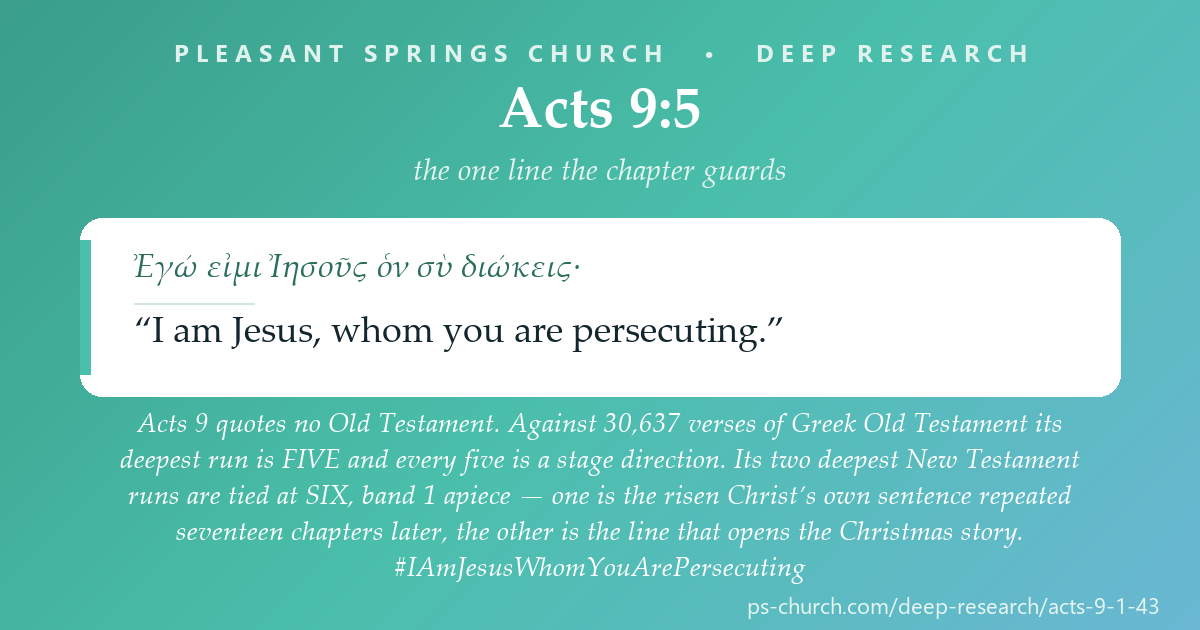
★ And the measured surprise: this chapter quotes no Old Testament at all. Screened verse by verse against the 30,637 verse units of Greek Old Testament held on this disk, no verse of Acts 9 reaches beyond a run of five, only four rows reach five, and every one of those four is a narrative formula — he said to him, and it came to pass in those days, and he entered the house. Against the Greek New Testament, by contrast, two rows reach six, each with a tie band of one — and the two are opposite kinds of thing. Stage 4 gives the tables, the bands, and the counter-examples.
The Shape of the Passage
A sequence in two movements — and deliberately not a chiasmThe spine is one imperative. ἀνάστηθι, rise, stands seven times in Acts — and three of the seven are in this chapter (9:6, 9:34, 9:40). No other chapter of Acts has more than one. It is said to a persecutor on the ground, to a paralysed man on a mat, and to a dead woman on a bier, and the same word does all three.
The most famous conversion in history, told three times by one author — here in the third person, at 22:6–16 to a Jerusalem mob, at 26:12–18 to a king. This page measures the three tellings against each other before it interprets any of them.
Author
Luke writes Acts 9 as the second panel of a triptych he will complete in chapters 10 and 11: a Pharisee, then a Roman centurion, then a whole Gentile church at Antioch. He does not editorialise. He narrates — and then he lets Paul narrate the same event twice more in his own voice, which is a deliberate authorial choice and the single most measurable thing about this chapter. Where the three tellings agree word for word, they agree on what the voice said, and almost nowhere else. The frame is retold freely; the sentence from heaven is not.
He also writes it as a healing story about a persecutor. Saul is struck to the ground, blinded, led by the hand, and does not eat for three days. Then a frightened man lays hands on him and calls him brother. Luke, who has told the raising of Jairus’s daughter in his Gospel, now tells two more restorations in the same chapter — Aeneas and Tabitha — and binds all three to Saul with one word: rise.
Audience
Theophilus, and every reader who has ever thought someone beyond reach. The chapter is built around two people’s fear of the same man. Ananias says plainly, “Lord, I have heard from many about this man” (9:13); the Jerusalem disciples “were all afraid of him, for they did not believe that he was a disciple” (9:26). Luke does not treat that fear as faithlessness. He records it, and then records Barnabas taking hold of him anyway.
And it is addressed to a church that already had a name for itself. Saul’s warrant at 9:2 is for people of the Way — the earliest self-designation of the movement in Acts, used here before “Christian” appears at 11:26. Then, in the same chapter, Luke uses the identical noun twice more for the literal road to Damascus (9:17, 9:27). The persecutor of the Way is stopped on the way.
Orient on Damascus, the Way, Ananias, Lydda and Joppa before reading a word of commentary.
Search by topic: Damascus · the Way · Saul/Paul, conversion of · Ananias of Damascus · Lydda · Joppa · Dorcas/Tabitha · tanner.
Which articles are relevant?
- Anchor Bible Dictionary — “Damascus,” “Way, The,” “Paul,” “Ananias (2),” “Lydda,” “Joppa,” “Tabitha.”
- Dictionary of the New Testament / Dictionary of Paul and His Letters — “Conversion and Call of Paul,” “Damascus Road,” “Persecution,” “Miracles in Acts.”
- NIDNTTE / TDNT — ὁδός (hodos), διώκω (diōkō), σκεῦος (skeuos), ἀνίστημι (anistēmi), ἅγιος (hagios).
- A note on what dictionaries will not settle. Every article on this chapter cites the Heliodorus story from 2 Maccabees 3 as its closest ancient analogue. Stage 4 measures that comparison rather than repeating it.
Bibliography surfaced:
- Craig Keener (Acts, 4 vols.), C. K. Barrett (ICC), Darrell Bock (BECNT), David Peterson (Pillar), F. F. Bruce (NICNT), Joseph Fitzmyer (AB), Richard Pervo (Hermeneia) on Acts.
- Studies of the three Damascus-road narratives and their divergences; the call-versus-conversion debate (Stendahl, Segal, Dunn, Kim).
- Bruce Metzger, A Textual Commentary on the Greek New Testament, on Acts 9 and on the Western text of Acts generally.
The parallel every commentary names, put on the scale.
Read the ancient analogues first, then measure them. On this chapter the measurement and the commentary tradition do not say the same thing.
The Heliodorus story, and what it actually shares
2 Maccabees 3 is the parallel. Heliodorus, sent to plunder the temple treasury at Jerusalem, is confronted by a rider on a horse and two young men, is struck to the ground, is carried out helpless and speechless, and is restored only when the high priest Onias prays for the very man who came to rob him. An opponent of God’s people, stopped mid-errand by a heavenly appearance, laid flat, blinded or dumbstruck, and then healed through the prayer of one of the people he came to harm. The shape is Acts 9. Commentators have said so since antiquity, and they are right about the shape.
They are not right about the words, and this page can show it. 2 Maccabees is on this disk, so the comparison did not have to be taken on trust.
| comparison | longest shared run | the shared words |
|---|---|---|
| Acts 9:1–9 vs 2 Maccabees 3:22–40 (Heliodorus) | 2 | ὁ δέ — but he |
| Acts 9:1–9 vs 4 Maccabees 4:1–14 (Apollonius) | 2 | τε καί — and |
Two words, and both of them are joins. The most-cited ancient parallel to the Damascus road shares no phrase with it at all. That does not make the parallel worthless — a shared narrative pattern is a real thing, and Luke wrote in a world where this story was known. It does mean the parallel is a pattern and not a text, and a page that printed “compare 2 Maccabees 3” without measuring it would leave a reader thinking otherwise.
Damascus, the letters, and the Way
The warrant. Saul asks the high priest for letters to the synagogues at Damascus — a city outside Judea, roughly 135 miles from Jerusalem, with a large Jewish population. Whether a Jerusalem high priest could compel extradition from a city in the Nabatean/Roman orbit is disputed; what the text says is that he asked for letters to synagogues, which is a request for cooperation from communities that recognised his authority, not a police warrant. The measurement cannot settle the legal question and this page does not pretend it can.
“The Way.” ὁδός used absolutely, as the name of the movement, appears in Acts at 9:2, 19:9, 19:23, 22:4, 24:14 and 24:22 — and 9:2 is the first. The idiom is at home in a Jewish world: the Qumran community called its own discipline the way (1QS 9:17–18, from Isaiah 40:3), and Isaiah’s highway in the wilderness stands behind both. We hold no Qumran corpus on this disk, so that link is reported from the published texts and not measured here.
Lydda, Joppa, and a tanner. Peter’s two miracles move the narrative down out of the Judean hills onto the coastal plain and into a port — and park him in the house of a βυρσεύς, a tanner, whose trade handled the skins of dead animals and was regarded as ritually awkward and physically malodorous. Luke ends the chapter there on purpose. The apostle who is about to be told that God has cleansed what he calls common is already lodging with a man whose work made him hard to lodge with.
- 2 Maccabees 3:22–40; 4 Maccabees 4:1–14 — the opponent struck down and restored by prayer: the pattern, measured above at a run of two.
- 1QS 9:17–18; Isaiah 40:3 — the way as a community self-description and as a prophetic highway (not measured here; no Qumran corpus on disk).
- Josephus, Antiquities 14.10 and 20.9 — on Jewish communal authority in Diaspora cities and its limits: background to the letters of 9:2.
It would be easy, and it would preach well, to open a study of Acts 9 by saying that Luke has written the Damascus road in the mould of the Heliodorus story, or in the mould of Ezekiel’s vision of the glory, or in the mould of the call of Isaiah. All three claims are made in print, all three are defensible as literary description, and not one of them survives contact with a run screen. Against the whole of 2 Maccabees 3 the deepest contact is the two-word join ὁ δέ; against the whole Greek Old Testament the chapter never reaches six. The honest report is that Luke is not writing out of any text here. He is writing out of an event, in his own Greek, and the only thing in this chapter that behaves like a quotation is the sentence he attributes to the risen Christ — which he then reproduces, seventeen chapters later, word for word for nine words. That is the measurement, and it is a stranger and better result than the parallels would have given us.
The Way, the pursuit, the vessel, and the imperative that binds three scenes.
Word forms, not lemmas. Every count below was run against the SBLGNT and the CATSS Greek Old Testament on disk and can be re-derived.
“Way; road.” Three times in this chapter, in two different senses. At 9:2 it is the movement — any belonging to the Way — the first of six absolute uses in Acts. At 9:17 and 9:27 it is the literal Damascus road: the Lord who appeared to you on the road. Luke does not comment on the overlap; he simply uses the same noun for both.
“You are persecuting.” The verb also means to pursue, to chase. The exact sequence τί με διώκεις occurs three times in the Greek New Testament and nowhere in the Greek Old Testament: Acts 9:4, 22:7 and 26:14 — the same sentence, in the same book, three times.
“A vessel of choosing” — ESV a chosen instrument. The pair occurs once in the Greek New Testament and nowhere in the Greek Old Testament held here. A skeuos is a pot, a tool, a piece of tackle: something used, not something consulted. Note the form: the genitive ἐκλογῆς stands only here; the other six occurrences of the noun in the New Testament are all nominative or accusative.
“Rise!” — aorist imperative of the same verb the New Testament uses of resurrection. Seven occurrences in Acts; three of them in this chapter, and no other chapter of Acts has two. Spoken to a man on the ground, a man on a mat, and a corpse.
“Those who call upon the name.” Four consecutive identical words, said first by a frightened disciple about Saul’s victims (your name, 9:14) and then by a bewildered crowd about Saul himself (this name, 9:21). It is the chapter’s own hinge — though the honest figure is a three-way tie: 9:20 with 9:22 and 9:27 with 9:28 also reach four, on stock phrases.
“Saints; holy ones” — here simply Christians, and Acts 9:13 is the first time in Acts the word is used that way of people rather than of the Spirit or the temple. Three of its uses in Acts fall in this chapter, on both sides of the Saul story: Ananias’s your saints, the saints at Lydda, the saints and widows at Joppa.
“Upper room.” The phrase εἰς τὸ ὑπερῷον occurs twice in the Greek New Testament — Acts 1:13 and Acts 9:39 — and four times in the Greek Old Testament — but only once of a prophet carrying a dead child upstairs (LXX 3 Kingdoms 17:19 = 1 Kings 17:19, Elijah at Zarephath). The other three are the room and not a raising: Elisha turns in there to sleep (LXX 4 Kingdoms 4:11 = 2 Kings 4:11), David goes up there to weep for Absalom, and Sarah goes up there in Tobit 3:10. Stage 4 measures what that is worth.
Where the New Testament picks these up:
- Acts 22:6–16; 26:12–18 — the same scene twice more in Paul’s own voice. Measured against each other in Stage 4.
- Galatians 1:13–24; Philippians 3:4–9; 1 Timothy 1:12–16 — Paul’s own retrospect: “I persecuted the church of God violently,” “whatever gain I had I counted as loss,” “I received mercy.” The chronology of Galatians 1 — Arabia, three years, then Jerusalem — is a historical question no run screen can touch; see Stage 5.
- Romans 9:21–23; 2 Corinthians 4:7; 2 Timothy 2:20–21 — Paul’s own skeuos language: vessels of mercy, treasure in clay jars, a vessel for honourable use.
- Acts 2:21; 22:16; Romans 10:13 — calling on the name. The link is real and theological; the verbatim contact between Acts 9:14 and Acts 2:21 is two words. Said plainly so that the four-word figure above is not read as more than it is.
Three tellings, two sixes, and a chapter with no Old Testament in it.
Method: longest contiguous run of identical normalised word forms, with the tie band — the number of target verses reaching the same maximum. Runs find verbatim contact, not allusion. Greek-vs-Greek screens use the unigram fallback, so a reported 1 means “shares only isolated words,” and 0 would mean “shares no word at all.” No verse of Acts 9 scores 0 on any screen below.
First: Acts 9 against the entire Greek Old Testament
Screened verse by verse against 30,637 verse units of Greek Old Testament — the 64 CATSS files on this disk, which include the deuterocanonical books and the double translations of Judges and Daniel — not one of the 43 verses of Acts 9 reaches a run of six.
| deepest run | how many of the 43 rows |
|---|---|
| 5 | 4 |
| 4 | 10 |
| 3 | 20 |
| 2 | 9 |
| 1 or 0 | none |
And here are all four of the fives.
| row | deepest Greek OT partner | run | tie band | the shared words |
|---|---|---|---|---|
| Acts 9:10 | Genesis 22:1, 22:11, 27:18 | 5 | 3 | ὁ δὲ εἶπεν Ἰδοὺ ἐγώ — and he said, Here I am |
| Acts 9:15 | Genesis 24:5 | 5 | 1 | εἶπεν δὲ πρὸς αὐτὸν ὁ — and … said to him |
| Acts 9:17 | LXX Jeremiah 45:11 = MT/English Jeremiah 38:11 | 5 | 1 | καὶ εἰσῆλθεν εἰς τὴν οἰκίαν — and he entered the house |
| Acts 9:37 | Exodus 2:11 | 5 | 1 | ἐγένετο δὲ ἐν ταῖς ἡμέραις — and it came to pass in the days |
Every one of the four is a stage direction. Acts 9 contains no Old Testament quotation, no allusion deep enough to measure, and no formula longer than the ordinary furniture of Septuagintal narrative Greek. In a book where Acts 2 carries Joel wholesale and Acts 7 is almost nothing but Old Testament, this chapter carries none. That is worth saying out loud, because a study that went looking for the Old Testament behind the Damascus road would find shapes and moods and never notice that there is no text there.
One of the four is still lovely, and the page will not pretend otherwise. Ananias’s answer to the voice — ὁ δὲ εἶπεν· Ἰδοὺ ἐγώ, and he said, Here I am — is the exact five-word form that stands at Genesis 22:1 and 22:11, where Abraham answers God on the way to Moriah, and at Genesis 27:18. But the tie band is three, and the sequence is simply how the Greek Old Testament writes that answer. It is an idiom Ananias shares with Abraham, not a citation Luke has made; the run engine cannot tell the difference and neither, honestly, can we.
Second: Acts 9 against the Greek New Testament — two sixes, both band 1
Screened against the other 7,884 verses of the Greek New Testament, exactly two rows of Acts 9 reach a run of six, and each has a tie band of one. They are not the same kind of thing at all.
| row | deepest NT partner | run | tie band | the shared words |
|---|---|---|---|---|
| Acts 9:5 | Acts 26:15 | 6 | 1 | ἐγώ εἰμι Ἰησοῦς ὃν σὺ διώκεις |
| Acts 9:37 | Luke 2:1 | 6 | 1 | ἐγένετο δὲ ἐν ταῖς ἡμέραις ἐκείναις |
| Acts 9:4 | Acts 22:7 and Acts 26:14 | 5 | 2 | Σαοὺλ Σαούλ, τί με διώκεις |
| Acts 9:31 | Luke 23:5 | 5 | 1 | καθ’ ὅλης τῆς Ἰουδαίας καί |
| Acts 9:21 | Luke 2:47 (the words below) — John 6:42 and John 9:8 tie at five on a different string, καὶ ἔλεγον οὐχ οὗτός ἐστιν | 5 | 3 | ἐξίσταντο δὲ πάντες οἱ ἀκούοντες |
Acts 9:5 → Acts 26:15 is a repetition Luke intended. It is the sentence he attributes to the risen Christ, given back word for word seventeen chapters later in Paul’s own mouth before Agrippa. Acts 9:37 → Luke 2:1 is an accident of habit. It is the line that opens the Christmas story — in those days a decree went out from Caesar Augustus — reused here to say that a woman in Joppa fell ill and died. Same author, same stock opener, no connection whatever between the two scenes. The two runs are numerically identical and the tie bands are identical, and if this page reported only the depths a reader would have no way to tell which was which.
Why the second six is not even slightly a signal. The four-word core ἐν ταῖς ἡμέραις ἐκείναις stands six times in the Greek New Testament — Luke 2:1, Luke 4:2, Acts 2:18, Acts 7:41, Acts 9:37, Revelation 9:6 — and the whole six-word form twice, both times in Luke’s own two volumes. The tie band of one is an artefact of the extra ἐγένετο δέ, not evidence of a link. A band is a measurement of how many verses reach the depth, not a measurement of how meaningful the depth is.
Third: the three tellings, block against block
Luke tells the Damascus road three times. Measured as continuous blocks, the first and third agree far more deeply than either agrees with the second — which is the opposite of what a reader expects.
| comparison | longest shared run | the shared words |
|---|---|---|
| Acts 9:3–9 vs Acts 26:12–18 | 9 | ἐγώ εἰμι Ἰησοῦς ὃν σὺ διώκεις ἀλλὰ ἀνάστηθι καί |
| Acts 9:3–9 vs Acts 22:6–11 | 5 | Σαοὺλ Σαούλ, τί με διώκεις |
| Acts 22:6–11 vs Acts 26:12–18 | 5 | Σαοὺλ Σαούλ, τί με διώκεις |
The nine-word run runs straight across a verse boundary in both places — Acts 9:5b into 9:6a, Acts 26:15b into 26:16a — and then the two accounts part company in the same breath: “rise and enter the city” in chapter 9, “rise and stand on your feet” before Agrippa. The join ἀλλὰ ἀνάστηθι καί occurs exactly twice in the Greek New Testament, at those two verses, and nowhere in the Greek Old Testament.
The middle telling breaks the run, and it breaks it on a title. Acts 9:5 and Acts 22:8 share only three words, τίς εἶ, κύριε — who are you, Lord? — because 22:8 has the answer as I am Jesus the Nazarene whom you are persecuting. Two extra words, spoken to a Jerusalem crowd in Aramaic, and the six-word run collapses to three. So the sole stretch on which all three tellings agree verbatim is the doubled name and the question — five words — and the rest of the scene Luke narrates freely each time: third person here, first person there, “falling to the ground” here and “we all fell” before Agrippa.
What this measurement does not show. It does not show that Luke had a source, or that Paul dictated one of the accounts, or that one telling is earlier than another. Direction of influence is not something a run screen can see, and with a single author retelling his own narrative the category barely applies. What it shows is where the wording is fixed and where it is free — and the wording is fixed on the words of the voice.
Fourth: the counter-examples this page owes you
Three connections that are preached constantly out of this chapter, measured. None of them survives.
| the connection as usually preached | longest shared run | the shared words |
|---|---|---|
| Acts 9:40 Ταβιθά, ἀνάστηθι vs Mark 5:41 ταλιθα κουμ | 1 | ὁ |
| Acts 9:40 vs Luke’s own Jairus scene, Luke 8:54 | 1 | δέ |
| Acts 9:34 (Aeneas, rise and make your bed) vs Mark 2:11 (the paralytic) | 1 | καί |
| Acts 9:36–43 vs LXX 3 Kingdoms 17:17–24 = 1 Kings 17 (Elijah) | 3 | εἰς τὸ ὑπερῷον — into the upper room |
| Acts 9:36–43 vs LXX 4 Kingdoms 4:25–37 = 2 Kings 4 (Elisha) | 2 | πρὸς αὐτόν |
The Tabitha / Talitha resemblance is real, and it is not in the Greek. Ταβιθά, ἀνάστηθι and ταλιθα κουμ differ by a single consonant in the Aramaic that lies behind them — and we hold no Aramaic or Syriac corpus on this disk, so we cannot measure that at all, only report it. What we can measure is Luke’s Greek, and in Greek the two verses share one word, and it is the definite article. If the resemblance is there, Luke has not put it in the text; a reader hears it only by going behind the text into a language this shelf cannot screen.
And the Elijah link is the same story in miniature. The one thing Acts 9:36–43 shares verbatim with the raising at Zarephath is the room. Both bodies go up to the ὑπερῷον. Three words, and the phrase εἰς τὸ ὑπερῷον stands four times in the Greek Old Testament on its own account. That is a shared architectural feature of an ancient house, not a shared text.
Fifth: the one contact that is genuinely strange
Acts 9:31 — the summary in which the church, for the first time in Acts, is a single church across three regions — reaches a run of five with exactly one other verse in the New Testament, and that verse is the charge sheet at the trial of Jesus.
| row | partner | run | tie band | the shared words |
|---|---|---|---|---|
| Acts 9:31 — the church throughout all Judea and Galilee and Samaria had peace | Luke 23:5 — he stirs up the people, teaching throughout all Judea, and beginning from Galilee | 5 | 1 | καθ’ ὅλης τῆς Ἰουδαίας καί |
Both continue into Galilee; both are geographic sweeps; both are Luke’s. The honest reading is that this is one author’s stock way of saying “all over the country,” and the tie band of one only tells us that the exact five-word string is rare, not that it is meaningful. It is printed here because it is the only place in this chapter where the measurement lands somewhere a reader would not have gone looking — and because a page that printed only the flattering coincidences would not be worth trusting on the unflattering ones.
Put the three screens side by side and a shape appears that no commentary would have given us. Against thirty thousand verses of Greek Old Testament, this chapter has nothing to say — four narrative formulae and a floor of threes. Against the closest ancient analogue anyone has proposed for it, two joining words. Against the New Testament, two sixes, and one of them is a stage direction Luke also used to open the Christmas story. Strip all that away and precisely one thing in Acts 9 behaves the way quoted material behaves: nine consecutive words, running across a verse boundary, reproduced without variation seventeen chapters later in a courtroom before a king.
Those nine words are I am Jesus whom you are persecuting; but rise, and — and then the two accounts diverge in the same breath, because what Saul was told to do next was different in the telling and the same in substance: get up and go. Luke is free with everything else. He changes person, he changes what the companions saw and heard, he moves the commission from Ananias’s mouth to Christ’s. He does not change the sentence. Whatever else Acts 9 is, it is a chapter that guards one line of speech and improvises the rest — and it is a chapter in which no one is quoting Scripture at anybody, because the risen Christ is doing the talking.
What was consulted, what was not, and where this page is weakest.
This section exists to keep the shelf honest. Read it before quoting anything above.
Commentaries and studies standing behind the prose:
- Craig S. Keener, Acts: An Exegetical Commentary (4 vols.); C. K. Barrett (ICC); Darrell L. Bock (BECNT); David G. Peterson (Pillar); F. F. Bruce (NICNT); Joseph A. Fitzmyer (Anchor); Richard I. Pervo (Hermeneia).
- On the three narratives: Ronald Witherup, “Functional Redundancy in the Acts of the Apostles”; Charles Hedrick on the conversion accounts; Beverly Gaventa, From Darkness to Light.
- On call versus conversion: Krister Stendahl, Paul Among Jews and Gentiles; Alan Segal, Paul the Convert; Seyoon Kim, The Origin of Paul’s Gospel; James D. G. Dunn on the Damascus christophany.
- On the text of Acts: Bruce Metzger, A Textual Commentary; W. A. Strange, The Problem of the Text of Acts; the standing debate over Codex Bezae and the “Western” text.
What this page could NOT check — stated plainly
- Only one edition of the Greek was screened. Every figure above is an SBLGNT figure, read through MorphGNT. We hold no Codex Bezae, no Byzantine text, no Textus Receptus and no apparatus beyond the variant brackets in the SBLGNT file, which this page strips for display. This matters concretely for the headline number: the Textus Receptus prints at Acts 9:5–6 the words it is hard for thee to kick against the pricks … Lord, what wilt thou have me to do?, which the SBLGNT does not have there. Measured on the text we hold, the clause σκληρόν σοι πρὸς κέντρα λακτίζειν occurs once in the Greek New Testament, at Acts 26:14. On a Textus Receptus the nine-word run reported above would be measured against a different Acts 9:5 and would come out differently. The number is real; it is a number about one edition.
- No Aramaic or Syriac corpus is held here. The Tabitha / Talitha resemblance, the “Hebrew dialect” Paul says the voice used (26:14), and the Semitic colouring of Luke’s narrative Greek are all beyond what this shelf can screen. We reported the Greek figure — a run of one — and left the Aramaic claim as a claim.
- No ESV file for Acts is held on this disk. The English column above is typed from the printed ESV rather than read off disk, so it is the one element of this page our tooling cannot re-derive. The Greek column and every measurement reported here were run against files on disk and can be.
- No Qumran corpus. The 1QS “way” parallel in Stage 2 is cited from published editions, not measured. It should be read as background, not as a result.
- Word forms, not lemmas. “ἐκλογῆς occurs once” is a statement about the genitive form. The noun ἐκλογή occurs seven times in the New Testament. Every count on this page is a form count; none is a lemma count.
- Runs find verbatim contact, not allusion. The four-word figure at 9:14 / 9:21 is strong; the three-word Elijah figure is not, and neither is the two-word figure against 2 Maccabees. A run of 2 or 3 in Greek narrative prose is noise, and this page has printed several of them precisely so that its one nine is not read as more than one nine.
- The historical questions are untouched. Whether Acts 9:19b–30 can be harmonised with Galatians 1:15–24 (Arabia, three years, only Cephas and James), whether a high priest could extradite from Damascus, and when the escape in the basket happened relative to Aretas IV (2 Cor 11:32–33) are chronology and history. NOT VERIFIABLE FROM LOCAL CORPORA. The page says nothing about them beyond naming them.
Where this page is weakest
Its central claim is a negative, and negatives are the easiest thing in the world to overstate. “Acts 9 quotes no Old Testament” means precisely: no verse of SBLGNT Acts 9 shares six or more consecutive normalised word forms with any of the 30,637 verse units in the 64 CATSS files on this disk. It does not mean Luke had no Scripture in mind. A writer can be soaked in Isaiah and Ezekiel and still produce prose that no run screen will flag — and several serious readers have argued that the Damascus christophany is shaped by prophetic call narratives (Isaiah 6, Jeremiah 1, Ezekiel 1–2) precisely at the level of shape. This page cannot rule that out. It can only report that the shape leaves no verbatim trace.
Second, the structural diagram is a reading. The nine units are not in dispute; the decision to draw 9:17–19a as the hinge is an editorial judgement, and the threat/peace frame is thematic, which the diagram’s own footnote says. Only the four-word pair at 9:14 / 9:21 and the three ἀνάστηθι are measured. Nothing else in that diagram is a measurement and it should not be quoted as one.
Third, the doctrinal reading is ours. That the appearance to Saul is an appearance of the risen and bodily Christ, that persecuting me identifies Christ with his church, and that a chosen instrument is chosen before he is willing — those are convictions this church holds and reads in the text. They are not outputs of a run screen, and this page does not dress them as such.
One sentence guarded, everything else free.
Name what you learned, why it matters, and one concrete response.
What should we carry away — and do?
- “Why are you persecuting me?” Saul had never laid a hand on Jesus of Nazareth. He had laid hands on Stephen’s friends. The voice does not say my people; it says me. Whatever is done to the church is done to Christ, and this is the sentence Luke guards word for word across seventeen chapters.
- A chosen instrument, chosen before he agreed. σκεῦος ἐκλογῆς — a vessel, a tool. And in the next breath: “For I will show him how much he must suffer for the sake of my name.” The call is not a promotion.
- Ananias went. He said what he was afraid of, out loud, and then he walked to Straight Street and called the man brother. The whole mission to the Gentiles runs through one frightened disciple doing the thing anyway.
- Rise. Three times in this chapter, to a persecutor, a paralysed man and a dead woman — three of the seven times the word is spoken in the whole book. It is the same word, and it is the same power.
Step in response: name the person you have quietly written off — the one you would argue with the Lord about, as Ananias did — and this week do the Ananias thing: go, and call them brother or sister to their face. And if you are the one on the ground: the command is not explain yourself. It is rise, and go into the city, and you will be told what to do.
Acts 9:5 · to share
Greek NT + ESVEvery Deep Research page traces its passage across the whole sweep — the Old Testament, the Second-Temple world between the testaments (historical witnesses, not Scripture), and the New Testament. Follow the thread:
Pleasant Springs Church — Deep Research
Research method after Michael S. Heiser’s Bible Research Method (examine dictionaries → ancient literature → important words → textual connections → academic publications → share), with the Pleasant Springs “Author & Audience” foundation. Scripture set in the Hebrew, the Greek editions named on each page and the ESV (Old Testament), and the Greek New Testament and the ESV (New Testament), per the practice of Pleasant Springs Church. Acts 9:1–43 measured with dr_tools against the SBLGNT (via MorphGNT, 7,927 verses) and the CATSS Greek Old Testament (64 files, 30,637 verse units); longest-contiguous-run screens with tie bands throughout, word forms and not lemmas, unigram fallback on. Prose grounded in Keener, Barrett, Bock, Peterson, Bruce, Fitzmyer and Pervo, with Metzger on the text of Acts. No direction of influence is asserted anywhere on this page; the three Damascus-road narratives are one author retelling his own work, and the six-word contact between Acts 9:37 and Luke 2:1 is named as an accident of narrative habit rather than a link. The versification note is given because Acts is a New Testament book and has no MT/LXX offset — while the Greek Old Testament passages compared against it do, and both numbers are printed each time. Stage 5 states what could not be checked: one Greek edition only, no Bezae or Byzantine text, no Aramaic or Syriac corpus, no Qumran, no ESV Acts file on disk, and no purchase at all on the Galatians 1 chronology.
Scripture quotations marked ESV are from the ESV® Bible (The Holy Bible, English Standard Version®), © 2001 by Crossway, a publishing ministry of Good News Publishers. ESV Text Edition: 2016. Used by permission. All rights reserved. The ESV text may not be quoted in any publication made available to the public by a Creative Commons license, and the ESV may not be translated in whole or in part into any other language. www.esv.org
|
Did this study bless you today? 💚 Give to Support PS Church100% of gifts go to the General Fund — thank you. |