Two chapters, two hands, and a small errand holding them together. Peter defends the Gentile mission in Jerusalem; the church at Antioch is founded and the disciples get a name; a famine is foretold and relief is carried down by the hand of Barnabas and Saul; and a king lays his hands on the church, kills one apostle, loses another, and dies. This study measures the passage instead of describing it — and the deepest results were not the ones the commentaries had led us to expect. See the method →
Acts 11:9, 14, 16, 18, 20, 21, 26, 30 · 12:2, 5, 7, 8, 11, 23, 24, 25
Greek New Testament · ESVThe Shape of the Passage
Sequence, with two nested bracketsTwo chapters that Luke plainly wrote as one movement: the Gentile question settled in Jerusalem, the first mixed church founded at Antioch, and a king who touches the church and dies. The measurements on this page were run for it, not taken from a commentary.
Author
Luke does something here he does almost nowhere else at this length: he tells the same story twice. Acts 10 narrates Cornelius; Acts 11:5–17 has Peter narrate it again to the circumcision party in Jerusalem. That gives this page a rare thing — a control. We can measure how much of a retelling in Acts is verbatim and how much is fresh, because both tellings are in the same book, in the same edition, by the same hand. The answer, row by row, is in stage 4: the vision comes back nearly word for word, and the argument is rewritten.
And then he changes register entirely. Chapter 12 is not apostolic preaching; it is a court story, with a night guard, a locked gate, a servant girl who leaves the visitor standing outside because she is too happy to open the door, and a king in a royal robe on a public platform. Luke lets it be funny. The one thing he will not let it be is a story about Peter: the deliverance is credited to an angel of the Lord in the same breath as the judgement, and the chapter ends on the word of God, not on the apostle.
Audience
Theophilus, and readers who already know how the argument came out. Luke is writing for a church in which Gentiles are already in, and he is showing them how the door opened — not by a policy but by an event that had to be reported, disputed, defended and finally conceded. The objection at 11:3 is given in full and is not caricatured: you went to uncircumcised men and ate with them. The concession at 11:18 is given in full too, and it is a silence before it is a doxology.
The first hearers of chapter 12 knew who Herod was. Herod Agrippa I, grandson of Herod the Great, ruled Judea from AD 41 to 44 by the gift of Rome, and Luke expects no introduction. What Luke expects instead is that the reader will notice the shape of the chapter: the king who stretches out his hands is himself struck; the apostle in chains walks out; and the last word before Barnabas and Saul pick their errand back up is that the word of God increased and multiplied. The chapter is not about whether God rescues his people from prison. James is killed in verse 2.
Antioch, Agrippa, the Hellenists, the famine, and the name Christian.
Search by topic: Antioch on the Orontes; Herod Agrippa I; Hellenists; Christian (name); Agabus; famine under Claudius; Barnabas; John Mark; prophets in the early church.
Which articles are relevant?
- Anchor Bible Dictionary — “Antioch (Syria),” “Agrippa I,” “Christian,” “Hellenists,” “Agabus,” “Barnabas,” “Mark, John.”
- Dictionary of the Later New Testament & Its Developments — “Antioch,” “Christian(s),” “Persecution,” “Prophets, Prophecy.”
- NIDNTT / TDNT — Χριστιανός, Ἑλληνιστής, διακονία, ἐξαιρέω, χείρ.
- Dictionary of New Testament Background — “Herodian Dynasty,” “Roman Emperors (Claudius),” “Famines,” “Prisons.”
Bibliography surfaced:
- Craig Keener, Acts: An Exegetical Commentary (4 vols.) — the fullest background work on these chapters in English.
- C. K. Barrett (ICC), Darrell Bock (BECNT), David Peterson (Pillar), F. F. Bruce (NICNT), Joseph Fitzmyer (Anchor Yale) on Acts.
- Studies of the Antiochene mission, of the name Christianoi, and of Agrippa I in Josephus.
- None of these were consulted for the measurements below. Every number on this page was run against the text files named in the footer.
A Roman-named sect, a Greek city, and a king eaten by worms.
Which parallels shed light on religion and worldview?
Antioch. Antioch on the Orontes was the capital of Roman Syria and, on the usual ancient reckoning, the third city of the empire after Rome and Alexandria — Greek-founded, Seleucid, polyglot, with a large and long-settled Jewish population. It is exactly the kind of place where the question of chapter 11 stops being theoretical. Luke marks the founding of the Antioch church with two things a reader from a Greek city would notice: the preachers are themselves diaspora men (“men of Cyprus and Cyrene”), and the disciples acquire a name.
The name. Χριστιανός is not a Greek formation. It is a Latin one, wearing Greek endings: the suffix behind it is the Latin -ianus that marks a partisan or a member of a household — Caesariani, Herodiani. Whether the name was coined by the Roman authorities, by the city’s wits, or by the church itself is argued and cannot be settled from the text; Luke’s verb, χρηματίσαι, is used both of a name being publicly borne and of a name being divinely given, which is exactly why the argument exists. What can be checked is the distribution: the word occurs three times in the Greek New Testament — Acts 11:26, Acts 26:28, 1 Peter 4:16 — and in the last two it is on the lips of outsiders or under trial.
The famine. Agabus foretells a famine “over all the world,” and Luke adds that it happened “in the days of Claudius” (AD 41–54). Roman and Jewish sources record repeated grain shortages under Claudius, and Judea in particular is remembered as having been relieved by outside charity in the mid-forties. The page does not date the relief visit; the relation of Acts 11:30 to Galatians 2:1–10 is one of the standing problems of New Testament chronology and it is named as a problem in stage 5, not solved here.
The king. Herod Agrippa I died at Caesarea in AD 44. Josephus tells the same scene Luke tells — a festival, a robe that caught the morning sun, flatterers calling the king a god, and a sudden agonising illness in the bowels that killed him after five days (Antiquities 19.343–350). Two independent tellings that agree on the robe, the acclamation and the suddenness, and differ on the detail. Luke has an angel of the Lord and worms; Josephus has an owl seen as an omen and pains in the belly. This page notes the agreement and does not harmonise the difference.
The worm-death. Death by worms is a recognised literary form for the end of a tyrant who claimed too much. 2 Maccabees 9 has Antiochus IV: “so that worms swarmed out of the body of the impious man” (9:9), and the moral drawn in 9:12 is that a mortal should not think himself equal to God. Judith 16:17 threatens fire and worms in flesh at the day of judgement. The form is real. The wording is not shared. Measured, Acts 12:23’s deepest run against the entire Greek Old Testament held here is three words — τῷ θεῷ καί — with a tie band of thirty-three — and 2 Maccabees 9:12 is one of the thirty-three, sharing exactly those three words and no more. 2 Maccabees says σκώληκας; Acts says σκωληκόβρωτος, a different word, and one that stands nowhere else in the Greek New Testament. Luke is writing inside a known topos and is not copying a line.
- Josephus, Antiquities 19.343–350 — Agrippa I at Caesarea: the silver robe, the crowd’s cry that he is a god and not a man, the sudden pain, five days, death.
- 2 Maccabees 9:5–12; Judith 16:17 — the tyrant eaten by worms; fire and worms in the flesh. Witnesses to the literary form, not Scripture on this shelf, and measured here as sharing no distinctive wording with Acts 12:23: Judith 16:17 shares isolated words only; 2 Maccabees 9:5 reaches two (ἐπάταξεν αὐτόν) and 2 Maccabees 9:12 reaches three (τῷ θεῷ καί), which is Acts 12:23’s ceiling against the whole Greek Old Testament and is shared with twenty-one other rows.
- Tacitus, Annals 15.44; Suetonius, Nero 16 — Latin writers using Christiani of the sect; the Latin -ianus formation behind the Greek word coined at Antioch.
- Genesis 7:1; Exodus 18:4; Greek Daniel 3:95 (ESV Daniel 3:28) — the three Greek Old Testament rows carrying the isolated contacts reported in stage 4. Not the only rows this passage touches at four words or more: sixteen of its fifty-five rows reach four, and two of those reach five on stock wording — Acts 11:6 (καὶ τὰ πετεινὰ τοῦ οὐρανοῦ, five partner rows) and Acts 11:8 (εἰσῆλθεν εἰς τὸ στόμα μου, Daniel 10:3 in both Greek editions). (see the flood, Jethro).
There is a habit in preaching and in commentary of treating a thematic parallel as though it were a textual one, and Acts 12 attracts it more than most chapters. The Passover setting is stated in the text (12:3–4), the angel tells Peter to gird himself and put on his sandals, and it is very natural to reach for Exodus 12:11, where Israel eats the Passover with loins girded and sandals on the feet. The reach is not foolish. But it is worth knowing what it is. When Acts 12:8 is measured against Greek Exodus 12:11 the longest shared run is one word: the two verses share no two consecutive words at all. The word forms they do share are δέ, καί, οὕτως and τά — particles, an adverb and an article. There is no shared phrase and no shared word form for anything either passage puts on a body: Exodus has loins and footwear and staffs, Acts has a girding, sandals and a cloak. Two of the roots are not strangers, and the page says so rather than overstating the gap: Exodus girds with περιεζωσμέναι and Acts with ζῶσαι; Exodus has ὑποδήματα and Acts ὑπόδησαι — cognate in both cases, and a run counts word forms and never roots, so neither pair counts. Meanwhile, three verses later, Peter opens his mouth and says something that does share five consecutive words with Exodus — not with Exodus 12 but with Exodus 18, where Moses names his son for the God who delivered him out of the hand of Pharaoh in the Greek; the Hebrew of Exodus 18:4 reads from the sword of Pharaoh. That is the shape of an honest result: the echo everyone expects measures nothing, and an echo nobody advertises measures five with a tie band of two. Neither outcome tells us what Luke intended. What the measurement can do is stop us saying the text alludes to Exodus 12:11 as though we had checked, when what we mean is that both passages describe a man getting dressed in a hurry at night.
The versification, stated
There is no offset inside this passage, and the page states that rather than leaving it unsaid. Acts 11 has thirty verses and Acts 12 has twenty-five in the SBL Greek New Testament and in the ESV alike. Every verse quoted on this page carries the same number in Greek and in English.
Across the book as a whole there is exactly one difference, and it is derived from the files on this disk rather than reported from a table. Chapter by chapter, the SBLGNT via MorphGNT and a public-domain English edition consulted on this disk as a versification witness agree on the verse count of twenty-seven of the twenty-eight chapters of Acts. The exception is chapter 19: the English numbering has 41 verses where the SBL edition numbers 40, because the critical Greek prints as one verse (19:40) what the English tradition divides into 19:40–41. Totals: 1,003 verse units in the English numbering, 1,002 in the SBLGNT.
Both fall short of the traditional 1,007 for the same reason, and it is not a numbering difference but a textual one. Acts 8:37, 15:34, 24:7 and 28:29 are not printed as text in either edition; the ESV carries them in footnotes. That is four verses, and 1,007 − 4 = 1,003. None of the four is in chapters 11 or 12.
The Old Testament rows this page reaches into are a different matter, and one of them carries a large offset. Greek Daniel chapter 3 in the Theodotion column held here runs to 97 verses; the ESV’s Daniel 3 has 30. The 67-verse difference is the Prayer of Azariah and the Song of the Three, standing in the Greek between 3:23 and the Aramaic’s 3:24. So the row measured on this page — Greek Daniel 3:95 — is ESV Daniel 3:28, and the page prints both numbers every time it names it. Greek Exodus 18:4 and Greek Genesis 7:1 carry the same numbers as the English — but the numbering agreeing is not the wording agreeing. At Exodus 18:4 the Greek reads ἐκ χειρὸς Φαραω, out of the hand, where the Hebrew reads mēḥerev, from the sword, and the ESV follows the Hebrew; the five-word contact measured on this page sits on the Greek side of that difference.
Hands, striking, rescuing, and a name that was not Greek.
Counts here are searches over the 7,927 verses of the SBL Greek New Testament held on this disk, not lexicon figures.
“Hand” — six occurrences in these fifty-five verses, and they carry the argument. The hand of the Lord is with the preachers (11:21); the relief goes by the hand of Barnabas and Saul (11:30); Herod lays his hands on the church (12:1); the chains fall from Peter’s hands (12:7); the Lord rescues him out of the hand of Herod (12:11); Peter motions with his hand for silence (12:17). Four of the six are in chapter 12, which ties chapters 7, 19, 21 and 28 for the most in any chapter of Acts.
“To take out, rescue” — the aorist middle indicative stands three times in the Greek New Testament and all three are in Acts: ἐξείλατο at 7:10 (God rescued Joseph out of all his afflictions) and here, and ἐξειλάμην at 23:27. Other tenses of the verb stand elsewhere in the New Testament. It is the Greek Old Testament’s ordinary verb for deliverance from a tyrant, and it is the verb that carries both of this verse’s five-word contacts.
“To strike” — three occurrences in Acts and two of them are in this chapter, done by the same agent. The angel of the Lord strikes Peter on the side to wake him (12:7) and strikes Herod so that he dies (12:23). The third is Stephen’s account of Moses striking the Egyptian (7:24).
“Christian” — a Latin-shaped word (-ianus, a partisan or a household member) in Greek dress. Three occurrences in the Greek New Testament: here, Acts 26:28 (Agrippa II to Paul), 1 Peter 4:16 (suffering under the name). Luke’s verb χρηματίσαι can mean simply to bear a name publicly; who did the naming is not stated.
“Greek-speaker” — three occurrences in the Greek New Testament, all in Acts (6:1, 9:29, 11:20), and this one is a textual crux: much of the manuscript tradition reads Ἕλληνας, Greeks, instead. The narrative sense requires a step beyond “Jews only” in v.19; the word printed does not by itself settle whether the step is to Greek-speaking Jews or to Gentiles.
“Eaten by worms” — once in the Greek New Testament, and it is not the word 2 Maccabees 9:9 uses of Antiochus (σκώληκας, worms, as a noun). The topos is shared; the vocabulary is not.
“Service, ministry” — here it means famine relief, money carried to hungry brothers. It stands at 11:29 and 12:25 and nowhere else in these two chapters, and the two occurrences bracket the whole Herod narrative. The same noun is what the Twelve keep for themselves at 6:4 and what the Seven are appointed over at 6:1.
Where the New Testament takes these words next:
- Acts 26:28; 1 Peter 4:16 — the other two occurrences of Χριστιανός: Agrippa II’s reply to Paul, and suffering “as a Christian.” The Antioch nickname becomes a charge and then a badge.
- Acts 5:17–21 — the earlier prison release: an angel of the Lord opens the doors at night. ἄγγελος κυρίου stands four times in Acts — 5:19, 8:26, 12:7, 12:23 — and two of the four are in this chapter.
- Acts 6:7; 9:31; 12:24; 16:5; 19:20 — the progress notices. Measured, only 6:7 and 12:24 are verbatim with each other (see stage 4).
- Acts 13:1–3; 15:1–35; Galatians 2:11–14 — Antioch as sending church, the council that ratifies what 11:18 concedes, and the table-fellowship quarrel that shows the concession still had to be lived.
Six measurements, one of which the page did not expect.
Every figure below was produced for this page by the run engine described in the footer: longest contiguous sequence of identical word forms, tie band reported beside every run. It finds verbatim contact. It does not find allusion.
1. A retelling used as a control: Acts 11:5–17 against Acts 10
Luke tells Cornelius twice, in the same book and the same edition. That makes the second telling measurable against the first, row by row.
| row | deepest partner in Acts 10 | run | tie band |
|---|---|---|---|
| Acts 11:5 the sheet | Acts 10:11 | 8 | 1 |
| Acts 11:9 what God has cleansed | Acts 10:15 | 7 | 1 |
| Acts 11:10 three times | Acts 10:16 | 6 | 1 |
| Acts 11:15 the Spirit fell | Acts 10:44 | 6 | 1 |
| Acts 11:7 rise, kill and eat | Acts 10:13 | 5 | 1 |
| Acts 11:13 send to Joppa | Acts 10:5 | 5 | 1 |
| Acts 11:3 you ate with them | — | 1 | 38 |
| Acts 11:14 you and all your household | Acts 10:33 | 2 | 1 |
| Acts 11:17 who was I | Acts 10:15 and nine others | 2 | 10 |
| Acts 11:18 to the Gentiles also | Acts 10:15 and seven others | 2 | 8 |
The pattern is clean and it is not what a reader assumes. The six verses that describe the vision itself — the sheet (11:5), the animals (11:6), the voice saying rise, kill and eat (11:7), Peter’s refusal (11:8), “what God has made clean” (11:9) and the third time (11:10) — come back at 8, 3, 5, 3, 7 and 6 words. The verses that carry the argument — the accusation Peter is answering (11:3), the appeal to the promise (11:14, 11:16 against chapter 10), the conclusion (11:17), and the church’s verdict (11:18) — come back at 1 and 2. Luke reproduces the event and rewrites the reasoning. Of the eighteen rows in 11:1–18, six reach five or more against Acts 10 and eight reach only two or less.
Read the zeroes and ones correctly. This screen runs with the unigram fallback on, so a row that shares no two consecutive words still reports 1 if any single word matches. Acts 11:3 measuring 1 with a band of 38 means it shares only isolated common words with 38 different verses of Acts 10 — it is a freshly worded sentence, not a silent one.
2. Six words, twice, and only twice: Acts 11:14 and Genesis 7:1
The single most isolated verbal contact on this page is one nobody advertises.
| the sequence | occurrences in the Greek Old Testament held here (30,637 rows) | occurrences in the Greek New Testament (7,927 verses) |
|---|---|---|
| σὺ καὶ πᾶς ὁ οἶκός σου — you and all your household | 1 — Genesis 7:1 | 1 — Acts 11:14 |
| even the five-word tail καὶ πᾶς ὁ οἶκός σου | 1 — Genesis 7:1 | 1 — Acts 11:14 |
Genesis 7:1: εἴσελθε σὺ καὶ πᾶς ὁ οἶκός σου εἰς τὴν κιβωτόν — “Go into the ark, you and all your household, for I have seen that you are righteous before me in this generation.” Acts 11:14, the angel’s word to Cornelius as Peter reports it: … ἐν οἷς σωθήσῃ σὺ καὶ πᾶς ὁ οἶκός σου — “a message by which you will be saved, you and all your household.”
What the page will and will not say about that. It will say the measurement: six consecutive identical word forms, and the sequence stands exactly once in each corpus held on this disk. It will not say that Luke is quoting Genesis, that the angel is quoting Genesis, or that Cornelius is a second Noah. Acts signals no citation here — no as it is written, no prophet named — and “you and all your household” is a perfectly ordinary thing to say in Greek. The engine finds verbatim contact, not allusion, and the honest report is that the two places where this exact string of Greek survives in the corpora here are a man being told to bring his household into the ark and a man being told his household will be saved.
3. Out of the hand: Acts 12:11 against the whole Greek Old Testament
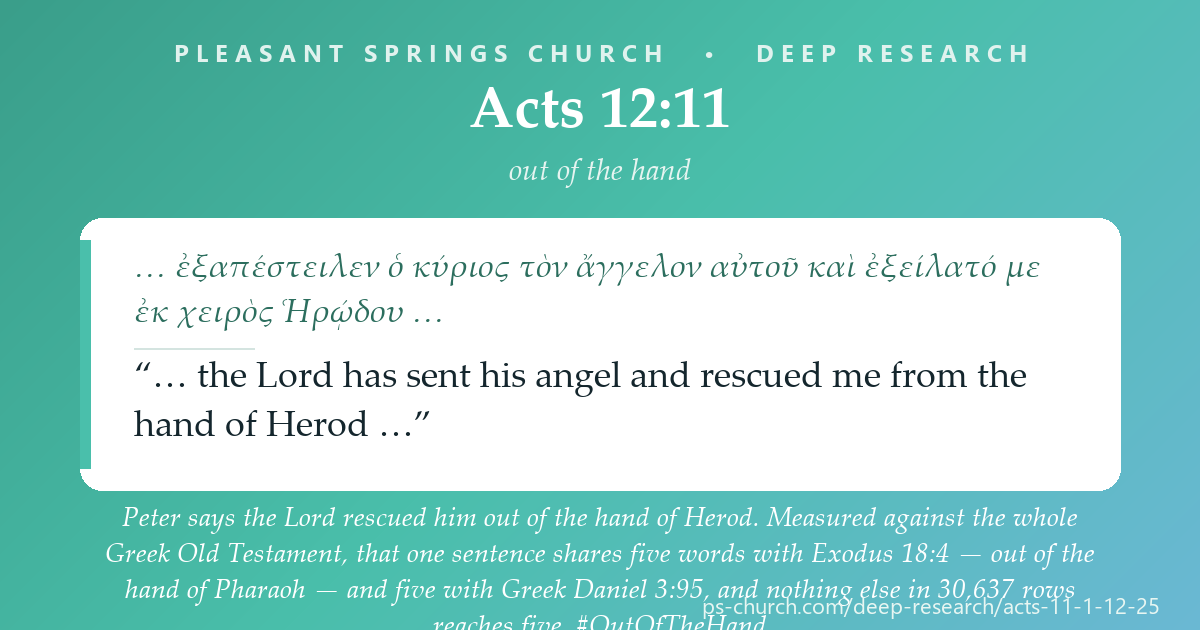
Peter’s one sentence of interpretation has two halves, and each half lands on a different Old Testament rescue-from-a-king. Across 30,637 Greek Old Testament rows the deepest run is five, and exactly two rows reach it.
| partner | run | tie band | the shared words |
|---|---|---|---|
| Greek Daniel (Theodotion) 3:95 — ESV Daniel 3:28 | 5 | 2 | τὸν ἄγγελον αὐτοῦ καὶ ἐξείλατο |
| Greek Exodus 18:4 | 5 | 2 | καὶ ἐξείλατό με ἐκ χειρός |
| Greek Daniel (Theodotion) 6:23 — ESV Daniel 6:22, the lions | 4 | — | τὸν ἄγγελον αὐτοῦ καί |
| Greek Daniel (Old Greek) 3:95 | 4 | — | τὸν ἄγγελον αὐτοῦ καί |
Daniel 3:95 / ESV 3:28 is Nebuchadnezzar after the furnace: “Blessed be the God of Shadrach, Meshach and Abednego, who sent his angel and delivered his servants.” Exodus 18:4 is the name of Moses’ second son, and this is the Greek: “the God of my father was my helper and delivered me out of the hand of Pharaoh.” Acts 12:11 is Peter in a Jerusalem street: “the Lord sent his angel and delivered me out of the hand of Herod.”
The Hebrew of Exodus 18:4 does not say hand. It reads מֵחֶרֶב פַּרְעֹה — mēḥerev par’oh, from the sword of Pharaoh — and the ESVfollows the Hebrew: “delivered me from the sword of Pharaoh.” The Greek of Exodus 18:4 held here has ἐκ χειρὸς Φαραω, out of the hand of Pharaoh. The five-word contact therefore exists in the Greek column and not in the Hebrew or the English, and the page names that rather than letting an English Bible carry a measurement it does not support.
Two five-word runs, one in each half of the sentence, and they are the only two in the corpus. The page reports that and asserts nothing about direction. Peter does not say “as it is written”; Luke does not name Exodus or Daniel; and both phrases use ordinary vocabulary (ἐξαιρέω plus ἐκ χειρός is the standard Greek Old Testament way of saying rescued from). What is measurable, and worth printing, is that the whole Greek Old Testament on this disk contains no third row that reaches five — and the two that do are the two archetypal deliverances from a king who overreached.
4. The counter-example this page prints against itself
The echo everyone reaches for in Acts 12 is Exodus 12:11, and it does not measure.
| comparison | longest shared run | the words |
|---|---|---|
| Acts 12:8 (gird yourself, put on your sandals) vs Greek Exodus 12:11 (loins girded, sandals on your feet) | 1 | no two consecutive words shared; the shared forms are δέ, καί, οὕτως, τά |
| Acts 12:8 vs its deepest partner anywhere in the Greek Old Testament | 3 | εἶπεν δὲ ὁ, 24 of the band — tie band 28 |
| Acts 12:23 (eaten by worms) vs its deepest partner in the Greek Old Testament | 3 | τῷ θεῷ καί, 22 of the band — tie band 33 |
| Acts 11:21 (the hand of the Lord was with them) vs the Greek Old Testament | 3 | ἐπὶ τὸν κύριον, 16 of the band — tie band 17 |
The Passover setting of Acts 12 is stated by Luke himself and needs no defending: it is the days of Unleavened Bread (12:3) and Herod means to bring Peter out after the Passover (12:4). What does not survive measurement is the further claim that the angel’s instructions are worded after Exodus 12:11. Their longest shared run is one: they share no two consecutive words at all. Exodus girds loins, shoes feet and arms hands with staffs; Acts belts a man, sandals him and wraps a cloak around him. Different word forms throughout — though the girding and the footwear are cognate roots, which stage 2 says out loud. The same picture.
Why the page prints this against itself. Two of the results above — the Genesis 7:1 string and the Exodus 18:4 / Daniel 3:95 tie — are unusual enough to be over-read. Printing the Exodus 12:11 result beside them is what keeps them the right size: this passage really does have three isolated Old Testament contacts, and it also has a famous one that turns out to be nothing but a shared situation. A page that reported only the hits would be telling you half of what it found.
5. The progress refrain, measured
Commentaries commonly print five or six summary notices in Acts as a matched set. Measured, only two of them are the same sentence.
| pair | run | the shared words |
|---|---|---|
| Acts 12:24 and Acts 6:7 | 6 | λόγος τοῦ θεοῦ ηὔξανεν καὶ ἐπληθύνετο |
| Acts 12:24 and Acts 19:20 | 2 | ηὔξανεν καί |
| Acts 12:24 and Acts 9:31 | 1 | τοῦ |
| Acts 12:24 and Acts 16:5 | 1 | καί |
| Acts 6:7 and Acts 9:31 | 1 | καί |
Acts 19:20 is a genuine growth notice and it is worded differently — “so the word of the Lord continued to increase and prevail mightily,” with κυρίου for θεοῦ and ἴσχυεν for ἐπληθύνετο. Acts 9:31 and 16:5 are about the church, not the word, and share nothing but articles and conjunctions with 12:24. The family resemblance is real; the identity is confined to one pair. And that pair is worth noticing where it falls: 6:7 stands at the hinge that closes his first section, five verses before Stephen is seized, and 12:24 immediately after Herod is struck down. The same sentence closes two sections of Acts, once on the edge of a martyrdom and once on the far side of a judgement.
6. Where the whole passage lands, in one table
All 55 verses of Acts 11–12, screened twice.
| screen | deepest run | distribution |
|---|---|---|
| Acts 11–12 vs the Greek New Testament, Acts 11–12 itself excluded | 8 — Acts 11:5 against Acts 10:11, tie band 1 | all 55 reach two, 47 reach three, 17 reach four, 9 reach five, 6 reach six, 2 reach seven, 1 reaches eight |
| Acts 11–12 vs 30,637 Greek Old Testament rows (64 files) | 6 — Acts 11:14 against Genesis 7:1, tie band 1 | 54 reach two, 46 reach three, 16 reach four, 4 reach five, 1 reaches six |
The six rows that reach six or more against the New Testament are worth naming, because they are three different kinds of thing.
| row | partner | run | band | what it is |
|---|---|---|---|---|
| Acts 11:5 | Acts 10:11 | 8 | 1 | self-retelling |
| Acts 11:9 | Acts 10:15 | 7 | 1 | self-retelling |
| Acts 11:10 | Acts 10:16 | 6 | 1 | self-retelling |
| Acts 11:16 | Acts 1:5 | 6 | 1 | a citation the text itself marks |
| Acts 12:24 | Acts 6:7 | 6 | 1 | a structural refrain |
| Acts 11:15 | Acts 10:44 and Acts 19:6 | 6 | 2 | one retelling and one accident |
Acts 11:16 is the only one of the six that announces itself: ἐμνήσθην… τοῦ ῥήματος τοῦ κυρίου ὡς ἔλεγεν, “I remembered the word of the Lord, how he said.” And the run tells you precisely where the remembering stops being verbatim. Acts 1:5 reads … Ἰωάννης μὲν ἐβάπτισεν ὕδατι, ὑμεῖς δὲ ἐν πνεύματι βαπτισθήσεσθε ἁγίῳ οὐ μετὰ πολλὰς ταύτας ἡμέρας. Acts 11:16 reads the same six words and then βαπτισθήσεσθε ἐν πνεύματι ἁγίῳ. The words after the break are the same words in a different order — and the engine cuts there, because a run counts sequence and not stock. The time clause (“not many days from now”) is simply dropped; by Acts 11 it had happened. Acts 11:15 is the counterweight: it reaches six against Acts 10:44, which is Luke retelling himself, and also against Acts 19:6, which is a different city, a different apostle and a different decade — τὸ πνεῦμα τὸ ἅγιον ἐπ’ αὐτούς is a formula, and the verbs on either side of it differ (ἐπέπεσεν here, ἦλθεν there). A run of six can be a quotation, a refrain, or a coincidence, and on this page it is all three.
What this page could not check, and where it is weakest.
What was not consulted
No commentary was opened for any measurement on this page. Keener, Barrett, Bock, Peterson, Bruce and Fitzmyer are named in stage 1 as the places to go next, not as sources for anything printed here. Where this page states a background fact rather than a measurement — Antioch as third city, Agrippa’s dates, the Latin shape of -ianus — it is stating a commonplace and has not verified it against a primary source on this disk.
No Greek critical apparatus. The Greek is the SBL edition as digitized by MorphGNT. The apparatus sigla in that file were stripped for printing, which means the codex above shows the SBL text and does not show where SBL differs from NA28 or from the Byzantine tradition. That matters specifically at 11:20.
No Josephus on this disk. The Antiquities 19.343–350 parallel is cited from general knowledge and was not measured, quoted from a text file, or checked line by line. It is the single largest unverified claim on this page, and it is doing real work in stage 2. Treat it as a pointer to be checked, not as a result.
No Latin sources on the word Christiani. Tacitus and Suetonius are named and were not consulted; nothing about the origin of the name at Antioch has been established here beyond the three New Testament occurrences, which were counted.
Where the page is weakest
11:20 is a textual decision the page declines to make, and that decision has consequences for the reading. If the men of Cyprus and Cyrene spoke to Ἕλληνας, Greeks, then Antioch is the second Gentile breakthrough and 11:19–21 answers 11:18 directly. If they spoke to Ἑλληνιστάς, Greek-speaking Jews, the step is smaller and the breakthrough is Cornelius alone. The SBL text printed above reads Ἑλληνιστάς; a great deal of the tradition reads Ἕλληνας; and the two words differ by very little in uncial script. The page cannot settle it from the corpora it holds, and it does not pretend the sense of v.19 (“to no one except Jews”) settles it either — that contrast is the main argument for Greeks, and it is an argument from context, not from manuscripts.
The chronology of 11:27–30 is left open. Whether the famine-relief visit of 11:30 / 12:25 is the visit Paul describes in Galatians 2:1–10, or a separate earlier one, is one of the long-running problems in Pauline chronology. It is not solvable from a run screen and no position is taken.
The text of 12:25 is itself contested and the page prints one reading. The Greek here has ὑπέστρεψαν… εἰς Ἰερουσαλήμ, and read straight through that says the two returned to Jerusalem, which sits awkwardly with 11:30 where they went to Jerusalem already. The SBL edition punctuates against that reading — the comma after ὑπέστρεψαν in the codex above takes εἰς Ἰερουσαλήμ with πληρώσαντες, “having fulfilled the service to Jerusalem.” And part of the tradition reads ἐξ or ἀπό, from. The ESV renders “returned from Jerusalem,” which is a translational decision about a difficult preposition. The Greek column above and the English column above are not saying the same thing at this point, and the page names that rather than smoothing it.
The Genesis 7:1 result is the kind of finding that invites over-reading, and the page has tried to fence it. Six identical word forms in sequence, once in each corpus, is a genuinely unusual measurement. It is still not evidence of a quotation, and the page has no way to distinguish “Luke echoing Genesis” from “two writers of Greek saying you and all your household because that is how the phrase goes.” If a reader takes one thing from stage 4, it should be the size of the claim, not the size of the number.
Doctrinal notes worth keeping
- God opened the door; the church conceded it. Acts 11:1–18 is not a policy debate resolved by argument but a report of an act of God that the church could only ratify (“who was I that I could stand in God’s way?”). Repentance itself is what God granted (11:18) — the grammar makes it a gift.
- Prayer and providence are not a transaction. The church prays; Peter walks out; James is already dead. Acts 12 will not support a doctrine that earnest prayer secures rescue, and it will not support one that says prayer changes nothing. The chapter puts both facts on the page and comments on neither.
- Herod dies for a specific reason and the text names it. “Because he did not give God the glory” (12:23). The judgement is on accepting a divine acclamation, not on politics or persecution as such — which is also the moral 2 Maccabees 9:12 draws from Antiochus.
- The name came from outside and was owned inside. Christianos at Antioch, on an enemy’s lips at Acts 26:28, and in 1 Peter 4:16 as something to suffer under without shame. The page does not assert who coined it.
- Nothing here is a promise of deliverance. The house position on this shelf is that typology is read as what the text says, what the New Testament itself draws, and what we see from this side of the cross — with the seeing left to the reader. Peter’s five words in common with Exodus 18:4 are printed as a measurement, not as a guarantee that the reader’s prison door will open.
Reading list
- Craig S. Keener, Acts: An Exegetical Commentary, vol. 2 (Baker).
- C. K. Barrett, The Acts of the Apostles (ICC), vol. 1.
- Joseph A. Fitzmyer, The Acts of the Apostles (Anchor Yale Bible 31).
- David G. Peterson, The Acts of the Apostles (Pillar); Darrell L. Bock, Acts (BECNT).
- Bruce M. Metzger, A Textual Commentary on the Greek New Testament — on 11:20 and 12:25.
- None of these were consulted for the measurements on this page, which were run on the text files named in the footer.
One hand closes; another does not.
What these two chapters put next to each other
Chapter 11 ends with a collection for hungry Christians in Judea, carried down by the hand of Barnabas and Saul. Chapter 12 opens with a king stretching out his hands against the church. Luke does not comment on the juxtaposition. He just puts the errand on both sides of the king.
James dies in verse 2, in seven Greek words, with no explanation offered and none since. Peter walks out of the same prison a few nights later, and even he thinks he is dreaming. The church that had been praying for him does not believe the girl who tells them he is at the door. Nothing in the chapter is tidy.
What the chapter ends on is not the rescue. It ends on six words that Luke has used once before, in the last line of his first section, five verses before Stephen is seized: λόγος τοῦ θεοῦ ηὔξανεν καὶ ἐπληθύνετο — the word of God increased and multiplied. Once on the edge of a martyrdom, once on the far side of a king’s death. Measured across the whole Greek New Testament those six words stand in exactly two places, and the tie band is one.
And the last sentence of the passage is not about any of it. Barnabas and Saul come back, having finished the errand, bringing a young man named John Mark — who will shortly leave them, and cause a quarrel, and be sent for again years later. The relief money got where it was going. The king did not stop it.
A note on how to use the numbers on this page. The deepest measurement here — six words shared with Genesis 7:1, once in each corpus — is not a doctrine and does not become one. It is a fact about two Greek sentences. Hold it lightly, and hold the counter-example beside it: the Passover parallel every commentary prints for Acts 12:8 measures a run of one — Acts 12:8 and Greek Exodus 12:11 share no two consecutive words at all.
Acts 12:11 · to share
Greek New Testament + ESVEvery Deep Research page traces its passage across the whole sweep — the Old Testament, the Second-Temple world between the testaments (historical witnesses, not Scripture), and the New Testament. Follow the thread:
Pleasant Springs Church — Deep Research
Research method after Michael S. Heiser’s Bible Research Method (examine dictionaries → ancient literature → important words → textual connections → academic publications → share), with the Pleasant Springs “Author & Audience” foundation. Scripture set in the Hebrew, the Greek editions named on each page and the ESV (Old Testament), and the Greek New Testament and the ESV (New Testament), per the practice of Pleasant Springs Church. Acts 11–12 background oriented by Keener, Barrett, Bock, Peterson, Bruce and Fitzmyer; none of them were consulted for any measurement on this page. Text: Greek New Testament from the SBL edition as digitized by MorphGNT (field 4 for printing, with the edition’s apparatus sigla stripped; field 6, the normalised word, for measuring). Greek Old Testament from Rahlfs’ Septuaginta as digitized by CATSS — 64 files, 30,637 verse rows, including the deuterocanonical books, which are cited here as witnesses to usage and not as Scripture. English is the ESV. ⚠️ VERSE NUMBERING — no offset inside this passage, and the page says so rather than leaving it unsaid. Acts 11 has 30 verses and Acts 12 has 25 in the SBLGNT and the ESV alike; every verse quoted here carries the same number in Greek and English. Derived from the files on this disk: across all 28 chapters of Acts the SBLGNT and a public-domain English edition consulted as a versification witness agree on verse count in 27 of them, differing only at chapter 19 (English 41, SBLGNT 40 — the critical Greek prints as 19:40 what the English divides into 19:40–41). Totals 1,003 and 1,002 against the traditional 1,007, the shortfall being Acts 8:37, 15:34, 24:7 and 28:29, which neither edition prints as text and the ESV carries in footnotes. None of those four is in chapters 11 or 12. The Old Testament side does carry an offset: Greek (Theodotion) Daniel 3 runs to 97 verses where the ESV’s Daniel 3 has 30, the 67-verse difference being the Prayer of Azariah and the Song of the Three — so the row measured here, Greek Daniel 3:95, is ESV Daniel 3:28, and both numbers are printed every time it is named. Greek Exodus 18:4 and Greek Genesis 7:1 carry the English numbers — but at Exodus 18:4 the Greek held here reads ἐκ χειρὸς Φαραω, out of the hand, where the Hebrew and the ESV read from the sword of Pharaoh, so the five-word contact measured on this page is a fact about the Greek column only. ⚠️ The measurement, in full. Longest contiguous sequence of identical word forms, never lemmas; no stemming, no gaps, no reordering. Both sides lowercased, accents and breathings dropped, final sigma folded, apostrophes stripped, then filtered to Greek letters — the same filter applied to both corpora. Greek-against-Greek comparisons across editions additionally apply the edition-spelling fold (ou/ouk/ouch, ek/ex, the movable nu). The tie band is reported beside every run, because a run without a band is misleading. Screens run with the unigram fallback on, so a reported 1 means “shares isolated words but no two consecutive ones” and 0 would mean “shares no word at all.” Corpora: 55 rows of Acts 11–12 against the other 7,872 of the 7,927 verses in 27 MorphGNT files (the passage itself excluded from its own screen) and against 30,637 rows in 64 CATSS files. Exhaustive and deterministic; nothing sampled, so no seed applies. ⚠️ Direction of influence is never asserted. Nothing on this page says that Luke is quoting Genesis 7:1, that Peter is quoting Exodus 18:4 or Daniel, that the Antioch church coined its own name, or what produced any reading. The one citation treated as a citation is Acts 11:16, and only because the text itself says “I remembered the word of the Lord, how he said.” ⚠️ Known limits, named in stage 5 rather than buried. No commentary was opened for any measurement; no Greek critical apparatus was consulted, which matters at 11:20 (Ἑλληνιστάς / Ἕλληνας) and at 12:25 (εἰς / ἀπό Jerusalem, where the Greek and the English columns above are not saying the same thing); Josephus is not on this disk and the Antiquities 19 parallel was not measured; and the relation of Acts 11:30 to Galatians 2:1–10 is left open. Typology is handled per the house position: what the text says, what the New Testament itself draws, and what we see from this side of the cross — with the seeing left to the reader.
Scripture quotations marked ESV are from the ESV® Bible (The Holy Bible, English Standard Version®), © 2001 by Crossway, a publishing ministry of Good News Publishers. ESV Text Edition: 2016. Used by permission. All rights reserved. The ESV text may not be quoted in any publication made available to the public by a Creative Commons license, and the ESV may not be translated in whole or in part into any other language. www.esv.org
|
Did this study bless you today? 💚 Give to Support PS Church100% of gifts go to the General Fund — thank you. |