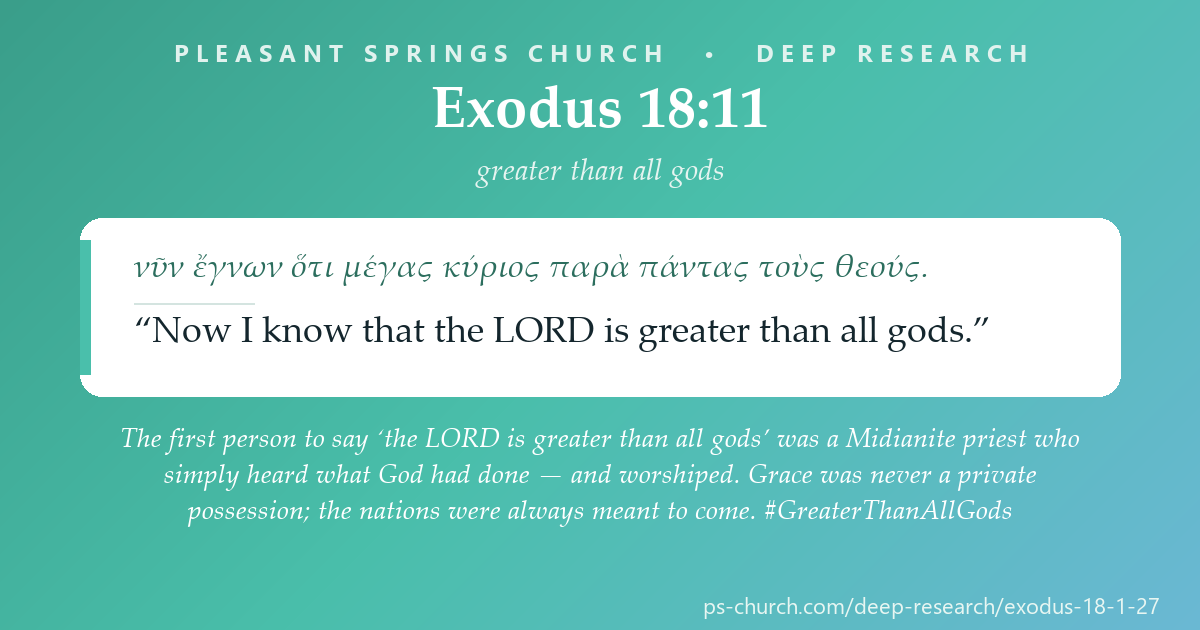
At the mountain of God, before the thunder of Sinai, the story pauses for a family reunion — and settles two deep questions. Jethro, priest of Midian and Moses’ father-in-law, hears all the Lord had done and confesses, “Now I know that the Lord is greater than all gods” — a Gentile priest worshiping at Israel’s table. Then, seeing Moses judge alone until he is worn out, he gives the counsel that shapes Israel forever: share the load with “able men… who fear God, are trustworthy, and hate a bribe.” And the meekest man on earth simply listens. This study works Exodus 18:1–27. See the method →
Exodus 18:11, 12, 18, 21, 24
Hebrew · LXX · ESVThe Shape of the Passage
Parallel panelsBetween the water and the war (ch. 17) and the thunder of Sinai (ch. 19), the narrative pauses for a family reunion — and quietly settles two of the covenant people’s deepest questions: who may worship the Lord, and how shall his people be led?
Author
The Torah of Moses sets this chapter at “the mountain of God” (18:5; cf. the burning bush), the threshold of Sinai. Jethro — priest of Midian, Moses’ father-in-law — brings back Zipporah and the two sons Moses had sent home: Gershom (“ger sham, a sojourner there,” 18:3) and Eliezer (“God is my help… and delivered me from the sword of Pharaoh,” 18:4). Moses recounts “all that the Lord had done” (18:8), and the Midianite priest responds with a burst of joy and one of the great confessions of the book: “Now I know that the Lord is greater than all gods” (18:11). He offers sacrifice, and Aaron and the elders eat bread with him before God (18:12) — a Gentile priest at Israel’s worshiping table.
The counsel. The next day Jethro watches Moses sit alone as sole judge “from morning till evening” while the people stand and wait (18:13–16). His verdict is blunt and loving: “What you are doing is not good… you and the people… will certainly wear yourselves out” (18:17–18). Then the remedy that will shape Israel forever: let Moses keep teaching the statutes and bringing the hardest cases before God (18:19–20), but appoint “able men… who fear God, are trustworthy, and hate a bribe” as rulers over thousands, hundreds, fifties, and tens (18:21–22). The character list — competence, reverence, integrity, incorruptibility — becomes the enduring template for covenant leadership (Deut 1:9–18; Acts 6:1–6; 1 Tim 3). And the meekest man on earth (Num 12:3) “listened to the voice of his father-in-law” (18:24) — humble enough to receive wisdom from an outsider.
Audience
Israel — freshly redeemed, still learning what kind of God had saved them. In Jethro they saw a startling thing: the nations beginning to come. The exodus was meant to be seen “in all the earth” (9:16), and here the first fruit appears — a foreign priest hearing the report and bowing to the Lord as supreme. Israel’s election was never meant to be a wall but a witness (19:5–6; Gen 12:3).
How the church hears it. Two gifts endure. First, the outsider’s confession warns against ever thinking grace is a private possession: the God who is “greater than all gods” will be owned by Midianites and magi and centurions before the story ends (Matt 8:11; Acts 10). Second, the delegated-leadership pattern rescues ministry from the lone burdened leader: no one, not even Moses, is meant to bear the whole load. Shared, character-rooted leadership — and the humility to be corrected — is not weakness but wisdom (Gal 6:2; Eph 4:11–16).
Orient on Jethro and Midian, the fear of God, judging, and delegated leadership.
Search by topic: Jethro / Reuel, Midian, priest, father-in-law, elders, judges, fear of God, oath / bribe.
Which articles are relevant?
- Anchor Bible Dictionary — “Jethro,” “Midian, Midianites,” “Reuel,” “Zipporah,” “Elders,” “Judge (OT).”
- Dictionary of the OT: Pentateuch — “Jethro,” “Midianites,” “Judges and Judging,” “Leadership,” “Sacrifice.”
- NIDOTTE / TDOT — יָרֵא (yārēʾ, fear/revere), אֱמֶת (ʾemeṯ, faithful/trustworthy), בֶּצַע (beṣaʿ, unjust gain), שָׁפַט (šāp̄aṭ, judge).
Bibliography surfaced:
- Brevard Childs, The Book of Exodus (OTL); Douglas Stuart, Exodus (NAC); John Durham, Exodus (WBC); Peter Enns, Exodus (NIVAC).
- Studies on Midian and the “Kenite/Midianite” question; on the office of elders and judges in early Israel.
- Works on the fear of God and on leadership qualifications across Deut 1, Acts 6, and the Pastoral Epistles.
A Midianite priest, the shared judgment-seat, and how the ancients heard the reunion.
Read Jethro’s worship and counsel against ancient priesthood, hospitality, and judicial custom, then note the Second-Temple retellings.
Which parallels shed light on religion and worldview?
A priest of another people. Jethro is kohen Midian, “priest of Midian” (18:1) — a Gentile religious figure who nonetheless meets the exodus report with worship of the Lord alone. In the ancient world every people had its gods; to say one god is “greater than all gods” and then to sacrifice to that god was a real crossing. The text does not tidy Jethro into an Israelite; it lets a Midianite bless the Lord, offer to him, and share the covenant meal — the nations beginning to come, on the eve of Sinai and centuries before the Gentile mission.
The judge who sits alone. In the ancient Near East the ruler was the fount of justice, and petitioners might wait at his seat for days. Jethro’s critique is administrative wisdom that any elder of any people could recognize — one man cannot absorb a nation’s disputes — but it is also more: he tells Moses to keep the vertical work (teaching God’s statutes, bringing the hard cases “to God,” 18:19–20) and to share the horizontal load. The genius is not mere efficiency; it is that leadership be distributed to men of character, tiered so that “every great matter they shall bring to you, but any small matter they shall decide themselves” (18:22).
- Josephus, Antiquities 3.63–74 (first-century Jewish history — not Scripture) — retells Raguel/Jethro’s visit and the appointment of rulers, praising Moses’ readiness to credit the counsel to his father-in-law rather than claim it himself.
- Philo, On the Life of Moses 1 (first-century Jewish philosophy — not Scripture) — treats the delegation as a lesson in ordered, shared governance.
- Numbers 10:29–32; Judges 1:16; 4:11 — the ongoing story of the Midianite/Kenite kin of Moses among Israel: the outsider-relative who stays near the covenant people.
- Deuteronomy 1:9–18 — Moses’ own later retelling of this delegation, adding “you shall not be partial in judgment… you shall not be intimidated by anyone, for the judgment is God’s.”
Jethro’s “now I know that the Lord is greater than all gods” is not a philosopher’s theorem but a worshiper’s response to a story: he has heard what the Lord did at the sea and in the wilderness, and he bows. Held soberly, the confession is a small dawn in Exodus — the God of Israel is not a tribal deity but the Lord of all, and the first outsider to say so is a Midianite priest at Israel’s worship table. The line from here runs long: Rahab, Ruth, Naaman, the Ninevites, the magi, the centurion of whom Jesus said “with no one in Israel have I found such faith” (Matt 8:10–11), and Cornelius, at whose door Peter learned “God shows no partiality” (Acts 10:34–35). Israel’s election was always for the nations’ blessing (Gen 12:3); Jethro is an early witness that the plan is on track. We hold it without triumphalism: the point is not that Israel converted a Midianite by argument, but that the God who saves is so evidently the Lord of all the earth that even a foreign priest cannot help but rejoice and worship.
The vocabulary of confession and shared leadership.
Watch the priest of Midian, the sons’ witnessing names, the confession “greater than all gods,” the fourfold character list, and Moses’ humble listening.
“Priest of Midian” — Jethro’s standing office among another people. That such a man blesses the Lord, sacrifices, and shares the covenant meal (18:12) is the chapter’s quiet wonder: the nations beginning to come.
“A sojourner there” (ger sham) — the elder son’s name preserving Moses’ years as a stranger in Midian (2:22). The redeemed people’s memory of exile is written into a child’s name.
“My God is help” — “the God of my father was my help and delivered me from the sword of Pharaoh.” The second son’s name is a standing testimony of rescue.
“The Lord is greater than all gods” — Jethro’s confession. YHWH (small caps) is supreme; “the gods” (lowercase) are the powers of the nations, shown up at the sea. The LXX: μέγας κύριος παρὰ πάντας τοὺς θεούς.
“Trustworthy men who hate a bribe” — with “able” and “God-fearing,” the fourfold leadership standard: competence, reverence, reliability, incorruptibility. LXX: “hating pride” (μισοῦντας ὑπερηφανίαν).
“And he listened to the voice” — the meekest man on earth (Num 12:3) receives correction from his father-in-law and acts on it. Humility in leadership is the willingness to be taught by an outsider.
How the rest of Scripture fills out the scene:
- Deuteronomy 1:9–18 — Moses retells the delegation and adds the judge’s charge: “you shall not be partial… the judgment is God’s.”
- Acts 6:1–6 — the apostles refuse to be spread thin and appoint seven “of good repute, full of the Spirit and of wisdom”: the Exodus 18 pattern in the church.
- 1 Timothy 3:1–13; Titus 1:5–9 — overseers and deacons “above reproach… not greedy for gain”: the character list matured into the offices of the church.
- Matthew 8:10–11; Acts 10:34–35 — the centurion’s faith and Cornelius: “God shows no partiality” — Jethro’s confession coming to full flower.
From a Midianite’s confession to the leaders of the church.
Trace the outsider’s worship and the delegated, character-rooted leadership toward their New Testament fulfillment.
Which cross-references matter?
- Exodus 2:15–22; 3:1; 4:18 — Moses in Midian, Reuel/Jethro, Zipporah and Gershom, the mountain of God: the backstory that makes this reunion possible.
- Numbers 11:14–17, 24–30 — the seventy elders share Moses’ burden by the Spirit: God himself extending the delegation of Exodus 18.
- Deuteronomy 1:9–18; 16:18–20; 17:8–13 — the judicial system built on this pattern: appointed judges, impartiality, the hard cases escalated.
- 2 Chronicles 19:5–7; Psalm 82 — judges warned to “judge not for man but for the Lord”: the fear of God at the seat of justice.
- Acts 6:1–6; 1 Timothy 3; Titus 1; Ephesians 4:11–16 — shared, gifted, character-tested leadership so that no one bears the whole load alone.
“What you are doing is not good… you will certainly wear yourselves out.” It is striking that the Bible records this rebuke of Moses — the mediator of the exodus, the friend of God — and records that he took it. The lone, indispensable leader is not a biblical ideal but a biblical danger: it exhausts the leader and starves the people, who “stand around… from morning till evening” waiting on one man (18:14). Jethro’s remedy is not to lower the standard but to multiply it — to look through the whole people for men marked by four things: capability, the fear of God, trustworthiness, and hatred of dishonest gain. Notice the order Moses keeps for himself: teaching the people God’s ways, and carrying the hardest matters “to God” (18:19–20). Leadership in God’s people is meant to be shared and tiered, rooted in character rather than charisma, and humble enough to be corrected — even by an outsider. The apostles will do exactly this in Acts 6, refusing to “give up preaching the word of God to serve tables,” and appointing others of proven character; Paul will write the character list into the qualifications for elders and deacons. Every pastor tempted to do it all alone, and every congregation tempted to let him, is handed this chapter: the burden is meant to be carried together (Gal 6:2).
The scholarship on Jethro, Midian, and delegated leadership.
Childs and Durham for the exegesis; the studies on Midian and on the judicial-administrative pattern.
Commentaries & studies:
- Brevard Childs, The Book of Exodus (OTL); John Durham, Exodus (WBC); Douglas Stuart, Exodus (NAC); Peter Enns, Exodus (NIVAC); Nahum Sarna, Exodus (JPS).
- Studies of Jethro/Midian and the “Kenite hypothesis” (evaluated critically, not assumed); of elders and judges in early Israel.
- Works on leadership and delegation from Exodus 18 → Deuteronomy 1 → Acts 6 → the Pastoral Epistles.
Interpretation notes worth keeping:
- The confession (18:11). “Greater than all gods” is comparative language on the lips of a polytheist beginning to worship; the canon’s fuller light is that the “gods” of the nations are no rivals at all (Deut 4:35; Ps 96:5). Hold Jethro’s words as a real, honest first step, not a finished theology.
- The LXX at 18:21. Where the Hebrew has “hating unjust gain” (בֶּצַע), the Greek reads “hating pride” (ὑπερηφανίαν) — a translator’s interpretive turn; both vices disqualify a leader.
- Did Jethro convert? The text neither says nor requires it; it says he rejoiced, confessed, sacrificed, and shared the meal, then “went away to his own country” (18:27). Later texts keep his kin near Israel (Num 10:29–32; Judg 1:16). Read the chapter for what it affirms, without over-claiming.
- Order of events. Exodus places the visit before Sinai; Deuteronomy 1 recalls the delegation after. Ancient narrative can be topical as well as strictly chronological; the theological placement here — a Gentile confession and ordered leadership on the eve of the covenant — is deliberate.
From an outsider’s confession to a shared, humble ministry.
Name what you learned, why it matters, and one concrete response.
What should we carry away — and do?
- Grace is never a private possession. The first to confess “the Lord is greater than all gods” is a Midianite priest. The God who saved Israel is the Lord of all the earth — and he is still gathering the nations.
- No one is meant to carry it all. “What you are doing is not good… you will wear yourselves out.” Shared, character-rooted leadership is wisdom, not weakness; the burden is meant to be carried together.
- Character over charisma. Able, God-fearing, trustworthy, incorruptible — the fourfold standard that runs to Acts 6 and 1 Timothy 3. Look for these, and be these.
Step in response: if you lead, name one load you are carrying alone that a trustworthy, God-fearing person could share — and hand it over this week. If you are led, ask God for the humility Moses showed: to “listen to the voice” of wise counsel, even from an unexpected source. And thank God for one “outsider” who helped you see him more clearly.
Exodus 18:11 · to share
LXX + ESVEvery Deep Research page traces its passage across the whole sweep — the Old Testament, the Second-Temple world between the testaments (historical witnesses, not Scripture), and the New Testament. Follow the thread:
Pleasant Springs Church — Deep Research
Research method after Michael S. Heiser’s Bible Research Method (examine dictionaries → ancient literature → important words → textual connections → academic publications → share), with the Pleasant Springs “Author & Audience” foundation. Scripture set in the Hebrew, the Greek editions named on each page and the ESV (Old Testament), and the Greek New Testament and the ESV (New Testament), per the practice of Pleasant Springs Church. Exodus 18:1–27 research grounded in Childs, Durham, Stuart, Enns, and Sarna; Jethro read as the Midianite priest whose confession (18:11) is an early sign of the nations coming to the Lord, held soberly (Matt 8:11; Acts 10:34–35); the delegation (18:21) as the enduring, character-rooted, tiered leadership pattern echoed in Deut 1, Acts 6, and 1 Tim 3; with Josephus (Ant. 3.63–74) and Philo read as witnesses, not Scripture. LXX notes: ὁ γαμβρός / Ιοθορ; φθορᾷ καταφθαρήσῃ for נָבֹל תִּבֹּל (18:18); and μισοῦντας ὑπερηφανίαν (“hating pride”) where the Hebrew has שֹׂנְאֵי בָצַע (“hating a bribe,” 18:21).
Scripture quotations marked ESV are from the ESV® Bible (The Holy Bible, English Standard Version®), © 2001 by Crossway, a publishing ministry of Good News Publishers. ESV Text Edition: 2016. Used by permission. All rights reserved. The ESV text may not be quoted in any publication made available to the public by a Creative Commons license, and the ESV may not be translated in whole or in part into any other language. www.esv.org
|
Did this study bless you today? 💚 Give to Support PS Church100% of gifts go to the General Fund — thank you. |