Two tests at one camp. First there is no water, and a redeemed people turns from complaint to accusation, quarreling and testing the Lord — “Is the Lord among us or not?” Grace answers: God stands on the rock at Horeb, Moses strikes it, and water flows for grumblers. Then war: Amalek attacks, and while Joshua fights, Moses holds up the staff of God — his weary hands steadied by Aaron and Hur till sunset — and builds an altar, “The Lord Is My Banner.” This study works Exodus 17:1–16 — the struck Rock (1 Cor 10:4), Massah and Meribah (Ps 95; Heb 3), and the Lord our warrior and standard. See the method →
Exodus 17:3, 6, 7, 11, 15–16
Hebrew · LXX · ESVThe Shape of the Passage
Parallel panelsOne campsite, two ordeals — thirst and battle — and one lesson underneath both: will Israel trust the Lord who brought them out, or test him? Grace answers the grumbling; the Banner answers the war.
Author
The Torah of Moses sets two wilderness scenes back to back at Rephidim. In the first, there is no water, and the people move from complaint to accusation: “Why did you bring us up out of Egypt to kill us… with thirst?” (17:3). The narrator names their sin with two verbs he will not let us miss — they quarrel (רִיב) and they test (נָסָה) the Lord — and reduces it to one terrible question: “Is the Lord among us or not?” (17:7). Grace answers grumbling: the Lord takes his stand on the rock at Horeb — the very mountain of the coming covenant — and tells Moses to strike it. Water for a rebel people. Moses fixes the memory in the place-name: Massah (“testing”) and Meribah (“quarreling”) — a name Israel’s worship would never forget (Ps 95:8 / LXX Ps 94:8).
The Banner over the battle. The second scene is war: Amalek attacks (Deut 25:17–19 remembers how — falling on the faint and the stragglers at the rear). Joshua leads the fighting; Moses climbs the hill with the staff of God, and “whenever Moses held up his hand, Israel prevailed” (17:11). The lifted staff is not magic but confessed dependence — the same rod that split the sea, held Godward. When Moses tires, Aaron and Hur put a stone under him and hold up his hands, one on each side, “until the going down of the sun” (17:12). Israel wins not by the sword alone but by hands held up to heaven — and held up by others. Moses builds an altar and names it The Lord Is My Banner (יְהוָה נִסִּי): the rallying-standard of God’s people is the Lord himself.
Audience
Israel heard its own story in both tests. A redeemed people, freshly out of Egypt and fed with manna, still faced real thirst and a real enemy — and had to learn that redemption is not the end of trials but the school of trust. The generation that made Massah and Meribah its habit would die in the wilderness (Num 14; 20:2–13, where Moses himself later fails at another Meribah); the warning “do not harden your hearts, as at Meribah” (Ps 95:8 / LXX Ps 94:8) became Israel’s standing summons to worship. And Amalek — the archetypal predator on the weak — stood under God’s long justice (17:16; Deut 25:19; 1 Sam 15): not a warrant for human vengeance, but the pledge that the Lord himself opposes those who make war on the defenseless.
For the church. The New Testament reads both scenes as written “for our instruction” (1 Cor 10:11). Paul says the wilderness generation “drank from the spiritual Rock that followed them, and the Rock was Christ” (1 Cor 10:4) — held as devotional analogy, not a claim about a rolling stone: the struck rock that pours out life points to Christ struck for us, the source of living water (Jn 7:37–38). Hebrews turns Massah into a gospel alarm: “Today, if you hear his voice, do not harden your hearts as in the rebellion” (Heb 3:7–4:11). And the held-up hands teach the body of Christ its own posture — intercession that leans on the Lord, and Aarons and Hurs who hold one another up when the arms grow heavy (Gal 6:2). The Banner still stands over the battle.
Orient on Rephidim/Horeb, Massah-Meribah, testing, Amalek, and the divine warrior.
Search by topic: Rephidim, Horeb, Massah and Meribah, testing / murmuring, Amalek, Joshua, Hur, banner (nes), the Lord as warrior.
Which articles are relevant?
- Anchor Bible Dictionary — “Rephidim,” “Horeb/Sinai,” “Massah,” “Meribah,” “Amalek,” “Joshua,” “Hur.”
- Dictionary of the OT: Pentateuch — “Wilderness Wanderings,” “Murmuring / Testing,” “War,” “Rock,” “Amalekites.”
- NIDOTTE / TDOT — צוּר (ṣūr, rock), נָסָה (nāsāh, to test), רִיב (rîb, to quarrel/contend), נֵס (nēs, banner/standard).
Bibliography surfaced:
- Brevard Childs, The Book of Exodus (OTL); Douglas Stuart, Exodus (NAC); John Durham, Exodus (WBC); Peter Enns, Exodus (NIVAC).
- Studies of the wilderness “murmuring” tradition and of the Massah–Meribah traditions across the Psalms.
- G. K. Beale & D. A. Carson, eds., Commentary on the NT Use of the OT (1 Corinthians 10; Hebrews 3–4).
Testing the deity, the remembered rock, holy war, and the archetypal enemy.
Read the demand for water and the war against Amalek against the wilderness world — then note how the Second-Temple writers and the psalmists remembered the rock and the rebellion.
Which parallels shed light on religion and worldview?
Testing the God who saves. To “test” a deity in the ancient world was to demand a proof of presence and power. Israel’s sin at Massah is not that they were thirsty — thirst is real, and God provides — but that, days after the sea and the manna, they made their obedience conditional on a sign: “Is the Lord among us or not?” The verb nāsāh cuts both ways in Exodus: God tests Israel to prove and school them (15:25; 16:4; 20:20; Deut 8:2–3), but Israel must never test God as if his covenant faithfulness were on trial (Deut 6:16, “you shall not put the Lord your God to the test, as you tested him at Massah” — the very verse Jesus quotes against Satan, Matt 4:7).
The remembered rock. The wilderness psalms retell this scene as the definitive picture of grace to grumblers: “He split rocks in the wilderness and gave them drink abundantly as from the deep” (Ps 78:15–16; cf. 105:41; 114:8). Second-Temple writers loved the memory: the Wisdom of Solomon praises the God who gave “water out of the flinty rock… a remedy for their thirst” (Wis 11:4), and Josephus and Philo retell the episode as proof of providence in the desert. What the psalmists will not soften is the other half: “Do not harden your hearts, as at Meribah, as on the day at Massah” (Ps 95:8–9 / LXX Ps 94:8–9) — the rebellion becomes the canonical warning.
Holy war and the standard. Amalek’s ambush (Deut 25:17–19 remembers it fell on “all who were lagging behind… when you were faint and weary”) marks him as the archetypal predator on the weak — and so the object of God’s long justice (Exod 17:16; 1 Sam 15; Esther and “Agagite” Haman). The victory is framed not as Israel’s military prowess but as the Lord’s doing: the raised staff, the held-up hands, the altar named for the Lord as Banner (נֵס) — the standard around which a people rallies. This is the sober biblical theme of the divine warrior who fights for the oppressed, never a glorification of human violence.
- Wisdom of Solomon 11:1–4 — the Second-Temple retelling: thirst in the desert, “water… out of the flinty rock” (a witness, not Scripture).
- Psalm 78:15–20; 105:41; 114:8; 95:7–11 — Israel’s own hymnody on the split rock and the hardened heart at Massah/Meribah.
- Deuteronomy 6:16; 8:2–3; 25:17–19 — do not test the Lord as at Massah; God’s testing to humble; the charge to remember Amalek (see the Shema).
- Josephus, Antiquities 3.1–2; Philo, Life of Moses 1.38–39 — the water and the Amalek war retold as providence and virtue (witnesses, not Scripture).
The church has read the struck rock as a figure of Christ almost from the beginning — and Paul licenses it: “they drank from the spiritual Rock that followed them, and the Rock was Christ” (1 Cor 10:4). It is important to hold this as devotional analogy rather than strict exegesis: Paul is not teaching that a literal boulder rolled through the desert, but reading the whole rock-and-water tradition (Exod 17; Num 20; the psalms) as bearing witness to the Christ who sustained his people. The shape, once seen, is hard to unsee. A rock is struck — at God’s own command, God himself ‘standing on the rock’ — and out of the smitten stone comes water for a people who deserved none. “He was pierced for our transgressions” (Isa 53:5); from the smitten Christ flows the living water he promised: “If anyone thirsts, let him come to me and drink” (Jn 7:37–38). And there is a sober warning folded in: at the second Meribah (Num 20) Moses is told only to speak to the rock, and strikes it instead — for the Rock, once struck, need never be struck again (cf. Heb 9:28, offered “once”). The gospel is not that we test God until he proves himself, but that God, unasked, took his stand on the rock and let it be struck for us.
The vocabulary of testing, the rock, the hand, and the Banner.
Watch the double edge of nāsāh (God tests / do not test God), the rock that becomes a name for God, the lifted hand, and the Lord as Banner.
“Rock” — the crag at Horeb, struck for water. The word becomes a favorite name for God himself: “the Rock, his work is perfect” (Deut 32:4; Ps 18:2; 95:1). Paul: “the Rock was Christ” (1 Cor 10:4) — held as devotional analogy.
“To test” — the pivot verb. God rightly tests Israel to prove and teach them (16:4; Deut 8:2); Israel wrongly tests God, demanding proof of a faithfulness already shown. “You shall not put the Lord… to the test” (Deut 6:16; Matt 4:7).
“Testing and Quarreling” — the place-name that fixes the sin in memory. The LXX translates rather than transliterates: Πειρασμὸς καὶ Λοιδόρησις. Israel’s worship keeps the warning alive (Ps 95:8 / LXX Ps 94:8; Heb 3:8).
“Is the Lord among us or not?” — the root doubt beneath every grumble. God’s answer is not a lecture but water — and, at the last, “God with us” in the flesh (Matt 1:23).
“Hand” — Moses’ hands lifted with the staff of God: dependence and intercession, not magic. “A hand upon the throne of Yah” (17:16) swears the Lord’s own hand to the war. Held up by Aaron and Hur — strength borrowed from the body (Gal 6:2).
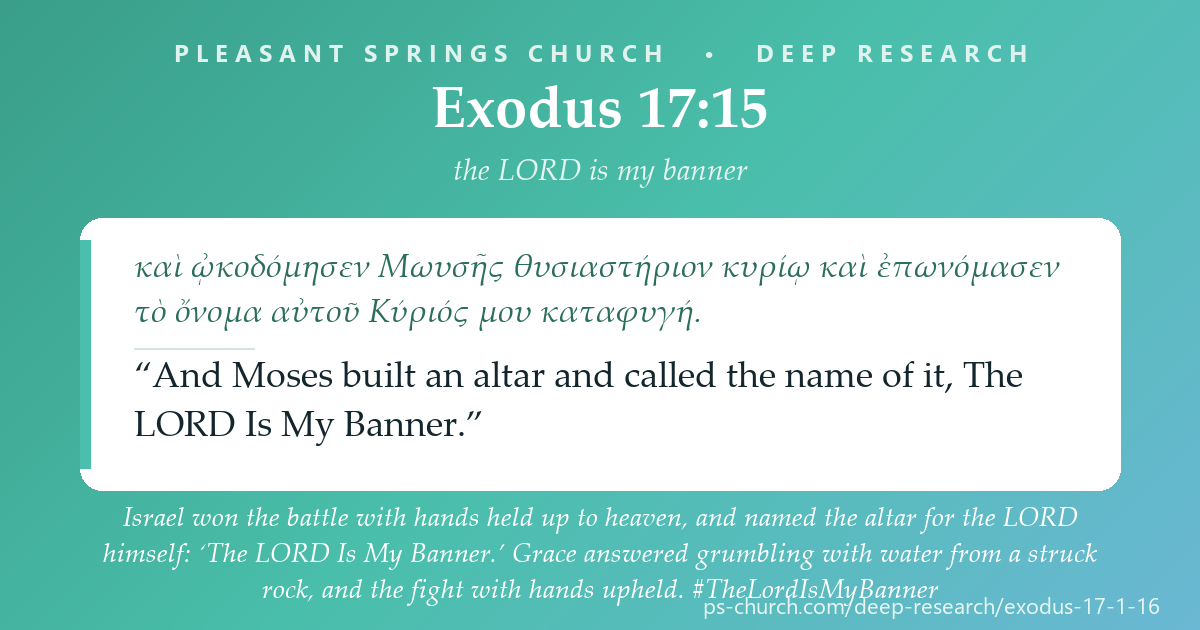
“The Lord Is My Banner” — the nēs, the rallying-standard lifted over an army. Not a talisman but a name: the Lord himself is the standard his people gather to. (LXX hears it as “refuge,” καταφυγή.)
How the rest of Scripture fills out the scene:
- Psalm 95:7–11; Hebrews 3:7–4:11 — “Today… do not harden your hearts as at Meribah”: Massah becomes the gospel’s standing warning against unbelief.
- 1 Corinthians 10:1–13 — the wilderness “for our instruction”; “the Rock was Christ”; “do not put Christ to the test, as some of them did” (10:9).
- Numbers 20:2–13; Deuteronomy 6:16; Matthew 4:7 — the second Meribah where Moses strikes what he should have addressed; the command not to test God, quoted by Jesus.
- Deuteronomy 25:17–19; 1 Samuel 15 — remember Amalek, who fell on the faint at the rear: the Lord’s long justice on the predator of the weak (see Deuteronomy’s prophet like Moses).
From the struck rock and the raised hands to Christ and his church.
Trace the rock, the testing, and the Banner across the canon — then note the Beale & Carson trajectory at 1 Corinthians 10 and Hebrews 3–4.
Which cross-references matter?
- Exodus 15:22–27 — the first wilderness test at Marah, where the Lord “tested” Israel and named himself their healer: the pattern of thirst answered by grace.
- Exodus 16 — the manna, the immediately preceding provision: bread from heaven, then water from the rock — daily dependence taught step by step.
- Numbers 20:2–13; Psalm 78:15–20; 105:41; 114:8 — the rock struck again, and Israel’s hymnody on the water from the crag.
- 1 Corinthians 10:1–13; John 7:37–39; Isaiah 53:5 — the smitten Rock, the living water, the pierced Christ: the devotional trajectory of the struck rock.
- Psalm 95; Hebrews 3:7–4:11; Galatians 6:2 — the Massah warning against hardened hearts; and the held-up hands as the pattern of bearing one another’s burdens.
The commentary’s treatment of 1 Corinthians 10 shows Paul doing exactly what this library calls devotional analogy — and doing it as inspired apostolic reading. Paul gathers the wilderness scenes (the cloud, the sea, the manna, the water from the rock) and says they were ‘types’ (10:6, 11) written down for the church at the end of the ages. The struck rock, he says, gave a ‘spiritual drink,’ ‘for the Rock was Christ’ — not a geological claim but a confession that the same Lord who sustained Israel is the Christ who sustains the church. And then, crucially, Paul turns the comfort into a warning: the very people who drank from the Rock ‘were overthrown in the wilderness’ because they tested Christ and grumbled (10:5, 9–10). Hebrews does the same with Massah: ‘Today, if you hear his voice, do not harden your hearts’ (Heb 3:7–8). The two ordeals at Rephidim thus become the New Testament’s standing lesson: the redeemed are still tested, still tempted to ask ‘is the Lord among us or not?’ — and the answer, both to Israel and to the church, is a struck Rock pouring out living water and a Banner lifted over the battle. Grace is real; so is the summons to trust it to the end.
The scholarship on Rephidim, Massah-Meribah, and the Amalek war.
Childs and Durham for the exegesis; the studies of the murmuring tradition and the Meribah cluster; Beale & Carson on the NT reuse.
Commentaries & studies:
- Brevard S. Childs, The Book of Exodus (OTL); John I. Durham, Exodus (WBC); Douglas K. Stuart, Exodus (NAC); Peter Enns, Exodus (NIVAC); Terence Fretheim, Exodus (Interpretation).
- Studies of the wilderness “murmuring” narratives (Coats) and of the Massah–Meribah traditions in the Psalter.
- G. K. Beale & D. A. Carson, eds., Commentary on the NT Use of the OT (1 Cor 10; Heb 3–4).
Interpretation notes worth keeping:
- Two Meribahs. Exodus 17 (Rephidim/Horeb) and Numbers 20 (Kadesh) are distinct episodes with similar names; at the second, Moses’ striking the rock instead of speaking to it costs him the land (Num 20:12). Keep them straight; do not harmonize into one.
- The struck rock as analogy. “The Rock was Christ” (1 Cor 10:4) is Paul’s own typological reading, not a legend of a mobile stone; hold the Christ-figure as devotional resonance on a real textual pattern — the house discipline for typology throughout this library.
- The raised hands (17:11–12). Best read as visible dependence on God (the staff = the Lord’s power) and intercession, not as a mechanical charm; the point is that victory is the Lord’s, sought with lifted hands and shared strength.
- The LXX endings (17:15–16). “Refuge” for “banner” and “hidden hand” for “a hand on the throne of Yah” reflect a different reading of a difficult Hebrew text; the MT drives the ESV, with the LXX noted as an ancient witness.
- Amalek and God’s justice. The war “from generation to generation” (17:16) is the Lord’s standing opposition to the predator on the weak (Deut 25:17–19), handled soberly — the Bible’s theology of divine justice, not a licence for human vengeance.
From testing to trusting; from the struck rock to the lifted Banner.
Name what you learned, why it matters, and one concrete response.
What should we carry away — and do?
- Do not make God prove himself. “Is the Lord among us or not?” is the question of a hard heart. Redemption is not the end of trials but the school of trust — remember the sea and the manna before you doubt the well.
- The Rock was struck for you. Grace answered grumbling with water from a smitten rock — a devotional picture of Christ struck for us, the living water for all who thirst (Jn 7:37–38). Come and drink; you need not earn it.
- Lift up hands — and hold others’ up. The battle was won by dependence, not by the sword alone; and when Moses’ arms grew heavy, Aaron and Hur held them up. Intercede; and be someone’s Aaron or Hur this week (Gal 6:2).
Step in response: name one place you are quietly demanding that God prove himself, and instead rehearse what he has already done — then bring the thirst to the struck Rock rather than to complaint. And this week, hold up someone’s weary hands: one specific act of holding a burden with a brother or sister until their arms are steady. The Lord is your Banner; gather to him.
Exodus 17:15 · to share
LXX + ESVEvery Deep Research page traces its passage across the whole sweep — the Old Testament, the Second-Temple world between the testaments (historical witnesses, not Scripture), and the New Testament. Follow the thread:
Pleasant Springs Church — Deep Research
Research method after Michael S. Heiser’s Bible Research Method (examine dictionaries → ancient literature → important words → textual connections → academic publications → share), with the Pleasant Springs “Author & Audience” foundation. Scripture set in the Hebrew, the Greek editions named on each page and the ESV (Old Testament), and the Greek New Testament and the ESV (New Testament), per the practice of Pleasant Springs Church. Exodus 17:1–16 research grounded in Childs, Durham, Stuart, Enns, and Fretheim; the double edge of nāsāh (God tests Israel / Israel must not test God, Deut 6:16; Matt 4:7); Massah–Meribah as Israel’s standing warning (Ps 95:8 / LXX Ps 94:8; Heb 3:7–4:11); the struck rock and living water held as devotional analogy on Paul’s own typology (1 Cor 10:4; Jn 7:37–38; Isa 53:5), not the literal sense; the raised hands as dependence and intercession, steadied by Aaron and Hur (Gal 6:2); Amalek’s war handled soberly as the Lord’s justice on the predator of the weak (Deut 25:17–19); and the LXX divergences at 17:15–16 (καταφυγή / ἐν χειρὶ κρυφαίᾳ) noted as ancient witnesses, the MT driving the ESV — per the house discipline for typology.
Scripture quotations marked ESV are from the ESV® Bible (The Holy Bible, English Standard Version®), © 2001 by Crossway, a publishing ministry of Good News Publishers. ESV Text Edition: 2016. Used by permission. All rights reserved. The ESV text may not be quoted in any publication made available to the public by a Creative Commons license, and the ESV may not be translated in whole or in part into any other language. www.esv.org
|
Did this study bless you today? 💚 Give to Support PS Church100% of gifts go to the General Fund — thank you. |