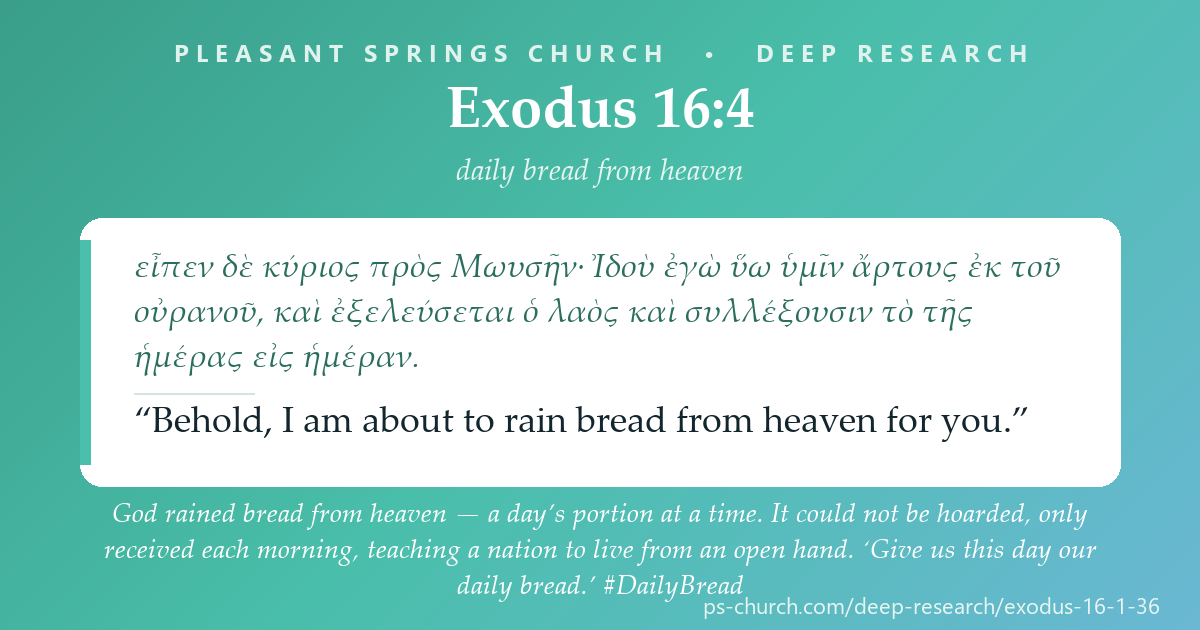
One month out of Egypt the redeemed people are hungry, and they grumble for the fleshpots of slavery. God answers not with a storehouse but with a daily gift: “I am about to rain bread from heaven for you… that I may test them.” In the morning a fine, flaky thing lies on the ground — “man hu?”, “what is it?” — and each gathers an omer, “whoever gathered much had nothing left over, and whoever gathered little had no lack.” It breeds worms if hoarded, doubles before the Sabbath, and teaches a nation to live from an open hand. This study works Exodus 16:1–36 — daily dependence, the gift of rest, and the true bread from heaven. See the method →
Exodus 16:4, 15, 18, 29, 31
Hebrew · LXX · ESVThe Shape of the Passage
SequenceOne month out of Egypt, the redeemed people are hungry — and God answers not with a warehouse but with a daily gift that cannot be hoarded, hiding a test inside the provision and planting the Sabbath before the law is ever given at Sinai.
Author
The Torah of Moses sets the manna in the wilderness of Sin, “on the fifteenth day of the second month” after the exodus (16:1) — one month to the day since Egypt. The whole congregation grumbles: better to have “died… in the land of Egypt, when we sat by the meat pots and ate bread to the full” (16:3). Slavery is remembered as a full stomach; freedom feels like starvation. God’s reply is startling in its patience: no rebuke, but bread. “I am about to rain bread from heaven for you… that I may test them, whether they will walk in my law” (16:4). The glory of the Lord appears in the cloud (16:7, 10); quail come up in the evening, and in the morning, when the dew lifts, “a fine, flake-like thing, fine as frost” lies on the ground (16:14).
The test inside the gift. The provision is engineered as a school of trust. Each is to gather only “a day’s portion every day” (16:4) — an omer apiece — and when they measure, “whoever gathered much had nothing left over, and whoever gathered little had no lack” (16:18): the bread apportions itself to need. Hoard it overnight and “it bred worms and stank” (16:20). You cannot store God’s provision against tomorrow; you can only receive it for today. Then the rhythm bends: on the sixth day a double portion falls and does not rot, “for tomorrow is a day of solemn rest, a holy Sabbath to the Lord” (16:23). Here, before Sinai, is Scripture’s first explicit Sabbath — given, not yet legislated: “See! The Lord has given you the Sabbath” (16:29). Some go out to gather on the seventh day anyway and find nothing (16:27). Finally an omer of manna is sealed “before the Testimony” as a memorial for the generations (16:32–34).
Audience
Israel is being retrained. A people shaped by Egypt’s economy of storehouses and stockpiles (the very labor Pharaoh had extracted from them) must learn a wholly different economy: daily bread, no surplus, no lack, and one day in seven with no gathering at all. Forty years of manna (16:35) would be forty years of the same lesson each dawn — that life comes moment by moment from an open hand, and that the God who redeemed them will also feed them. The grumbling is recorded, not excused (“your grumbling is not against us but against the Lord,” 16:8); yet the answer to it is grace.
How the church hears it. Later Scripture draws the manna forward as the pattern of trust: “he humbled you… and fed you with manna… that he might make you know that man does not live by bread alone, but man lives by every word that comes from the mouth of the Lord” (Deut 8:3; on Jesus’ own lips, “the mouth of God,” Mt 4:4). It becomes the shape of the prayer “give us this day our daily bread” (Mt 6:11), and the ground of Paul’s ethic of enough (2 Cor 8:15). And the church has long heard, as devotional analogy rather than strict exegesis, its deepest echo where Jesus says, “I am the bread of life… the true bread from heaven” (Jn 6:32–35) — not the manna that could not keep death out (“your fathers ate… and died,” Jn 6:49), but the bread that is himself, given for the life of the world.
Orient on manna, the omer, the wilderness itinerary, and the Sabbath.
Search by topic: manna, quail, Sabbath, wilderness wanderings / itinerary, omer and ephah, grumbling / murmuring, glory of the LORD.
Which articles are relevant?
- Anchor Bible Dictionary — “Manna,” “Quail,” “Sabbath,” “Wilderness,” “Weights and Measures.”
- Dictionary of the OT: Pentateuch — “Manna,” “Sabbath,” “Wilderness Wanderings,” “Murmuring / Complaint,” “Provision.”
- NIDOTTE / TDOT — מָן (mān, manna), שַׁבָּת (šabbāt, Sabbath/rest), עֹמֶר (ʻōmer, a measure), נסה (nāsâ, to test), לון (lûn, to grumble).
Bibliography surfaced:
- Brevard Childs, The Book of Exodus (OTL); Douglas Stuart, Exodus (NAC); John Durham, Exodus (WBC); Peter Enns, Exodus (NIVAC).
- Studies of the Sabbath in the Pentateuch (its grounding before Sinai, Exod 16); of the wilderness “murmuring” tradition; and of ancient dry measures (omer / ephah).
- Beale & Carson, Commentary on the NT Use of the OT (John 6; 2 Corinthians 8).
“Bread of angels,” the desert’s tamarisk, and the memory of the manna.
Read the manna against its natural desert setting, the wilderness psalms’ retelling, and the Second-Temple traditions (Wisdom of Solomon, Josephus, Philo) — then note Paul’s and John’s use.
Which parallels shed light on religion and worldview?
What was the manna? The text is deliberately reticent — its very name is a question (“what is it?”). Naturalist proposals (the honeydew secretions of insects on desert tamarisk shrubs, gathered by Sinai bedouin to this day) may catch an echo of the phenomenon, but they cannot account for the narrative’s claims: it fell six days and never the seventh, doubled on the sixth, rotted overnight except before the Sabbath, and fed a nation for forty years. Scripture presents it not as a lucky ecology but as a daily miracle of provision shaped to teach a doctrine of trust. The wilderness psalms sing it exactly so — “he rained down on them manna to eat and gave them the grain of heaven. Man ate of the bread of the angels” (Ps 78:24–25 / LXX Ps 77:24–25; cf. 105:40).
- Psalm 78:23–29; 105:40; 106:14–15 (Scripture) — the wilderness psalms retell the manna and the quail: God’s open-handed provision, and Israel’s craving that “put God to the test.”
- Wisdom of Solomon 16:20–26 (Second-Temple, not Scripture) — the manna as “food of angels… ready to eat… suited to every taste,” a meditation on God feeding his people while the same creation plagued Egypt; read as a witness to how later Jews prized the story.
- Josephus, Antiquities 3.1.6 (§26–32) — retells the quail and manna, notes the name means “what is this?” and reports the manna still falling in his day; a first-century Jewish framing for a Greek audience.
- Philo, On the Change of Names; Allegorical Interpretation 3 (Second-Temple Jewish philosophy, not Scripture) — allegorizes the manna as the nourishing λόγος, the “heavenly food” of the soul: the daily word by which one truly lives.
The Second-Temple imagination loved the manna: “bread of the angels,” food that suited every taste, the archetype of God’s open hand (Ps 78; Wis 16). But Scripture keeps a sober edge on the wonder. The same craving that received quail “tested God in their heart” (Ps 78:18), and the manna could not finally keep death away: “your fathers ate the manna in the wilderness, and they died” (Jn 6:49). So when Jesus stands in Capernaum — after feeding five thousand with bread — and is challenged with this very episode (“he gave them bread from heaven to eat,” Jn 6:31, quoting Ps 78:24 / LXX Ps 77:24), he neither denies the gift nor rests in it. “It was not Moses who gave you the bread from heaven, but my Father gives you the true bread from heaven… I am the bread of life” (Jn 6:32–35). Held as devotional analogy, the manna is the shadow and Christ the substance: the daily gift that could not conquer the grave points to the Bread who was “given for the life of the world” (Jn 6:51) and raises the one who eats at the last day.
The vocabulary of daily bread, the test, and the Sabbath.
Watch “bread from heaven,” the “day’s portion each day,” the pun that names the manna, the equal omer, and the first-given Sabbath.
“Bread from heaven” — provision that comes down, unearned, from God’s side; the LXX ἄρτος ἐκ τοῦ οὐρανοῦ becomes the language of Psalm 78:24 (LXX Ps 77:24) and John 6:31.
“A day’s portion, each day” — the rule that forbids hoarding: enough for today, trust for tomorrow. The seed of “give us this day our daily bread” (Mt 6:11).
“What is it?” — the people’s bewildered question becomes the food’s name: מָן, manna. A wonder they cannot classify, received before it is understood.
An omer — the day’s ration, defined for us as “a tenth of an ephah” (16:36; roughly two quarts). The exact, equal measure in which “much” and “little” both came out to enough.
“Sabbath / solemn rest” — here first named and given, before Sinai commands it. Rooted in creation (Gen 2:2–3), it is grace and rhythm, not merely law: a day to receive and not to gather.
“Bread from heaven” — the LXX phrase of 16:4, echoed in Psalm 77:24 LXX (“ἄρτον οὐρανοῦ”) and taken up by Jesus: “the true bread from heaven… the bread of life” (Jn 6:32–35).
How the rest of Scripture reuses the manna:
- Deuteronomy 8:3 — “he… fed you with manna… that he might make you know that man does not live by bread alone, but man lives by every word that comes from the mouth of the Lord” — quoted by Jesus against the tempter (Mt 4:4; Lk 4:4).
- Matthew 6:11; Psalm 78:24–25 (LXX Ps 77:24–25); 105:40 — “give us this day our daily bread”; the wilderness psalms’ “grain of heaven” and “bread of the angels.”
- 2 Corinthians 8:15 — Paul quotes 16:18 (“whoever gathered much had nothing left over…”) for the church’s equality: abundance meeting need.
- John 6:31–35, 48–51; Revelation 2:17 — the true bread from heaven; the “hidden manna” promised to the one who conquers.
From the wilderness table to the bread of life.
Trace three threads — daily provision, the Sabbath rest, and the ethic of enough — toward their fulfillment, and note the Beale & Carson trajectory at John 6.
Which cross-references matter?
- Exodus 15:22–27 — the water at Marah just before: the wilderness school of testing and provision opens, and “the Lord your healer” is proved as here he is proved provider.
- Exodus 17:1–16 — water from the rock, and Massah/Meribah, immediately after: the same grumbling, the same patient supply.
- Exodus 20:8–11 — the Sabbath commanded at Sinai, grounded in creation (Gen 2:2–3): what ch.16 gives, the Decalogue codifies.
- Deuteronomy 8:2–3; Numbers 11:4–9; Joshua 5:12 — the manna interpreted, craved beyond it (the quail of Num 11), and ceasing when the land’s produce begins.
- John 6:22–59; 1 Corinthians 10:3; 2 Corinthians 8:15; Revelation 2:17 — the bread of life; the “spiritual food” of the fathers; the ethic of enough; the hidden manna.
The commentary’s John treatment reads the Bread of Life discourse as a sustained meditation on Exodus 16 through the lens of Psalm 78:24 (LXX Ps 77:24). The crowd, freshly fed, quotes the manna text as a demand: match Moses (Jn 6:30–31). Jesus’ answer corrects the memory at three points. First, the giver: ‘not Moses… but my Father gives you the true bread’ — the manna was always the Father’s gift, and still is. Second, the tense: ‘gives’, present — the true bread is being given now, in the Son. Third, the effect: the wilderness manna fed a day and could not defeat death (‘they died’), but ‘whoever feeds on this bread will live forever’ (Jn 6:58). The daily, perishable, need-matched provision of Exodus 16 — gathered each morning, spoiling if hoarded, teaching a nation to live from the open hand of God — is not discarded but fulfilled: it was always a lesson pointing beyond itself, that the life of God’s people comes down from heaven as sheer gift, and that the gift, at the last, is a Person. Held as devotional analogy on a real textual line (Exod 16 → Ps 78 → Jn 6), the manna teaches the church to pray for daily bread and to feed on Christ — ‘the bread that I will give for the life of the world is my flesh’ (Jn 6:51).
The scholarship on the manna and the Sabbath.
Childs, Durham, and Stuart for the exegesis; the studies on the pre-Sinai Sabbath and the wilderness murmuring tradition; Beale & Carson at John 6 and 2 Corinthians 8.
Commentaries & studies:
- Brevard Childs, The Book of Exodus (OTL); John Durham, Exodus (WBC); Douglas Stuart, Exodus (NAC); Peter Enns, Exodus (NIVAC); Nahum Sarna, Exodus (JPS).
- Studies of the Sabbath’s pre-Sinai grounding (Exod 16), of the wilderness “murmuring” narratives, and of ancient dry measures (omer / ephah).
- G. K. Beale & D. A. Carson, eds., Commentary on the NT Use of the OT (John 6; 2 Corinthians 8:15).
Interpretation notes worth keeping:
- The Sabbath given before Sinai (16:23, 29). The text presents the Sabbath as an existing gift Israel is taught to keep, not a novelty invented at ch.16 — consonant with its creation grounding (Gen 2:2–3). Rest is woven into the order of things, then commanded (Exod 20:8–11).
- “That I may test them” (16:4). The test is not to trip Israel but to reveal and train the heart (Deut 8:2–3): will they gather as commanded, and rest as given? Provision itself is the classroom of obedience.
- The omer “no lack” (16:18). Not a proto-communism but the ethic of enough: God’s supply matched to need, hoarding judged (worms), sharing implied. Paul reads it exactly so for church generosity (2 Cor 8:13–15).
- Manna and Christ (Jn 6). The bread-of-life reading is devotional analogy built on a real canonical line (Exod 16 → Ps 78:24 / LXX Ps 77:24 → Jn 6:31), not the chapter’s literal sense — the house discipline for typology throughout this library.
From the morning manna to your daily bread.
Name what you learned, why it matters, and one concrete response.
What should we carry away — and do?
- Live from the open hand, one day at a time. The manna could not be stockpiled; it had to be received each morning. Anxiety hoards; faith gathers today’s portion and trusts tomorrow’s dawn (Mt 6:11, 34).
- Receive the Sabbath as gift. Before it was ever a law it was a grace: a day to stop gathering and rest in a God who already provided the double portion. Rest is trust made visible.
- ‘No lack’ is an ethic of enough. God’s supply, shared, meets every need (2 Cor 8:15). Much with leftovers and little with lack are both undone where his people hold provision loosely.
Step in response: pick one worry you are trying to “stockpile” against and hand God just today’s portion of it — pray “give us this day our daily bread” and mean the this day. Keep one real hour of Sabbath rest this week without gathering. And, remembering “no lack,” give something you have more than enough of to someone who lacks — then feed on the true bread from heaven, who is Christ himself.
Exodus 16:4 · to share
LXX + ESVEvery Deep Research page traces its passage across the whole sweep — the Old Testament, the Second-Temple world between the testaments (historical witnesses, not Scripture), and the New Testament. Follow the thread:
Pleasant Springs Church — Deep Research
Research method after Michael S. Heiser’s Bible Research Method (examine dictionaries → ancient literature → important words → textual connections → academic publications → share), with the Pleasant Springs “Author & Audience” foundation. Scripture set in the Hebrew, the Greek editions named on each page and the ESV (Old Testament), and the Greek New Testament and the ESV (New Testament), per the practice of Pleasant Springs Church. Exodus 16:1–36 research grounded in Childs, Durham, Stuart, Enns, and Sarna; the manna read through the wilderness psalms (Ps 78:23–25 / LXX Ps 77:23–25; 105:40) and Deuteronomy 8:3; the Second-Temple memory in Wisdom of Solomon 16 and Josephus (Ant. 3.1.6) weighed as witnesses, not Scripture; 16:18 followed into Paul’s ethic of “enough” (2 Cor 8:15); the Sabbath honored as gift given before Sinai (16:23, 29; cf. Gen 2:2–3; Exod 20:8–11); and the bread-of-life reading (Jn 6:31–51) held as devotional analogy on a real canonical line, not the literal sense — per the house discipline for typology.
Scripture quotations marked ESV are from the ESV® Bible (The Holy Bible, English Standard Version®), © 2001 by Crossway, a publishing ministry of Good News Publishers. ESV Text Edition: 2016. Used by permission. All rights reserved. The ESV text may not be quoted in any publication made available to the public by a Creative Commons license, and the ESV may not be translated in whole or in part into any other language. www.esv.org
|
Did this study bless you today? 💚 Give to Support PS Church100% of gifts go to the General Fund — thank you. |