Three days after the Song of the Sea, the redeemed people stand at a spring they cannot drink: the water of Marah is bitter. They grumble; Moses cries out; and the Lord shows him a tree that, cast in, makes the bitter sweet. There God tests them and gives one of his great names: “I am the Lord, your healer” — YHWH-Rapha. Then Elim, with twelve springs and seventy palms: rest after the test. This study works Exodus 15:22–27 — the wilderness as school, healing as covenant character, and the tree that sweetens the bitter. See the method →
Exodus 15:23–27 (selections)
Hebrew · LXX · ESVThe Shape of the Passage
SequenceThree days separate the Song of the Sea from the bitter water of Marah. Deliverance is not the end of hardship but the beginning of formation — and the first lesson of the wilderness school is that the God who saved at the sea is the God who heals at the spring.
Author
The Torah of Moses turns immediately from triumph to thirst. Israel has just sung, “The Lord is a man of war” (15:3) and watched Egypt sink; now, three days into the wilderness of Shur, they find no water (15:22). When they reach Marah the water is undrinkable — bitter, like its name — and the redeemed people grumble (15:24). Moses cries out to the Lord, who shows him a log/tree; thrown into the water, it makes the bitter sweet (15:25). The miracle is small and strange after the sea — and deliberately so. The narrator is teaching that the same God works in the great deliverance and in the daily provision, and that the wilderness is not punishment but school.
Statute, test, and the name. “There the Lord made for them a statute and a rule, and there he tested them” (15:25). The test is trust expressed as obedience: “If you will diligently listen to the voice of the Lord your God… I will put none of the diseases on you that I put on the Egyptians, for I am the Lord, your healer” (15:26). The plagues that broke Egypt reveal, in reverse, God’s heart toward his covenant people: the hand that struck the oppressor is the hand that heals the delivered. יְהוָה רֹפְאֶךָ — YHWH-Rapha — is not a health-for-obedience formula but a disclosure of character: the Redeemer is by nature the Restorer.
Elim. The chapter ends in rest: at Elim there are twelve springs and seventy palms (15:27) — water enough and shade enough, one spring per tribe, a foretaste of provision. After the test, the oasis; after Marah, Elim. The pattern of the whole wilderness is set here: testing and grace, thirst and springs, held together in the hand of the healing Lord.
Audience
Israel — a freed people who quickly discovered that redemption from Egypt did not mean the end of need. Three days past the miracle their throats were dry and their faith was bitter, and the story was written so that later generations would recognize their own pattern in it: saved, then tested; delivered, then formed. The grumbling is recorded — honestly, not excused — and set beside the greater fact that God met it not with wrath but with a sweetened spring and a healing name.
How they were to hear it. Marah taught Israel to read the wilderness rightly: that the Lord who tests is the Lord who heals, and that listening to his voice is the way through (a lesson later gathered into the Shema, “Hear, O Israel”). The church has heard more still — carefully, as devotional analogy rather than the verse’s plain sense: a tree cast into the world’s bitter waters to make them sweet, and a healer whose deepest cure is for the soul (Ps 103:3 / LXX Ps 102:3; Isa 53:5). The manna and the struck rock lie just ahead (ch. 16; ch. 17); Marah opens the wilderness road, and names the God who walks it as the one who restores.
Orient on Marah, testing, the divine names, and healing in the OT.
Search by topic: Marah / Elim, wilderness itinerary, testing (massah/nasah), divine names (YHWH-Rapha), healing, grumbling.
Which articles are relevant?
- Anchor Bible Dictionary — “Marah,” “Elim,” “Shur, Wilderness of,” “Wilderness Wanderings,” “Healing.”
- Dictionary of the OT: Pentateuch — “Wilderness,” “Testing,” “Murmuring/Grumbling,” “God, Names of,” “Law.”
- NIDOTTE / TDOT — מָרַר (mārar, be bitter), נָסָה (nāsâ, test), רָפָא (rāp̄ā’, heal), עֵץ (ʿēṣ, tree/wood), לוּן (lûn, grumble).
Bibliography surfaced:
- Brevard Childs, The Book of Exodus (OTL); Douglas Stuart, Exodus (NAC); John Durham, Exodus (WBC); Peter Enns, Exodus (NIVAC).
- Studies on the wilderness itineraries and on the murmuring/testing tradition (e.g., G. W. Coats, Rebellion in the Wilderness).
- Studies on the divine-name titles of God (YHWH-Rapha) and on healing in the Old Testament.
The bitter spring, the healing word, and the wood in Second-Temple memory.
Read the miracle against the desert-survival world of the itinerary, then note how the Second-Temple writers remembered Marah — especially the theme that it is God’s word, not the wood itself, that heals.
Which parallels shed light on religion and worldview?
Bitter water in the desert. Travelers on the Sinai routes knew the terror of a spring that turns out to be brackish — water in sight, and none to drink. The narrative is at home in that world: the crisis is ordinary, the deliverance particular. What matters theologically is who heals the water. The people are not told to search for a mineral or a technique; Moses cries out, and the Lord answers with a shown tree. The point is not folk-medicine but covenant dependence: the God who split the sea also sweetens the spring.
The healing is God’s, not the wood’s. The Second-Temple writers were careful to say so. The Wisdom of Solomon, reflecting on the exodus, insists that in Israel’s healings “it was neither herb nor poultice that cured them, but your word, O Lord, which heals all people” (Wisdom 16:12) — a Jewish witness (not Scripture) reading the wilderness cures exactly as Exodus frames Marah: the Lord himself is the healer, the means merely his instrument.
- Wisdom of Solomon 16:5–13 (Second-Temple Jewish wisdom, not Scripture) — the wilderness cures credited to God’s word, not the remedy: “your word… heals all people” (16:12); the sovereign “power over life and death.”
- Philo, Life of Moses 1.181–187 (Second-Temple Jewish philosophy, not Scripture) — narrates Marah and Elim, and reads the twelve springs and seventy palms of Elim as the twelve tribes and the seventy elders.
- Josephus, Antiquities 3.1.1–3 — the distress at bitter Marah, Moses’ prayer, the wood cast in, and the palm-shaded rest at Elim, retold for a Greco-Roman audience.
- Justin Martyr, Dialogue with Trypho 86 (early church, not Scripture) — an early Christian reading of the wood at Marah among the “tree” figures pointing to the cross: held as devotional reception, not the text’s plain sense.
It is easy to imagine that the miracle at the sea should have settled Israel’s faith for good — and just as easy, reading on, to be startled that it did not. Three days. That is all it took for a people who had walked through walls of water to stand at a spring and despair. But the narrator is not embarrassed by this; he is teaching by it. Redemption, Exodus insists, is the beginning of formation, not the end of hardship — the door out of Egypt opens not onto the Promised Land but onto a wilderness, and the wilderness is a school. Its first lesson is written at Marah: that the God who delivers in spectacular power also provides in daily mercy, and that the two are the same faithfulness. Deuteronomy will look back and name the curriculum plainly — the Lord “humbled you and let you hunger… that he might make you know that man does not live by bread alone” (Deut 8:2–3). Marah is the entrance exam. It asks a single question — when the water is bitter, will you grumble or will you cry out? — and it answers with a tree, a statute, and a name. The people fail the mood of the test and are met, all the same, with sweetened water and a God who calls himself their healer. That is grace teaching in a hard classroom: the bitter made sweet, not to end the wilderness, but to make it survivable in the company of the Lord.
The vocabulary of bitterness, the tree, the test, and the healing name.
Watch the pun on Marah, the shown tree (Heb. ʿēṣ / Gk. ξύλον), the testing verb nāsâ, and the covenant name YHWH-Rapha.
“Bitter” / “Bitterness” — both the taste of the water and the name of the place (from mārar, to be bitter). The LXX names it Πικρία. The word will name a mood as well: bitter water, bitter people.
“Tree / wood / log” — the Lord shows Moses an ʿēṣ; cast in, it sweetens the water. The LXX ξύλον is the very word the NT uses for the cross (Acts 5:30; Gal 3:13; 1 Pet 2:24) — hence the church’s devotional reading.
“He tested him” (root nāsâ) — the same verb of the wilderness testing (Deut 8:2, 16) and of Massah just ahead (17:7). The test is not to trip the people up but to reveal and train the heart’s trust.
“A statute and a rule” — the first hint of covenant law, before Sinai. The LXX makes them plural, δικαιώματα καὶ κρίσεις. Life in the wilderness is life ordered by the Lord’s word.
“The Lord, your healer” — YHWH-Rapha, from rāp̄ā’, to heal/restore. A name, not a formula: God’s covenant character as restorer (Ps 103:3 / LXX Ps 102:3), whose ultimate healing is in Christ and the resurrection (Isa 53:5).
“Wood / tree” — the LXX’s rendering of ʿēṣ. Because the Greek NT calls the cross a ξύλον (Acts 5:30; 1 Pet 2:24), the Fathers heard the tree at Marah as a figure of the tree that sweetens the world’s bitterness (devotional analogy).
How the rest of Scripture fills out the healing name:
- Psalm 103:3 (LXX Ps 102:3) — “who forgives all your iniquity, who heals all your diseases”: YHWH-Rapha gathered into Israel’s praise, forgiveness and healing named together.
- Isaiah 53:5; 57:18–19; Jeremiah 3:22; Hosea 6:1; 14:4 — “with his wounds we are healed”; the Lord who wounds and heals, whose deepest cure is of the sin-sick heart.
- 2 Kings 2:19–22; 4:38–41 — Elisha heals the bad water with salt and the poisoned pot with flour: the Marah pattern — death in the water/pot made wholesome by the prophet’s God-given means.
- Matthew 9:12; Mark 2:17 — “Those who are well have no need of a physician, but those who are sick”: the healer of Marah, come in person as the physician of sinners.
From bitter Marah to the tree of life whose leaves are for healing.
Trace the wilderness testing, the healing name, and the sweetening tree toward their fulfillment — holding the cross/healing readings as labeled devotional analogy.
Which cross-references matter?
- Deuteronomy 8:2–3, 15–16 — the wilderness as testing and humbling: “he… tested you… that he might make you know” — Marah’s lesson gathered into Israel’s memory.
- Deuteronomy 6:4–9 — “Hear, O Israel”: the “if you will diligently listen to the voice of the Lord” of 15:26 becomes the Shema’s whole shape of covenant life.
- Exodus 16; Exodus 17:1–7 — the manna and the struck rock: daily dependence and the water from the Rock, the wilderness school continued (grumbling met with grace).
- Psalm 78; 95; 105:41; 106 — the wilderness psalms: God’s wonders remembered and Israel’s grumbling recounted, the same honest pattern as Marah.
- 1 Corinthians 10:1–13 — Paul’s reading of the wilderness: “these things took place as examples for us” (10:6), a warning against grumbling (10:10) “written down for our instruction” (10:11); the desert generation as a warning and a hope for the church.
- 1 Peter 2:24; Revelation 22:1–2 — “by his wounds you have been healed” (borne on the ξύλον); and the tree of life “whose leaves were for the healing of the nations” — the bitter waters of the world made finally, fully sweet.
“I am the Lord, your healer” is one of the great covenant names of God, and it is often mishandled — pressed into a guarantee that faith or obedience will keep the body from every sickness. The text will not carry that weight, and the whole of Scripture forbids it. The promise at Marah is set in a covenant frame (“if you will diligently listen…”) and aimed at a specific mercy — Israel would not suffer “the diseases… of the Egyptians,” the very plagues by which God had judged their oppressors. It is a disclosure of character, not a health contract: the God who is Redeemer is by nature Restorer. And Scripture is candid that his healing is not always in this life on our timetable — Job suffers, Paul’s thorn remains (2 Cor 12:7–9), Timothy has his ailments (1 Tim 5:23), and every saint of every age finally dies. The name is truer than the prosperity reading, not smaller: YHWH-Rapha heals the body when he wills, heals the soul certainly in Christ (“by his wounds you have been healed,” 1 Pet 2:24; Ps 103:3 / LXX Ps 102:3, where healing stands beside forgiveness), and heals all things at the last, when he raises the dead and the leaves of the tree of life are “for the healing of the nations” (Rev 22:2). The bitter water made sweet is a pledge of that final sweetness — not a promise that the wilderness will have no bitter springs, but that the Lord who meets us at them is the healer, all the way to the resurrection.
The scholarship on Marah, the wilderness tradition, and healing.
Childs, Durham, and Stuart for the exegesis; the murmuring/testing studies for the tradition; the careful reception-history of the “tree.”
Commentaries & studies:
- Brevard Childs, The Book of Exodus (OTL); John Durham, Exodus (WBC); Douglas Stuart, Exodus (NAC); Peter Enns, Exodus (NIVAC); Nahum Sarna, Exodus (JPS).
- George W. Coats, Rebellion in the Wilderness; studies on the murmuring motif and the wilderness itineraries (Num 33).
- Studies on the divine-name titles (YHWH-Rapha) and on healing/medicine in ancient Israel and the ANE.
Interpretation notes worth keeping:
- The “log” / tree (15:25). The text does not credit the wood’s properties; the Lord “showed” it, and the healing is his (cf. Wisdom 16:12; 2 Kgs 4:41). Read the miracle as revelation, not botany.
- “Statute and a rule” (15:25). A pre-Sinai anticipation of covenant law; the wilderness is the Lord’s ordered space, not a lawless waste. The LXX’s plural (δικαιώματα καὶ κρίσεις) leans the same way.
- YHWH-Rapha (15:26). A covenant name disclosing character, not a prosperity-health guarantee; its horizon is forgiveness, resurrection, and the “healing of the nations” — hold it there, against both the deniers and the health-and-wealth readers.
- The tree/cross reading. Venerable (Justin, Dial. 86) and homiletically rich — the wood that sweetens the world’s bitter waters — but held as devotional analogy on the LXX ξύλον, not the plain sense of Exodus: the house discipline for typology throughout this library.
From the bitter spring to the healing name.
Name what you learned, why it matters, and one concrete response.
What should we carry away — and do?
- Deliverance is the start of the school, not the end of the hardship. Three days from the sea’s song to bitter water: the wilderness forms what Egypt could not. Expect the testing spring, and cry out at it rather than grumble.
- The healing is the Lord’s. Not the wood, not a technique — “your word… heals” (Wis 16:12). Bring the bitter thing to God, who still sweetens waters and still calls himself your healer.
- YHWH-Rapha is a name, not a formula. He heals the body when he wills, the soul certainly in Christ (Ps 103:3 / LXX Ps 102:3; 1 Pet 2:24), and all things at the resurrection. Hope in him is bigger than the prosperity promise, not smaller.
Step in response: take one bitterness you are carrying — a grief, a wound, a resentment gone brackish — and instead of grumbling, cry out to the Lord over it this week; ask him to cast the tree in. Then look for your Elim: name one mercy, one “spring” he has already given, and rest there.
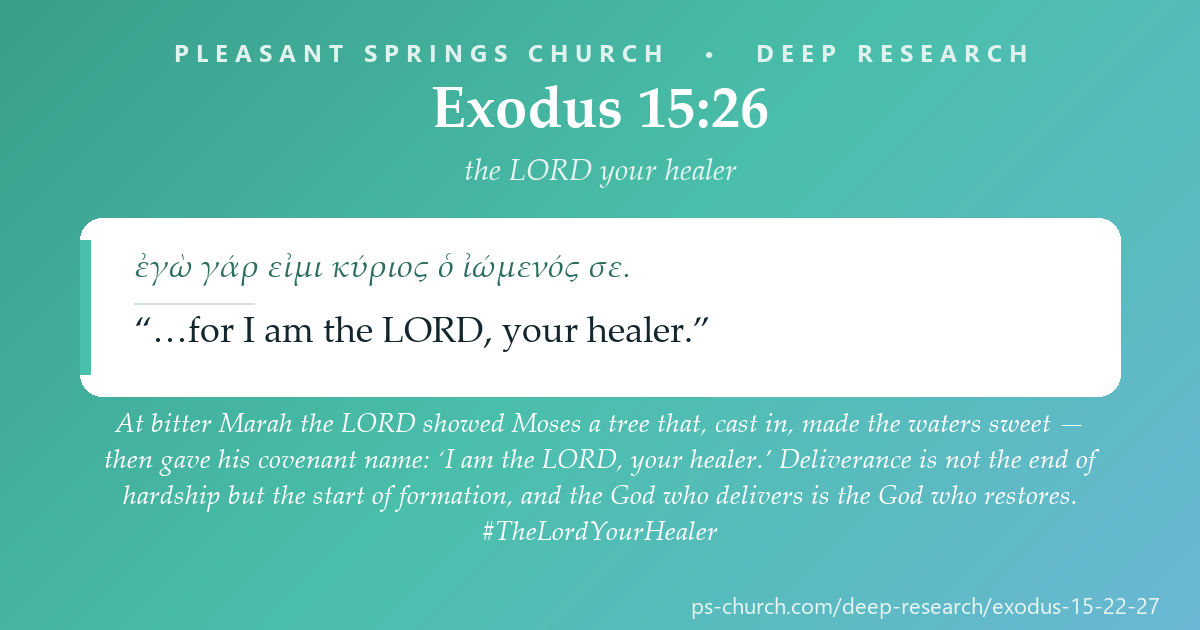
Exodus 15:26 · to share
LXX + ESVEvery Deep Research page traces its passage across the whole sweep — the Old Testament, the Second-Temple world between the testaments (historical witnesses, not Scripture), and the New Testament. Follow the thread:
Pleasant Springs Church — Deep Research
Research method after Michael S. Heiser’s Bible Research Method (examine dictionaries → ancient literature → important words → textual connections → academic publications → share), with the Pleasant Springs “Author & Audience” foundation. Scripture set in the Hebrew, the Greek editions named on each page and the ESV (Old Testament), and the Greek New Testament and the ESV (New Testament), per the practice of Pleasant Springs Church. Exodus 15:22–27 research grounded in Childs, Durham, Stuart, Enns, and Sarna; the wilderness testing tradition (Coats; Deut 8:2–3) and the murmuring motif; YHWH-Rapha read as a covenant disclosure of character rather than a prosperity-health formula (Ps 103:3 / LXX Ps 102:3; Isa 53:5; horizon in the resurrection and Rev 22:2); the Second-Temple witness that the healing is God’s word and not the wood (Wisdom 16:12; Philo, Life of Moses 1; Josephus, Ant. 3.1), read as witnesses, not Scripture; and the wood/cross reading of the LXX ξύλον (Justin, Dial. 86; 1 Pet 2:24) held as labeled devotional analogy, per the house discipline for typology.
Scripture quotations marked ESV are from the ESV® Bible (The Holy Bible, English Standard Version®), © 2001 by Crossway, a publishing ministry of Good News Publishers. ESV Text Edition: 2016. Used by permission. All rights reserved. The ESV text may not be quoted in any publication made available to the public by a Creative Commons license, and the ESV may not be translated in whole or in part into any other language. www.esv.org
|
Did this study bless you today? 💚 Give to Support PS Church100% of gifts go to the General Fund — thank you. |