When the sea has closed over Egypt’s chariots, the prose stops and Israel bursts into poetry — the Shirat ha-Yam, the Song of the Sea, the first great hymn in the Bible. “I will sing to the Lord, for he has triumphed gloriously”; “the Lord is my strength and my song, and he has become my salvation”; “Who is like you, O Lord?”; “the Lord will reign forever and ever.” Then Miriam the prophetess takes a tambourine, and the women answer. This study works Exodus 15:1–21 — worship as the native response to redemption. See the method →
Exodus 15:1–21 (selections)
Hebrew · LXX · ESVThe Shape of the Passage
Ring compositionThe narrative of the Red Sea crossing halts, and Israel bursts into poetry. Redemption’s native language is worship — and Scripture’s first great hymn is a song of salvation.
Author
The Torah of Moses sets, at the hinge of the exodus, its first sustained poem. When the sea has closed over Egypt’s chariots, the prose stops and a hymn begins: “Then Moses and the people of Israel sang this song to the Lord” (15:1). The Shirat ha-Yam — the Song of the Sea — is among the oldest Hebrew in the Bible, its archaic grammar and pounding meter marking it as ancient. In the Torah scroll it is even written in a distinctive brickwork layout, words set like the walls of water that stood on either side.
The shape of the song. It opens in praise (“I will sing… he has triumphed gloriously,” 15:1–2), narrates the victory (the sea, the enemy, “the Lord is a man of war,” 15:3–12), and then reaches forward — the nations melt, and the redeemed are led to God’s “holy abode,” planted on “your own mountain… the sanctuary, O Lord, which your hands have established” (15:13–17), ending on the note that will crown the whole canon: “The Lord will reign forever and ever” (15:18). A song that begins at a sea ends at a throne.
God as warrior-redeemer. “The Lord is a man of war” (15:3) is not a glorying in violence but the cry of the powerless whose Deliverer has broken the arm that enslaved them: his might exercised to save. The song’s deepest confession is not the horse in the sea but the incomparability of the Saviour: “Who is like you, O Lord?” (15:11).
Audience
Israel — a people who had just watched the sea do what no army could — received this song not only as history but as liturgy. It became worship: sung at the sea, treasured in the Psalter (“the Lord is my strength and my song” reappears verbatim in Psalm 118:14 (LXX Ps 117:14), and with the added divine name in Isaiah 12:2, “the Lord God”), read in the synagogue on the seventh day of Passover, and set daily in the morning service. Israel learned to name its God by what he had done: the God who saves.
The forward reach. The song’s “mountain” and “sanctuary” (15:17) sing beyond the moment — toward Sinai, and beyond it Zion and the temple where God would fill his dwelling with glory; and “the Lord will reign” is the seed of the whole Bible’s hope of the kingdom. Then Miriam the prophetess — here first named (15:20) — takes a tambourine, and the women answer the men’s song with the same refrain (15:21): worship overflowing, generation to generation, until the redeemed sing it again at the last sea (Rev 15:3).
Orient on the victory hymn, the divine warrior, Miriam, and the incomparable God.
Search by topic: Song of the Sea, divine warrior / holy war, Miriam, incomparability of God, Zion / sanctuary, Exodus.
Which articles are relevant?
- Anchor Bible Dictionary — “Song of the Sea,” “Miriam,” “Exodus, The,” “Divine Warrior,” “Poetry, Hebrew.”
- Dictionary of the OT: Pentateuch — “Song of the Sea,” “Miriam,” “Warfare,” “Praise,” “Zion.”
- NIDOTTE / TDOT — גָּאָה (gāʾâ, be exalted / triumph), עֹז (ʿōz, strength), זִמְרָה (zimrâ, song), נָוֶה (nāweh, abode), נֶאְדָּר (neʾdār, majestic).
Bibliography surfaced:
- Brevard Childs, The Book of Exodus (OTL); John Durham, Exodus (WBC); Douglas Stuart, Exodus (NAC); William Propp, Exodus 1–18 (AB).
- Frank Moore Cross & David Noel Freedman on the archaic poetry of the Song; Cross, Canaanite Myth and Hebrew Epic.
- Tremper Longman & Daniel Reid, God Is a Warrior; studies on Miriam and on the divine-warrior hymn.
The victory hymn, the women with timbrels, and the God who fights to save.
Read the Song against the ancient victory-hymn and against the Bible’s own theology of God as warrior-redeemer; then note the Second-Temple witnesses who sang it after.
Which parallels shed light on religion and worldview?
The victory hymn — and its subversion. Ancient peoples celebrated triumph in song, crediting king or war-god. The Song of the Sea borrows the genre and overturns it: there is no army, no hero, no chariot on Israel’s side — only a sea and the Lord. Egypt’s might is undone not by Israel’s strength but by God’s. So “the Lord is a man of war” (15:3) must be heard for what the song makes it: the power of the Redeemer bent to rescue slaves. It is the cry of the oppressed whose Deliverer has come, not a warrant for human vengeance — and even the Greek translators felt the weight, rendering it “the Lord who shatters wars” (κύριος συντρίβων πολέμους).
Women, tambourines, and the answering choir. When Miriam and the women go out “with tambourines and dancing” (15:20), the narrative touches a known custom: women greeting victory with drum and song (Judg 11:34; 1 Sam 18:6–7). But Miriam is named prophetess (נְבִיאָה) — the first woman so called — and later Scripture ranks her with Moses and Aaron as a leader of the exodus (Mic 6:4). Hers is not a mere echo but an antiphon: the men sing, the women answer, and the whole redeemed people become a choir.
- Judges 11:34; 1 Samuel 18:6–7; Psalm 68:24–25 — women greeting victory with timbrel and dance: the cultural setting of Miriam’s song.
- Wisdom of Solomon 10:20–21 (Second-Temple, a witness, not Scripture) — the redeemed at the sea “sang praises, O Lord, to thy holy name”: an early meditation on the Song.
- Philo, On the Contemplative Life 83–88 (Second-Temple Jewish philosophy, not Scripture) — the Therapeutae form two choirs, men and women, “in imitation of the one established of old beside the Red Sea,” led by Moses and Miriam.
- Josephus, Antiquities 2.346 — the deliverance at the sea and Israel’s song of thanksgiving, retold for a Greco-Roman audience.
Scripture opens the story of redemption with a people singing on the shore of a sea their enemy could not cross — and closes it the same way. In the Revelation, those “who had conquered the beast” stand beside “a sea of glass mingled with fire,” holding harps, and they sing “the song of Moses, the servant of God, and the song of the Lamb” (Rev 15:2–3). Held as devotional analogy rather than strict exegesis, the frame is unmistakable: the Song of the Sea is the first draft of the last hymn. What Israel sang over drowned chariots, the redeemed of every nation will sing over the final defeat of every enemy — the same wonder (“Great and amazing are your deeds… Who will not fear, O Lord?”, Rev 15:3–4, taking up the “who is like you” of Exod 15:11), the same King (“the Lord will reign forever and ever,” 15:18). Worship is not merely redemption’s response; it is redemption’s destination.
The vocabulary of triumph, incomparability, and reign.
Watch the doubled “triumphed gloriously,” the “strength and song” that becomes Israel’s creed, the “who is like you,” the sober “man of war,” and the closing “he will reign.”
“He has triumphed gloriously” — the verb doubled (infinitive absolute + finite): “he is highly exalted” / “he has risen up in majesty.” The song’s refrain, sung by Moses and again by Miriam.
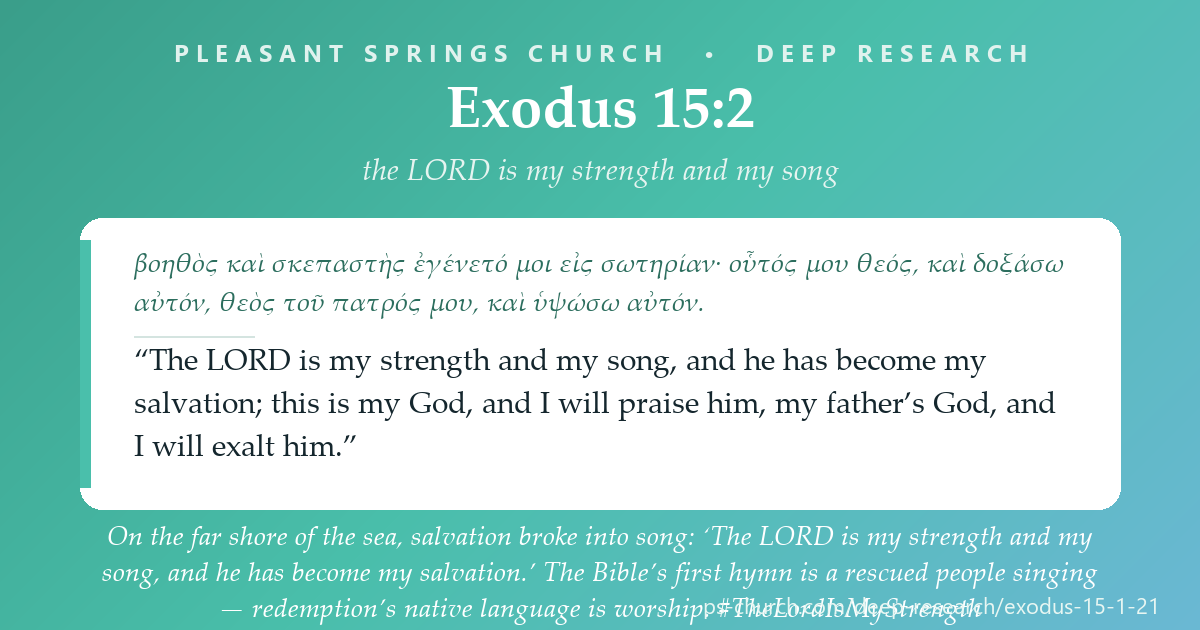
“My strength and my song” — the confession echoed verbatim in Psalm 118:14 (LXX Ps 117:14), and (with the added divine name) in Isaiah 12:2. The LXX paraphrases “a helper and shelterer” (βοηθὸς καὶ σκεπαστής): God is not only the reason for the song but its very content.
“Who is like you?” — the incomparability of the Lord: no god among the nations can be named beside him. The phrase lives on in the names Micah and Michael (“who is like God?”) and in Israel’s liturgy.
“A man of war” — the Warrior-Redeemer whose might is exercised to free the oppressed. Held soberly: his strength saves the powerless; it is not a glorying in violence. The LXX has “the one who shatters wars.”
“Majestic in holiness” — God’s glory is the glory of his holiness: not raw power but power made awesome by purity and love. The wonder that draws worship rather than mere fear.
“He will reign” — “the Lord will reign forever and ever.” The song’s last word is a kingdom: the deliverance at the sea is the opening act of a reign that has no end (cf. Rev 11:15).
How the rest of Scripture takes up the Song:
- Psalm 118:14 (LXX Ps 117:14); Isaiah 12:2 — “The Lord is my strength and my song; he has become my salvation”: Exodus 15:2 becomes the confession of psalmist and prophet.
- Psalm 78; 105; 106; 114 — the wilderness psalms retelling the sea and the journey: Israel keeps singing its rescue.
- Isaiah 51:9–11 — “Awake, awake… O arm of the Lord”: the exilic prophet prays the exodus again, and the redeemed “come to Zion with singing.”
- Revelation 15:2–4 — “the song of Moses… and the song of the Lamb”: “who is like you” and “the Lord will reign” sung at the last sea.
From the first hymn to the last, and the King between.
Trace the Song’s three great movements — salvation, the incomparable God, and the eternal reign — across the canon; then note the Beale & Carson trajectory at Revelation.
Which cross-references matter?
- Exodus 14 — the deliverance the Song celebrates: the sea divided, Egypt overthrown, Israel saved “on dry ground.” The prose that becomes poetry.
- Exodus 3:13–15 — “the Lord is his name” (15:3): the Name revealed at the bush is now sung over the sea.
- Psalm 118:14 (LXX Ps 117:14); Isaiah 12:2 — Exodus 15:2 taken up (verbatim in Ps 118:14 / LXX Ps 117:14; with the added divine name in Isa 12:2): the Song’s heart becomes Israel’s standing creed.
- Exodus 40:34–38 — the “sanctuary” and “mountain” of 15:17 anticipated: God’s glory filling the dwelling his hands established.
- 1 Corinthians 10:1–2; Revelation 11:15; 15:2–4 — the sea and the cloud read for the church; “the kingdom of the world has become… our Lord’s”; the song of Moses and the Lamb.
The commentary’s Revelation treatment reads chapter 15 as a deliberate re-singing of Exodus 15. John sees the conquerors of the beast standing where Israel stood — on the far side of a sea their enemy could not pass — and their hymn fuses two songs into one: “the song of Moses, the servant of God, and the song of the Lamb.” Its very words are quarried from the Song of the Sea and the wilderness psalms: “Great and amazing are your deeds… Who will not fear, O Lord, and glorify your name?” is the “who is like you” of Exodus 15:11 grown to fill the cosmos, and “King of the nations” is the “Lord will reign forever and ever” of 15:18 come into its own. The point is not merely literary. The God who saved a slave-people by drowning a tyrant’s chariots is the same God who saves a countless multitude by the blood of the Lamb; the first exodus rhymes with the last. And the response is identical in both testaments — not analysis but adoration, not a doctrine recited but a song sung. What began on a Red Sea shore with a tambourine ends before the throne with harps, and the melody is one: salvation belongs to our God.
The scholarship on the Song of the Sea.
Childs, Durham, Stuart, and Propp for the exegesis; Cross and Freedman on the archaic poetry; Longman & Reid on the divine warrior; the studies on Miriam.
Commentaries & studies:
- Brevard Childs, The Book of Exodus (OTL); John Durham, Exodus (WBC); Douglas Stuart, Exodus (NAC); William H. C. Propp, Exodus 1–18 (AB); Peter Enns, Exodus (NIVAC).
- Frank Moore Cross & David Noel Freedman, Studies in Ancient Yahwistic Poetry; Cross, Canaanite Myth and Hebrew Epic — the Song’s antiquity and its imagery.
- Tremper Longman III & Daniel G. Reid, God Is a Warrior; studies on Miriam the prophetess (e.g., Phyllis Trible).
Interpretation notes worth keeping:
- The antiquity of the Song. Its archaic morphology and meter lead most scholars to date the poem very early — a hymn Israel sang long before the surrounding prose was set down; a living memory of the sea.
- “A man of war” (15:3). Read in the song’s own frame: God’s might exercised to save the enslaved, never a glorying in bloodshed. The LXX’s “who shatters wars” already hears it as deliverance; the church holds the divine warrior soberly, with judgment left to God (Rom 12:19).
- The “mountain” and “sanctuary” (15:17). Whether Sinai, or (prophetically) Zion and the temple, the song reaches beyond the sea to a place of settled worship — the trajectory that ends in the dwelling of God with his people.
- Miriam’s song (15:20–21). Not a lesser appendix but the antiphon that completes the hymn; her title prophetess and her place beside Moses and Aaron (Mic 6:4) mark her as a genuine leader of the redeemed.
From the shore of the sea to your own song.
Name what you learned, why it matters, and one concrete response.
What should we carry away — and do?
- Salvation issues in song. The Bible’s first hymn is a rescued people singing. Worship is not an extra added to redemption; it is redemption finding its voice. When God saves, the redeemed sing.
- “Who is like you?” The song’s peak is not the enemy’s defeat but the Saviour’s incomparability — “majestic in holiness.” The point of every deliverance is to make us marvel at the Deliverer.
- The Lord will reign. The song ends at a throne. Your rescue is the opening note of a kingdom that has no end — the same song the redeemed will sing at the last sea (Rev 15:3).
Step in response: name one thing the Lord has brought you through — a “sea” behind you now — and answer it the way Israel did: put it into praise. Sing it, write it, or say it aloud to God: “the Lord is my strength and my song, and he has become my salvation.” And like Miriam, do not sing it alone — hand someone else a tambourine.
Exodus 15:2 · to share
LXX + ESVEvery Deep Research page traces its passage across the whole sweep — the Old Testament, the Second-Temple world between the testaments (historical witnesses, not Scripture), and the New Testament. Follow the thread:
Pleasant Springs Church — Deep Research
Research method after Michael S. Heiser’s Bible Research Method (examine dictionaries → ancient literature → important words → textual connections → academic publications → share), with the Pleasant Springs “Author & Audience” foundation. Scripture set in the Hebrew, the Greek editions named on each page and the ESV (Old Testament), and the Greek New Testament and the ESV (New Testament), per the practice of Pleasant Springs Church. Exodus 15:1–21 research grounded in Childs, Durham, Stuart, Propp, and Enns, with Cross and Freedman on the Song’s archaic poetry and Longman & Reid on the divine warrior; “a man of war” (15:3) held soberly as the Redeemer’s might exercised to save the oppressed (the LXX reading κύριος συντρίβων πολέμους, “who shatters wars”); the LXX divergences noted (βοηθὸς καὶ σκεπαστής for “my strength and song,” 15:2; δικαιοσύνη for hesed, 15:13; both YHWH and Adonai rendered κύριε, 15:17); Miriam the prophetess (15:20; Mic 6:4) honored as a leader of the redeemed; and the “song of Moses and the Lamb” (Rev 15:2–4) held as devotional analogy on the real textual pattern, not the passage’s literal sense — per the house discipline for typology.
Scripture quotations marked ESV are from the ESV® Bible (The Holy Bible, English Standard Version®), © 2001 by Crossway, a publishing ministry of Good News Publishers. ESV Text Edition: 2016. Used by permission. All rights reserved. The ESV text may not be quoted in any publication made available to the public by a Creative Commons license, and the ESV may not be translated in whole or in part into any other language. www.esv.org
|
Did this study bless you today? 💚 Give to Support PS Church100% of gifts go to the General Fund — thank you. |