Two Greek words — crushing wars — stand in exactly three of the 30,348 Greek Old Testament units this shelf screens, and each time beside Lord: in the Song of the Sea at Exodus 15:3 (Lord on both sides), in Judith’s prayer at 9:7 (Lord before them), and in Judith’s song at 16:2 (Lord after them, with God before). The Hebrew of Exodus 15:3 says something else — a man of war — and so does the Latin of Exodus. Yet the Latin of Judith carries the Greek line, twice. And the Greek file of Judith cuts the line in half at a verse boundary, so the screen this shelf runs on every page sees three words where five stand. Of every chapter of the Greek Old Testament screened here, the one whose wording Judith’s prayer and song share most often, and with nothing else, is Exodus 15, the Song of the Sea — and with Deborah’s song they share no run longer than two words. This is the second half of the book: the widow, the prayer, the camp, the night, the head, the song. It is not Scripture for us, and the page says what that means. The first half is the previous study, Judith 1:1–7:32. See the method →
Judith is a Second-Temple Jewish story, set in a war the book places in the reign of a Nebuchadnezzar who rules from Nineveh (1:1); commentators commonly read it as a story rather than a chronicle. It is canonical in the Roman Catholic and Orthodox churches, was printed among the Apocrypha in the Reformation-era Protestant Bibles (the KJV of 1611 among them), and is absent from the Hebrew Bible. It is not Scripture for us. We read it as a witness — a window on how Jews between the Testaments prayed, fasted, kept the food laws, and sang over a deliverance — and we test everything in it by the canon. It is a violent book, and its heroine prays for deceit, which the book’s own song names among her deeds (16:8); the page reports both exactly and does not soften or applaud either.
⚠️ What this page can and cannot measure — read this first.
HELD: the Greek of Judith in one CATSS file (340 rows, every label parsing); the whole screened Greek Old Testament — 30,348 units screened of 30,637 held (the Odes are held and not screened, by house convention); the Greek New Testament (7,927 verses, SBLGNT); the Masoretic Hebrew of the canonical books; the KJV Apocrypha (1769 standard text, public domain); and the Clementine Vulgate.
NOT HELD: any Hebrew or Aramaic Judith — the book is not in the Masoretic corpus, and no Semitic text of it is on this disk in any form; the Old Latin; the Syriac; and the critical Greek edition with its apparatus. CONSEQUENCE: the Hebrew-side screens cannot be run on Judith at all, and anything this page says about a Semitic original is reported from outside scholarship and labelled as such, never measured.
Judith 8–16 — ten lines, in three witnesses
Greek: CATSS Judith (Rahlfs) · English: KJV Apocrypha (1769 standard text, public domain) · Latin: Clementine VulgateSeven Greek words stand in two of the 30,348 screened Greek Old Testament units: here, and Genesis 29:17, where they describe Rachel. The run is 7 with a tie band of 1, and from Genesis’s side Judith 8:7 is the only unit that reaches it. The Latin carries one phrase of beauty here, not two.
VULGATE 8:7 Erat autem eleganti aspectu nimis, cui vir suus reliquerat divitias multas, et familiam copiosam, ac possessiones armentis boum, et gregibus ovium plenas.
The seam. The Greek file ends 9:7 on κύριος συντρίβων πολέμους and opens 9:8 on κύριος ὄνομά σοι. Read across the seam, five consecutive words match Exodus 15:3; a verse-by-verse screen, which never reads across a seam, sees three. The KJV prints the whole line inside its 9:7 (“the Lord that breakest the battles: the Lord is thy name”), and its 9:8 begins at the Greek 9:8’s fifth word (the fourth, you, has no word of its own in the KJV). The Latin keeps both halves in one verse, 9:10.
VULGATE 9:10 et nesciunt quia tu ipse es Deus noster, qui conteris bella ab initio, et Dominus nomen est tibi. VULGATE 9:11 Erige brachium tuum sicut ab initio, et allide virtutem illorum in virtute tua : cadat virtus eorum in iracundia tua, qui promittunt se violare sancta tua, et polluere tabernaculum nominis tui, et dejicere gladio suo cornu altaris tui.
First of three: ἐν χειρὶ θηλείας. The Latin has no word of deceiving in this prayer (Stage 3 lists the stems searched) — where the Greek asks for the lips of my deceit, the Latin 9:13 reads ex labiis caritatis meæ, “from the lips of my charity” (both our glosses) — and it carries the woman’s hand two verses later, at 9:15.
VULGATE 9:13 capiatur laqueo oculorum suorum in me, et percuties eum ex labiis caritatis meæ. VULGATE 9:15 Erit enim hoc memoriale nominis tui, cum manus feminæ dejecerit eum.
Told in a single sentence. καὶ ἀφεῖλεν τὴν κεφαλὴν αὐτοῦ — five words this verse shares with 1 Samuel 17:51, David and Goliath (a tie band of 2: 2 Samuel 20:22 also reaches five, with a different five). The four-word core and took off the head stands in three screened units: 1 Samuel 17:51, 2 Samuel 20:22, and this one.
VULGATE 13:10 Et percussit bis in cervicem ejus, et abscidit caput ejus, et abstulit conopeum ejus a columnis, et evolvit corpus ejus truncum.
Second of three: the Lord struck him ἐν χειρὶ θηλείας. And the canopy, κωνώπιον — a word that stands four times in the screened Greek Old Testament, all four in Judith.
VULGATE 13:19 Et proferens de pera caput Holofernis, ostendit illis, dicens : Ecce caput Holofernis principis militiæ Assyriorum, et ecce conopeum illius, in quo recumbebat in ebrietate sua, ubi per manum feminæ percussit illum Dominus Deus noster.
Achior’s blessing, and one of the three New Testament contacts that are band 1 from both sides at five words: Luke 1:42 (Stage 4). The Latin stands at 13:31, not 14:7, and blesses her in omni tabernaculo Jacob where the Greek has Judah.
VULGATE 13:31 Benedicta tu a Deo tuo in omni tabernaculo Jacob, quoniam in omni gente quæ audierit nomen tuum, magnificabitur super te Deus Israël.
The KJV numbers this verse 16:1. Its chapter 15 has 13 verses where the Greek has 14. The verb ἐξῆρχεν (she led off) stands in this form in two screened units: here, and Exodus 15:21, where Miriam leads the women.
VULGATE 16:1 Tunc cantavit canticum hoc Domino Judith, dicens :
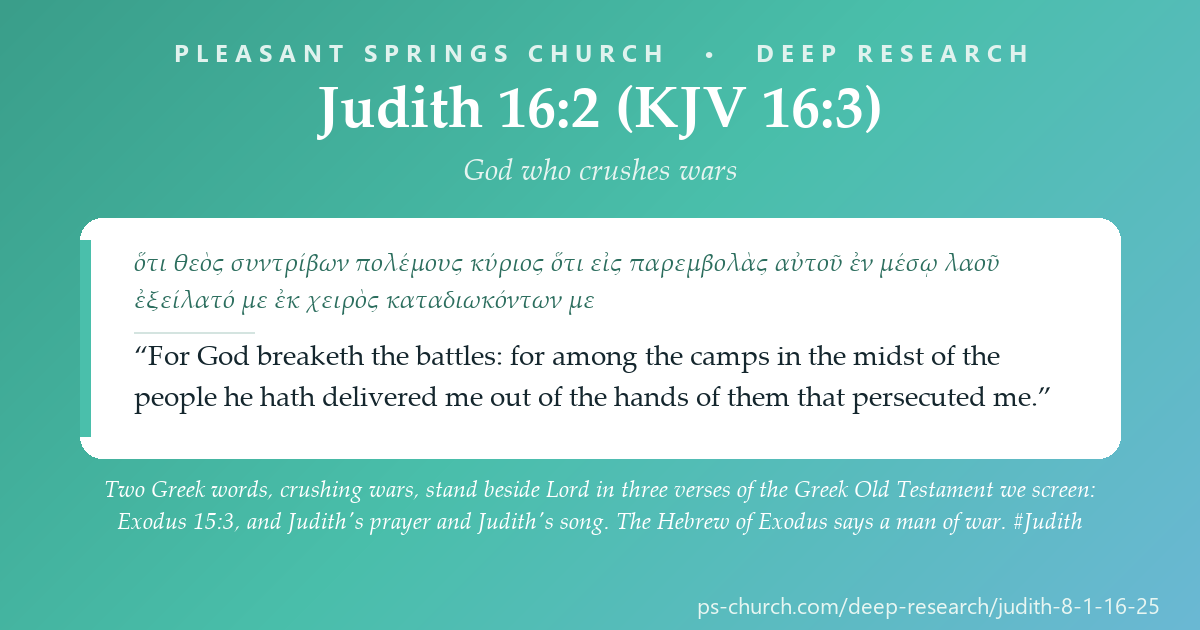
The second time. συντρίβων πολέμους κύριος — three words shared with Exodus 15:3 and with no other screened unit. The KJV numbers it 16:3. The Latin 16:3 carries both halves of the Exodus line, Dominus conterens bella, Dominus nomen est illi, though the Greek row has no word for name.
VULGATE 16:3 Dominus conterens bella,/ Dominus nomen est illi./ VULGATE 16:4 Qui posuit castra sua in medio populi sui,/ ut eriperet nos de manu omnium inimicorum nostrorum./
Third of three. The KJV numbers it 16:6 and renders all three “by the hand of a woman”; the Latin has manus feminæ or manum feminæ at 9:15, 13:19 and 16:7. Three witnesses, the same three places.
VULGATE 16:7 Dominus autem omnipotens nocuit eum,/ et tradidit eum in manus feminæ, et confodit eum./
Fire and worms. Against Mark 9:48 this verse measures one word; against Isaiah 66:24, one; against Sirach 7:17, two. See Stage 4.
VULGATE 16:20 Væ genti insurgenti super genus meum :/ Dominus enim omnipotens vindicabit in eis ;/ in die judicii visitabit illos./ VULGATE 16:21 Dabit enim ignem et vermes in carnes eorum,/ ut urantur et sentiant usque in sempiternum.
On the beheading (13:6–10). The text narrates it in five short verses and does not linger, and neither does this page: she takes his sword from the bedpost, prays, strikes his neck twice, and the head goes into the food bag her maid carries. The page reports what the text says and what it shares with other texts; it offers no comment on the act beyond what the book itself says.
Versification — stated, as on every page here, in the third state this shelf meets in the Apocrypha: no Masoretic text and no licensed English.
Greek (CATSS “Judith”, Rahlfs): 340 rows, 1:1–16:25. This study’s range, 8:1–16:25, is 194 rows — 36·14·23·23·20·20·19·14·25 — and 5,280 Greek words.
English (KJV Apocrypha (1769 standard text, public domain)): 339 verses; the range is 193 — 36·14·23·23·20·20·19·13·25 (chapter 15 is one short).
Latin (Clementine Vulgate): 346 verses, 1:1–16:31; the range is 209 — 34·19·20·21·20·31·18·15·31. A different text, not a different numbering of the same one; it is aligned here line by line, by content, and never verse by verse.
The Greek–KJV mapping, measured by content:
• 8:1–15:13 carry the same numbers in both — but two verse boundaries fall differently: the Greek opens 9:8 with the words the KJV renders the Lord is thy name, which the KJV prints as the end of its 9:7; and the Greek opens 10:9 with and she worshipped God (our gloss, singular), which the KJV prints as the end of its 10:8, in the plural (“Then they worshipped God”).
• Greek 15:14 = KJV 16:1.
• Greek 16:1–6 = KJV 16:2–7.
• Greek 16:7–8 = KJV 16:8 (one English verse for two Greek).
• Greek 16:9–25 = KJV 16:9–25.
Chapter 16 has 25 verses in both, and its first eight are divided differently. Agreement of count is not agreement of division.
Canonical verses are cited in the Greek file’s numbering (so Jeremiah 28:19 and 40:2 below are Hebrew and English 51:19 and 33:2, and Psalm 67:5 is Hebrew 68:5, English 68:4). None of the canonical verses printed on this page has its English on this disk, so canonical verses are given in Greek or Hebrew with our own literal gloss, marked as a gloss.
Other offsets in the tables and prose: every table label is the Greek file’s number. 1 Kgs in the tables is the Greek 3 Kingdoms, whose chapters 20 and 21 are English 1 Kings 21 and 20 (so Greek 3 Kingdoms 21:29 and 21:37 are English 1 Kings 20:29 and 20:37); 2 Esdr is the Greek Ezra–Nehemiah (its chapters 1–10 are Ezra, and Nehemiah n is its chapter n+10), not the 2 Esdras of the KJV Apocrypha; Psalms carry the Greek numbering; and Genesis 32:10 is English 32:9.
The Shape of the Passage
A sequence, with three measured refrainsThis is NOT offered as a chiasm. The shape drawn here is a sequence, and the colours mark only the rows that carry a counted refrain. Toni Craven’s Artistry and Faith in the Book of Judith (1983) reads the book as built concentrically; this page has not tested that outline and prints only what it can count. The night (13:1–10) is highlighted because the book turns on it, not because a count makes it a centre.
⚠️ Where this page sits. Judith is filed with the Apocrypha / Deuterocanon. Nothing taught at Pleasant Springs rests on it. Dates and authorship below are reported from the commentaries and are not tested here.
Author
Anonymous. The book names no author and claims none. It is commonly dated by its commentators to the late second or early first century BC, and commonly argued to have been composed in Hebrew; no Semitic text of it is held here, so neither claim can be checked on this disk.
The book’s Greek shares wording with older stories. Measured on this disk: Judith is described in the seven Greek words Genesis uses of Rachel (8:7); she takes off the garments of her widowhood in five words that otherwise stand only at Genesis 38:19, of Tamar; and her prayer and song share sequences found nowhere else with the Song of the Sea. The page reports the shared wording and does not say who read whom.
Audience
People under a siege that God seemed to have forgotten. Bethulia’s water has run out and its elders have set a deadline: if God has not acted in five days, they will surrender. Judith’s first speech (8:11–27) is to them, and it is about whether anyone may set God a deadline.
And readers of a book that ends in a song. The book ends with a woman leading Israel in a song with timbrels after an enemy is destroyed — and the one verb it uses for her leading the song stands, in that form, only here and at Exodus 15:21. The wording this page can measure is shared with the sea, not with Deborah.
Orient on the book, its text, and the women it is built beside.
Search by topic: Judith; Bethulia; Holofernes; Achior; Bagoas; Song of the Sea; Miriam; Deborah; Jael; Apocrypha; Septuagint.
Which articles are relevant?
- Anchor Bible Dictionary — look up Judith and the names of the book’s people and places; and the articles on the Song of the Sea and on Deborah.
- Eerdmans Dictionary of Early Judaism — Judith, and the articles on prayer and on women in Second-Temple literature.
- On the text — any article that says which Greek it is describing. This page prints Rahlfs’s text as CATSS digitised it, not the critical Greek edition, and the difference matters for exactly the kind of verse boundary Stage 4 turns on.
Bibliography surfaced:
- Carey A. Moore, Judith (Anchor Bible 40, 1985).
- Deborah Levine Gera, Judith (Commentaries on Early Jewish Literature, 2014).
- Lawrence M. Wills, Judith (Hermeneia, 2019).
- Toni Craven, Artistry and Faith in the Book of Judith (1983) — the study of the book’s literary shape; named because the structure diagram above declines to adopt its outline.
- Robert Hanhart (ed.), Iudith (the Göttingen Septuagint, 1979) — the critical Greek edition. Not held here.
- NETS (A New English Translation of the Septuagint) — which includes Judith. Not the English quoted on this page.
The older stories Judith is written beside — measured, not assumed.
Each line below gives a shared sequence of Greek words and says how many of the 30,348 screened Greek Old Testament units carry it. A shared sequence is evidence of shared wording, not of who read whom.
Which parallels shed light on the world of the text?
- Miriam and the Song of the Sea (Exodus 15). Seven pairs of verses in which Judith 8–16 shares a sequence of two or more words with Exodus 15 and with no other screened passage — more such pairs than with any other chapter of the screened Greek Old Testament (Stage 4 gives the whole count, and the narrow margin). Add the single verb ἐξῆρχεν, which stands in this form only at Exodus 15:21 and Judith 15:14, and the timbrels of 16:1.
- Deborah and Jael (Judges 4–5). The story most like Judith’s in plot — a woman, a tent, a sleeping general, a blow to the head. In wording it is far away: against Deborah’s song (Judges 5) neither Judith’s prayer nor her song reaches more than two consecutive words, in either Greek text of Judges. Judges 4:9 has the Lord sell Sisera ἐν χειρὶ γυναικὸς; Judith three times has ἐν χειρὶ θηλείας. Same idea; a different noun.
- David and Goliath (1 Samuel 17). καὶ ἀφεῖλεν τὴν κεφαλὴν αὐτοῦ — five words shared by 1 Samuel 17:51 and Judith 13:8, the only two screened units that carry all five.
- The wise woman of Abel (2 Samuel 20). A woman who saves her besieged city when the head of the man the besiegers want is thrown over the wall. Six exclusive contacts with the chapter (Stage 4 ranks them); two are with 20:22: τῇ σοφίᾳ αὐτῆς καὶ (Judith 11:20, where the word before is at, and 2 Samuel 20:22, where it is in) and αὐτῆς καὶ ἀφεῖλεν τὴν κεφαλὴν (Judith 13:8).
- Tamar (Genesis 38). τὰ ἱμάτια τῆς χηρεύσεως αὐτῆς, the garments of her widowhood, stands in three screened units: Genesis 38:19 and Judith 8:5 and 10:3. Tamar puts them back on at 38:19; Judith wears them at 8:5 and takes them off at 10:3.
- Rachel and Hagar (Genesis 29, 16). Judith is described in Rachel’s seven words (Genesis 29:17, Judith 8:7), and the Assyrian patrol asks her Hagar’s question in the angel’s five words — πόθεν ἔρχῃ καὶ ποῦ πορεύῃ — which stand in two screened units, Genesis 16:8 and Judith 10:12. A run of 7, tie band 1 from both sides.
- Simeon at Shechem (Genesis 34). Judith’s prayer opens by remembering the sword God gave her ancestor Simeon against the men of Shechem (9:2–4). Genesis records two further verdicts on that day — Jacob’s rebuke (34:30) and his curse on the anger of Simeon and Levi (49:5–7). Judith’s prayer recalls the sword and neither verdict. The page reports the prayer as it reads.
Holofernes and Bagoas are names that commentators connect with Persian commanders and officials of the fourth century BC; the akinakes Judith takes from the bedpost (13:6) is the word Greek writers from Herodotus on use for a Persian short sword. None of those outside sources is held on this disk, and the page builds nothing on them. What it can say from the files: ἀκινάκης stands twice in the screened Greek Old Testament, both in Judith (13:6 and 16:9), and nowhere in the Greek New Testament; the KJV renders it fauchion both times.
Five words and phrases — three of them found, in the screened Greek Old Testament, only in this book.
Counts are over the 30,348 screened Greek Old Testament units (the Odes excluded) and the 7,927 verses of the Greek New Testament. A count of a phrase is a count of units that carry it; a count of a word stem is a count of occurrences. Neither is a count over “the Septuagint”.
Three of the 30,348 screened Greek Old Testament units: Exodus 15:3, Judith 9:7, Judith 16:2. None of the 7,927 Greek New Testament verses. The Hebrew of Exodus 15:3 reads אִישׁ מִלְחָמָה, a man of war, and the Clementine Exodus quasi vir pugnator. In the 73 books of the Clementine Vulgate held here (not its appendix), a form of conterere standing directly before bella occurs twice, and both are Judith (9:10 and 16:3).
Three screened units, all Judith (9:10, 13:15, 16:5), none in the New Testament. The adjective is the one Leviticus uses for the female, animal (4:28) or human (15:33; 27:4–7); its feminine forms (thēlei-) stand seventeen times in the screened Greek Old Testament, six of them in Leviticus. Judges 4:9 says the same thing with gynē, the ordinary word for a woman.
Three screened units, all Judith (10:8, 13:4, 15:9). The noun itself stands four times in the screened Greek Old Testament — three Judith, one Job — and twice in the New Testament (Romans 8:39, 2 Corinthians 10:5).
The prayer asks for it. Words built on this stem — the noun, the verb apataō with its augmented forms (ēpatēsen), and the compound exapataō, but not hēpar, ‘liver’, whose forms begin with the same letters once breathings are stripped — stand 48 times in the screened Greek Old Testament, and 8 of them are in Judith — more than any other book (Jeremiah is next, with 7; 2 Chronicles has 6): 9:3 twice (of Shechem), 9:10 and 9:13 (Judith’s request), 10:4 (her adornment), 12:16 (Holofernes’s intent), 13:16 (Judith at the gate: “my countenance hath deceived him”, KJV) and 16:8 (the song). Searched by the stems decip-, decep-, dolo-, dolu-, fall-, fraud-, menda-, the Latin of chapters 8–16 has one word of deceiving, at 16:10 (decipiendum); the whole Latin book has one more, fallit, at 5:28. At the place of 9:10 the Latin reads caritatis, and at 10:4 it says all her adornment depended non ex libidine, sed ex virtute, not on lust but on virtue (our gloss). The page reports what each column reads and does not adjudicate the morality of the deceit; the book itself does not comment on it.
Holofernes’s bed-net. Four screened units, all Judith (10:21, 13:9, 13:15, 16:19). The KJV says canopy at all four and nowhere else in its Apocrypha; the Latin says conopeum at the matching four (10:19, as conopeo; 13:10, 13:19, 16:23) and nowhere else in the 73 Clementine books held here. The word is built on kōnōps, “gnat” — which stands once in the Greek New Testament, in Matthew 23:24.
Counted here, not assumed:
- Greek 8:4 says she had been a widow three years and four months; the Latin says three years and six. The Greek phrase three years and … months stands in one screened unit (Judith 8:4) and one New Testament verse, Luke 4:25, of Elijah’s drought — a run of 4, tie band 1 on Judith’s side, about two different things (Luke 4:25’s own deepest Greek Old Testament run is 5, and it is not Judith); and it is the Latin Judith, not the Greek, whose number is Luke’s.
- Judith lives to one hundred and five (16:23) in the Greek, the KJV and the Latin alike.
- The Latin’s chapter 16 runs to 31 verses; the Greek’s to 25. The Latin’s last verse, 16:31, says the day of this victory is kept as a feast among the Hebrews to the present day. No row of the Greek file’s chapter 16 carries a word of the heort- (festival) family. Its 16:20 has εὐφραινόμενος (our gloss: rejoicing), of the people in Jerusalem for three months, which the KJV renders feasting.
- Achior’s circumcision stands at Greek 14:10 and Latin 14:6, and the Greek says he was added to the house of Israel. 14:5 calls him the Ammonite. Deuteronomy 23:4 (23:3 in English Bibles) says in the Greek οὐκ εἰσελεύσεται Αμμανίτης into the assembly of the Lord. The page notes the two texts side by side and does not resolve them.
A line the run screen cannot see, a song that is not Deborah’s, and three runs of five that look alike and are not.
Every one of the 194 rows of Judith 8–16 screened against every other screened Greek Old Testament unit (30,348 less Judith’s own 340: 30,008) and against all 7,927 verses of the Greek New Testament. Contiguous runs of whole word forms; the tie band — how many units reach the same depth — is printed beside every run, and from both sides: how many partners the Judith row has at that depth, and what the partner’s own deepest run is. Greek against Greek New Testament uses the shelf’s cross-corpus normaliser; Greek Old Testament against itself uses the plain one, as the phrase search does. A 1 means at least one shared word; a 0 means none.
1. The line, and why the screen does not see it
Exodus 15:3 in the Greek reads κύριος συντρίβων πολέμους κύριος ὄνομα αὐτῷ — ‘the Lord crushing wars, the Lord [is] his name’ (our literal gloss). The Hebrew reads יְהֹוָה אִישׁ מִלְחָמָה יְהֹוָה שְׁמוֹ — ‘YHWH is a man of war; YHWH is his name’ (our literal gloss). The two columns say different things, and the page does not say why.
Measured: συντρίβων πολέμους stands in three of the 30,348 screened Greek Old Testament units — Exodus 15:3, Judith 9:7 and Judith 16:2 — and in none of the 7,927 Greek New Testament verses. A fourth copy stands in the Odes (Ode 1 is Exodus 15), which are held and not screened; counted in, the three would be four.
And the run screen does not report it as the contact for either Judith verse. Judith 9:7’s own deepest Greek Old Testament run is 4 — ὅτι σὺ εἶ κύριος, a formula five other screened units carry, in a tie band of 6 (the sixth partner, Hosea 11:3, reaches four with different words, καὶ οὐκ ἔγνωσαν ὅτι) — and 16:2’s is 4, ἐξείλατό με ἐκ χειρὸς, in a band of 2 (1 Samuel 17:37 and Exodus 18:4). The Exodus contact is three words in both, and three is shallower than four. From Exodus’s side, 15:3’s own deepest run is 3, in a band of 6: the two Judith verses, and four units that share the Lord [is] his name (Jeremiah 10:16, 28:19, 40:2; Psalm 67:5). Depth is not rarity. A four-word formula outranks a three-word line that nothing else in the corpus carries.
And the verse boundary hides the rest. The Greek file ends 9:7 on κύριος συντρίβων πολέμους and begins 9:8 with κύριος ὄνομά σοι. Join the two rows and screen them again: the deepest run becomes 5, tie band 1, and the one partner is Exodus 15:3 — five consecutive words, the sixth the only difference (to you where Exodus has to him: second person against third). κύριος ὄνομά σοι itself stands in one screened unit, Judith 9:8; the third-person form stands in five. The KJV prints the whole line inside its 9:7, and the Latin inside its 9:10. Of the three witnesses on this page, the Greek file is the only one that divides the line.
2. Not one line — a chapter
Every sequence of two to twelve words in Judith 8–16 was checked against the whole screened Greek Old Testament for the ones that stand in exactly one other passage (the two Greek texts of Judges, Joshua, Tobit, Daniel, Susanna and Bel counting as one passage). 627 pairs of verses share such a sequence, spread over 390 chapters. Exodus 15 has seven of them:
| Judith | Exodus | words | the sequence (normalised forms) |
|---|---|---|---|
| Jdt 9:7 | Exod 15:3 | 3 | κυριοσ συντριβων πολεμουσ |
| Jdt 16:2 | Exod 15:3 | 3 | συντριβων πολεμουσ κυριοσ |
| Jdt 9:12 | Exod 15:2 | 5 | θεοσ του πατροσ μου και |
| Jdt 16:14 | Exod 15:10 | 4 | απεστειλασ το πνευμα σου |
| Jdt 14:3 | Exod 15:16 | 4 | επι αυτουσ φοβοσ και |
| Jdt 15:2 | Exod 15:15 | 2 | αυτουσ τρομοσ |
| Jdt 11:23 | Exod 15:2 | 3 | μου θεοσ και |
Four of the seven are in the prayer and the song. Confined to those two passages (9:1–14 and 15:14–16:17), the same screen finds 90 such pairs; Exodus 15 has 4 of them, Daniel 9 — another prayer — has 3, and no other chapter has more than 2. Two of the remaining Exodus contacts are the terror falling on the enemy (Exodus 15:15–16, Judith 14:3 and 15:2); one, at 11:23, is Holofernes talking. 9:12’s five words reach five only because the fifth is and: without it, God of my father occurs eight times in seven screened units. Both sides of the two longest: Exodus 15:2’s own deepest run is 5, band 1, and its one partner is Judith 9:12, while 9:12 reaches five with three units (Genesis 31:42 and 32:10 as well, the second English 32:9); Exodus 15:10’s own deepest is 4, band 1, and its one partner is Judith 16:14, while 16:14 reaches four with ten units. Stated so that nobody reads the seven as seven equal things.
Ranked against every other chapter, the count is narrow, and depends on how it is counted:
| counted as | first | next |
|---|---|---|
| pairs of verses sharing an exclusive sequence | Exodus 15: 7 | Genesis 38, Daniel 9, 2 Samuel 20: 6 each |
| pairs whose exclusive sequence is three words or more | Exodus 15: 6 | Deuteronomy 22, Daniel 2, 2 Samuel 20: 5 each |
| total words in those exclusive sequences | Deuteronomy 22: 25 | Exodus 15: 24 |
Deuteronomy 22’s lead in words comes from town-gate wording — the men of the city, the gate of the city, at 22:21 and 22:24 — which happens to be worded the same way nowhere else in the screened corpus. Exodus 15’s seven are spread across five of its verses (15:2, 15:3, 15:10, 15:15, 15:16).
3. Deborah’s song, measured the same way
Judges 5 is the other song of a woman over a dead general, and the plot of Judges 4–5 is closer to Judith’s than anything in Exodus. The wording is not.
- Against Judges 5, in either Greek text of Judges, the deepest run reached by any verse of Judith’s prayer (9:1–14) or song (15:14–16:17) is 2. Against Exodus 15 the same verses reach 5 (the prayer, 9:12) and 4 (the song, 16:14, ἀπέστειλας τὸ πνεῦμά σου — a sequence two screened units carry: Exodus 15:10 and this one).
- Exclusive contacts with Judges 5: one — Judges 5:30 in the B text, οὐχ εὑρήσουσιν αὐτὸν (Sisera’s mother waits), with Judith 14:3. With Judges 4: one — 4:18 in both texts, her into the tent, with Judith 10:20.
- Jael’s blessing against Ozias’s. Judges 5:24, which blesses Jael among women (our gloss), against Judith 13:18, “O daughter, blessed art thou of the most high God above all the women upon the earth” (KJV): a run of 0 in both Greek texts of Judges — not one word in common. The A text even has a different preposition (from among women) from the B text (among women).
4. The whole Greek Old Testament screen, every run of four or more
The 194 rows against the other 30,008 screened units: all 194 reach two, 189 reach three, 145 reach four, 55 reach five, 19 reach six, 9 reach seven, 2 reach eight, and 1 reaches ten; nothing reaches eleven.
Judith 8:3 → 2 Chronicles 26:23: ten words, tie band 1. Judith’s husband Manasseh is buried with his fathers in the words used of King Uzziah. From the other side, 2 Chronicles 26:23’s own deepest run is 12, with 2 Kings 13:9 and 15:7 — the royal burial formula — and Judith is not among its deepest partners. The deepest number on this page is the least interesting one.
- 8:26 → Genesis 29:10, eight words, band 1 — Judith names Jacob tending the sheep of Laban, so this is a reference the text signals. Genesis 29:10’s own deepest is 8 in a band of 3 (Genesis 29:3 and 29:8, and Judith 8:26).
- 8:7 → Genesis 29:17, seven words, band 1 from both sides (Rachel); 10:12 → Genesis 16:8, seven words, band 1 from both sides (Hagar’s question).
- 12:10 → Judges 14:15, seven words, band 2 — and the 2 is one passage counted twice: the A and B texts of Judges both carry Samson’s and it came to pass on the fourth day, and each Judges text’s own deepest run is its twin, at 23. Recension twins inflate bands; the page says so wherever it happens.
- 10:21 → 2 Samuel 4:7, six words, band 1 — Holofernes on his bed in the canopy, Ish-bosheth on his bed in his chamber. 2 Samuel 4:7’s own deepest is 6, in a band of 2: 1 Chronicles 10:9 and Judith 10:21.
Open: all 145 rows that reach four or more against the Greek Old Testament, with bands both ways
| Jdt | run | band | partner(s) at that depth · shared forms · the partner’s own deepest run and band (✓ = this Judith row is among them) |
|---|---|---|---|
| 8:3 | 10 | 1 | 2 Chr 26:23 αυτου και εθαψαν αυτον μετα των πατερων αυτου εν τω (its own deepest: 12, band 2 –) |
| 8:26 | 8 | 1 | Gen 29:10 τα προβατα λαβαν του αδελφου τησ μητροσ αυτου (its own deepest: 8, band 3 ✓) |
| 8:7 | 7 | 1 | Gen 29:17 καλη τω ειδει και ωραια τη οψει (its own deepest: 7, band 1 ✓) |
| 10:12 | 7 | 1 | Gen 16:8 ποθεν ερχη και που πορευη και ειπεν (its own deepest: 7, band 1 ✓) |
| 10:19 | 7 | 1 | Jonah 1:7 και ειπεν εκαστοσ προσ τον πλησιον αυτου (its own deepest: 8, band 1 –) |
| 11:19 | 7 | 1 | 2 Chr 18:16 ωσ προβατα οισ ουκ εστιν ποιμην και (its own deepest: 7, band 2 ✓) |
| 12:10 | 7 | 2 | Judg (A) 14:15 και εγενετο εν τη ημερα τη τεταρτη (its own deepest: 23, band 1 –) Judg (B) 14:15 και εγενετο εν τη ημερα τη τεταρτη (its own deepest: 23, band 1 –) |
| 13:12 | 7 | 1 | Deut 22:24 επι την πυλην τησ πολεωσ αυτων και (its own deepest: 7, band 6 ✓) |
| 16:22 | 7 | 1 | Tob (S) 4:3 αυτην πασασ τασ ημερασ τησ ζωησ αυτησ (its own deepest: 7, band 1 ✓) |
| 10:4 | 6 | 1 | Isa 3:20 τουσ χλιδωνασ και τα ψελια και (its own deepest: 6, band 1 ✓) |
| 10:20 | 6 | 1 | Exod 12:30 και παντεσ οι θεραποντεσ αυτου και (its own deepest: 6, band 1 ✓) |
| 10:21 | 6 | 1 | 2 Sam 4:7 επι τησ κλινησ αυτου εν τω (its own deepest: 6, band 2 ✓) |
| 11:7 | 6 | 1 | Hos 2:14 τα θηρια του αγρου και τα (its own deepest: 7, band 1 –) |
| 11:20 | 6 | 1 | Exod 11:3 και εναντιον παντων των θεραποντων αυτου (its own deepest: 13, band 1 –) |
| 12:4 | 6 | 1 | 2 Sam 14:19 ζη η ψυχη σου κυριε μου (its own deepest: 7, band 1 –) |
| 13:17 | 6 | 1 | Exod 19:18 και εξεστη πασ ο λαοσ σφοδρα (its own deepest: 6, band 1 ✓) |
| 14:7 | 6 | 1 | Deut 2:25 οιτινεσ ακουσαντεσ το ονομα σου ταραχθησονται (its own deepest: 6, band 1 ✓) |
| 16:21 | 6 | 1 | 2 Chr 31:1 εκαστοσ εισ την κληρονομιαν αυτου και (its own deepest: 6, band 2 ✓) |
| 16:23 | 6 | 1 | Num 30:11 εν τω οικω του ανδροσ αυτησ (its own deepest: 6, band 1 ✓) |
| 8:5 | 5 | 2 | 2 Sam 11:2 επι του δωματοσ του οικου (its own deepest: 5, band 7 ✓) Gen 38:19 τα ιματια τησ χηρευσεωσ αυτησ (its own deepest: 5, band 2 ✓) |
| 8:11 | 5 | 5 | 2 Sam 18:20 εν τη ημερα ταυτη και (its own deepest: 6, band 1 –) 1 Kgs 2:26 εν τη ημερα ταυτη και (its own deepest: 6, band 1 –) Deut 5:1 εν τη ημερα ταυτη και (its own deepest: 6, band 5 –) + 2 more at the same depth |
| 8:12 | 5 | 1 | 1 Chr 13:12 τον θεον εν τη ημερα (its own deepest: 6, band 1 –) |
| 8:16 | 5 | 1 | Num 23:19 ουχ ωσ ανθρωποσ ο θεοσ (its own deepest: 5, band 1 ✓) |
| 9:1 | 5 | 4 | 2 Sam 12:20 εισ τον οικον του θεου (its own deepest: 7, band 1 –) 2 Sam 13:19 επι την κεφαλην αυτησ και (its own deepest: 5, band 1 ✓) Isa 2:3 εισ τον οικον του θεου (its own deepest: 13, band 1 –) + 1 more at the same depth |
| 9:2 | 5 | 2 | Gen 31:42 ο θεοσ του πατροσ μου (its own deepest: 8, band 1 –) Gen 32:10 ο θεοσ του πατροσ μου (its own deepest: 8, band 1 –) |
| 9:4 | 5 | 3 | 2 Chr 24:23 και παντα τα σκυλα αυτων (its own deepest: 5, band 4 ✓) Gen 49:25 ο θεοσ ο εμοσ και (its own deepest: 5, band 2 ✓) Num 31:11 και παντα τα σκυλα αυτων (its own deepest: 5, band 2 ✓) |
| 9:12 | 5 | 3 | Exod 15:2 θεοσ του πατροσ μου και (its own deepest: 5, band 1 ✓) Gen 31:42 ο θεοσ του πατροσ μου (its own deepest: 8, band 1 –) Gen 32:10 ο θεοσ του πατροσ μου (its own deepest: 8, band 1 –) |
| 9:14 | 5 | 5 | 2 Macc 1:27 οτι συ ει ο θεοσ (its own deepest: 5, band 5 ✓) Isa 37:20 οτι συ ει ο θεοσ (its own deepest: 8, band 1 –) Ps 24:5 οτι συ ει ο θεοσ (its own deepest: 5, band 8 ✓) + 2 more at the same depth |
| 10:3 | 5 | 1 | Gen 38:19 τα ιματια τησ χηρευσεωσ αυτησ (its own deepest: 5, band 2 ✓) |
| 10:6 | 5 | 2 | Deut 22:24 επι την πυλην τησ πολεωσ (its own deepest: 7, band 6 –) Judg (A) 8:16 και τουσ πρεσβυτερουσ τησ πολεωσ (its own deepest: 9, band 1 –) |
| 10:8 | 5 | 9 | 1 Chr 12:18 ο θεοσ των πατερων ημων (its own deepest: 6, band 7 –) 2 Chr 20:6 ο θεοσ των πατερων ημων (its own deepest: 6, band 4 –) 2 Esdr 7:27 ο θεοσ των πατερων ημων (its own deepest: 6, band 2 –) + 6 more at the same depth |
| 10:9 | 5 | 2 | 2 Kgs 7:10 την πυλην τησ πολεωσ και (its own deepest: 6, band 1 –) Judg (A) 9:44 την πυλην τησ πολεωσ και (its own deepest: 7, band 1 –) |
| 10:10 | 5 | 1 | Deut 22:21 αυτην οι ανδρεσ τησ πολεωσ (its own deepest: 7, band 5 –) |
| 11:13 | 5 | 4 | 2 Esdr 20:40 τασ απαρχασ του σιτου και (its own deepest: 8, band 1 –) 2 Esdr 23:5 του οινου και του ελαιου (its own deepest: 9, band 1 –) 2 Esdr 23:12 του οινου και του ελαιου (its own deepest: 6, band 2 –) + 1 more at the same depth |
| 11:17 | 5 | 3 | Dan (OG) 4:37a τον θεον του ουρανου και (its own deepest: 5, band 8 ✓) Gen 24:3 τον θεον του ουρανου και (its own deepest: 5, band 7 ✓) Tob (S) 8:15 τον θεον του ουρανου και (its own deepest: 6, band 1 –) |
| 12:7 | 5 | 3 | Gen 16:7 επι τησ πηγησ του υδατοσ (its own deepest: 5, band 3 ✓) Gen 24:13 επι τησ πηγησ του υδατοσ (its own deepest: 5, band 4 ✓) Gen 24:43 επι τησ πηγησ του υδατοσ (its own deepest: 8, band 2 –) |
| 12:13 | 5 | 5 | 2 Sam 12:24 και εισηλθεν προσ αυτην και (its own deepest: 8, band 2 –) Gen 38:18 και εισηλθεν προσ αυτην και (its own deepest: 5, band 10 ✓) Judg (A) 4:22 και εισηλθεν προσ αυτην και (its own deepest: 19, band 1 –) + 2 more at the same depth |
| 13:1 | 5 | 1 | 1 Sam 25:10 εκ προσωπου του κυριου αυτου (its own deepest: 5, band 1 ✓) |
| 13:4 | 5 | 9 | 1 Sam 5:9 απο μικρου εωσ μεγαλου και (its own deepest: 7, band 1 –) 1 Sam 30:19 απο μικρου εωσ μεγαλου και (its own deepest: 5, band 6 ✓) 1 Macc 5:45 απο μικρου εωσ μεγαλου και (its own deepest: 8, band 2 –) + 6 more at the same depth |
| 13:7 | 5 | 3 | Bel (Th) 36 τησ κομησ τησ κεφαλησ αυτου (its own deepest: 5, band 1 ✓) Deut 27:9 ισραηλ εν τη ημερα ταυτη (its own deepest: 5, band 2 ✓) Pss Sol 11:1 ο θεοσ ισραηλ εν τη (its own deepest: 5, band 2 ✓) |
| 13:8 | 5 | 2 | 1 Sam 17:51 και αφειλεν την κεφαλην αυτου (its own deepest: 5, band 1 ✓) 2 Sam 20:22 αυτησ και αφειλεν την κεφαλην (its own deepest: 5, band 7 ✓) |
| 13:10 | 5 | 1 | Exod 10:19 και ενεβαλεν αυτην εισ την (its own deepest: 5, band 1 ✓) |
| 13:11 | 5 | 2 | Ps 47:15 ο θεοσ ο θεοσ ημων (its own deepest: 9, band 10 –) Ps 66:7 ο θεοσ ο θεοσ ημων (its own deepest: 5, band 2 ✓) |
| 13:20 | 5 | 2 | 1 Sam 12:19 και ειπαν πασ ο λαοσ (its own deepest: 5, band 2 ✓) Ps 105:48 πασ ο λαοσ γενοιτο γενοιτο (its own deepest: 16, band 1 –) |
| 14:2 | 5 | 1 | Deut 1:41 εκαστοσ τα σκευη τα πολεμικα (its own deepest: 7, band 3 –) |
| 14:3 | 5 | 1 | 1 Macc 12:26 εισ την παρεμβολην αυτων και (its own deepest: 5, band 1 ✓) |
| 14:5 | 5 | 3 | Ezek 3:4 τον οικον του ισραηλ και (its own deepest: 6, band 13 –) Jer 3:18 τον οικον του ισραηλ και (its own deepest: 8, band 2 –) Jer 13:11 τον οικον του ισραηλ και (its own deepest: 5, band 3 ✓) |
| 14:6 | 5 | 1 | Judg (A) 20:2 εν τη εκκλησια του λαου (its own deepest: 9, band 1 –) |
| 14:10 | 5 | 7 | 1 Chr 17:5 ισραηλ εωσ τησ ημερασ ταυτησ (its own deepest: 7, band 1 –) 2 Sam 7:6 ισραηλ εωσ τησ ημερασ ταυτησ (its own deepest: 7, band 1 –) Gen 17:14 την σαρκα τησ ακροβυστιασ αυτου (its own deepest: 6, band 3 –) + 4 more at the same depth |
| 14:16 | 5 | 4 | 2 Chr 34:19 και διερρηξεν τα ιματια αυτου (its own deepest: 9, band 1 –) 2 Sam 13:31 και διερρηξεν τα ιματια αυτου (its own deepest: 6, band 1 –) Gen 37:29 και διερρηξεν τα ιματια αυτου (its own deepest: 5, band 4 ✓) + 1 more at the same depth |
| 14:18 | 5 | 4 | 2 Chr 23:20 εισ τον οικον του βασιλεωσ (its own deepest: 7, band 1 –) 2 Kgs 7:9 εισ τον οικον του βασιλεωσ (its own deepest: 7, band 3 –) 2 Kgs 7:11 εισ τον οικον του βασιλεωσ (its own deepest: 5, band 4 ✓) + 1 more at the same depth |
| 15:8 | 5 | 5 | 2 Esdr 13:1 ο ιερευσ ο μεγασ και (its own deepest: 7, band 1 –) 2 Kgs 12:11 ο ιερευσ ο μεγασ και (its own deepest: 7, band 3 –) Hag 1:12 ο ιερευσ ο μεγασ και (its own deepest: 8, band 1 –) + 2 more at the same depth |
| 15:10 | 5 | 3 | 1 Kgs 1:39 και ειπεν πασ ο λαοσ (its own deepest: 5, band 2 ✓) 1 Kgs 12:24t και ειπεν πασ ο λαοσ (its own deepest: 9, band 1 –) Isa 34:10 εισ τον αιωνα χρονον και (its own deepest: 5, band 1 ✓) |
| 15:12 | 5 | 1 | Gen 39:13 εν ταισ χερσιν αυτησ και (its own deepest: 7, band 1 –) |
| 16:1 | 5 | 1 | Ps 104:1 και επικαλεισθε το ονομα αυτου (its own deepest: 5, band 1 ✓) |
| 8:2 | 4 | 4 | 1 Sam 4:19 και ο ανηρ αυτησ (its own deepest: 4, band 15 ✓) 2 Kgs 4:14 και ο ανηρ αυτησ (its own deepest: 5, band 2 –) Num 30:14 και ο ανηρ αυτησ (its own deepest: 5, band 1 –) + 1 more at the same depth |
| 8:4 | 4 | 1 | Josh (B) 6:17 εν τω οικω αυτησ (its own deepest: 6, band 2 –) |
| 8:6 | 4 | 38 | 1 Esdr 5:51 και νουμηνιων και εορτων (its own deepest: 4, band 1 ✓) 1 Sam 7:15 πασασ τασ ημερασ τησ (its own deepest: 6, band 7 –) 1 Macc 9:71 πασασ τασ ημερασ τησ (its own deepest: 6, band 7 –) + 35 more at the same depth |
| 8:9 | 4 | 1 | Exod 19:9 τα ρηματα του λαου (its own deepest: 7, band 1 –) |
| 8:10 | 4 | 2 | Judg (A) 8:16 τουσ πρεσβυτερουσ τησ πολεωσ (its own deepest: 9, band 1 –) Judg (B) 8:16 τουσ πρεσβυτερουσ τησ πολεωσ (its own deepest: 9, band 1 –) |
| 8:14 | 4 | 12 | 2 Chr 13:10 κυριον τον θεον ημων (its own deepest: 7, band 1 –) Bar 1:13 κυριον τον θεον ημων (its own deepest: 6, band 2 –) Deut 6:24 κυριον τον θεον ημων (its own deepest: 4, band 24 ✓) + 9 more at the same depth |
| 8:15 | 4 | 2 | Amos 9:4 προ προσωπου των εχθρων (its own deepest: 8, band 1 –) Num 14:42 προ προσωπου των εχθρων (its own deepest: 4, band 4 ✓) |
| 8:17 | 4 | 1 | Ps 54:18 και εισακουσεται τησ φωνησ (its own deepest: 4, band 1 ✓) |
| 8:18 | 4 | 35 | 1 Sam 20:19 εν τη ημερα τη (its own deepest: 4, band 41 ✓) 1 Macc 11:18 εν τη ημερα τη (its own deepest: 6, band 4 –) 2 Chr 7:9 εν τη ημερα τη (its own deepest: 5, band 3 –) + 32 more at the same depth |
| 8:19 | 4 | 2 | 2 Chr 29:6 οι πατερεσ ημων και (its own deepest: 5, band 5 –) Jer 51:17 οι πατερεσ ημων και (its own deepest: 9, band 1 –) |
| 8:21 | 4 | 1 | 1 Macc 2:12 τα αγια ημων και (its own deepest: 4, band 2 ✓) |
| 8:22 | 4 | 12 | 1 Macc 9:10 των αδελφων ημων και (its own deepest: 4, band 7 ✓) Bar 2:13 εν τοισ εθνεσιν ου (its own deepest: 4, band 9 ✓) Bar 2:29 εν τοισ εθνεσιν ου (its own deepest: 5, band 1 –) + 9 more at the same depth |
| 8:23 | 4 | 55 | 1 Chr 16:14 κυριοσ ο θεοσ ημων (its own deepest: 12, band 1 –) 1 Sam 12:12 κυριοσ ο θεοσ ημων (its own deepest: 6, band 1 –) 2 Chr 30:9 κυριοσ ο θεοσ ημων (its own deepest: 6, band 1 –) + 52 more at the same depth |
| 8:24 | 4 | 3 | 2 Macc 15:17 και τα αγια και (its own deepest: 4, band 3 ✓) Ezek 41:16 και ο οικοσ και (its own deepest: 4, band 3 ✓) Ps 106:18 η ψυχη αυτων και (its own deepest: 4, band 2 ✓) |
| 8:25 | 4 | 13 | 1 Esdr 5:67 κυριω τω θεω ημων (its own deepest: 5, band 1 –) 2 Esdr 19:32 και τουσ πατερασ ημων (its own deepest: 7, band 2 –) Deut 29:28 κυριω τω θεω ημων (its own deepest: 7, band 1 –) + 10 more at the same depth |
| 8:28 | 4 | 27 | 2 Sam 13:20 και ειπεν προσ αυτην (its own deepest: 5, band 1 –) 2 Sam 14:2 και ειπεν προσ αυτην (its own deepest: 4, band 25 ✓) 2 Sam 14:5 και ειπεν προσ αυτην (its own deepest: 5, band 2 –) + 24 more at the same depth |
| 8:29 | 4 | 3 | 1 Sam 11:4 πασ ο λαοσ την (its own deepest: 7, band 2 –) 2 Sam 3:36 εγνω πασ ο λαοσ (its own deepest: 6, band 1 –) 2 Sam 3:37 εγνω πασ ο λαοσ (its own deepest: 6, band 1 –) |
| 8:32 | 4 | 57 | 1 Sam 11:2 και ειπεν προσ αυτουσ (its own deepest: 4, band 61 ✓) 1 Macc 6:10 και ειπεν προσ αυτουσ (its own deepest: 6, band 1 –) 2 Esdr 4:3 και ειπεν προσ αυτουσ (its own deepest: 5, band 3 –) + 54 more at the same depth |
| 8:33 | 4 | 26 | 1 Macc 5:55 και εν ταισ ημεραισ (its own deepest: 5, band 2 –) 1 Macc 14:36 και εν ταισ ημεραισ (its own deepest: 5, band 1 –) 2 Chr 26:5 και εν ταισ ημεραισ (its own deepest: 5, band 1 –) + 23 more at the same depth |
| 8:35 | 4 | 7 | 1 Chr 14:15 ο θεοσ εμπροσθεν σου (its own deepest: 9, band 1 –) 1 Sam 12:12 και κυριοσ ο θεοσ (its own deepest: 6, band 1 –) 1 Sam 20:42 πορευου εισ ειρηνην και (its own deepest: 9, band 1 –) + 4 more at the same depth |
| 9:7 | 4 | 6 | 1 Kgs 18:36 οτι συ ει κυριοσ (its own deepest: 9, band 1 –) 1 Kgs 18:37 οτι συ ει κυριοσ (its own deepest: 9, band 1 –) Dan (Th) 3:45 οτι συ ει κυριοσ (its own deepest: 6, band 3 –) + 3 more at the same depth |
| 9:8 | 4 | 1 | Ps 89:7 εν τω θυμω σου (its own deepest: 4, band 6 ✓) |
| 9:9 | 4 | 1 | Bar 2:20 την οργην σου εισ (its own deepest: 8, band 1 –) |
| 10:1 | 4 | 10 | 1 Sam 19:7 παντα τα ρηματα ταυτα (its own deepest: 4, band 24 ✓) 1 Sam 25:9 παντα τα ρηματα ταυτα (its own deepest: 4, band 14 ✓) Deut 30:1 παντα τα ρηματα ταυτα (its own deepest: 4, band 44 ✓) + 7 more at the same depth |
| 10:2 | 4 | 12 | 1 Chr 23:31 και εν ταισ εορταισ (its own deepest: 6, band 2 –) 1 Sam 28:23 και ανεστη απο τησ (its own deepest: 6, band 1 –) 2 Chr 2:3 και εν ταισ εορταισ (its own deepest: 7, band 1 –) + 9 more at the same depth |
| 10:7 | 4 | 3 | Gen 38:15 το προσωπον αυτησ και (its own deepest: 4, band 4 ✓) Isa 24:1 το προσωπον αυτησ και (its own deepest: 4, band 4 ✓) Sir 16:30 το προσωπον αυτησ και (its own deepest: 4, band 4 ✓) |
| 10:14 | 4 | 4 | Gen 38:15 το προσωπον αυτησ και (its own deepest: 4, band 4 ✓) Isa 24:1 το προσωπον αυτησ και (its own deepest: 4, band 4 ✓) Josh (B) 9:1 ωσ δε ηκουσαν οι (its own deepest: 6, band 2 –) + 1 more at the same depth |
| 10:15 | 4 | 3 | 1 Esdr 8:78 του κυριου ημων και (its own deepest: 5, band 2 –) Gen 47:25 του κυριου ημων και (its own deepest: 4, band 4 ✓) Josh (B) 7:24 την σκηνην αυτου και (its own deepest: 9, band 1 –) |
| 10:16 | 4 | 3 | Deut 30:5 και ευ σε ποιησει (its own deepest: 9, band 1 –) Ezek 33:31 τα ρηματα σου και (its own deepest: 5, band 2 –) Gen 32:10 σου και ευ σε (its own deepest: 8, band 1 –) |
| 10:18 | 4 | 1 | Judg (B) 7:22 εν παση τη παρεμβολη (its own deepest: 7, band 1 –) |
| 10:22 | 4 | 1 | Tob (S) 14:10 και εξηλθεν εισ το (its own deepest: 4, band 18 ✓) |
| 10:23 | 4 | 6 | Exod 7:10 και των θεραποντων αυτου (its own deepest: 8, band 3 –) Exod 8:27 και των θεραποντων αυτου (its own deepest: 7, band 1 –) Exod 9:34 και των θεραποντων αυτου (its own deepest: 7, band 1 –) + 3 more at the same depth |
| 11:1 | 4 | 21 | 2 Sam 13:20 και ειπεν προσ αυτην (its own deepest: 5, band 1 –) 2 Sam 14:2 και ειπεν προσ αυτην (its own deepest: 4, band 25 ✓) 2 Sam 14:5 και ειπεν προσ αυτην (its own deepest: 5, band 2 –) + 18 more at the same depth |
| 11:2 | 4 | 1 | Josh (B) 13:6 ο κατοικων την ορεινην (its own deepest: 4, band 3 ✓) |
| 11:3 | 4 | 3 | 2 Macc 11:19 και εισ το λοιπον (its own deepest: 4, band 1 ✓) Exod 12:12 εν τη νυκτι ταυτη (its own deepest: 6, band 3 –) Gen 19:33 εν τη νυκτι ταυτη (its own deepest: 9, band 1 –) |
| 11:5 | 4 | 91 | 1 Sam 1:11 τησ δουλησ σου και (its own deepest: 8, band 1 –) 1 Sam 15:28 και ειπεν προσ αυτον (its own deepest: 7, band 1 –) 1 Sam 19:4 και ειπεν προσ αυτον (its own deepest: 5, band 3 –) + 88 more at the same depth |
| 11:6 | 4 | 9 | 1 Chr 17:17 σου ο θεοσ και (its own deepest: 6, band 1 –) Bel (OG) 41 ο θεοσ και ουκ (its own deepest: 5, band 2 –) Bel (Th) 38 ο θεοσ και ουκ (its own deepest: 4, band 10 ✓) + 6 more at the same depth |
| 11:8 | 4 | 5 | 1 Kgs 2:6 την σοφιαν σου και (its own deepest: 5, band 2 –) 2 Kgs 5:15 παση τη γη οτι (its own deepest: 5, band 2 –) Deut 6:5 τησ ψυχησ σου και (its own deepest: 15, band 2 –) + 2 more at the same depth |
| 11:9 | 4 | 3 | 2 Kgs 19:21 ο λογοσ ον ελαλησεν (its own deepest: 10, band 1 –) Isa 37:22 ο λογοσ ον ελαλησεν (its own deepest: 10, band 1 –) Jer 51:31 ο λογοσ ον ελαλησεν (its own deepest: 5, band 2 –) |
| 11:10 | 4 | 15 | 1 Sam 9:19 εν τη καρδια σου (its own deepest: 5, band 2 –) 2 Chr 1:11 εν τη καρδια σου (its own deepest: 5, band 10 –) 2 Sam 6:16 αυτον εν τη καρδια (its own deepest: 10, band 1 –) + 12 more at the same depth |
| 11:11 | 4 | 4 | 1 Kgs 7:43 επι προσωπον αυτων και (its own deepest: 4, band 5 ✓) 1 Kgs 18:39 επι προσωπον αυτων και (its own deepest: 7, band 1 –) Num 16:22 επι προσωπον αυτων και (its own deepest: 6, band 2 –) + 1 more at the same depth |
| 11:12 | 4 | 2 | Num 16:30 αυτων και παντα οσα (its own deepest: 10, band 1 –) Num 35:3 τοισ κτηνεσιν αυτων και (its own deepest: 4, band 6 ✓) |
| 11:15 | 4 | 185 | 1 Chr 10:6 εν τη ημερα εκεινη (its own deepest: 6, band 1 –) 1 Chr 13:12 εν τη ημερα εκεινη (its own deepest: 6, band 1 –) 1 Chr 16:7 εν τη ημερα εκεινη (its own deepest: 4, band 182 ✓) + 182 more at the same depth |
| 11:16 | 4 | 11 | 1 Sam 25:25 εγω η δουλη σου (its own deepest: 4, band 3 ✓) 1 Macc 6:6 απο προσωπου αυτων και (its own deepest: 4, band 8 ✓) 2 Kgs 1:15 απο προσωπου αυτων και (its own deepest: 5, band 4 –) + 8 more at the same depth |
| 11:18 | 4 | 12 | 1 Macc 3:40 συν παση τη δυναμει (its own deepest: 5, band 1 –) Dan (Th) 4:35 και ουκ εστιν οσ (its own deepest: 6, band 2 –) Deut 32:39 και ουκ εστιν οσ (its own deepest: 5, band 6 –) + 9 more at the same depth |
| 11:21 | 4 | 4 | Deut 13:8 εωσ ακρου τησ γησ (its own deepest: 8, band 3 –) Deut 28:64 εωσ ακρου τησ γησ (its own deepest: 8, band 2 –) Jer 12:12 εωσ ακρου τησ γησ (its own deepest: 8, band 2 –) + 1 more at the same depth |
| 11:22 | 4 | 20 | 2 Sam 13:20 και ειπεν προσ αυτην (its own deepest: 5, band 1 –) 2 Sam 14:2 και ειπεν προσ αυτην (its own deepest: 4, band 25 ✓) 2 Sam 14:5 και ειπεν προσ αυτην (its own deepest: 5, band 2 –) + 17 more at the same depth |
| 11:23 | 4 | 10 | 2 Sam 14:17 ο θεοσ σου εσται (its own deepest: 5, band 25 –) Dan (OG) 3:32 παρα πασαν την γην (its own deepest: 11, band 1 –) Dan (OG) 7:23 παρα πασαν την γην (its own deepest: 6, band 1 –) + 7 more at the same depth |
| 12:3 | 4 | 22 | 2 Sam 13:20 και ειπεν προσ αυτην (its own deepest: 5, band 1 –) 2 Sam 14:2 και ειπεν προσ αυτην (its own deepest: 4, band 25 ✓) 2 Sam 14:5 και ειπεν προσ αυτην (its own deepest: 5, band 2 –) + 19 more at the same depth |
| 12:5 | 4 | 5 | Exod 12:29 μεσουσησ τησ νυκτοσ και (its own deepest: 8, band 1 –) Exod 40:21 εισ την σκηνην και (its own deepest: 6, band 18 –) Josh (B) 7:22 εισ την σκηνην και (its own deepest: 4, band 12 ✓) + 2 more at the same depth |
| 12:6 | 4 | 2 | 1 Sam 26:19 δη ο κυριοσ μου (its own deepest: 6, band 2 –) 2 Sam 14:18 δη ο κυριοσ μου (its own deepest: 6, band 6 –) |
| 12:8 | 4 | 4 | 1 Esdr 7:4 του κυριου θεου ισραηλ (its own deepest: 4, band 3 ✓) 1 Esdr 7:9 του κυριου θεου ισραηλ (its own deepest: 6, band 2 –) 1 Esdr 9:39 του κυριου θεου ισραηλ (its own deepest: 5, band 1 –) + 1 more at the same depth |
| 12:14 | 4 | 83 | 1 Chr 29:14 και τισ ειμι εγω (its own deepest: 4, band 2 ✓) 1 Sam 15:28 και ειπεν προσ αυτον (its own deepest: 7, band 1 –) 1 Sam 19:4 και ειπεν προσ αυτον (its own deepest: 5, band 3 –) + 80 more at the same depth |
| 12:16 | 4 | 6 | 1 Sam 28:5 και εξεστη η καρδια (its own deepest: 5, band 1 –) Gen 41:8 η ψυχη αυτου και (its own deepest: 5, band 1 –) Gen 42:28 και εξεστη η καρδια (its own deepest: 4, band 8 ✓) + 3 more at the same depth |
| 12:17 | 4 | 20 | 2 Sam 13:20 και ειπεν προσ αυτην (its own deepest: 5, band 1 –) 2 Sam 14:2 και ειπεν προσ αυτην (its own deepest: 4, band 25 ✓) 2 Sam 14:5 και ειπεν προσ αυτην (its own deepest: 5, band 2 –) + 17 more at the same depth |
| 12:18 | 4 | 37 | 1 Sam 7:15 πασασ τασ ημερασ τησ (its own deepest: 6, band 7 –) 1 Macc 9:71 πασασ τασ ημερασ τησ (its own deepest: 6, band 7 –) 2 Chr 36:21 πασασ τασ ημερασ τησ (its own deepest: 6, band 2 –) + 34 more at the same depth |
| 13:2 | 4 | 3 | 2 Chr 1:6 εν τη σκηνη και (its own deepest: 4, band 16 ✓) 2 Chr 5:5 εν τη σκηνη και (its own deepest: 10, band 1 –) 2 Kgs 4:32 επι την κλινην αυτου (its own deepest: 7, band 1 –) |
| 13:3 | 4 | 8 | 1 Sam 18:24 κατα τα ρηματα ταυτα (its own deepest: 5, band 3 –) 1 Sam 25:12 κατα τα ρηματα ταυτα (its own deepest: 4, band 13 ✓) 1 Macc 5:14 κατα τα ρηματα ταυτα (its own deepest: 4, band 10 ✓) + 5 more at the same depth |
| 13:13 | 4 | 12 | 1 Sam 5:9 απο μικρου εωσ μεγαλου (its own deepest: 7, band 1 –) 1 Sam 30:2 απο μικρου εωσ μεγαλου (its own deepest: 5, band 4 –) 1 Sam 30:19 απο μικρου εωσ μεγαλου (its own deepest: 5, band 6 –) + 9 more at the same depth |
| 13:14 | 4 | 6 | Exod 12:12 εν τη νυκτι ταυτη (its own deepest: 6, band 3 –) Gen 19:33 εν τη νυκτι ταυτη (its own deepest: 9, band 1 –) Gen 24:56 δε ειπεν προσ αυτουσ (its own deepest: 8, band 1 –) + 3 more at the same depth |
| 13:15 | 4 | 5 | 2 Chr 23:3 και ειπεν αυτοισ ιδου (its own deepest: 5, band 5 –) 2 Chr 28:9 και ειπεν αυτοισ ιδου (its own deepest: 5, band 4 –) 1 Kgs 21:37 και επαταξεν αυτον ο (its own deepest: 4, band 1 ✓) + 2 more at the same depth |
| 13:16 | 4 | 4 | 1 Kgs 3:14 εν τη οδω μου (its own deepest: 7, band 3 –) Gen 28:20 με εν τη οδω (its own deepest: 4, band 8 ✓) Gen 35:3 με εν τη οδω (its own deepest: 5, band 1 –) + 1 more at the same depth |
| 13:18 | 4 | 50 | 1 Chr 16:36 ευλογημενοσ κυριοσ ο θεοσ (its own deepest: 16, band 1 –) 1 Esdr 5:49 επι τησ γησ και (its own deepest: 4, band 61 ✓) 1 Esdr 6:30 τω θεω τω υψιστω (its own deepest: 4, band 15 ✓) + 47 more at the same depth |
| 14:1 | 4 | 57 | 1 Sam 11:2 και ειπεν προσ αυτουσ (its own deepest: 4, band 61 ✓) 1 Macc 6:10 και ειπεν προσ αυτουσ (its own deepest: 6, band 1 –) 2 Esdr 4:3 και ειπεν προσ αυτουσ (its own deepest: 5, band 3 –) + 54 more at the same depth |
| 14:4 | 4 | 20 | 1 Macc 5:4 αυτουσ εν ταισ οδοισ (its own deepest: 4, band 1 ✓) 2 Kgs 23:2 και παντεσ οι κατοικουντεσ (its own deepest: 9, band 2 –) Dan (Th) 4:35 και παντεσ οι κατοικουντεσ (its own deepest: 6, band 2 –) + 17 more at the same depth |
| 14:8 | 4 | 14 | 1 Sam 10:23 εν μεσω του λαου (its own deepest: 4, band 13 ✓) 1 Kgs 3:8 εν μεσω του λαου (its own deepest: 5, band 1 –) 2 Kgs 4:13 εν μεσω του λαου (its own deepest: 5, band 2 –) + 11 more at the same depth |
| 14:11 | 4 | 1 | 2 Sam 20:16 εκ του τειχουσ και (its own deepest: 4, band 1 ✓) |
| 14:13 | 4 | 1 | 1 Macc 2:41 επι ημασ εισ πολεμον (its own deepest: 4, band 28 ✓) |
| 14:15 | 4 | 3 | 1 Esdr 3:3 εισ τον κοιτωνα και (its own deepest: 4, band 3 ✓) Judg (A) 15:1 εισ τον κοιτωνα και (its own deepest: 14, band 1 –) Lev 13:45 και η κεφαλη αυτου (its own deepest: 5, band 2 –) |
| 14:17 | 4 | 7 | Ezek 40:6 και εισηλθεν εισ την (its own deepest: 7, band 1 –) Ezek 41:3 και εισηλθεν εισ την (its own deepest: 6, band 4 –) Gen 38:20 και ουχ ευρεν αυτην (its own deepest: 4, band 1 ✓) + 4 more at the same depth |
| 14:19 | 4 | 5 | 1 Chr 25:1 οι αρχοντεσ τησ δυναμεωσ (its own deepest: 8, band 1 –) 2 Kgs 9:5 οι αρχοντεσ τησ δυναμεωσ (its own deepest: 4, band 7 ✓) 2 Kgs 25:23 οι αρχοντεσ τησ δυναμεωσ (its own deepest: 11, band 1 –) + 2 more at the same depth |
| 15:2 | 4 | 2 | Gen 14:15 και επεπεσεν επι αυτουσ (its own deepest: 6, band 2 –) Isa 50:2 και ουκ ην ανθρωποσ (its own deepest: 5, band 1 –) |
| 15:4 | 4 | 3 | 1 Sam 11:3 εισ παν οριον ισραηλ (its own deepest: 4, band 4 ✓) 1 Sam 11:7 εισ παν οριον ισραηλ (its own deepest: 4, band 4 ✓) 1 Sam 27:1 εισ παν οριον ισραηλ (its own deepest: 5, band 1 –) |
| 15:5 | 4 | 18 | 1 Sam 5:3 και τα ορια αυτησ (its own deepest: 9, band 1 –) 1 Macc 10:31 και τα ορια αυτησ (its own deepest: 4, band 4 ✓) 2 Chr 9:28 και εκ πασησ τησ (its own deepest: 5, band 2 –) + 15 more at the same depth |
| 15:6 | 4 | 2 | 1 Macc 8:10 και επρονομευσαν αυτουσ και (its own deepest: 8, band 1 –) Judg (A) 2:14 και επρονομευσαν αυτουσ και (its own deepest: 6, band 2 –) |
| 15:7 | 4 | 10 | 2 Chr 26:10 εν τη ορεινη και (its own deepest: 4, band 26 ✓) Exod 1:7 οι δε υιοι ισραηλ (its own deepest: 4, band 8 ✓) Exod 12:35 οι δε υιοι ισραηλ (its own deepest: 6, band 3 –) + 7 more at the same depth |
| 15:11 | 4 | 1 | 1 Sam 11:4 πασ ο λαοσ την (its own deepest: 7, band 2 –) |
| 15:13 | 4 | 11 | Ezek 33:31 εν τω στοματι αυτων (its own deepest: 5, band 2 –) Mic 6:12 εν τω στοματι αυτων (its own deepest: 4, band 14 ✓) Ps 5:10 εν τω στοματι αυτων (its own deepest: 9, band 1 –) + 8 more at the same depth |
| 15:14 | 4 | 1 | 1 Sam 11:4 πασ ο λαοσ την (its own deepest: 7, band 2 –) |
| 16:2 | 4 | 2 | 1 Sam 17:37 εξειλατο με εκ χειροσ (its own deepest: 5, band 4 –) Exod 18:4 εξειλατο με εκ χειροσ (its own deepest: 4, band 11 ✓) |
| 16:4 | 4 | 1 | 1 Chr 4:10 τα ορια μου και (its own deepest: 4, band 5 ✓) |
| 16:9 | 4 | 1 | Isa 37:24 αυτου και το καλλοσ (its own deepest: 5, band 1 –) |
| 16:11 | 4 | 8 | 1 Sam 11:4 την φωνην αυτων και (its own deepest: 7, band 2 –) 1 Sam 30:4 την φωνην αυτων και (its own deepest: 5, band 17 –) 2 Sam 13:36 την φωνην αυτων και (its own deepest: 7, band 4 –) + 5 more at the same depth |
| 16:14 | 4 | 10 | Dan (Th) 4:35 και ουκ εστιν οσ (its own deepest: 6, band 2 –) Deut 32:39 και ουκ εστιν οσ (its own deepest: 5, band 6 –) Esth 4:17c και ουκ εστιν οσ (its own deepest: 7, band 3 –) + 7 more at the same depth |
| 16:16 | 4 | 2 | Ezek 16:19 εισ οσμην ευωδιασ και (its own deepest: 5, band 1 –) Lev 17:4 εισ οσμην ευωδιασ και (its own deepest: 10, band 1 –) |
| 16:18 | 4 | 1 | Isa 56:7 τα ολοκαυτωματα αυτων και (its own deepest: 6, band 2 –) |
| 16:19 | 4 | 1 | Joel 2:16 εκ του κοιτωνοσ αυτου (its own deepest: 4, band 1 ✓) |
| 16:20 | 4 | 3 | 2 Esdr 4:4 και ην ο λαοσ (its own deepest: 4, band 21 ✓) Ezek 41:21 κατα προσωπον των αγιων (its own deepest: 4, band 3 ✓) Num 11:1 και ην ο λαοσ (its own deepest: 6, band 1 –) |
| 16:24 | 4 | 4 | 1 Sam 1:18 του ανδροσ αυτησ και (its own deepest: 5, band 3 –) Num 5:13 του ανδροσ αυτησ και (its own deepest: 5, band 1 –) Ruth 1:5 του ανδροσ αυτησ και (its own deepest: 4, band 5 ✓) + 1 more at the same depth |
| 16:25 | 4 | 14 | 1 Chr 2:24 και μετα το αποθανειν (its own deepest: 4, band 10 ✓) 1 Chr 22:9 ισραηλ εν ταισ ημεραισ (its own deepest: 4, band 23 ✓) Ezek 38:17 ισραηλ εν ταισ ημεραισ (its own deepest: 5, band 13 –) + 11 more at the same depth |
5. The Greek New Testament: the distribution, the formula, and three runs of five
The 194 rows against the 7,927 verses: all 194 reach two, 168 reach three, 62 reach four, 11 reach five, and 1 reaches six; nothing reaches seven.
The one six is a formula. Judith 12:10 → Luke 1:59, καὶ ἐγένετο ἐν τῇ ἡμέρᾳ τῇ, tie band 1 on Judith’s side. On Luke’s side it is a band of 7: Luke 1:59’s deepest Greek Old Testament run is six, and seven units reach it — 3 Kingdoms 21:29 (English 1 Kings 20:29), 2 Samuel 12:18, Judith 12:10, and both Greek texts of Judges 14:15 and 14:17. The deepest New Testament run in Judith 8–16 is a way of telling time.
Three runs reach five with a tie band of 1 from both sides — the Judith row has one New Testament partner at that depth, and the New Testament verse has that Judith row as its only Greek Old Testament partner at its own deepest:
- 14:7 → Luke 1:42 — καὶ εἶπεν εὐλογημένη σὺ ἐν. Achior to Judith; Elizabeth to Mary. Both are a blessing spoken to a woman. The core εὐλογημένη σὺ ἐν stands in one screened Greek Old Testament unit and one New Testament verse, and they are these two.
- 11:10 → Romans 10:9 — ἐν τῇ καρδίᾳ σου ὅτι. Judith, in her speech to Holofernes; Paul on confessing and believing. Five common words, and no other run: the only other words the two verses share are him and if.
- 8:33 → Revelation 2:13 — μου καὶ ἐν ταῖς ἡμέραις. A run that crosses a clause boundary in both verses: Judith’s my maid; and in the days and Revelation’s my faith; and in the days of Antipas (our literal glosses).
All three are five words, all three are band 1 both ways, and only one of them is about the same thing. The page prints the other two precisely so that the first is not read as more than it is. And the first is not evidence that Luke read Judith: a blessing formula addressed to a woman is something two writers can reach for separately, and direction of influence is not measurable and is not asserted. Set beside Luke 1:42, Ozias’s blessing at 13:18 — the one the KJV renders above all the women upon the earth — measures 2: and he said.
16:17 against Mark 9:48 — one word. Judith 16:17 reads οὐαὶ ἔθνεσιν ἐπανιστανομένοις τῷ γένει μου κύριος παντοκράτωρ ἐκδικήσει αὐτοὺς ἐν ἡμέρᾳ κρίσεως δοῦναι πῦρ καὶ σκώληκας εἰς σάρκας αὐτῶν καὶ κλαύσονται ἐν αἰσθήσει ἕως αἰῶνος. Mark 9:48 reads ὅπου ὁ σκώληξ αὐτῶν οὐ τελευτᾷ καὶ τὸ πῦρ οὐ σβέννυται. — ‘where their worm does not die and the fire is not quenched’ (our literal gloss). The run is 1 (fire): Judith’s worms are skōlēkas, plural, and Mark’s worm is skōlēx, a different form. Against Isaiah 66:24, καὶ ἐξελεύσονται καὶ ὄψονται τὰ κῶλα τῶν ἀνθρώπων τῶν παραβεβηκότων ἐν ἐμοί ὁ γὰρ σκώληξ αὐτῶν οὐ τελευτήσει καὶ τὸ πῦρ αὐτῶν οὐ σβεσθήσεται καὶ ἔσονται εἰς ὅρασιν πάσῃ σαρκί, Judith 16:17 also measures 1; against Sirach 7:17, ταπείνωσον σφόδρα τὴν ψυχήν σου ὅτι ἐκδίκησις ἀσεβοῦς πῦρ καὶ σκώληξ, it measures 2 (fire and), and the three words fire and worms in Judith’s form stand in no other screened unit.
And the screen cannot see Mark’s nearest text either. Isaiah 66:24 against Mark 9:48 is a run of 3, σκώληξ αὐτῶν οὐ; but Mark 9:48’s own deepest Greek Old Testament run is 3 in a band of 9 — Isaiah 66:24, Isaiah 37:19 (the fire not), and seven units that share only and the fire. Judith 16:17’s own deepest New Testament run is 3, in a band of 5: ἐν ἡμέρᾳ κρίσεως, in a day of judgment, four times in Matthew (10:15, 11:22, 11:24, 12:36), plus τῷ γένει μου (my kindred) in Galatians 1:14. The phrase stands in three screened Greek Old Testament units: Judith 16:17, Proverbs 6:34 and Psalms of Solomon 15:12. Read with the house rule: the text of 16:17 puts fire and worms in the flesh of nations that rise against Judith’s people, in a day of judgment, and has them weep forever. The page reports that wording exactly and draws no doctrine from a Second-Temple witness; it does not identify Judith’s picture with Mark’s, and the measurement does not either.
Open: all 62 rows that reach four or more against the Greek New Testament, with bands both ways
| Jdt | run | band | partner(s) at that depth · shared forms · the partner’s own deepest run and band (✓ = this Judith row is among them) |
|---|---|---|---|
| 12:10 | 6 | 1 | Luke 1:59 και εγενετο εν τη ημερα τη (its own deepest: 6, band 7 ✓) |
| 8:3 | 5 | 1 | Rev 10:1 επι την κεφαλην αυτου και (its own deepest: 5, band 12 ✓) |
| 8:11 | 5 | 1 | Luke 19:42 εν τη ημερα ταυτη και (its own deepest: 5, band 4 ✓) |
| 8:33 | 5 | 1 | Rev 2:13 μου και εν ταισ ημεραισ (its own deepest: 5, band 1 ✓) |
| 9:1 | 5 | 3 | Matt 12:4 εισ τον οικον του θεου (its own deepest: 7, band 1 –) Mark 2:26 εισ τον οικον του θεου (its own deepest: 6, band 1 –) Luke 6:4 εισ τον οικον του θεου (its own deepest: 7, band 1 –) |
| 10:8 | 5 | 3 | Acts 3:13 ο θεοσ των πατερων ημων (its own deepest: 6, band 2 –) Acts 5:30 ο θεοσ των πατερων ημων (its own deepest: 5, band 10 ✓) Acts 22:14 ο θεοσ των πατερων ημων (its own deepest: 5, band 10 ✓) |
| 11:7 | 5 | 5 | Matt 8:20 και τα πετεινα του ουρανου (its own deepest: 5, band 5 ✓) Luke 8:5 και τα πετεινα του ουρανου (its own deepest: 5, band 5 ✓) Luke 9:58 και τα πετεινα του ουρανου (its own deepest: 5, band 5 ✓) + 2 more at the same depth |
| 11:10 | 5 | 1 | Rom 10:9 εν τη καρδια σου οτι (its own deepest: 5, band 1 ✓) |
| 13:13 | 5 | 2 | Acts 8:10 παντεσ απο μικρου εωσ μεγαλου (its own deepest: 5, band 1 ✓) Heb 8:11 απο μικρου εωσ μεγαλου αυτων (its own deepest: 23, band 1 –) |
| 14:7 | 5 | 1 | Luke 1:42 και ειπεν ευλογημενη συ εν (its own deepest: 5, band 1 ✓) |
| 16:21 | 5 | 1 | Acts 21:15 μετα δε τασ ημερασ ταυτασ (its own deepest: 5, band 2 ✓) |
| 8:1 | 4 | 8 | Matt 24:19 εν εκειναισ ταισ ημεραισ (its own deepest: 4, band 1 ✓) Mark 1:9 εν εκειναισ ταισ ημεραισ (its own deepest: 4, band 1 ✓) Mark 8:1 εν εκειναισ ταισ ημεραισ (its own deepest: 4, band 1 ✓) + 5 more at the same depth |
| 8:4 | 4 | 1 | Luke 4:25 ετη τρια και μηνασ (its own deepest: 5, band 1 –) |
| 8:12 | 4 | 3 | Luke 1:59 εν τη ημερα τη (its own deepest: 6, band 7 –) Eph 6:13 εν τη ημερα τη (its own deepest: 4, band 40 ✓) Heb 4:4 εν τη ημερα τη (its own deepest: 9, band 1 –) |
| 8:18 | 4 | 3 | Luke 1:59 εν τη ημερα τη (its own deepest: 6, band 7 –) Eph 6:13 εν τη ημερα τη (its own deepest: 4, band 40 ✓) Heb 4:4 εν τη ημερα τη (its own deepest: 9, band 1 –) |
| 8:21 | 4 | 1 | Matt 3:5 πασα η ιουδαια και (its own deepest: 4, band 2 ✓) |
| 8:23 | 4 | 2 | Mark 12:29 κυριοσ ο θεοσ ημων (its own deepest: 9, band 1 –) Acts 2:39 κυριοσ ο θεοσ ημων (its own deepest: 4, band 56 ✓) |
| 8:32 | 4 | 7 | Luke 2:49 και ειπεν προσ αυτουσ (its own deepest: 6, band 2 –) Luke 4:23 και ειπεν προσ αυτουσ (its own deepest: 4, band 62 ✓) Luke 8:22 και ειπεν προσ αυτουσ (its own deepest: 5, band 2 –) + 4 more at the same depth |
| 9:4 | 4 | 1 | Heb 1:9 ο θεοσ ο θεοσ (its own deepest: 20, band 1 –) |
| 9:12 | 4 | 5 | Matt 11:27 του πατροσ μου και (its own deepest: 4, band 26 ✓) Luke 10:22 του πατροσ μου και (its own deepest: 4, band 27 ✓) John 5:43 του πατροσ μου και (its own deepest: 4, band 26 ✓) + 2 more at the same depth |
| 9:14 | 4 | 6 | Mark 3:11 οτι συ ει ο (its own deepest: 4, band 13 ✓) Mark 12:32 και ου εστιν αλλοσ (its own deepest: 5, band 1 –) Luke 4:41 οτι συ ει ο (its own deepest: 4, band 13 ✓) + 3 more at the same depth |
| 10:1 | 4 | 2 | Luke 1:65 παντα τα ρηματα ταυτα (its own deepest: 4, band 12 ✓) Luke 2:51 παντα τα ρηματα ταυτα (its own deepest: 5, band 2 –) |
| 10:2 | 4 | 1 | Matt 23:30 εν ταισ ημεραισ των (its own deepest: 5, band 1 –) |
| 10:3 | 4 | 3 | Acts 5:37 εν ταισ ημεραισ τησ (its own deepest: 4, band 2 ✓) Heb 5:7 εν ταισ ημεραισ τησ (its own deepest: 4, band 2 ✓) Rev 10:7 εν ταισ ημεραισ τησ (its own deepest: 4, band 3 ✓) |
| 10:9 | 4 | 7 | Luke 2:49 και ειπεν προσ αυτουσ (its own deepest: 6, band 2 –) Luke 4:23 και ειπεν προσ αυτουσ (its own deepest: 4, band 62 ✓) Luke 8:22 και ειπεν προσ αυτουσ (its own deepest: 5, band 2 –) + 4 more at the same depth |
| 10:10 | 4 | 1 | Luke 9:15 και εποιησαν ουτωσ και (its own deepest: 4, band 2 ✓) |
| 10:14 | 4 | 1 | Luke 1:61 και ειπαν προσ αυτην (its own deepest: 4, band 3 ✓) |
| 10:15 | 4 | 3 | 2 Pet 1:11 του κυριου ημων και (its own deepest: 4, band 4 ✓) 2 Pet 3:18 του κυριου ημων και (its own deepest: 4, band 3 ✓) Rev 11:15 του κυριου ημων και (its own deepest: 5, band 3 –) |
| 11:1 | 4 | 1 | Rom 10:9 τη καρδια σου οτι (its own deepest: 5, band 1 –) |
| 11:3 | 4 | 1 | Matt 26:31 εν τη νυκτι ταυτη (its own deepest: 4, band 5 ✓) |
| 11:5 | 4 | 4 | Matt 26:31 εν τη νυκτι ταυτη (its own deepest: 4, band 5 ✓) Luke 2:48 και ειπεν προσ αυτον (its own deepest: 4, band 97 ✓) Acts 7:3 και ειπεν προσ αυτον (its own deepest: 11, band 1 –) + 1 more at the same depth |
| 11:8 | 4 | 1 | Mark 12:30 τησ ψυχησ σου και (its own deepest: 21, band 1 –) |
| 11:11 | 4 | 1 | Matt 17:6 επι προσωπον αυτων και (its own deepest: 6, band 1 –) |
| 11:15 | 4 | 4 | Matt 13:1 εν τη ημερα εκεινη (its own deepest: 4, band 177 ✓) Luke 10:12 εν τη ημερα εκεινη (its own deepest: 4, band 177 ✓) Acts 2:41 εν τη ημερα εκεινη (its own deepest: 4, band 177 ✓) + 1 more at the same depth |
| 11:17 | 4 | 5 | John 1:1 προσ τον θεον και (its own deepest: 4, band 12 ✓) Acts 4:24 προσ τον θεον και (its own deepest: 13, band 1 –) Acts 24:16 προσ τον θεον και (its own deepest: 4, band 12 ✓) + 2 more at the same depth |
| 11:23 | 4 | 1 | Rom 3:4 εν τοισ λογοισ σου (its own deepest: 8, band 1 –) |
| 12:7 | 4 | 1 | Rev 21:6 τησ πηγησ του υδατοσ (its own deepest: 4, band 5 ✓) |
| 12:13 | 4 | 1 | Luke 19:42 εν τη ημερα ταυτη (its own deepest: 5, band 4 –) |
| 12:14 | 4 | 3 | Luke 2:48 και ειπεν προσ αυτον (its own deepest: 4, band 97 ✓) Acts 7:3 και ειπεν προσ αυτον (its own deepest: 11, band 1 –) Acts 9:10 και ειπεν προσ αυτον (its own deepest: 5, band 3 –) |
| 13:1 | 4 | 2 | Luke 12:47 του κυριου αυτου και (its own deepest: 4, band 9 ✓) John 6:16 ωσ δε οψια εγενετο (its own deepest: 4, band 2 ✓) |
| 13:4 | 4 | 5 | Luke 2:19 εν τη καρδια αυτησ (its own deepest: 4, band 5 ✓) Luke 2:51 εν τη καρδια αυτησ (its own deepest: 5, band 2 –) Acts 8:10 απο μικρου εωσ μεγαλου (its own deepest: 5, band 1 –) + 2 more at the same depth |
| 13:7 | 4 | 2 | Matt 27:29 τησ κεφαλησ αυτου και (its own deepest: 5, band 3 –) Luke 19:42 εν τη ημερα ταυτη (its own deepest: 5, band 4 –) |
| 13:8 | 4 | 1 | Matt 18:6 εισ τον τραχηλον αυτου (its own deepest: 4, band 8 ✓) |
| 13:11 | 4 | 2 | Matt 1:23 μετα ημων ο θεοσ (its own deepest: 10, band 1 –) Heb 1:9 ο θεοσ ο θεοσ (its own deepest: 20, band 1 –) |
| 13:14 | 4 | 7 | Matt 26:31 εν τη νυκτι ταυτη (its own deepest: 4, band 5 ✓) Luke 3:13 δε ειπεν προσ αυτουσ (its own deepest: 5, band 1 –) Luke 4:43 δε ειπεν προσ αυτουσ (its own deepest: 5, band 1 –) + 4 more at the same depth |
| 13:17 | 4 | 3 | Luke 1:59 εν τη ημερα τη (its own deepest: 6, band 7 –) Eph 6:13 εν τη ημερα τη (its own deepest: 4, band 40 ✓) Heb 4:4 εν τη ημερα τη (its own deepest: 9, band 1 –) |
| 13:18 | 4 | 6 | Mark 8:6 επι τησ γησ και (its own deepest: 4, band 46 ✓) Mark 14:35 επι τησ γησ και (its own deepest: 4, band 45 ✓) Luke 21:23 επι τησ γησ και (its own deepest: 4, band 46 ✓) + 3 more at the same depth |
| 13:20 | 4 | 3 | 2 Thess 1:12 του θεου ημων και (its own deepest: 4, band 8 ✓) 2 Pet 1:1 του θεου ημων και (its own deepest: 4, band 7 ✓) Rev 12:10 ενωπιον του θεου ημων (its own deepest: 6, band 1 –) |
| 14:1 | 4 | 7 | Luke 2:49 και ειπεν προσ αυτουσ (its own deepest: 6, band 2 –) Luke 4:23 και ειπεν προσ αυτουσ (its own deepest: 4, band 62 ✓) Luke 8:22 και ειπεν προσ αυτουσ (its own deepest: 5, band 2 –) + 4 more at the same depth |
| 14:2 | 4 | 2 | Luke 4:29 εξω τησ πολεωσ και (its own deepest: 5, band 1 –) Acts 21:5 εξω τησ πολεωσ και (its own deepest: 4, band 6 ✓) |
| 14:4 | 4 | 1 | Rom 3:16 εν ταισ οδοισ αυτων (its own deepest: 7, band 2 –) |
| 14:8 | 4 | 4 | Luke 1:39 εν ταισ ημεραισ ταυταισ (its own deepest: 4, band 3 ✓) Luke 6:12 εν ταισ ημεραισ ταυταισ (its own deepest: 5, band 1 –) Luke 24:18 εν ταισ ημεραισ ταυταισ (its own deepest: 4, band 3 ✓) + 1 more at the same depth |
| 14:10 | 4 | 3 | Luke 1:68 ο θεοσ του ισραηλ (its own deepest: 5, band 7 –) Acts 14:27 οσα εποιησεν ο θεοσ (its own deepest: 4, band 2 ✓) Acts 15:12 οσα εποιησεν ο θεοσ (its own deepest: 4, band 6 ✓) |
| 14:16 | 4 | 1 | Matt 26:65 διερρηξεν τα ιματια αυτου (its own deepest: 4, band 10 ✓) |
| 14:17 | 4 | 1 | Acts 9:17 και εισηλθεν εισ την (its own deepest: 5, band 1 –) |
| 14:18 | 4 | 7 | Matt 12:4 εισ τον οικον του (its own deepest: 7, band 1 –) Mark 2:26 εισ τον οικον του (its own deepest: 6, band 1 –) Mark 5:38 εισ τον οικον του (its own deepest: 4, band 28 ✓) + 4 more at the same depth |
| 15:5 | 4 | 1 | Luke 20:31 ωσαυτωσ δε και οι (its own deepest: 4, band 2 ✓) |
| 15:9 | 4 | 1 | Luke 1:61 και ειπαν προσ αυτην (its own deepest: 4, band 3 ✓) |
| 15:13 | 4 | 2 | Rev 9:19 εν τω στοματι αυτων (its own deepest: 4, band 14 ✓) Rev 14:5 εν τω στοματι αυτων (its own deepest: 4, band 12 ✓) |
| 16:2 | 4 | 1 | Acts 12:11 εξειλατο με εκ χειροσ (its own deepest: 5, band 2 –) |
| 16:20 | 4 | 1 | Luke 1:21 και ην ο λαοσ (its own deepest: 4, band 4 ✓) |
| 16:23 | 4 | 1 | Acts 7:20 εν τω οικω του (its own deepest: 5, band 12 –) |
What this page could not check, and where it is weakest.
This is the section that makes the shelf trustworthy. Every limit below is real.
⚠️ What this page could NOT check:
- Any Semitic text of Judith. None is held. The common scholarly view that the book was composed in Hebrew is reported, not tested, and nothing on this page depends on it.
- The critical Greek text. CATSS digitises Rahlfs’s hand edition, not the Göttingen edition with its apparatus. Whether other Greek manuscripts divide 9:7 and 9:8 where this file does, or read the same words there, is not checked. The seam in Stage 4 is a fact about this file.
- The Old Latin and the Syriac. Not held. The Latin printed here is the Clementine Vulgate; Jerome’s own preface to Judith, which commentators cite for how he made his Latin, is not on this disk, and the page builds nothing on it.
- Which Greek the KJV translators followed. Not determined. The page reports the KJV’s numbering and wording and nothing about its source.
- The commentaries in the bibliography were not used for any number on this page. Every count comes from the files named in the footer.
- Allusion. The run engine finds verbatim contact. Stage 4 is the proof that it misses things: the Exodus 15:3 line is invisible in both Judith verses’ deepest runs, and Mark 9:48’s own nearest text is lost in a band of nine.
⚠️ Where this page is weakest:
- The “Exodus 15 ranks first” finding is narrow. Seven against six by one count, six against five by another, and second, 24 words against 25, by a third. The page prints all three counts. The finding that does not depend on the ranking is the line itself: three screened units, two of them Judith’s prayer and song.
- The exclusivity screen depends on its settings. Sequences of two to twelve words; recension twins merged; maximal sequence per pair. Change any of those and the 627 and the 390 change. The Exodus 15 rows themselves do not depend on those three settings, but they do depend on leaving the Odes out: Ode 1 repeats Exodus 15 and carries all seven of the Exodus 15 sequences, so with the Odes screened none of the seven would be exclusive, and Exodus 15 would drop out of the ranking. Each of the seven is checked separately by direct phrase search.
- Two normalisers. The New Testament screen uses the shelf’s cross-corpus normaliser; the Greek Old Testament screen uses the plain one. Run the Greek Old Testament screen with the cross-corpus normaliser and the distribution is identical, and six rows’ bands move, by between one and five.
- Recension twins inflate bands (Judges A and B, Daniel OG and Th, Tobit BA and S) — the page flags it where it touches a printed number.
- The Odes are excluded. Ode 1 is Exodus 15 again; counted in, the three units carrying crushing wars would be four, all the same line, and (as above) the Exodus 15 exclusivity count would fall to nothing.
- The KJV alignment is by content, and content alignment is judgment. The page states each mapping and its self-check tests each one against anchor words in both columns, but the anchors are chosen by us.
- The structure diagram is a sequence with three counted refrains. It is expressly not a chiasm, and it has not been tested against Craven’s concentric outline.
Commentaries & studies:
- Carey A. Moore, Judith (Anchor Bible 40, 1985).
- Deborah Levine Gera, Judith (Commentaries on Early Jewish Literature, 2014).
- Lawrence M. Wills, Judith (Hermeneia, 2019).
- Toni Craven, Artistry and Faith in the Book of Judith (1983).
- Robert Hanhart (ed.), Iudith (Göttingen Septuagint, 1979). Not held.
A widow who would not set God a deadline, and a song that shares words with the Song of the Sea.
Name what you learned, why it matters, and one concrete response.
What should we carry away — and do?
- The rarest words are not always the deepest run. The line Judith shares with Exodus 15 is three words long, and a formula of four outranks it in both verses. A list of top matches can hide the one that matters.
- A plot can resemble one story and the words another. Judith’s plot resembles Jael’s; her song shares wording found nowhere else with the Song of the Sea. Measure before you say what a passage is “based on”.
- Three witnesses, three ways of dividing one line. The Greek file splits the Lord who crushes wars / the Lord is your name across two verses; the KJV and the Latin keep it whole. Verse numbers are a later layer, and they can hide a sentence.
- Judith’s first speech is the one this page draws its application from. The elders had given God five days. “And now who are ye that have tempted God this day, and stand instead of God among the children of men?” (KJV 8:12). One concrete response: name one thing you have quietly given God a deadline on, and take the deadline back.
Judith 16:2 · to share
Greek (CATSS) · KJV Apocrypha (1769 standard text, public domain) · LatinVULGATE 16:3 Dominus conterens bella,/ Dominus nomen est illi./
Every Deep Research page traces its passage across the whole sweep — the Old Testament, the Second-Temple world between the testaments (historical witnesses, not Scripture), and the New Testament. Follow the thread:
Pleasant Springs Church — Deep Research
Research method after Michael S. Heiser’s Bible Research Method (examine dictionaries → ancient literature → important words → textual connections → academic publications → share), with the Pleasant Springs “Author & Audience” foundation. Scripture set in the Hebrew, the Greek editions named on each page and the ESV (Old Testament), and the Greek New Testament and the ESV (New Testament), per the practice of Pleasant Springs Church. ⚠️ Status: Judith is not part of the Protestant canon. It is canonical in the Roman Catholic and Orthodox churches, was printed among the Apocrypha in the Reformation-era Protestant Bibles, and is absent from the Hebrew Bible. This study is filed under Apocrypha / Deuterocanon and nothing taught at Pleasant Springs rests on it. Greek text: the CATSS morphologically analysed Septuagint (Rahlfs), quoted at verse level with attribution; the Greek Old Testament screens run over the 30,348 CATSS units screened (30,637 held; the Odes excluded), and the New Testament screens over the 7,927 verses of the SBLGNT via MorphGNT. English: the KJV Apocrypha (1769 standard text, public domain), the verse-per-line file held on this disk, quoted verbatim and aligned to the Greek by content, with every mapping stated. It is the only English on this page. Canonical verses for which no English is held are given in Greek or Hebrew with our own literal gloss, marked as such. Hebrew: the Masoretic text (Sefaria, Miqra according to the Masorah), for canonical verses only; no Hebrew or Aramaic Judith is held. Latin: the Clementine Vulgate (public domain), a fourth witness with its own text and its own count (346 verses), never a source for the English. Direction of influence is nowhere asserted. Scholarship after Moore, Gera, Wills, Craven and Hanhart.
Scripture quotations marked ESV are from the ESV® Bible (The Holy Bible, English Standard Version®), © 2001 by Crossway, a publishing ministry of Good News Publishers. ESV Text Edition: 2016. Used by permission. All rights reserved. The ESV text may not be quoted in any publication made available to the public by a Creative Commons license, and the ESV may not be translated in whole or in part into any other language. www.esv.org
|
Did this study bless you today? 💚 Give to Support PS Church100% of gifts go to the General Fund — thank you. |