Judith is not in the first seven chapters of Judith. Her name stands thirty-two times in the Greek, and the first is 8:1. What fills these 146 verses instead is an empire and a question. In the Greek of chapters 1–3 the word for lord, κύριος, occurs four times, and every time it means Nebuchadnezzar; the word for god occurs twice, both in his decree that every god of the land be destroyed so that he alone is called upon as god (3:8). The God of Israel is not named until 4:2. The title the king gives himself at 2:5 — ὁ κύριος πάσης τῆς γῆς, the lord of all the earth — stands in ten units of the Greek Old Testament held here: two in Judith, both of them his, and eight that are all God’s. His first words in the book open with six words that the Greek Old Testament files hold elsewhere only in the mouth of the Assyrian envoy at the wall of Jerusalem. And at the opening of chapter 6 his general asks it outright — τίς θεὸς εἰ μὴ Ναβουχοδονοσορ — who is god except Nebuchadnezzar? — a question put in those words in no other unit of the 30,348 Greek Old Testament units screened here, and in none of the 7,927 verses of the New (Psalm 17:32 asks it of the Lord with another word for except). This page measures how the first half of Judith builds that question; the second half, where a widow answers it, is a separate study. Judith is not Scripture for us: it is filed with the Apocrypha, read as a witness, and nothing taught here rests on it. There is no Hebrew Judith on this disk and no ESV of this book; the English is the King James Apocrypha of 1769, and the page says plainly what that costs. See the method →
Judith is a Second-Temple Jewish narrative, commonly dated to the Hasmonean period (the late second or early first century BC) — reported from outside this shelf, not tested here. It is canonical in the Roman Catholic and Orthodox churches, was printed among the Apocrypha in the Protestant Bibles of the Reformation era — including the King James Version of 1611, whose standardised text of 1769 is quoted on this page — and is absent from the Hebrew Bible. Jerome, putting it into Latin, wrote in his preface that its authority was judged less fit for settling disputed questions, and in another preface that the Church reads Judith but does not receive it among the canonical Scriptures (Stage 2). It is not Scripture for us. We read it as a witness — to how a Jewish writer between the Testaments told the story of a king who would be called god — and we test everything by the canon.
On the violence. These chapters narrate a campaign of destruction as a list (2:23–27), threaten a massacre in the empire’s own voice (6:4), and end with children fainting of thirst in a besieged town (7:22). The page reports what the text says, in the text’s terms, and makes no modern comparisons. Holofernes’ own death, in chapter 13, lies outside this page’s range.
⚠️ What this page can and cannot measure — read this first.
HELD: the Greek of Judith in one CATSS file (Judith.mlxx, 340 rows, 1:1–16:25, every label parsing); the 30,348 screened units of the Greek Old Testament files around it (30,637 held; the Odes are not screened); the Greek New Testament (7,927 verses, SBLGNT via MorphGNT); the King James Apocrypha’s Judith (339 verses); the Clementine Vulgate’s Judith (346 verses); and the Masoretic Hebrew of the canonical books (23,204 verses), used here only for comparison verses.
NOT HELD: any Hebrew or Aramaic Judith. Judith is not a book of the Tanakh; no Semitic text of it from antiquity is on this disk, and the copy Jerome says he translated from is not extant (reported, not checked). The critical Greek edition and the manuscripts behind it; the Old Latin; the Syriac.
CONSEQUENCE: the Hebrew-side screens this shelf owns cannot be run on Judith at all, and every Hebrew word on this page belongs to a canonical comparison verse, labelled as such.
Judith 1:1–7:32 — eight rows, three witnesses
Greek: CATSS Judith (Rahlfs) · English: King James Apocrypha (1769 standard text, public domain) · Latin: Clementine VulgateThe book’s own opening claim. Of the 125 units of the Greek Old Testament held here that name Nebuchadnezzar, two put him in Nineveh: this one, where he reigns there, and the last verse of Tobit in its BA text (14:15), where he and Ahasuerus take it captive. The English line has no ‘Assyrians’ in it. The Latin begins its book with Arphaxad instead and reaches this sentence at its 1:5.
VULGATE 1:5 Anno igitur duodecimo regni sui, Nabuchodonosor rex Assyriorum, qui regnabat in Ninive civitate magna, pugnavit contra Arphaxad, et obtinuit eum
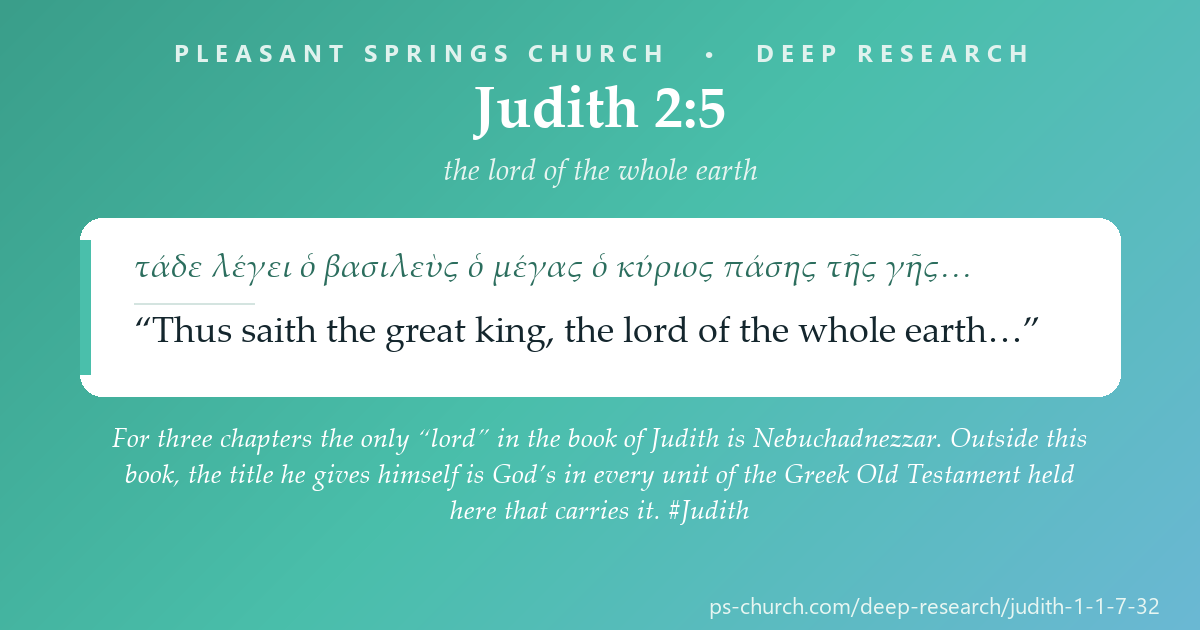
The first six words stand in two other units of the 30,348 screened — 2 Kings 18:19 and Isaiah 36:4, the Rabshakeh at the wall of Jerusalem — and at the seventh word the three part. There: king of the Assyrians. Here: the lord of all the earth, a title which, outside Judith, stands in eight units of these files and is God’s in all eight (Stage 3). The Latin has no title here at all.
VULGATE 2:5 et dixit ei : Egredere adversus omne regnum occidentis, et contra eos præcipue, qui contempserunt imperium meum.
The first time the word god appears in the book. In the 1,142 Greek words of chapters 1–2 there is no θεός at all. Here it comes twice in one sentence: every god of the land destroyed, so that every nation would call on Nebuchadnezzar as god. The four words ἐπικαλέσωνται αὐτὸν εἰς θεόν stand in no other unit of the 30,348. The Latin spreads the sentence over 3:12–13.
VULGATE 3:12 nam et civitates eorum destruxit, et lucos eorum excidit.
VULGATE 3:13 Præceperat enim illi Nabuchodonosor rex, ut omnes deos terræ exterminaret, videlicet ut ipse solus diceretur deus ab his nationibus quæ potuissent Holofernis potentia subjugari.
The God of Israel is named for the first time — in the 56th of the book’s 340 Greek rows. Israel has entered the story one verse earlier. From here to the end of chapter 4, every κύριος — seven of them — is God.
VULGATE 4:2 Tremor et horror invasit sensus eorum, ne hoc faceret Jerusalem et templo Domini, quod fecerat ceteris civitatibus et templis earum.
An Ammonite telling Israel’s story to Israel’s enemy. The form κατεξήρανεν (dried up) stands in two units of the 30,348: this one, and Joshua 2:10 — where Rahab, a Canaanite, tells Israel’s spies what her people had heard. Other forms of the verb stand elsewhere (Hosea 13:15). The Latin has the sea opened, not dried.
VULGATE 5:12 fugientibus his, Deus cæli mare aperuit, ita ut hinc inde aquæ quasi murus solidarentur, et isti pede sicco fundum maris perambulando transirent.
One verse, one word, two lords. Achior’s ὁ κύριός μου is Holofernes; his ὁ κύριος αὐτῶν is the God of Israel. The Greek makes no distinction between them; the 1769 English does — let my lord now pass by, lest their Lord defend them.
VULGATE 5:25 Si vero non est offensio populi hujus coram Deo suo, non poterimus resistere illis, quoniam Deus eorum defendet illos : et erimus in opprobrium universæ terræ.
KJV 6:3 “He will send his power, and will destroy them from the face of the earth, and their God shall not deliver them: but we his servants will destroy them as one man; for they are not able to sustain the power of our horses.”
The question the first half of the book is built toward. The four-word frame τίς θεὸς εἰ μὴ stands in no other unit of the 30,348 Greek Old Testament units screened and in none of the 7,927 New Testament verses — though the same question with another word for except, τίς θεὸς πλὴν τοῦ κυρίου, stands twice in Psalm 17:32 (Greek numbering; English 18:31). The Latin does not ask; it asserts: non est deus nisi Nabuchodonosor. And the English divides here: the second half of Greek 6:2 — he will send his power — opens KJV 6:3.
VULGATE 6:2 Quoniam prophetasti nobis, dicens quod gens Israël defendatur a Deo suo, ut ostendam tibi quoniam non est deus nisi Nabuchodonosor,
Thirty-four days in the Greek; per dies viginti — twenty — in the Latin. The two do not agree on the size of the army either (Greek 7:2: 170,000 foot and 12,000 horse; Latin 7:2: 120,000 foot and 22,000 horse), the year of the campaign, or the high priest’s name. The English line keeps its printer’s ‘inhibitants’; it is quoted as it stands.
VULGATE 7:11 Cumque ista custodia per dies viginti fuisset expleta, defecerunt cisternæ et collectiones aquarum omnibus habitantibus Bethuliam, ita ut non esset intra civitatem unde satiarentur vel una die, quoniam ad mensuram dabatur populis aqua quotidie.
⚠️ There is ONE Greek Judith on this shelf, not two. Unlike Tobit, the CATSS file holds a single text (Rahlfs’ edition, 340 rows, every label parsing). The manuscript variation recorded in the critical edition is not held here; Stage 5 says what that costs.
On the columns. The Greek is the CATSS morphological Septuagint, quoted at verse level with attribution, as on every page of this shelf. The English is the King James Apocrypha, standardised text of 1769, public domain — read from the verse-per-line file held on this disk, and printed with its own spelling and its own misprints; it is quotation, not a licensed parallel measured against the Greek, and in at least seven places in these chapters it departs from this Greek (Stage 5 lists them). The Latin is the Clementine Vulgate, which Jerome says he made from an Aramaic copy (Stage 2): it is a different and much shorter text, aligned here by content, and it is never a source for the English.
Versification — stated, as on every page here, and here it is a third state: there is no Masoretic Judith and no ESV of this book, so the usual Hebrew/Greek/English offset does not exist. The shelf’s versification table has no entry for Judith, and the page will not invent one. What does exist is three witnesses, counted:
• Greek (CATSS). 340 rows in 16 chapters. Chapters 1–7: 146 rows — 16 · 28 · 10 · 15 · 24 · 21 · 32.
• English (KJV, 1769). 339 verses — one fewer than the Greek. In chapters 1–7 the counts agree chapter for chapter, and the division still differs twice, found by reading the two side by side: the first clause of Greek 4:12 (sackcloth put round the altar) closes KJV 4:11, and the second half of Greek 6:2 opens KJV 6:3. The missing verse is in the other half of the book, and the page records where it went: Greek 15:14 (Judith leading the thanksgiving) is KJV 16:1; KJV 16:2–7 are Greek 16:1–6; KJV 16:8 joins Greek 16:7 and 16:8; from 16:9 to the end the two agree again. So KJV chapter 15 has 13 verses where the Greek has 14, and chapter 16 has 25 in both.
• Latin (Clementine). 346 verses; chapters 1–7 have 137 — 12 · 18 · 15 · 17 · 29 · 21 · 25. Within this range the Latin agrees with the Greek on the verse count in one chapter, the sixth — and agreement of count is not agreement of content: the Latin names the town’s rulers at its 6:11, the Greek at 6:15. Every Latin line on this page is aligned by content and labelled with the Latin’s own number.
The Shape of the Passage
Sequence in seven movements — with one word counted through itWhat is measured is the word running through it. κύριος occurs 22 times in the Greek of chapters 1–7. Every one of the first four is Nebuchadnezzar (2:5, 2:13, 2:14, 2:15). Every one of the next seven is God (chapter 4). Chapters 5–6 contend: Holofernes four times, Nebuchadnezzar once, God twice. And in chapter 7 every κύριος is God, while the chiefs of Esau and Moab and the captains of the coast (7:8) address Holofernes as δέσποτα. Rows of one colour have a single referent for every lord in them: the teal rows (2–3) only Nebuchadnezzar, the blue rows (4 and 7) only God; the two brass rows (5–6) are the contest; row 1, in grey, has no lord at all.
⚠️ What is read, not counted. The count of the word is the corpus’s. Who each one refers to is a reading of context — twenty-two decisions, all listed in Stage 3 so that a reader can check them. None of them is hard; all of them are ours.
⚠️ Where this page sits. Judith is filed here under Apocrypha / Deuterocanon. This library treats it as a witness worth reading closely; nothing taught at Pleasant Springs rests on it.
Author
Anonymous, and never on stage. No narrator says I; no author is named in the Greek or the Latin. The book is told in the third person from its first word.
A writer who puts history-shaped claims side by side and lets them stand. In the same seven chapters Nebuchadnezzar reigns over the Assyrians in Nineveh (1:1), and the people of Judea have recently come up from the captivity, with the temple consecrated again after its profanation (4:3) — and an Ammonite tells Holofernes that the temple was razed to the ground and the people have come back (5:18–19). The page reports the tension and does not resolve it; whether the reader was meant to notice is not a thing a corpus can measure.
And a writer who knows Israel’s story well enough to have an outsider tell it. The seventeen verses of Achior’s speech run from Chaldea to the return; Stage 4 measures which books their wording actually touches.
Audience
Readers for whom “who is lord?” was not abstract. The first half of the book is built around a claim to divinity: a decree that every god be destroyed so that one king is called god (3:8), and a general asking who is god except Nebuchadnezzar? (6:2).
Readers who may have known the Rabshakeh. The king’s first words in the book open exactly as the Assyrian envoy’s do at the wall of Jerusalem in 2 Kings 18 and Isaiah 36, and the general’s taunt — their God will not deliver them — asserts what the envoy put as a question. Measured in Stages 2 and 4; what a first reader heard in it is not.
And a town with no water. Chapter 7 ends with a people who would rather be slaves than watch their children die of thirst, and a ruler who gives God five more days. The book stops its first half there, on a deadline — and only then, at 8:1, introduces a widow.
Orient on the book, its two great names, and the one Greek text this shelf holds.
Search by topic: Judith, Book of; Holofernes; Achior; Bethulia; Nebuchadnezzar; Arphaxad; Esdraelon; Apocrypha; Deuterocanon; Vulgate (Jerome’s Judith).
Which articles are relevant?
- Anchor Bible Dictionary — “Judith, Book of,” “Holofernes,” “Achior,” “Bethulia,” “Nebuchadnezzar.”
- Eerdmans Dictionary of Early Judaism — “Judith” and the articles on Second-Temple historiography and Jewish novels.
- Dictionary of New Testament Background (IVP) — “Apocrypha and Pseudepigrapha.”
- On the text — any article that distinguishes the Greek (the form measured on this page) from Jerome’s Latin, which is a separate and shorter text. An article that cites “Judith 7:11” without saying which numbering it uses may be citing a different verse: the Greek 7:11 is the advice of the chiefs of Esau and Moab; the Latin 7:11 is the cisterns running dry.
Bibliography surfaced:
- Carey A. Moore, Judith (Anchor Bible 40, 1985).
- Deborah Levine Gera, Judith (Commentaries on Early Jewish Literature, 2014).
- Lawrence M. Wills, Judith (Hermeneia, 2019).
- Benedikt Otzen, Tobit and Judith (Guides to Apocrypha and Pseudepigrapha, 2002).
- Robert Hanhart, Iudith (Septuaginta, Vetus Testamentum Graecum VIII/4, Göttingen, 1979) — the critical Greek text. Not held; see Stage 5.
- NETS (A New English Translation of the Septuagint), Ioudith — an English made from the Greek, which the 1769 English on this page is not everywhere. Named as the obvious next step, not quoted here.
An Assyrian king’s envoy, a Persian demand, a Median city — and Jerome working by night.
Every source below was read for this study — the canonical ones in the Greek files on this disk; Jerome’s prefaces in the Latin, and Herodotus Books 1–4 in Macaulay’s English, both held on this disk; Herodotus Books 5 and 7 and Diodorus online in the named translations, which are not held here. Each is marked where it is used. Juxtaposition is not identification: where Judith and an outside text share a detail, the page sets them side by side and draws no line of dependence.
The Rabshakeh at the wall — 2 Kings 18 and Isaiah 36 (canonical; Greek, with our gloss)
2 Kings 18:19 (the Greek ‘4 Kingdoms’; same numbering in Hebrew and English):
καὶ εἶπεν πρὸς αὐτοὺς Ραψακης εἴπατε δὴ πρὸς Εζεκιαν τάδε λέγει ὁ βασιλεὺς ὁ μέγας βασιλεὺς Ἀσσυρίων τίς ἡ πεποίθησις αὕτη ἣν πέποιθας
[gloss, ours: And Rabshakeh said to them: Say now to Hezekiah, Thus says the great king, king of the Assyrians: what is this confidence in which you have trusted?]
Judith 2:5, the king’s first words in the book: τάδε λέγει ὁ βασιλεὺς ὁ μέγας ὁ κύριος πάσης τῆς γῆς — thus says the great king, the lord of all the earth.
Measured: the six words τάδε λέγει ὁ βασιλεὺς ὁ μέγας stand in exactly three of the 30,348 units screened — 2 Kings 18:19, Isaiah 36:4, Judith 2:5. Even the four-word core ὁ βασιλεὺς ὁ μέγας stands in those three and nowhere else — with its articles. Without them the two words stand in eight other units, and in three of them the great king is God (Psalms 46:3 and 94:3, Greek numbering; Malachi 1:14): βασιλεὺς μέγας ἐπὶ πᾶσαν τὴν γῆν, [gloss, ours: a great king over all the earth], Psalm 46:3 (Greek numbering; English 47:2). The Rabshakeh’s own genitive, τοῦ μεγάλου βασιλέως, stands in 2 Kings 18:28 and Isaiah 36:13. At the seventh word they part: the Rabshakeh’s king is king of the Assyrians; Judith’s is the lord of all the earth.
What the envoy asks, the general asserts. Isaiah 36:20: τίς τῶν θεῶν πάντων τῶν ἐθνῶν τούτων ἐρρύσατο τὴν γῆν αὐτοῦ ἐκ τῆς χειρός μου ὅτι ῥύσεται ὁ θεὸς Ιερουσαλημ ἐκ χειρός μου [gloss, ours: Who among all the gods of these nations rescued his land from my hand, that God will rescue Jerusalem from my hand?] Judith 6:2 ends: καὶ οὐ ῥύσεται αὐτοὺς ὁ θεὸς αὐτῶν — and their God will not rescue them. Counted: ῥύσεται occurs 30 times in the Greek Old Testament files screened; four stand in the Rabshakeh’s speech (2 Kings 18:32; Isaiah 36:15, 18, 20) and one in Holofernes’. A shared verb is a weak link and the page calls it one; the six-word opening is the strong one.
The demand for earth and water — Herodotus
Judith 2:7: Nebuchadnezzar tells Holofernes to order the West ἑτοιμάζειν γῆν καὶ ὕδωρ — to make ready earth and water.
Herodotus has Persian envoys demanding earth and water as the token of submission — the seven Persians Megabazus sends to Amyntas of Macedon to demand them for king Darius (5.17–18), and Xerxes’ heralds sent to the Greeks (7.32). Read online for this study in G. C. Macaulay’s translation, volume 2 (Project Gutenberg #2456, prepared from the third edition of 1914); that volume is not held on this disk.
Measured: γῆν καὶ ὕδωρ stands in one unit of the 30,348 — this one — and in none of the 7,927 New Testament verses. An Assyrian king in Nineveh, making a demand that Herodotus gives to Persian kings: the page notes it and goes no further.
Ecbatana and a Median king — Herodotus again
Judith 1:1–15: Arphaxad, king of the Medes, fortifies Ecbatana with walls and towers measured in cubits, and is killed in the mountains of Ragau by the king who reigns in Nineveh.
Herodotus 1.98 has Ecbatana walled by the Mede Deioces, in circles one within another, seven in number; 1.102 has his son Phraortes march against “those Assyrians … who dwelt at Nineveh” and die in the attempt. Macaulay’s translation, volume 1 (Project Gutenberg #2707, prepared from the edition of 1890), held on this disk and read there.
The name is the measured part. Αρφαξαδ stands 12 times in the Greek Old Testament files: five in Judith, where he is a Median king, and seven in Genesis and 1 Chronicles, where he is a son of Shem. In the New Testament he appears once, in Luke 3:36 — Shem’s son, in a genealogy. The page identifies Judith’s Arphaxad with no one.
The name Holofernes — Diodorus Siculus
Ολοφέρνης stands 44 times in the Greek Old Testament files, every one in Judith, and nowhere in the New Testament. Outside the Bible the name is in Diodorus Siculus 31.19.2, as a son of Ariamnes and younger brother of the Cappadocian Ariarathes (I), who promotes him; in the translation’s reading of 31.19.3 it is this brother who is sent to aid the Persians in their war against the Egyptians and comes home with honours from the Persian king Ochus. The Loeb editor’s note calls the spelling a textual corruption of Orophernes. Loeb Classical Library vol. XI (1957), read online at LacusCurtius; not held. A name, a Persian-era setting, and no more: the page draws no conclusion from it.
Jerome’s Latin — the preface
Jerome’s preface to his Judith says that among the Hebrews the book is read among the Hagiographa (the Writings), its authority judged less fit for settling disputed questions; that it was written in Chaldean (Aramaic) and is counted among the histories; that the Council of Nicaea is read to have counted it among the Scriptures; that he translated it sense for sense rather than word for word, in a single night’s work; and that he set down only what he could find whole in the Chaldean, cutting away the corrupt variety of the many copies. In his preface to the books of Solomon he writes that the Church reads Judith, Tobit and the Maccabees but does not receive them among the canonical Scriptures. Both prefaces were read in Latin in the Latin Library transcription of Jerome’s prologues, held on this disk; no other printing of them was checked, and neither preface is in the Clementine file held here.
Measured: the Latin of chapters 1–7 has 137 verses and 2,690 words against the Greek’s 146 and 3,894 — 0.69 Latin words for every Greek word. That does not set these chapters apart. Judith as a whole is 0.72, and its chapters 8–16 are 0.75. Across the 38 other books whose names match in the two sets of files, whole-book ratios run from 0.72 (Leviticus, level with Judith) to 1.40 (Baruch, whose Latin carries the Letter of Jeremiah as a sixth chapter); Leviticus 1–7 alone is 0.70; and Tobit, matched by hand, is 0.92 against its BA Greek but 0.70 against its S Greek. A rough measure — Latin has no article and the translators differ — and the page draws nothing from it about what Jerome cut.
The other book that puts Nebuchadnezzar in Nineveh
Of the 125 units in the Greek Old Testament files that name Ναβουχοδονοσορ, two also name Nineveh. One is Judith 1:1. The other is the last verse of Tobit in the BA text: καὶ ἤκουσεν πρὶν ἢ ἀποθανεῖν αὐτὸν τὴν ἀπώλειαν Νινευη ἣν ᾐχμαλώτισεν Ναβουχοδονοσορ καὶ Ασυηρος ἐχάρη πρὸ τοῦ ἀποθανεῖν ἐπὶ Νινευη [gloss, ours: and before he died he heard of the destruction of Nineveh, which Nebuchadnezzar and Ahasuerus took captive; he rejoiced before he died over Nineveh]
Two Second-Temple books, one name, one city: in Tobit (BA) he and Ahasuerus take Nineveh; in Judith he reigns in it. And Tobit’s other Greek text, S, names a different conqueror at the same verse. Measured on the files; the page does not say which, if either, is history.
The text’s own claims, measured: Nebuchadnezzar is king of the Assyrians, reigning in Nineveh (1:1, and the title five more times through 4:1); the word Babylon never occurs in Judith, though its stem stands 325 times in the Greek Old Testament files screened (298 of them Babylon itself, 27 Babylonia or Babylonians); and the Judea he marches on has recently come up from the captivity (4:3).
From outside this shelf, the standard chronology: Nineveh fell in 612 BC, and Nebuchadnezzar II reigned over Babylon from 605 to 562 BC. Elsewhere in the Greek Old Testament he is king of Babylon — the exact phrase Ναβουχοδονοσορ βασιλεὺς Βαβυλῶνος and its genitive form stand in 28 units, none of them Judith — and the one who destroys the temple whose return Judith 4:3 and 5:19 describe.
The page reports both and resolves neither. Whether the opening is error, disguise, or a signal to the reader that this is not a chronicle is a question for the commentaries named in Stage 1, which this page did not consult; it is not measurable, and none of this page’s findings depends on the answer.
Holofernes’ route — a sequence, as the text gives it
From Nineveh three days to the plain of Bectileth (2:21); the upper Cilicia; Put and Lud, the sons of Rassis and of Ishmael (2:23); across the Euphrates, through Mesopotamia, the high cities on the wadi Abrona, to the sea (2:24); Cilicia again, and the borders of Japheth toward Arabia (2:25); Midian (2:26); the plain of Damascus at wheat harvest (2:27); the coast — Sidon, Tyre, Sur, Okina, Jamnia, Azotus, Ascalon (2:28); Esdraelon near Dotaea (3:9); camp between Geba and Scythopolis for a month (3:10). It is a list, in the text’s order, and the page prints it as one.
Measured: seven of the places on the route and around Bethulia — Bectileth, Abrona, Okina, Belbaim, Kyamon, Egrebel and the wadi Mochmour — are named, under the spellings these chapters use, in one unit each of the 30,348, and that unit is always Judith. Dotaea is left off that list. Its spelling is in no other unit, but where 3:9 puts Esdraelon near Dotaea, 4:6 puts it near Δωθαϊμ — a name the book has again at 7:3, 7:18 and 8:3, and the files hold in Genesis 37:17 and 2 Kings 6:13 as well: seven times in six units. The great plain the whole half keeps returning to, Εσδρηλων, is named in four units, all of them Judith 1–7 (1:8, 3:9, 4:6, 7:3); elsewhere the Greek Old Testament files have ἐν τῇ κοιλάδι Ιεζραελ (in the valley of Jezreel, Judges 6:33, A text). And the town itself, Βαιτυλουα, stands 20 times in 19 units — every one in Judith. Beyond setting those two names side by side, identifying the places is not attempted here.
One word for lord, one title, one king’s name — and a verb form two outsiders share.
Every count below is over the 30,348 screened units of the Greek Old Testament files held here (the Odes excluded), the 7,927 verses of the Greek New Testament, or the 23,204 verses of the Masoretic Hebrew — never over “the Septuagint” or “the Bible.” Phrases are exact sequences of word forms; a single word or name is matched on its stem, so its count takes in every inflected form. Where a count is of units rather than occurrences, it says so.
22 occurrences in the Greek of chapters 1–7. Read by context: Nebuchadnezzar 5, Holofernes 4, the God of Israel 13. The first four are all Nebuchadnezzar; the God of Israel first holds the word at 4:2 and holds every occurrence in chapters 4 and 7. The 1769 English prints the king’s with a small l and God’s with a capital; the Greek has one word. Every decision is in the table below.
Ten units of the Greek Old Testament files carry the title, in any case. Eight are God’s — Exodus 8:18; Joshua 3:11, 3:13, 4:7; Psalm 96:5 (Greek numbering; Hebrew and English 97:5); Micah 4:13; Zechariah 4:14, 6:5. The other two are Nebuchadnezzar’s, both in Judith: his own words at 2:5, and at 6:4 in Holofernes’ mouth, introduced with says King Nebuchadnezzar. In the Hebrew the title is אֲד֖וֹן כׇּל־הָאָ֑רֶץ and it stands in six verses of the 23,204 — every one of them God’s. Zero in the 7,927 New Testament verses.
129 occurrences in 125 units of the Greek Old Testament files; 20 of them in Judith, 13 in chapters 1–7. King of Babylon in 28 units, none of them Judith; king of the Assyrians in five, all of them Judith (1:7, 1:11, 2:1, 2:4, 4:1). The word Babylon: its stem 325 times in those files (298 of them Babylon itself), never in Judith. Zero in the New Testament.
Two units of the 30,348: Joshua 2:10 and Judith 5:13. In Joshua it is Rahab, a Canaanite, telling the spies [gloss, ours: we have heard that the Lord God dried up the Red Sea before you]; in Judith it is Achior, an Ammonite, telling Holofernes. Both speakers are outsiders reporting what Israel’s God did; the page reports the coincidence of the verb form and nothing more. Other forms of the verb stand at Hosea 13:15 (and an adjective from it at Numbers 11:6).
Achior’s first name for Israel’s God (5:8), and the town’s in its prayer (6:19). The phrase stands in 35 units of the Greek Old Testament files: 2 Esdras (Ezra–Nehemiah) 12, Daniel 11 (Old Greek 6, Theodotion 5), Judith 3, Tobit 3, Genesis 2, Psalms 2, 2 Chronicles 1, Jonah 1. In the New Testament, twice — both in Revelation (11:13, 16:11).
Every κύριος in chapters 1–7, and whom the page reads it as meaning:
| row | read as |
|---|---|
| 2:5 | Nebuchadnezzar |
| 2:13 | Nebuchadnezzar |
| 2:14 | Nebuchadnezzar |
| 2:15 | Nebuchadnezzar |
| 4:2 | the God of Israel |
| 4:11 | the God of Israel |
| 4:13 | the God of Israel |
| 4:13 | the God of Israel |
| 4:14 | the God of Israel |
| 4:14 | the God of Israel |
| 4:15 | the God of Israel |
| 5:5 | Holofernes |
| 5:20 | Holofernes |
| 5:21 | Holofernes |
| 5:21 | the God of Israel |
| 6:4 | Nebuchadnezzar |
| 6:13 | Holofernes |
| 6:19 | the God of Israel |
| 7:19 | the God of Israel |
| 7:28 | the God of Israel |
| 7:29 | the God of Israel |
| 7:30 | the God of Israel |
The 22 positions are the corpus’s; the second column is ours. Three verses have two: 4:13 and 4:14, both God’s, and 5:21, which has one of each.
Counted here, not assumed:
- Judith is absent from her own first half. Ιουδιθ stands 32 times in the Greek Old Testament files, every one in Judith, and the first is 8:1. In chapters 1–7 Holofernes is named 15 times, Nebuchadnezzar 13, Bethulia 10, Achior 9, Ozias 5 — Judith 0.
- No θεός in chapters 1–2. 1,142 Greek words, and the word for god is not among them. Its first two occurrences are both in 3:8, and both are about Nebuchadnezzar: the gods to be destroyed, and the god he is to be called.
- ἐπικαλέσωνται αὐτὸν εἰς θεόν — that they should call upon him as god — one unit of the 30,348. And τίς θεὸς εἰ μὴ Ναβουχοδονοσορ — the four-word frame τίς θεὸς εἰ μὴ — one unit of the 30,348, none of the 7,927. Uniqueness completes at the third word: the two words τίς θεὸς open a question in three other units (Micah 7:18; Psalms 17:32, 76:14), and Psalm 17:32 (Greek numbering; English 18:31) asks the same question twice with another word for except: τίς θεὸς πλὴν τοῦ κυρίου. The shorter θεὸς εἰ μὴ is in four Greek Old Testament units (Judith 6:2; Psalms of Solomon 9:6, 15:2; Wisdom 7:28) and one New Testament verse, 1 Corinthians 8:4: οὐδεὶς θεὸς εἰ μὴ εἷς [gloss, ours: no God except one]. Three shared words, a confession and a boast; no claim is made of it.
- Achior the Ammonite — Αχιωρ — 13 times in Judith and once elsewhere, Numbers 34:27, where the Greek gives the name to a chief of the tribe of Asher.
- The high priest. Ιωακιμ (Joakim) in the Greek at 4:6, 4:8, 4:14 (and 15:8); the Latin names him Eliachim (Sacerdos etiam Eliachim, 4:5).
- Water. Words for water, springs and thirst (word forms beginning hydat-, hydōr, hydreu-, pēg- or dips-, counted as tokens) occur 14 times in chapter 7 of the Greek and at most twice in any other chapter of the book. The siege is a water siege, and the vocabulary says so.
Two screens, both directions, and the counter-examples printed beside the finds.
Contiguous runs of whole word forms; the tie band — how many units reach the same depth — printed beside every run, from both sides where both exist. Greek against Greek; a run of 1 means one shared word, 0 would mean none. The screen finds verbatim contact, not allusion, and it cannot tell a citation from a formula; a reader can.
Against the rest of the Greek Old Testament — the distribution
Judith 1–7, 146 rows, against the 30,008 screened units outside Judith: all 146 reach two, 143 reach three, 117 reach four, 55 reach five, 15 reach six, 7 reach seven, one of those goes on to ten, and nothing reaches eleven.
| Judith | run | band | partner | the shared words (Judith’s surface text) | the partner’s own deepest, against every other screened unit |
|---|---|---|---|---|---|
| 7:14 | 10 | 1 | 1 Maccabees 2:38 | αὐτοὶ καὶ αἱ γυναῖκες αὐτῶν καὶ τὰ τέκνα αὐτῶν καὶ — a household list: they, and their wives, and their children | 10, with Judith 7:14 alone (band 1) |
| 4:8 | 7 | 1 | Exodus 39:10 (Greek numbering; the Hebrew has the sentence at 39:32) | καὶ ἐποίησαν οἱ υἱοὶ Ισραηλ καθὰ συνέταξεν — and the sons of Israel did as … commanded | 7, band 3: Judith 4:8 and Numbers 9:5, 17:26 (English 17:11) |
| 4:10 | 7 | 2 | 1 Maccabees 2:38 · Daniel (Old Greek) 6:25 | αὐτοὶ καὶ αἱ γυναῖκες αὐτῶν καὶ τὰ — the household list again | neither partner’s deepest: 1 Maccabees 2:38 reaches 10 with Judith 7:14; Daniel (Old Greek) 6:25 reaches 9 with 1 Maccabees 2:38 and Judith 7:14 (band 2) |
| 4:14 | 7 | 1 | Haggai 1:12 | ὁ ἱερεὺς ὁ μέγας καὶ πάντες οἱ — the high priest, and all the | 8, with Haggai 2:4 (band 1); Judith 4:14 is not its deepest |
| 5:16 | 7 | 1 | Joshua 12:8 (Joshua B text) | τὸν Χαναναῖον καὶ τὸν Φερεζαῖον καὶ τὸν — a list of nations | 8, with Joshua 3:10 (B text; band 1); Judith 5:16 is not its deepest |
| 7:4 | 7 | 1 | 1 Maccabees 3:43 | καὶ εἶπαν ἕκαστος πρὸς τὸν πλησίον αὐτοῦ — and they said each to his neighbour | 7, with Judith 7:4 alone (band 1) |
| 7:5 | 7 | 1 | Deuteronomy 1:41 | καὶ ἀναλαβόντες ἕκαστος τὰ σκεύη τὰ πολεμικὰ — and taking up each the weapons of war | 7, band 3: Judith 7:5 and Deuteronomy 1:19, 6:20 |
⚠️ Read the top row as the page’s own counter-example. The deepest verbatim contact the first half of Judith makes with any other unit in the Greek Old Testament files is ten words, tie band 1 from both sides — and the ten are a list of who dies: they, and their wives, and their children. In 1 Maccabees 2:38 it is the households killed on the sabbath; in Judith 7:14 it is the town’s families, foreseen melting away in famine. The stretch is rare; its pieces are not. The ten words stand in exactly these two units; the first nine stand in a third as well (Daniel (Old Greek) 6:25), the last nine in a different third (Numbers 16:27); and every five-word window of the list stands in 4 to 11 units. Depth is not rarity of thought: the deepest contact this half of the book makes is a household list, in two different scenes.
And a band can be doubled by the corpus, not the text. The screened files carry two Joshuas, two Judges, two Daniels, two Tobits, two Susannas and two Bels; 7:18 ties at six with Judges 10:17 twice — once in each Judges file — which is one verse counted two times.
The two runs that carry the thesis
Judith 2:5 → 2 Kings 18:19 and Isaiah 36:4 — a run of six, tie band 2. The two partners are one scene told twice, the Rabshakeh at the wall (Stage 2), and the same three units are the only holders of the six-word string. From the other side, 2 Kings 18:19’s own deepest partner in the Greek Old Testament files is Isaiah 36:4 — eight words, band 1, the same speech — and Judith 2:5 comes next, at six. Six words, three units, one speech-opening.
Judith 6:4 → Exodus 8:18 — a run of five, tie band 1. The five are ὁ κύριος πάσης τῆς γῆς. From the other side the band is 16: Exodus 8:18 reaches five words with sixteen units, thirteen of them through the formula that I am the Lord the… — and the only two that share the title are Judith 2:5 and 6:4. Distinctive from Judith’s side, ordinary from Exodus’; the page prints both. Exodus 8:18 is God speaking: καὶ παραδοξάσω ἐν τῇ ἡμέρᾳ ἐκείνῃ τὴν γῆν Γεσεμ ἐφ' ἧς ὁ λαός μου ἔπεστιν ἐπ' αὐτῆς ἐφ' ἧς οὐκ ἔσται ἐκεῖ ἡ κυνόμυια ἵνα εἰδῇς ὅτι ἐγώ εἰμι κύριος ὁ κύριος πάσης τῆς γῆς [gloss, ours: …that you may know that I am the Lord, the lord of all the earth] (Greek and Hebrew number it 8:18; the English numbers it 8:22.) The Hebrew of that verse does not carry the title: וְהִפְלֵיתִי֩ בַיּ֨וֹם הַה֜וּא אֶת־אֶ֣רֶץ גֹּ֗שֶׁן אֲשֶׁ֤ר עַמִּי֙ עֹמֵ֣ד עָלֶ֔יהָ לְבִלְתִּ֥י הֱיֽוֹת־שָׁ֖ם עָרֹ֑ב לְמַ֣עַן תֵּדַ֔ע כִּ֛י אֲנִ֥י יְהֹוָ֖ה בְּקֶ֥רֶב הָאָֽרֶץ׃ [gloss, ours: …that you may know that I am the LORD in the midst of the earth]. Where the Hebrew does carry it, it reads, for instance at Joshua 3:11: הִנֵּה֙ אֲר֣וֹן הַבְּרִ֔ית אֲד֖וֹן כׇּל־הָאָ֑רֶץ עֹבֵ֥ר לִפְנֵיכֶ֖ם בַּיַּרְדֵּֽן׃ [gloss, ours: Behold, the ark of the covenant of the Lord of all the earth is passing over before you into the Jordan] — and the Greek of that verse: ἰδοὺ ἡ κιβωτὸς διαθήκης κυρίου πάσης τῆς γῆς διαβαίνει τὸν Ιορδάνην.
Achior’s seventeen verses (5:5–21) against the books that tell the same history
An Ammonite officer retells Israel’s story from Chaldea to the return: Mesopotamia, Canaan, famine, Egypt, brick and plagues, the Red Sea, Sinai and Kadesh-barnea, the Amorites, the Jordan, the nations driven out, sin, exile, the temple razed, and the return. Measured against the 30,008 screened units outside Judith: all 17 rows reach three, 14 reach four, 7 reach five, one reaches seven, and nothing reaches eight.
| Achior | run | single partner (band 1) | shared words | the partner’s own deepest |
|---|---|---|---|---|
| 5:7 | 4 | Joshua 24:15 | τοῖς θεοῖς τῶν πατέρων — the gods of the fathers — Joshua at Shechem: choose whom you will serve | 5, band 3 (Joshua 24:14; 1 Maccabees 7:8; 2 Esdras 5:6) |
| 5:9 | 5 | Genesis 12:5 | πορευθῆναι εἰς γῆν Χανααν καὶ — Abram setting out for Canaan | 6, with Genesis 14:12 (band 1) |
| 5:10 | 5 | 2 Chronicles 12:3 | καὶ οὐκ ἦν ἀριθμὸς τοῦ — a count formula | 5, band 2: Judith 5:10 and Isaiah 2:7 |
| 5:13 | 5 | Joshua 2:10 | ὁ θεὸς τὴν ἐρυθρὰν θάλασσαν — Rahab: [gloss, ours: the Lord God dried up the Red Sea] | 10, band 2 (Deuteronomy 31:4; Joshua 9:10), on the kings of the Amorites |
| 5:15 | 4 | Tobit (S) 14:8–9 | τῇ ἰσχύι αὐτῶν καὶ — a phrase, not a scene | 7, with 2 Esdras 10:11 (band 1) |
| 5:16 | 7 | Joshua 12:8 | τὸν Χαναναῖον καὶ τὸν Φερεζαῖον καὶ τὸν — the list of nations | 8, with Joshua 3:10 (band 1) |
| 5:18 | 5 | 1 Esdras 5:52 | καὶ ὁ ναὸς τοῦ θεοῦ — and the temple of God | 5, with Judith 5:18 alone (band 1) |
Seven of the seventeen rows have a single deepest partner, and three of those seven are in Joshua — the covenant speech at Shechem (24:15), Rahab’s report (2:10) and a list of conquered peoples (12:8). From the partners’ side the contact is thinner: only 1 Esdras 5:52 has an Achior verse as its single deepest partner, 2 Chronicles 12:3 ties Judith 5:10 with Isaiah 2:7, and Rahab’s verse reaches ten words elsewhere. The four rows that tell the exodus (5:10–13) reach the book of Exodus only once: at 5:11, where three Exodus verses tie with Daniel (Old Greek) 11:40 at four words around the king of Egypt, and the Red Sea line’s one partner is not Exodus 14 but Rahab. Rahab’s is the only other unit of the 30,348 with the form κατεξήρανεν, and she, like Achior, is an outsider. That is a description of where the shared words are, not a claim about what the writer was reading.
Against the Greek New Testament — the distribution, and the deepest run
Judith 1–7, 146 rows, against all 7,927 verses of the Greek New Testament: all 146 reach two, 128 reach three, 47 reach four, 6 reach five, 1 reaches six, and nothing reaches seven. Across all 340 rows of the book, two reach six and none reaches seven.
The six: Judith 7:28 → Acts 4:24, Acts 14:15 and Revelation 14:7 — tie band 3. The words are τὸν οὐρανὸν καὶ τὴν γῆν καὶ — heaven and earth and. In Judith the townspeople call heaven and earth to witness against their rulers; in Acts and Revelation it is God [gloss, ours: who made heaven and earth and the sea].
From the other side it is not close to anyone’s deepest. The six-word string stands in ten units of the Greek Old Testament files — nine passages, since Bel 5 is counted once in each Greek text (Exodus 20:11 and 31:17, Haggai 2:6 and 2:21, 2 Maccabees 7:28, Daniel (Old Greek) 4:37, Esther 4:17c, Bel 5 twice, and Judith 7:28). Acts 4:24 and Acts 14:15 each reach thirteen words with Exodus 20:11 (band 1): τὸν οὐρανὸν καὶ τὴν γῆν καὶ τὴν θάλασσαν καὶ πάντα τὰ ἐν αὐτοῖς. Revelation 14:7 reaches seven with Psalm 113:23 (Greek numbering; Hebrew and English 115:15), band 1. A formula with ten Old Testament holders and three New Testament ones; Judith’s copy is one of the ten.
⚠️ The counter-example — New Testament verses whose deepest Old Testament contact is Judith 1–7
Screened the other way — each New Testament verse against all 30,348 Greek Old Testament units — seven verses reach five words with a verse of these chapters among their deepest partners, and none goes deeper: three in a single Judith verse alone, one in two Judith verses, two tied with one verse of another book, and one in a 26-way tie:
| NT verse | its deepest Greek OT partner | run | band | the shared words | from Judith’s side (against the 7,927) |
|---|---|---|---|---|---|
| Revelation 7:11 | Judith 5:8 | 5 | 1 | αὐτῶν καὶ προσεκύνησαν τῷ θεῷ | 5:8 reaches 5 with Revelation 7:11 and 11:16 (band 2) |
| Revelation 11:16 | Judith 5:8 | 5 | 1 | αὐτῶν καὶ προσεκύνησαν τῷ θεῷ | the same |
| Luke 12:56 | Judith 7:18 | 5 | 1 | τὸ πρόσωπον τῆς γῆς καὶ | 7:18 reaches 5 with Luke 12:56 alone (band 1) |
| Revelation 16:4 | Judith 7:7 · 7:17 | 5 | 2 | καὶ τὰς πηγὰς τῶν ὑδάτων | 7:7 and 7:17 each reach 5 with Revelation 16:4 alone (band 1) |
| Acts 1:8 | Judith 4:13 · 1 Kings 10:22a (3 Kingdoms) | 5 | 2 | ἐν πάσῃ τῇ Ἰουδαίᾳ καὶ | 4:13 reaches 5 with Acts 1:8 alone (band 1) |
| Luke 2:51 | Judith 7:28 · 1 Samuel 25:9 (1 Kingdoms) | 5 | 2 | τὰ ῥήματα ταῦτα ἐν τῇ | 7:28 reaches 6 elsewhere (Acts 4:24, 14:15; Revelation 14:7; band 3) |
| Luke 16:17 | Judith 7:28 and 25 other units (24 passages; Bel 5 is counted in both Greek texts) | 5 | 26 | τὸν οὐρανὸν καὶ τὴν γῆν |
Below five words the same count goes on. Across all 7,927 verses, 1,321 have a verse of Judith 1–7 among their deepest Greek Old Testament partners (78 at one word, 870 at two, 313 at three, 53 at four, 7 at five). Twenty-two have a single Judith verse as their only deepest partner — the three at five words above, nine at four and ten at three — and one more (Revelation 16:4) has two Judith verses and nothing else.
Not one of them is a citation, and the page prints them so that nobody mistakes a band of 1 for a source. Two of the strings straddle a seam: in Revelation 7:11 their belongs to faces and in Judith 5:8 to parents, and a new clause begins after it in both; Luke’s face of the earth and goes on to the sky, where Judith’s and starts a new clause about tents. The springs of water are a besieged town’s in Judith and a bowl of wrath’s target in Revelation. Luke 2:51 and 16:17 share stock strings that other books hold as well. Unique is not the same as related.
It settles that no New Testament verse shares more than six consecutive word forms with Judith 1–7. The deepest run is a formula with ten Old Testament holders; every other contact is five words or fewer, and the five-word ones are stock phrases or joints between clauses. The New Testament never names Nebuchadnezzar, Holofernes, Achior, Bethulia or Judith (zero of each in 7,927 verses).
It does not settle that the book was unread. The run engine cannot see a shared question. 1 Corinthians 8:4–6 sets [gloss, ours: no God except one] against [gloss, ours: many gods and many lords] in its own words; the screen registers three shared words with Judith 6:2 and can register nothing more, and the page claims nothing more.
What this page could not check, where the English is not this Greek, and where the page is weakest.
This is the section that makes the shelf trustworthy, and for a book with no Hebrew, no critical edition on disk and an English made from a different printed Greek, it is long.
⚠️ A tool fault found while building this page — reported, not buried:
The shelf’s Greek New Testament loader returns MorphGNT’s normalised word column, while its own comment calls it the surface column. For measuring that is harmless — accents are stripped before any comparison — but anything printed from it shows forms the SBLGNT does not print (an acute where the text has a grave; a bracketed movable nu). Every New Testament word on this page is therefore read from MorphGNT’s word column directly, and the self-check re-reads it the same way. Reported for the tooling to fix; no number on this page depends on it.
⚠️ Where the 1769 English is not a translation of this Greek
Read side by side, verse by verse, the King James text departs from the CATSS Greek in at least these seven places in chapters 1–7. The list is what this reading found; it is not claimed to be exhaustive, and the page does not know which printed Greek the 1611 translators worked from, so no departure is blamed on anyone.
- 1:1 — the English has no ‘Assyrians’; the Greek reads ἐβασίλευσεν Ἀσσυρίων.
- 1:16 — the English sends him back to Nineve; the Greek row names no city.
- 2:23 — the English reads the children of Israel; the Greek reads υἱοὺς Ισμαηλ, sons of Ishmael, and so does the Latin (filios Ismaël, its 2:13).
- 3:9 — the English has near unto Judea; the Greek has πλησίον τῆς Δωταιας, near Dotaea.
- 4:4 — the English has and the villages where the Greek names a place, Κωνα.
- 7:14 — the English has them consumed with fire; the Greek has τακήσονται ἐν τῷ λιμῷ, melt away in famine.
- 7:27 — the English has than to die for thirst, which the Greek row does not have.
⚠️ What this page could NOT check:
- Anything Semitic behind the Greek. There is no Hebrew or Aramaic Judith on this disk. Jerome’s statement that he worked from a Chaldean copy is reported from his preface; the copy itself is not extant, and whether the Greek was translated from a Semitic original is argued in the commentaries and not tested here.
- The Greek manuscripts. CATSS prints Rahlfs’ text. The Göttingen edition (Hanhart, 1979) and the manuscripts it records are not held, so every run and count on this page is a figure for one printed Greek text; where the manuscripts differ, a number could move.
- The Old Latin and the Syriac. Not held. The Latin printed here is Jerome’s, and it is a different text, not a check on the Greek.
- The history. The dates of Nineveh’s fall and of Nebuchadnezzar’s reign are the standard chronology, reported, not measured. The places on Holofernes’ route are counted, not located.
- The commentaries. Moore, Gera, Wills and Otzen are named in Stage 1 as the next step; none of them was read for this page. Of the sources in Stage 2, Jerome’s prefaces (Latin) and Herodotus Books 1–4 (Macaulay) were read in copies held on this disk; Herodotus Books 5 and 7 and Diodorus were read online in the named translations and are not held; the Hebrew and Greek comparison verses were read in the files on this disk. Only one transcription of Jerome’s preface to Judith was read, so a variant in other printings of it would not have been seen.
- Allusion. The screens find verbatim contact. They cannot see a shared idea, and a run of one is not proof of independence any more than a run of ten is proof of copying.
⚠️ Where this page is weakest:
- The thesis rests on 22 readings. The count of κύριος is the corpus’s; who each one means is ours. Every decision is printed in Stage 3. If a reader disagrees with one, the shape survives; if with several, it should be re-drawn.
- The structure’s seven movements are the page’s divisions, drawn at changes of scene; the per-movement counts depend on where the lines fall.
- The Latin length figure is rough, and it does not single Judith out. 0.69 Latin words per Greek word in chapters 1–7 (Judith as a whole 0.72), against whole-book ratios from 0.72 (Leviticus) upward in 38 other books; Latin has no article, the translators differ, and a ratio is not a measurement of what Jerome left out.
- The Greek Old Testament screen counts recension pairs twice (two Joshuas, Judges, Daniels, Tobits, Susannas, Bels) and so can double a band or a count; the page names the places among the figures it reports where that happens — 7:18’s tie with Judges 10:17, and Bel 5 among the ten holders of heaven and earth and and the 26 behind Luke 16:17.
- The English column is quotation, not a measured parallel. There is no licensed English of this book to align to the Greek; the 1769 text is printed as it stands, and Stage 5’s list of departures is a reader’s list, not a machine alignment.
- The Vulgate alignments are by content and by eye — the eight in the codex and the few cited in the prose; the Latin’s chapters do not divide where the Greek’s do.
Commentaries & studies:
- Carey A. Moore, Judith (Anchor Bible 40, 1985). Not consulted.
- Deborah Levine Gera, Judith (CEJL, 2014). Not consulted.
- Lawrence M. Wills, Judith (Hermeneia, 2019). Not consulted.
- Benedikt Otzen, Tobit and Judith (2002). Not consulted.
- Robert Hanhart, Iudith (Göttingen Septuaginta VIII/4, 1979). Not held.
- Read for this page, held on this disk: Jerome, prefaces to Judith and to the books of Solomon (The Latin Library transcription of the prologues); Herodotus 1.98, 1.102 (Macaulay, vol. 1, Project Gutenberg #2707). Read online, not held: Herodotus 5.17–18, 7.32 (Macaulay, vol. 2, Project Gutenberg #2456); Diodorus Siculus 31.19 (Loeb XI, LacusCurtius).
A half-book with no heroine, and a question it leaves open on purpose.
Name what you learned, why it matters, and one concrete response.
What should we carry away — and do?
- The question comes before the answer. For seven chapters nobody in Judith answers who is god except Nebuchadnezzar? The book makes its readers sit with the question — and with a town that is running out of water while it waits.
- Titles are claims. The king’s first words open as the Assyrian envoy’s did at Jerusalem, and the title he takes is God’s in every unit of the Greek Old Testament held here that carries it outside this book. Listen to what a voice calls itself.
- An outsider tells the story. In these chapters it is an Ammonite who tells Israel’s story and states its rule: as long as they did not sin before their God, good things were with them (5:17). And the form of the verb in his Red Sea line stands in one other unit of the Greek Old Testament files: Rahab’s.
- Measure before you repeat. The first half of Judith touches the New Testament at six words of a formula and nowhere more deeply. Twenty-two New Testament verses — three at five words, nineteen at three or four — have one of its verses as their single closest Greek Old Testament partner, and none of them carries a citation formula or shares more than five words with it.
- One concrete response. This week, read 2 Kings 18–19 — the Rabshakeh at the wall — and then Judith 6–7. Both ask whether God will deliver a besieged people. Notice where Hezekiah takes the threat (2 Kings 19:14–19) and where Bethulia sets a deadline (Judith 7:30–31).
Judith 2:5 · to share
Greek (CATSS) · KJV Apocrypha (1769) · VulgateVULGATE 2:5 et dixit ei : Egredere adversus omne regnum occidentis, et contra eos præcipue, qui contempserunt imperium meum.
Every Deep Research page traces its passage across the whole sweep — the Old Testament, the Second-Temple world between the testaments (historical witnesses, not Scripture), and the New Testament. Follow the thread:
Pleasant Springs Church — Deep Research
Research method after Michael S. Heiser’s Bible Research Method (examine dictionaries → ancient literature → important words → textual connections → academic publications → share), with the Pleasant Springs “Author & Audience” foundation. Scripture set in the Hebrew, the Greek editions named on each page and the ESV (Old Testament), and the Greek New Testament and the ESV (New Testament), per the practice of Pleasant Springs Church. ⚠️ Status: Judith is not part of the Protestant canon. It is canonical in the Roman Catholic and Orthodox churches, was printed among the Apocrypha in the Reformation-era Protestant Bibles, and is absent from the Hebrew Bible. This study is filed under Apocrypha / Deuterocanon and nothing taught at Pleasant Springs rests on it. Greek text: the CATSS morphologically analysed Septuagint (Rahlfs), quoted at verse level with attribution; one file, Judith.mlxx; every row, run, band and count was re-derived from it for this study. English: the King James Apocrypha, standardised 1769 text, public domain, read from the verse-per-line file held on this disk (339 verses in 16 chapters) and printed verbatim; there is no ESV of this book, so the English is quotation from a named public-domain edition, not a licensed parallel measured against the Greek, and Stage 5 lists where it departs from this Greek. Latin: the Clementine Vulgate (public domain), printed as a separate witness aligned by content, never as a source for the English. Comparison verses are printed in the CATSS Greek, the Masoretic Hebrew (Sefaria, Miqra according to the Masorah) and the SBLGNT (via MorphGNT), with glosses marked as ours. ⚠️ NOT HELD: any Hebrew or Aramaic Judith, the Göttingen edition, the Old Latin, the Syriac. Classical sources are marked in Stage 2 as held on this disk or read online. Direction of influence is nowhere asserted.
Scripture quotations marked ESV are from the ESV® Bible (The Holy Bible, English Standard Version®), © 2001 by Crossway, a publishing ministry of Good News Publishers. ESV Text Edition: 2016. Used by permission. All rights reserved. The ESV text may not be quoted in any publication made available to the public by a Creative Commons license, and the ESV may not be translated in whole or in part into any other language. www.esv.org
|
Did this study bless you today? 💚 Give to Support PS Church100% of gifts go to the General Fund — thank you. |