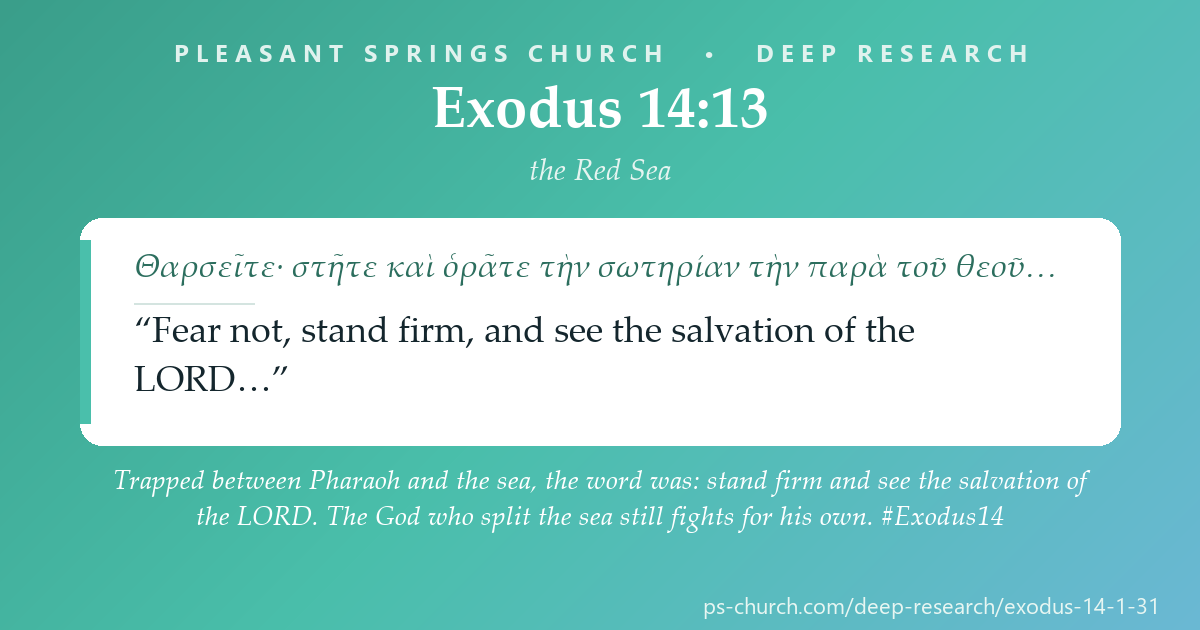
Trapped between Pharaoh’s chariots and an impassable sea, freed Israel panics — and Moses answers with the creed of the exodus: “Fear not, stand firm, and see the salvation of the Lord… the Lord will fight for you.” A wind divides the sea; Israel crosses on dry ground; the waters return on their enemies. This study works the Red Sea crossing — salvation through the water, told in the language of a new creation — all the way to baptism into Christ. See the method →
Exodus 14:1–31 (selections)
Hebrew · LXX · ESVThe Shape of the Passage
Ring compositionSame Author and audience as Exodus 3 — and the sea-crossing is the climactic act of the exodus, Israel’s definitive picture of the Lord as Redeemer and Warrior.
Author
The Torah of Moses stages the crisis: freed Israel is trapped between Pharaoh’s army and the sea, and panics. Moses answers with the exodus creed: “Fear not, stand firm, and see the salvation of the Lord… The Lord will fight for you, and you have only to be silent.” God drives back the sea by an east wind all night; Israel passes through on dry ground, walls of water to left and right; and the pursuing Egyptians are drowned. Salvation is entirely the Lord’s doing.
A new creation. The vocabulary is deliberate: a wind over the waters, the waters divided, dry ground appearing — the language of Genesis 1 and the flood. God brings his people through the waters of judgment into new life on the far shore.
Audience
Israel — who would sing this deliverance forever (the Song of the Sea, Exod 15) and rehearse it as the ground of faith: “the Lord is a warrior.” The Red Sea became the paradigm of every rescue — and of the ultimate one.
How they heard it. When you are trapped with no way out, salvation is not something you achieve but something you see the Lord do. “Stand firm… be silent” — the posture of faith before a God who fights for his people. And the same sea that saves Israel judges Egypt: deliverance and judgment in one act.
Orient on the sea-crossing, salvation, and the divine warrior.
Search by topic: Red Sea / Reed Sea, exodus, salvation, divine warrior, pillar of cloud.
Which articles are relevant?
- Anchor Bible Dictionary — “Red Sea,” “Exodus, The,” “Divine Warrior,” “Salvation.”
- Dictionary of the OT: Pentateuch — “Exodus,” “Red Sea,” “Salvation,” “Warfare.”
- NIDOTTE / TDOT — יְשׁוּעָה (yəšûʿâ, salvation), יַבָּשָׁה (yabbāšâ, dry land), לָחַם (lāḥam, fight), רוּחַ (rûaḥ).
Bibliography surfaced:
- Childs (OTL), Durham (WBC), Stuart (NAC); Frank Moore Cross, Canaanite Myth and Hebrew Epic.
- Tremper Longman & Daniel Reid, God Is a Warrior.
- Bernard Batto, Slaying the Dragon — the sea and the exodus.
The sea, the divine warrior, and the exodus as new creation.
Read the crossing against the ANE sea-and-warrior imagery, then note how the Scriptures and Second-Temple texts make the sea-crossing a creation and a hope.
Which parallels shed light on religion and worldview?
The divine warrior and the sea. The ANE told of storm-gods defeating the chaos-sea (Baal vs. Yamm; Marduk vs. Tiamat). The exodus uses the imagery of the Lord as warrior mastering the sea — but here the sea is no rival god; it is a tool in the Creator’s hand, driven back at his word to save his people and drown their oppressors. Israel’s poets celebrate the victory (Exod 15; Ps 77:16–20) without ever making the sea divine.
- Exodus 15 (the Song of the Sea) — “The Lord is a man of war… the waters were piled up”: one of Israel’s oldest hymns, the sea-crossing set to music.
- Psalm 77:16–20; 114; Isaiah 51:9–11 — the sea “saw and fled”; the Lord who “dried up the sea” called on to redeem again.
- Jubilees 48 (Pseudepigrapha — a witness, not Scripture) — retells the exodus and the sea, with Mastema opposing.
- Wisdom of Solomon 10:18–19; 19:1–9 (Apocrypha — likewise not Scripture) — the sea-crossing as new creation, the elements re-formed for Israel’s passage.
The New Testament reads the sea-crossing as a type of baptism and of salvation itself. Paul: “our fathers… all passed through the sea, and all were baptized into Moses in the cloud and in the sea” (1 Cor 10:1–2). As Israel passed through the waters of judgment from slavery to freedom, so the believer passes through the waters of baptism from death to life in Christ — “buried with him… raised” (Rom 6:4). And the redeemed of Revelation stand beside a sea of glass singing “the song of Moses… and the song of the Lamb” (Rev 15:2–3) — a new song that recalls Israel’s deliverance at the sea (the “song of Moses” also echoes Deut 32): the exodus rescue and the cross meet as one great deliverance, celebrated forever. When you have no way out, the God who split the sea still says, “stand firm, and see the salvation of the Lord.”
The vocabulary of salvation, dry ground, and the fighting God.
Watch the “salvation” Israel sees, the creation-echo “dry ground,” the wind that divides, and the God who fights.
“Salvation / deliverance” — the root behind the name Yeshua / Jesus. Here it is something Israel sees God do, not something they achieve.
“Dry ground” — the same word as the dry land of creation (Gen 1:9–10); dry land likewise reappears after the flood (Gen 8:13–14, a cognate verb): redemption as new creation.
“East wind” — God’s wind/Spirit driving back the waters, as the rûaḥ hovered at creation and passed over the flood: the same divine breath making a way.
“Will fight” — the Lord as warrior fighting for his people while they are silent. Salvation is his battle, not ours.
“Stand firm” — the posture of faith at the dead end: not fleeing, not fighting, but standing to see what God will do.
“And they believed” — from אָמַן (as at Gen 15:6): salvation seen produces faith. Deliverance is the ground of trust.
How the New Testament reuses the sea-crossing:
- 1 Corinthians 10:1–2 — “all passed through the sea, and all were baptized into Moses in the cloud and in the sea”: the crossing as a type of baptism.
- Hebrews 11:29 — “by faith the people crossed the Red Sea as on dry land”: the crossing as an act of faith.
- Romans 6:3–4; Colossians 2:12 — baptism as passage through death to new life: the Red Sea pattern in the believer.
- Revelation 15:2–3 — the redeemed by the “sea of glass” sing “the song of Moses… and of the Lamb”: the exodus victory fulfilled.
From the divided sea to the waters of baptism.
Trace the sea-crossing through the Psalms, the prophets, and the New Testament’s baptism theology — then note the Beale & Carson trajectory.
Which cross-references matter?
- Genesis 1:9–10; 8:1 — dry land from the waters and wind over the deep: the crossing as new creation.
- Exodus 15; Psalm 77:16–20; 106:9–12; 114 — the sea-crossing sung as the Lord’s signature act of salvation.
- Joshua 3–4; 2 Kings 2:8, 14 — the Jordan divided for Israel and for Elijah/Elisha: the exodus pattern repeated.
- Isaiah 43:1–3, 16–19; 51:9–11 — “when you pass through the waters… I will be with you”; the new exodus of the return, and of the gospel.
- 1 Corinthians 10:1–2; Romans 6:3–4; Revelation 15:2–3 — baptism into Moses, into Christ, and the final song of the sea.
The commentary’s treatment of 1 Corinthians 10 reads the sea-crossing as a divinely intended type: Israel’s passage through the sea “baptized into Moses” prefigures the church’s baptism into Christ — both a passage through waters of judgment into a redeemed people. Paul presses it as warning and assurance: the God who saved through the sea is the God who saves in Christ, and the same grace calls for faithful pilgrimage. From Genesis 1’s dry land to the Red Sea to the baptismal font, salvation runs the same course — through the water, by the wind of God, onto the far shore — until the redeemed sing the song of Moses and the Lamb.
The scholarship on the sea-crossing.
Childs for the exegesis; Cross and Longman/Reid for the divine-warrior theme; the studies on the exodus as new creation.
Commentaries & studies:
- Childs (OTL), Durham (WBC), Stuart (NAC), Sarna, Exploring Exodus.
- Frank Moore Cross, Canaanite Myth and Hebrew Epic; Tremper Longman & Daniel Reid, God Is a Warrior.
- Bernard Batto, Slaying the Dragon; studies on the “Reed Sea” (yam suph) geography and the miracle.
Interpretation notes worth keeping:
- “Red Sea” / “Reed Sea” (יַם סוּף, yam sûp̄): the exact body of water is debated; the theological point — God made a way through the sea by his own power — is not.
- The creation vocabulary (wind, divided waters, dry ground) is widely recognized: the exodus is told as a new creation, God bringing order and life out of chaos and death.
- “The Lord will fight for you” establishes the “divine warrior” theme that runs to the cross, where the decisive battle is won (Col 2:15).
From the dead end to the far shore.
Name what you learned, why it matters, and one concrete response.
What should we carry away — and do?
- Salvation is something you see, not achieve. At the dead end, “stand firm and see the salvation of the Lord.” The battle is his; faith’s posture is to trust and stand.
- God brings you through, not around. The way out led straight into the sea — and out the other side. Deliverance often runs through the deep to the far shore.
- Your baptism is a Red Sea. You have already passed through the waters from death to life in Christ (1 Cor 10:2; Rom 6:4). The decisive crossing is behind you; the promised land is ahead.
Step in response: name the “sea” you are trapped against this week, and take the exodus posture — stand firm, be silent, and watch for the salvation of the Lord — remembering you have already crossed the decisive sea in Christ.
Exodus 14:13 · to share
LXX + ESVEvery Deep Research page traces its passage across the whole sweep — the Old Testament, the Second-Temple world between the testaments (historical witnesses, not Scripture), and the New Testament. Follow the thread:
Pleasant Springs Church — Deep Research
Research method after Michael S. Heiser’s Bible Research Method (examine dictionaries → ancient literature → important words → textual connections → academic publications → share), with the Pleasant Springs “Author & Audience” foundation. Scripture set in the Hebrew, the Greek editions named on each page and the ESV (Old Testament), and the Greek New Testament and the ESV (New Testament), per the practice of Pleasant Springs Church. Exodus 14 research grounded in Childs, Durham, Stuart, Sarna, Cross, Longman & Reid, and Batto; ANE divine-warrior/sea background; Second-Temple exodus material per Jubilees 48 and Wisdom 19 (read as witnesses, not Scripture).
Scripture quotations marked ESV are from the ESV® Bible (The Holy Bible, English Standard Version®), © 2001 by Crossway, a publishing ministry of Good News Publishers. ESV Text Edition: 2016. Used by permission. All rights reserved. The ESV text may not be quoted in any publication made available to the public by a Creative Commons license, and the ESV may not be translated in whole or in part into any other language. www.esv.org
|
Did this study bless you today? 💚 Give to Support PS Church100% of gifts go to the General Fund — thank you. |