After the Passover night, Israel is out the door — and redemption immediately asks two things: a gift and a memory. Every firstborn now belongs to the Lord (“it is mine”), redeemed by a substitute; the feast and the sign on hand and brow exist so “the law of the Lord may be in your mouth” and pass to the children. Then Moses lifts Joseph’s bones — an oath four centuries old, kept — and the Lord himself goes before them in a pillar of cloud by day and fire by night that never departs. This study works Exodus 13:1–22. See the method →
Exodus 13:2, 9, 14, 19, 21
Hebrew · LXX · ESVThe Shape of the Passage
Parallel panelsThe Passover has happened; Israel is out the door. Before the sea, before Sinai, the narrator pauses on what redemption creates in the redeemed — a consecrated life, a catechized memory — and on the God who now walks visibly in front of them.
Author
The Torah of Moses holds two panels together in one chapter. First, the firstborn and the unleavened bread (13:1–16): because the Lord struck Egypt’s firstborn but spared Israel’s, every firstborn of Israel — of man and beast — now belongs to him: “Consecrate to me all the firstborn… it is mine” (13:2). A clean animal is offered; a donkey (unclean) is redeemed by a lamb or its neck is broken; and — unmistakably — “every firstborn of man among your sons you shall redeem” (13:13). Redemption costs a substitute. Alongside it stands the seven-day Feast of Unleavened Bread and a teaching device — “a sign on your hand” and “frontlets between your eyes” (13:9, 16) — whose whole purpose is that “the law of the Lord may be in your mouth” and be handed to the next generation.
‘When your son asks.’ Twice the chapter scripts a child’s question and a father’s answer (13:8, 14): “By a strong hand the Lord brought us out of Egypt, from the house of slavery.” Israel’s deliverance was never meant to be a private rescue but a story told at every table — the origin of the Passover Haggadah and of catechesis itself.
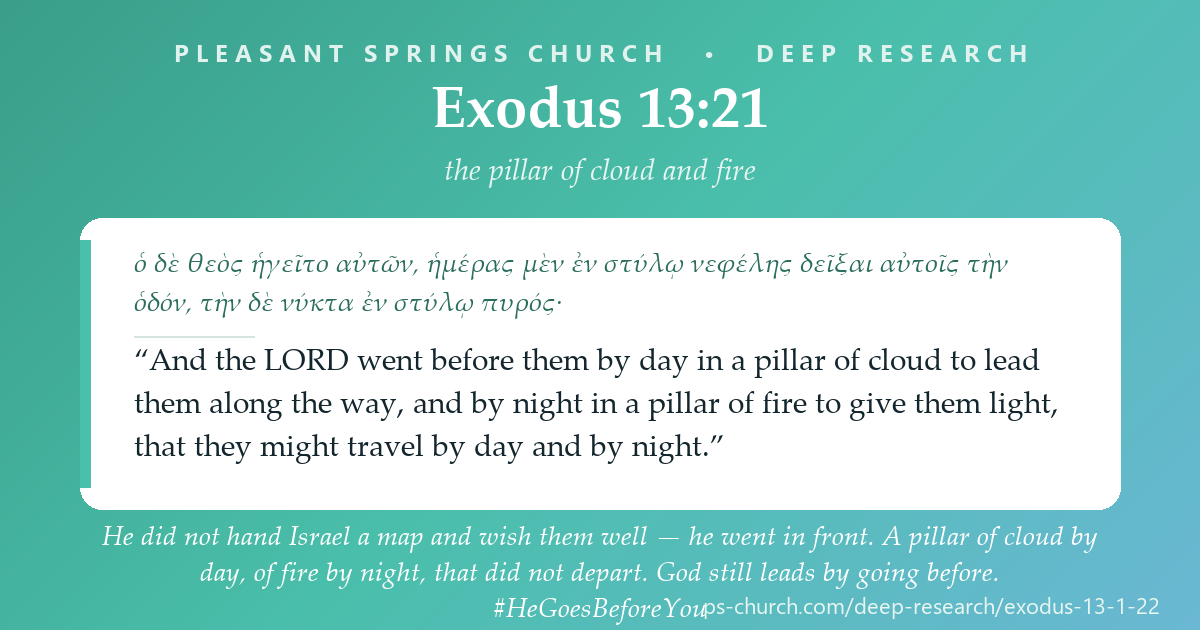
The pillar and the bones (13:17–22). God does not lead by the short coastal road through Philistine country, “lest the people… change their minds when they see war and return to Egypt” (13:17) — the tender wisdom of a Guide who knows what a fragile people can bear. Moses carries Joseph’s bones, keeping the oath sworn four centuries earlier (13:19; Gen 50:25) — a promise made in Genesis, kept in Exodus. And the Lord himself goes in front: “a pillar of cloud by day… a pillar of fire by night… that they might travel by day and by night” (13:21) — a presence that “did not depart” (13:22).
Audience
Israel — a people freshly redeemed, needing to learn what redemption means for the redeemed. Not less freedom but a new belonging: the firstborn “is mine.” The chapter answers the question every liberated people faces — now what? — with worship (consecrate), memory (keep the feast), and instruction (teach the children). Grace does not float free of obligation; it grounds a whole ordered life of gratitude.
Held soberly and hopefully. The consecrated firstborn look back to the terrible Passover night and forward to the Levites who will later stand in their place (Num 3:12–13), and to the temple redemption-price for every firstborn son — the same rite under which the infant Jesus was “presented to the Lord” (Luke 2:22–23). And the pillar taught Israel the deepest lesson of the wilderness: they were not marching alone toward an empty horizon. The God who had “come down to deliver” (3:8) now walked in front of them, day and night, and would fill the tabernacle with the same cloud and fire (40:34–38). For the church this is read — as devotional analogy, not the text’s plain sense — toward the One who is “the light of the world” (Jn 8:12) and the Spirit who leads (Rom 8:14): the presence that still goes before.
Orient on the firstborn, redemption, unleavened bread, and the pillar of presence.
Search by topic: firstborn / consecration, redemption of the firstborn, Feast of Unleavened Bread, phylacteries / frontlets, pillar of cloud and fire, shekinah / divine presence, wilderness itinerary.
Which articles are relevant?
- Anchor Bible Dictionary — “Firstborn,” “Redemption (OT),” “Unleavened Bread, Feast of,” “Phylacteries,” “Pillar of Cloud and Fire.”
- Dictionary of the OT: Pentateuch — “Firstborn,” “Passover and Unleavened Bread,” “Presence of God,” “Wilderness Wanderings,” “Joseph.”
- NIDOTTE / TDOT — בְּכוֹר (bəkōr, firstborn), קדשׁ (qādaš, consecrate), פדה (pādāh, redeem), עָנָן (ʿānān, cloud).
Bibliography surfaced:
- Brevard Childs, The Book of Exodus (OTL); Douglas Stuart, Exodus (NAC); John Durham, Exodus (WBC); Peter Enns, Exodus (NIVAC).
- T. D. Alexander on the firstborn and Passover; studies on the redemption of the firstborn and the Levitical substitution (Num 3; 8).
- Studies on the “pillar” and the divine presence / kabod in the wilderness traditions.
Firstborn rights, the taught memory, and the fire that guides an army.
Read the firstborn claim and the guiding fire against ancient Near Eastern custom and worship, then hear how the Second-Temple witnesses retell the exodus night and the pillar.
Which parallels shed light on religion and worldview?
The firstborn belongs to the deity. Across the ancient Near East the firstborn held pride of place — a double inheritance, the family’s future. Israel’s law makes a startling claim on exactly that treasure: the firstborn is the Lord’s, not by dread of the pagan practice of child sacrifice (which the Torah abhors, Deut 12:31) but by redemption — a lamb dies, the son is bought back (13:13, 15). The claim that could have meant death is turned into the pattern of substitutionary rescue.
A religion you wear and recite. “A sign on your hand… frontlets between your eyes” (13:9, 16) gave rise to the tefillin (phylacteries) — small boxes bound to arm and brow holding these very texts — and the twin-panel “When your son asks” became the heart of the Passover Haggadah. In a world of secret temple lore, Israel’s faith was designed to be worn, spoken, and taught to children at the table.
- Wisdom of Solomon 18:3–4 (a Second-Temple book, read as a witness, not Scripture) — celebrates the pillar as “a flaming pillar of fire” guiding the journey and giving light, while Egypt lay in darkness: the era’s meditation on Exodus 13–14.
- Jubilees 49 — retells the Passover and the going-out, binding the firstborn deliverance to the festival calendar (Second-Temple witness, not Scripture).
- Josephus, Antiquities 2.15.2–2.16.1; Philo, Life of Moses 1.166, 178–179 — the historian and the philosopher on the exodus route and the guiding cloud and fire (ancient witnesses, not Scripture).
- Mishnah Pesahim 10; the Passover Haggadah — the child’s question of 13:8, 14 grown into a whole liturgy of remembered redemption.
One quiet verse carries an astonishing weight of faithfulness. As Israel marches out, “Moses took the bones of Joseph with him” (13:19). Generations earlier, dying in an Egyptian palace, Joseph had refused an Egyptian tomb and made his brothers swear an oath: “God will surely visit you, and you shall carry up my bones with you” (Gen 50:25). For well over three centuries an unburied coffin had waited in Egypt as a standing prophecy — every Hebrew child who saw it was told, we are not staying here. Now the oath comes due, and Moses stoops to keep a dead man’s word. It is a portrait in miniature of the whole covenant: God is slow, and God is sure; the promise that seems to have died in Egypt is carried out on the shoulders of the redeemed. Joseph’s bones would go the whole wilderness way and be buried at last at Shechem (Josh 24:32) — faith’s long patience finally laid to rest in the land of promise.
The vocabulary of belonging, memory, and presence.
Watch the “consecrate” claim on the firstborn, the redeeming substitute, the “strong hand” refrain, the wearable/teachable sign, Joseph’s kept oath, and the guiding pillar.
“Consecrate to me” — set apart as holy, made wholly God’s. The redeemed firstborn are not merely spared but claimed: rescue creates belonging.
“Firstborn” — the family’s treasure and future. Spared on Passover night, now the Lord’s by right and “redeemed” (pādāh) by a substitute (13:13).
“By a strong hand” — the chapter’s refrain for the exodus. Not Israel’s strength but the Lord’s: the answer a father gives his child.
“Frontlets” / bands between the eyes — with “a sign on your hand,” the source of the tefillin: the redemption story bound to body and memory (cf. Deut 6:8).
“The bones of Joseph” — the oath of Genesis 50:25 kept four centuries later. God is slow and sure; the promise buried in Egypt marches home.
“Pillar of cloud and fire” — the visible presence going before Israel, guiding and giving light, which “did not depart.” The LXX names it ὁ θεός, “God,” where the Hebrew has YHWH.
How the rest of Scripture fills out the scene:
- Numbers 3:11–13; 8:16–18 — the Levites taken “instead of” the firstborn: the substitution of 13:13–15 written into Israel’s worship.
- Luke 2:22–23 — the infant Jesus “presented to the Lord” under this very law (“every male who first opens the womb”): the firstborn Son consecrated.
- 1 Corinthians 5:7–8 — “Christ, our Passover lamb, has been sacrificed… let us keep the feast… with the unleavened bread of sincerity and truth”: the feast of ch. 13 read forward (devotional).
- Nehemiah 9:12, 19; Psalm 78:14; 105:39; 1 Corinthians 10:1–2 — the pillar remembered as Israel’s guiding, sheltering presence — “our fathers… all passed through the sea… under the cloud.”
From the redeemed firstborn and the pillar to the presence that never departs.
Trace the firstborn/redemption theme and the guiding presence across the canon — then note the trajectory toward Christ and the Spirit, held as devotional analogy.
Which cross-references matter?
- Exodus 12:1–14 — the Passover night that grounds it all: the firstborn spared under the blood, now consecrated (see the Passover study).
- Exodus 14:19–24 — the pillar moves behind Israel at the sea, a wall of darkness to Egypt and light to Israel: guidance becomes protection (see the Red Sea study).
- Exodus 40:34–38; Numbers 9:15–23 — the cloud and fire fill the finished tabernacle and set Israel’s marching orders: the pillar comes to dwell (see the glory-filled tent).
- Deuteronomy 6:4–9, 20–25 — the sign on hand and brow and the child’s question become the Shema’s catechesis (see “these words… on your heart”).
- John 8:12; Hebrews 12:1–2; Colossians 1:15–18; Revelation 21:23 — “the light of the world”; the “firstborn” over all; the city needing no sun, “for the glory of God gives it light” (devotional trajectory).
Israel’s first lesson outside Egypt was not a map but a Guide. The Lord did not hand Moses a route and wish them well; he went in front — a column of cloud by day so the whole camp could see the way, a column of fire by night so no darkness could hide it — and the text lingers on the mercy of it: “the pillar of cloud by day and the pillar of fire by night did not depart from before the people” (13:22). He also chose their road for them, and against the obvious: not the short way that would have marched a slave-people straight into Philistine war and a panicked retreat to Egypt, but the long wilderness way that a fragile people could survive (13:17). This is how God still leads — going before rather than merely sending ahead, choosing the road we would not choose because he knows what we cannot bear, present in the dark as truly as in the day. The old teachers heard here, softly and as devotional analogy rather than the plain sense, the shape of the gospel: the God who walked visibly before Israel took flesh as “the light of the world” (Jn 8:12), and now leads his people by his Spirit (Rom 8:14) — until the city where “night will be no more” and the Lamb is its lamp (Rev 21:23–25). The pillar has a face.
The scholarship on the firstborn, the feast, and the pillar.
Childs, Durham, and Stuart for the exegesis; the studies on firstborn redemption and Levitical substitution; the work on the pillar and the divine presence.
Commentaries & studies:
- Brevard Childs, The Book of Exodus (OTL); John Durham, Exodus (WBC); Douglas Stuart, Exodus (NAC); Peter Enns, Exodus (NIVAC); Nahum Sarna, Exodus (JPS).
- T. D. Alexander, studies on Passover and the firstborn; treatments of the redemption-price and the Levites “in place of” the firstborn (Num 3; 8).
- Studies on the pillar of cloud/fire and the theology of divine presence (e.g., Sommer, The Bodies of God; the kabod traditions).
Interpretation notes worth keeping:
- Redemption, not sacrifice. The firstborn law (13:13, 15) institutes substitution — a lamb for the son — and stands worlds apart from the child sacrifice the Torah condemns (Deut 12:31; cf. the ram for Isaac, Gen 22). Grace claims the firstborn by buying, not killing, him.
- The LXX at 13:21. Where the Hebrew reads the covenant name YHWH going before Israel, the Greek reads ὁ θεός (“God”) — a translator’s reverence for the Name, not a change of who leads; the same presence, named two ways.
- Unleavened bread and the calendar. Ch. 13 fixes the seven-day feast “in the month of Abib” (13:4) as the annual re-telling — the liturgical engine that would carry the exodus memory across every generation (cf. 12:14–20).
- Joseph’s bones as literary bracket. The oath of Genesis 50:25 fulfilled at 13:19 (and the burial at Josh 24:32) frames the whole sojourn: what Genesis promised, Exodus carries, Joshua completes — one long faithfulness.
From the redeemed firstborn and the pillar to your own following.
Name what you learned, why it matters, and one concrete response.
What should we carry away — and do?
- Redemption makes you belong. The spared firstborn is not just rescued but claimed: “it is mine.” To be redeemed is to be owned by love — a lamb died in your place, and now your life is his.
- Keep the memory; teach the children. “When your son asks… you shall say, ‘By a strong hand the Lord brought us out.’” Grace un-recited dies in a generation; put the story in your mouth and theirs.
- He goes before you. God chose Israel’s long road because he knew their frailty, and walked in front by cloud and fire that never departed. He leads the same way still — present in the dark, choosing the road you would not, never absent.
Step in response: tell the story out loud this week — to a child, a friend, or your own soul: name one “strong hand” deliverance God has worked, and why it means you now belong to him. Then, wherever you cannot see the road, look for the pillar rather than the map: ask not “which way?” but “who goes before me?” — and follow the presence that does not depart.
Exodus 13:21 · to share
LXX + ESVEvery Deep Research page traces its passage across the whole sweep — the Old Testament, the Second-Temple world between the testaments (historical witnesses, not Scripture), and the New Testament. Follow the thread:
Pleasant Springs Church — Deep Research
Research method after Michael S. Heiser’s Bible Research Method (examine dictionaries → ancient literature → important words → textual connections → academic publications → share), with the Pleasant Springs “Author & Audience” foundation. Scripture set in the Hebrew, the Greek editions named on each page and the ESV (Old Testament), and the Greek New Testament and the ESV (New Testament), per the practice of Pleasant Springs Church. Exodus 13:1–22 research grounded in Childs, Durham, Stuart, Enns, and Sarna; the firstborn-redemption and Levitical-substitution studies (Num 3; 8); Second-Temple witnesses on the pillar and Passover (Wisdom of Solomon 18; Jubilees 49; Josephus; Philo — witnesses, not Scripture); the LXX’s ὁ θεός at 13:21 where the Hebrew reads YHWH; and the Christ/Spirit trajectory (Passover lamb, the light of the world, the leading Spirit) held as devotional analogy, not the text’s plain sense — per the house discipline for typology.
Scripture quotations marked ESV are from the ESV® Bible (The Holy Bible, English Standard Version®), © 2001 by Crossway, a publishing ministry of Good News Publishers. ESV Text Edition: 2016. Used by permission. All rights reserved. The ESV text may not be quoted in any publication made available to the public by a Creative Commons license, and the ESV may not be translated in whole or in part into any other language. www.esv.org
|
Did this study bless you today? 💚 Give to Support PS Church100% of gifts go to the General Fund — thank you. |