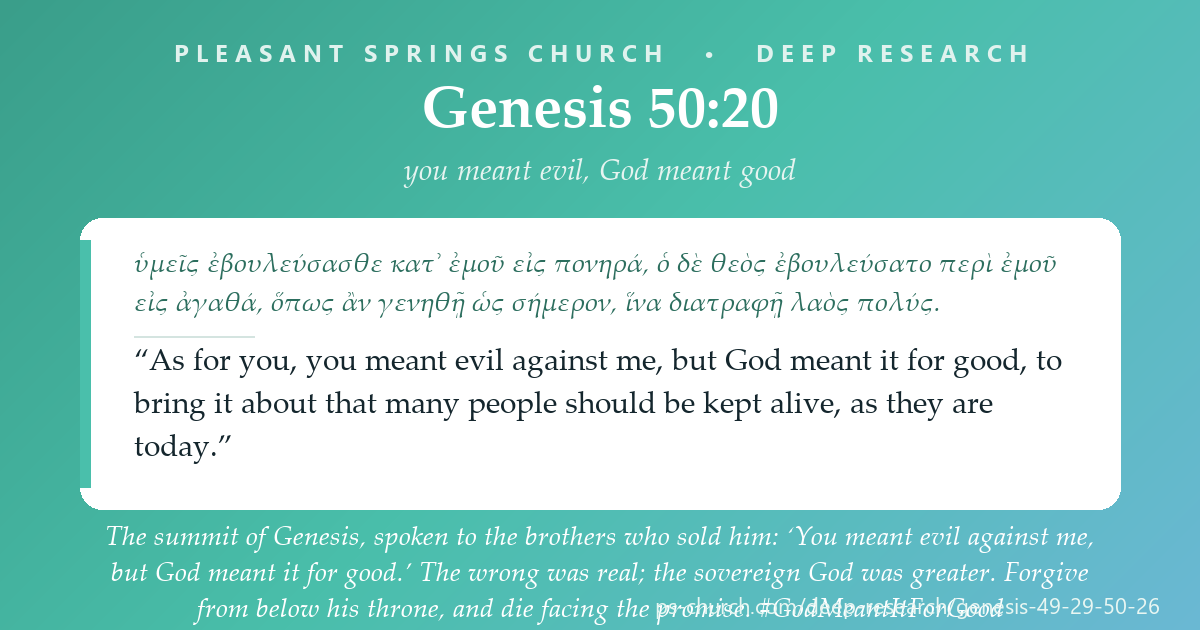
Genesis ends with two deaths and one sentence. Jacob is buried with the fathers at Machpelah; Joseph weeps, and a great Egyptian procession carries the pilgrim home to Canaan. Then the brothers, their father dead, fear revenge — and Joseph speaks the theological summit of the whole book: “Do not fear, for am I in the place of God? As for you, you meant evil against me, but God meant it for good.” The wrong was real; the sovereign God was greater; and both stand. Dying at 110, Joseph preaches the Exodus over his own bones: “God will surely visit you.” The book that opened “In the beginning, God created” closes facing redemption to come. This study works Genesis 49:29–50:26. See the method →
Genesis 49:33; 50:19, 20, 24, 25
Hebrew · LXX · ESVThe Shape of the Passage
Parallel panelsGenesis ends not with a wonder but with a grave, a fear, and a sentence — and that sentence, “you meant evil… God meant it for good,” is the theological summit of the whole book, the key that unlocks the Joseph story and the God who runs it.
Author
Moses closes his first book with two deaths and one confession. Jacob, having blessed his twelve sons (49:1–28), turns to burial: “I am to be gathered to my people; bury me with my fathers in the cave… at Machpelah” (49:29–32) — where Abraham and Sarah, Isaac and Rebekah lie, and where he himself had buried Leah. The land Israel does not yet possess already holds its dead; the grave is a claim on the promise. Then, in a line of great dignity, “when Jacob finished commanding his sons, he drew up his feet into the bed and breathed his last and was gathered to his people” (49:33). Joseph falls on his father’s face and weeps (50:1); Egypt embalms him and mourns seventy days; and a vast procession of Egyptian officials and chariots goes up to Canaan to lay him in the cave (50:2–13). The most powerful man in Egypt buries his father as a landless pilgrim, in a borrowed field in a country he does not rule.
The brothers’ fear. With the father gone, the old guilt resurfaces: “It may be that Joseph will hate us and pay us back for all the evil that we did to him” (50:15). They send a message in their father’s name pleading forgiveness, then fall down before him: “Behold, we are your servants” (50:18) — the very dreams of chapter 37 coming true one last, unwanted time. Joseph weeps again (50:17). He has already forgiven (45:5–8); their fear grieves him. And then he speaks the words the whole narrative has been climbing toward: “Do not fear, for am I in the place of God? As for you, you meant evil against me, but God meant it for good, to bring it about that many people should be kept alive, as they are today” (50:19–20). Two verbs, one object, one event: they reckoned it for evil; God reckoned the same act for good — neither pretending the evil was not evil, nor letting it have the last word.
‘God will surely visit you.’ Joseph lives to 110 — an ideal Egyptian lifespan — and sees Ephraim’s children to the third generation and Machir’s sons “counted as Joseph’s own” (50:23). Dying, he does the one thing that matters most: he preaches the Exodus before it happens. “I am about to die, but God will surely visit (paqad) you and bring you up out of this land to the land that he swore to Abraham, to Isaac, and to Jacob” (50:24). He binds Israel by oath to carry his bones home (50:25) — and so the last words of Genesis face away from Egypt, toward a redemption four centuries off. He is embalmed and “put in a coffin in Egypt” (50:26); the book ends with a body in a box in a foreign land, and a promise louder than the box.
Audience
Israel — the nation Moses was leading out of that very land — read the close of Genesis as the hinge of its own story. Joseph’s dying word, “God will surely visit you” (paqod yiphqod, 50:24–25), is the same emphatic paqad promise Moses would hear renewed at the bush and speak to the elders (Exod 3:16, “I have observed you”; cf. 4:31). The bones Joseph made them swear to carry are lifted out at the Exodus (“Moses took the bones of Joseph with him,” Exod 13:19) and buried at last in the Land at Shechem (Josh 24:32). Genesis ends in a coffin so that Exodus can begin in a rescue: the covenant does not die with its patriarchs, and Egypt is never the end of the road.
Providence over evil. For the church, 50:20 is the interpretive summit not only of the Joseph story but of a whole doctrine of providence. The brothers’ sin was real, culpable, freely chosen — the text never softens it (they “meant evil”). And the same event was, at one and the same time, God’s sovereign good purpose to preserve life — not evil permitted grudgingly and salvaged after the fact, but evil meant, aimed, woven by God toward good without God being its author (Gen 45:5–8; Ps 105:17; Acts 2:23; Rom 8:28). Joseph grounds his forgiveness in exactly this: “am I in the place of God?” — vengeance belongs to the One who governs all ends, so the wronged man is freed to comfort his wrongers (Rom 12:19; Eph 4:32). Held rightly, the two truths never cancel: human agents remain responsible for the evil they mean; God remains sovereign and good over the good he means through it.
Orient on burial and mourning, Machpelah, embalming, forgiveness, and providence.
Search by topic: death and burial, Machpelah, embalming / mummification, mourning customs, forgiveness, providence, Joseph, visitation (paqad), oath.
Which articles are relevant?
- Anchor Bible Dictionary — “Death and Burial,” “Machpelah,” “Embalming,” “Mourning,” “Joseph,” “Providence.”
- Dictionary of the OT: Pentateuch — “Joseph,” “Death,” “Blessing,” “Forgiveness,” “Providence,” “Egypt.”
- NIDOTTE / TDOT — gava’ (breathe one’s last), ’asaph (be gathered), qavar (bury), chashav (reckon, purpose), ra’ah / tovah (evil / good), chayah (keep alive), paqad (visit, attend to).
Bibliography surfaced:
- Gordon Wenham (WBC), Victor Hamilton (NICOT), Kenneth Mathews (NAC), Bruce Waltke, Nahum Sarna (JPS) on Genesis.
- Studies of the Joseph narrative’s theology of providence (von Rad, Brueggemann); of Egyptian embalming and mourning; and of forgiveness in the Old Testament.
- Beale & Carson, Commentary on the NT Use of the OT (Acts 7; Hebrews 11); treatments of Genesis 50:20 in works on providence and theodicy.
Egyptian embalming, a patriarch’s grave in Canaan, and the God who governs evil.
Read the death, the mourning, and the great confession against Egyptian funerary custom and the Bible’s theology of sovereign providence.
Which parallels shed light on religion and worldview?
Egyptian death, Hebrew hope. The narrative is precisely at home in Egypt: Jacob is embalmed by physicians over forty days, and the land mourns seventy (50:2–3) — figures that fit Egyptian mummification and its long mourning; Joseph too is embalmed and “put in a coffin” (’aron, a wooden Egyptian sarcophagus, 50:26). Yet the theology cuts hard against Egypt’s. Egypt embalmed its dead to secure them in Egypt forever, in eternal houses along the Nile. Jacob and Joseph are embalmed only to be carried out — one home to Machpelah now, one held in trust for the Exodus. The mummy of a patriarch becomes a portable promise: even in death these men refuse to be finally settled in Egypt (Heb 11:13–16, 22).
The grave as covenant claim. Jacob’s insistence on Machpelah (49:29–32) is theology in a burial plot. The cave Abraham bought (Gen 23) is the first parcel of the Land the patriarchs legally owned — a down-payment on a promise still unfulfilled. To be buried there beside Abraham, Sarah, Isaac, Rebekah, and Leah is to stake the family’s dead on the family’s future, to say with a corpse what the lips confessed: this land, not Egypt, is home. The great Egyptian cortege that escorts Jacob up to Canaan (50:7–9) unwittingly honors a claim it does not understand: the empire’s chariots carry a shepherd home to a country the empire does not own.
Providence, not fatalism. Genesis 50:20 is the ancient world’s deepest word on the problem of evil, and it refuses every cheap resolution. It does not say the brothers’ act was secretly good (they “meant evil”). It does not say God merely made the best of a bad situation after the fact (God “meant it” — the same verb, the same event, aimed from the start toward life). It does not make God the author of the sin (the evil is theirs, owned and named). What it asserts is that one event carried two intentions — a human intention to destroy and a divine intention to save — and that the divine intention, without erasing human guilt, governed the outcome for good. This is the doctrine later called concurrence or, in the reading this library follows, God’s sovereign purpose worked over and through genuinely free human agency (cf. Acts 2:23; 4:27–28) — neither the fatalism that dissolves responsibility nor the deism that dissolves providence.
- Genesis 23; 45:5–8; Psalm 105:16–22 — Machpelah purchased; “God sent me before you to preserve life”; the psalm’s retelling of Joseph as God’s providence in a man (see ‘God sent me before you’).
- Exodus 3:16; 4:31; 13:19; Joshua 24:32 — God “surely visits” his people; the bones of Joseph carried out and buried at Shechem: the dying oath of Genesis 50:25 kept.
- Acts 2:23; 4:27–28; Romans 8:28 — the definite plan of God worked through lawless human hands, all things for good: the New Testament’s Genesis-50 theology (see ‘if God is for us’).
The whole of Genesis has been quietly building toward the sentence Joseph speaks to his terrified brothers, and once it is spoken the book can end. ‘You meant evil against me, but God meant it for good.’ Everything the narrator has shown us — the coat and the pit and the caravan, Potiphar’s wife and the prison, the forgotten cupbearer and the seven lean years — is gathered up into a single theological claim: that the sovereign God of the covenant so governs the moral universe that even the free and guilty malice of men becomes, in his hands and without ceasing to be their sin, the instrument of his saving purpose. Note carefully what the verse does not do. It does not excuse the brothers; their intention is named evil and left there. It does not sentimentalize their crime into a blessing in disguise; what they did was wicked, and Joseph’s scars are real. And it does not make God the doer of the wrong; the evil is theirs, the good is God’s, and the two are held apart even as the one event serves them both. This is the mature doctrine of providence: not that evil is unreal, nor that God is helpless before it, nor that God authors it, but that God is great enough and good enough to mean the very act that men mean for ruin, and to mean it toward life. And notice where the doctrine lands Joseph — not in resignation but in tears and tenderness: ‘Do not fear… I will provide for you and your little ones.’ The man who has seen the providence of God most deeply is the man most able to forgive, because he no longer has to be God. ‘Am I in the place of God?’ Vengeance is God’s business; comfort can be ours. That is why the book of beginnings ends not with a curse repaid but with a family fed, and a coffin waiting on a promise.
The vocabulary of the ending: gathered, God’s place, reckoned, kept alive, visited.
Watch the dignified “gathered to his people,” the forgiving “am I in the place of God?”, the double “reckoned” of the summit verse, the saving “keep alive,” and the Exodus-word “surely visit” over Joseph’s bones.
“And he was gathered to his people” — the dignified idiom of a covenant death (25:8; 35:29): more than burial, a rejoining of the fathers who died in faith. Jacob dies as he lived, reaching toward the family of promise.
“Am I in the place of God?” — the ground of forgiveness. Vengeance belongs to the God who governs all ends (Deut 32:35; Rom 12:19); the wronged man steps out of the judgment seat and is freed to comfort. Jacob once said it in bitterness (30:2); Joseph says it in grace.
“You reckoned… he reckoned” — one verb (chashav, to plan, purpose, weave), one event, two intentions. The brothers aimed it at evil; God aimed the same act at good — neither pretending the evil was not evil, nor letting it be the last word. LXX ἐβουλεύσατο, “purposed.”
“To keep many people alive” — the good God meant: life for the nations through the famine, and a family preserved to carry the promise. The same purpose Joseph named at 45:5–7 — providence with a saving aim.
“God will surely visit” — the emphatic infinitive of paqad: to attend to, to intervene for. Joseph’s dying prophecy of the Exodus, echoed root-for-root at the burning bush (Exod 3:16) and fulfilled when Israel goes out.
“My bones” — the pledge that binds Genesis to the Exodus and the Land. Carried out by Moses (Exod 13:19), buried at Shechem (Josh 24:32), remembered as faith (Heb 11:22): a coffin in Egypt that refuses to stay there.
How the rest of Scripture fills out the scene:
- Genesis 25:8; 35:29; 49:33 — “gathered to his people”: the covenant death-idiom for Abraham, Isaac, and Jacob — a hope in the fathers that outlives the grave.
- Deuteronomy 32:35; Romans 12:19; Ephesians 4:32 — “vengeance is mine”: Joseph’s “am I in the place of God?” is the root of forgiving as one who has been forgiven, leaving judgment to God.
- Genesis 45:5–8; Psalm 105:16–22; Acts 2:23; Romans 8:28 — the providence of 50:20 across the canon: God’s sovereign good purpose over and through human evil (see ‘God sent me before you’).
- Exodus 3:16; 13:19; Joshua 24:32; Hebrews 11:22 — paqad, “surely visit,” and the bones of Joseph: the dying oath reaching from Genesis into the Exodus and the Land.
From a coffin in Egypt to a definite plan, an empty tomb, and all things for good.
Trace the providence, the forgiveness, and the awaited visitation toward their New Testament fulfillment.
Which cross-references matter?
- Genesis 37; 39–45; 50:20 — the whole Joseph arc read backward from its summit: pit, slavery, prison, and rise, all “meant” by God for the keeping of life (see the reconciliation).
- Genesis 44:18–34 — Judah’s self-offering in his brother’s place: the family’s repentance that Joseph’s forgiveness now completes — recorded as a devotional analogy to substitution, not a secret allegory (see Judah’s plea).
- Genesis 23; 47:29–31; 49:29–32 — Machpelah bought and the burial charge repeated: faith reaching for the Land through death (see the burial oath).
- Acts 2:23; 4:27–28; 7:9–16 — “the definite plan and foreknowledge of God” worked through lawless hands; Stephen’s retelling of Joseph and the burial at Shechem: the apostolic reading of Genesis 50.
- Romans 8:28; 12:19–21; Hebrews 11:22 — all things for good to those who love God; leave vengeance to God, overcome evil with good; “by faith Joseph… gave directions concerning his bones” (see ‘if God is for us’).
Genesis ends twice over — with a sentence and with a coffin — and both endings look past themselves. The sentence is Joseph’s to his brothers, and it is the hardest and freest thing a wronged man ever says: ‘you meant evil against me, but God meant it for good.’ What makes it possible is the question that precedes it: ‘am I in the place of God?’ Joseph can forgive precisely because he will not play God — will not seize the scales of final justice that belong to Another. He has suffered real evil at these men’s hands; he does not deny it, minimize it, or pretend it away. But he has come to see a larger hand at work above their malice, and that vision releases him from the exhausting labor of revenge into the lighter work of mercy: ‘I will provide for you and your little ones.’ The church has long heard here, held as resonance and not as strict exegesis, the shape of a greater Sufferer — betrayed by his own, sold, condemned, and raised to save the very ones who wronged him, whose word from the height of his exaltation is not vengeance but ‘Father, forgive.’ And then the coffin. The book of beginnings ends with a mummy in a box in Egypt — and that is not despair but the deepest faith in the book. Joseph will not let them bury him for good in the land of his glory; he makes them swear that when God visits, his bones go home. So the last word of Genesis is not death but a promise stronger than death: ‘God will surely visit you.’ The whole story of redemption is coiled in that coffin, waiting for an Exodus — and, past it, for a tomb that could not hold its occupant at all.
The scholarship on Genesis 49:29-50:26.
The commentators on the close of Genesis; the studies of the Joseph novella, its theology of providence, and Egyptian funerary custom.
Commentaries & studies:
- Gordon J. Wenham (WBC), Victor P. Hamilton (NICOT), Kenneth A. Mathews (NAC), Bruce K. Waltke, Nahum M. Sarna (JPS) on Genesis.
- Gerhard von Rad and Walter Brueggemann on the Joseph narrative and its wisdom-theology of hidden providence; Kenneth Kitchen and James Hoffmeier on the Egyptian setting and embalming.
- G. K. Beale & D. A. Carson, eds., Commentary on the NT Use of the OT (Acts 7; Hebrews 11); treatments of Genesis 50:20 in the literature on providence and theodicy.
Interpretation notes worth keeping:
- ‘God meant it for good’ (50:20). Read it in full strength: the same verb (chashav) governs both clauses and the same event both intentions. Neither collapse the evil into good (the brothers really sinned) nor make God its author (the evil is theirs). The house reading: God’s sovereign good purpose worked over and through free, culpable human agency — concurrence, not fatalism, and not deism.
- ‘Am I in the place of God?’ (50:19). Not modesty but theology: forgiveness rests on refusing the judgment seat that is God’s (Deut 32:35; Rom 12:19). The same idiom Jacob used in exasperation (30:2), Joseph turns toward grace.
- The brothers’ message (50:16–17). Whether Jacob truly left the charge or the brothers framed it, the narrator does not say; the point is their fear and Joseph’s tears. His weeping shows forgiveness already given (45:5–8) grieved by their doubt of it — a caution against reading suspicion into the reconciled.
- Embalming and the coffin (50:2–3, 26). The Egyptian details are accurate and theologically pointed: patriarchs embalmed not to stay in Egypt but to be carried out. Handle as local color turned to covenant hope (Heb 11:22), not as endorsement of Egyptian afterlife religion.
- The devotional analogy. Joseph-as-suffering-then-exalted-deliverer and Judah-as-substitute (ch 44) richly foreshadow Christ; hold them as resonance built on real patterns (Acts 7; Rom 8:28–39), not as the text’s literal sense — the house discipline for typology throughout this library.
From a grave in Canaan to the sentence that governs all our evils for good.
Name what you learned, why it matters, and one concrete response.
What should we carry away — and do?
- Evil is real; God is greater. “You meant evil… God meant it for good” refuses every cheap comfort: the wrong done you was truly wrong, and the sovereign God was truly at work over and through it for good (Rom 8:28). Both, and neither cancels the other.
- Forgive from below God’s throne. “Am I in the place of God?” Vengeance is his; comfort can be yours. The one who has seen God’s providence most deeply is freed to forgive, because he no longer has to play God.
- Die facing the promise. Joseph preached the Exodus from his deathbed and left his bones as a pledge. Hold the promise past the grave; refuse to be finally at home in Egypt; let the last word be “God will surely visit you.”
Step in response: take the deepest wound someone has meant against you and pray it slowly through Genesis 50:20 — naming the evil honestly, then handing the outcome to the God who means good through it — until you can step out of the judgment seat (“am I in the place of God?”) and, like Joseph, speak comfort instead of vengeance. And live this week as one who dies facing the promise: hold heaven so surely that you can be generous, unafraid, and free (Rom 8:28–39).
Genesis 50:20 · to share
LXX + ESVEvery Deep Research page traces its passage across the whole sweep — the Old Testament, the Second-Temple world between the testaments (historical witnesses, not Scripture), and the New Testament. Follow the thread:
Pleasant Springs Church — Deep Research
Research method after Michael S. Heiser’s Bible Research Method (examine dictionaries → ancient literature → important words → textual connections → academic publications → share), with the Pleasant Springs “Author & Audience” foundation. Scripture set in the Hebrew, the Greek editions named on each page and the ESV (Old Testament), and the Greek New Testament and the ESV (New Testament), per the practice of Pleasant Springs Church. Genesis 49:29–50:26 research grounded in Wenham, Hamilton, Mathews, Waltke, and Sarna, with von Rad and Brueggemann on the Joseph narrative’s theology of hidden providence and Kitchen and Hoffmeier on the Egyptian setting; the passage read as the close of Genesis — Jacob “gathered to his people” (49:33) and buried at Machpelah (49:29–32; Gen 23), the Egyptian embalming and mourning (50:2–3) turned to covenant hope; the summit verse (50:20) held in full strength, one verb (chashav) and one event carrying two intentions — the brothers’ real, culpable evil and God’s sovereign good purpose to keep many alive, neither cancelling the other and God never its author (45:5–8; Ps 105; Acts 2:23; Rom 8:28); forgiveness grounded in “am I in the place of God?” (50:19; Deut 32:35; Rom 12:19); and Joseph’s dying paqod yiphqod and the oath about his bones (50:24–25) reaching past Egypt to the Exodus (Exod 3:16; 13:19; Josh 24:32; Heb 11:22); the Joseph-as-sufferer-exalted and Judah-substitute resonances held as devotional analogy on real patterns, not the literal sense — per the house discipline for typology.
Scripture quotations marked ESV are from the ESV® Bible (The Holy Bible, English Standard Version®), © 2001 by Crossway, a publishing ministry of Good News Publishers. ESV Text Edition: 2016. Used by permission. All rights reserved. The ESV text may not be quoted in any publication made available to the public by a Creative Commons license, and the ESV may not be translated in whole or in part into any other language. www.esv.org
|
Did this study bless you today? 💚 Give to Support PS Church100% of gifts go to the General Fund — thank you. |