Joseph’s silver cup is planted in Benjamin’s sack, the brothers are overtaken and torn open, and Judah says the thing the reader has waited twenty years to hear a brother say: “God has found out the guilt of your servants.” Then comes the longest speech in Genesis — Judah retelling the whole story, pleading for Benjamin for their aged father’s sake, and finally offering himself: “please let your servant remain instead of the boy.” The very man who proposed selling Joseph now trades his own freedom to bring Rachel’s other son home. The seller has become the surety; repentance has learned to bear the cost. This study works Genesis 44:1–34. See the method →
Genesis 44:16, 18, 30, 33, 34
Hebrew · LXX · ESVThe Shape of the Passage
LeitwortThe longest speech in Genesis is not a sermon or an oracle but a plea — a guilty man offering to take a brother’s punishment on himself, and thereby proving that guilt can truly change.
Author
Moses builds the whole Joseph narrative toward this chapter. Twice already Joseph has tested his brothers — the demand for Benjamin, the imprisonment of Simeon, the returned silver — watching to see whether the men who once sold Rachel’s firstborn will now abandon Rachel’s second son to save themselves. The planted cup is the final probe, and it is engineered with cruel precision: it is placed in Benjamin’s sack alone, so that the brothers could ride home free if they simply let the boy be enslaved (44:17). The narrator wants us to feel the exact shape of the old sin re-offered — one favored son of Rachel, in the hands of hostile power, and eleven brothers free to walk away.
They do not walk away. “They tore their clothes” (44:13) — and all of them, though only Benjamin is charged, load their donkeys and return to the city. Judah’s opening word is the theological hinge of the book: “God has found out the guilt of your servants” (44:16). He is not confessing to the cup; he knows they did not take it. He is confessing to something the reader has waited twenty years to hear a brother name — the ‘awon, the buried iniquity of Genesis 37. The men who once lied to their father with a bloodied coat now accept a judgment they did not earn, because they finally see, beneath it, one they did.
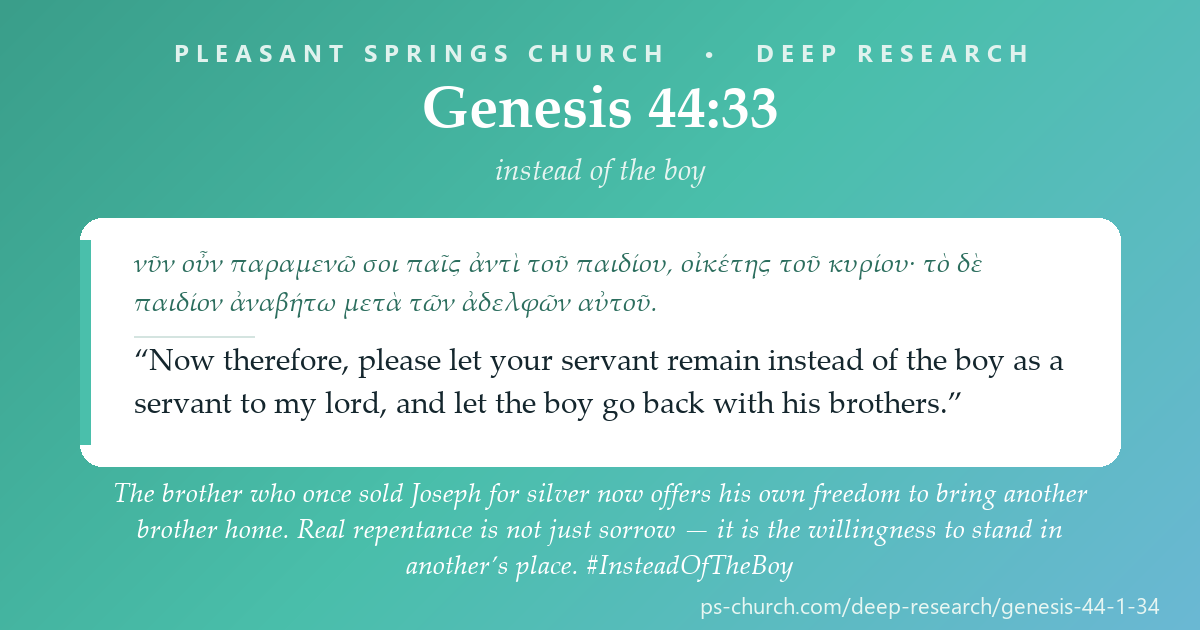
Judah’s plea (44:18–34). What follows is the longest uninterrupted speech in Genesis, and its art is disarmingly plain: no rhetoric, no bargaining, only the retelling of a family’s love and a father’s fragility, ending in an offer. Judah rehearses how their father clings to Benjamin because “his life is bound up in the boy’s life” (44:30); how he himself had become surety for the boy, pledging his own standing forever (44:32; cf. 43:9); and then he asks the unthinkable: “please let your servant remain instead of the boy as a servant to my lord, and let the boy go back with his brothers” (44:33). The tachat — “in place of” — is the word the whole chapter has been climbing toward. Judah, who profited from selling a brother into slavery, now volunteers into slavery to keep a brother free. This is what repentance looks like when it is real: not remorse only, but the willingness to bear the cost oneself.
Audience
Israel heard in Judah’s speech the making of a tribe. This is the same Judah who proposed the sale (37:26), who broke faith with Tamar and had to declare her “more righteous than I” (38:26), who is anything but a hero at the story’s start. That the leadership of the twelve tribes — and eventually the throne of David and the hope of Messiah — passes to this line is Scripture’s standing witness that God’s election runs through repentance, not through unblemished records. Genesis has just shown Israel the moment their royal tribe was morally born: at the point where a man stepped forward to bear another’s doom.
Substitution, surety, and the greater Judah. For the church, Genesis 44 is the Old Testament’s clearest human picture of one person taking the place of another — and the narrative labels it plainly as surety and substitution, not as a hidden prophecy. Held soberly as devotional analogy rather than strict prediction, the resonance is nonetheless hard to miss: the tribe of Judah, which would produce “the Lion of the tribe of Judah” (Rev 5:5), is first seen offering one of its own into bondage so that a brother might go free and a father’s grief be spared. Judah could only offer to substitute; he could not actually redeem — Joseph, moved to tears, would do the redeeming in the next chapter. But the pattern the gospel completes begins here: love proven by willingness to stand in the guilty one’s place (Jn 15:13; Rom 5:6–8; 2 Cor 5:21). The chapter asks its readers the question repentance always asks: are you willing to bear the cost?
Orient on divination cups, surety, substitution, repentance, and the tribe of Judah.
Search by topic: Joseph, Judah, divination and the cup, surety / pledge, slavery and servitude, repentance, tribe of Judah.
Which articles are relevant?
- Anchor Bible Dictionary — “Joseph,” “Judah (Person),” “Divination,” “Slavery (Old Testament),” “Surety.”
- Dictionary of the OT: Pentateuch — “Joseph,” “Judah,” “Repentance,” “Retribution,” “Blessings and Curses.”
- NIDOTTE / TDOT — ‘awon (guilt/iniquity), tsadaq (be in the right / clear oneself), ‘arab (go surety, pledge), tachat (in place of), nachash (divine).
Bibliography surfaced:
- Gordon Wenham (WBC), Victor Hamilton (NICOT), Kenneth Mathews (NAC), Bruce Waltke, Nahum Sarna (JPS) on Genesis.
- Studies of the Joseph novella as a unified narrative of testing and reconciliation; treatments of Judah’s character arc across Genesis 37–44.
- Robert Alter, The Art of Biblical Narrative (Genesis 38 and 44; the education of Judah); works on hesed, surety, and substitution in the Old Testament.
The divining cup, the pledge of a surety, and slavery for a theft.
Read the planted cup, the search, and Judah’s offer against ancient custom — divination, debt-surety, and the penalties for theft.
Which parallels shed light on religion and worldview?
The divining cup. Joseph’s steward calls the vessel the cup his lord drinks from and uses to practice divination (44:5) — lecanomancy, reading omens in the patterns of liquid or floating objects in a cup, was a known Egyptian and Mesopotamian art. The narrator is not endorsing it; he is letting Joseph play, for the last time, the fully Egyptian lord his brothers take him to be. The irony is layered: the brothers stand accused by a pagan rite that Joseph, the man who insists “interpretations belong to God” (40:8), does not actually practice. The cup is a prop in a test of character, not a real oracle — and yet it “finds out” a guilt the brothers really do carry.
Surety and the pledge of a life. Judah reminds Joseph, and reminds the reader, that he had become ‘arab — surety — for Benjamin, telling his father, “I will be a pledge of his safety… then let me bear the blame forever” (43:9; recalled in 44:32). In the ancient world a surety staked his own person and property against another’s obligation; the guarantor could be seized, enslaved, or ruined if the one he vouched for failed (cf. Prov 6:1–5; 22:26–27). Judah is not speaking loosely. Having legally bound his own future to Benjamin’s return, he now presents the bill to himself: the surety steps in to be seized in the debtor’s place. The Bible’s later vocabulary of redemption grows from exactly this soil — one who pays what another owes.
Slavery for a theft — and the offer of a swap. Ancient law codes treated theft from a ruler’s house as a capital or enslaving offense; the brothers themselves rashly propose death and slavery (44:9). Joseph mercifully narrows it: only the guilty party, Benjamin, need remain a slave; the rest may go home in peace (44:17). That “mercy” is the trap. It offers the brothers precisely the deal they once took — abandon Rachel’s son, keep your own freedom, return to your father with a story. Judah’s counter-offer detonates the test: he will not take the deal a second time. He asks to be enslaved instead of (tachat) the boy — the exact reversal of Genesis 37, where he sold a brother into slavery for silver. The man who once turned a brother into a slave for profit now offers to become a slave at a loss.
- Genesis 37:26–28; 38:26; 42:21–22 — Judah’s arc: the sale for silver, Tamar’s “more righteous than I,” the brothers’ dawning guilt (see the selling of Joseph and Judah and Tamar).
- Genesis 43:8–9; 44:32 — Judah’s surety pledge for Benjamin, staking his own standing forever (see the second journey to Egypt).
- Proverbs 6:1–5; 22:26–27; Philemon 18–19 — the surety who assumes another’s debt: “charge it to my account.”
Genesis has been unhurried and deliberate in showing us Judah at his worst. It was Judah who looked at his brother in the pit and calculated, ‘What profit is it if we kill our brother? Come, let us sell him’ — sentiment and self-interest wrapped together, a brother reduced to a transaction in silver. It was Judah who broke faith with Tamar and had to hear a wronged woman declare herself the more righteous of the two. He is not the son we would have chosen to carry the scepter. And that is precisely the point of Genesis 44. When the old sin is re-offered in a new form — one son of Rachel in chains, the rest free to go — the narrative holds its breath to see whether Judah has changed, and Judah answers with the longest speech in the book. He does not argue that Benjamin is innocent, though he is; he does not bargain the price down. He offers his own body in the boy’s place and asks only that the boy be sent home to the father whose life is bound up with his. This is repentance carried all the way to its costliest conclusion: not the feeling of sorrow, but the will to bear the penalty of the very sin one once committed against another. The man who sold a brother into slavery for gain now offers to become a slave at his own expense — and in that offer the tribe of the coming king is morally born. Scripture will not let us forget that the line of David and of David’s greater Son runs not through the flawless but through the forgiven, and that the surest mark of true repentance is a heart at last willing to pay.
The vocabulary of the plea: found-out guilt, surety, and 'in place of.'
Watch the confessed ‘awon, the ended self-justification, the father’s bound life, the surety’s pledge, and the substitution word tachat.
“Guilt / iniquity” — Judah’s word for what “God has found out.” Not the guilt of a cup they never stole, but the old buried ‘awon of Genesis 37. The LXX renders it ἀδικία (“wrongdoing”): a sin catches up with them at last (Num 32:23).
“Clear ourselves” — a rare reflexive of tsadaq, “to justify oneself.” Judah confesses that self-justification is finished: they cannot make themselves righteous. The vocabulary of justification, used to surrender it (cf. Rom 3:20).
“His life is bound up” — the father’s nefesh tied to the boy’s nefesh with the verb qashar, “to bind.” The LXX is vivid: ἐκκρέμαται, “hangs suspended from” his soul. To lose Benjamin is to kill Jacob (44:31).
“Became surety” — a legal pledge staking oneself for another’s obligation. Judah vowed to “bear the blame forever” (43:9); now he pays the pledge with his own freedom. The seed of the Bible’s redemption language (Prov 6:1; Heb 7:22).
“Instead of / in place of” — the substitution word the whole chapter climbs toward. Judah asks to remain a slave tachat ha-na‘ar, in the boy’s place. The same preposition names the ram offered “instead of” Isaac (22:13).
“Servant / slave” — the word woven through the plea. Judah, who turned a brother into an ‘eved for silver (37:27–28), now offers to become one himself so a brother may go free: slavery for profit answered by slavery at cost.
How the rest of Scripture fills out the scene:
- Numbers 32:23; Genesis 42:21–22 — “be sure your sin will find you out”: the buried guilt of Genesis 37 surfacing at last in the brothers’ own words.
- Genesis 22:13; Leviticus 16:21–22; Isaiah 53:5–6 — the ram tachat Isaac; the scapegoat bearing iniquity away; the servant “wounded for our transgressions”: the canon’s deepening picture of one bearing another’s doom.
- Genesis 49:8–12 — the dying blessing on Judah, the tribe of the scepter and the coming ruler: the royal line whose moral birth this chapter records.
- John 15:13; Romans 5:6–8; 2 Corinthians 5:21; Hebrews 7:22 — greater love laying down its life; the righteous dying for the unrighteous; the surety of a better covenant: the plea’s furthest horizon, held as analogy.
From a brother's offer in Egypt to the Lion of Judah who gives himself.
Trace the substitution, the surety, and the repentant tribe toward their fulfillment — carefully, as devotional analogy resting on real textual patterns.
Which cross-references matter?
- Genesis 37:26–27 — “let us sell him… for he is our brother”: the sale for silver that Genesis 44 reverses, word for word, in Judah’s offer of himself.
- Genesis 45:1–8 — the plea answered: Joseph, unable to keep the mask, weeps and reveals himself — “God sent me before you to preserve life.” Judah could offer to substitute; only Joseph could redeem (see Joseph makes himself known).
- Genesis 49:8–12 — “the scepter shall not depart from Judah”: the blessing that rests on the tribe morally born in this chapter.
- Exodus 32:32; Romans 9:3 — Moses and Paul each offering to be cursed in their people’s place: the intercessor who would take the doom himself, in Judah’s lineage of love.
- Revelation 5:5–9 — “the Lion of the tribe of Judah… a Lamb, as though it had been slain”: the tribe’s substitutionary pattern brought to its fulfillment — held as devotional analogy, not the chapter’s literal sense.
There is a temptation, reading Genesis 44, to make Judah’s speech into a coded prophecy of the cross, and the discipline of honest interpretation resists it. Judah is not a secret Christ; he is a forgiven sinner, and what he offers he cannot actually accomplish. He asks to remain a slave in Benjamin’s place, but Benjamin was never truly guilty, and Judah’s enslavement would have redeemed no one — the whole scene is Joseph’s device, and it is Joseph, not Judah, who holds the power to release. That is the honest limit of the analogy, and it should be kept. And yet, kept, the analogy is luminous rather than diminished. For the gospel does place a member of this very tribe in precisely Judah’s posture — stepping between a father’s beloved and the penalty, saying in effect, ‘let the debt fall on me and let them go free’ — and unlike Judah, he possesses the power to make the substitution real. Judah’s offer is love reaching the outer edge of what a sinner can do; Calvary is love doing what only the sinless can. The line from the one to the other is not a chain of prediction but a single, unmistakable shape: a son of Judah surrendering himself so that his brethren might be spared. Genesis lets us see the shape first in a man who meant it truly and could not carry it through, so that when we meet the Lion of the tribe of Judah who is also the Lamb, we recognize the family likeness — and understand that the willingness to bear another’s doom, first stammered out in an Egyptian audience hall, was always the heart of God.
The scholarship on Genesis 44:1-34.
The commentators on Judah’s speech; the studies of the Joseph novella, of Judah’s character arc, and of surety and substitution.
Commentaries & studies:
- Gordon J. Wenham (WBC), Victor P. Hamilton (NICOT), Kenneth A. Mathews (NAC), Bruce K. Waltke, Nahum M. Sarna (JPS) on Genesis.
- Robert Alter, The Art of Biblical Narrative and Genesis: Translation and Commentary (the education of Judah; Genesis 38 read alongside 44).
- Studies of the Joseph story as a unified novella (von Rad; Coats, From Canaan to Egypt); treatments of surety and substitution in Old Testament law and theology.
Interpretation notes worth keeping:
- The divining cup (44:5, 15). Joseph plays the Egyptian lord; the narrative does not commend lecanomancy, and Joseph elsewhere insists interpretation belongs to God (40:8). The cup is a device of the test, not an endorsed oracle.
- ‘God has found out’ (44:16). Judah confesses guilt for a crime he did not commit (the cup) because it has become the occasion for confessing the crime he did (the sale). Providence uses a false charge to surface a true one.
- The surety (44:32; cf. 43:9). Judah’s offer is not spontaneous heroics but the honoring of a legal pledge — he vowed to bear the blame, and he does. Integrity is a promise kept when the bill comes due.
- The tachat of 44:33. The substitution is explicit in the text’s own vocabulary (“in place of the boy”), and links to the ram “instead of” Isaac (22:13). This is the passage’s plain sense, not an allegorical overlay.
- The devotional analogy. Judah-as-substitute and the Lion-of-Judah reading (Rev 5:5) are homiletically rich and rest on real patterns, but Judah is a repentant sinner, not a hidden Christ — hold the resonance as analogy, per the house discipline for typology in this library.
From a planted cup to the love that offers to take another's place.
Name what you learned, why it matters, and one concrete response.
What should we carry away — and do?
- Real repentance bears the cost. The proof that Judah had changed was not remorse but willingness — to be enslaved in a brother’s place. Sorrow that will not pay is not yet repentance.
- Old sin surfaces to be healed. “God has found out the guilt of your servants” is not only judgment; it is the mercy that drags a buried wrong into the light where it can finally be confessed and mended.
- Love steps into the gap. Judah put himself between a father’s beloved and the penalty — the shape love always takes, and the shape the gospel fills to the full (Jn 15:13; Rom 5:8).
Step in response: name one old wrong you have kept buried — a betrayal, a debt, a broken faith — and, like Judah, stop trying to clear yourself (nitstaddaq) and simply confess it before God and, where you can, before the one you wronged. Then ask where love is calling you to stand in someone’s place this week: to absorb a cost, cover a debt, take a blame, or bear an inconvenience so that another can go free. And when the weight of your own guilt presses, look past Judah — who could only offer — to the Lion of his tribe who is also the Lamb, and who actually carried it through: “the Son of Man came… to give his life as a ransom for many” (Mk 10:45).
Genesis 44:33 · to share
LXX + ESVEvery Deep Research page traces its passage across the whole sweep — the Old Testament, the Second-Temple world between the testaments (historical witnesses, not Scripture), and the New Testament. Follow the thread:
Pleasant Springs Church — Deep Research
Research method after Michael S. Heiser’s Bible Research Method (examine dictionaries → ancient literature → important words → textual connections → academic publications → share), with the Pleasant Springs “Author & Audience” foundation. Scripture set in the Hebrew, the Greek editions named on each page and the ESV (Old Testament), and the Greek New Testament and the ESV (New Testament), per the practice of Pleasant Springs Church. Genesis 44:1–34 research grounded in Wenham, Hamilton, Mathews, Waltke, and Sarna, with Alter on the education of Judah (Gen 38 read alongside 44); the chapter read as the moral climax of the Joseph novella — the planted divining cup (44:5, 15) as the device of a final test, not an endorsed oracle; Judah’s confession of the buried ‘awon of Genesis 37 (44:16; cf. Num 32:23); his surety pledge (‘arab, 43:9; 44:32) honored at his own cost; and the explicit substitution of 44:33 (tachat ha-na‘ar, “instead of the boy”; cf. the ram “instead of” Isaac, 22:13). The Judah-as-substitute and Lion-of-Judah reading (Rev 5:5–9; cf. Jn 15:13; Rom 5:6–8; 2 Cor 5:21) is held as devotional analogy resting on real textual patterns — Judah a repentant sinner who could only offer, never a hidden Christ — per the house discipline for typology.
Scripture quotations marked ESV are from the ESV® Bible (The Holy Bible, English Standard Version®), © 2001 by Crossway, a publishing ministry of Good News Publishers. ESV Text Edition: 2016. Used by permission. All rights reserved. The ESV text may not be quoted in any publication made available to the public by a Creative Commons license, and the ESV may not be translated in whole or in part into any other language. www.esv.org
|
Did this study bless you today? 💚 Give to Support PS Church100% of gifts go to the General Fund — thank you. |