Joseph can restrain himself no longer. He empties the room and cries, “I am Joseph! Is my father still alive?” His brothers stand frozen with fear — and into their dread he speaks pure grace: “do not be distressed… because you sold me here, for God sent me before you to preserve life.” He names their sin and refuses to let it be the last word: “it was not you who sent me here, but God” (45:8) — both true, the seed of 50:20. Then weeping, kisses, wagons, and an old man’s numb heart revived: “It is enough; Joseph my son is still alive.” This study works Genesis 45:1–28. See the method →
Genesis 45:3, 4, 5, 8, 28
Hebrew · LXX · ESVThe Shape of the Passage
InclusioThe climax of the Joseph story is not a throne or a rescue but a reconciliation — and the theology that makes reconciliation possible: God’s saving purpose running sovereign over, and through, the very sin that meant to destroy.
Author
Moses has built this scene for maximum pressure and then released it. Judah has just finished the longest speech in Genesis (44:18–34), offering himself as a slave in Benjamin’s place so that his father’s grief will not kill him — the brother who once sold Joseph now ready to be sold for a brother. It is more than the disguised governor can bear. “Joseph could not control himself… He cried, ‘Make everyone go out from me’” (45:1). Alone with the ten, stripped of Egyptian ceremony, he weeps so loudly the household hears it through the walls, and speaks the two words that undo twenty-two years: ani Yosef, “I am Joseph” (45:3). The narrator lets the silence land — the brothers cannot answer, nivhalu mippanav, dumbstruck with terror before a face that holds their lives. Every reader who has felt guilt seen through knows this silence.
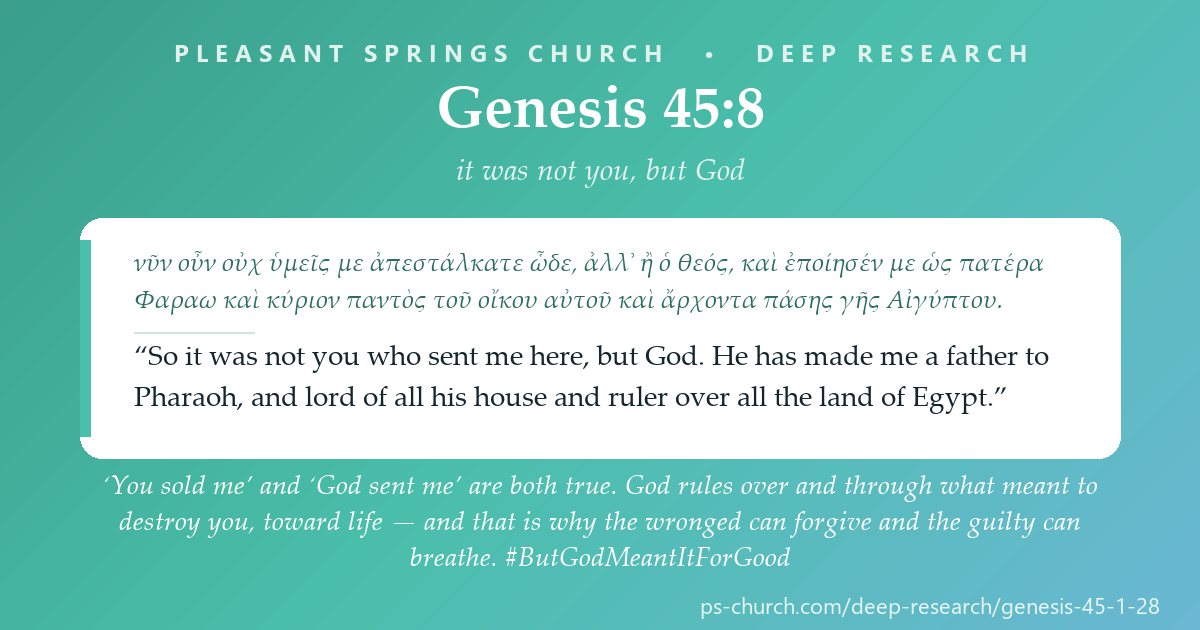
The interpretation of the whole story. Joseph does not minimize the crime; twice he names it plainly — “whom you sold into Egypt” (45:4), “because you sold me here” (45:5). But over the naked fact he lays a second, larger truth: “God sent me before you to preserve life” (45:5); “God sent me before you to preserve for you a remnant on earth” (45:7); “it was not you who sent me here, but God” (45:8). This is not the erasure of their guilt but its enclosure inside a purpose they could not see and did not intend. Their act was real, free, and evil; God’s act was real, sovereign, and good — and the same event served both. The divine name is deliberately Elohim, God the sovereign orderer of history, not the covenant name in fire: the point is providence, ordinary and hidden, governing a famine and a caravan and a pit and a prison toward the saving of many lives. Joseph has read his own suffering to the end of the sentence, and its last word is grace.
‘Joseph my son is still alive.’ The scene widens: kisses and tears over every brother (45:14–15), Pharaoh’s glad welcome and wagons (45:16–21), the charge to hurry Jacob and all the family down to Goshen. And when the news reaches the old man, Moses gives us one of Scripture’s tenderest turns: Jacob’s heart wayyapog — went numb, “for he did not believe them” (45:26); then, seeing the wagons, wattechi ruach Yaaqov, “the spirit of Jacob their father revived” (45:27). Israel, who has mourned Joseph as dead for two decades, speaks like a man raised: “It is enough; Joseph my son is still alive. I will go and see him before I die” (45:28). The dead son lives; the numb heart beats; the family is gathered. The shape of the joy is the shape of resurrection.
Audience
Israel — the nation that would one day sing “he had sent a man ahead of them, Joseph, who was sold as a slave” (Ps 105:17) — heard in this chapter the charter of its own existence. The twelve tribes exist because a wronged brother forgave, and because God had gone down into Egypt ahead of them in the person of a slave. Israel learned here to read its history theologically: the same events that looked like disaster (a favored son sold, a family driven by famine into a foreign land) were the hidden machinery of preservation. And it learned the ethic of the family of promise: not vengeance when you hold the power, but reconciliation — the brother who could have destroyed the ten instead weeps on their necks and settles them in the best of the land.
Providence, forgiveness, and the greater Brother. For the church, Genesis 45 is the Old Testament’s clearest lesson in how God’s sovereignty and human sin coexist without collapsing into each other. “You sold me” and “God sent me” are both wholly true: God ordained the life-saving end through their free and guilty choice, without being the author of their evil (the seed of 50:20 — “you meant evil against me, but God meant it for good”). This is not fatalism, which would dissolve their guilt, nor mere permission, which would surrender the outcome to chance; it is providence — the Lord who bends even malice to mercy while the malice remains fully its own. And the church has long heard, held carefully as devotional analogy and not as the chapter’s literal sense, the deeper rhyme: a beloved son rejected and “sold” by his brothers, humbled and reckoned as good as dead, then raised to a place of all authority, from which he does not avenge but forgives and feeds and gathers his own — and Judah, offering his own body in a brother’s place (44:33), foreshadowing the Lion of Judah who would truly take the sentence of the guilty. Joseph is not a secret Christ; but the God who wrote Joseph’s story wrote the gospel’s, and the family resemblance is not an accident (Acts 7:9–14; Rom 8:28).
Orient on reconciliation, providence, forgiveness, and the Joseph narrative’s shape.
Search by topic: Joseph, reconciliation, forgiveness, providence, Elohim / divine name, Goshen, famine, remnant.
Which articles are relevant?
- Anchor Bible Dictionary — “Joseph (son of Jacob),” “Reconciliation,” “Forgiveness,” “Providence,” “Goshen.”
- Dictionary of the OT: Pentateuch — “Joseph,” “Providence,” “Forgiveness,” “Divine Presence,” “Egypt.”
- NIDOTTE / TDOT — shalach (send), machyah (preservation of life), she’erit (remnant), bahal (be dismayed/terrified), chayah (live/revive).
Bibliography surfaced:
- Gordon Wenham (WBC), Victor Hamilton (NICOT), Kenneth Mathews (NAC), Bruce Waltke, Nahum Sarna (JPS) on Genesis.
- Studies of the Joseph narrative as a unified novella and of its theology of providence; treatments of forgiveness and reconciliation in the Old Testament.
- Gerhard von Rad, The Joseph Narrative and Ancient Wisdom; Robert Alter on the recognition scene.
The recognition scene, the wronged ruler, and providence over evil.
Read the disclosure, the forgiveness, and the providence statements against ancient recognition scenes and the Bible’s theology of divine sovereignty and human freedom.
Which parallels shed light on religion and worldview?
The recognition scene. Ancient storytelling prized the moment when a hidden identity is at last unveiled — the disguised figure who reveals himself to those who cannot yet see who he is. Genesis 45 is the masterwork of the form in Scripture: the governor of Egypt, whom the brothers have addressed in fear and through an interpreter, suddenly speaks Hebrew and says ani Yosef. But the biblical scene subverts its type. In the pagan versions the recognition typically triggers reversal and revenge — the wronged one now holds the power. Here the revelation triggers reassurance: “Come near to me… do not be distressed.” The power is total and the use of it is mercy. What the culture expected to be a scene of retribution Moses makes a scene of grace.
The wronged ruler who forgives. In the ancient Near East a vizier so betrayed and now so elevated would be within every right to execute the ten. Joseph instead draws them close, names their crime without flinching, and then dismantles the fear that names it: he reframes the past not by denying the sin but by enclosing it in a purpose. Notice the pastoral order — he does not say “it was nothing” (it was not nothing; they meant murder and settled for slavery), nor “you are forgiven, now grovel”; he says, in effect, God has been at work in and beyond your evil, so let the terror go and let us live. Forgiveness here is not the pretense that no wrong occurred; it is the refusal to let the wrong have the final say — grounded in a confidence about God, not a low view of sin.
Providence over and through evil. The chapter’s three providence sentences (45:5, 7, 8) are the Old Testament’s densest statement of a truth the whole Bible holds: God governs history sovereignly, and human beings act freely and answerably, and these are not rivals dividing the event between them but two full descriptions of the one event. “You sold me” is completely true — a free, wicked, culpable act. “God sent me” is completely true — a sovereign, wise, saving intention that ran through their choice to an end they neither wanted nor imagined. God did not plant the malice in their hearts (he is not the author of their sin); he ordained to bring life out of the death they intended, so that the very act by which they tried to be rid of Joseph became the road by which Joseph was set to save them. This is the doctrine later sung (Ps 105:16–22), stated by Joseph again at 50:20, and lived to its uttermost at the cross, “delivered up according to the definite plan and foreknowledge of God” and yet “crucified and killed by the hands of lawless men” (Acts 2:23) — the same grammar, the same God.
- Genesis 37:18–28; 42:6–9; 44:18–34 — the sale, the first bowing, and Judah’s self-offer: the story the recognition scene resolves.
- Genesis 50:15–21; Psalm 105:16–22; Acts 2:23; 4:27–28 — “you meant evil… God meant it for good”; the sold slave who saved; the cross under the same providence.
- Acts 7:9–14; Hebrews 11:22; Romans 8:28 — Stephen’s retelling, Joseph’s faith, and the promise that God works all things toward good for those he calls.
The whole moral and theological weight of the Joseph story rests on a single sentence spoken twice: it was not you, it was God — and yet, you sold me. Joseph does not resolve the tension by subtraction. He does not say, ‘It only looked as though you sold me; really God did it,’ which would make God the author of their sin and the brothers innocent puppets. Nor does he say, ‘You sold me, and God merely made the best of your mess afterward,’ which would leave the outcome to luck and God to improvisation. He holds both at full strength: their act was genuinely free and genuinely wicked, and God’s purpose was genuinely sovereign and genuinely good, and the one event carried both meanings the whole way down. This is the mystery the Scriptures never dissolve and never abandon — that the Lord so governs the free acts of moral agents, including their sins, that his good ends are infallibly reached through them, while the evil remains fully and only theirs. It is why Joseph can weep on the necks of men who tried to murder him: he has learned to read providence without excusing sin, and to name sin without despairing of providence. A believer who grasps Genesis 45 has the key to Romans 8:28 and to the cross — and the freedom, when wronged, to say to those who wronged him, ‘you meant it for evil; God meant it for good; come near to me, and let us live.’
The vocabulary of disclosure, forgiveness, and providence.
Watch the two-word revelation, the crime twice named, the ‘you sent / God sent’ contrast, the aim ‘to preserve life,’ the brothers’ terror, and the old man’s reviving spirit.
“I am Joseph” — the two words (LXX Ἐγώ εἰμι Ιωσηφ) that end twenty-two years of hiding and grief. The hidden brother unveils himself not to avenge but to save; the revelation itself is grace (cf. the disclosure that overwhelms in Lk 24:31).
“You sold” — LXX ἀπέδοσθε. Joseph names the crime twice and never erases it. Forgiveness that reframes the past does not deny the sin; it refuses to let the sin be the final word (Gen 37:28).
“God sent me” — set against “you sent me” (45:8, lo’ attem shelachtem). Same verb, two subjects, one event: the free evil deed and the sovereign saving purpose, both wholly true (Ps 105:17).
“To preserve life” — LXX εἰς ζωήν. The stated aim of the whole ordeal: not Joseph’s vindication but a family’s survival and “a remnant” kept alive (45:7). Providence bends the pit toward preservation.
“They were dismayed” — bahal, struck with terror; LXX ἐταράχθησαν. Guilt seen through is speechless before the face it wronged — until grace speaks first: “Come near to me” (45:4).
“The spirit… revived” — LXX ἀνεζωπύρησεν, was rekindled. Jacob’s numb heart (45:26, wayyapog libbo) comes back to life at the news that his dead son lives: joy shaped like resurrection (cf. Lk 15:24).
How the rest of Scripture fills out the scene:
- Genesis 50:15–21 — the mature restatement: “you meant evil against me, but God meant it for good, to bring it about that many people should be kept alive” — 45:5 grown to full doctrine.
- Psalm 105:16–22; Acts 7:9–14; Hebrews 11:22 — Israel’s song, Stephen’s sermon, and the roll of faith all reading Joseph as God’s man sent ahead.
- Acts 2:23; 4:27–28; Romans 8:28 — the same providence-grammar at the cross, and the promise that God works all things toward good for those he has called.
- Luke 15:24, 32; 24:31, 41 — the dead son alive again, and joy too great at first to believe: the resurrection-shape of 45:26–28.
From a pit in Dothan to the cross, and from a numb heart to Easter joy.
Trace the sold-and-exalted brother, the providence over evil, and the reconciliation toward their fulfillment.
Which cross-references matter?
- Genesis 37:18–36; 42:1–9 — the sale into Egypt and the dreams of bowing sheaves: the wrong the recognition scene answers, and the dream it fulfills.
- Genesis 44:18–34 — Judah’s self-substitution for Benjamin: the brother offering himself in another’s place, the change of heart that breaks Joseph open — and (held as devotional analogy) a shadow of the Lion of Judah who takes the guilty’s sentence.
- Genesis 50:15–21 — the story’s final word on providence and forgiveness, sealing what 45:5–8 begins.
- Acts 2:23; 4:27–28 — the definite plan of God and the hands of lawless men: the cross under the identical sovereignty-and-freedom that governs Genesis 45.
- Romans 8:28–39 — God working all things for good, and nothing able to separate his own from his love (see Romans 8:31–39).
It is worth dwelling on how Joseph forgives, because the church has often gotten forgiveness exactly backward. We tend to think forgiveness means minimizing — ‘it wasn’t so bad,’ ‘you didn’t really mean it,’ ‘let’s not dwell on the past.’ Joseph does none of that. He looks the ten in the eye and says the unbearable thing twice: you sold me. He will not let them, or himself, pretend. And yet in the same breath he releases them from the terror of it: do not be grieved or angry with yourselves. How can he name the sin so plainly and still set them free? Because his confidence does not rest on a small view of their guilt but on a large view of God’s government. He can afford to tell the whole truth about what they did precisely because he knows the whole truth about what God did — and God’s purpose has swallowed their malice without excusing it. This is the only forgiveness that actually heals: not the amnesia that pretends nothing happened, but the faith that can say what happened, in full, and then say, and God was in it for life, so come near to me. The brother who can weep on the neck of the one who betrayed him is not the brother who forgot; he is the brother who trusted — and there is a Brother greater than Joseph who, from a throne he reached through a betrayal far worse, still says to those who pierced him, come near.
The scholarship on Genesis 45:1-28.
The commentators on the recognition scene; the studies of the Joseph narrative, of providence, and of Old Testament forgiveness.
Commentaries & studies:
- Gordon J. Wenham (WBC), Victor P. Hamilton (NICOT), Kenneth A. Mathews (NAC), Bruce K. Waltke, Nahum M. Sarna (JPS) on Genesis.
- Gerhard von Rad, The Joseph Narrative and Ancient Wisdom; Robert Alter, The Art of Biblical Narrative (recognition and reconciliation).
- Studies of divine providence and human freedom in the Joseph story; treatments of forgiveness and reconciliation in Old Testament ethics.
Interpretation notes worth keeping:
- ‘It was not you… but God’ (45:8). Read as emphasis, not erasure: an idiom that subordinates their agency to God’s, not one that denies it — 45:5 (“because you sold me”) and 50:20 (“you meant evil”) keep their guilt fully in view. Sovereignty over sin, not authorship of it.
- The divine name. Genesis 45 says Elohim throughout — God the sovereign governor of nations and famines — not the covenant name YHWH. The accent falls on providence quietly ordering history, fitting a chapter with no theophany and no miracle, only a caravan, a famine, and a purpose.
- The three ‘God sent me’ sayings (45:5, 7, 8). Rising in scope — to preserve life, to keep a remnant, to make a ruler — they teach the reader to interpret the whole ordeal from its end, the discipline of faith that reads suffering to the last word.
- The devotional analogy. Joseph-as-sufferer-exalted and Judah-as-self-substitute are venerable Christ-figures and homiletically rich; hold them as resonance built on real textual patterns (Acts 7:9–14; the Lion of Judah, Rev 5:5), not as the chapter’s literal sense — Joseph is a type, not a secret Christ. The house discipline for typology throughout this library.
- Jacob’s revival (45:26–28). The numb heart that will not believe, then leaps at the evidence, is drawn with deliberate resurrection colors — a pattern the Gospels will reuse for joy too great to believe at first (Lk 24:41).
From a brother’s tears to the providence that saves through what meant to destroy.
Name what you learned, why it matters, and one concrete response.
What should we carry away — and do?
- Both are true. “You sold me” and “God sent me” stand together. God rules over and works through real human evil toward good, without ever authoring the evil — and that is the ground on which the wronged can forgive and the guilty can breathe.
- Forgiveness names the sin. Joseph does not pretend it away; he tells the whole truth and then refuses to let it have the last word. Real forgiveness rests on a large view of God, not a small view of sin.
- Read your suffering to the end of the sentence. What looked like a pit was a road to preservation. Faith interprets the story from its end, trusting the God who kept a remnant alive to be keeping you.
Step in response: take the wound you are still nursing — the person who ‘sold’ you — and practice Joseph’s two sentences over it: first tell the truth about what was done (do not minimize it), then ask where God has been sending life through it, and toward whom you might now say, “come near to me.” If you are on the guilty side of a wrong, hear 45:4–5 as the gospel it prefigures: the offended One speaks first, and his first word is not sentence but welcome. And when good news seems too good to believe, remember old Jacob’s reviving heart — go and see; your Joseph is alive.
Genesis 45:8 · to share
LXX + ESVEvery Deep Research page traces its passage across the whole sweep — the Old Testament, the Second-Temple world between the testaments (historical witnesses, not Scripture), and the New Testament. Follow the thread:
Pleasant Springs Church — Deep Research
Research method after Michael S. Heiser’s Bible Research Method (examine dictionaries → ancient literature → important words → textual connections → academic publications → share), with the Pleasant Springs “Author & Audience” foundation. Scripture set in the Hebrew, the Greek editions named on each page and the ESV (Old Testament), and the Greek New Testament and the ESV (New Testament), per the practice of Pleasant Springs Church. Genesis 45:1–28 research grounded in Wenham, Hamilton, Mathews, Waltke, and Sarna, with von Rad and Alter on the Joseph narrative and its recognition scene; the chapter read as Scripture’s clearest lesson in providence over and through human evil — “you sold me” (45:4–5, mekhartem) and “God sent me” (45:5, 7, 8, shelachani Elohim) both wholly true, the free and guilty act enclosed within a sovereign saving purpose without God authoring the evil (the seed of 50:20; the same grammar as Acts 2:23; 4:27–28); the divine name deliberately Elohim, providence not theophany; forgiveness that names the sin (twice) rather than minimizing it; Jacob’s reviving spirit (45:27, wattechi ruach; LXX ἀνεζωπύρησεν) drawn in resurrection colors; and the Joseph-sufferer-exalted and Judah-self-substitute readings held as devotional analogy on real textual patterns (Acts 7:9–14; Rev 5:5), not the literal sense — per the house discipline for typology.
Scripture quotations marked ESV are from the ESV® Bible (The Holy Bible, English Standard Version®), © 2001 by Crossway, a publishing ministry of Good News Publishers. ESV Text Edition: 2016. Used by permission. All rights reserved. The ESV text may not be quoted in any publication made available to the public by a Creative Commons license, and the ESV may not be translated in whole or in part into any other language. www.esv.org
|
Did this study bless you today? 💚 Give to Support PS Church100% of gifts go to the General Fund — thank you. |