With the wagons loaded and a son alive in Egypt, Jacob still turns aside at Beersheba to worship — and God meets his fear of leaving the land with the promise that reaches all the way to the Exodus: “Do not be afraid to go down to Egypt… I myself will go down with you… and I will also bring you up again.” The seventy go down; Judah is sent ahead; and father and long-lost son meet — “now let me die, since I have seen your face.” Settled apart in Goshen, the covenant family is preserved in the very place of its exile. This study works Genesis 46:1–34. See the method →
Genesis 46:3, 4, 27, 30, 34
Hebrew · LXX · ESVThe Shape of the Passage
SequenceBefore the last great migration of his life, an old covenant-bearer stops to worship — and God meets fear with a promise that reaches all the way to the Exodus: “I will go down with you… and I will also bring you up again.”
Author
Moses hangs the whole chapter on a hinge no one else would have paused for. The wagons are loaded, Joseph is alive and ruling, the famine is real — every human reason says go. Yet Jacob turns aside at Beersheba, the southern edge of the land, the well where Abraham and Isaac both called on the name of the Lord and cut covenants (21:31–33; 26:23–25), and there he “offered sacrifices to the God of his father Isaac” (46:1). The reader who knows the family history hears the unspoken fear: the last time a patriarch went down to Egypt it went badly (12:10–20), and Isaac had been expressly forbidden to go at all (26:2). To leave the land of promise for the granary of Egypt feels like abandoning the covenant. So Jacob asks the only question worth asking — and God answers it in visions of the night: “Jacob, Jacob… do not be afraid to go down to Egypt, for there I will make you into a great nation. I myself will go down with you… and I will also bring you up again” (46:2–4).
Providence, not flight. Those two verbs — go down and bring up — are the architecture of everything that follows in the Torah. The descent to Egypt is not the covenant derailing; it is the covenant advancing along a road God himself paves. Egypt will be the womb where seventy persons become a nation too many to number (Ex 1:7), and the promise “I will also bring you up again” is the Exodus spoken four hundred years early. God does not merely send Israel down; he says I will go down with you — the same God who will later “come down to deliver them” (Ex 3:8). The personal note is tender past the theology: “Joseph’s hand shall close your eyes” (46:4) — the son Jacob mourned as dead will bury him. God answers a father’s deepest grief inside a covenant oracle.
The seventy, and the reunion. Moses then does what Genesis always does at its turning points: he counts. The seventy souls of Jacob’s house are named and numbered (46:8–27) — the whole future of the promise small enough to list, large enough to become the twelve tribes. (The Septuagint, followed by Stephen in Acts 7:14, reckons seventy-five, counting more of Joseph’s Egyptian-born line.) Judah — the brother who once sold Joseph and later offered himself for Benjamin — is sent ahead “to show the way before him in Goshen” (46:28). And then the meeting the whole Joseph cycle has strained toward: the viceroy of Egypt throws propriety to the wind, “fell on his neck and wept on his neck a good while” (46:29), and the aged father speaks his nunc dimittis: “Now let me die, since I have seen your face and know that you are still alive” (46:30). Grief that began in 37:35 — “I shall go down to Sheol to my son, mourning” — is answered at last.
Audience
Israel, hearing this at the edge of its own wilderness, was hearing its birth certificate. Every Israelite tracing descent from one of the seventy learned here that the nation began as a listed handful, carried down into Egypt not by accident or defeat but by a God who went down with them and pledged in advance to bring them up. The Exodus they had just lived was not improvisation; it was the keeping of a word spoken at Beersheba to a frightened old man. And the strange last note — that Egyptians abhor shepherds, so Israel must settle apart in Goshen (46:34) — taught them how the covenant family survives inside a foreign empire: separate. The very prejudice of Egypt becomes the wall God uses to keep his people distinct, un-absorbed, remembering whose they are, until the day of bringing-up.
The God who goes down and brings up. For the church, Genesis 46 is a school in guided descent. Not every road that leads downward — into exile, into a hard providence, into a place we would never have chosen — is a road away from God. Sometimes the Lord himself is leading down, and the mark of it is not that the way is easy but that he says I am with you and I will bring you up. Jacob’s pattern is the pattern of faith under such providence: worship first (46:1), then ask, then go where the promise goes. And the church has long heard, held as devotional analogy and not as the chapter’s plain sense, the deepest rhyme of those two verbs in the One who “descended into the lower regions” and “also ascended far above all the heavens” (Eph 4:9–10) — the God who goes down into the furnace with his people is, in the end, the God who came down himself, and was brought up on the third day, that he might bring many up with him.
Orient on Beersheba, Goshen, night visions, the seventy, and Egypt’s scorn of shepherds.
Search by topic: Beersheba, Goshen, dream/vision revelation, table of the seventy, migration to Egypt, shepherds and Egyptians, Israel in Egypt.
Which articles are relevant?
- Anchor Bible Dictionary — “Beersheba,” “Goshen,” “Dreams,” “Egypt (History),” “Jacob,” “Seventy.”
- Dictionary of the OT: Pentateuch — “Joseph,” “Egypt,” “Dreams and Visions,” “Genealogies,” “Providence.”
- NIDOTTE / TDOT — yarad (go down), ’alah (go up), mar’ah (vision), nephesh (soul/person), to’evah (abomination), Goshen.
Bibliography surfaced:
- Gordon Wenham (WBC), Victor Hamilton (NICOT), Kenneth Mathews (NAC), Bruce Waltke, Nahum Sarna (JPS) on Genesis.
- Studies of the Joseph narrative, the Beersheba theophany, and the descent/exodus theme (yarad/’alah) across the Pentateuch.
- Beale & Carson, Commentary on the NT Use of the OT (Acts 7:9–16; the seventy/seventy-five).
Worship at the border, a night vision at a hinge of history, and a nation kept apart.
Read the Beersheba sacrifice, the night oracle, and the Goshen settlement against ancient migration, revelation, and Egypt’s social order.
Which parallels shed light on religion and worldview?
Worship at the threshold. Migrations in the ancient world were sealed with sacrifice; a household leaving ancestral ground would seek the favor and permission of its gods. Jacob does exactly this — but the narrative bends the convention toward covenant. He does not sacrifice to secure safe passage in general; he sacrifices “to the God of his father Isaac” at Beersheba, the precise place where that God had sworn the family’s oaths (21:31–33; 26:23–25). The geography is theology: he stops at the last altar of the promised land to ask whether he may leave the promised land. Worship precedes the question, and the question precedes the wagons — the order of a life ordered under God.
The night vision at the hinge. “Visions of the night” (mar’ot ha-laylah, 46:2) mark the great seams of Genesis — God comes to Abram “in a vision” to cut the covenant of the pieces (15:1–21), to Jacob at Bethel in a dream as he first left the land (28:10–22), and now to Jacob again as he leaves it a final time. The doubled name — “Jacob, Jacob” — is the language of intimate, urgent address (“Abraham, Abraham,” 22:11; “Moses, Moses,” Ex 3:4; “Samuel, Samuel,” 1 Sam 3:10), and his answer, hinneni, “here I am,” is the covenant servant’s whole posture in a word. At the two moments Jacob crosses the border — leaving in fear of Esau, leaving in fear of Egypt — God meets him with the identical assurance he gave at Bethel: I am with you… and I will bring you back (28:15; cf. the ladder at Bethel).
Goshen, and the wall of scorn. That “every shepherd is an abomination to the Egyptians” (46:34) reflects a real feature of Egyptian society, where settled agriculturalists looked down on the semi-nomadic herders of the eastern delta. Joseph, master strategist, turns the prejudice to the family’s good: their trade guarantees them a district of their own — Goshen, the well-watered pastureland of the eastern delta — where they can live apart, un-absorbed into Egypt’s cults and courts. The same social barrier that despises them preserves them. Israel will multiply in Goshen for four centuries as a distinct people precisely because Egypt kept them at arm’s length. Providence works even through a culture’s contempt: the God who plants his people in exile also fences the field.
- Genesis 15:1–21; 28:10–22 — night visions at the covenant’s seams; the Bethel promise (“I am with you… and will bring you back”) reprised at the border.
- Genesis 12:10–20; 26:1–3 — earlier descents toward Egypt (Abram’s peril; Isaac forbidden): why leaving the land needed a word from God.
- Exodus 1:1–7; 3:8 — the seventy become a nation; “I have come down to deliver them”: the descent/bring-up promise kept.
It is worth pausing over how strange Jacob’s hesitation looks, and how right it is. By every ordinary measure the move to Egypt is obvious — there is bread there, and a son ruling, and starvation here. A lesser man would have harnessed the wagons and gone. But Jacob has learned, across a long and disciplined life, that the promised land is not merely real estate; it is the land of the promise, and to leave it is to risk leaving the very theatre in which God had staged the covenant. So he does the one thing that changes everything: he stops at Beersheba and worships before he decides. And God, who never rebukes a man for asking whether he may follow providence, answers not with permission only but with presence: ‘I myself will go down with you.’ This is the deepest comfort the chapter offers — not that the road leads somewhere good, though it does, but that God travels it. The descent into Egypt would become, for Israel’s memory, the archetype of every hard providence: the place you would never have chosen, the exile, the furnace. And the word spoken over it at the outset is the word the church may hold over every such descent of its own — that the God who leads down goes down too, and that having gone down with his people he has bound himself, by an oath older than their fear, to bring them up again.
The vocabulary of guided descent: down and up, the seventy, and the peace to die.
Watch the doubled call and hinneni, the paired verbs go down / bring up, the counted seventy, Jacob’s readiness to die, and the scorn that becomes a shelter.
The doubled name — the tone of urgent, intimate calling (cf. “Abraham, Abraham,” 22:11; “Moses, Moses,” Ex 3:4) — met by hinneni, “here I am”: the covenant servant’s whole readiness in a single word.
“I will go down with you” — yarad, the chapter’s leitwort of descent. God does not merely send Israel down to Egypt; he goes down with them — the same verb, the same pledge, as “I have come down to deliver them” (Ex 3:8).
“I will also bring you up again” — ’alah, doubled for certainty. The Exodus spoken four centuries early: the God who goes down binds himself to bring up. LXX anabibasο se eis telos — “bring you up at the last.”
“Seventy” — the whole future of the promise small enough to list (46:8–27), large enough to become a nation (Ex 1:7). The LXX reads seventy-five (hebdom&emacron;konta pente), the number Stephen follows in Acts 7:14.
“Now let me die” — Jacob’s nunc dimittis. The grief of 37:35 (“I shall go down to Sheol… mourning”) is answered: having seen Joseph’s living face, the old man is ready to depart in peace (cf. Lk 2:29–30).
“An abomination to the Egyptians” — Egypt’s scorn for shepherds becomes the wall that keeps Israel apart in Goshen, un-absorbed and distinct. Providence fences the covenant field even with a culture’s contempt.
How the rest of Scripture fills out the scene:
- Exodus 1:1–7; 3:8; 12:37–41 — the seventy become a nation; “I have come down to deliver”; the bringing-up: Genesis 46:4 kept to the letter.
- Genesis 15:13–16; 28:15; Deuteronomy 26:5 — the descent foretold to Abram, the presence pledged at Bethel, the creed remembered: “A wandering Aramean was my father… and went down into Egypt… few in number.”
- Acts 7:9–16 — Stephen’s retelling: Jacob and “seventy-five souls” go down; the patriarchs and the buried bones — the descent read into the church’s own story (see Bethel).
- Luke 2:29–30; Ephesians 4:9–10 — “now you are letting your servant depart… my eyes have seen”; the One who descended and also ascended: the chapter’s furthest devotional horizon.
From an altar at Beersheba to the God who descends and ascends.
Trace the guided descent, the counted seed, and the presence-in-exile toward their fulfillment.
Which cross-references matter?
- Genesis 26:2–3; 12:10–20 — Isaac forbidden to go to Egypt; Abram’s peril there: leaving the land was never a light thing, which is why Jacob waited for a word (see the call of Abram).
- Genesis 28:10–22; 31:3; 32:9 — the Bethel promise renewed at every border Jacob crosses: “I am with you… and will bring you back” — the same assurance now at the edge of Egypt.
- Exodus 1:7; 3:8; 19:4 — the seventy multiplied, the God who came down to deliver, the people borne “on eagles’ wings”: the bringing-up promised in Genesis 46:4.
- Deuteronomy 26:5–9 — Israel’s harvest creed: “went down into Egypt… there became a nation… and the Lord brought us out” — Genesis 46 confessed as national memory.
- Acts 7:9–16; Hebrews 11:22 — the descent in the church’s preaching; Joseph’s dying faith in the exodus and his bones: the promise reaching past the grave.
The center of gravity in this chapter is not the reunion, moving as it is, nor even the list of seventy names, weighty as that is, but a single divine sentence: ‘I myself will go down with you to Egypt, and I will also bring you up again.’ Everything the Torah will later say about the Exodus is already latent in those two verbs. God does not stand at the border of the promised land and wave Israel across into the unknown; he crosses with them. The descent into Egypt is real — it will harden into slavery, into brick and straw and infanticide — and yet from the first night of it God has bound himself to its outcome: up again. This is why Israel could remember four hundred hard years and still call the whole arc grace. The word was spoken before the suffering began. And the church, reading slowly and reverently, and refusing to force the text past its plain sense, has nonetheless found in these paired verbs a shape it cannot help but recognize — that the God who was willing to go down with his people, into the very furnace of their exile, would one day come down himself, all the way down, and having gone down would be brought up on the third day, and would carry up with him a great nation that no one can number. Held as analogy rather than exegesis, the pattern preaches: no descent under the promise is ever a descent alone, and none is ever the end of the story.
The scholarship on Genesis 46:1-34.
The commentators on the Beersheba theophany and the descent; the studies of the seventy/seventy-five and the Goshen settlement.
Commentaries & studies:
- Gordon J. Wenham (WBC), Victor P. Hamilton (NICOT), Kenneth A. Mathews (NAC), Bruce K. Waltke, Nahum M. Sarna (JPS) on Genesis.
- Studies of the Joseph narrative and its theology of providence; treatments of the descent/exodus yarad–’alah pattern in the Pentateuch.
- G. K. Beale & D. A. Carson, eds., Commentary on the NT Use of the OT (Acts 7:9–16; the seventy vs. seventy-five).
Interpretation notes worth keeping:
- Seventy vs. seventy-five (46:27). The MT counts seventy of Jacob’s house; the LXX (and a Qumran witness) counts seventy-five, adding descendants of Joseph, and Stephen follows the LXX in Acts 7:14. A textual variant, not a contradiction — both traditions reckon a small, numbered seed on the eve of becoming a nation.
- ‘The God of his father Isaac’ (46:1). Jacob worships at Beersheba under the ancestral title, binding this migration to Isaac’s oaths there (26:23–25). The night vision then names the God as “the God of your father” — ordinary El/Elohim, the covenant God of the patriarchs; no divine Name (YHWH) appears in the chapter’s speeches.
- ‘I will also bring you up again’ (46:4). Read at the level of the family it means Jacob’s bones will return to Canaan (49:29–33; 50:13); read at the level of the nation it is the Exodus in promise. Both are true; the text is deliberately layered.
- The Goshen strategy (46:31–34). Joseph coaches the brothers to profess their trade so Egypt’s scorn for shepherds will win them a separate district. Shrewd and providential at once: the wisdom that preserves the covenant family is not naivety but sanctified strategy.
- The devotional analogy. Descent-and-ascent (Eph 4:9–10) and Jacob’s nunc dimittis beside Simeon’s (Lk 2:29–30) are homiletically rich; hold them as resonance built on real textual patterns, not as the chapter’s literal sense — the house discipline for typology throughout this library.
From an altar at the border to the God who goes down and brings up.
Name what you learned, why it matters, and one concrete response.
What should we carry away — and do?
- Worship before you decide. With the wagons loaded and the reasons obvious, Jacob still stopped at Beersheba to sacrifice and ask. The order of a life ordered under God: worship, then question, then go where the promise goes.
- Not every descent is a defeat. The road that leads down — into exile, a hard providence, a place you’d never have chosen — may be the very road God is leading. The mark of it is not an easy way but a present God: “I myself will go down with you.”
- He brings up again. The same word that sends down pledges to raise up. Whatever furnace you are being led into, the God who goes down with his people has bound himself, by an oath older than your fear, to bring you up.
Step in response: take the hardest move in front of you — the one that feels like going down — and do with it what Jacob did. Bring it first to God in worship rather than only to your own calculation; ask honestly whether you may go; and listen for the promise that turns a descent into a pilgrimage: I am with you, and I will bring you up again. Then go, unafraid, taking your whole household with you — and, like Jacob, let the sight of an unlooked-for mercy be enough to make you ready to say, whenever it comes, “now let me depart in peace.”
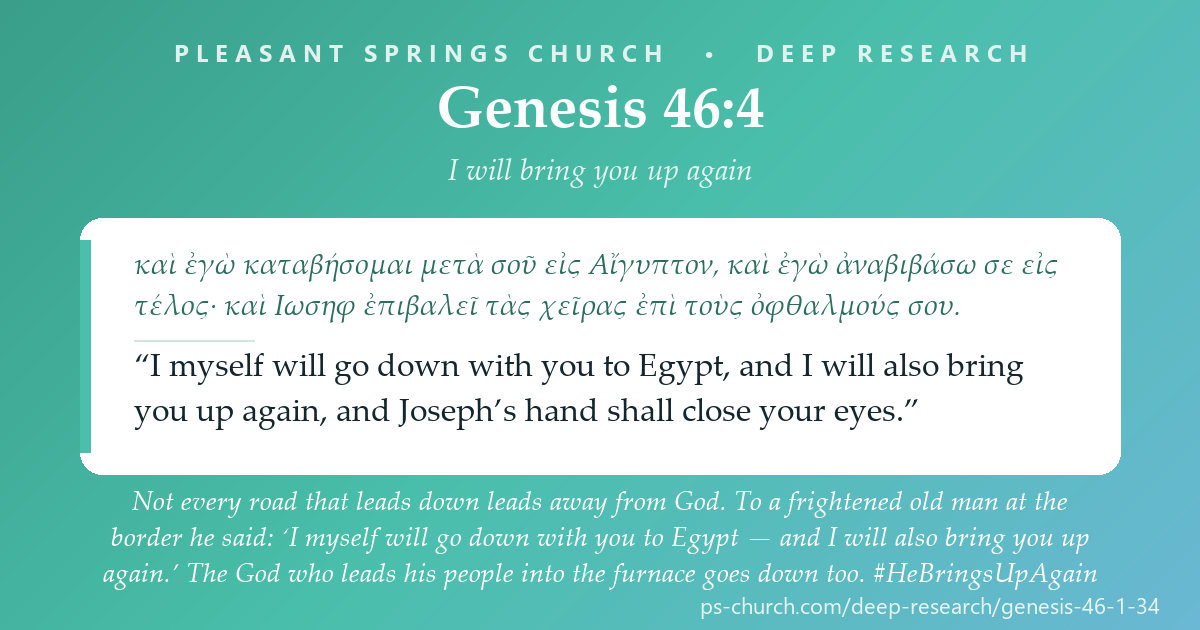
Genesis 46:4 · to share
LXX + ESVEvery Deep Research page traces its passage across the whole sweep — the Old Testament, the Second-Temple world between the testaments (historical witnesses, not Scripture), and the New Testament. Follow the thread:
Pleasant Springs Church — Deep Research
Research method after Michael S. Heiser’s Bible Research Method (examine dictionaries → ancient literature → important words → textual connections → academic publications → share), with the Pleasant Springs “Author & Audience” foundation. Scripture set in the Hebrew, the Greek editions named on each page and the ESV (Old Testament), and the Greek New Testament and the ESV (New Testament), per the practice of Pleasant Springs Church. Genesis 46:1–34 research grounded in Wenham, Hamilton, Mathews, Waltke, and Sarna; the chapter read as guided descent, not flight — Jacob’s worship at Beersheba (46:1) under “the God of his father Isaac,” the night vision’s doubled call and hinneni (46:2), and the paired verbs yarad/’alah (“I will go down with you… and bring you up again,” 46:4) as the Exodus spoken in seed (Ex 1:7; 3:8; Deut 26:5–9). The seventy of the house of Jacob (46:27; LXX and Acts 7:14 seventy-five) numbered as the covenant seed; Goshen’s separateness secured by Egypt’s scorn of shepherds (46:34); and the descent/ascent pattern (Eph 4:9–10) with Jacob’s nunc dimittis beside Simeon’s (Lk 2:29–30) held as devotional analogy on real textual patterns, not the literal sense — per the house discipline for typology. Divine name in the chapter is El/Elohim (“God”); no Tetragrammaton appears in its speeches.
Scripture quotations marked ESV are from the ESV® Bible (The Holy Bible, English Standard Version®), © 2001 by Crossway, a publishing ministry of Good News Publishers. ESV Text Edition: 2016. Used by permission. All rights reserved. The ESV text may not be quoted in any publication made available to the public by a Creative Commons license, and the ESV may not be translated in whole or in part into any other language. www.esv.org
|
Did this study bless you today? 💚 Give to Support PS Church100% of gifts go to the General Fund — thank you. |