A landless, aged shepherd is led into the throne room of the greatest kingdom on earth — and it is he who blesses Pharaoh. Asked his age, Jacob reckons 130 years a sojourn, “few and evil,” the confession of a pilgrim not yet home. Around this quiet scene the famine grinds on: Joseph gathers Egypt’s money, livestock, land, and people to Pharaoh for bread — saving them alive at the cost of freedom — while Israel multiplies greatly in Goshen. And dying rich in a foreign land, Jacob makes Joseph swear the ancient oath: “Do not bury me in Egypt.” Then he bows in worship. This study works Genesis 47:1–31. See the method →
Genesis 47:7, 9, 25, 29, 31
Hebrew · LXX · ESVThe Shape of the Passage
Parallel panelsGenesis brings the reunion story to rest not on a miracle but on three ordinary, weighty things: an old man’s blessing, a nation’s survival, and a dying request about a grave — because faith is proved in exactly such places.
Author
Moses arranges Genesis 47 as a deliberate diptych: at the top, the patriarch before the throne; at the bottom, the patriarch preparing for the grave. In between runs the famine ledger. Joseph presents five of his brothers, and then his father, to Pharaoh (47:1–10); Goshen is formally granted and the family settled “in the best of the land” (47:11), pointedly kept apart because shepherds are loathsome to Egypt (46:34) — a separation that will preserve Israel’s distinct identity right up to the Exodus. The narrator lingers on one astonishing detail: twice (47:7, 10) the landless old herdsman blesses the god-king of the age. In a court where Pharaoh outranks everyone, the true order of things is quietly inverted — Abraham’s heir stands higher than Egypt’s throne (Heb 7:7).
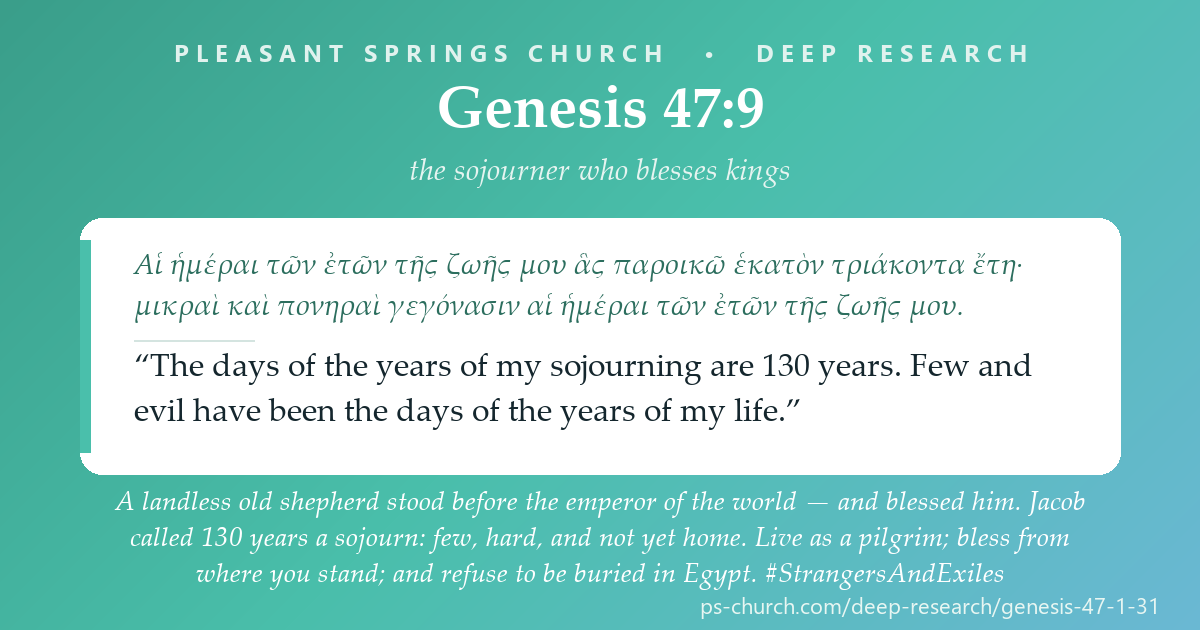
‘Few and evil.’ Pharaoh asks the natural question — how old are you? — and Jacob’s answer is one of Scripture’s great self-appraisals: “The days of the years of my sojourning are 130 years; few and evil have been the days… and they have not attained to the days… of my fathers” (47:9). It is honest to the point of melancholy — a life of exile, bereavement, deception given and received, a favorite son long thought dead — yet the very word he reaches for, megurai (my sojournings), is the language of pilgrimage: he counts himself a stranger passing through, an heir of a promise not yet possessed (cf. Heb 11:13; Ps 39:12; 1 Chr 29:15). The blessing and the confession belong together: only a man who knows he is a sojourner can bless an emperor and mean it.
The famine ledger. The chapter reports Joseph’s administration with sober, unblinking realism (47:13–26). As the famine deepens, the money of Egypt and Canaan flows to Pharaoh for grain; then the livestock; then, when nothing else remains, the people sell their land and finally themselves into Pharaoh’s service, resettled and given seed, owing a fifth of the harvest henceforth (the priests’ land alone exempt). The text neither celebrates nor condemns it. Its verdict is on the people’s own lips: “You have saved our lives” (47:25). Joseph’s wisdom keeps a civilization alive through catastrophe — at real cost to its freedom. Scripture records the policy as it was, letting the reader weigh the price of survival and the ambiguity of even godly power in a fallen world.
Audience
Israel — the nation Moses led out of Egypt — read this chapter as its own back-story, and every line pointed forward. The clause “Israel… was fruitful and multiplied greatly” (47:27) is the seed of Exodus 1:7, where the same words describe the swarming growth that alarms a later Pharaoh. The people who once owed themselves to Egypt for bread would one day be owned by Egypt as slaves — and the God who fed them in Goshen would bring them out with a mighty hand. Israel learned here that the covenant survives famine and empire alike: kept alive in exile, multiplied in a foreign field, never abandoned by the God of the promise even when no wonder is on display.
Buried toward the promise. The chapter’s last scene is its deepest word to every generation of faith. Jacob, dying rich and honored in the finest land of the greatest kingdom on earth, wants none of it for a grave. He makes Joseph swear by the solemn thigh-oath: “Do not bury me in Egypt… carry me out… and bury me in their burying place” (47:29–30). Egypt is comfort; Egypt is not home. His faith reaches past the Nile to Machpelah, the one small parcel of the Land his fathers ever owned — a down-payment on a promise he will not live to see kept. And Scripture records his response in the same breath as his worship: “Israel bowed himself upon the head of his bed” (47:31; Heb 11:21 — “by faith Jacob… bowing in worship over the head of his staff”). The dying patriarch worships. For the church, the lesson is plain: hold the land-promise even in death, refuse to be finally at home in Egypt, and let faith bow while it still can (Heb 11:13–16; Phil 3:20).
Orient on Goshen, sojourning, Egyptian land tenure, the thigh-oath, and burial.
Search by topic: Goshen, sojourner / ger, Pharaoh, Egyptian land and taxation, famine, oath, burial customs, Machpelah, embalming.
Which articles are relevant?
- Anchor Bible Dictionary — “Goshen,” “Sojourner,” “Pharaoh,” “Famine,” “Oath,” “Burial,” “Machpelah.”
- Dictionary of the OT: Pentateuch — “Joseph,” “Egypt,” “Land,” “Sojourner, Alien, Stranger,” “Death and Burial.”
- NIDOTTE / TDOT — gur / magor (sojourn), barakh (bless), chayah (keep alive), chesed we-’emet (kindness and faithfulness), shachah (bow, worship), qavar (bury).
Bibliography surfaced:
- Gordon Wenham (WBC), Victor Hamilton (NICOT), Kenneth Mathews (NAC), Bruce Waltke, Nahum Sarna (JPS) on Genesis.
- Studies of Egyptian land tenure and the ‘fifth,’ the sojourner (ger) motif in the Pentateuch, and ancient oath and burial custom.
- Kenneth Kitchen and James Hoffmeier on Israel in Egypt; the Joseph narrative and its Egyptian setting.
The shepherd who blesses a king, the price of bread, and a grave in the Land.
Read the throne-room blessing, the famine administration, and the burial oath against ancient Near Eastern kingship, land law, and death custom.
Which parallels shed light on religion and worldview?
The lesser blesses the greater. In every ancient court, benediction flowed downward — the god-king blessed his subjects. Genesis 47 inverts it without comment: Jacob, who owns not a foot of Egypt and belongs to a despised trade (46:34), lays his blessing on Pharaoh coming and going (47:7, 10). The narrator expects the reader to feel the wrongness of the world’s ranking and the rightness of God’s: the covenant patriarch is the true dispenser of blessing, because through Abraham’s line “all the families of the earth shall be blessed” (12:3). Hebrews later states the principle the scene enacts — “it is beyond dispute that the inferior is blessed by the superior” (7:7).
Egyptian land and the ‘fifth.’ The famine policy Joseph administers (47:13–26) mirrors what we know of Pharaonic Egypt, where in the historical period nearly all land was Crown land, the temple estates were tax-exempt, and a fixed proportion of the harvest was owed to the throne. The narrative reports the transformation soberly: money, then cattle, then land, then persons pass to Pharaoh, the people resettled and re-seeded, owing a twenty-percent tax — the priests alone excepted, as Egyptian sources confirm. Scripture does not moralize the account. It is neither a manifesto for such a system nor a denunciation of it; it is a clear-eyed record of wise, costly crisis-management in a fallen world — a rescue that saves lives (47:25) at a heavy price, the kind of hard good that statecraft in a broken age so often is.
The thigh-oath and the reach for the Land. Twice in Genesis a servant or son swears with a hand placed “under the thigh” (24:2, 9; 47:29) — a solemn, bodily gesture binding the oath to the sphere of posterity and the covenant seed, fitting for an oath about where the covenant’s bearer will lie. Jacob’s demand is theologically loaded: to be buried at Machpelah (49:29–31), the one patch of the Land Abraham ever purchased (23), is to stake a claim on the whole promise in the teeth of death. Egypt embalms its dead and builds them eternal houses; Jacob wants a borrowed cave in Canaan. His grave is a confession of faith — “these all died in faith, not having received the things promised, but having seen them and greeted them from afar, and having acknowledged that they were strangers and exiles on the earth” (Heb 11:13).
- Genesis 12:3; 23; 24:2, 9; 49:29–33; 50:24–25 — the blessing to the nations, the purchase of Machpelah, the thigh-oath, and the chain of burial requests reaching from Jacob to Joseph.
- Exodus 1:7 — “the people of Israel were fruitful… and multiplied”: Genesis 47:27 is its seed, the growth in Goshen that a later Pharaoh will fear (see Joseph’s rise and the famine’s beginning).
- Hebrews 7:7; 11:13–22; Psalm 39:12; 1 Chronicles 29:15 — the superior’s blessing, the pilgrim confession, and life reckoned as a sojourn: the theology Jacob lives out before Pharaoh.
The genius of Genesis 47 is that it stages the whole paradox of the people of God in a single room. Here is Jacob — old, poor, landless, a member of a caste the Egyptians cannot abide, utterly dependent on Joseph’s favor for the bread on his table — and here is Pharaoh, master of the granaries of the earth, before whom a starving world is selling itself into slavery. By every visible measure Pharaoh is the greater and Jacob the lesser. And yet it is Jacob who blesses Pharaoh, not the reverse; it is Jacob who, asked about his life, speaks the language of a pilgrim who has somewhere better to go; it is Jacob who, dying in the richest land on earth, refuses it for a grave and demands to be carried home to a cave in an as-yet-unconquered country. The chapter teaches the covenant people how to live inside an empire without belonging to it: receive its Goshen gratefully, serve its Pharaoh honestly, bless it truly — and never, ever mistake it for home. Egypt can feed you; Egypt cannot be your burying place. The man of faith holds the promise so firmly that he will not let even his corpse settle for less than the land God swore. That is why the scene ends not in negotiation but in worship: the sojourner bows, because the God he has followed through 130 few and evil years has never once let go of the promise — and Jacob, at the last, lets the promise, not the palace, have the final word.
The vocabulary of the chapter: blessing, sojourning, saving, and worship.
Watch the twofold “he blessed,” the pilgrim word “sojournings,” the blunt “few and evil,” the people’s “you have saved us,” the oath’s “kindness and faithfulness,” and the closing “he bowed / worshiped.”
“And he blessed” — barakh. The landless patriarch blesses the god-king, twice: “the inferior is blessed by the superior” (Heb 7:7). Abraham’s heir outranks Egypt’s throne, for through him the nations are blessed (12:3).
“My sojournings” — from gur, to reside as a stranger. Jacob measures his whole life as pilgrimage, not possession: an heir of a promise not yet held (Heb 11:13; Ps 39:12 · LXX 38:13; 1 Chr 29:15). LXX παροικῶ, “I sojourn.”
“Few and evil” — Jacob’s unflinching reckoning of a hard life of exile and grief. Honest lament, not despair: the same lips that call the days evil have just blessed a king and will die worshiping (47:31).
“You have saved our lives” — from chayah, to keep alive. The people’s own verdict on Joseph’s costly administration: rescue through servitude, survival at a price. LXX σέσωκας ἡμᾶς, “you have saved us.”
“Kindness and faithfulness” — the covenant word-pair Jacob binds to the oath, the same loyalty the servant praised at the well (24:27). Steadfast love that keeps its word, even to a dead man’s bones.
“And he bowed / worshiped” — shachah. MT reads “upon the head of his bed” (mittah); the LXX, same consonants pointed matteh, “upon the head of his staff” (ῥάβδου) — and Hebrews 11:21 quotes the LXX: the dying patriarch worships.
How the rest of Scripture fills out the scene:
- Hebrews 7:7; 11:13–22 — the superior blesses the inferior; the patriarchs as strangers and exiles who die in faith greeting the promise from afar; “by faith Jacob… bowing in worship over the head of his staff.”
- Psalm 39:12; 119:19; 1 Chronicles 29:15; 1 Peter 2:11 — “I am a sojourner with you, a guest, like all my fathers”: Jacob’s megurim becomes the confession of all God’s pilgrim people.
- Genesis 24:27, 49; 47:29 — chesed we-’emet, kindness and faithfulness: the covenant loyalty invoked at the marriage errand and again at the deathbed oath (see the bride for Isaac).
- Exodus 1:7; Genesis 47:27 — Israel “fruitful and multiplied greatly” in Goshen: the covenant seed swelling even in exile, the germ of a nation.
From a grave in Machpelah to the strangers and exiles who seek a homeland.
Trace the pilgrim confession, the buried hope, and the multiplying people toward their fulfillment.
Which cross-references matter?
- Genesis 45:5–8; 50:19–20 — the providence that frames the whole rescue: God’s sovereign good purpose over and through the famine and even human evil, neither cancelling the other (see ‘God sent me before you’).
- Genesis 23; 49:29–33; 50:24–25 — Machpelah bought, the burial charge repeated, and Joseph’s own dying oath about his bones: the chain of faith reaching for the Land through death (see Joseph’s last days).
- Exodus 1:7; 13:19 — the people multiplied in Goshen, and Moses carrying Joseph’s bones out of Egypt at last: the oath kept generations later.
- Hebrews 11:9–16, 21–22 — the patriarchs who lived in tents, died in faith, and “desire a better country, that is, a heavenly one”: Jacob’s worship and burial-request read as the paradigm of pilgrim faith.
- Philippians 3:20; 1 Peter 2:11; 2 Corinthians 5:1–9 — “our citizenship is in heaven”; sojourners and exiles; longing for the house not made with hands: the church living Jacob’s posture.
The most quietly radical act in Genesis 47 is a funeral instruction. Jacob has arrived at the summit of every earthly good: rescued from famine, reunited with a son he mourned as dead, honored before the throne of the world’s superpower, settled in its choicest land, provided for to the end. If ever a man had reason to sink his roots and call a place home, it is Jacob in Goshen. And the first thing he does as death nears is to make his powerful son swear a solemn oath that he will not be buried where all this comfort is. ‘Do not bury me in Egypt.’ The refusal is not ingratitude — he blesses Pharaoh, he receives Egypt’s kindness — it is faith. Egypt fed him; Egypt is not the Land. To be laid in Machpelah, the solitary field Abraham ever owned in the country God had sworn to give, is to press even a corpse into the service of the promise, to say with his bones what his lips had said before the king: I am a sojourner here. The New Testament seizes on exactly this and makes it the definition of the whole company of faith — they confessed that they were strangers and exiles, they desired a better country, and God was not ashamed to be called their God, for he had prepared for them a city. The church that learns Jacob’s deathbed learns how to live: grateful in Egypt, useful in Egypt, generous in Egypt — and never, in the end, willing to be buried there. Hold the promise past the grave, and bow in worship while you can.
The scholarship on Genesis 47:1-31.
The commentators on the Joseph narrative; the studies of Egyptian land tenure, the sojourner motif, and ancient oath and burial custom.
Commentaries & studies:
- Gordon J. Wenham (WBC), Victor P. Hamilton (NICOT), Kenneth A. Mathews (NAC), Bruce K. Waltke, Nahum M. Sarna (JPS) on Genesis.
- Kenneth A. Kitchen and James K. Hoffmeier on the Egyptian setting of the Joseph story; studies of Pharaonic land tenure and the temple-estate exemption.
- G. K. Beale & D. A. Carson, eds., Commentary on the NT Use of the OT (Hebrews 11); studies of the ger / sojourner theme across the Pentateuch.
Interpretation notes worth keeping:
- The famine policy (47:13–26). Report it soberly: not a divine endorsement of enserfment, nor a scandal the text hides, but a clear record of costly crisis-stewardship that saved lives (47:25) at the price of freedom. The narrative withholds a moral verdict; readers should be slow to add one the text does not.
- The priests’ exemption (47:22, 26). That Egypt’s temple lands stayed tax-free matches known Egyptian practice — a mark of the narrative’s at-home familiarity with its setting, not a theological point.
- ‘Bed’ or ‘staff’ (47:31). The MT’s mittah (bed) and the LXX’s matteh (staff) differ only in vowel-points of identical consonants (מטה); Hebrews 11:21 follows the LXX. Both readings agree on the essential: the dying patriarch worships. Handle it as a genuine, well-known textual variant, not an error in either witness.
- Jacob’s ‘few and evil’ (47:9). Honest lament, not faithlessness. Scripture lets its saints name their sorrows plainly; the same chapter shows the lament held within blessing and worship.
- Providence, not fatalism. The rescue of Egypt and Israel stands under the same providence Joseph will name at 45:5–8 and 50:19–20: God’s sovereign good purpose worked over and through real human agency and even evil — neither erasing human responsibility nor making God the author of evil. The house reading throughout this library.
From a shepherd before the throne to a pilgrim who worships toward home.
Name what you learned, why it matters, and one concrete response.
What should we carry away — and do?
- You are a sojourner. Jacob reckoned 130 years a sojourn — a pilgrim passing through, holding a promise not yet possessed. Receive your Goshen gratefully; never mistake it for home (Heb 11:13–16; Phil 3:20).
- Bless from where God has placed you. The landless old man blessed the emperor. The people of God are dispensers of blessing in every court and cubicle — the inferior in worldly power can be the superior in grace.
- Steward wisely and honestly through catastrophe. Joseph’s costly administration saved a nation alive. Faithful work in hard times is holy work — even when the goods it buys are mixed and the costs are real.
Step in response: live this week as a grateful sojourner — enjoy God’s provision without letting it become your resting place. Speak a genuine blessing over someone with more worldly power than you. And do Jacob’s hardest, deepest thing: settle in your heart that you will not, in the end, be buried in Egypt — that your citizenship is elsewhere (Phil 3:20) — and let that certainty make you bow in worship today, while you still can (Heb 11:21).
Genesis 47:9 · to share
LXX + ESVEvery Deep Research page traces its passage across the whole sweep — the Old Testament, the Second-Temple world between the testaments (historical witnesses, not Scripture), and the New Testament. Follow the thread:
Pleasant Springs Church — Deep Research
Research method after Michael S. Heiser’s Bible Research Method (examine dictionaries → ancient literature → important words → textual connections → academic publications → share), with the Pleasant Springs “Author & Audience” foundation. Scripture set in the Hebrew, the Greek editions named on each page and the ESV (Old Testament), and the Greek New Testament and the ESV (New Testament), per the practice of Pleasant Springs Church. Genesis 47:1–31 research grounded in Wenham, Hamilton, Mathews, Waltke, and Sarna, with Kitchen and Hoffmeier on the Egyptian setting; the chapter read as the covenant’s survival inside an empire — the landless patriarch blessing Pharaoh (47:7, 10; Heb 7:7), the pilgrim confession of “my sojournings… few and evil” (47:9; Heb 11:13; Ps 39:12); the famine administration (47:13–26) reported soberly as costly crisis-stewardship that saved lives (47:25) at the price of freedom, under the providence Joseph names at 45:5–8 and 50:19–20 (God’s sovereign good purpose over and through human agency, never authoring evil); Israel multiplied in Goshen (47:27; Exod 1:7); and the thigh-oath and burial charge (47:29–31) — with the well-known MT “bed” / LXX “staff” variant at 47:31 that Hebrews 11:21 follows — read as faith reaching past Egypt to the promised Land, and worship at the last.
Scripture quotations marked ESV are from the ESV® Bible (The Holy Bible, English Standard Version®), © 2001 by Crossway, a publishing ministry of Good News Publishers. ESV Text Edition: 2016. Used by permission. All rights reserved. The ESV text may not be quoted in any publication made available to the public by a Creative Commons license, and the ESV may not be translated in whole or in part into any other language. www.esv.org
|
Did this study bless you today? 💚 Give to Support PS Church100% of gifts go to the General Fund — thank you. |