Told that his father is failing, Joseph brings his two sons — and the dying Jacob rouses himself for one of Scripture’s great deathbed scenes. He recalls God Almighty’s promise at Luz, adopts Ephraim and Manasseh as his own (“as Reuben and Simeon are”), and blesses them by the God who was his shepherd all his life and “the angel who has redeemed me from all evil” — the first “redeem” of God in the Bible. Then he crosses his hands, setting the younger Ephraim over the elder: grace, not primogeniture. This study works Genesis 48:1–22. See the method →
Genesis 48:5, 15, 16, 19, 20
Hebrew · LXX · ESVThe Shape of the Passage
Type-sceneA dying man, leaning on his staff, gathers two boys and gives away a blessing he never earned and cannot keep — and Genesis pauses over it, because this is how the covenant travels: from open hands at the edge of the grave.
Author
Moses sets this chapter as the first of Jacob’s two deathbed scenes (ch. 48, then the poem of ch. 49). Told that his father is failing, Joseph brings Ephraim and Manasseh; and the man who has spent the narrative being carried, wept over, and settled in Goshen now sits up in bed and takes command of the future (48:2). He anchors everything in memory: “God Almighty (El Shaddai) appeared to me at Luz… and blessed me” (48:3) — the very place, Bethel, where the fugitive once saw the ladder (28:10–22). What God promised there, Jacob now hands on.
The adoption. The chapter’s legal heart is 48:5: “Ephraim and Manasseh… are mine; as Reuben and Simeon are.” Jacob formally adopts his two grandsons as his own sons, elevating them to full tribal standing. Through them Joseph receives the double portion of the firstborn (cf. 1 Chr 5:1–2 — the birthright forfeited by Reuben passing to Joseph) — which is why later Israel counts twelve tribes with no “Joseph” but with Ephraim and Manasseh in his place. The blessing itself (48:15–16) is one long relative clause naming the God who has kept him: the God before whom the fathers walked, the God who shepherded him (the first time Scripture calls God a shepherd), and — startlingly — “the Angel who has redeemed me from all evil,” the first use of the verb ga’al (redeem) with God as subject. God and the Angel stand in poetic apposition, and the blessing verb is singular: the Angel who redeems is the God who shepherds.
The crossed hands. Joseph arranges the boys for the expected blessing — Manasseh the firstborn under Jacob’s right hand, Ephraim under the left — and the blind old man crosses his arms, “crossing his hands knowingly” (48:14, the rare verb sikkel), and lays the right hand on the younger. Joseph is displeased: “Not this way, my father” (48:18). Jacob — who once stole a blessing meant for the elder, and knows exactly what he is doing — refuses gently: “I know, my son, I know… his younger brother shall be greater than he” (48:19). And he sets Ephraim before Manasseh in the very words Israel will bless its children with forever (48:20).
Audience
Israel — and especially the northern tribes led by Ephraim — heard in this chapter the charter of their own standing: not a Canaanite accident but a patriarch’s deliberate, Spirit-led blessing, the birthright divided by grace rather than birth order. The recurring pattern would not have been lost on them: Isaac over Ishmael, Jacob over Esau, Judah and Joseph over Reuben, now Ephraim over Manasseh. God’s choosing has never run along the lines the world assumes; the covenant advances by election, sovereign and free, never owed to the firstborn’s claim (cf. Deut 7:7–8 — chosen not because you were many, but because he loved you).
The Redeemer, the Shepherd, and faith at the grave. For the church, Genesis 48 gathers three treasures. First, the vocabulary of rescue: the God who shepherds (Ps 23:1; 80:1; Jn 10:11) and the Angel who redeems (ga’al, the kinsman-redeemer’s word — Ruth 4; Job 19:25; Isa 41:14) — a fullness the church cannot help but see completed in the One who is both Shepherd and Redeemer of his people (held as devotional resonance, not a hidden Christ in the text). Second, the freedom of grace: “the elder shall serve the younger” becomes, in Paul’s hands, the very case-study of election that God’s purpose “might continue… not because of works but because of him who calls” (Rom 9:10–13). Third, the posture: Hebrews frames the whole scene in a single word — “By faith Jacob, when dying, blessed each of the sons of Joseph, bowing in worship over the head of his staff” (Heb 11:21). A failing man, seeing only a promise, worships and gives it away. That is how the covenant is passed on.
Orient on adoption and the birthright, the goel-redeemer, the Angel of the LORD, and the tribes of Ephraim and Manasseh.
Search by topic: Ephraim, Manasseh, Joseph, adoption, birthright / firstborn, blessing, redeem (ga’al) / kinsman-redeemer, Angel of the LORD, Bethel / Luz.
Which articles are relevant?
- Anchor Bible Dictionary — “Ephraim,” “Manasseh,” “Joseph,” “Adoption,” “Firstborn,” “Blessing,” “Redemption (OT).”
- Dictionary of the OT: Pentateuch — “Blessing,” “Birthright,” “Election,” “Angel of the Lord,” “Adoption.”
- NIDOTTE / TDOT — ga’al (redeem, act as kinsman), ra’ah (shepherd, tend), mal’akh (angel/messenger), bekhor (firstborn), barakh (bless).
Bibliography surfaced:
- Gordon Wenham (WBC), Victor Hamilton (NICOT), Kenneth Mathews (NAC), Bruce Waltke, Nahum Sarna (JPS) on Genesis.
- Studies of the go’el / kinsman-redeemer, of adoption formulae in the ancient Near East, and of the Angel of the Lord in the patriarchal narratives.
- Beale & Carson, Commentary on the NT Use of the OT (Romans 9; Hebrews 11).
Deathbed blessing, adoption and the double portion, and the crossing of hands.
Read the adoption, the blessing, and the crossed hands against ancient Near Eastern inheritance custom and the Bible’s theology of election.
Which parallels shed light on the world and worldview?
Deathbed blessing as legal act. In the patriarchal world a father’s spoken blessing at death was no mere well-wishing but a performative, quasi-legal bestowal of destiny and inheritance — which is why Esau wept for a blessing already given away (27:34–38) and why Jacob’s words here settle tribal futures. Genesis 48 shows the machinery running with unusual deliberation: the recollection of the covenant grant (48:3–4), a formal adoption formula (“are mine… as Reuben and Simeon are,” 48:5, echoing ancient adoption language), the laying on of hands, and the fixed blessing sentence that Israel will repeat (48:20). The dying patriarch is executing a will.
The double portion and the displaced firstborn. The firstborn’s right (later codified in Deut 21:15–17) was a double share of the inheritance. By adopting Joseph’s two sons, Jacob gives Joseph precisely that double portion — two tribal allotments where every other brother received one — and the Chronicler names the reason: Reuben, the actual firstborn, “defiled his father’s couch,” so “the birthright was given to the sons of Joseph” (1 Chr 5:1–2). Yet even here the pattern bends: within Joseph’s double blessing, the younger son’s portion outstrips the elder’s. The narrative keeps refusing to let mere birth order be the engine of blessing.
The crossed hands and the freedom of grace. Joseph’s objection is entirely reasonable by custom — the right hand carries the greater blessing, and it belongs on the firstborn’s head. Jacob’s answer is not senile confusion but sighted intent: the text says he crossed his hands sikkel, “knowingly” (48:14). Blind Jacob, who in his own youth impersonated the firstborn to steal a blessing, now with clear inner sight hands the greater blessing to the younger — not by theft this time but by open, sovereign choice. The whole of Genesis has been schooling its readers in this: Isaac not Ishmael, Jacob not Esau, Perez not Zerah, and now Ephraim not Manasseh. Election is God’s free prerogative, exercised through, and often against, the customs of men (cf. 1 Sam 16:7–12).
- Genesis 25:23; 27:1–40; 38:27–30; 1 Samuel 16:6–13 — the younger chosen over the elder, again and again: a Genesis-and-beyond leitmotif of electing grace.
- Deuteronomy 21:15–17; 1 Chronicles 5:1–2 — the firstborn’s double portion, and how Reuben’s forfeiture routed it to Joseph’s two adopted sons.
- Genesis 28:10–22 — El Shaddai at Luz/Bethel, the covenant Jacob now recalls and passes on (see Jacob’s ladder at Bethel).
It is one of the quiet ironies of Genesis that the man who cheated his way into a stolen blessing should end his life as the freest and most deliberate dispenser of blessing in the book. Jacob is blind now, but he sees; his eyes are dim, yet he crosses his hands ‘knowingly.’ Joseph, seeing only the custom, tries to correct him — and Jacob, seeing the purpose of God, will not be corrected. This is the whole doctrine of election compressed into a gesture. The blessing does not run down the channel the world has dug for it — eldest first, by right of birth — because the God of the covenant has never been bound by the priorities of the flesh. He took the younger Isaac over Ishmael, the younger Jacob over Esau, the shepherd-boy David over his taller brothers, and he will take a crucified carpenter over the whole apparatus of religious respectability. The point is never that the elder is despised; Manasseh too is blessed, and greatly. The point is that blessing is grace — unowed, unpurchasable, undeserved — and grace is free precisely because it is not wages. Jacob’s crossed arms are the shape of the gospel in the patriarchal age: the hand of favor laid, against all natural expectation, exactly where sovereign love decides to lay it. The church that receives its own blessing by the same free choosing (‘he chose us in him before the foundation of the world’) should recognize the gesture, and worship.
The vocabulary of the blessing: adopted, shepherded, redeemed, and the younger set first.
Watch the adoption (“they are mine”), the first “shepherd” and the first “redeem” of God, the Angel named as God, and the electing of the younger.
“They are mine” — the adoption formula: Ephraim and Manasseh raised from grandsons to sons, “as Reuben and Simeon are.” Through them Joseph receives the firstborn’s double portion (1 Chr 5:1–2); Israel will count twelve tribes with Joseph’s two boys in his place.
“The (one) shepherding” — the first time Scripture calls God a shepherd, the seed of Psalm 23:1 (LXX 22:1) and 80:1 (LXX 79:2) and John 10:11. The LXX has ὁ τρέφων, “the one who feeds / nourishes me” — the same care, told as provision.
“The (one) redeeming” — the first use of ga’al with God as subject: the kinsman-redeemer’s word (Ruth 4; Lev 25), reclaiming what is his own. It will carry Job’s hope (“I know that my Redeemer lives,” 19:25) and Isaiah’s gospel (41:14; 43:1). LXX ῥυόμενός, “the one delivering me.”
“The Angel” — set in poetic apposition to “the God” of 48:15, with a singular blessing verb: the redeeming Angel and the shepherding God are named as one. The Angel who wrestled and blessed at Peniel (32:24–30) is the Angel who redeems from all evil.
“The younger / lesser” — “his younger brother shall be greater than he.” The recurring election of the smaller and later-born (Isaac, Jacob, Perez, David): blessing by grace, not by the rights of birth (cf. Rom 9:10–13; 1 Cor 1:27–29).
“God make you” — the blessing formula fixed for all Israel: “God make you as Ephraim and as Manasseh.” Two boys of grace become the words a father lays on his children forever — and Jacob “put Ephraim before Manasseh.”
How the rest of Scripture fills out the scene:
- Psalm 23:1; 80:1; Ezekiel 34; John 10:11; Hebrews 13:20 — ra’ah, the shepherding God: Jacob’s deathbed word becomes Israel’s comfort and the Good Shepherd’s claim.
- Ruth 4:1–10; Job 19:25; Isaiah 41:14; 43:1; 44:6 — ga’al, the Redeemer: the kinsman who reclaims his own, from Jacob’s blessing to Isaiah’s “Fear not… I have redeemed you.”
- Genesis 28:10–22; 32:24–30 — El Shaddai at Bethel and the Angel at Peniel: the God and the Angel whom Jacob now blesses his grandsons by (see Jacob at Bethel).
- Romans 9:10–13; 1 Corinthians 1:27–29; Hebrews 11:21 — the younger over the elder as the pattern of electing grace; and Jacob’s dying blessing named as an act of faith.
From a blind man's crossed hands to the Shepherd-Redeemer and the freedom of grace.
Trace the adoption, the Angel-Redeemer, and the electing of the younger toward their New Testament fulfillment.
Which cross-references matter?
- Genesis 48:5 ↔ 1 Chronicles 5:1–2; Numbers 1:32–35; Joshua 16–17 — the adoption worked out in Israel’s history: Ephraim and Manasseh as full tribes, Joseph’s double portion, and Ephraim’s later leadership of the north.
- Genesis 48:15–16 ↔ Psalm 23; John 10:11–18; 1 Peter 2:25; Revelation 7:17 — the Shepherd who feeds and the Redeemer who rescues, gathered in the Lamb who shepherds his flock and wipes away every tear.
- Genesis 48:14, 19 ↔ Romans 9:6–13 — “the elder will serve the younger”: Paul’s proof that God’s saving purpose stands by election and calling, “not because of works but because of him who calls.”
- Genesis 48:1–22 ↔ Hebrews 11:21 — “By faith Jacob, when dying, blessed each of the sons of Joseph, bowing in worship over the head of his staff”: the whole scene read as faith giving away a promise it will not live to see.
- Genesis 48:16 ↔ Matthew 1:21; Titus 2:14; Galatians 3:13; 4:5 — the redeeming Angel and the fullness of redemption: “he gave himself… to redeem us” (held as devotional resonance on a real textual pattern, not the chapter’s literal sense).
There is a phrase in this blessing that a careful reader cannot walk past without stopping: ‘the Angel who has redeemed me from all evil.’ It is the first time in the Bible that the verb ga’al — redeem, act as the kinsman who buys back what is his own — is used with God as its subject. And it does not stand alone: it is set in deliberate poetic apposition to ‘the God… who has been my shepherd,’ and the three lines share a single verb of blessing. Jacob is not naming three different helpers; he is naming one, from three angles — the God before whom the fathers walked, the God who shepherded him, the Angel who redeemed him. The Angel of the Lord in these narratives speaks as God, is addressed as God, and yet is somehow distinguishable from God — the same mysterious nearness Jacob met wrestling at Peniel, where he came away saying ‘I have seen God face to face.’ The church has never claimed that Jacob understood the Trinity, or that the text is secretly about Christ; the discipline of this library forbids reading a hidden Jesus into an old man’s blessing. But it has always recognized, and rightly, that when God finally comes as a kinsman to redeem his own from all evil — taking flesh, tending the flock, and paying the redemption price himself — he is doing in fullness what Jacob, dying, already knew how to bless his grandsons by. The vocabulary was ready long before the Redeemer stood up in Nazareth and read it aloud.
The scholarship on Genesis 48:1-22.
The commentators on the deathbed blessing; the studies of adoption, the go’el, the Angel of the LORD, and OT election.
Commentaries & studies:
- Gordon J. Wenham (WBC), Victor P. Hamilton (NICOT), Kenneth A. Mathews (NAC), Bruce K. Waltke, Nahum M. Sarna (JPS) on Genesis.
- Studies of the kinsman-go’el and OT redemption; of ancient Near Eastern adoption formulae; and of the Angel of the Lord in the patriarchal narratives.
- G. K. Beale & D. A. Carson, eds., Commentary on the NT Use of the OT (Romans 9; Hebrews 11).
Interpretation notes worth keeping:
- The Angel and the God (48:15–16). The apposition and the singular verb make the Angel and the shepherding God one in the act of blessing. Read it as the Old Testament’s way of speaking of God’s redeeming nearness — not as a proof-text for later dogma, but not less than a genuine glimpse of it.
- The double portion (48:5). Joseph, not Judah, receives the firstborn’s double share (two tribes); Judah, however, receives the ruler’s scepter (49:8–10). Birthright and kingship are split — the blessing of Genesis is larger than any one son can hold.
- The crossed hands (48:14, 19). Sikkel (“crossing knowingly”) rules out any reading of Jacob as merely confused. This is deliberate election, not a blind man’s mistake — and Joseph’s displeasure (48:17) is corrected, not indulged.
- The election of the younger. Handle the leitmotif as Scripture does: the elder is not cursed or despised (Manasseh is greatly blessed; Esau too is given a future). The point is that blessing is grace, freely bestowed, never a wage owed to birth order (Rom 9:10–16).
- The devotional analogy. Shepherd-and-Redeemer readings that hear Christ in 48:15–16 are venerable and rich; hold them as resonance built on real vocabulary (ra’ah, ga’al, the Angel), not as the chapter’s literal claim — the house discipline for typology throughout this library.
From a dying man's crossed hands to the Redeemer who blesses the boys.
Name what you learned, why it matters, and one concrete response.
What should we carry away — and do?
- Bless with open hands. A failing man, leaning on his staff, gave away a promise he could not keep — and worshiped as he did it (Heb 11:21). The covenant travels through people willing to hand on what they were only ever given.
- Know the Redeemer’s names. The God who shepherds “all my life long to this day” and the Angel who redeems “from all evil” are one. When you name your keeper, name him fully: Shepherd and Redeemer, near and enough.
- Grace, not birth order. Jacob crossed his hands knowingly. Blessing runs where sovereign love decides, not where custom expects — so stop ranking yourself by the world’s order and receive the favor freely laid on your head.
Step in response: speak a blessing this week over someone younger or smaller than you — a child, a new believer, someone the world has not ranked highly — and mean it as Jacob did, laying the hand of favor exactly where grace, not merit, would place it. Then look back over your own life and name, out loud, the God who has been your shepherd “all my life long to this day” and the Redeemer who has bought you back “from all evil.” Bless the boys; you were once one of them.
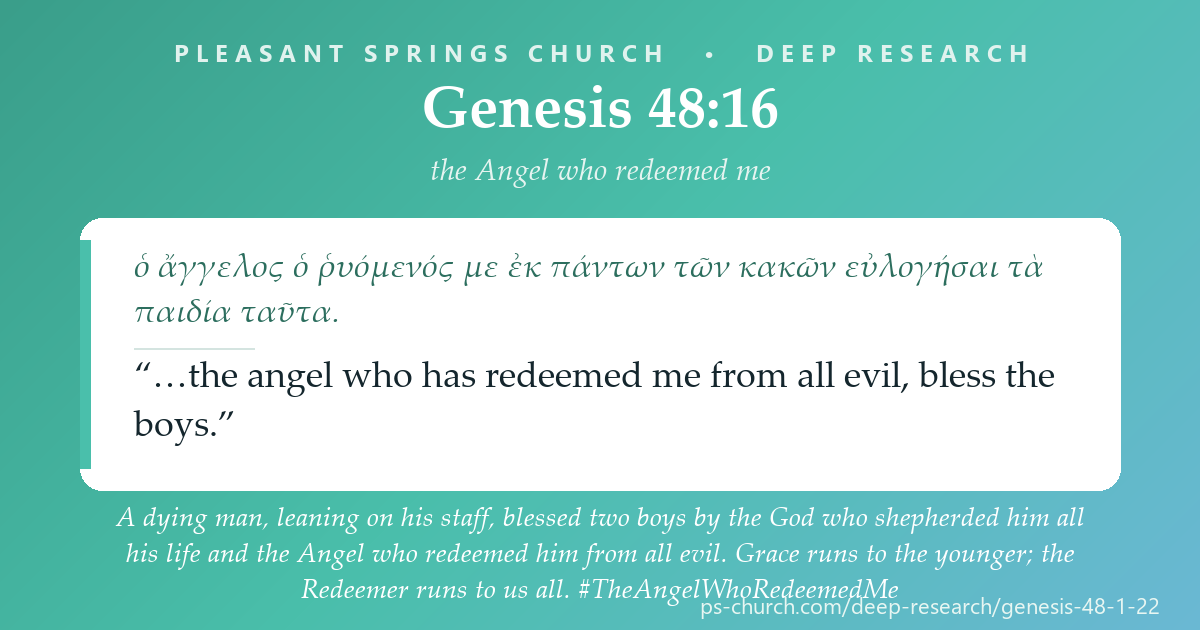
Genesis 48:16 · to share
LXX + ESVEvery Deep Research page traces its passage across the whole sweep — the Old Testament, the Second-Temple world between the testaments (historical witnesses, not Scripture), and the New Testament. Follow the thread:
Pleasant Springs Church — Deep Research
Research method after Michael S. Heiser’s Bible Research Method (examine dictionaries → ancient literature → important words → textual connections → academic publications → share), with the Pleasant Springs “Author & Audience” foundation. Scripture set in the Hebrew, the Greek editions named on each page and the ESV (Old Testament), and the Greek New Testament and the ESV (New Testament), per the practice of Pleasant Springs Church. Genesis 48:1–22 research grounded in Wenham, Hamilton, Mathews, Waltke, and Sarna; the chapter read as a deathbed blessing executed “by faith” (Heb 11:21): the covenant recalled from Luz/Bethel (48:3; cf. 28:10–22), the formal adoption of Ephraim and Manasseh giving Joseph the firstborn’s double portion (48:5; 1 Chr 5:1–2), and the blessing naming the shepherding God (48:15, first ra’ah of God) and “the Angel who has redeemed me from all evil” (48:16, first ga’al of God) in one poetic apposition with a singular verb; the crossed hands (sikkel, 48:14) setting the younger Ephraim before Manasseh handled as the sovereign freedom of electing grace (Rom 9:10–13; 1 Cor 1:27–29), the elder blessed and never despised; and the Shepherd-Redeemer resonance with Christ held as devotional analogy on real vocabulary, not the literal sense — per the house discipline for typology.
Scripture quotations marked ESV are from the ESV® Bible (The Holy Bible, English Standard Version®), © 2001 by Crossway, a publishing ministry of Good News Publishers. ESV Text Edition: 2016. Used by permission. All rights reserved. The ESV text may not be quoted in any publication made available to the public by a Creative Commons license, and the ESV may not be translated in whole or in part into any other language. www.esv.org
|
Did this study bless you today? 💚 Give to Support PS Church100% of gifts go to the General Fund — thank you. |