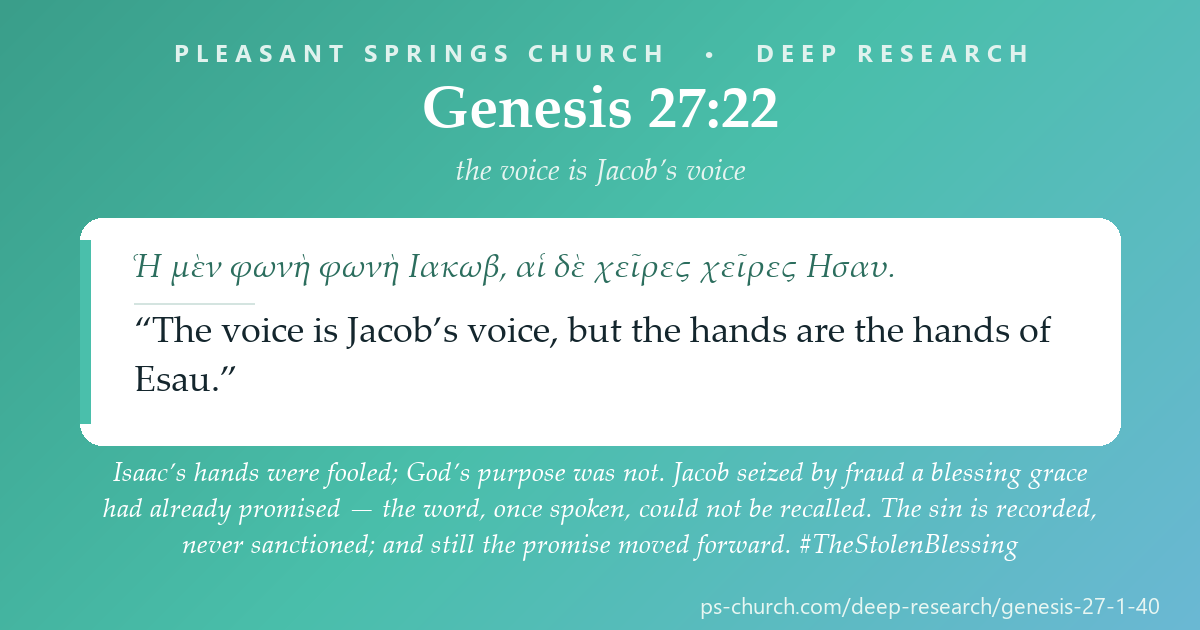
A blind old man, ruled by his appetite, moves to bless the wrong son. A mother who holds God’s oracle will not wait for God, and schemes. A younger brother dresses in goatskins and lies outright — “I am Esau your firstborn” — even dragging the divine name into it. “The voice is Jacob’s voice, but the hands are the hands of Esau.” When the fraud is exposed, Isaac trembles violently, seeing at last the hand of God — and still will not take the blessing back: “I have blessed him, and indeed he shall be blessed.” All four act badly; the deception is recorded, not sanctioned; and God’s sovereign purpose (25:23) advances through, but never endorses, the sin. This study works Genesis 27:1–40. See the method →
Genesis 27:19, 22, 28–29, 34, 39–40
Hebrew · LXX · ESVThe Shape of the Passage
Parallel panelsGenesis tells this story with unflinching honesty: four people sin, and the promise of God advances anyway — through their failures, never because of them. The chapter neither excuses the deceivers nor denigrates the deceived.
Author
Moses narrates the covenant’s ugliest family scene without a word of editorial approval — and that restraint is the point. Isaac is old, his eyes are “dim so that he could not see” (27:1), and he moves to bless Esau against the oracle Rebekah had received (25:23) and against Esau’s own contempt for the birthright (25:34; 26:34–35). His motive is disclosed a chapter earlier with quiet devastation: “Isaac loved Esau because he ate of his game” (25:28); now he wants “delicious food, such as I love” before he blesses (27:4). Appetite and favoritism drive a patriarch to the brink of overturning God’s stated word.
Rebekah and Jacob. Rebekah holds the true oracle and yet will not trust God to keep it; she engineers a lie with breathtaking detail — the stolen garments, the goatskins on the smooth hands and neck (27:15–16), the borrowed food — and takes the curse upon herself (“let your curse be on me,” 27:13). Jacob, whose name already means “he grasps the heel / he supplants” (25:26; 27:36), does the deed: he wears his brother’s identity and speaks a flat, three-fold lie — “I am Esau your firstborn” (27:19), “I am” (27:24), and worst of all he drags God into it: “because the Lord your God granted me success” (27:20). The narrator records every stroke; he sanctions none. Deception is told here, not taught — and Jacob will spend twenty years being deceived in return by Laban (ch. 29–31), reaping precisely what he sowed.
The word that cannot be recalled. When Esau returns and the fraud is exposed, Isaac “trembled very violently” (27:33) — a physical terror at the sudden, unmistakable evidence of God’s hand overruling his own intention. And then, astonishingly, he does not revoke the blessing: “I have blessed him? Yes, and he shall be blessed” (27:33). Isaac now sees what he had fought: the blessing had gone where God meant it to go all along. A patriarchal blessing was understood as a prophetic, performative word — spoken in the Lord’s name, it set the future in motion and could not be unsaid. Hebrews reads Isaac’s final settled act, not his earlier scheming, as the moment of faith: “By faith Isaac invoked future blessings on Jacob and Esau” (Heb 11:20).
Audience
Israel — the nation descended from this Jacob — was given its own origin story with the varnish stripped off. Their father was a supplanter; their matriarch a schemer; their grandfather blind in more than his eyes; and Edom, their perennial rival, was the wronged and weeping Esau. The point is not national pride but its opposite: Israel exists by grace and not by merit. The blessing they carried was never earned — not by Jacob’s cleverness, which only reaped him exile, and certainly not by any righteousness of the line. “The older shall serve the younger” (25:23) was God’s sovereign purpose of election, spoken before either child had done good or ill (Rom 9:10–13) — real, gracious, and free.
Election, responsibility, and a wronged brother. Scripture holds two truths together without flinching. God’s choosing of Jacob is genuine and gracious — the oracle concerns nations and their service, not a bare decree consigning an individual to ruin. And every human actor is genuinely responsible: Isaac for his favoritism, Rebekah and Jacob for their fraud, and Esau — whose earlier contempt for holy things (25:34) is named as real and culpable sin (Heb 12:16). Esau is never mocked as a person; his cry is heard as bitter and his tears as real (27:34, 38). Hebrews sets the sober warning: he “found no chance to repent, though he sought it with tears” (Heb 12:17) — he could not undo the consequence, though grief was real. God’s purpose stood; so did every person’s accountability. That is the balance the church must keep: the promise runs on grace, and no one who sins against it is thereby excused.
Orient on blessing, birthright, Isaac, Esau/Edom, and the patriarchal word.
Search by topic: blessing (berakah), birthright, Isaac, Esau / Edom, Jacob, deception in the patriarchal narratives, oracle / election.
Which articles are relevant?
- Anchor Bible Dictionary — “Blessing,” “Birthright,” “Isaac,” “Esau,” “Edom,” “Jacob.”
- Dictionary of the OT: Pentateuch — “Blessing,” “Birthright,” “Election,” “Jacob,” “Deception.”
- NIDOTTE / TDOT — barak (bless), berakah (blessing), bekorah (birthright), ’arar (curse), mirmah (deceit, 27:35).
Bibliography surfaced:
- Gordon Wenham (WBC), Victor Hamilton (NICOT), Kenneth Mathews (NAC), Bruce Waltke, Nahum Sarna (JPS) on Genesis.
- Studies of the patriarchal blessing as prophetic-performative word, and of the Jacob–Esau cycle (Gen 25–33).
- Beale & Carson, Commentary on the NT Use of the OT (Romans 9; Hebrews 11–12).
The blessing as an irrevocable word, and a story that indicts its own heroes.
Read the deathbed blessing, the birthright, and the deception against ancient inheritance custom and the Bible’s theology of the spoken word.
Which parallels shed light on religion and worldview?
The blessing as a performative word. In the patriarchal world a father’s deathbed blessing was not a wish but a deed done in words — a prophetic pronouncement, spoken solemnly and often in the deity’s name, that was believed to release the future it named and could not afterward be recalled. This is why Isaac cannot simply hand Esau an identical blessing: the definitive word has already gone out over Jacob, and Isaac himself confirms, “I have blessed him — and indeed he shall be blessed” (27:33). The gravity of the spoken word runs through Scripture: Balaam cannot curse whom God has blessed (Num 22–24); Israel’s later blessings and curses (Deut 27–28) carry the same binding force; “the word that goes out from my mouth… shall not return to me empty” (Isa 55:11). Genesis 27 is a narrative in the theology of the word.
Birthright and blessing. The bekorah (birthright) gave the firstborn a double share and headship of the family; the blessing conferred the covenant future. Esau had already sold the first for a bowl of stew, “despising” it (25:29–34) — the narrator’s verdict, echoed by Hebrews’ “unholy” (Heb 12:16). Now the second is taken by fraud. Two wrongs do not cancel: Esau’s contempt was real, and Jacob’s deceit was real. The text refuses to make either brother innocent. What it insists on is that behind the whole tangle stands a sovereign purpose announced before birth (25:23) — working through the failures of everyone involved, endorsing none of them.
A story that accuses its own family. Ancient national epics flatter their founders; Genesis does the reverse. Isaac is passive, sensual, and set against God’s word; Rebekah manipulates; Jacob lies under oath. The Hebrew even lets the punishment fit the crime with grim symmetry: Jacob deceives his blind father by exploiting the sense of touch and pretending to be the elder; he will himself be deceived in the dark by Laban, given the elder daughter Leah in place of the younger Rachel he loved (29:23–26) — “the deceiver deceived.” The moral order is not suspended for the elect; it catches up with Jacob for twenty years. Grace chooses him; it does not exempt him.
- Genesis 25:23, 27–34; 26:34–35 — the oracle, the despised birthright, and Esau’s Hittite wives: the backstory that makes chapter 27 legible.
- Genesis 29:15–30 — Laban gives Leah for Rachel: the deceiver deceived, the harvest of 27 (see the earlier Rebekah narrative).
- Numbers 22–24; Isaiah 55:11 — the blessing/curse as a word that, once released, accomplishes what it was sent to do.
The most uncomfortable feature of Genesis 27 is that God’s purpose and human sin run through the very same events, and the narrator will not let us pull them apart into tidy heroes and villains. Jacob receives the covenant blessing — that is God’s doing, promised before he drew breath. Jacob receives it by lying to a blind old man — that is Jacob’s doing, and it is sin, full stop. The chapter neither says the end justified the means nor that the sin thwarted the end. It says both things were true at once: the Lord was accomplishing exactly what he had spoken in 25:23, and every human being in the room was acting badly. This is the hardest and most liberating lesson of the patriarchal narratives. Our God is so sovereign that he can steer his promises to their appointed end even through the schemes of people who have stopped trusting him — and so holy that he never blesses the scheming, but lets it recoil on the schemer’s own head. Rebekah never sees her favored son again; Jacob flees for his life and spends two decades tasting his own medicine. Grace had chosen him; it did not spare him the consequences of grasping what grace would have given. The believer learns here to stop justifying the shortcuts we take to secure what God has already promised. He does not need our lies to keep his word — and he will not bless them, even when he keeps it.
The vocabulary of the stolen blessing: berakah, the bare lie, and the divided man.
Watch the fivefold berakah, Jacob’s outright “I am Esau,” the truthful voice, the named “deceit,” the fatness that both blesses and withholds, and Esau’s future revolt.
“Blessing” — the chapter’s driving word, spoken like a deed: a prophetic, performative pronouncement that releases the future it names and, once given, cannot be recalled (27:33; cf. Isa 55:11; Num 23:20).
“I am Esau” — the bare lie, wearing a brother’s name and clothes. Jacob (ya‘aqob, “he supplants,” 25:26) lives up to his name; he even drags the Lord’s name into it, crediting his success to “the Lord your God” (27:20). Recorded, never sanctioned.
“The voice is Jacob’s voice” — ears tell the truth the hands cannot feel. A whole theology of the divided self: the disguise fools the flesh, but the word betrays the man. Deception seen, and God’s purpose still moving through it.
“Deceit” — Isaac’s own verdict to Esau: “Your brother came with deceit.” The narrator names the sin plainly. The same root brands Laban’s trick on Jacob (29:25) — the deceiver deceived.
“Fatness of the earth” — the same phrase blesses Jacob (28) and, with the preposition min turned to privation, dooms Esau (39: “away from”). The LXX has “from the fatness” at 39 — one terse Hebrew word, two readings.
“When you grow restless… you shall break his yoke” — Esau’s lesser word: life by the sword, service to his brother, yet a future breaking-loose (fulfilled when Edom revolts, 2 Kgs 8:20–22). Subordination is real, but not absolute.
How the rest of Scripture fills out the scene:
- Genesis 25:23, 26, 34; 27:36 — the oracle, Jacob’s name (“supplanter”), Esau’s despised birthright: the word-play the chapter cashes in.
- Isaiah 55:11; Numbers 23:20; Deuteronomy 27–28 — the spoken blessing/curse as an effective, irrevocable word: why Isaac cannot take it back.
- Genesis 29:25; 31:7; 37:31–35 — Jacob deceived by Laban, then by his own sons with a goat and a garment: the harvest of 27 (see the family’s earlier story).
- Romans 9:10–13; Hebrews 11:20; 12:16–17 — the sovereign purpose of election; Isaac’s blessing counted as faith; Esau’s real and culpable loss: the New Testament’s reading of this chapter.
From a blind father's tent to Romans 9 and the mountain that cannot be touched.
Trace the elder-and-younger, the irrevocable blessing, and the wronged brother toward their New Testament resolution.
Which cross-references matter?
- Genesis 25:19–34; 26:34–35 — the birth-oracle and Esau’s contempt: the divine purpose and the human failure that frame the theft.
- Genesis 28:1–4; 32–33 — Isaac’s knowing, second blessing of Jacob (now with the name of El Shaddai, “God Almighty”), and the eventual reconciliation of the brothers: grace matures, and Esau is embraced, not erased.
- Romans 9:6–13 — “the older will serve the younger”: Paul’s locus classicus for God’s sovereign, gracious purpose of election — before either had done good or ill, that God’s purpose “might continue… because of him who calls.”
- Hebrews 11:20 — “By faith Isaac invoked future blessings on Jacob and Esau”: the trembling patriarch’s final act read as faith in the God who had overruled him.
- Hebrews 12:16–17 — Esau, “unholy,” who sold his birthright and later “found no chance to repent, though he sought it with tears”: a sober warning against despising holy things.
It would be simpler if Genesis let us admire Jacob and despise Esau; it does neither. The chosen son is the one who lies under oath; the rejected son is the one whose tears fill the tent. Scripture’s point is not that Jacob deserved the blessing and Esau deserved to lose it — the whole force of Paul’s appeal to this story in Romans 9 is that the choice was made ‘though they were not yet born and had done nothing either good or bad, in order that God’s purpose of election might continue.’ Election is grace precisely because it is not wages. And yet Paul is not describing puppets. Esau really despised his birthright; Jacob really sinned in seizing the blessing; and both bore the weight of what they did — Esau his loss, Jacob his exile. The Bible holds sovereignty and responsibility together in a single, honest ledger: God freely purposes, and human beings freely answer for their deeds. The pastoral fruit is twofold. To the anxious it says: your place in the promise rests on God’s calling, not your performance — rest there. To the presumptuous it says: do not, like Esau, hold holy things cheap, thinking grace will let you trade them back at leisure; some doors, once walked past, do not open again in this life. Grace is free, but it is not to be trifled with.
The scholarship on Genesis 27:1-40.
The commentators on the Jacob cycle; the studies of blessing, birthright, deception, and the Romans-9 use of the oracle.
Commentaries & studies:
- Gordon J. Wenham (WBC), Victor P. Hamilton (NICOT), Kenneth A. Mathews (NAC), Bruce K. Waltke, Nahum M. Sarna (JPS) on Genesis.
- Studies of the patriarchal blessing as prophetic-performative speech; of the Jacob–Esau (Israel–Edom) cycle; and of mirmah / deception motifs in Genesis.
- G. K. Beale & D. A. Carson, eds., Commentary on the NT Use of the OT (Romans 9; Hebrews 11–12).
Interpretation notes worth keeping:
- Isaac’s blindness (27:1). More than physical: the man who loved Esau for his game (25:28) is, at the last, spiritually as well as bodily unable to see — and God’s word reaches its end despite him. The narrator invites, but does not force, the double meaning.
- Jacob’s oath by the divine name (27:20). The most brazen stroke: he attributes his “quick” success to “the Lord your God.” Scripture records the profaning of the Name without a syllable of approval — a warning, not a warrant.
- ‘I have blessed him… he shall be blessed’ (27:33). Isaac’s trembling is recognition, not mere anger: he perceives that God has overruled his intent. His refusal to revoke is the chapter’s theological hinge — and Hebrews 11:20 reads it as faith.
- Esau’s ‘blessing’ (27:39–40). Grammatically thin and partly privative (“away from the fatness”); the LXX reads it more positively (“from the fatness”). Either way it is a lesser, non-covenantal word — and the promised breaking of the yoke was fulfilled when Edom revolted from Judah (2 Kgs 8:20–22).
- The election texts. The oracle (25:23) and Romans 9 concern God’s sovereign, gracious purpose for nations and their service, held together with genuine human responsibility — not a bare decree of individual reprobation, and never a denigration of Esau or Edom as persons. The house discipline: real election, real accountability, and no gloating.
From a stolen blessing to the grace that keeps its word and will not bless the lie.
Name what you learned, why it matters, and one concrete response.
What should we carry away — and do?
- God keeps his word — and does not need our lies to do it. The blessing was Jacob’s by promise (25:23) before it was ever his by fraud. The scheming added nothing but grief. Stop grasping what grace has already pledged to give.
- Sin is recorded, not sanctioned. All four act badly — Isaac’s appetite, Rebekah’s and Jacob’s deceit, Esau’s earlier contempt. God’s purpose ran through the mess and endorsed none of it; the deceiver was deceived in turn. Grace chooses; it does not exempt.
- Do not, like Esau, hold holy things cheap. He wept, and his tears were real — but he “found no chance to repent” to undo what his contempt had spent (Heb 12:16–17). Treasure the birthright while it is in your hands.
Step in response: find the one place where you are tempted to secure by manipulation something God has already promised — a reputation, a provision, an outcome — and lay down the shortcut. Ask instead in honest prayer, and wait. Then, holding both truths of this chapter, rest your standing with God on his free calling and not your performance (Rom 9:11–12), while refusing to treat that grace as license (Heb 12:16). If you have wronged a brother the way Jacob wronged Esau, do not wait twenty years, as he did, to seek the face you deceived (Gen 33:4).
Genesis 27:22 · to share
LXX + ESVEvery Deep Research page traces its passage across the whole sweep — the Old Testament, the Second-Temple world between the testaments (historical witnesses, not Scripture), and the New Testament. Follow the thread:
Pleasant Springs Church — Deep Research
Research method after Michael S. Heiser’s Bible Research Method (examine dictionaries → ancient literature → important words → textual connections → academic publications → share), with the Pleasant Springs “Author & Audience” foundation. Scripture set in the Hebrew, the Greek editions named on each page and the ESV (Old Testament), and the Greek New Testament and the ESV (New Testament), per the practice of Pleasant Springs Church. Genesis 27:1–40 research grounded in Wenham, Hamilton, Mathews, Waltke, and Sarna; the chapter read as Scripture’s frankest account of grace working through — and never endorsing — human sin: Isaac’s appetite and favoritism (25:28; 27:4), Rebekah’s and Jacob’s mirmah (27:35), and Esau’s earlier contempt (25:34) all named as real and culpable, with the deceiver deceived in turn (ch. 29–31). The patriarchal blessing is treated as a prophetic, irrevocable word (27:33; cf. Isa 55:11; Num 23:20), Isaac’s final settled act counted as faith (Heb 11:20). The oracle of 25:23 and its use in Romans 9:10–13 are taken as God’s sovereign, gracious purpose of election concerning nations and their service — held with genuine human responsibility (Esau “found no chance to repent,” Heb 12:16–17) — not a bare decree of individual reprobation, and never a denigration of Esau or Edom. LXX divergences noted (27:39 “from” vs. MT/ESV “away from” the fatness).
Scripture quotations marked ESV are from the ESV® Bible (The Holy Bible, English Standard Version®), © 2001 by Crossway, a publishing ministry of Good News Publishers. ESV Text Edition: 2016. Used by permission. All rights reserved. The ESV text may not be quoted in any publication made available to the public by a Creative Commons license, and the ESV may not be translated in whole or in part into any other language. www.esv.org
|
Did this study bless you today? 💚 Give to Support PS Church100% of gifts go to the General Fund — thank you. |