Jubilees tells Jacob’s children in exactly the order Genesis does — Reuben, Simeon, Levi, Judah, then Dan — and then it does something Genesis never does: it dates every birth to the day. Work those dates out and they do not keep the order the text has just told. On the book’s own numbers Dan is born in AM 2127 and Judah in AM 2129, though the same chapter says Rachel gave Bilhah to Jacob only after Leah had borne Judah; Issachar comes before Asher; Joseph before Zebulun and Dinah. The English and the Geʻez carry the same numerals; Charles set his sign for corruption on the dates of five births — five of the six caught out of order — and the notes printed with his translation in 1917 call the order ‘complicated by textual difficulties’. Around that, this page measures the Geʻez of Jubilees against the Geʻez of Genesis word for word: the stolen blessing gets more words than Genesis gives it; the Jabbok and the meeting with Esau get one verse of twenty-one. Jubilees is not Scripture for us — it is a Second-Temple witness, read critically and tested by the canon — and there is no Greek, Masoretic, KJV or ESV Jubilees to print. See the method →
The Book of Jubilees is a Second-Temple Jewish retelling of Genesis and the first chapters of Exodus, framed as a revelation to Moses on Sinai (Exodus 24) and dictated by “the angel of the presence”, and commonly dated to the second century BC. It is not Scripture for us. It belongs to the Pseudepigrapha; it was copied at Qumran and is canonical in the Ethiopian Orthodox Church. We read it as a window into how Jews before Christ read Genesis, and we read it critically: gratefully for the light it throws on the Bible’s world, testing everything by the canon, and saying plainly where it adds to Scripture or departs from it. Where it puts law in the mouths of the patriarchs, or in heaven’s tablets, we report it as the book’s claim, not ours.
⚠️ What this page can and cannot measure — read this first.
HELD AND MEASURED: Charles’s English (all 1,307 verses); VanderKam’s Geʻez Jubilees (all 1,307, as measurement substrate); Dillmann’s Geʻez Genesis (1,526 verses); the Masoretic Genesis; the CATSS Greek Genesis; the Samaritan Pentateuch (MS Chester Beatty 751, read from the Text-Fabric files on disk); the KJV Genesis; and three Qumran Hebrew fragments of Jubilees that fall in this range — 1Q17 (27:19–20) and 4Q222 fragments 1–2 (25:9–12; 27:6–7) — fetched for this study from the Scripta Qumranica Electronica edition (CC BY-SA 4.0).
HELD AND READ BY EYE: the larger Cambridge Septuagint’s Genesis (Brooke and McLean, 1906), a scan whose Greek OCR is unusable — its apparatus was read at two verses only (27:28, 27:39).
THE NEW MEASUREMENT: Geʻez against Geʻez — every verse of Jubilees 24–29 run against every verse of the Geʻez Genesis, contiguous whole word forms, tie bands both ways. Valid comparisons only: Geʻez with Geʻez, Hebrew with Hebrew. No word runs are taken across languages, and none involve the English.
NOT POSSIBLE: any Greek New Testament screen. There is no Greek Jubilees to run; the New Testament passages that touch this story are named in Stage 4 and measured against nothing. NOT HELD: the Latin Jubilees (which Charles used, and which this page can see only through his notes), VanderKam’s apparatus, and his commentary.
Jubilees 24:1–29:20 — eighteen verses, each with what was measured there
Geʻez (measured; short phrases only) · English: R. H. Charles (1902; SPCK reprint 1917), verbatimAM 2073. The jubilee is not named in the verse; 24:21’s move to the forty-fourth fixes it as the forty-third, and Charles’s margin agrees. The deepest Geʻez contact anywhere in these six chapters: eight consecutive words shared with Dillmann’s Geʻez Genesis 25:11, tie band 1 both ways — ወኮነ ፡ እምድኅረ ፡ ሞተ ፡ አብርሃም ፡ ባረኮ ፡ እግዚአብሔር ፡ ለይስሐቅ ፡ ወልዱ. The seam where this stretch begins is the place it stands closest to Genesis.
“Did not find water.” Jubilees’ Geʻez ወኢረከቡ ፡ ማየ is the same two words as Dillmann’s Genesis 26:32 (ወኢረከቡ ፡ ማየ), and the Greek reads οὐχ εὕρομεν ὕδωρ. The Masoretic (מָצָ֥אנוּ מָֽיִם) and the Samaritan (מצאנו מים) read the opposite, as the KJV does: “We have found water”. The verse before, 24:24, has a well where they “found living water”.
No counterpart in any Genesis column. Genesis 26 closes its Philistine scene with an oath and “they departed from him in peace”. Jubilees sets the curse directly after 24:27: Isaac “knew that day that under constraint he had sworn to them to make peace with them” (Geʻez በግፉዕ, ‘under compulsion’). The curse runs to 24:32 and is “written and engraved concerning him on the heavenly tables” (24:33). On ‘Kittim’ see Stage 2.
Nine weeks of years = 63, and the book’s own arithmetic closes. Jacob’s birth (19:13, “in the sixth week, in the second year thereof” of the forty-second jubilee) computes to AM 2046; this speech is dated AM 2109 (25:1); 2109 − 2046 = 63. Geʻez: ተስዐቱ ፡ ሱባዔ ፡ ዓመት, ‘nine weeks of years’.
Its deepest Geʻez partner in all of Genesis is Melchizedek’s blessing, Genesis 14:19: four words, ልዑል ፡ ዘፈጠረ ፡ ሰማየ ፡ ወምድረ, ‘Most High, who created heaven and earth’, tie band 1 from this side and band 2 from Genesis’s: the same four words are also in Jubilees 22:6, Abraham blessing “the Most High God, Who hath created heaven and earth”. The Hebrew of this verse survives at Qumran (4Q222), and its preserved letters read ותפתח פיה ותברך את אל עליון — ‘and she opened her mouth and blessed God Most High’ — the next word beginning with a damaged qof. Those preserved Hebrew words reach two in a row with three verses, band 3: Genesis 14:20 and 14:22 by ‘God Most High’ (אֵ֣ל עֶלְי֔וֹן), and Psalm 78:8 by a different pair. So the Geʻez screen and the Hebrew screen both land in Melchizedek’s scene, on neighbouring verses; neither says who echoed whom.
“I am thy son” (Geʻez አነ ፡ ወልድከ). At Genesis 27:19 every Genesis column held here has “I am Esau thy firstborn”: אָנֹכִי֙ עֵשָׂ֣ו בְּכֹרֶ֔ךָ · ἐγὼ Ησαυ ὁ πρωτότοκός σου · አነ ፡ ውእቱ ፡ ዔሳው ፡ ዘበኵርከ. Jacob gives the same answer at 26:19 (ወይቤ ፡ አነ ፡ ወልድከ), where Genesis 27:24 has him say only ‘I’ (אָֽנִי, ὁ δὲ εἶπεν ἐγώ) and Dillmann’s Geʻez prints no reply at all.
Corn and OIL (ስርናይ ፡ ወቅብእ). Every Genesis column held here as text has wine at 27:28: דָּגָ֖ן וְתִירֹֽשׁ · דגן ותירש · σίτου καὶ οἴνου · ስርናየከ ፡ ወወይነከ; the apparatus of the larger Cambridge Septuagint records uini et olei, wine and oil, in the Old Latin and Cyprian (Stage 4). And ‘the dew of the earth’ (ወእምጠለ ፡ ምድር): Dillmann’s Geʻez Genesis has the same two words (ወእምጠለ ፡ ምድር), where the Masoretic, the Samaritan and the Greek have ‘the fatness of the earth’ (וּמִשְׁמַנֵּ֖י הָאָ֑רֶץ · ומשמני הארץ · τῆς πιότητος τῆς γῆς). The verse’s second half still shares five consecutive Geʻez words with Genesis 27:29, tie band 1.
Shares no two consecutive Geʻez words with any of the 1,526 verses of Genesis. Its first line shares one whole Geʻez word with Genesis 27:40 — its first, ‘and by thy sword’ — and never two in a row; its last two lines stand in no Genesis column. ‘When thou becomest great’ is እመ ፡ ዐበይከ; Genesis reads כַּאֲשֶׁ֣ר תָּרִ֔יד (MT), כאשר תהדר (Samaritan), ἡνίκα ἐὰν καθέλῃς (Greek), ወእመ ፡ ትፈቅድ (Dillmann). The 1917 note on the line: ‘So Sam. of Gen. xxvii. 40’.
AM 2115, Jacob aged 69 on the book’s own dates; Bethel reached on the new moon of the first month. The Hebrew of this verse and the next survives at Qumran (1Q17): of its 218 letters as transcribed, 61 are preserved and 157 are the editors’ reconstruction. Its deepest run with any of the 23,204 verses of the Masoretic Bible is three words, היא בית אל, ‘that is Bethel’ — and the partner is Joshua 18:13, not Genesis.
“He was journeying alone”: the Geʻez ወውእቱ ፡ ባሕቲቱ ፡ የሐውር and the preserved Qumran Hebrew לבדו היה carry a clause that no Genesis column has at 28:11; the two Hebrew words form no two-word run with any verse of the Masoretic Bible. The fragment’s one run that lands on Genesis 28 is מאבני המקום, ‘of the stones of the place’ — two words, and Genesis 28:11 is the only verse in the Hebrew Bible that has them side by side.
Laban’s excuse is followed by a law ‘written in the heavenly tables’ — the second of the two places in these six chapters where the tablets are named (Geʻez ጽላተ ፡ ሰማይ; the other is 24:33). And in the next verse the dictating angel turns to Moses: “And command thou the children of Israel”. The 1917 note: ‘This rule seems to be unknown to tradition.’
AM 2129. Charles’s daggers mark ‘first’ and ‘fourth’ as corrupt. VanderKam’s Geʻez carries the same two numerals — year ቀዳሚ, week ራብዕ.
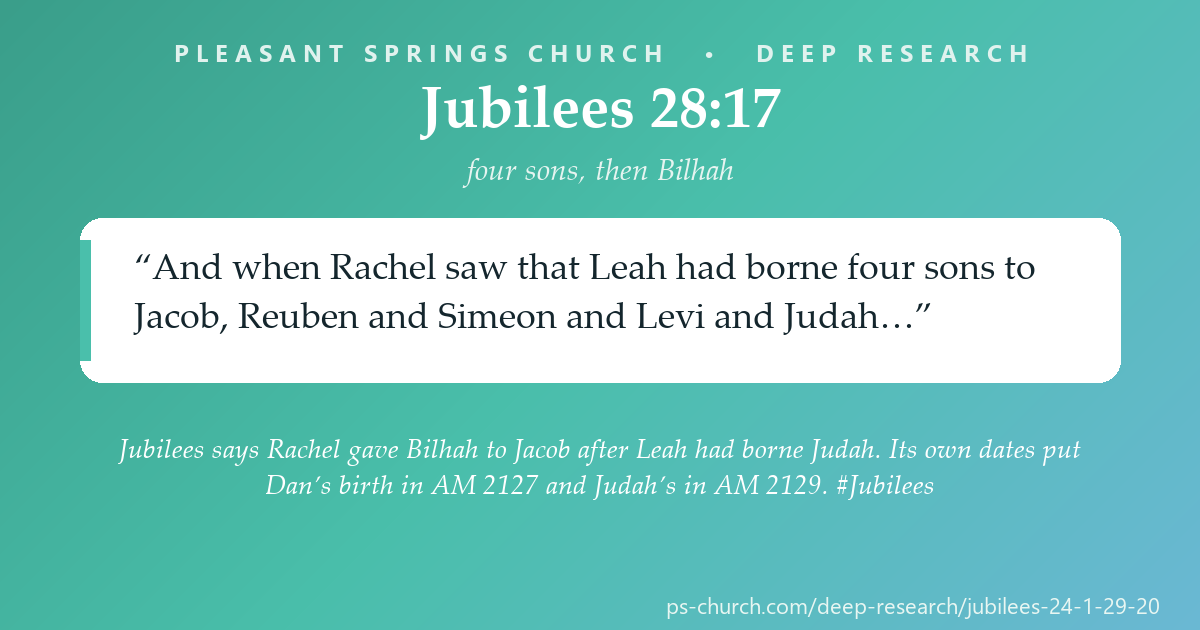
The order of events the text itself states: Bilhah is given after Leah has borne four sons, Judah the fourth. The Geʻez names the same four, in the same order.
AM 2127 — Geʻez year ሳድስ, week ሣልስ, both daggered by Charles. On the book’s own numbers Dan is born in 2127 and Judah in 2129, although the verse before has Judah born first.
One birth, two children (Geʻez ክልኤተ ፡ ወልደ ፡ ወወለተ, ‘two, a son and a daughter’). Genesis gives Dinah her own verse: “afterwards she bare a daughter” (30:21). Dated AM 2134, seventh month — three months after Joseph.
AM 2134, fourth month (Geʻez year ሳድስ). Told after Zebulun and Dinah here and in Genesis; dated before them.
“Hid his intention”: the Geʻez is ወኀብአ ፡ ያዕቆብ ፡ ልቦ ፡ ለላባ, ‘and Jacob hid his heart from Laban’. The verb matches the Greek and Dillmann (ἔκρυψεν δὲ Ιακωβ Λαβαν; ወያዕቆብሰ ፡ ኀብኦ ፡ ለላባ); the noun ‘heart’ matches the Masoretic and the Samaritan (וַיִּגְנֹ֣ב יַעֲקֹ֔ב אֶת־לֵ֥ב לָבָ֖ן; ויגנב יעקב את לב לבן), where those two say ‘stole’. No Genesis column held here has both.
The Jabbok, Esau and the reconciliation in one verse: 21 Geʻez words, where Dillmann’s Genesis 32:1–33:17 runs to 658 in 50 verses. No verse of Genesis 32 or 33 shares more than two consecutive Geʻez words with these six chapters, or more than three with any verse of Jubilees. There is no wrestling here; Genesis’s “And Jacob was left alone” (English 32:24, Hebrew 32:25) has no line in this chapter.
Every Geʻez phrase is short on purpose. The Geʻez Jubilees measured here is J. C. VanderKam’s critical text (1989), digitised by Ran HaCohen; two hosts label the digitisation CC BY-SA, the digitiser describes it as posted under fair use with VanderKam’s blessing, and the edition itself is in copyright. So this page measures the whole of it and prints none of it beyond a few words at a time, and only where those words are the finding. The Geʻez Genesis (Dillmann, 1853; digitised by HaCohen; Beta maṣāḥəft, CC BY-SA 4.0) is printed more freely, with attribution.
There is no Greek, Masoretic, KJV, ESV or Vulgate Jubilees. The book’s Hebrew survives only in Qumran fragments, its Greek only in quotations by later writers, part of it in Latin, and its complete text only in Geʻez — as the standard introductions describe it. The Hebrew, Samaritan and Greek columns quoted in the flags above are Genesis, set beside Jubilees for comparison.
Versification — a third state: there is no Masoretic text of Jubilees and no ESV.
Jubilees. Charles’s English and VanderKam’s Geʻez have identical verse counts in all fifty chapters (1,307 verses each, plus the Prologue). Chapters 24–29 run 33 · 23 · 35 · 27 · 30 · 20 = 168 in both. There is no offset between the two columns this page uses. One verse division is the shelf’s own, not necessarily VanderKam’s: the digitised Geʻez carries no numeral for 26:33, and the builder of this disk’s file inserted the break where VanderKam’s parallel English begins the verse. The KJV and the Vulgate have no Jubilees, so there is no KJV or Vulgate shape to state.
Genesis, as cited on this page. References follow the Hebrew numbering, which the Masoretic text, Dillmann’s Geʻez (it follows the Septuagint’s numbers) and the CATSS Greek share in Genesis 25–33 — with two measured exceptions: the CATSS file has no row 31:51 (53 rows in chapter 31, against 54), and the English Bible numbers Genesis 32 one lower. Counted on the KJV on this disk, English chapter 31 has 55 verses and chapter 32 has 32: Hebrew 32:1 is English 31:55, so the crossing of the Jabbok (Hebrew 32:23) is English 32:22 and the wrestling (Hebrew 32:25–33) is English 32:24–32. Chapters 25–30 and 33 have the same counts in all four.
The Shape of the Passage
Sequence, dated by the text itself — not a chiasmWhere it sits in the book’s frame. Jubilees presents itself as dictated to Moses on Sinai by the angel of the presence (1:27; 2:1), out of ‘heavenly tables’, and it counts history in fifty jubilees: 50:4 has “forty-nine jubilees from the days of Adam until this day, and one week and two years”, i.e. AM 2410 at Sinai, “and there are yet forty years to come” to the crossing of the Jordan — AM 2450, exactly fifty jubilees. These six chapters run from AM 2073 to 2136, inside the forty-third and forty-fourth. The frame shows through twice: the tablets at 24:33 and 28:6, and the angel’s aside to Moses at 28:7.
The weight is measured, not asserted. In Geʻez words, Jubilees gives the blessing (unit 5) more room than Dillmann’s Genesis does and gives the Jabbok and the meeting with Esau (unit 9) one verse. No mirror is claimed: the units do not pair, and the page does not pretend they do.
⚠️ Where this page sits. Jubilees is filed here under Pseudepigrapha & Second Temple. It is canonical in the Ethiopian Orthodox Church and was copied at Qumran; it is not Scripture for us, and nothing taught at Pleasant Springs rests on it. For the book’s introduction see Jubilees, Prologue & 1.
Author
Anonymous, and writing in a borrowed voice. The book is put in the mouth of the angel of the presence, dictating to Moses on Sinai; it is commonly dated to the middle of the second century BC, and its author is usually described as priestly and Torah-centred. Nothing on this page depends on the date, and nothing here tests it.
He writes with a calendar open. In these six chapters the text dates twenty-two events to the year — eleven narrative moments and eleven births. VanderKam’s brackets reproduce all twenty-two, and Charles’s margins every one he dates. Genesis, in the same stretch, dates none of them.
And he stops the story to legislate. Twice the narration turns to law written on the ‘heavenly tables’ (24:33; 28:6), and once the angel turns from Jacob’s wedding to Moses himself: “And command thou the children of Israel that they do not this thing”.
Audience
Readers who already knew Genesis. The text never explains who Esau is or why the blessing matters; it assumes the story and spends its words elsewhere — on Rebecca, on dates, on law. Measured: the blessing gets more Geʻez words than Genesis gives it; the Jabbok and the meeting with Esau get one verse of twenty-one.
Readers for whom marriage was a boundary. Seven of the eight times these chapters name Canaan in Geʻez, the subject is whom Jacob may marry (25:1 twice, 25:4, 25:5, 25:9, 27:8, 27:10); the eighth is the land he returns to (29:2). This page reports that charge; it does not adjudicate it — and the sharper form of it, in chapter 30, belongs to the next page.
Readers who had enemies. The curse on the Philistines (24:28–33) is the harshest passage here. The notes printed with the 1917 reprint read it against the Maccabean wars; that reading is reported in Stage 2, attributed, and not adopted as a finding.
Orient on the book, its calendar, and the Genesis chapters it runs beside.
Search by topic: Jubilees; jubilee chronology; the 364-day calendar; Jacob; Esau; Rebecca; Bilhah and Zilpah; rewritten Bible; Qumran Jubilees manuscripts; Ethiopic Bible.
Which articles are relevant?
- Anchor Bible Dictionary — “Jubilees, Book of,” “Calendars (Ancient Israelite and Early Jewish),” “Jacob,” “Esau,” “Rebekah.”
- Eerdmans Dictionary of Early Judaism — “Jubilees,” “Calendars,” “Rewritten Bible.”
- Dictionary of New Testament Background (IVP) — “Jubilees,” “Rewritten Bible.”
- On the Ethiopic text — any article on the Geʻez Bible that distinguishes the translation of Jubilees from the translation of Genesis. They are commonly held to be two translations by different hands, and this page compares them word for word.
Bibliography surfaced:
- R. H. Charles, The Book of Jubilees, or the Little Genesis (London: A. & C. Black, 1902) — the translation quoted here, in the SPCK reprint of 1917 with an introduction by G. H. Box.
- James C. VanderKam, The Book of Jubilees: A Critical Text (CSCO 510, Scriptores Aethiopici 87; Louvain: Peeters, 1989) — the Geʻez measured here, without its apparatus.
- James C. VanderKam, Jubilees (Hermeneia, two volumes) — the standard commentary. Not consulted for this page.
- August Dillmann, Octateuchus Aethiopicus (Leipzig, 1853–55) — the Geʻez Genesis measured here.
- John C. Endres, Biblical Interpretation in the Book of Jubilees (CBQ Monograph Series) — on the Jacob chapters. Named as a next step; not consulted.
- Betsy Halpern-Amaru, The Empowerment of Women in the Book of Jubilees — on the women of the book, Rebecca among them. Named; not consulted.
The book’s clock, worked through — and two notes from 1917 that are reported, not adopted.
Jubilees dates events “in the Nth jubilee, in the Mth week, in the Kth year”. AM = 49(N−1) + 7(M−1) + K. Every date below is computed from Charles’s English and from the Geʻez numerals, then checked against two outside computations: Charles’s own margin dates (stripped from the text file, kept in its build log) and the years VanderKam brackets in his translation, printed beside the Geʻez on the digitised pages. Those two are cross-checks; the measurement is the arithmetic.
Eleven dated moments outside the births:
| verse | event | Charles’s date words | jubilee · week · year | AM | Charles’s margin | VanderKam’s bracket |
|---|---|---|---|---|---|---|
| 24:1 | Isaac goes to the Well of the Vision | “in the first year of the third week of this jubilee” | 43 · 3 · 1 | 2073 | 2073 | 2073 |
| 24:2 | a famine begins | “in the first year of the fourth week” | 43 · 4 · 1 | 2080 | 2080 | 2080 |
| 24:8 | Isaac sets out for Egypt and goes to Gerar | “in the second year of this week” | 43 · 4 · 2 | 2081 | — | 2081 |
| 24:17 | Isaac leaves for the valleys of Gerar | “in the first year of the seventh week” | 43 · 7 · 1 | 2101 | 2101 | 2101 |
| 24:21 | up to the Well of the Oath | “in the first year of the first week in the forty-fourth jubilee” | 44 · 1 · 1 | 2108 | 2108 | 2108 |
| 25:1 | Rebecca’s charge to Jacob | “in the second year of this week in this jubilee” | 44 · 1 · 2 | 2109 | 2109 | 2109 |
| 26:1 | Isaac calls Esau: the blessing | “in the seventh year of this week” | 44 · 1 · 7 | 2114 | 2114 | 2114 |
| 27:19 | Jacob leaves for Haran; Bethel | “on the first year of the second week in the forty-fourth Jubilee” | 44 · 2 · 1 | 2115 | 2115 | 2115 |
| 28:2 | “Give me my wife” | “in the first year of the third week” | 44 · 3 · 1 | 2122 | 2122 | 2122 |
| 29:5 | Jacob turns toward Gilead | “in the seventh year of the fourth week” | 44 · 4 · 7 | 2135 | 2135 | 2135 |
| 29:14 | Jacob crosses the Jordan | “in the first year of the fifth week in this jubilee” | 44 · 5 · 1 | 2136 | 2136 | 2136 |
All eleven computations agree with both outside sources wherever a source gives a figure. Charles prints no year at 24:8 (his next margin, at 24:12, spans 2080–2101, the ‘three weeks of years’ in Gerar); VanderKam brackets 2081, which is what the words compute to.
⚠️ The one place English and Geʻez do not carry the same words: 24:2. The digitised Geʻez has no year numeral there — ‘in the year of the fourth week’ — and both English translations, Charles’s and VanderKam’s, give ‘the first year’. The page cannot see VanderKam’s apparatus, which is not digitised, and so cannot say what the manuscripts have.
Where the jubilee is not named. 24:1 says ‘this jubilee’; 24:2–17 name only a week and a year. It is the forty-third by necessity: weeks three, four and seven pass, and 24:21 then begins the forty-fourth.
Jacob’s ages, on the book’s own dates — and what Genesis says:
Jacob’s birth at 19:13 computes to AM 2046. So he is 63 at Rebecca’s charge (and says so: “I am nine weeks of years old”), 68 at the blessing, 69 at Bethel, 76 when he asks for his wife, 88 at Joseph’s birth and 89 when he leaves Laban. Genesis states none of these ages.
- Twenty years with Laban. Jubilees: AM 2115 to AM 2135 = 20. Genesis 31:38 and 31:41 say twenty in all four Genesis columns held here (Masoretic, Samaritan, Greek, Dillmann). Agreement.
- Seven years, then seven more. Jubilees 28:1 has Jacob serve “for Rachel his daughter one week” — 2115 to 2122 — and 28:10 “yet other seven years for Rachel”. Genesis 29:20 and 29:30 say seven and seven. Agreement.
- Six years for the flock. Genesis 31:41 has Jacob say “fourteen years for thy two daughters, and six years for thy cattle”, and Genesis 30:25 puts the wage bargain after Joseph’s birth. Jubilees’ own dates put Joseph’s birth in the fourth month of AM 2134 and the departure in the first month of AM 2135 — less than a year between them. Arithmetic on each text’s own figures; the page does not decide between them.
- Esau’s marriage. Genesis 26:34 has Esau marry at forty, in all four Genesis columns. On Jubilees’ birth year for the twins that is AM 2086 — twenty-three years before Rebecca’s charge. In that charge Jacob says Esau has urged a Canaanite marriage on him “these two and twenty years” — one year fewer. Arithmetic only; these chapters give no date for Esau’s first marriages (29:18 places his marriage to Mahalath ‘in the days when Jacob went to Mesopotamia’).
The calendar the dates are kept in — the book’s position, reported:
The months and days here are those of Jubilees’ own year: 364 days (“three hundred and sixty-four days”, 6:32), with a polemic against lunar reckoning in 6:32–38. Bethel is reached ‘on the new moon of the first month’ (27:19); God appears to Isaac on the same date (24:22). That calendar is the book’s position. This page reports it and does not endorse it; nothing below depends on month lengths, because every comparison is made on year numbers or on month order within a year.
Two notes from 1917, reported as notes:
- The Philistines and the Kittim (24:28–33). The notes printed with the 1917 reprint read the curse as reflecting ‘the bitter feeling towards the Philistines existing among the Jews in Maccabean times’, gloss Kittim as ‘i. e. the Macedonians’ and point to 1 Maccabees 1:1 and 8:5. Checked here: the CATSS Greek of 1 Maccabees 1:1 does say Alexander came ἐκ γῆς Χεττιιμ, ‘from the land of Kittim’. Whether Jubilees’ author meant Macedonians is the note’s reading, not this page’s finding. The passage curses a people to destruction; it is reported here as what it is, without approval and without modern comparison.
- Bilhah and Zilpah as sisters. Jubilees 28:9 calls Bilhah “the sister of Zilpah”. The 1917 note: ‘According to Test. Naphtali i. also, Bilhah and Zilpah were sisters.’ The Testament of Naphtali is not held on this disk; the note is reported, not checked.
Counted in the Geʻez, the column the book survives in — short forms only.
Each count is over VanderKam’s Geʻez of Jubilees 24–29 (168 verses, 3,135 words) unless it says ‘whole book’. Words are split on the Geʻez word divider; nothing is lemmatised; a form with a prefix counts as a form of the word. The English glosses are Charles’s, or plain-sense glosses of single words; no English is counted.
Twenty-seven occurrences in these six chapters. The unit of the book’s clock: seven years. Every date in the chronology table above is counted in it, and Jacob gives his own age in it (25:4).
Five uses in these chapters, and five spellings — ኢዩቤሌዉ (24:1), ኢዮቤለው (24:21), ኢዮቤሌው (25:1), ኢዮቤሌዉ (27:19), በዝኢዮቤልውስ (29:14). Across the whole book: 100 occurrences in 35 different forms — one of them, at 4:20, with a syllable more: ኢዮበቤልዉ. The word the book is named for is the best demonstration on the page of why a whole-form run is a lower bound.
27 times in the Geʻez of the whole book; twice here — the Philistine curse ‘engraved’ there (24:33), and the rule that the elder daughter marries first (28:6). Charles renders the phrase ‘heavenly tables’.
Eight occurrences in these chapters; seven are about whom Jacob may marry (25:1 twice, 25:4, 25:5, 25:9, 27:8, 27:10). The eighth is the land he goes home to (29:2). Counted in the Geʻez; the page reports the charge and does not adjudicate it.
Jacob’s reply — twice (26:13, on entering; 26:19, to “Art thou my son Esau?”). Where Genesis 27:19 has him say ‘I am Esau thy firstborn’ in every column held here, Jubilees has him say this. Measured on both Jubilees columns; no motive is assigned.
Ten occurrences, every one in chapter 24 — the wells, the oath, and the curse. After 24:33 the Philistines are not named again in these chapters.
What the angel says to Moses, counted:
At 28:7 the dictating angel stops the wedding story to speak to Moses: “And command thou the children of Israel” (Geʻez ወአንተኒ ፡ አዝዝ ፡ ለደቂቀ ፡ እስራኤል). Across the whole book that address — ‘and thou, command the children of Israel’ — occurs in eight verses of the Geʻez with nothing between the words: 2:26, 6:13, 6:20, 6:32, 15:28, 28:7, 41:26 and 49:15 (three more, 30:11, 33:13 and 49:22, put the name Moses between ‘and thou’ and the verb, and are not counted), spelled three ways for ‘and thou’, two for the verb and two for ‘children’. Charles renders all eight with “And command thou the children of Israel” or “do thou command the children of Israel”, and nowhere else uses either wording; at the three with the name he has “do thou, Moses, command the children of Israel”. Every one introduces a law: the Sabbath, blood, the feast of weeks, the 364-day year, circumcision, this marriage rule, incest, and the passover. 28:7 is the only one inside these six chapters.
Eleven births (twelve children) told in Genesis’ order and dated out of it; a Geʻez screen that fades by chapter; and seven readings that belong to no single family.
Three measurements, none of them across languages. (1) The births: dates computed from the text’s own words, compared with its own narrative order and with Genesis’s. (2) Geʻez against Geʻez: every verse of Jubilees 24–29 run against all 1,526 verses of Dillmann’s Genesis — contiguous whole word forms, tie band beside every run, both ways. (3) Hebrew against Hebrew: the preserved letters of the Qumran fragments against the 23,204 verses of the Masoretic Bible.
1. The births — the measured surprise of this page:
Jubilees 28 tells Jacob’s children in exactly Genesis’s order — Reuben, Simeon, Levi, Judah; Dan, Naphtali; Gad, Asher; Issachar, Zebulun, Dinah; Joseph — as the 1917 note on 28:11 already says: ‘The twelve sons of Jacob appear in our text in the same order as in Gen. xxix. 32-34, xxx. 1-24, xxxv. 17-18’. Then it does what Genesis never does: it dates every birth to the day. Computed, those dates do not keep the order the text tells.
| Genesis (told in this order) | child | mother | Jubilees 28 — Charles’s date words | Geʻez: year · week | AM | month / day | order by date |
|---|---|---|---|---|---|---|---|
| 29:32 | Reuben | Leah | “on the fourteenth day of the ninth month, in the first year of the third week” | ቀዳሚ · ሣልስ | 2122 | 9 / 14 | 1 |
| 29:33 | Simeon | Leah | “on the twenty-first of the tenth month, and in the third year of this week” | ሣልስ · this week | 2124 | 10 / 21 | 2 |
| 29:34 | Levi | Leah | “in the new moon of the first month in the sixth year of this week” | ሳድስ · this week | 2127 | 1 / 1 | 3 |
| 29:35 | Judah | Leah | “on the fifteenth of the third month, in the †first† year of the †fourth† week” | ቀዳሚ · ራብዕ | 2129 | 3 / 15 | 5 |
| 30:6 | Dan | Bilhah | “on the ninth of the sixth month, in the †sixth† year of the †third† week” | ሳድስ · ሣልስ | 2127 | 6 / 9 | 4 |
| 30:8 | Naphtali | Bilhah | “on the fifth of the seventh month, in the second year of the fourth week” | ካልእ · ራብዕ | 2130 | 7 / 5 | 6 |
| 30:11 | Gad | Zilpah | “on the twelfth of the eighth month, in the third year of the fourth week” | ሣልስ · ራብዕ | 2131 | 8 / 12 | 7 |
| 30:13 | Asher | Zilpah | “on the second of the eleventh month, in the †fifth† year of the fourth week” | ኃምስ · ራብዕ | 2133 | 11 / 2 | 9 |
| 30:18 | Issachar | Leah | “on the fourth of the fifth month, in the †fourth† year of the fourth week” | ራብዕ · ራብዕ | 2132 | 5 / 4 | 8 |
| 30:20–21 | Zebulun and Dinah | Leah | “in the seventh of the seventh month, in the sixth year of the fourth week” | ሳድስ · ራብዕ | 2134 | 7 / 7 | 11 |
| 30:24 | Joseph | Rachel | “on the new moon of the fourth month, in the †sixth† year in this fourth week” | ሳድስ · ራብዕ | 2134 | 4 / 1 | 10 |
- Dan before Judah. Dan: AM 2127. Judah: AM 2129. Yet 28:17 has Rachel give Bilhah to Jacob only “when Rachel saw that Leah had borne four sons to Jacob, Reuben and Simeon and Levi and Judah”. On its own numbers the text’s story and its clock disagree.
- Issachar before Asher. Issachar: AM 2132. Asher: AM 2133. Told the other way round, here and in Genesis 30.
- Joseph before Zebulun and Dinah. All three in AM 2134 — Joseph in the fourth month, the twins in the seventh. Told the other way round, here and in Genesis 30.
- Nothing else is out of order. Of the fifty-five pairs among the eleven dated births, exactly these three run backwards.
- Dinah is Zebulun’s twin. Jubilees: one birth, “bare two (children), a son and a daughter”. Genesis 30:21: “afterwards she bare a daughter”.
The disagreement is not an artefact of one column. Charles’s English and VanderKam’s Geʻez carry the same numerals for all eleven births; Charles’s margin prints the same eleven years; VanderKam brackets the same eleven years in his own translation. Charles’s daggers — his sign for corruption — sit on seven numerals in five birth dates: Judah, Dan, Asher, Issachar and Joseph. Those five are five of the six births caught in the three inversions; none of the five births outside an inversion carries a dagger (the sixth inverted birth, Zebulun-and-Dinah, carries none either). The same 1917 note goes on: ‘The order of birth, as given in Jubilees, is complicated by textual difficulties; see Charles ad loc.’ VanderKam’s 1989 critical text still prints the same numerals. Whether the author wrote them or a copyist made them, this page cannot tell: the apparatus that would show what the manuscripts read is not digitised, and Charles’s 1902 notes were not consulted. What the page adds to the 1917 note is only the count: three inversions, and where the daggers fall.
Benjamin, for completeness: Jubilees 32:33, on the next page’s ground, dates him to AM 2143 by the same formula — last, as in Genesis 35:18.
2. Geʻez against Geʻez — the distribution first:
Normalisation, declared. Both files are split on the Geʻez word divider (፡) and on spaces; the full stop and the other punctuation marks are dropped; Dillmann’s editorial brackets and asterisks (and VanderKam’s eight pairs of square brackets, none in chapters 24–29) are deleted but the words inside them are kept (he brackets letters inside words). No letters are folded in the headline numbers. Zero here means ‘shares no two consecutive words’: single shared words are not counted.
Across the 168 verses of Jubilees 24–29 against the 1,526 verses of Dillmann’s Genesis: 150 reach two, 72 reach three, 32 reach four, 14 reach five, 4 reach six, 2 reach seven, 1 reaches eight, and nothing reaches nine. 18 verses share no two consecutive words with any verse of Genesis. The median verse reaches two.
With the fold — treating as one letter the series manuscripts interchange (ሀ/ሐ/ኀ, ሰ/ሠ, አ/ዐ, ጸ/ፀ, in all seven orders) — only one figure of the distribution moves: the deepest run is still eight at 24:1, band 1 both ways, and the fourteen deepest rows, the 18 verses at zero, the median and every chapter figure are unchanged. What does move, all of it: one verse deepens — 26:31 goes from three to four against Genesis 27:37, so 33 verses reach four instead of 32 — and four bands widen (25:16 from 1 to 3; 28:8 from 10 to 12; 29:2 from 23 to 24; 29:18 from 18 to 20). So 64 verses, not 65, have a single deepest partner, and 36 pairs, not 35, are mutual. In the full table below, which prints the unfolded screen, 17 rows would change under the fold: those 5, and 12 others only in a partner’s own figures. In the reverse screen, 112 Genesis verses are at zero instead of 113, and 5 verses of Genesis 32–33 reach three against the whole of Jubilees instead of 4.
By chapter (median / deepest / verses at zero): 24 — 2 / 8 / 5; 25 — 2 / 4 / 4; 26 — 3 / 7 / 3; 27 — 3 / 6 / 2; 28 — 2 / 5 / 0; 29 — 2 / 3 / 4.
| Jubilees | run | band among 1,526 Genesis verses | partner | partner’s band among all 1,308 Jubilees rows |
|---|---|---|---|---|
| 24:1 | 8 | 1 | Genesis 25:11 | 1 |
| 26:17 | 7 | 1 | Genesis 27:22 | 1 |
| 26:6 | 6 | 1 | Genesis 27:9 | 1 |
| 27:27 | 6 | 1 | Genesis 28:20 | 1 |
| 24:16 | 5 | 1 | Genesis 26:15 | 1 |
| 24:18 | 5 | 1 | Genesis 26:18 | 1 |
| 26:2 | 5 | 1 | Genesis 27:3 | 1 |
| 26:23 | 5 | 1 | Genesis 27:29 | 1 |
| 26:32 | 5 | 1 | Genesis 27:38 | 1 |
| 27:6 | 5 | 1 | Genesis 27:11 | 1 |
| 27:12 | 5 | 2 | Genesis 28:5, 29:1 | 1 |
| 27:23 | 5 | 1 | Genesis 28:14 | 1 |
| 28:4 | 5 | 1 | Genesis 29:25 | 1 |
| 28:12 | 5 | 1 | Genesis 29:31 | 1 |
Every one of these partners is band 1 in the other direction too: run against all 1,308 rows of Jubilees, each Genesis verse finds this same Jubilees verse, at this same depth, and no other.
And for every verse, not only the deepest. Of the 150 verses that have a partner at all, 65 have exactly one deepest partner in Genesis (band 1), and 35 of those form mutual pairs: the Genesis verse’s own deepest partner in all of Jubilees is that same verse, alone, at the same depth. Four more verses (24:10, 24:15, 27:12, 27:26) have two tied partners, each of which points back to that verse alone. The widest band is 44, at 25:20 — three different two-word phrases (‘on the earth’, ‘heaven and earth’, ‘in all’), each common across Genesis. The full table is below.
All 168 verses — each with its deepest Genesis partner, and the band both ways (open)
| Jubilees | run | band among 1,526 Genesis verses | deepest partner(s) | partner’s own best in all of Jubilees: run / band (✓ = it is this verse) |
|---|---|---|---|---|
| 24:1 | 8 | 1 | Genesis 25:11 | 25:11: 8 / 1 ✓ |
| 24:2 | 3 | 1 | Genesis 26:1 | 26:1: 3 / 1 ✓ |
| 24:3 | 3 | 1 | Genesis 25:29 | 25:29: 3 / 1 ✓ |
| 24:4 | 3 | 1 | Genesis 27:41 | 27:41: 3 / 1 ✓ |
| 24:5 | 2 | 17 | Genesis (17 verses, e.g. 25:31, 25:33) | 12 of the 17 point back |
| 24:6 | 2 | 1 | Genesis 25:34 | 25:34: 2 / 2 ✓ |
| 24:7 | 0 | — | no two consecutive words with any verse of Genesis | — |
| 24:8 | 2 | 28 | Genesis (28 verses, e.g. 1:11, 1:14) | 11 of the 28 point back |
| 24:9 | 4 | 2 | Genesis 12:1, 26:2 | 12:1: 4 / 2 ✓; 26:2: 4 / 1 ✓ |
| 24:10 | 4 | 2 | Genesis 26:3, 26:4 | 26:3: 4 / 1 ✓; 26:4: 4 / 1 ✓ |
| 24:11 | 3 | 2 | Genesis 18:18, 26:5 | 18:18: 3 / 4 ✓; 26:5: 3 / 1 ✓ |
| 24:12 | 0 | — | no two consecutive words with any verse of Genesis | — |
| 24:13 | 2 | 9 | Genesis (9 verses, e.g. 8:15, 9:8) | 5 of the 9 point back |
| 24:14 | 0 | — | no two consecutive words with any verse of Genesis | — |
| 24:15 | 2 | 2 | Genesis 26:14, 37:11 | 26:14: 2 / 1 ✓; 37:11: 2 / 1 ✓ |
| 24:16 | 5 | 1 | Genesis 26:15 | 26:15: 5 / 1 ✓ |
| 24:17 | 3 | 1 | Genesis 26:16 | 26:16: 3 / 1 ✓ |
| 24:18 | 5 | 1 | Genesis 26:18 | 26:18: 5 / 1 ✓ |
| 24:19 | 3 | 2 | Genesis 16:14, 21:31 | 16:14: 3 / 1 ✓; 21:31: 4 / 1 |
| 24:20 | 2 | 31 | Genesis (31 verses, e.g. 1:11, 1:14) | 15 of the 31 point back |
| 24:21 | 2 | 10 | Genesis (10 verses, e.g. 12:8, 21:14) | 3 of the 10 point back |
| 24:22 | 4 | 1 | Genesis 46:3 | 46:3: 4 / 2 ✓ |
| 24:23 | 3 | 1 | Genesis 46:1 | 46:1: 5 / 1 |
| 24:24 | 0 | — | no two consecutive words with any verse of Genesis | — |
| 24:25 | 2 | 14 | Genesis (14 verses, e.g. 15:1, 21:11) | 12 of the 14 point back |
| 24:26 | 4 | 1 | Genesis 21:31 | 21:31: 4 / 1 ✓ |
| 24:27 | 2 | 6 | Genesis (6 verses, e.g. 7:11, 26:32) | 5 of the 6 point back |
| 24:28 | 2 | 5 | Genesis (5 verses, e.g. 7:11, 26:32) | 5 of the 5 point back |
| 24:29 | 2 | 3 | Genesis 4:14, 6:12, 7:3 | 4:14: 2 / 22 ✓; 6:12: 3 / 1; 7:3: 3 / 1 |
| 24:30 | 2 | 2 | Genesis 3:5, 7:10 | 3:5: 7 / 1; 7:10: 2 / 16 ✓ |
| 24:31 | 2 | 22 | Genesis (22 verses, e.g. 1:22, 1:25) | 6 of the 22 point back |
| 24:32 | 3 | 3 | Genesis 9:19, 19:31, 34:30 | 9:19: 3 / 6 ✓; 19:31: 3 / 6 ✓; 34:30: 3 / 7 ✓ |
| 24:33 | 0 | — | no two consecutive words with any verse of Genesis | — |
| 25:1 | 3 | 2 | Genesis 24:3, 36:2 | 24:3: 3 / 3 ✓; 36:2: 3 / 2 ✓ |
| 25:2 | 2 | 2 | Genesis 8:21, 30:43 | 8:21: 2 / 10 ✓; 30:43: 2 / 2 ✓ |
| 25:3 | 2 | 14 | Genesis (14 verses, e.g. 20:13, 24:7) | 7 of the 14 point back |
| 25:4 | 2 | 10 | Genesis (10 verses, e.g. 9:9, 24:3) | 5 of the 10 point back |
| 25:5 | 2 | 5 | Genesis (5 verses, e.g. 14:23, 24:38) | 4 of the 5 point back |
| 25:6 | 2 | 1 | Genesis 24:48 | 24:48: 3 / 2 |
| 25:7 | 2 | 5 | Genesis (5 verses, e.g. 3:14, 3:17) | 2 of the 5 point back |
| 25:8 | 2 | 2 | Genesis 14:4, 46:1 | 14:4: 2 / 3 ✓; 46:1: 5 / 1 |
| 25:9 | 2 | 10 | Genesis (10 verses, e.g. 3:14, 3:17) | 5 of the 10 point back |
| 25:10 | 0 | — | no two consecutive words with any verse of Genesis | — |
| 25:11 | 4 | 1 | Genesis 14:19 | 14:19: 4 / 2 ✓ |
| 25:12 | 2 | 6 | Genesis (6 verses, e.g. 21:13, 22:11) | 4 of the 6 point back |
| 25:13 | 2 | 1 | Genesis 24:48 | 24:48: 3 / 2 |
| 25:14 | 2 | 3 | Genesis 8:11, 48:14, 48:17 | 8:11: 2 / 7 ✓; 48:14: 2 / 3 ✓; 48:17: 2 / 6 ✓ |
| 25:15 | 2 | 3 | Genesis 16:13, 24:48, 26:29 | 16:13: 2 / 2 ✓; 24:48: 3 / 2; 26:29: 2 / 3 ✓ |
| 25:16 | 2 | 1 | Genesis 41:49 | 41:49: 3 / 1 |
| 25:17 | 2 | 3 | Genesis 6:5, 24:7, 26:4 | 6:5: 3 / 1; 24:7: 2 / 27 ✓; 26:4: 4 / 1 |
| 25:18 | 2 | 1 | Genesis 9:3 | 9:3: 3 / 1 |
| 25:19 | 0 | — | no two consecutive words with any verse of Genesis | — |
| 25:20 | 2 | 44 | Genesis (44 verses, e.g. 1:22, 1:25) | 14 of the 44 point back |
| 25:21 | 2 | 18 | Genesis (18 verses, e.g. 2:11, 8:9) | 5 of the 18 point back |
| 25:22 | 0 | — | no two consecutive words with any verse of Genesis | — |
| 25:23 | 0 | — | no two consecutive words with any verse of Genesis | — |
| 26:1 | 3 | 1 | Genesis 27:2 | 27:2: 3 / 2 ✓ |
| 26:2 | 5 | 1 | Genesis 27:3 | 27:3: 5 / 1 ✓ |
| 26:3 | 0 | — | no two consecutive words with any verse of Genesis | — |
| 26:4 | 0 | — | no two consecutive words with any verse of Genesis | — |
| 26:5 | 3 | 2 | Genesis 27:4, 27:7 | 27:4: 3 / 2 ✓; 27:7: 3 / 2 ✓ |
| 26:6 | 6 | 1 | Genesis 27:9 | 27:9: 6 / 1 ✓ |
| 26:7 | 4 | 1 | Genesis 27:11 | 27:11: 5 / 1 |
| 26:8 | 4 | 1 | Genesis 27:12 | 27:12: 4 / 1 ✓ |
| 26:9 | 2 | 3 | Genesis 27:6, 27:13, 27:46 | 27:6: 2 / 5 ✓; 27:13: 2 / 1 ✓; 27:46: 2 / 8 ✓ |
| 26:10 | 2 | 5 | Genesis (5 verses, e.g. 22:3, 27:9) | 3 of the 5 point back |
| 26:11 | 4 | 1 | Genesis 27:15 | 27:15: 4 / 1 ✓ |
| 26:12 | 2 | 1 | Genesis 27:17 | 27:17: 2 / 9 ✓ |
| 26:13 | 3 | 2 | Genesis 27:19, 27:31 | 27:19: 3 / 1 ✓; 27:31: 3 / 2 ✓ |
| 26:14 | 3 | 1 | Genesis 27:20 | 27:20: 3 / 1 ✓ |
| 26:15 | 2 | 6 | Genesis (6 verses, e.g. 27:20, 31:32) | 3 of the 6 point back |
| 26:16 | 3 | 1 | Genesis 27:26 | 27:26: 3 / 2 ✓ |
| 26:17 | 7 | 1 | Genesis 27:22 | 27:22: 7 / 1 ✓ |
| 26:18 | 3 | 2 | Genesis 27:22, 27:23 | 27:22: 7 / 1; 27:23: 3 / 1 ✓ |
| 26:19 | 2 | 3 | Genesis 27:24, 27:25, 27:32 | 27:24: 2 / 2 ✓; 27:25: 4 / 1; 27:32: 3 / 1 |
| 26:20 | 3 | 1 | Genesis 27:25 | 27:25: 4 / 1 |
| 26:21 | 3 | 1 | Genesis 27:26 | 27:26: 3 / 2 ✓ |
| 26:22 | 2 | 3 | Genesis 4:25, 27:25, 27:27 | 4:25: 6 / 1; 27:25: 4 / 1; 27:27: 2 / 3 ✓ |
| 26:23 | 5 | 1 | Genesis 27:29 | 27:29: 5 / 1 ✓ |
| 26:24 | 3 | 1 | Genesis 13:15 | 13:15: 3 / 3 ✓ |
| 26:25 | 2 | 12 | Genesis (12 verses, e.g. 7:10, 8:6) | 9 of the 12 point back |
| 26:26 | 3 | 2 | Genesis 27:18, 27:31 | 27:18: 3 / 1 ✓; 27:31: 3 / 2 ✓ |
| 26:27 | 3 | 1 | Genesis 27:32 | 27:32: 3 / 1 ✓ |
| 26:28 | 3 | 1 | Genesis 24:65 | 24:65: 3 / 1 ✓ |
| 26:29 | 3 | 1 | Genesis 27:34 | 27:34: 3 / 2 ✓ |
| 26:30 | 3 | 1 | Genesis 27:35 | 27:35: 3 / 1 ✓ |
| 26:31 | 3 | 1 | Genesis 27:37 | 27:37: 3 / 2 ✓ |
| 26:32 | 5 | 1 | Genesis 27:38 | 27:38: 5 / 1 ✓ |
| 26:33 | 3 | 1 | Genesis 27:37 | 27:37: 3 / 2 ✓ |
| 26:34 | 0 | — | no two consecutive words with any verse of Genesis | — |
| 26:35 | 2 | 2 | Genesis 27:41, 28:6 | 27:41: 3 / 1; 28:6: 2 / 28 ✓ |
| 27:1 | 3 | 2 | Genesis 27:15, 27:42 | 27:15: 4 / 1; 27:42: 3 / 3 ✓ |
| 27:2 | 3 | 1 | Genesis 27:42 | 27:42: 3 / 3 ✓ |
| 27:3 | 3 | 1 | Genesis 27:43 | 27:43: 3 / 1 ✓ |
| 27:4 | 2 | 5 | Genesis (5 verses, e.g. 31:32, 32:3) | 3 of the 5 point back |
| 27:5 | 2 | 2 | Genesis 27:45, 39:11 | 27:45: 2 / 2 ✓; 39:11: 2 / 8 ✓ |
| 27:6 | 5 | 1 | Genesis 27:11 | 27:11: 5 / 1 ✓ |
| 27:7 | 2 | 2 | Genesis 27:6, 27:46 | 27:6: 2 / 5 ✓; 27:46: 2 / 8 ✓ |
| 27:8 | 2 | 22 | Genesis (22 verses, e.g. 11:31, 12:5) | 10 of the 22 point back |
| 27:9 | 0 | — | no two consecutive words with any verse of Genesis | — |
| 27:10 | 4 | 1 | Genesis 28:2 | 28:2: 4 / 1 ✓ |
| 27:11 | 4 | 1 | Genesis 28:4 | 28:4: 4 / 1 ✓ |
| 27:12 | 5 | 2 | Genesis 28:5, 29:1 | 28:5: 5 / 1 ✓; 29:1: 5 / 1 ✓ |
| 27:13 | 2 | 11 | Genesis (11 verses, e.g. 7:10, 8:6) | 9 of the 11 point back |
| 27:14 | 2 | 1 | Genesis 38:11 | 38:11: 3 / 1 |
| 27:15 | 2 | 1 | Genesis 19:30 | 19:30: 2 / 10 ✓ |
| 27:16 | 2 | 2 | Genesis 39:16, 49:10 | 39:16: 2 / 34 ✓; 49:10: 2 / 28 ✓ |
| 27:17 | 2 | 20 | Genesis (20 verses, e.g. 6:9, 24:17) | 18 of the 20 point back |
| 27:18 | 0 | — | no two consecutive words with any verse of Genesis | — |
| 27:19 | 3 | 1 | Genesis 35:6 | 35:6: 3 / 4 ✓ |
| 27:20 | 2 | 4 | Genesis (4 verses, e.g. 3:17, 22:3) | 3 of the 4 point back |
| 27:21 | 3 | 1 | Genesis 28:12 | 28:12: 3 / 1 ✓ |
| 27:22 | 4 | 1 | Genesis 35:12 | 35:12: 4 / 1 ✓ |
| 27:23 | 5 | 1 | Genesis 28:14 | 28:14: 5 / 1 ✓ |
| 27:24 | 2 | 2 | Genesis 28:15, 46:4 | 28:15: 2 / 3 ✓; 46:4: 3 / 1 |
| 27:25 | 3 | 1 | Genesis 28:17 | 28:17: 3 / 1 ✓ |
| 27:26 | 4 | 2 | Genesis 28:19, 35:7 | 28:19: 4 / 1 ✓; 35:7: 4 / 1 ✓ |
| 27:27 | 6 | 1 | Genesis 28:20 | 28:20: 6 / 1 ✓ |
| 28:1 | 2 | 5 | Genesis (5 verses, e.g. 27:43, 28:5) | 1 of the 5 point back |
| 28:2 | 3 | 5 | Genesis (5 verses, e.g. 29:14, 29:15) | 5 of the 5 point back |
| 28:3 | 2 | 4 | Genesis (4 verses, e.g. 19:31, 19:34) | 1 of the 4 point back |
| 28:4 | 5 | 1 | Genesis 29:25 | 29:25: 5 / 1 ✓ |
| 28:5 | 2 | 1 | Genesis 29:30 | 29:30: 3 / 2 |
| 28:6 | 3 | 5 | Genesis (5 verses, e.g. 29:14, 29:15) | 5 of the 5 point back |
| 28:7 | 2 | 9 | Genesis (9 verses, e.g. 19:31, 19:34) | 5 of the 9 point back |
| 28:8 | 2 | 10 | Genesis (10 verses, e.g. 8:10, 8:12) | 6 of the 10 point back |
| 28:9 | 2 | 2 | Genesis 29:28, 34:1 | 29:28: 2 / 6 ✓; 34:1: 2 / 3 ✓ |
| 28:10 | 2 | 5 | Genesis (5 verses, e.g. 29:18, 29:20) | 2 of the 5 point back |
| 28:11 | 2 | 10 | Genesis (10 verses, e.g. 4:1, 4:17) | 4 of the 10 point back |
| 28:12 | 5 | 1 | Genesis 29:31 | 29:31: 5 / 1 ✓ |
| 28:13 | 2 | 11 | Genesis (11 verses, e.g. 4:1, 4:17) | 6 of the 11 point back |
| 28:14 | 4 | 1 | Genesis 4:25 | 4:25: 6 / 1 |
| 28:15 | 2 | 14 | Genesis (14 verses, e.g. 12:8, 25:2) | 11 of the 14 point back |
| 28:16 | 4 | 1 | Genesis 30:1 | 30:1: 4 / 2 ✓ |
| 28:17 | 4 | 1 | Genesis 30:1 | 30:1: 4 / 2 ✓ |
| 28:18 | 4 | 1 | Genesis 4:25 | 4:25: 6 / 1 |
| 28:19 | 3 | 2 | Genesis 30:23, 38:3 | 30:23: 3 / 5 ✓; 38:3: 3 / 5 ✓ |
| 28:20 | 4 | 1 | Genesis 30:9 | 30:9: 4 / 1 ✓ |
| 28:21 | 4 | 1 | Genesis 4:25 | 4:25: 6 / 1 |
| 28:22 | 3 | 1 | Genesis 29:30 | 29:30: 3 / 2 ✓ |
| 28:23 | 2 | 11 | Genesis (11 verses, e.g. 4:1, 4:17) | 4 of the 11 point back |
| 28:24 | 3 | 2 | Genesis 30:23, 38:3 | 30:23: 3 / 5 ✓; 38:3: 3 / 5 ✓ |
| 28:25 | 2 | 9 | Genesis (9 verses, e.g. 24:38, 24:40) | 6 of the 9 point back |
| 28:26 | 3 | 4 | Genesis (4 verses, e.g. 29:14, 29:15) | 4 of the 4 point back |
| 28:27 | 2 | 1 | Genesis 30:32 | 30:32: 2 / 1 ✓ |
| 28:28 | 2 | 1 | Genesis 30:42 | 30:42: 2 / 1 ✓ |
| 28:29 | 2 | 4 | Genesis (4 verses, e.g. 12:16, 20:14) | 4 of the 4 point back |
| 28:30 | 2 | 2 | Genesis 31:24, 31:29 | 31:24: 2 / 10 ✓; 31:29: 2 / 5 ✓ |
| 29:1 | 3 | 1 | Genesis 30:25 | 30:25: 3 / 1 ✓ |
| 29:2 | 2 | 23 | Genesis (23 verses, e.g. 11:31, 12:5) | 10 of the 23 point back |
| 29:3 | 3 | 1 | Genesis 20:13 | 20:13: 3 / 1 ✓ |
| 29:4 | 2 | 5 | Genesis (5 verses, e.g. 26:18, 28:8) | 3 of the 5 point back |
| 29:5 | 2 | 2 | Genesis 8:4, 8:14 | 8:4: 3 / 4; 8:14: 4 / 1 |
| 29:6 | 2 | 24 | Genesis (24 verses, e.g. 1:8, 1:10) | 14 of the 24 point back |
| 29:7 | 2 | 7 | Genesis (7 verses, e.g. 14:24, 29:18) | 4 of the 7 point back |
| 29:8 | 2 | 4 | Genesis (4 verses, e.g. 22:14, 28:19) | 0 of the 4 point back |
| 29:9 | 0 | — | no two consecutive words with any verse of Genesis | — |
| 29:10 | 2 | 4 | Genesis (4 verses, e.g. 11:31, 15:7) | 3 of the 4 point back |
| 29:11 | 2 | 22 | Genesis (22 verses, e.g. 1:22, 1:25) | 6 of the 22 point back |
| 29:12 | 2 | 1 | Genesis 32:4 | 32:4: 3 / 1 |
| 29:13 | 3 | 2 | Genesis 8:4, 8:14 | 8:4: 3 / 4 ✓; 8:14: 4 / 1 |
| 29:14 | 0 | — | no two consecutive words with any verse of Genesis | — |
| 29:15 | 0 | — | no two consecutive words with any verse of Genesis | — |
| 29:16 | 0 | — | no two consecutive words with any verse of Genesis | — |
| 29:17 | 2 | 2 | Genesis 12:8, 26:18 | 12:8: 2 / 54 ✓; 26:18: 5 / 1 |
| 29:18 | 2 | 18 | Genesis (18 verses, e.g. 4:16, 13:12) | 8 of the 18 point back |
| 29:19 | 2 | 8 | Genesis (8 verses, e.g. 22:14, 26:18) | 4 of the 8 point back |
| 29:20 | 2 | 2 | Genesis 28:7, 31:1 | 28:7: 2 / 3 ✓; 31:1: 2 / 3 ✓ |
… and the close-following test: Jubilees 26 against Genesis 27.
The stolen blessing is where the two texts run closest. Of Jubilees 26’s 35 verses, 30 have their deepest Genesis partner in Genesis 27, and for 25 every partner is in Genesis 27. The other five: 26:3 and 26:4 (zero — they cover Genesis 27:5 in other words), 26:34 (zero), 26:24 (three words with Genesis 13:15, a land-promise formula) and 26:28 (three with Genesis 24:65). Chapter 26 is one of the two chapters with a median of three; the deepest single run in it is seven.
… then the same screen from the other side — and it fades:
Run the other way — each of the 294 verses of Geʻez Genesis 25:29–33:20 against Jubilees 24–29 — and count, chapter by chapter, the verses that share at least three consecutive words, and the verses that share no two:
| Geʻez Genesis | verses | verses sharing 3+ consecutive words with Jubilees 24–29 | deepest | verses at zero (no two consecutive words) |
|---|---|---|---|---|
| Genesis 25:29–34 | 6 | 1 | 3 | 1 |
| Genesis 26 | 35 | 10 | 5 | 10 |
| Genesis 27 | 46 | 26 | 7 | 3 |
| Genesis 28 | 22 | 10 | 6 | 4 |
| Genesis 29 | 35 | 8 | 5 | 15 |
| Genesis 30 | 43 | 4 | 4 | 16 |
| Genesis 31 | 54 | 2 | 3 | 33 |
| Genesis 32 | 33 | 0 | 2 | 20 |
| Genesis 33:1–20 | 20 | 0 | 2 | 11 |
With the fold, Genesis 28 has 3 verses at zero instead of 4 (28:9 gains a partner); nothing else in this table moves.
Genesis 27: 26 of 46. Genesis 32: none of 33. Genesis 33: none of 20. 113 of the 294 Genesis verses share no two consecutive words with these six chapters (112 with the fold). Against the whole of Jubilees, no verse of Genesis 32 or 33 gets past three — and the four that reach three (five with the fold) do it with other parts of the book.
It is not only closeness; it is room. Counted in Geʻez words, each Jubilees block set against the Genesis verses it covers:
| Jubilees | its Geʻez words | Dillmann’s Genesis | its Geʻez words | ratio |
|---|---|---|---|---|
| 26:1–35 | 584 | 27:1–41 (41 verses) | 494 | 1.18 |
| 27:1–27 | 501 | 27:42–28:22 (27 verses) | 377 | 1.33 |
| 28:1–30 | 623 | 29:1–31:2 (80 verses) | 1,008 | 0.62 |
| 29:1–12 | 235 | 31:3–54 (52 verses) | 656 | 0.36 |
| 29:13 | 21 | 32:1–33:17 (50 verses) | 658 | 0.03 |
The 1917 section headings pair Jubilees 26 with the whole of Genesis 27; on that pairing the blessing’s ratio is 1.04 (584 words to 561), still above one. Both effects are real and the page does not separate them: where Jubilees gives Genesis less room it also shares fewer of its words. Genesis 32:1–33:17 — fifty verses: the messengers, the gifts, the night at the Jabbok, the wrestling, the new name, the meeting — is one verse of twenty-one words; the name Israel comes later in Jubilees, at Bethel (32:17, on a later page).
… and what the screen finds nothing for:
Which Genesis verses have no partner at all? The 113 at zero are counted by chapter in the table above. These are the places where three or more consecutive Genesis verses share no two consecutive Geʻez words with any verse of Jubilees 24–29 — with what Genesis tells there, and what a reader of Charles finds in these chapters:
| Genesis (Hebrew numbering) | verses at zero in a row | what Genesis tells there | what Jubilees 24–29 has (a reading of Charles, not a measurement) |
|---|---|---|---|
| Genesis 26:33–35 | 3 | the well named Shebah; Esau’s two Hittite wives, ‘a grief of mind’ | in other words: the ‘Well of the Oath’ named (24:26); Esau’s two wives (25:1) |
| Genesis 29:2–9 | 8 | the well in the field, the stone, the shepherds of Haran; Rachel comes with the sheep | nothing: 28:1 goes straight to Laban |
| Genesis 29:22–24 | 3 | Laban’s feast; Leah brought to Jacob; Zilpah given | in other words, 28:3 — the same three events |
| Genesis 30:13–15 | 3 | Leah names Asher; Reuben’s mandrakes | Asher’s birth only (28:21); no mandrakes |
| Genesis 30:38–41 | 4 | the peeled rods at the watering troughs | nothing: 28:28 has the speckled flock and no rods |
| Genesis 31:6–12 | 7 | Jacob to Rachel and Leah: wages changed ten times; the dream of the rams | one clause: 29:3 |
| Genesis 31:14–17 | 4 | Rachel and Leah answer; Jacob sets them on camels | in other words: 29:3–4 |
| Genesis 31:33–40 | 8 | Laban searches the tents; Rachel sits on the images; Jacob’s complaint | nothing here; the idols surface on the next page, at 31:2 |
| Genesis 31:49–52 | 4 | Mizpah; the heap and the pillar as witness | in other words: 29:7–8 |
| Genesis 32:15–21 English 32:14–20 | 7 | the droves of the gift for Esau | nothing |
| Genesis 32:23–27 English 32:22–26 | 5 | across the Jabbok by night; the wrestling until daybreak | one clause: 29:13, ‘he passed over the Jabbok’ |
| Genesis 32:31–33 English 32:30–32 | 3 | Peniel; the limp; the sinew | nothing |
| Genesis 33:4–7 | 4 | Esau runs to meet him; the women and children bow | one clause: 29:13, ‘he was reconciled to him’ |
All 113 Genesis verses at zero (open)
Genesis 25: 30 · Genesis 26: 6–7, 11, 21, 26, 30–31, 33–35 · Genesis 27: 5, 16, 40 · Genesis 28: 3, 9, 16, 18 · Genesis 29: 2–9, 11, 16–17, 22–24, 29 · Genesis 30: 3, 7–8, 11, 13–15, 20–21, 28, 30, 33, 38–41 · Genesis 31: 6–12, 14–17, 19, 23, 27–28, 30–31, 33–40, 44–45, 47, 49–52, 54 · Genesis 32: 1, 6, 8, 11, 15–21, 23–27, 29, 31–33 · Genesis 33: 2, 4–7, 11–12, 14–15, 19–20
Among them are the verses that name Naphtali (30:8), Gad (30:11), Asher (30:13) and Zebulun (30:20), and Dinah’s birth (30:21): Jubilees 28 dates each of those births but tells none of the naming speeches. And Esau’s blessing at 27:40, whose counterpart, Jubilees 26:34, is at zero from the other side as well.
A zero is not an absence, and a partner is not a presence. Genesis 29:22–24 are at zero, yet Jubilees 28:3 tells the same three events in its own words. And Genesis 26:8–10 — the episode in which Isaac passes Rebekah off as his sister, which Jubilees does not tell (the 1917 note on 24:13: ‘Notice that no reference is made in our text to Isaac's deception about Rebecca.’) — each reach two, on stock phrases such as ወይቤሎ ፡ አቤሜሌክ, ‘and Abimelech said to him’. The table is where to look, not what to conclude.
⚠️ The page’s own counter-examples:
- The births of Levi, Dan and Asher all find their deepest Genesis partner in Seth’s birth, Genesis 4:25 — four words, ‘and she conceived and bore him a son’, band 1. Not one of them finds its own birth notice in Genesis 29–30. And Genesis 4:25’s own deepest partner in Jubilees is a run of six at Jubilees 4:7 — Seth again. A birth formula, not a link: printed so the other fours are not read as more than they are.
- A run understates agreement. Dillmann’s Genesis 27:3 is ten words: ወይእዜኒ ፡ ንሣእ ፡ ንዋየ ፡ ሐቅልከ ፡ ምጐንጳከ ፡ ወቀስተከ ፡ ወፃእ ፡ ሐቅለ ፡ ወነዐው ፡ ሊተ. Jubilees 26:2 opens with the same ten in the same order except two — ነዓዌከ where Genesis has ሐቅልከ (roughly ‘of your hunting’ for ‘of your field’), and ምጕንጳከ for ምጐንጳከ, the same word with a different vowel on a labialised letter. Eight of ten positions agree, and the run engine reports five, with or without the fold, because the fold does not touch labialised vowels. Every run on this page is a floor.
- Zero does not mean invented. Of the 18 Jubilees verses at zero, some cover the same ground as Genesis in other words (26:3–4 cover Genesis 27:5; 24:12 and 24:14 cover Genesis 26:6 and 26:13–14) and some have no Genesis counterpart at all (24:33, the tablets; 25:19 and 25:22–23, Rebecca’s blessing; 29:14–16, Jacob across the Jordan and his gifts to his parents). The screen cannot tell those apart; a reader has to.
- Two Geʻez translations, two editors. The Jubilees text is VanderKam’s (1989); the Genesis text is Dillmann’s (1853). Each is a critical edition built on its own manuscripts. Agreement between them is a lower bound; disagreement may be editorial. And they can agree where no Hebrew or Greek column held here does — see ‘the dew of the earth’ below.
3. Seven readings, and the families they fall in:
These are seven of the places in chapters 24–29 where the 1917 notes point at a Genesis reading (each row names its note), and every column on disk was read at each. Notes of the same kind that are not tabulated: 148:4 (‘he called’ at 28:11, where Genesis 29:32 has ‘she called’), 150:1–3 (28:26–28, on the wording of Genesis 30:28 and 30:32) and 152:1 (29:10, on Genesis 14:5). They are selected, not sampled — so no score is kept, and none should be inferred.
| where | Masoretic | Samaritan | Greek (CATSS) | Dillmann’s Geʻez Genesis | Jubilees: Geʻez · Charles |
|---|---|---|---|---|---|
| Jub 24:25 / Gen 26:32 was water found? 1917 note 135:4 | מָצָ֥אנוּ מָֽיִם found | מצאנו מים found | οὐχ εὕρομεν ὕδωρ not found | ወኢረከቡ ፡ ማየ not found | ወኢረከቡ ፡ ማየ · “did not find water” |
| Jub 26:22 / Gen 27:27 the smell of a field 1917 note 142:1 | כְּרֵ֣יחַ שָׂדֶ֔ה field | כריח השדה מלא full field | ὡς ὀσμὴ ἀγροῦ πλήρους full field | ጼና ፡ ገዳም ፡ ጥቀ ፡ ዘባረኮ field, plus ጥቀ ‘very’ | ጼና ፡ ገዳም ፡ ዘባረኮ ፡ እግዚአብሔር · “the smell of a (full) field” Geʻez: field only. Charles’s parentheses mark ‘full’ as his own supply; the 1917 note: ‘So Latin here’. |
| Jub 26:23 and 26:33 / Gen 27:28 and 27:39 the dew of the earth, or its fatness? 1917 note 142:2 | וּמִשְׁמַנֵּ֖י הָאָ֑רֶץ · מִשְׁמַנֵּ֤י הָאָ֙רֶץ֙ fatness, both times | ומשמני הארץ · משמני הארץ fatness, both times | τῆς πιότητος τῆς γῆς · ἀπὸ τῆς πιότητος τῆς γῆς fatness, both times | ወእምጠለ ፡ ምድር · ወእምጠለ ፡ ምድር dew, both times | ወእምጠለ ፡ ምድር · እምጠለ ፡ ምድር · “of the dew of the earth”, “far from the dew of the earth” dew, both times |
| Jub 26:23 / Gen 27:28 corn and … 1917 note 142:3 | דָּגָ֖ן וְתִירֹֽשׁ wine | דגן ותירש wine | σίτου καὶ οἴνου wine | ስርናየከ ፡ ወወይነከ wine | ስርናይ ፡ ወቅብእ · “corn and oil” oil |
| Jub 26:34 / Gen 27:40 ‘when thou …’ 1917 note 143:1 | כַּאֲשֶׁ֣ר תָּרִ֔יד | כאשר תהדר a different verb | ἡνίκα ἐὰν καθέλῃς | ወእመ ፡ ትፈቅድ | እመ ፡ ዐበይከ · “when thou becomest great” The 1917 note pairs it with the Samaritan. |
| Jub 28:29 / Gen 30:43 oxen? 1917 note 150:4 | צֹ֣אן רַבּ֔וֹת no oxen | צאן רבות no oxen | καὶ βόες oxen | ወአልህምተ oxen | አልህምተ · “oxen and sheep” The 1917 note, anchored after ‘oxen and sheep’, reads ‘And sheep so LXX (Gen. xxx. 43); but MT and other versions omit.’ The columns do not obviously fit that wording: the Masoretic and the Samaritan have a word for flocks and none for oxen; the Greek has κτήνη πολλὰ καὶ βόες, ‘much livestock and oxen’. The row tabulates oxen; what the note meant is not settled here. |
| Jub 29:4 / Gen 31:20 hid, or stole the heart? 1917 note 151:1 | וַיִּגְנֹ֣ב יַעֲקֹ֔ב אֶת־לֵ֥ב לָבָ֖ן stole … heart | ויגנב יעקב את לב לבן stole … heart | ἔκρυψεν δὲ Ιακωβ Λαβαν hid | ወያዕቆብሰ ፡ ኀብኦ ፡ ለላባ hid | ወኀብአ ፡ ያዕቆብ ፡ ልቦ ፡ ለላባ · “Jacob hid his intention from Laban” hid … heart |
What the seven show is that no single column is ‘Jubilees’ Genesis’. Three times Jubilees’ Geʻez reads with Dillmann’s Geʻez Genesis: twice with the Greek as well, against the Masoretic and the Samaritan (no water; oxen), and once against all three (the dew of the earth, in both blessings). Once its Geʻez lacks the ‘full’ that the Samaritan and the Greek have, as the Masoretic does. Once it has a word that no column held here as text has (oil). Once the 1917 note pairs it with the Samaritan. And once it carries the verb the Greek has with the noun the Hebrew has. At 26:22 the two Jubilees columns disagree with each other: Charles’s ‘(full)’ is supplied from the Latin, which this disk does not hold.
‘The dew of the earth’ is the reading that matters most for the screen above. In all of Dillmann’s Genesis a word for ‘dew’ stands directly before ‘earth’ in exactly 2 verses, the two blessings; in VanderKam’s Jubilees, in 3 — the two blessings and 2:7. Here two Geʻez translations, commonly held to be by different hands, agree with each other and with no Hebrew or Greek column held here. So a Geʻez-to-Geʻez run can register agreement that belongs to the Geʻez side — or to a Greek text this disk does not hold; the screen cannot tell which, and this page does not guess.
One more witness, read by eye. The larger Cambridge Septuagint — A. E. Brooke and N. McLean, The Old Testament in Greek, I.1 Genesis (1906) — is held here as a scan whose Greek OCR is unusable, so its apparatus was read from the page images at these two verses only. At 27:39 (page 73) it gives the Ethiopic’s reading, in Latin: ‘a rore caeli desuper et a rore terrae … sit uictus tuus’ — ‘from the dew of heaven above and from the dew of the earth’ — with no Greek manuscript beside it. At 27:28 (page 71) it has no entry on ‘fatness’ at all; but its introduction says of the Ethiopic that ‘from the middle of Genesis onward the use of its evidence has been confined almost entirely to the cases where it agrees with some other authority or with the Hebrew original’, so that silence is not evidence. At 27:28 it does record ‘uini et olei’ — wine and oil — in the Old Latin and in Cyprian.
4. The Hebrew behind the Geʻez, where it survives:
Three Qumran fragments fall in this range. 1Q17 carries 27:19–20; 4Q222 fragment 1 carries 25:9–12 and fragment 2 carries 27:6–7 (its fragment 3 is chapter 48 and is not used). The identification is by content, against the Geʻez and Charles; the edition does not number Jubilees verses.
- Most of what an edition prints is reconstruction. 1Q17: 61 of 218 letters preserved. 4Q222 fragments 1–2: 147 of 387. Only preserved letters are measured — the reconstruction is the editors’ text, filled in from other witnesses, so measuring it against Genesis would be measuring the editors. Letters marked damaged-but-read count as preserved; three letters the scribe himself erased in 4Q222 are excluded (a reader that ignores the erasure mark prints ‘עאל’ for ‘אל’ at 25:11).
- Against the 23,204 verses of the Masoretic Bible, the preserved words reach three at most, three times: היא בית אל (Joshua 18:13, band 1), אשר נתן לי (Genesis 48:9 and Isaiah 8:18, band 2) and אלך כי אם (Numbers 10:30, band 1). All three are coincidences of common words. Genesis 35:6 has ‘that is Bethel’ too, but in the Pentateuch’s spelling of the pronoun, which a whole-form screen does not match.
- The one run that lands on the Genesis verse being told: מאבני המקום — two words found in one verse of the Hebrew Bible, Genesis 28:11, the verse whose ground Jubilees 27:20 covers.
- Hebrew for Jubilees-only words. לבדו היה (27:20, ‘he was [journeying] alone’) and אל תיראי אמי (25:10, ‘fear not, mother’) carry clauses that the Geʻez and Charles also have and Genesis does not. The Hebrew word ‘alone’ describes Jacob himself once in the Masoretic Genesis — left alone at the Jabbok, Hebrew 32:25 (at 30:40 the same form, in a verse that names Jacob, sets his flocks apart: “he put his own flocks by themselves”). The page notes the coincidence and draws nothing from it.
5. The New Testament — named, not measured:
There is no Greek Jubilees, so there is no run to take. The New Testament passages that touch this story touch Genesis, and are named here so a reader can follow them:
- Hebrews 12:16–17 — Esau, who sold his birthright for a single meal and afterwards sought the blessing with tears (Jubilees 24:3–7; 26:29–32).
- Hebrews 11:20 — by faith Isaac invoked future blessings on Jacob and Esau (Jubilees 26).
- Romans 9:10–13 — Rebecca’s twins and the choice of Jacob.
- John 1:51 — angels ascending and descending on the Son of Man (Jubilees 27:21; Genesis 28:12).
- Acts 7:8 — Jacob and the twelve patriarchs (Jubilees 28).
- Acts 7:53; Galatians 3:19; Hebrews 2:2 — the law given through angels. Jubilees’ whole frame is an angel dictating to Moses, and it surfaces in this range at 28:7. Named for the theme only.
None of these is offered as evidence that a New Testament writer read Jubilees; none can be. For the Genesis chapters themselves, see Genesis 27:1–40, Genesis 29:31–30:24 and Genesis 32:22–32.
What this page could not check, where it is weakest, and what it found wrong on the shelf.
This is the section that makes the shelf trustworthy. Read it before quoting anything above.
⚠️ What this page could NOT check:
- VanderKam’s apparatus. The digitised Geʻez is the critical text without its apparatus. So the page cannot say what the manuscripts read at the daggered birth numerals, or at 24:2 where the year numeral is missing.
- The Latin Jubilees. Not held. Charles supplied words from it (26:22’s ‘(full)’), and his notes cite it; every claim about the Latin on this page is Charles’s or the 1917 notes’, reported.
- The commentaries. VanderKam’s Hermeneia commentary, Charles’s own 1902 notes (‘see Charles ad loc.’, as the 1917 note puts it), Endres, Halpern-Amaru — none consulted. The only scholarship quoted is the annotation printed with the 1917 English, and one sentence of Brooke and McLean’s introduction.
- The Qumran editions. The fragments were measured from the Scripta Qumranica Electronica transcription (provided by Reinhard G. Kratz, Ingo Kottsieper and Annette Steudel on the basis of the Göttingen Qumran-Wörterbuch text, itself based on a preliminary text by Martin Abegg). The printed editions and the photographs were not consulted.
- Dillmann’s apparatus and every Geʻez Genesis manuscript. The Genesis column is one 1853 eclectic text.
- The Testament of Naphtali, Josephus, and the other retellings of these chapters. Not measured.
- The Septuagint’s apparatus. Brooke and McLean’s 1906 Genesis was read from its page images at 27:28 and 27:39 only; the rest of its apparatus for Genesis 25–33 was not read, and the Göttingen Genesis was not consulted. So ‘no Greek column’ on this page means the CATSS text, plus those two verses of Brooke and McLean.
⚠️ Where this page is weakest:
- The Geʻez screen compares two translations. Both Geʻez texts are commonly held to have been translated from Greek, by different hands and probably at different times. A shared run may come from the Greek, from the Geʻez translators, or from later copyists; the screen cannot tell which, and the page never says.
- Whole-form runs are a floor. ‘Jubilee’ is spelled five ways in five uses here; Jubilees 26:2 agrees with Genesis 27:3 in eight of ten positions and scores five. The fold the page declares moves one figure of the distribution (verses reaching four, 32 to 33) and changes seventeen rows of the full table. An orthography-aware screen would score higher everywhere, and would need its own declaration.
- The seven readings are selected. They are seven of the places the 1917 notes flag (Stage 4 names the others in this range), not a random sample of verses; they show that Jubilees’ Genesis is not one family’s, and nothing more.
- The two Geʻez texts can agree with each other against every other column (‘the dew of the earth’). Some of what the Geʻez screen counts as contact may therefore belong to the Geʻez transmission rather than to anything Jubilees and Genesis shared earlier; the screen cannot separate the two.
- One date parse rests on agreement, not on syntax. The Geʻez of 28:23 sets its numerals in an unusual order (‘in the seventh, the month of the seventh; year in the sixth; week of the fourth’). The page reads it as the seventh day of the seventh month of the sixth year of the fourth week — which is how Charles and VanderKam both render it and what both their year numbers presuppose.
- The English column is a 1902 translation in a 1917 reprint, transcribed by a website. It is quoted verbatim, and the file has at least one transcription slip in this range: 26:31 reads ‘com’ where the 1917 scan reads ‘corn’. That verse is not printed here.
- The Qumran evidence is small. 208 preserved letters across two manuscripts. It shows Hebrew standing behind several clauses that Genesis does not have; it cannot carry more weight than that.
⚠️ Found on the shelf while building this page — reported, not silently fixed:
- The two live Jubilees pages quote Charles inexactly. Jubilees 1 and Jubilees 2 attribute their English to ‘R. H. Charles, 1913 (public domain), lightly modernized’. The text on this disk is the 1917 reprint of the 1902 translation, and their lines differ from it — Jubilees 1:23 in particular is printed with its two promises in reverse order. This page quotes the file verbatim and its self-check proves it; the older pages are not edited here.
- The Genesis 28:10–22 page links Jubilees 27 to the Jubilees 2 page, twice; that page covers chapter 2 only. Chapter 27 now has a page: this one.
Editions & studies:
- R. H. Charles, The Book of Jubilees (1902; SPCK reprint 1917, introduction by G. H. Box) — public domain; the English here.
- J. C. VanderKam, The Book of Jubilees: A Critical Text (CSCO 510, 1989) — the Geʻez, digitised by Ran HaCohen.
- A. Dillmann, Octateuchus Aethiopicus (1853–55) — the Geʻez Genesis, digitised by HaCohen; Beta maṣāḥəft, CC BY-SA 4.0.
- Scripta Qumranica Electronica — 1Q17 and 4Q222, CC BY-SA 4.0.
- A. E. Brooke and N. McLean, The Old Testament in Greek, I.1 Genesis (Cambridge, 1906) — public domain; read from the scan at two verses.
- The Samaritan Pentateuch, MS Chester Beatty 751 — Text-Fabric dataset by Christian Canu Højgaard, Martijn Naaijer and Stefan Schorch (2023), CC BY-NC 4.0.
An old retelling that kept Genesis’s order and wrote its own clock — and, as its text now stands, the two do not agree.
Name what you learned, why it matters, and one concrete response.
What should we carry away — and do?
- A retelling shows where its teller spent his words. Jubilees gives the stolen blessing more words than Genesis does, and the Jabbok and the meeting with Esau one verse of twenty-one words. Reading the two side by side is the quickest way to see what Genesis itself chose to linger on.
- Precision is not the same as accuracy. Every birth here is dated to the day, and in three places the dates run against the order the story tells (once against its explicit words, 28:17). Genesis dates none of them, and its order has nothing to contradict.
- ‘What the ancient text says’ usually means ‘what one column says’. Seven readings, and no one column holds Jubilees’ Genesis. Ask which copy.
- Genesis records Jacob’s deception in his own words. At Genesis 27:19 he says ‘I am Esau thy firstborn’, and Genesis later has him limp. Where the old retelling has ‘I am thy son’, go back and read Genesis’s line again. Scripture tells the truth about the people God chose, and the grace is in that.
- One concrete response. Read Genesis 27 and Genesis 32 aloud on the same day. Notice which one the old retelling gives the most words, and which one it gives a single verse — then thank God for the one where he met Jacob alone in the dark.
Jubilees 28:17 · to share
English: R. H. Charles (1902; SPCK reprint 1917), verbatimEvery Deep Research page traces its passage across the whole sweep — the Old Testament, the Second-Temple world between the testaments (historical witnesses, not Scripture), and the New Testament. Follow the thread:
← Jubilees 17–23 · Jubilees 24–29 · Jubilees 30–34 →
Pleasant Springs Church — Deep Research
Research method after Michael S. Heiser’s Bible Research Method (examine dictionaries → ancient literature → important words → textual connections → academic publications → share), with the Pleasant Springs “Author & Audience” foundation. Scripture set in the Hebrew, the Greek editions named on each page and the ESV (Old Testament), and the Greek New Testament and the ESV (New Testament), per the practice of Pleasant Springs Church. ⚠️ Status: Jubilees is not part of the canon read at Pleasant Springs; it is studied here as a Second-Temple witness, filed under Pseudepigrapha & Second Temple, and nothing taught here rests on it. English: R. H. Charles, The Book of Jubilees (1902; SPCK reprint 1917), public domain, quoted verbatim from the transcription held on this disk with its provenance (sacred-texts.com, John Bruno Hare, redactor). Geʻez Jubilees: VanderKam’s critical text (1989), digitised by Ran HaCohen — licence chain disputed, so measured in full and quoted only in short phrases. Geʻez Genesis: Dillmann, Octateuchus Aethiopicus (1853), digitised by Ran HaCohen; Beta maṣāḥəft, CC BY-SA 4.0. Hebrew Genesis: the Masoretic text (Miqra according to the Masorah). Samaritan: MS Chester Beatty 751, Text-Fabric dataset (Hoejgaard, Naaijer, Schorch), CC BY-NC 4.0. Greek Genesis and 1 Maccabees: the CATSS morphological Septuagint. English Genesis: the KJV (public domain). Septuagint apparatus: Brooke and McLean, Genesis (1906), public domain, read from the scan at two verses. Qumran: 1Q17 and 4Q222 from Scripta Qumranica Electronica, CC BY-SA 4.0. Every number and every quoted line is re-derived from those files by this page’s self-check. Direction of influence is nowhere asserted.
Scripture quotations marked ESV are from the ESV® Bible (The Holy Bible, English Standard Version®), © 2001 by Crossway, a publishing ministry of Good News Publishers. ESV Text Edition: 2016. Used by permission. All rights reserved. The ESV text may not be quoted in any publication made available to the public by a Creative Commons license, and the ESV may not be translated in whole or in part into any other language. www.esv.org
|
Did this study bless you today? 💚 Give to Support PS Church100% of gifts go to the General Fund — thank you. |