Alone at the Jabbok, on the night before he must face the brother he cheated, Jacob wrestles a “man” until daybreak. Unable to overpower him, the stranger touches Jacob’s hip and puts it out of joint — and the crippled schemer, for the first time in his life, stops grasping and starts clinging: “I will not let you go unless you bless me.” He is blessed with a new name — no longer Jacob the supplanter but Israel, “for you have striven with God and with men, and have prevailed” — and he names the place Peniel, “the face of God,” astonished to be alive. The sun rises as he limps away: wounded and renamed at once. This study works Genesis 32:22–32 (there is no divine name YHWH here — 32:28, 30 read simply “God,” Elohim). See the method →
Genesis 32:24, 26, 28, 30, 32
Hebrew · LXX · ESV(Note the versification: in the Hebrew and most printed Septuagints these verses are numbered 32:23–33, one higher than the English, because the Hebrew counts English 31:55 as 32:1. The English numbers are used above for ease of reference.)
The Shape of the Passage
ConcentricThe nation is named in a wrestling match by night — wounded, clinging, and blessed — because that is how a grasping man becomes a God-wrestler, and how Israel learned what its own name would cost and mean.
Author
Moses sets this scene at the hinge of Jacob’s life. Twenty years earlier he fled Canaan a fugitive, having cheated Esau of blessing and birthright; now he returns to meet the brother who swore to kill him (27:41), and word comes that Esau is riding to meet him with four hundred men (32:6). Jacob does what Jacob always does — he divides the camp and plans (32:7–8), then he prays, honestly, out of fear (32:9–12), and sends waves of appeasing gifts ahead (32:13–21). The night before the reckoning he ferries his family across the Jabbok and stays behind, and Scripture states it bluntly: “Jacob was left alone.” The schemer has finally run out of schemes. It is precisely there, with nothing left to grasp, that God comes to grapple with him.
The man in the dark. The narrative is deliberately reticent: “a man wrestled with him” (32:24). Only slowly does the reader learn who this is — the stranger cannot be overpowered yet declines to end it by force, disabling Jacob with a mere touch (32:25); he gives a new name with divine authority (32:28); he withholds his own name (32:29); and Jacob concludes, trembling, “I have seen God face to face” (32:30). The prophet Hosea, reading this same night, says Jacob “strove with the angel and prevailed… he met God at Bethel” (Hos 12:3–4) — holding the “man,” the “angel,” and “God” together without collapsing the mystery. The church has long heard here the Angel of the Lord, the God who makes himself met, even a foreshadowing of the God who would take flesh; but the text keeps its holy reserve (“Why is it that you ask my name?”), and reverent readers keep it too. This is a real encounter with the living God, not a dream and not a demon — and it leaves a body changed.
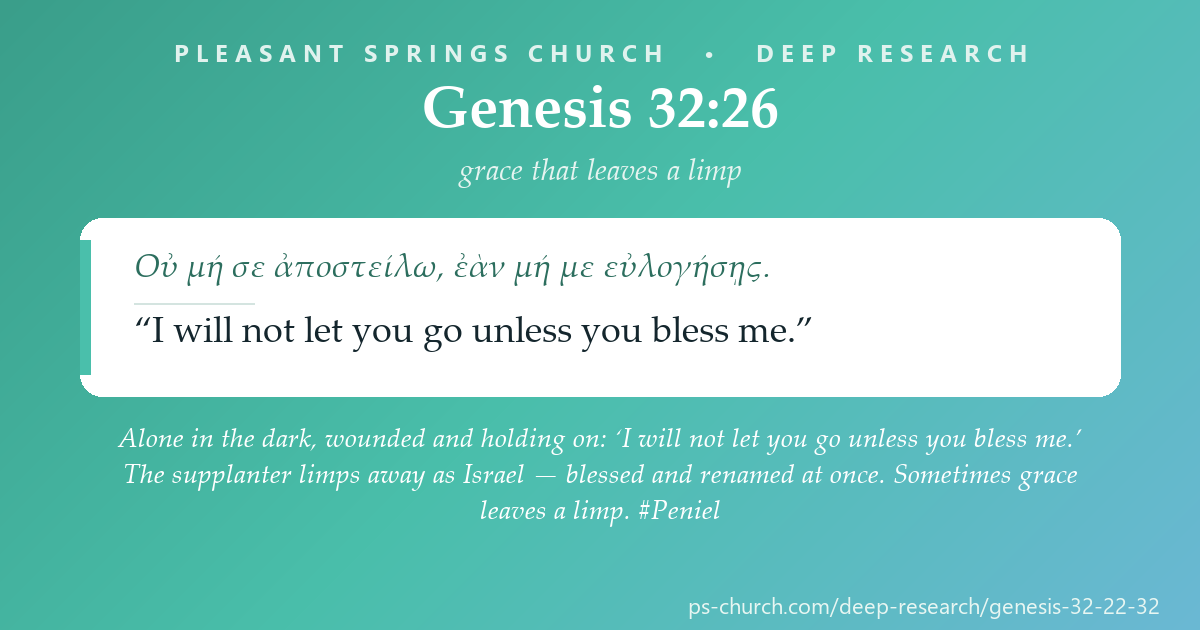
Wounded and renamed at once. The turning is not that Jacob wins — no one overpowers God — but that, once crippled, he refuses to quit: “I will not let you go unless you bless me” (32:26). The grasper’s whole life had been the pursuit of blessing by fraud; now, undone, he seeks it by clinging, and receives it as gift. The new name seals the change: Ya’aqob, “he grasps the heel / supplants,” becomes Yisra’el, “he strives with God” (32:28) — a whole people carried in one man’s wound. He limps into the sunrise (32:31), and the limp is the point: he prevails and is disabled in the same night, blessed and broken by the same hand. Israel will remember it in its very diet (32:32) — a nation that eats around the site of the wound.
Audience
Israel heard, in this chapter, the meaning of its own name. To be Israel is not to be the effortless favorite but the one who has grappled with God in the dark and come away limping and blessed — a people whose identity is forged in a wound. The generation at Sinai and in the wilderness, forever wrestling with the God who had bound himself to them, would recognize their patriarch: fearful and faithful, grasping and clinging, undone and renamed. The place-name Peniel preached to them that their God can be met — that a mortal can see “the face of God” and yet live — while the withheld name preached that he is never merely mastered or managed. The dietary custom (32:32), older than the Law and kept “to this day,” wrote the whole story into the body of the nation.
Clinging, and grace that limps. For the church, Genesis 32 is the classic portrait of prevailing prayer and of strength perfected in weakness. Here is a man who, having exhausted his own cunning, holds on to God through the night and will not release him without a blessing — the posture Jesus commends in the friend at midnight and the persistent widow (Lk 11:5–8; 18:1–8), the “wept and sought his favor” of Hosea 12:4. And here is a blessing that arrives as a wound: Jacob rises a prince with God and a cripple for life, so that ever after he leans on the very hip God struck. Paul would name the pattern exactly — a thorn not removed, and the word, “My grace is sufficient for you, for my power is made perfect in weakness” (2 Cor 12:7–10). The church learns to pray as Jacob prayed, to cling as Jacob clung, and to walk — unashamed — with Jacob’s limp.
Orient on Peniel/Penuel, the name Israel, theophany, and the Jabbok.
Search by topic: Jacob, Israel (name), Peniel / Penuel, angel of the LORD / theophany, Jabbok, wrestling, the sinew of the thigh (gid ha-nasheh).
Which articles are relevant?
- Anchor Bible Dictionary — “Jacob,” “Israel (name),” “Peniel/Penuel,” “Jabbok,” “Angel of the LORD,” “Theophany.”
- Dictionary of the OT: Pentateuch — “Jacob,” “Names / Name-Giving,” “Angel of Yahweh,” “Theophany,” “Blessing.”
- NIDOTTE / TDOT — ’avaq (wrestle), sarah (strive/contend), barakh (bless), panim (face), natsal (deliver), mal’akh (angel/messenger).
Bibliography surfaced:
- Gordon Wenham (WBC), Victor Hamilton (NICOT), Kenneth Mathews (NAC), Bruce Waltke, Nahum Sarna (JPS) on Genesis.
- Studies of the Angel of the LORD and Old Testament theophany; of name-changing as covenant act; of the Jacob cycle’s structure (the two nights at Bethel and Peniel bracketing the exile years).
- Beale & Carson, Commentary on the NT Use of the OT (John 1:47–51; the Jacob traditions).
Night crossings, the touch that disables, and seeing God and living.
Read the Jabbok crossing, the wrestling “man,” and the “face of God” against ancient river-boundary lore, name-giving custom, and the Bible’s theology of theophany.
Which parallels shed light on religion and worldview?
The night, the river, the boundary. Jacob is crossing back into the land of promise; the Jabbok is the threshold. In the ancient imagination borders and river-fords are liminal, dangerous places, and the dark before a decisive day is a time of testing. Genesis takes up that atmosphere only to overturn it: the peril at the ford is not a river-demon or a hostile spirit to be bribed past, but the covenant God himself, come to bring Jacob through the crisis by breaking and blessing him. The wordplay is dense and deliberate — Ya’aqob (Jacob) ye’aveq (wrestles) at the Yabboq (Jabbok): the man’s very name, his struggle, and the place all ring on the same consonants, as if the ground itself were named for the fight that his whole life has been.
The touch that disables. The stranger wrestles all night as an equal, then ends the deadlock not by superior force but by a single touch to the hip socket (32:25) — the narrator’s quiet disclosure that this was never a fair fight. What could shatter Jacob with a touch had condescended to grapple with him till dawn. This is the shape of the Bible’s theophanies: the infinite God stooping to be met on a human scale, veiling a power that could annihilate. And the disabling is mercy as much as might: the very wound that ends the match is the thing that makes Jacob cling, and the cling is what wins the blessing. God cripples him into dependence.
To see God and live. Across the ancient Near East it was axiom that no mortal could look on a god and survive; and Israel’s own Scripture agrees — “you cannot see my face, for man shall not see me and live” (Ex 33:20). That is exactly why Jacob’s wonder at Peniel is worship, not boast: “I have seen God face to face, and yet my life has been delivered” (32:30). The same astonishment runs through the theophany accounts — Hagar (“Have I really seen… and remained alive?” 16:13), Gideon (Judg 6:22–23), Manoah (“We shall surely die, for we have seen God,” Judg 13:22). To meet God and walk away is sheer grace. And note the next morning: Jacob tells Esau, “I have seen your face, which is like seeing the face of God” (33:10) — the reconciled brother’s face lit, for a healed man, with the light of Peniel.
- Genesis 16:7–13; Exodus 33:18–23; Judges 6:22–23; 13:21–22 — the theophany tradition: to see God (or his Angel) and live is astonishing mercy.
- Hosea 12:3–4 — the prophet’s own reading: Jacob “strove with the angel and prevailed; he wept and sought his favor… he met God at Bethel” — struggle turned to weeping supplication.
- Genesis 32:32 — the gid ha-nasheh (sinew of the thigh) custom: an ancestral practice, older than the Sinai law, keeping the night’s wound in the nation’s memory and diet.
The old expositors returned again and again to the strange logic of this night, and it repays the attention. Everything in Jacob’s life to this point has been an exercise in taking — the heel grasped in the womb, the birthright bought at a low price, the blessing stolen in a disguise, the flocks multiplied by cunning against Laban. He is a man who prevails by grasping. So when God finally comes to deal with him in person, he does not simply overpower him — that would teach nothing — nor does he leave him to grasp his way through one more crisis. He wrestles with him: he lets Jacob spend his whole strength against him in the dark, and then, when Jacob has held on all night, he reaches out and with one touch takes the grasper’s strength away. The dislocation is the sermon. It ends forever the possibility of prevailing by force, and it leaves Jacob a man who can now only cling. And clinging, it turns out, is the one posture that wins the blessing: ‘I will not let you go unless you bless me.’ The wound and the blessing arrive in the same instant, from the same hand; the new name and the ruined hip are given together. This is not a defeat that is later reversed by a victory; it is a defeat that is the victory. Jacob rises a prince with God precisely because he has been broken by God — and he will limp on that hip for the rest of his life, so that the memory of the God who bested him is written into every step he takes. Whoever would have the blessing of this God should count on the same terms: he tends to give it through the very place he has wounded, and to send his princes out limping, that they may lean on him and not on themselves.
The vocabulary of the night: wrestle, cling, striven, and the face of God.
Watch the wordplay Jacob/Jabbok/wrestle, the disabling touch, the “unless you bless me,” the new name Israel, and the wonder of Peniel — God’s face seen, and life delivered.
“And he wrestled” — from ’avaq, a rare verb rung on the consonants of Ya’aqob (Jacob) and Yabboq (Jabbok): the man, the fight, and the ford all echo one another. The whole grasping life comes to a head in one all-night grip.
“The hip socket” — touched, and dislocated by a mere touch: the disclosure that this was no equal. What could shatter Jacob had stooped to grapple him. The wound that ends the match is the wound that makes him cling.
“Unless you bless me” — the grasper’s new grammar. He has sought blessing all his life by fraud and force; now, crippled, he seeks it only by holding on. Prevailing prayer is a wounded man who will not let go (Hos 12:4; Lk 18:1–8).
“Israel” — “he strives with God” (from sarah, to contend), given because “you have striven with God and with men, and have prevailed.” A whole nation named in one man’s wrestling. The LXX reads ἐνίσχυσας μετὰ θεοῦ — “you were strong with God.”
“The face of God” — the place-name Jacob coins: “I have seen God panim el-panim, face to face, and yet my life has been delivered.” The LXX renders it interpretively Εἶδος θεοῦ, “Form of God.” To meet God and live is grace.
“My life has been delivered” — natsal, rescued, snatched to safety. Not a boast at having survived but wonder: the same night that broke his body spared his life. He walks away astonished to be alive, and limping.
How the rest of Scripture fills out the scene:
- Genesis 35:9–10 — God confirms the name at Bethel: “no longer shall your name be called Jacob, but Israel” — the Peniel night ratified where the exile began.
- Hosea 12:2–6 — the prophet’s meditation: struggle become weeping supplication; a call to Jacob’s heirs, “return to your God, hold fast to love and justice.”
- Exodus 33:11, 20; Deuteronomy 34:10 — “face to face” and “no one may see me and live”: the tension Peniel holds in wonder (see Hagar and the God who sees).
- Genesis 33:10 — “I have seen your face, which is like seeing the face of God”: the reconciled brother’s face lit, for a healed man, with Peniel’s light.
From a limp at the Jabbok to the ladder, the new name, and power in weakness.
Trace the wounded blessing, the new name, and prevailing prayer toward their New Testament fulfillment.
Which cross-references matter?
- Genesis 28:10–22 ↔ 32:22–32 — the two nights that frame the exile: at Bethel God met the fleeing schemer with a ladder and a promise; at Peniel God meets the returning man hand to hand. Grace bookends the running years.
- Hosea 12:3–6 — Israel’s own prophets read this night as the paradigm of the people: strivers with God who must turn their striving into weeping, and hold fast to their God.
- Luke 11:5–8; 18:1–8 — the friend at midnight and the persistent widow: Jesus teaches the prayer that will not let go — Jacob’s “I will not let you go” turned catechism.
- John 1:47–51 — “an Israelite indeed, in whom there is no deceit” (no Jacob in him!), and the promise of heaven opened and angels ascending: the Son of Man is the true ladder, and the true meeting-place of God and man.
- 2 Corinthians 12:7–10; Revelation 2:17; 3:12 — power made perfect in weakness; the conqueror given a new name written by God: the limp and the renaming carried to their end (see the city and the new name).
Scripture makes a great deal of names, and never more than here. To be renamed by God is to be re-created — the old identity, with all its history, taken up and transformed. ‘Jacob’ means grasper, supplanter, heel; it is a name that is almost an accusation, and it had fit him perfectly. ‘Israel’ means one who strives with God — and, remarkably, it keeps the struggle in it: God does not rename him ‘the peaceful’ or ‘the settled,’ but names him for the very wrestling that has just crippled him. The new life is not the end of the contending; it is the contending redeemed, the grasping turned to clinging, the fight for self turned to holding on to God. When John’s Gospel opens, Jesus sees Nathanael and says, ‘Behold, an Israelite indeed, in whom there is no deceit’ — a man, that is, who is Israel without the Jacob, all the striving toward God and none of the guile — and then promises him the sight of Jacob’s own ladder, ‘heaven opened, and the angels of God ascending and descending on the Son of Man.’ What Jacob glimpsed for one shattering night at Peniel, the face of God turned toward mortal man, has come near and stayed: the Word made flesh is the place where God is seen face to face and the seer is not destroyed but delivered. And to everyone who overcomes, the risen Christ promises the thing given to Jacob in the dark — ‘a new name written, which no one knows except the one who receives it.’ The wound heals; the limp remains as honor; the name is forever.
The scholarship on Genesis 32:22-32.
The commentators on the Peniel narrative; the studies of theophany, name-change, and the Jacob cycle.
Commentaries & studies:
- Gordon J. Wenham (WBC), Victor P. Hamilton (NICOT), Kenneth A. Mathews (NAC), Bruce K. Waltke, Nahum M. Sarna (JPS) on Genesis.
- Studies of the Angel of the LORD and OT theophany; of the Jacob cycle’s chiastic shape (Bethel ↔ Peniel); of ancient name-giving and blessing.
- G. K. Beale & D. A. Carson, eds., Commentary on the NT Use of the OT (John 1:47–51 and the Jacob traditions).
Interpretation notes worth keeping:
- Who is the ‘man’? (32:24, 30). The text is studied in its reticence — “a man,” then “God,” and Hosea’s “the angel.” Read it as a genuine theophany, the God who condescends to be met (the Angel of the LORD tradition), and resist the urge to pin down more than the narrator will. The withheld name (32:29) is itself instruction: this God is met, never mastered.
- The disabling touch (32:25). Not a lucky blow but a disclosure: the stranger who could not be overpowered ends it with a touch. The wrestling was condescension; the wound is both power and mercy — it is what turns Jacob from struggling to clinging.
- ‘You have prevailed’ (32:28). Jacob does not defeat God; he “prevails” by holding on for blessing after he can no longer fight. The victory is the surrender-that-clings. Where the Hebrew has “striven with God,” the LXX has enischysas… dynatos (“you were strong… mighty”) — a difference commentators commonly read as reverential, and one worth noting rather than smoothing away. What the reason for it was is not something these columns can settle.
- Peniel / Penuel (32:30–31). Two spellings of one name, “face of God.” The LXX renders it interpretively as “Form of God” (Εἶδος θεοῦ) — wrestling, like every translator, with how a man could see God’s face and live.
- The sinew custom (32:32). An etiological note: an ancestral food practice, pre-Mosaic, kept “to this day.” Handle as the narrator does — a memorial written into the body of the nation, not a law imposed from Sinai.
From a night of wrestling to a life that leans on the God who wounded it.
Name what you learned, why it matters, and one concrete response.
What should we carry away — and do?
- God will wrestle you to the end of yourself. Jacob had to be “left alone,” with nothing to grasp, before he could be blessed. Grace often comes only after our own strength is spent — and sometimes it comes disabling us, so that we finally cling instead of grab.
- Cling, and do not let go. “I will not let you go unless you bless me” is prevailing prayer in one sentence — the persistent, weeping, holding-on faith that Jesus praises. The wounded, not the strong, are the ones who hold on hardest.
- Wear the limp. The blessing and the wound came together; Jacob walked out a prince and a cripple. Do not despise the place God has struck you — it may be the very thing that keeps you leaning on him, and the mark that you have truly met him.
Step in response: take the fear or the reckoning you are dreading — the “Esau” riding toward you — and, before you scheme your way around it, get alone and hold on to God in honest prayer until dawn if you must. Name the place where he has wounded you (a loss, a limitation, a thorn) and ask him to make it the very ground of your dependence, not your shame. And if you know the God who was seen face to face at Peniel, remember that he has since come near in the flesh, the true ladder between heaven and earth — and to everyone who holds on and overcomes he promises a new name (Rev 2:17). Cling until the blessing; then walk on, limping and unashamed.
Genesis 32:26 · to share
LXX + ESVEvery Deep Research page traces its passage across the whole sweep — the Old Testament, the Second-Temple world between the testaments (historical witnesses, not Scripture), and the New Testament. Follow the thread:
Pleasant Springs Church — Deep Research
Research method after Michael S. Heiser’s Bible Research Method (examine dictionaries → ancient literature → important words → textual connections → academic publications → share), with the Pleasant Springs “Author & Audience” foundation. Scripture set in the Hebrew, the Greek editions named on each page and the ESV (Old Testament), and the Greek New Testament and the ESV (New Testament), per the practice of Pleasant Springs Church. Genesis 32:22–32 research grounded in Wenham, Hamilton, Mathews, Waltke, and Sarna, with the Angel-of-the-LORD and theophany studies; the night read as a genuine divine encounter held in the text’s own reticence (“a man” → “God” → Hosea’s “the angel,” 32:24, 30; Hos 12:3–4) — met, never mastered; the dense wordplay Ya’aqob / ye’aveq / Yabboq; the disabling touch (32:25) as both power and mercy; the new name Yisra’el (“he strives with God,” 32:28; LXX enischysas… dynatos) given with the wound; Peniel / “the face of God” (32:30; LXX Eidos theou) against Exodus 33:20 held in wonder; the pre-Mosaic sinew custom (32:32) as a memorial in the body of the nation; prevailing prayer and power perfected in weakness (Hos 12:4; Lk 18:1–8; 2 Cor 12:7–10) — and the Father’s reticence honored, the identification held with reverence, not over-precision. There is no Tetragrammaton in the passage; “God” renders Elohim throughout.
Scripture quotations marked ESV are from the ESV® Bible (The Holy Bible, English Standard Version®), © 2001 by Crossway, a publishing ministry of Good News Publishers. ESV Text Edition: 2016. Used by permission. All rights reserved. The ESV text may not be quoted in any publication made available to the public by a Creative Commons license, and the ESV may not be translated in whole or in part into any other language. www.esv.org
|
Did this study bless you today? 💚 Give to Support PS Church100% of gifts go to the General Fund — thank you. |