For twenty years Jacob feared this morning. Esau is coming with four hundred men, and the night before, at Peniel, Jacob had wrestled God and prayed to be delivered from his brother’s hand. He bows seven times — and then the dread dissolves: Esau runs to meet him, falls on his neck, kisses him, and the two brothers weep. The prayer is answered; the fearsome face is full of grace. “I have seen your face,” Jacob says, “which is like seeing the face of God, and you have accepted me.” Reconciliation received where wrath was feared — and a quiet caution as Jacob settles at Shechem and builds his first altar, El-Elohe-Israel. This study works Genesis 33:1–20. See the method →
Genesis 33:4, 9, 10, 11, 20
Hebrew · LXX · ESVThe Shape of the Passage
SequenceThe most feared reunion in Genesis turns out to be its tenderest — because the God who wrestled Jacob at night had already gone ahead to soften the brother by day. Reconciliation is answered prayer.
Author
Moses sets this chapter in the raw morning after Peniel. Jacob — newly named Israel, and limping (32:31) — lifts his eyes and there is Esau, “and four hundred men with him” (33:1), the very sight that had driven him to prayer and to dividing his camp. He arranges the family for the worst, walks out in front of them all, and bows himself to the ground seven times as he approaches (33:3) — the sevenfold prostration a vassal made before a king, the last posture we would expect from the man who once bought and stole the birthright and blessing. Then the narrative breaks open with a run of verbs that leaves no room for fear: Esau ran, embraced him, fell on his neck, kissed him, and “they wept” (33:4). The brother armed with four hundred men has come not to avenge but to welcome. The dread was real; the danger, it turns out, was already disarmed — by the God to whom Jacob had prayed the night before.
The face motif. Moses has been building the word panim (“face”) since the night before. Jacob had tried to appease Esau’s face with a gift going on ahead (32:20), then met God face to face and called the place Peni-el, “the face of God” (32:30). Now, pressing the gift on his brother, he says the astonishing thing: “I have seen your face, which is like seeing the face of God, and you have accepted me” (33:10). The verb of acceptance, ratsah, is the cultic word for a sacrifice graciously received. Jacob has been received — by God at Peniel, and now by the brother whose favor he could not earn and dared not assume. The grace runs one direction only: undeserved, and therefore all the sweeter.
‘I have enough’ — and ‘I have everything.’ Esau waves off the present: “I have enough (rav), my brother; keep what you have for yourself” (33:9). Jacob insists: “because God has dealt graciously with me, and because I have everything (kol)” (33:11). The former supplanter, who spent his youth grasping for what belonged to his brother, now has all and gives it away. The parting is the one place the chapter turns gray: Esau offers escort and company toward Seir; Jacob, pleading the pace of the children and flocks, says he will follow to Seir (33:14) — then travels instead to Succoth (“booths”) and on to Shechem, buys a parcel of land, and there raises his first altar, El-Elohe-Israel (33:18–20). Worship at last — and yet not quite the obedience of a full return, for God had bound him to Bethel (31:13; 35:1). The altar is real; the settling near Shechem casts the shadow that the next chapter will darken.
Audience
Israel — the nation whose long, bitter history with Edom (the sons of Esau) ran through Obadiah and the prophets — heard in this chapter a memory older and gentler than the feud: a morning when the two brothers wept on each other’s necks. Whatever came later, the founding scene between Jacob and Esau was reconciliation, not war. And Israel heard the theology plainly: the fearsome brother was softened not by Jacob’s gifts or bows but by the God who answers prayer and turns hearts (Prov 21:1). The reunion Jacob dreaded he could not manufacture; he could only pray, prepare, humble himself — and receive the grace that had already gone ahead of him.
Forgiveness, and the danger of stopping short. For the church, Genesis 33 is one of Scripture’s great pictures of reconciliation: the wronged brother running, the offender bowing, the embrace, the tears, the refused-then-pressed gift, the good word “you have accepted me.” Jesus paints the very same scene — a father who ran and fell on the neck of a returning son and kissed him (Lk 15:20) — and the apostles make it the church’s own ministry: “God… gave us the ministry of reconciliation” (2 Cor 5:18). But the chapter’s honest ending is a warning as well as a comfort. Jacob, reconciled and blessed, settles at Shechem when God had called him to Bethel — a half-step of obedience that leaves his household exposed (ch 34). Grace received is meant to move us all the way home. The church learns both halves: run to be reconciled, and then do not linger short of where God is calling you to worship.
Orient on Esau/Edom, reconciliation and prostration, the minchah gift, Succoth, and Shechem.
Search by topic: Esau / Edom, reconciliation, bowing / prostration, minchah (gift, tribute), Seir, Succoth, Shechem, altar names.
Which articles are relevant?
- Anchor Bible Dictionary — “Esau,” “Edom,” “Seir,” “Succoth,” “Shechem,” “Reconciliation.”
- Dictionary of the OT: Pentateuch — “Jacob,” “Esau,” “Blessing,” “Worship / Altars,” “Reconciliation.”
- NIDOTTE / TDOT — ratsah (accept, be pleased with), panim (face), minchah (gift/tribute/offering), chanan (deal graciously), berakhah (blessing), nashaq (kiss).
Bibliography surfaced:
- Gordon Wenham (WBC), Victor Hamilton (NICOT), Kenneth Mathews (NAC), Bruce Waltke, Nahum Sarna (JPS) on Genesis.
- Studies of the Jacob cycle and its chiastic shape (departure and return, Esau at the frame); of the panim (“face”) motif across Genesis 32–33; and of ancient Near Eastern greeting, prostration, and gift diplomacy.
- Beale & Carson, Commentary on the NT Use of the OT (the reconciliation motif; Luke 15; 2 Corinthians 5).
Sevenfold bowing, the gift that seals peace, and the face of a brother.
Read the approach, the embrace, and the refused-then-pressed gift against ancient custom of homage, tribute, and audience “before the face.”
Which parallels shed light on religion and worldview?
Bowing seven times. Jacob’s sevenfold prostration as he nears Esau (33:3) is not mere courtesy; in the diplomacy of the age it was the homage of an inferior to a lord. The el-Amarna letters, written by Canaanite vassals to Pharaoh a few centuries later, repeat the very formula — “seven times and seven times I fall at the feet of my lord.” Jacob, who had schemed to be lord over his brother (25:23; 27:29, “be lord over your brothers”), now takes the servant’s posture at his brother’s feet and repeatedly calls him “my lord” and himself “your servant” (33:5, 8, 13–14). The blessing he grasped by deceit he now, in effect, hands back in humility — and receives grace instead.
The gift that seals peace. The minchah Jacob sends and presses (32:13–21; 33:10–11) belongs to a world where gifts carried covenantal weight: they could be tribute, apology, or the seal of a restored bond. Esau’s reluctance — “I have enough, my brother” (33:9) — and Jacob’s insistence are the choreography of ancient reconciliation: to accept the gift was to accept the giver, to ratify the peace. So Jacob’s pressing is not stubbornness but need: “accept my present… you have accepted me” (33:10–11). The word he uses, berakhah (“my blessing,” 33:11), is deliberate — the man who stole a blessing now returns one, freely given, gladly received.
‘To see the face.’ In the ancient court, “to see the face” of a king was to be granted audience and favor; to be denied his face was to be banished (cf. 2 Sam 14:24, 32). Jacob layers this royal idiom over the Peniel language of the night before: to see Esau’s reconciled face is, he says, “like seeing the face of God” (33:10) — not because Esau is divine, but because in the brother’s undeserved welcome Jacob meets the same grace he had met wrestling in the dark. The face he feared has become the face of favor; the audience he dreaded has become acceptance. It is one of the Bible’s tenderest sightings of God in the countenance of a forgiving human being.
- el-Amarna letters (EA 137, 234, and many others) — the vassal’s formula, “seven times and seven times I fall at the feet of my lord”: the diplomatic backdrop to Jacob’s sevenfold bow (a cultural witness, not Scripture).
- Genesis 32:20, 30 ↔ 33:10 — the panim thread: appease his face → the face of God at Peniel → your face like the face of God (see the method for tracing a keyword).
- Josephus, Antiquities 1.20; Jubilees 29–30 — later retellings of the reunion and of Jacob’s settling at Succoth (Jub 29) and near Shechem (Jub 30) (historical witnesses, not Scripture).
Everything in Genesis 33 flows toward Jacob, and none of it is earned. He comes to the meeting having done all the calculating a frightened man can do — the divided camps, the graduated waves of gifts, the careful ranking of the family, the rehearsed speeches, the sevenfold bow — and in the end not one of these devices is what turns Esau’s heart. Esau is already running before the first gift is mentioned. The narrative is engineered to make us feel the disproportion: the offender bows seven times; the offended runs the whole distance, throws his arms around the neck he might have wrung, and weeps. This is the shape of grace as the Bible always draws it — not a negotiation that meets in the middle, but a welcome that covers the distance while the other is still a long way off. Jacob’s own word for it is exactly right: to be received like this, with nothing to compel it, is ‘like seeing the face of God.’ And that is the point the chapter presses on every reader who has a brother to face or a wrong to carry: you cannot manufacture reconciliation with enough gifts or clever enough speeches; you can only humble yourself, pray, go — and discover that the God who softens hearts has gone ahead of you. The tears on the neck are grace, and grace is always a gift arriving before it is deserved.
The vocabulary of reunion: the neck, the face, acceptance, and the altar.
Watch the rush of welcome verbs, the panim that binds Peniel to the brother, the cultic “accepted,” the “everything” that answers “enough,” and the first altar name.
“And he fell on his neck” — the whole verse is a rush of welcome: ran, embraced, fell on his neck, kissed, wept. The same gesture returns on the father of the prodigal, who “ran and embraced him and kissed him” (Lk 15:20) — where the Greek reads, literally, “fell on his neck,” echoing Genesis 33:4. Reconciliation looks the same across the Testaments.
“And he kissed him” — in the Masoretic scrolls this word carries the puncta extraordinaria, scribal dots set above each letter. The ancient rabbis debated the dots (was the kiss sincere?); the narrative itself does not doubt it — “and they wept.”
“Like seeing the face of God” — panim, the chapter’s bridge back to Peni-el (32:30). The brother’s undeserved welcome mirrors the grace Jacob met in the dark. Ordinary “God” (Elohim), not the covenant name — grace glimpsed in a human face.
“And you have accepted me” — ratsah, the cultic verb for a sacrifice graciously received (Lev 1:4; 22:20). To be ‘accepted’ by the brother he wronged is favor, not obligation. The LXX renders it εὐδοκήσεις με, “you will be well-pleased with me.”
“I have everything” — Jacob’s answer to Esau’s “I have enough” (rav, 33:9). The supplanter who grasped for what was his brother’s now has all and presses it away: contentment as the fruit of grace (cf. Phil 4:11–12).
“God, the God of Israel” — Jacob’s first altar, naming the new name he was given (32:28). Ordinary El/God, not the Tetragrammaton. The LXX does not transliterate the name but reads it as an act: “he called upon the God of Israel.”
How the rest of Scripture fills out the scene:
- Genesis 32:20, 30; 33:10 — the panim (“face”) thread from appeasement to Peniel to the brother’s face: the key word of the whole Jacob-and-Esau reunion.
- Luke 15:20 — the father who “ran and embraced him and kissed him” (the Greek: “fell on his neck”): Genesis 33:4 reborn as the gospel’s picture of a welcomed sinner.
- Leviticus 1:4; 22:20; Malachi 1:8–10 — ratsah, “accepted”: the language of a sacrifice received with favor, lent to a reconciled brother.
- Genesis 31:13; 35:1 — the call to Bethel that Jacob’s stop at Shechem defers: the shadow over the altar of 33:20 (see the method).
From two brothers weeping to the Father who runs and the ministry of reconciliation.
Trace the reconciliation, the face of grace, and the unfinished return toward the wider canon — and toward Christ.
Which cross-references matter?
- Genesis 32:22–32 — Peniel the night before: “I have seen God face to face.” The chapter cannot be read apart from it; the reconciled brother’s face echoes the face of God.
- Genesis 34; 35:1–4 — the cost of stopping at Shechem, and God’s renewed call to Bethel: reconciliation with Esau does not excuse a settling short of full obedience.
- Matthew 5:23–24 — leave your gift at the altar and first be reconciled to your brother: the ethic Genesis 33 dramatizes before an altar is built.
- Luke 15:20 — the running father, the neck, the kiss: the reunion of Jacob and Esau as the gospel’s own vocabulary of grace.
- 2 Corinthians 5:18–20; Ephesians 2:14–16 — the ministry of reconciliation and the breaking down of the dividing wall: what began between two brothers becomes the church’s commission.
It is worth pausing to defend Esau, whom the tradition has often been quick to blacken. In this chapter he is nothing but generous. He has had twenty years and four hundred men in which to nurse a grievance that was, by any human reckoning, entirely justified — his birthright bargained away in a moment of hunger, his blessing stolen outright while he hunted for his father’s meal. And when the moment finally comes, he runs to it not with a sword but with open arms, weeps on the neck of the brother who wronged him, waves off the guilt-gift, and offers to travel at his brother’s side. Whatever the later feud between Israel and Edom, Scripture will not let us forget that the founder of Edom forgave first and embraced hardest. Jacob, for his part, gives Esau the highest compliment one man can pay another: to look on you, he says, is ‘like seeing the face of God.’ The line has often been read as mere flattery, but it is theology. Jacob had spent a lifetime studying faces — his blind father’s face he deceived, his brother’s face he fled, and just hours before he had seen the face of God and lived. Now, in the unearned warmth of a wronged brother’s welcome, he recognizes the same thing: grace, arriving from outside himself, asking nothing, covering everything. That recognition — that the mercy of a forgiving human being can genuinely image the mercy of God — is one of the quiet summits of Genesis, and it points forward to the day when God’s own reconciling face would run the whole distance to meet us.
The scholarship on Genesis 33:1-20.
The commentators on the Jacob cycle; studies of the panim motif, ANE prostration and gift diplomacy, and Jacob’s itinerary from Succoth to Shechem.
Commentaries & studies:
- Gordon J. Wenham (WBC), Victor P. Hamilton (NICOT), Kenneth A. Mathews (NAC), Bruce K. Waltke, Nahum M. Sarna (JPS) on Genesis.
- Robert Alter and studies of the Jacob-cycle chiasm (Esau framing departure and return); treatments of the “face” (panim) motif across Genesis 32–33; and of ancient Near Eastern greeting, homage, and gift custom.
- G. K. Beale & D. A. Carson, eds., Commentary on the NT Use of the OT (reconciliation; Luke 15; 2 Corinthians 5).
Interpretation notes worth keeping:
- Did Jacob deceive again? (33:14–17). Jacob tells Esau he will follow to Seir, then turns aside to Succoth and Shechem. Commentators divide: a courteous, open-ended deferral (he simply never found the pace to go south), or one more of Jacob’s evasions. The text records it without comment; it neither commends the swerve nor accuses him — a caution against reading either too much charity or too much cynicism into the silence.
- The ordering of the family (33:1–2). Jacob places the servants and their children in front, Leah and hers next, Rachel and Joseph last — a protective ranking that has been read as revealing his affections. The narrator reports it plainly; it should not be turned into a slur on Leah or the handmaids, whose sons are no less heirs of the promise.
- ‘Like the face of God’ (33:10). Not idolatry of a brother, but the recognition that undeserved human forgiveness genuinely images divine grace — read against the Peniel panim of the previous night, the phrase is the chapter’s theological center, not a courtly excess.
- El-Elohe-Israel (33:20). Jacob’s first altar confesses the new name he was given (32:28) — genuine worship. Yet it stands at Shechem, not Bethel, where God had summoned him (31:13); most read the setting as a subtle flag that the return is real but incomplete, preparing chapter 34. The LXX’s “he called upon the God of Israel” hears the name as an act of invocation rather than a title on stone.
From a dreaded reunion to grace received in a brother's face.
Name what you learned, why it matters, and one concrete response.
What should we carry away — and do?
- Reconciliation is answered prayer. Jacob could divide camps and rehearse speeches, but he could not soften Esau’s heart — God did. Pray for the hard reunion before you prepare for it; the grace you need may already be running to meet you.
- Grace runs one direction. The offended brother covered the whole distance — ran, embraced, wept. That is the shape of forgiveness, and the shape of the gospel: welcome that arrives undeserved (Lk 15:20).
- Do not stop short of Bethel. Jacob, reconciled and blessed, settled at Shechem when God had called him home. Grace received is meant to move us all the way to obedience; a half-step of settling can expose everything you love.
Step in response: name the brother or sister you have dreaded facing — the estrangement you have let harden over months or years. Do what Jacob did in the right order: pray for the meeting, humble yourself, prepare a genuine gesture of peace, and then go. Be ready to run the whole distance yourself if you are the one who was wronged. And when the reunion is given, do not treat it as license to settle short of what God is asking next — let the reconciled relationship carry you forward to Bethel, to worship, to the altar you owe him.
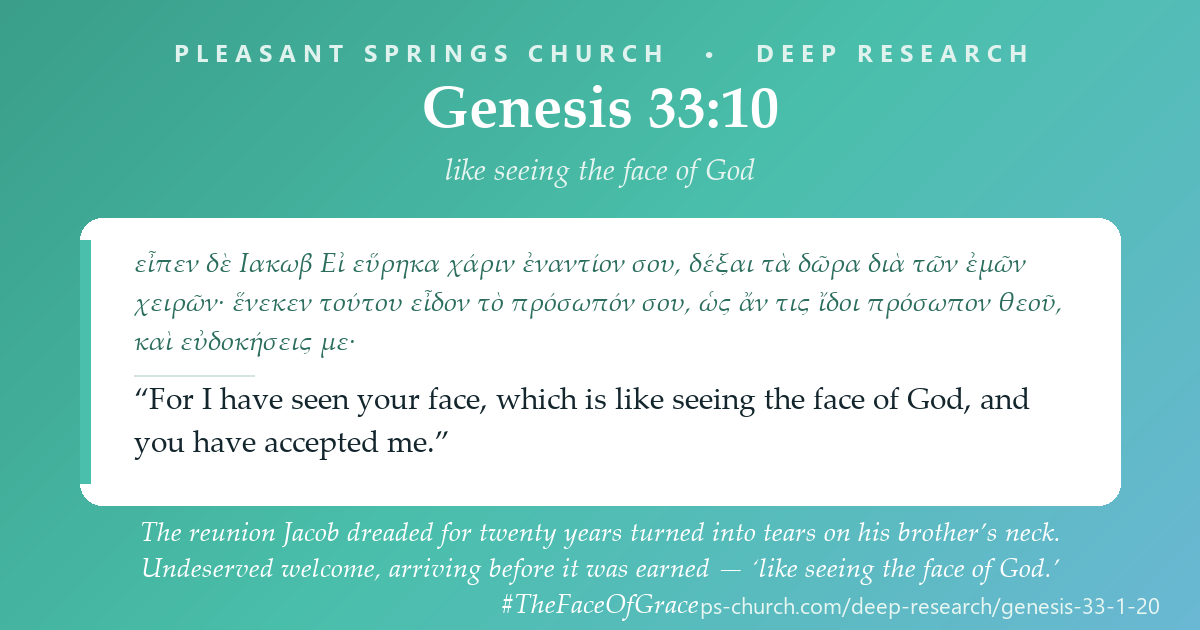
Genesis 33:10 · to share
LXX + ESVEvery Deep Research page traces its passage across the whole sweep — the Old Testament, the Second-Temple world between the testaments (historical witnesses, not Scripture), and the New Testament. Follow the thread:
Pleasant Springs Church — Deep Research
Research method after Michael S. Heiser’s Bible Research Method (examine dictionaries → ancient literature → important words → textual connections → academic publications → share), with the Pleasant Springs “Author & Audience” foundation. Scripture set in the Hebrew, the Greek editions named on each page and the ESV (Old Testament), and the Greek New Testament and the ESV (New Testament), per the practice of Pleasant Springs Church. Genesis 33:1–20 research grounded in Wenham, Hamilton, Mathews, Waltke, and Sarna, with Alter on the Jacob-cycle chiasm; the reunion read against Peniel through the panim (“face”) motif (32:20, 30; 33:10) and against ancient Near Eastern homage (the sevenfold bow of the el-Amarna vassal formula, 33:3) and gift diplomacy (minchah, 33:10–11); ratsah (“you have accepted me,” 33:10; LXX εὐδοκήσεις με) heard as the cultic language of a graciously received offering; Esau honored as the brother who forgave and embraced first, and Leah, Rachel, and the handmaids’ sons never denigrated; Jacob’s swerve from Seir to Succoth and Shechem (33:14–17) and his altar El-Elohe-Israel (33:20; LXX “he called upon the God of Israel”) read as real worship that still stops short of the Bethel to which God had called him (31:13; 35:1) — deception and half-obedience recorded, never sanctioned; and the reunion traced to its fulfillment in the running Father (Lk 15:20) and the ministry of reconciliation (2 Cor 5:18–20).
Scripture quotations marked ESV are from the ESV® Bible (The Holy Bible, English Standard Version®), © 2001 by Crossway, a publishing ministry of Good News Publishers. ESV Text Edition: 2016. Used by permission. All rights reserved. The ESV text may not be quoted in any publication made available to the public by a Creative Commons license, and the ESV may not be translated in whole or in part into any other language. www.esv.org
|
Did this study bless you today? 💚 Give to Support PS Church100% of gifts go to the General Fund — thank you. |