A dark chapter, told without a hero. Dinah is seized and violated by Shechem; her brothers answer “with deceit,” weaponizing the covenant sign of circumcision, and Simeon and Levi put the whole city to the sword. Scripture calls the assault an outrage that “must not be done” — and it does not bless the massacre that follows: Jacob curses their violence at his deathbed (49:5–7). This is realism, not endorsement. We read it soberly — grieving for Dinah, whose voice the record never gives; refusing to weaponize the holy; and leaving vengeance to the God who alone may repay. This study works Genesis 34:1–31. See the method →
Genesis 34:1, 2, 7, 13, 25, 31
Hebrew · LXX · ESVThe Shape of the Passage
LeitwortGenesis tells this atrocity with cold restraint and no hero — because Scripture is honest about the sin inside the covenant family, and about the cost of a settling that should have kept moving toward Bethel.
Author
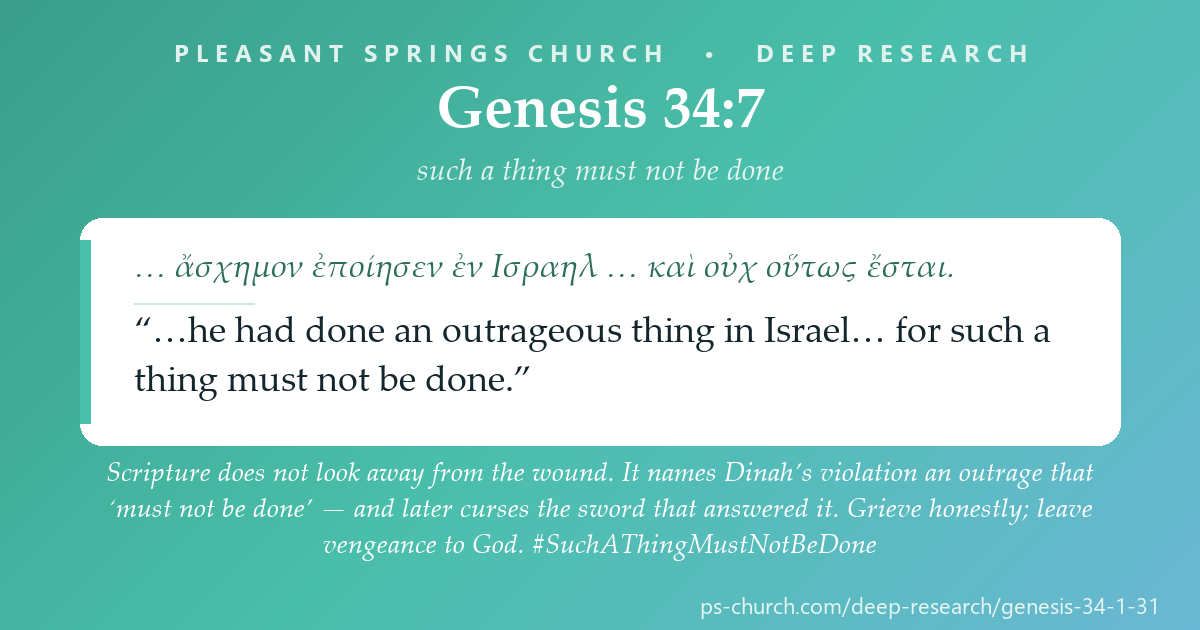
Moses sets this chapter deliberately after Jacob’s arrival at Shechem, where he “bought… a piece of land” and built an altar (33:18–20) instead of pressing on to Bethel, where God had met him (28:13–22; 35:1). The narrator opens with a single, ominous verb: Dinah “went out” among the daughters of the land (34:1) — and Shechem “saw… seized… lay with… humiliated” her (34:2). Four verbs of a predator with power; the text neither softens the crime nor blames the girl for walking out. It is an outrage (34:7, nebalah — the Bible’s harshest word for a violation that tears the fabric of a people), “a thing that must not be done in Israel.”
The deceit that profanes the sign. What follows is a study in sin answering sin. Shechem’s “love” (34:3) and Hamor’s smooth talk of intermarriage and shared land (34:8–10) come after the assault and cannot undo it. But the sons’ reply is its own evil: they answer “with deceit” (34:13, bemirmah — the very word used of Jacob’s own theft of the blessing, 27:35), and they make circumcision — the covenant sign of belonging to God (17:9–14) — the bait in a trap. On the third day, when the men are helpless with pain, Simeon and Levi take their swords into a city that “felt secure” and kill every male (34:25); Hamor and Shechem fall (34:26); the rest of the brothers plunder wealth, wives, and little ones (34:27–29). The narrator records the massacre in flat, factual verbs. He does not cheer.
Two failures, one silence. Jacob’s rebuke (34:30) is the weakest possible word: not “you have done wickedness,” but “you have brought trouble on me… I shall be destroyed.” His concern is survival, not justice; the passive father of 34:5 is a passive father still. The sons’ retort — “Should he treat our sister like a prostitute?” (34:31) — carries a real wound and the chapter’s last human word, but their grief does not sanctify their treachery. And through it all Dinah, for whom every man in the chapter claims to act, never speaks. Her silence is the loudest thing in the text: a woman violated, avenged, and never once asked. Scripture leaves the wound open, and its true verdict for later — Jacob’s deathbed curse on “the weapons of violence” of Simeon and Levi (49:5–7).
Audience
Israel heard in Genesis 34 an unflinching account of how not to seek justice, and of what it costs to settle among the nations. The chapter is a warning laid over Jacob’s compromise: he lingered at Shechem, bought land there, and his daughter walked out into a world whose prince took what he saw. The covenant people learned that the holy sign can be profaned into a weapon, that vengeance which outruns justice makes the avengers stink to the whole land (34:30), and that a family which will not deal with sin honestly will watch sin metastasize into atrocity. The book’s own theology answers the sons’ question: the outrage was real — and so was the treachery, and the slaughter, and the plunder. Two wrongs never made a right in Israel.
The curse, and the mercy that outlasts it. Simeon and Levi thought they had defended the family’s honor; Jacob, dying, pronounced God’s judgment on their “fierce” anger and “cruel” wrath: “I will divide them in Jacob and scatter them in Israel” (49:7). Simeon dwindled and was absorbed into Judah; Levi was scattered — and there the covenant God did something only grace can do. He took the very tribe cursed with scattering and, when Levi’s zeal was later turned toward him at Sinai (Ex 32:26–29) and in Phinehas (Num 25:11–13), transfigured the scattering into priesthood: Levites distributed through every tribe not as a curse now but as a blessing, to teach Torah and carry the altar (Deut 33:8–11; Mal 2:4–6). The church reads this carefully — not as an excusing of the sword, but as the pattern of a God who can redeem a cursed inheritance without ever pretending the sin was righteous. The refining of “the sons of Levi” (Mal 3:3) is grace, not amnesia. And in Dinah’s enduring silence the church is taught to lament for every violated one whom the powerful use and the record forgets — and to let God, not the sword, be the avenger (Deut 32:35; Rom 12:19).
Orient on Dinah, Shechem, the Hivites, circumcision, nebalah, and the ethics of vengeance.
Search by topic: Dinah, Shechem, Hamor, Hivite / Horite, circumcision, rape and sexual violence in the OT, nebalah (outrage), blood-vengeance, Simeon, Levi.
Which articles are relevant?
- Anchor Bible Dictionary — “Dinah,” “Shechem,” “Hamor,” “Hivites,” “Circumcision,” “Rape,” “Blood Vengeance.”
- Dictionary of the OT: Pentateuch — “Dinah,” “Circumcision,” “Ethics,” “Violence,” “Simeon,” “Levi.”
- NIDOTTE / TDOT — nebalah (outrage/folly), ’innah (humble/violate), timme’ (defile), mirmah (deceit), cherev (sword), zanah (prostitute).
Bibliography surfaced:
- Gordon Wenham (WBC), Victor Hamilton (NICOT), Kenneth Mathews (NAC), Bruce Waltke, Nahum Sarna (JPS) on Genesis.
- Meir Sternberg, The Poetics of Biblical Narrative (the reading of Genesis 34), with the Fewell & Gunn rejoinder — the scholarly debate over the narrator’s judgment.
- Studies of nebalah and sexual violence in the OT (cf. Judg 19–20; 2 Sam 13), and of circumcision as covenant sign.
Honor and violation, the covenant sign as a trap, and the sword that outran justice.
Read the assault, the negotiation, and the massacre against ancient marriage-and-honor custom, the meaning of circumcision, and the Bible’s own theology of vengeance.
Which parallels shed light on religion and worldview?
Honor, violation, and a daughter’s worth. In the ancient world a daughter’s sexual integrity was bound to her family’s honor, and a violation was reckoned an assault on the whole household. That world’s common “solution” — the offender marries the woman and pays the bride-price (a custom later legislated with restraint in Ex 22:16–17; Deut 22:28–29) — is exactly what Hamor and Shechem propose (34:11–12). Genesis 34 lets that machinery run, and then shows it collapse: no negotiated settlement can heal what was torn, and the brothers’ honor-vengeance, far from restoring the family, imperils and defiles it. The narrator’s sober refusal to resolve the horror is itself a moral judgment: the honor-culture’s scripts, on both sides, lead only to more ruin.
The covenant sign turned into a weapon. Circumcision was the God-given sign of belonging to the covenant (17:9–14) — the mark of the promise. In Genesis 34 the sons of Jacob take that holy sign and make it the mechanism of a massacre: they demand it “with deceit” (34:13), knowing the men will be incapacitated on the third day (34:25). This is the chapter’s deepest profanation. To weaponize the very sign of grace — to use what marks a people as God’s in order to slaughter the helpless — is a sin the covenant could never bless, and the book records it precisely so that Israel would never mistake such cunning for zeal. Deceit (mirmah) haunts this family (27:35; 29:25); here it turns lethal.
The sword, and the God who reserves vengeance. Simeon and Levi “took their swords and came against the city while it felt secure” (34:25) — treacherous violence against the defenseless, and grossly disproportionate: for one man’s crime, every male dies and every household is plundered. The Torah’s later ethic runs directly against this: guilt is personal (Deut 24:16), vengeance belongs to God (“Vengeance is mine, and recompense,” Deut 32:35), and even lawful justice is bounded and measured. Genesis 34 is the anti-type — a family taking blood-vengeance into its own deceitful hands. When Jacob at last renders a verdict, it is condemnation, not praise (49:5–7); and the New Testament seals the principle: “Beloved, never avenge yourselves… ‘Vengeance is mine, I will repay,’ says the Lord” (Rom 12:19).
- Genesis 17:9–14 — circumcision as the covenant sign, here profaned into a trap (34:13–24).
- Deuteronomy 22:28–29; Exodus 22:16–17 — the later, bounded law on violation and bride-price, against which the chapter’s honor-vengeance is measured.
- Deuteronomy 24:16; 32:35; Romans 12:19 — personal guilt and God’s reserved vengeance: the ethic Simeon and Levi trampled.
- Judges 19–20; 2 Samuel 13 — other “outrages” (nebalah) and avenging brothers: the same wound, the same spiral of violence in Israel.
Genesis 34 is one of the hardest chapters in the Bible to read rightly, because it withholds every comfort the reader craves — there is no narrator’s aside to tell us whom to blame, no divine speech, no punishment on the page, no rescue for Dinah, and no clean hero. Scholars have long argued over whose side the story is on: does the last word — ‘Should he treat our sister like a prostitute?’ — vindicate the brothers, or expose them? The safest answer is the one the whole Torah supplies: the outrage against Dinah was real and evil, and so was the deceit that profaned the covenant sign, and so was the slaughter of a helpless city, and so was Jacob’s cowardly, self-interested silence. The narrative’s refusal to resolve is not moral neutrality; it is a mirror held up to a covenant family that has learned to answer sin with sin and call it honor. And Scripture does finally speak — not here, but at Jacob’s deathbed, where the sword of Simeon and Levi is named a weapon of violence and cursed (49:5–7). We must not do what the chapter refuses to do: we must not glorify the massacre. The right posture before Genesis 34 is grief — for Dinah, unheard; for a city’s dead; for a family that could not tell its zeal from its cruelty — and a sober fear of the God who alone may avenge, and who will not be mocked by holy signs turned into knives.
The vocabulary of an atrocity: outrage, deceit, the sword, and a question left open.
Watch the assault named (’innah, nebalah), the covenant sign profaned by mirmah, the sword that felled a secure city, and the brothers’ last unanswered word.
“And she went out” — the chapter’s opening verb, spare and foreboding. The narrator neither excuses Shechem by it nor blames Dinah; her going out is simply the hinge on which a predator with power acts. The text keeps its judgment on him.
“And he humiliated her” — from ’innah, to abuse, degrade, force (the word for violation, cf. 2 Sam 13:14). The last of four verbs (saw, seized, lay, humiliated) that name the assault for exactly what it was, without a shred of softening.
“An outrageous thing” — the Bible’s gravest word for a violation that shreds the moral fabric of a people (Judg 19:23; 2 Sam 13:12). “Such a thing must not be done in Israel.” The crime is named a crime; the chapter never pretends otherwise.
“With deceit” — the same word used of Jacob’s stolen blessing (27:35). The sons answer a real wrong with treachery, and make the covenant sign of circumcision the bait. Deceit runs in this family like a fever; here it turns to murder.
“Each his sword” — Simeon and Levi enter a city that “felt secure” and kill every male. Jacob will call these the “weapons of violence” and curse them (49:5–7). The sword that outran justice is condemned, not crowned.
“Like a prostitute?” — the brothers’ final, wounded question (zanah, to treat as a harlot). A real grief for Dinah’s dishonor — and yet a grief that does not sanctify the slaughter it is meant to justify. The chapter ends on a question, not an absolution.
How the rest of Scripture weighs the scene:
- Genesis 27:35; 29:25; 34:13 — mirmah (deceit) threading through the family: Jacob deceives, is deceived, and now his sons deceive to kill.
- Deuteronomy 22:21; Judges 19:23–24; 2 Samuel 13:12; Jeremiah 29:23 — nebalah, “outrage in Israel”: the word’s grim company, and its consistent condemnation.
- Deuteronomy 24:16; 32:35; Romans 12:19; Hebrews 10:30 — personal guilt and God’s reserved vengeance: the standard the sword violated.
- Genesis 49:5–7 — the deathbed verdict on Simeon and Levi’s “weapons of violence”: Scripture’s own judgment on this chapter.
From a settling at Shechem to a curse, a scattering, and a grace that refines Levi.
Trace the compromise that set the scene, the verdict that judged it, and the mercy that later redeemed the cursed tribe.
Which cross-references matter?
- Genesis 33:18–20; 35:1–5 — Jacob settles and builds at Shechem instead of going up to Bethel; only after the horror does God call him up, and “a terror from God” falls on the cities so none pursue (see Jacob and Esau reconciled).
- Genesis 49:5–7 — “Simeon and Levi are brothers; weapons of violence are their swords… Cursed be their anger… I will divide them in Jacob and scatter them in Israel.” The chapter’s true verdict.
- Exodus 32:26–29; Numbers 25:11–13; Deuteronomy 33:8–11 — Levi’s zeal later turned toward God, and the scattering transfigured into priesthood: a cursed inheritance redeemed by grace, never by excusing the sword.
- Malachi 2:4–6; 3:3 — “the covenant of Levi” and the refining of “the sons of Levi” till they bring offerings in righteousness (see the refiner’s fire).
- 2 Samuel 13; Romans 12:19–21 — another violated daughter and avenging brother; and the gospel’s command to leave vengeance to God and overcome evil with good.
The most searching thing about Genesis 34 is what God does with its worst man. Levi — whose sword helped slaughter a helpless city, whose father cursed his cruelty from a deathbed, whose very name Jacob wished divided and scattered — becomes the ancestor of the priesthood. The scattering that was pronounced as a judgment (no tribal territory, dispersed among the others) is precisely the form the blessing takes: Levites planted in forty-eight cities across every tribe, carrying the ark, teaching the Torah, standing between a holy God and a sinful people. How does a curse become a calling? Not by anyone deciding the massacre was righteous after all — Scripture never softens 49:5–7 — but by grace redirecting the tribe’s fierce loyalty toward God himself: at Sinai, when Levi alone rallies to God’s side (Ex 32:26); in Phinehas, whose zeal turns back wrath and earns ‘a covenant of peace’ (Num 25). The same intensity that made Levi terrible in Genesis 34 makes Levi useful at the altar — once it is surrendered to God rather than to honor and the sword. This is the deep comfort buried in a dark chapter: no inheritance is so cursed that grace cannot refine it, and no zeal so bloodied that God cannot cleanse and consecrate it. But the refining is real fire (Mal 3:3), and it never renames the old sin as virtue. It burns it away.
The scholarship on Genesis 34:1-31.
The commentators on the Dinah narrative; the debate over the narrator’s judgment; the studies of nebalah, circumcision, and biblical vengeance.
Commentaries & studies:
- Gordon J. Wenham (WBC), Victor P. Hamilton (NICOT), Kenneth A. Mathews (NAC), Bruce K. Waltke, Nahum M. Sarna (JPS) on Genesis.
- Meir Sternberg, The Poetics of Biblical Narrative, ch. on Genesis 34; Danna Nolan Fewell & David M. Gunn, “Tipping the Balance” (JBL) — the debate over whether the narrator condemns the brothers or the reader’s sympathies.
- Studies of nebalah and of sexual violence in the Hebrew Bible; treatments of circumcision as covenant sign and of blood-vengeance ethics.
Interpretation notes worth keeping:
- Dinah’s silence (throughout). The one person on whose behalf every man claims to act is never asked, never quoted. The narrative’s silence is not indifference but indictment — and an invitation to lament for the violated whom the record forgets.
- Shechem’s “love” (34:3). Tenderness that follows assault does not undo it; the sequence (seize, violate, then “love” and bargain) is the text’s quiet exposure of a self-serving affection. Do not read it as a redeeming romance.
- The deceit is not endorsed (34:13). That the brothers had a real grievance does not baptize their mirmah. Scripture uses the same word for Jacob’s own sin; the family’s besetting fault turns homicidal here.
- Jacob’s rebuke is pragmatic, not moral (34:30). He fears for himself (“you have brought trouble on me”), not for righteousness. The genuine moral verdict waits for 49:5–7 — where it is a curse.
- No glorification. Later Second-Temple retellings (Jubilees 30; Testament of Levi; Judith 9:2–4; the poet Theodotus) recast the massacre as heroic zeal against defilement. These are witnesses to a later reading, not Scripture, and they run against Genesis’s own verdict. The house discipline: read the chapter as sober realism, grieve the sin on every side, and let 49:5–7 stand.
From an outrage and a sword to lament, and the God who alone may avenge.
Name what you learned, why it matters, and one concrete response — soberly.
What should we carry away — and do?
- Name the sin as sin. Scripture calls Dinah’s violation an “outrage” that “must not be done” (34:7). It does not minimize sexual violence, blame the woman, or hurry past her pain — and neither may we. Believe survivors; grieve with them; pursue real, bounded justice.
- Never weaponize the holy. The sons made the covenant sign a trap. Any use of God’s things — his name, his signs, his people’s trust — to deceive and harm is among the gravest sins the Bible records. Zeal that lies is not zeal for God.
- Leave vengeance to God. The sword that outran justice was cursed (49:5–7). “Vengeance is mine, I will repay” (Rom 12:19). Grace can even refine a cursed inheritance into priestly service — but never by calling the old cruelty righteous.
Step in response: hold this chapter without flinching and without applause. Grieve for Dinah, whose voice the record never gives — and let that grief make you a safer person for the violated and unheard around you: listen, believe, protect, and refuse to hurry anyone past their wound. Search your own heart for any “honor” that would answer a real wrong with deceit or disproportionate harm, and lay down that sword. Where you have been sinned against, entrust the vengeance to God, who judges justly (1 Pet 2:23), and give yourself instead to the slow, bounded work of true justice and mercy. And take comfort, soberly, that no inheritance is too cursed for grace to refine — the tribe of the sword became the tribe of the altar — while remembering that the refining is real fire, and never renames the sin.
Genesis 34:7 · to share
LXX + ESVEvery Deep Research page traces its passage across the whole sweep — the Old Testament, the Second-Temple world between the testaments (historical witnesses, not Scripture), and the New Testament. Follow the thread:
Pleasant Springs Church — Deep Research
Research method after Michael S. Heiser’s Bible Research Method (examine dictionaries → ancient literature → important words → textual connections → academic publications → share), with the Pleasant Springs “Author & Audience” foundation. Scripture set in the Hebrew, the Greek editions named on each page and the ESV (Old Testament), and the Greek New Testament and the ESV (New Testament), per the practice of Pleasant Springs Church. Genesis 34:1–31 research grounded in Wenham, Hamilton, Mathews, Waltke, and Sarna, with the Sternberg / Fewell & Gunn debate over the narrator’s judgment; the chapter read as sober realism and not endorsement — Dinah’s violation named an “outrage” (nebalah, 34:7) that “must not be done,” the covenant sign of circumcision (17:9–14) profaned into a trap “with deceit” (bemirmah, 34:13), and the treacherous, disproportionate sword of Simeon and Levi (34:25) cursed by Jacob at his deathbed (49:5–7); Dinah’s enduring silence met with lament, vengeance left to God (Deut 32:35; Rom 12:19), and Levi’s scattering redeemed into priesthood (Ex 32:26–29; Num 25:11–13; Mal 2:4–6; 3:3) as grace that refines but never renames sin. Second-Temple retellings that glorify the massacre (Jubilees 30; T. Levi; Judith 9; Theodotus) are noted as witnesses, not Scripture. Handled with pastoral care for the violated and the unheard.
Scripture quotations marked ESV are from the ESV® Bible (The Holy Bible, English Standard Version®), © 2001 by Crossway, a publishing ministry of Good News Publishers. ESV Text Edition: 2016. Used by permission. All rights reserved. The ESV text may not be quoted in any publication made available to the public by a Creative Commons license, and the ESV may not be translated in whole or in part into any other language. www.esv.org
|
Did this study bless you today? 💚 Give to Support PS Church100% of gifts go to the General Fund — thank you. |