Five chapters of the Book of Jubilees retell Genesis 34 to 37: Dinah and Shechem, Jacob's return to Bethel, Rachel's death, Reuben and Bilhah, Joseph sold into Egypt. Measured in Geʻez, the one language in which they survive whole — Jubilees beside the Geʻez of the five books of Moses — they keep Genesis's events and very little of its sentences. No verse shares more than five consecutive words with Genesis, and of the 141 verses of Genesis 33:18–37:36, 95 share not two consecutive words with any of them. The longest run anywhere in the five chapters is eight words, and it is not from Genesis at all. It is Deuteronomy 27:20 — the curse on the man who lies with his father's wife — at the one verse where the angel says it is written a second time. A Hebrew fragment of that very sentence survives from Qumran. Jubilees is not Scripture for us; it is read here as a Second-Temple witness and tested by the canon, and in these chapters — which praise a killing whose anger Genesis curses — that matters more than usual. See the method →
The Book of Jubilees is a Second-Temple Jewish retelling of Genesis 1 through Exodus 24, framed as a revelation given to Moses at Sinai and dictated by the Angel of the Presence. It is not Scripture for us: it belongs to the Pseudepigrapha, though copies of it were kept at Qumran and it is canonical in the Ethiopian Orthodox Church. We read it the way we read the other Second-Temple books — as a window into how Jews before Christ read Genesis — and we read it critically, testing everything by the canon (Acts 17:11). In these chapters Jubilees gives penalties and reasons Scripture does not give, most of them said to stand on ‘heavenly tablets’ — stoning for the man who gives his daughter to a Gentile, a Day of Atonement grounded in Joseph’s coat — and calls righteous a massacre whose anger Genesis 49:5–7 curses. The page reports what the book says; it does not adopt it.
⚠️ What this page can and cannot measure — read this first.
HELD: Charles’s English of the whole book (1,307 verses and the Prologue); the Geʻez of Jubilees (VanderKam’s critical text, same chapter and verse counts as Charles in all fifty chapters); the Geʻez of all five books of Moses in Dillmann’s edition (5,797 verses; Exodus to Deuteronomy were fetched for this study); the Masoretic Hebrew (23,204 verses); the CATSS Greek Old Testament; and three Hebrew fragments of these very chapters from Qumran (4Q221, 4Q223–224), as published by the Scripta Qumranica Electronica.
NOT HELD: any Greek or Latin text of these chapters. There is no King James or ESV Jubilees at all, and the book survives complete only in Geʻez; the partial Latin version and the Greek and Syriac excerpts that editors list are not on this disk, and this page does not say which of them reach chapters 30–34.
CONSEQUENCE: every run on this page is same-language — Geʻez against Geʻez, or Hebrew against Hebrew. There is no Greek New Testament screen, because no Greek text of these chapters is held, and English-against-anything runs measure translators, not texts. New Testament passages are named in Stage 4 and never measured.
Jubilees 30:1–34:21 — nine verses, in R. H. Charles’s English
English: R. H. Charles (1902; SPCK reprint 1917), verbatim · Geʻez: measured, quoted only in phrasesGenesis gives Dinah no age; Jubilees gives one — ዐሠርቱ ፡ ወክልኤቱ, ‘ten and two’. By the book’s own dates she was born in AM 2134 (28:23) and this is AM 2143 (30:1): nine years. Stage 2 sets the arithmetic out; the page does not resolve it. The verse describes the rape of a child. The number is reported because the book’s own dates disagree with it, and for no other reason.
The angel says he wrote down ‘how the sons of Jacob spake’ — Genesis 34:14. Measured in Geʻez against the Geʻez Genesis: a run of two as the two files spell it, and four once the letters manuscripts interchange are folded — Jubilees writes እስመ ፡ ጽዕለት ፡ ውእቱ ፡ ለነ, Genesis writes እስመ ፡ ፅእለት ፡ ውእቱ ፡ ለነ. Either way the shared words stand in one verse of the Geʻez Pentateuch and one of Jubilees — these two.
‘For he was zealous’ — እስመ ፡ ቀንአ. The bare form ቀንአ stands in two verses of the Geʻez Pentateuch, Numbers 25:11 and 25:13 (Phinehas), and in one verse of Geʻez Jubilees, this one. A run of two. It is not the deepest partner on either side: this verse’s own deepest run in the Pentateuch is three words, ‘before the Lord, that’, with four verses of Exodus and Leviticus (band 4), and Numbers 25:11’s own deepest partners in Jubilees are 19 verses at two words.
The deepest run these five chapters make with Genesis: five words, ያዕቆብ ፡ ኀበ ፡ ይስሐቅ ፡ አቡሁ ፡ ውስተ, shared with Genesis 35:27 — tie band 1 both ways. Genesis 35:27 has no embrace and no weeping.
The line stops before a slip in the transcription held here, which reads ‘journey, set’ where both printings read ‘journey; set’ (Stage 5).
Isaac’s age, ምእት ፡ ወስሳ ፡ ወኀምስቱ ፡ ዓመት: one hundred and sixty-five. By the book’s own week-numbers he was born in AM 1987, which makes him 156 here; on Charles’s emended dates, 163. See Stage 2.
The numbers do not agree across the columns. Charles: fourteen, twenty-eight, forty-nine, seven, twenty-one — every one a multiple of seven. The digitised Geʻez has the first three, then ወመሓስአ ፡ ስሳ ፡ ወመሓስአ ፡ ጠሊ ፡ ዕሥራ ፡ ወተስዐተ — sixty lambs and twenty-nine kids. VanderKam’s own English, printed beside that Geʻez on the digitiser’s page, reads seven and twenty-one. Not resolvable from this disk.
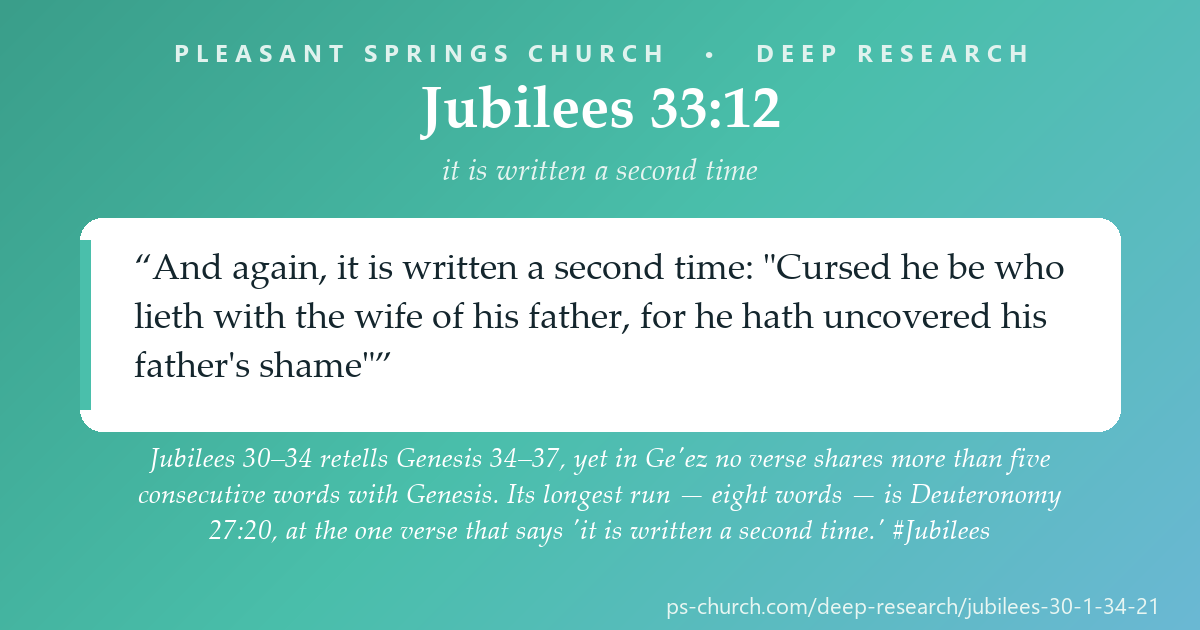
The measured surprise of the page. ‘It is written a second time’ — and eight consecutive Geʻez words of this verse stand in Deuteronomy 27:20 of the Geʻez Pentateuch: ዘይሰክብ ፡ ምስለ ፡ ብእሲተ ፡ አቡሁ ፡ እስመ ፡ ከሠተ ፡ ኀፍረተ ፡ አቡሁ. Tie band 1 both ways. With Genesis this verse shares not two consecutive words, and nothing these five chapters share with Genesis reaches six. The identification is not new: the 1917 edition’s note at the end of this verse already reads “Cf. Deut. xxvii. 20.” Its note on 33:10 reads “Cf. Lev. xx. 11.” What is new is the measurement in Geʻez.
In English this reads like Genesis 37:33. In Geʻez no two consecutive words match. Jubilees has አርዌ ፡ ፀዋግ ፡ በልዖ ፡ ለዮሴፍ; the Geʻez Genesis has ወአርዌ ፡ እኩይ ፡ በልዖ ፡ አርዌ ፡ መሠጦ ፡ ለዮሴፍ. Beast, devoured and Joseph are shared; no two of them stand side by side, in the same order, in both texts. A run of one.
The bond is the date, not the wording. Leviticus 16:29 and 23:27 set the affliction on the tenth of the seventh month; Jubilees 34:12 dates the coat to that day. Against Leviticus 16:29 the run is two — አመ ፡ ዐሡሩ, ‘on the tenth’, a pair 8 Pentateuch verses and 13 Jubilees verses carry, though in seven of those Pentateuch verses and eleven of those Jubilees verses it opens a longer date (‘the fourteenth’, ‘the fifteenth’); against 16:34 it is also two (‘to make atonement’, in 4 Pentateuch verses and 3 Jubilees verses). Neither is this verse’s deepest partner: its own deepest run in the Pentateuch is three words, ‘the children of Israel, that’, with Exodus 28:1 alone (band 1; from the other side Exodus 28:1 reaches three with three Jubilees verses).
There is no Geʻez column, on purpose. The Geʻez of Jubilees held here is J. C. VanderKam’s critical text (1989), digitised by Ran HaCohen; two hosts label it CC BY-SA, the digitiser says one of them posted it under fair use and that his own copy stands with the editor’s blessing, and the edition itself is in copyright. So this page measures that Geʻez and prints only the few words a finding rests on. The Geʻez of Genesis to Deuteronomy is Dillmann’s Octateuch (1853–55, public domain; HaCohen’s digitisation, CC BY-SA 4.0), and the eight words printed at 33:12 are quoted from Dillmann’s Deuteronomy, where they are identical.
Geʻez phrases from Jubilees: VanderKam’s critical text (1989), digitised by Ran HaCohen. The older pages of this series say ‘Charles 1913, lightly modernized’; the text held now is the 1917 reprint of the 1902 translation, and this page quotes it unaltered.
Versification — stated, as on every page here. Jubilees has no Masoretic, Greek, King James, ESV or Vulgate numbering to be offset from. The two witnesses that do exist agree exactly: Charles’s English and the Geʻez both run chapters 30–34 at 26·32·34·23·21 = 136 verses. No offset.
The offset that matters is in Genesis, the book being retold. Masoretic Genesis 35 has 29 verses; the CATSS Greek and Dillmann’s Geʻez have 28, because neither has a verse 35:21: the tower of Eder stands inside their 35:16. Dillmann’s Geʻez follows the Greek numbering in Genesis 33–37, but not verse for verse everywhere: its chapters 6, 10, 19, 22, 23, 31 and 40 differ in verse count from the CATSS Greek (it lacks 6:20, 10:12, 19:23, 22:4, 23:20 and 40:4, and has a 31:51 the Greek lacks). The Geʻez Pentateuch files lack the numbers Exod 25:6, 25:39, 32:9, Lev 14:41 and Num 23:27 as well — gaps in the source, not in extraction.
Masoretic verse numbers on this page are the Hebrew Bible’s; where English Bibles number a verse differently, the English number is given in brackets.
The Shape of the Passage
A sequence: each story stops for a law (measured)Where it sits in the book. Jubilees is framed as the Angel of the Presence dictating to Moses on Sinai (ch. 1), from ‘heavenly tablets’, through a scheme of fifty jubilees that ends with Israel at the edge of Canaan (ch. 50). These chapters are years AM 2143–2149 of that scheme, in the forty-fourth jubilee — and they are where the frame shows through most: outside the opening chapters, the Geʻez names Moses in five verses, and three of them are here.
⚠️ Where this page sits. Jubilees is filed on this shelf under Pseudepigrapha & Second Temple. It is canonical in the Ethiopian Orthodox Church, was copied at Qumran, and is not part of the Protestant canon. Nothing taught at Pleasant Springs rests on it.
Author
Anonymous, commonly described as priestly in outlook, writing in a borrowed voice. The book is usually dated to the middle of the second century BC (see the first page of this series). The voice is the Angel of the Presence, dictating to Moses on Sinai — and in these chapters the angel turns to Moses by name three times: “And do thou, Moses, command the children of Israel” (30:11), and again at 33:13 and 33:18.
His stories ground laws. Dinah grounds a law against giving a daughter to a Gentile; Levi’s zeal grounds his priesthood; Jacob’s second tithe grounds the second tithe; Reuben grounds the law of the father’s wife; the brothers’ lie about Joseph grounds the Day of Atonement. Every one of those laws but the last is said to stand on the heavenly tablets; the Day of Atonement (34:18) is simply ‘ordained’.
Audience
Readers for whom marriage outside Israel, the right to the priesthood, the tithe and the feast-days were live questions. That is how these chapters are commonly read; the page does not test it.
And readers who knew Genesis. That too is the usual reading of a book that retells Genesis, and the page does not test it. Set beside Genesis, these chapters lack much of what it tells and carry what it does not say: Dinah’s age, Isaac’s blessing of Levi and Judah, a war with seven Amorite kings, Bilhah’s and Dinah’s deaths in the month Joseph was lost. The measurement in Stage 4 shows how little of Genesis’s wording they carry.
Orient on Jubilees, on the Levi tradition, and on the laws these chapters write into the patriarchs.
Search by topic: Jubilees; heavenly tablets; Levi and the priesthood in Second-Temple literature; Aramaic Levi; intermarriage; second tithe; Day of Atonement; Dinah.
Which articles are relevant?
- Anchor Bible Dictionary — “Jubilees, Book of” (J. C. VanderKam); the entries on Dinah, Levi, the Day of Atonement and tithes, for the canonical side.
- Eerdmans Dictionary of Early Judaism — its articles on Jubilees, on the Aramaic Levi Document and on intermarriage.
- Dictionary of New Testament Background (IVP) — “Jubilees” and the articles on the calendar and the priesthood.
Bibliography surfaced:
- James C. VanderKam, Jubilees (Hermeneia, two volumes) — a two-volume commentary. Not consulted for this page; see Stage 5.
- James C. VanderKam, The Book of Jubilees: A Critical Text (CSCO 510) — the Geʻez measured here, in a digitisation of its text without the apparatus.
- R. H. Charles, The Book of Jubilees, or the Little Genesis (1902) — the English quoted here, from the 1917 SPCK reprint.
- James L. Kugel, A Walk through Jubilees; Michael Segal, The Book of Jubilees: Rewritten Bible, Redaction, Ideology and Theology; Betsy Halpern-Amaru, The Empowerment of Women in the Book of Jubilees.
- Discoveries in the Judaean Desert XIII (Qumran Cave 4.VIII) — the printed edition of 4Q221 and 4Q223–224. Not held; the Hebrew here is the SQE text.
What the retelling keeps from Genesis, who else told Shechem this way, and the book’s own clock.
Three comparisons: Jubilees against the Genesis it retells (measured, in Geʻez); against other Second-Temple tellings of Shechem (named, and quoted where the text is held); and against itself — its own dates, which can be computed.
What does the retelling keep, and what does it pass over?
The coverage map. Every verse of the Geʻez Genesis from 33:18 to 37:36 (141 verses) was screened against the 136 verses of Jubilees 30–34. 95 of the 141 share no two consecutive words with any of them. Against the whole of Jubilees, 50 still share none.
| Genesis (Geʻez, Dillmann) | verses | sharing no two consecutive words with Jub 30–34 |
|---|---|---|
| Genesis 33:18–20 | 3 | 2 |
| Genesis 34 | 31 | 15 |
| Genesis 35 | 28 | 9 |
| Genesis 36 | 43 | 39 |
| Genesis 37 | 36 | 30 |
All 141 verses of Genesis 33:18–37:36 — each with its deepest partner in Jubilees 30–34, and its deepest run anywhere in Jubilees (open)
| Genesis (Geʻez) | run with Jub 30–34 | band among those 136 verses | partner(s) | run with any of Jubilees’ 1,307 verses |
|---|---|---|---|---|
| Gen 33:18 | 2 | 3 | Jub 30:2, 32:34, 33:7 | 2 |
| Gen 33:19 | 0 | — | — | 0 |
| Gen 33:20 | 0 | — | — | 2 |
| Gen 34:1 | 2 | 1 | Jub 33:22 | 2 |
| Gen 34:2 | 3 | 1 | Jub 30:2 | 3 |
| Gen 34:3 | 2 | 1 | Jub 33:22 | 2 |
| Gen 34:4 | 0 | — | — | 0 |
| Gen 34:5 | 2 | 4 | Jub 30:2, 30:6, 32:16, 32:20 | 3 |
| Gen 34:6 | 2 | 5 | Jub 30:6, 30:24, 32:16, 34:12 and 1 more | 2 |
| Gen 34:7 | 2 | 5 | Jub 30:17, 30:18, 33:8, 33:15 and 1 more | 2 |
| Gen 34:8 | 0 | — | — | 2 |
| Gen 34:9 | 0 | — | — | 0 |
| Gen 34:10 | 0 | — | — | 0 |
| Gen 34:11 | 0 | — | — | 2 |
| Gen 34:12 | 0 | — | — | 0 |
| Gen 34:13 | 4 | 1 | Jub 30:3 | 4 |
| Gen 34:14 | 2 | 2 | Jub 30:4, 30:12 | 2 |
| Gen 34:15 | 0 | — | — | 0 |
| Gen 34:16 | 0 | — | — | 0 |
| Gen 34:17 | 0 | — | — | 0 |
| Gen 34:18 | 2 | 1 | Jub 33:18 | 2 |
| Gen 34:19 | 2 | 1 | Jub 30:2 | 2 |
| Gen 34:20 | 0 | — | — | 0 |
| Gen 34:21 | 0 | — | — | 2 |
| Gen 34:22 | 0 | — | — | 0 |
| Gen 34:23 | 0 | — | — | 2 |
| Gen 34:24 | 2 | 2 | Jub 31:6, 33:19 | 2 |
| Gen 34:25 | 3 | 1 | Jub 30:17 | 3 |
| Gen 34:26 | 3 | 1 | Jub 30:24 | 3 |
| Gen 34:27 | 3 | 1 | Jub 30:3 | 3 |
| Gen 34:28 | 4 | 1 | Jub 30:24 | 4 |
| Gen 34:29 | 0 | — | — | 2 |
| Gen 34:30 | 3 | 1 | Jub 34:4 | 3 |
| Gen 34:31 | 0 | — | — | 0 |
| Gen 35:1 | 2 | 2 | Jub 31:30, 32:1 | 2 |
| Gen 35:2 | 2 | 2 | Jub 31:1, 31:18 | 2 |
| Gen 35:3 | 2 | 2 | Jub 31:30, 32:1 | 2 |
| Gen 35:4 | 2 | 4 | Jub 30:2, 31:1, 32:34, 34:19 | 2 |
| Gen 35:5 | 2 | 1 | Jub 30:11 | 2 |
| Gen 35:6 | 2 | 5 | Jub 30:2, 31:2, 32:34, 34:4 and 1 more | 3 |
| Gen 35:7 | 3 | 1 | Jub 32:30 | 4 |
| Gen 35:8 | 0 | — | — | 0 |
| Gen 35:9 | 0 | — | — | 2 |
| Gen 35:10 | 0 | — | — | 0 |
| Gen 35:11 | 2 | 2 | Jub 32:18, 32:25 | 3 |
| Gen 35:12 | 0 | — | — | 4 |
| Gen 35:13 | 0 | — | — | 2 |
| Gen 35:14 | 2 | 1 | Jub 32:34 | 2 |
| Gen 35:15 | 2 | 1 | Jub 32:30 | 3 |
| Gen 35:16 | 0 | — | — | 2 |
| Gen 35:17 | 0 | — | — | 0 |
| Gen 35:18 | 2 | 1 | Jub 32:33 | 2 |
| Gen 35:19 | 3 | 1 | Jub 32:34 | 3 |
| Gen 35:20 | 2 | 1 | Jub 32:34 | 2 |
| Gen 35:22 | 2 | 5 | Jub 30:17, 33:2, 33:10, 33:14 and 1 more | 3 |
| Gen 35:23 | 2 | 1 | Jub 34:3 | 2 |
| Gen 35:24 | 2 | 1 | Jub 33:22 | 2 |
| Gen 35:25 | 2 | 1 | Jub 33:22 | 2 |
| Gen 35:26 | 2 | 1 | Jub 30:17 | 2 |
| Gen 35:27 | 5 | 1 | Jub 31:8 | 5 |
| Gen 35:28 | 0 | — | — | 2 |
| Gen 35:29 | 0 | — | — | 2 |
| Gen 36:1 | 0 | — | — | 0 |
| Gen 36:2 | 2 | 2 | Jub 30:13, 30:14 | 3 |
| Gen 36:3 | 0 | — | — | 0 |
| Gen 36:4 | 0 | — | — | 0 |
| Gen 36:5 | 0 | — | — | 2 |
| Gen 36:6 | 2 | 1 | Jub 34:4 | 2 |
| Gen 36:7 | 0 | — | — | 2 |
| Gen 36:8 | 0 | — | — | 2 |
| Gen 36:9 | 0 | — | — | 0 |
| Gen 36:10 | 0 | — | — | 2 |
| Gen 36:11 | 0 | — | — | 0 |
| Gen 36:12 | 0 | — | — | 2 |
| Gen 36:13 | 0 | — | — | 0 |
| Gen 36:14 | 0 | — | — | 0 |
| Gen 36:15 | 0 | — | — | 2 |
| Gen 36:16 | 0 | — | — | 2 |
| Gen 36:17 | 0 | — | — | 2 |
| Gen 36:18 | 0 | — | — | 0 |
| Gen 36:19 | 0 | — | — | 2 |
| Gen 36:20 | 2 | 2 | Jub 33:20, 34:4 | 2 |
| Gen 36:21 | 0 | — | — | 0 |
| Gen 36:22 | 0 | — | — | 0 |
| Gen 36:23 | 0 | — | — | 0 |
| Gen 36:24 | 0 | — | — | 0 |
| Gen 36:25 | 0 | — | — | 0 |
| Gen 36:26 | 0 | — | — | 0 |
| Gen 36:27 | 0 | — | — | 0 |
| Gen 36:28 | 0 | — | — | 0 |
| Gen 36:29 | 0 | — | — | 0 |
| Gen 36:30 | 2 | 3 | Jub 31:2, 32:34, 34:10 | 2 |
| Gen 36:31 | 0 | — | — | 7 |
| Gen 36:32 | 0 | — | — | 4 |
| Gen 36:33 | 0 | — | — | 4 |
| Gen 36:34 | 0 | — | — | 2 |
| Gen 36:35 | 0 | — | — | 4 |
| Gen 36:36 | 0 | — | — | 2 |
| Gen 36:37 | 0 | — | — | 2 |
| Gen 36:38 | 0 | — | — | 2 |
| Gen 36:39 | 0 | — | — | 2 |
| Gen 36:40 | 0 | — | — | 0 |
| Gen 36:41 | 0 | — | — | 0 |
| Gen 36:42 | 0 | — | — | 0 |
| Gen 36:43 | 0 | — | — | 0 |
| Gen 37:1 | 2 | 8 | Jub 30:2, 31:2, 31:8, 32:34 and 4 more | 3 |
| Gen 37:2 | 2 | 4 | Jub 31:3, 31:5, 32:31, 33:1 | 2 |
| Gen 37:3 | 0 | — | — | 2 |
| Gen 37:4 | 0 | — | — | 2 |
| Gen 37:5 | 0 | — | — | 0 |
| Gen 37:6 | 0 | — | — | 0 |
| Gen 37:7 | 0 | — | — | 0 |
| Gen 37:8 | 0 | — | — | 0 |
| Gen 37:9 | 0 | — | — | 2 |
| Gen 37:10 | 2 | 1 | Jub 33:20 | 2 |
| Gen 37:11 | 0 | — | — | 2 |
| Gen 37:12 | 2 | 1 | Jub 34:1 | 2 |
| Gen 37:13 | 0 | — | — | 3 |
| Gen 37:14 | 0 | — | — | 0 |
| Gen 37:15 | 0 | — | — | 2 |
| Gen 37:16 | 0 | — | — | 0 |
| Gen 37:17 | 0 | — | — | 2 |
| Gen 37:18 | 0 | — | — | 0 |
| Gen 37:19 | 0 | — | — | 2 |
| Gen 37:20 | 0 | — | — | 2 |
| Gen 37:21 | 0 | — | — | 0 |
| Gen 37:22 | 2 | 4 | Jub 31:3, 31:5, 32:31, 33:1 | 2 |
| Gen 37:23 | 0 | — | — | 0 |
| Gen 37:24 | 0 | — | — | 0 |
| Gen 37:25 | 0 | — | — | 2 |
| Gen 37:26 | 0 | — | — | 0 |
| Gen 37:27 | 0 | — | — | 2 |
| Gen 37:28 | 0 | — | — | 2 |
| Gen 37:29 | 0 | — | — | 0 |
| Gen 37:30 | 0 | — | — | 0 |
| Gen 37:31 | 0 | — | — | 2 |
| Gen 37:32 | 0 | — | — | 2 |
| Gen 37:33 | 0 | — | — | 0 |
| Gen 37:34 | 0 | — | — | 0 |
| Gen 37:35 | 2 | 1 | Jub 34:17 | 2 |
| Gen 37:36 | 0 | — | — | 2 |
Genesis 34, verse by verse — the test of what a retelling keeps.
234:2
334:3
234:4
·34:5
234:6
234:7
234:8
·34:9
·34:10
·34:11
·34:12
·34:13
434:14
234:15
·34:16
·34:17
·34:18
234:19
234:20
·34:21
·34:22
·34:23
·34:24
234:25
334:26
334:27
334:28
434:29
·34:30
334:31
·
Each cell is one verse of Dillmann’s Geʻez Genesis 34, with the longest run of consecutive words it shares with any of the 136 verses of Jubilees 30–34 (unfolded). A dot = no two consecutive words. Darker = deeper.
Fifteen of its 31 verses share no two consecutive words with Jubilees 30–34: Shechem’s request to his father (34:4), Hamor’s and Shechem’s offers (34:8–12), the terms of circumcision (34:15–17), the speech at the city gate (34:20–23), the wives and children taken captive (34:29) and the brothers’ last word (34:31). Seven reach three or more, and six of those seven find their partner in Jubilees 30: Shechem son of Hamor (34:2, with 30:2), ‘because they had defiled Dinah their sister’ (34:13 and 34:27, with 30:3), ‘two of the sons of Jacob’ (34:25, with 30:17), Dinah brought out of Shechem’s house and the flocks, herds and asses taken (34:26 and 34:28, with 30:24) — each with a single partner in these chapters (band 1). The seventh, 34:30, is a counter-example: its three words are ‘who dwell in’, a phrase 18 Pentateuch verses carry, and its partner is 34:4 of Jubilees — the Amorite war. Jubilees’ own telling of Jacob’s reproach, 30:25, shares one word with Genesis 34:30. What the measurement keeps is the outrage, the killing and the spoil; what it cannot find is the negotiation.
What has no trace at all. Ten verses of Genesis 34 share no two consecutive words with any verse of Jubilees — Shechem’s request (34:4), the offers of marriage (34:9, 34:10, 34:12), the terms of circumcision and their acceptance (34:15–17, 34:20, 34:22) and the brothers’ last word (34:31). The 1917 edition’s note on 30:3 had already said so in its own terms: “Our author omits all reference to the circumcision of the Shechemites” — and went on to give a motive, which is that editor’s reading, not a measurement. Joseph’s dreams (Genesis 37:5–8) share no two consecutive words with any verse of Jubilees, and the word ‘sheaves’ is not in Charles’s English of the book at all. Genesis 36, Esau’s line, is 39 silent verses out of 43 here (the Edomite kings return in Jubilees 38).
Even what is kept is kept in other words. Jubilees 34:10–17 tells the same events as Genesis 37:12–36 — Joseph sent to Shechem, sold to Ishmaelites, the coat dipped in a kid’s blood, the father who will go down to the grave mourning — and no pair of their verses shares more than two consecutive words — and those two are ‘into the grave’ (34:17 and 37:35), a phrase five Pentateuch verses and three Jubilees verses carry.
And what Jubilees has that Genesis lacks cannot be measured against it. The war with the seven Amorite kings (34:1–9) is set beside Genesis 48:22, where Jacob speaks of land taken from the Amorite with sword and bow, by the 1917 edition’s note on 34:2: the legend “harmonizes with the statement given in Gen. xlviii. 22”. Measured: Genesis 48:22 shares no two consecutive words with any verse of Jubilees. The connection is an idea, not a text. Against the whole Geʻez Genesis, the nine verses of the war reach at most three consecutive words, twice: 34:3 shares ‘were in the house’ with Genesis 39:14 — Potiphar’s household, another story — band 1 both ways; 34:4 shares ‘who dwell in’, a phrase 18 verses of the Geʻez Pentateuch carry (band 3 in Genesis). The one partner worth naming is where the war begins: 34:1 shares two words, ‘to pasture their sheep’, with Genesis 37:12 — the verse that sends Joseph’s brothers to Shechem — tie band 1 both ways. Jubilees opens its war and Genesis opens Joseph’s sale with the brothers at pasture by Shechem; two words, reported as two words.
Who else told Shechem as zeal?
Genesis itself does not. Jacob’s last words curse the anger of Simeon and Levi (Genesis 49:5–7). Measured: Genesis 49:6 shares no two consecutive words with any verse of Jubilees, and 49:5 only the pair of names, ‘Simeon and Levi’, with Jubilees 30:4 — a pair that stands in four Pentateuch verses and one verse of Jubilees. Jubilees calls the same act righteousness written in heaven (30:17–23).
Judith does, in her prayer. In the King James Apocrypha: “O Lord God of my father Simeon, to whom thou gavest a sword to take vengeance of the strangers” (9:2), and of the avengers, “which were moved with thy zeal” (9:4). The Testament of Levi and the Aramaic Levi Document also tell Levi’s part at Shechem and his call to the priesthood; neither is held on this disk, so they are named, not quoted. A Hellenistic poem on Shechem by one Theodotus survives in quotation in Eusebius; also not held.
Genesis and Jubilees do not say the same thing about the sword at Shechem, and the page does not blend them. The church’s reading, set out on our Genesis 34 study, is that Scripture names Dinah’s violation an outrage and lets Jacob’s curse in Genesis 49:5–7 stand as its verdict on the killing. Jubilees is read here as a witness to how some Jews of the second century BC told the story — not as a correction of Genesis.
The book’s own clock — computed, not assumed:
Jubilees dates events ‘in the Nth jubilee, in the Mth week, in the Kth year’, so a date converts to a year from creation (Anno Mundi): AM = 49(N−1) + 7(M−1) + K. Every dated verse in these chapters, computed from Charles’s English and checked against the Geʻez numerals, which agree with it at every one:
| verse | the text’s date (the jubilee is named only at 34:1; 32:33 says ‘this jubilee’; the others carry it from 24:21) | AM by the formula | Charles’s margin |
|---|---|---|---|
| 30:1 | year 1 of week 6, jubilee 44 | 49×43 + 7×5 + 1 = 2143 | 2143 |
| 32:33 | year 1 of week 6, jubilee 44 | 49×43 + 7×5 + 1 = 2143 | 2143 |
| 33:21 | year 3 of week 6, jubilee 44 | 49×43 + 7×5 + 3 = 2145 | 2145 |
| 34:1 | year 6 of week 6, jubilee 44 | 49×43 + 7×5 + 6 = 2148 | 2148 |
| 34:10 | year 7 of week 6, jubilee 44 | 49×43 + 7×5 + 7 = 2149 | 2149 |
Charles’s margin years agree with the formula at all five. From Salem in the fourth month (30:1) to Benjamin’s birth on the eleventh of the eighth month (32:33), everything happens in AM 2143: Shechem, Bethel, the visit to Isaac, Levi’s ordination, the feast, Deborah’s death, Benjamin’s birth, Rachel’s death.
Three ages, set against the same clock:
| who | the age the text gives | the book’s own dates | by subtraction |
|---|---|---|---|
| Dinah | twelve (30:2; Geʻez ዐሠርቱ ፡ ወክልኤቱ) | born AM 2134 (28:23, no editorial mark; Charles’s margin agrees); 30:1 is AM 2143 | nine |
| Isaac | one hundred and sixty-five (31:27) | born AM 1987 by the text’s own numbers (the forty-first jubilee at 13:16; the fourth week at 15:1 and 16:15; the birth at 16:13); Charles marks those week-numbers corrupt and his margin puts the birth at AM 1980 | 156 (or 163) |
| Joseph, when sold | seventeen — at 39:2, outside this range, as in Genesis 37:2 (בֶּן־שְׁבַֽע־עֶשְׂרֵ֤ה שָׁנָה֙; δέκα ἑπτὰ ἐτῶν) | born AM 2134 (28:24, where Charles marks ‘sixth’ corrupt); sold in AM 2149 (34:10) | fifteen |
None of the three ages fits the book’s own dates. Dinah’s is the cleanest case: no editor marks either date, and both editors’ reckonings put nine years between her birth and Shechem. The page does not explain the difference. It is the kind of thing the commentaries discuss, and none was consulted (Stage 5). The Samaritan Genesis held here covers only chapters 5 and 11, so no Samaritan figure can be set beside these.
The feast days in chapter 32 — the fifteenth and twenty-second of the seventh month — and the tenth of the seventh month in 34:18 are Leviticus’s dates, set inside Jubilees’ own 364-day year, which the book defends against the lunar calendar at 6:32–38. That calendar is the book’s position. This page reports it and does not adopt it.
Tablets, zeal, a doubled ‘so be it’, a date, and a place that may be a distance.
Counts are over the files held here: Geʻez Jubilees (1,307 verses), the Geʻez Pentateuch (5,797 verses), the Masoretic text and the CATSS Greek. They are not counts over ‘Geʻez literature’ or ‘the Bible’, and each one is said in its scope.
Nine verses of these five chapters name them — the same nine in Charles’s English and in the Geʻez. Across the whole book the Geʻez pair stands in 27 verses (Charles’s ‘heavenly tables’ in 29), so a third of them are here. The pair occurs in no verse of the Geʻez Pentateuch. The tablets are Jubilees’ own claim of authority, and in these chapters they are where every law but the last is said to be kept.
This bare form is in two verses of the Geʻez Pentateuch, Numbers 25:11 and 25:13 — Phinehas (see our Numbers 25 study) — and in one verse of Geʻez Jubilees, 30:18 — Levi. The two-word ‘for he was zealous’ is shared, a run of two, and in the Geʻez Pentateuch and Jubilees the pair stands in those three verses only. The wider screen does not single the link out: 30:18’s own deepest run in the Pentateuch is three words, ‘before the Lord, that’, with four verses of Exodus and Leviticus (band 4), none of them Numbers 25; from the other side, Numbers 25:11’s deepest partners in Jubilees are 19 verses at two words (30:18 among them), and Numbers 25:13’s is Jubilees 19:9 alone, at three (‘to him and to his seed after him’). A shared pair of words, reported as that. Deuteronomy 33:8–11, Moses’ blessing of Levi, is in the Geʻez held here and shares no two consecutive words with any verse of Jubilees 30–34 (its deepest pair is one word). Malachi 2:4–7, the covenant with Levi, is not held in Geʻez and is only named.
Four columns, four responses. The Masoretic Deuteronomy 27:20 ends with one אָמֵֽן; the Greek with γένοιτο; Dillmann’s Geʻez with አሜን ፡ ወአሜን — doubled, at every one of the twelve curses; Jubilees’ Geʻez with this doubled ‘so be it’, which occurs nowhere in the Geʻez Pentateuch. And the Hebrew of Jubilees from Qumran (4Q221) preserves a final nun followed by a whole ‘Amen’ here, which the edition restores as a doubled Amen. The eight-word run stops just before the response, where the columns part.
The coat reaches Jacob on the tenth of the seventh month (34:12), and 34:18 makes that the day Israel afflicts itself ‘once a year, for their sins’. The date is Leviticus’s (16:29; 23:27); the reason is not. The 1917 edition’s note: “The reason here given for the institution of the Day of Atonement (cf. Lev. xvi.) seems to be peculiar to our Book.” The kid slaughtered to stain the coat (34:12) and the young goat of atonement (34:18) stand six verses apart.
Four columns, three different things at one spot. The Masoretic Genesis 35:16 reads כִּבְרַת־הָאָ֖רֶץ, ‘a stretch of land’. The Greek reads a name, Χαβραθα. Dillmann’s Geʻez Genesis has no name there at all. Jubilees’ Geʻez has the name. The two Geʻez texts are not copies of one another at this point — which is what makes the measurements between them worth taking.
Counted here, not assumed:
- 136 verses, 2,790 Geʻez word tokens in chapters 30–34, chapter by chapter 26·32·34·23·21 in both the English and the Geʻez.
- Moses is named at 30:11, 33:13 and 33:18, in both languages; each time the angel tells him to command Israel or to write.
- The digitised Geʻez of 32:4 reads sixty lambs and twenty-nine kids where Charles, and VanderKam’s own English, read seven and twenty-one. It is a question for the printed edition, which is not held.
- The book gives Levi’s priesthood two grounds, two chapters apart. At 30:18 it is his zeal at Shechem; at 32:3 Jacob counts his sons from Benjamin upward and ‘Levi fell to the portion of the Lord’ — a tithe of sons. The 1917 edition’s note on 30:18 already observed it: “A different reason for Levi's choice for the priesthood is given in xxxii. 3”.
- Simeon’s and Judah’s wives are called Canaanites in 34:20, four chapters after the law against marriage with Gentiles, and 34:21 goes on to say that Simeon ‘repented, and took a second wife from Mesopotamia’. The text records it; the page does not reconcile it.
Geʻez against Geʻez, Hebrew against Hebrew — and the run that is not from Genesis.
How the screen works. Each of the 136 verses of Jubilees 30–34 in Geʻez is compared with every verse of the Geʻez Pentateuch for the longest run of identical consecutive word forms. Normalisation, declared: words split on the Ethiopic word-divider and spaces; full stops, other Ethiopic punctuation and the editors’ brackets removed; no stemming. Corrected 10 October 2026: until then the code put a space where a bracket stood, splitting any word an editor had bracketed part of; the brackets are now deleted, as stated, and every count below was re-measured — 31:29 now has a two-word partner in the Pentateuch (Exodus 38:23). The fold, declared and optional: the letters manuscripts interchange — the three h-letters, the two s-letters, the two glottal letters, the two emphatic s-letters, in all their vowel forms — treated as one. Every headline number is given with and without it. A zero here means no two consecutive words shared; single words are not counted. The tie band is the number of verses that reach the same depth, counted from both sides.
The distribution — against Genesis, and against all five books:
Against the Geʻez Genesis (1,526 verses): of the 136 verses of Jubilees 30–34, 32 share no two consecutive words with any verse of Genesis; 104 reach two, 22 reach three, 4 reach four, 1 reaches five, and nothing reaches six. With the fold: 32 share no two consecutive words with any verse of Genesis; 104 reach two, 23 reach three, 5 reach four, 1 reaches five, and nothing reaches six.
Against the whole Geʻez Pentateuch (5,797 verses): 14 share no two consecutive words with any verse of the five books; 122 reach two, 39 reach three, 7 reach four, 2 reach five, 1 reaches six, 1 reaches seven, 1 reaches eight, and nothing reaches nine. With the fold: 14 share no two consecutive words with any verse of the five books; 122 reach two, 40 reach three, 8 reach four, 2 reach five, 1 reaches six, 1 reaches seven, 1 reaches eight, and nothing reaches nine. The one verse that reaches eight is 33:12.
Is that low? Measured on the same screen, the whole book against Genesis: 86 of Jubilees’ 1,307 verses reach four or more, and the deepest run anywhere is eight words (24:1 with Genesis 25:11, band 1 both ways). In Jubilees 24–28 — the stolen blessing and the flight to Laban — 32 of 148 verses reach four or more with Genesis. Here, 4 of 136. With the fold: 91 in the whole book, 33 in Jubilees 24–28, 5 here; the deepest run in the book is still eight, at 24:1. Two stretches of one book, a chapter apart, retell Genesis at very different distances from its wording.
For every verse, not only the deepest. Of the 104 verses with a two-word partner in Genesis, 38 have exactly one deepest partner (band 1), and eleven form mutual pairs: the Genesis verse’s own deepest partner in all of Jubilees is that same verse, alone, at the same depth. The widest band is 29, at 33:20, made of three different two-word phrases — chiefly ዲበ ፡ ምድር, ‘on the earth’, which 25 verses of Genesis carry. The fold changes the depth of one verse only, 30:12, against Genesis and against the whole Pentateuch alike. The full table is below.
All 136 verses — each with its deepest Genesis partner, and the band both ways (open)
| Jubilees | run | run with the fold | band among 1,526 Genesis verses | deepest partner(s) | partner’s own best in all of Jubilees: run / band (✓ = it is this verse) |
|---|---|---|---|---|---|
| Jub 30:1 | 0 | 0 | — | — | — |
| Jub 30:2 | 3 | 3 | 1 | Gen 34:2 | 3 / 1 ✓ |
| Jub 30:3 | 4 | 4 | 1 | Gen 34:13 | 4 / 1 ✓ |
| Jub 30:4 | 2 | 2 | 3 | Gen 34:14, 34:25, 49:5 | 2 of the 3 point back |
| Jub 30:5 | 2 | 2 | 1 | Gen 32:29 | 2 / 17 ✓ |
| Jub 30:6 | 2 | 2 | 7 | Gen 1:17, 2:8, 11:8 and 4 more | 4 of the 7 point back |
| Jub 30:7 | 2 | 2 | 2 | Gen 38:11, 41:51 | 1 of the 2 point back |
| Jub 30:8 | 2 | 2 | 4 | Gen 3:14, 3:17, 6:4 and 1 more | 1 of the 4 point back |
| Jub 30:9 | 2 | 2 | 1 | Gen 38:10 | 2 / 34 ✓ |
| Jub 30:10 | 2 | 2 | 1 | Gen 32:29 | 2 / 17 ✓ |
| Jub 30:11 | 2 | 2 | 6 | Gen 6:8, 6:11, 13:13 and 3 more | 6 of the 6 point back |
| Jub 30:12 | 2 | 4 | 1 | Gen 34:14 | 2 / 2 ✓ |
| Jub 30:13 | 2 | 2 | 2 | Gen 24:3, 36:2 | 0 of the 2 point back |
| Jub 30:14 | 2 | 2 | 2 | Gen 24:3, 36:2 | 0 of the 2 point back |
| Jub 30:15 | 2 | 2 | 3 | Gen 23:12, 41:40, 41:55 | 2 of the 3 point back |
| Jub 30:16 | 0 | 0 | — | — | — |
| Jub 30:17 | 3 | 3 | 1 | Gen 34:25 | 3 / 1 ✓ |
| Jub 30:18 | 2 | 2 | 22 | Gen 1:8, 1:10, 1:12 and 19 more | 15 of the 22 point back |
| Jub 30:19 | 0 | 0 | — | — | — |
| Jub 30:20 | 0 | 0 | — | — | — |
| Jub 30:21 | 3 | 3 | 1 | Gen 29:13 | 3 / 2 ✓ |
| Jub 30:22 | 0 | 0 | — | — | — |
| Jub 30:23 | 2 | 2 | 5 | Gen 1:14, 1:15, 1:17 and 2 more | 1 of the 5 point back |
| Jub 30:24 | 4 | 4 | 1 | Gen 34:28 | 4 / 1 ✓ |
| Jub 30:25 | 2 | 2 | 2 | Gen 19:30, 26:7 | 2 of the 2 point back |
| Jub 30:26 | 2 | 2 | 4 | Gen 1:17, 2:8, 11:8 and 1 more | 1 of the 4 point back |
| Jub 31:1 | 3 | 3 | 2 | Gen 24:8, 28:16 | 2 of the 2 point back |
| Jub 31:2 | 2 | 2 | 27 | Gen 2:16, 4:16, 12:8 and 24 more | 7 of the 27 point back |
| Jub 31:3 | 3 | 3 | 4 | Gen 13:3, 13:4, 31:18 and 1 more | 2 of the 4 point back |
| Jub 31:4 | 2 | 2 | 6 | Gen 26:9, 26:27, 27:4 and 3 more | 3 of the 6 point back |
| Jub 31:5 | 3 | 3 | 1 | Gen 31:18 | 4 / 1 |
| Jub 31:6 | 2 | 2 | 3 | Gen 19:1, 24:45, 34:24 | 3 of the 3 point back |
| Jub 31:7 | 2 | 2 | 6 | Gen 4:14, 6:12, 7:3 and 3 more | 4 of the 6 point back |
| Jub 31:8 | 5 | 5 | 1 | Gen 35:27 | 5 / 1 ✓ |
| Jub 31:9 | 2 | 2 | 1 | Gen 38:11 | 3 / 1 |
| Jub 31:10 | 0 | 0 | — | — | — |
| Jub 31:11 | 2 | 2 | 2 | Gen 45:4, 48:10 | 2 of the 2 point back |
| Jub 31:12 | 0 | 0 | — | — | — |
| Jub 31:13 | 0 | 0 | — | — | — |
| Jub 31:14 | 2 | 2 | 20 | Gen 2:11, 8:9, 9:15 and 17 more | 5 of the 20 point back |
| Jub 31:15 | 0 | 0 | — | — | — |
| Jub 31:16 | 0 | 0 | — | — | — |
| Jub 31:17 | 2 | 2 | 4 | Gen 23:10, 32:20, 47:21 and 1 more | 3 of the 4 point back |
| Jub 31:18 | 2 | 2 | 6 | Gen 4:20, 4:21, 13:9 and 3 more | 5 of the 6 point back |
| Jub 31:19 | 0 | 0 | — | — | — |
| Jub 31:20 | 2 | 2 | 3 | Gen 23:10, 32:20, 50:14 | 2 of the 3 point back |
| Jub 31:21 | 2 | 2 | 3 | Gen 27:30, 28:1, 28:5 | 0 of the 3 point back |
| Jub 31:22 | 2 | 2 | 16 | Gen 19:33, 19:35, 20:3 and 13 more | 10 of the 16 point back |
| Jub 31:23 | 2 | 2 | 1 | Gen 15:6 | 2 / 1 ✓ |
| Jub 31:24 | 2 | 2 | 5 | Gen 1:1, 2:4, 24:66 and 2 more | 4 of the 5 point back |
| Jub 31:25 | 2 | 2 | 1 | Gen 26:18 | 5 / 1 |
| Jub 31:26 | 2 | 2 | 7 | Gen 10:9, 18:22, 19:13 and 4 more | 6 of the 7 point back |
| Jub 31:27 | 3 | 3 | 3 | Gen 27:30, 28:1, 28:5 | 2 of the 3 point back |
| Jub 31:28 | 2 | 2 | 4 | Gen 2:4, 5:1, 5:2 and 1 more | 2 of the 4 point back |
| Jub 31:29 | 0 | 0 | — | — | — |
| Jub 31:30 | 2 | 2 | 7 | Gen 12:8, 13:3, 22:9 and 4 more | 4 of the 7 point back |
| Jub 31:31 | 2 | 2 | 4 | Gen 28:6, 35:27, 48:15 and 1 more | 3 of the 4 point back |
| Jub 31:32 | 3 | 3 | 1 | Gen 22:12 | 3 / 2 ✓ |
| Jub 32:1 | 2 | 2 | 13 | Gen 6:3, 12:8, 13:3 and 10 more | 10 of the 13 point back |
| Jub 32:2 | 2 | 2 | 5 | Gen 6:7, 7:23, 8:4 and 2 more | 1 of the 5 point back |
| Jub 32:3 | 0 | 0 | — | — | — |
| Jub 32:4 | 2 | 2 | 1 | Gen 31:41 | 2 / 7 ✓ |
| Jub 32:5 | 0 | 0 | — | — | — |
| Jub 32:6 | 2 | 2 | 4 | Gen 8:10, 8:12, 39:10 and 1 more | 4 of the 4 point back |
| Jub 32:7 | 2 | 2 | 4 | Gen 8:10, 8:12, 50:10 and 1 more | 3 of the 4 point back |
| Jub 32:8 | 0 | 0 | — | — | — |
| Jub 32:9 | 2 | 2 | 1 | Gen 29:2 | 2 / 6 ✓ |
| Jub 32:10 | 2 | 2 | 3 | Gen 6:8, 6:11, 13:13 | 3 of the 3 point back |
| Jub 32:11 | 2 | 2 | 6 | Gen 10:9, 18:22, 19:13 and 3 more | 5 of the 6 point back |
| Jub 32:12 | 2 | 2 | 2 | Gen 39:16, 49:10 | 2 of the 2 point back |
| Jub 32:13 | 0 | 0 | — | — | — |
| Jub 32:14 | 0 | 0 | — | — | — |
| Jub 32:15 | 2 | 2 | 1 | Gen 50:3 | 2 / 6 ✓ |
| Jub 32:16 | 2 | 2 | 5 | Gen 6:3, 13:15, 31:32 and 2 more | 3 of the 5 point back |
| Jub 32:17 | 2 | 2 | 3 | Gen 12:7, 18:1, 28:1 | 2 of the 3 point back |
| Jub 32:18 | 3 | 3 | 4 | Gen 15:7, 17:1, 28:13 and 1 more | 4 of the 4 point back |
| Jub 32:19 | 2 | 2 | 21 | Gen 1:9, 2:11, 7:19 and 18 more | 7 of the 21 point back |
| Jub 32:20 | 2 | 2 | 3 | Gen 11:4, 15:5, 34:5 | 1 of the 3 point back |
| Jub 32:21 | 0 | 0 | — | — | — |
| Jub 32:22 | 2 | 2 | 11 | Gen 3:5, 15:16, 26:24 and 8 more | 5 of the 11 point back |
| Jub 32:23 | 2 | 2 | 3 | Gen 35:27, 48:15, 48:16 | 2 of the 3 point back |
| Jub 32:24 | 2 | 2 | 1 | Gen 24:66 | 2 / 5 ✓ |
| Jub 32:25 | 2 | 2 | 10 | Gen 15:7, 17:1, 28:13 and 7 more | 3 of the 10 point back |
| Jub 32:26 | 0 | 0 | — | — | — |
| Jub 32:27 | 0 | 0 | — | — | — |
| Jub 32:28 | 0 | 0 | — | — | — |
| Jub 32:29 | 0 | 0 | — | — | — |
| Jub 32:30 | 3 | 3 | 2 | Gen 28:19, 35:7 | 0 of the 2 point back |
| Jub 32:31 | 3 | 3 | 1 | Gen 31:18 | 4 / 1 |
| Jub 32:32 | 2 | 2 | 1 | Gen 12:8 | 2 / 54 ✓ |
| Jub 32:33 | 2 | 2 | 3 | Gen 8:4, 8:14, 35:18 | 1 of the 3 point back |
| Jub 32:34 | 3 | 3 | 1 | Gen 35:19 | 3 / 1 ✓ |
| Jub 33:1 | 4 | 4 | 1 | Gen 31:18 | 4 / 1 ✓ |
| Jub 33:2 | 2 | 2 | 1 | Gen 35:22 | 3 / 1 |
| Jub 33:3 | 2 | 2 | 1 | Gen 31:33 | 2 / 2 ✓ |
| Jub 33:4 | 2 | 2 | 1 | Gen 34:2 | 3 / 1 |
| Jub 33:5 | 0 | 0 | — | — | — |
| Jub 33:6 | 2 | 2 | 1 | Gen 24:9 | 2 / 1 ✓ |
| Jub 33:7 | 2 | 2 | 4 | Gen 30:38, 33:11, 33:18 and 1 more | 3 of the 4 point back |
| Jub 33:8 | 2 | 2 | 4 | Gen 7:18, 30:43, 31:36 and 1 more | 4 of the 4 point back |
| Jub 33:9 | 2 | 2 | 4 | Gen 6:8, 6:11, 13:13 and 1 more | 4 of the 4 point back |
| Jub 33:10 | 2 | 2 | 25 | Gen 1:14, 1:15, 1:17 and 22 more | 6 of the 25 point back |
| Jub 33:11 | 0 | 0 | — | — | — |
| Jub 33:12 | 0 | 0 | — | — | — |
| Jub 33:13 | 2 | 2 | 1 | Gen 19:31 | 3 / 6 |
| Jub 33:14 | 2 | 2 | 24 | Gen 1:22, 1:25, 1:30 and 21 more | 7 of the 24 point back |
| Jub 33:15 | 2 | 2 | 2 | Gen 34:7, 35:22 | 1 of the 2 point back |
| Jub 33:16 | 2 | 2 | 1 | Gen 9:12 | 2 / 15 ✓ |
| Jub 33:17 | 3 | 3 | 2 | Gen 5:1, 5:2 | 2 of the 2 point back |
| Jub 33:18 | 2 | 2 | 9 | Gen 15:1, 21:11, 22:20 and 6 more | 8 of the 9 point back |
| Jub 33:19 | 2 | 2 | 10 | Gen 18:25, 19:25, 20:8 and 7 more | 6 of the 10 point back |
| Jub 33:20 | 2 | 2 | 29 | Gen 1:11, 1:14, 1:15 and 26 more | 12 of the 29 point back |
| Jub 33:21 | 2 | 2 | 6 | Gen 3:8, 27:22, 27:30 and 3 more | 2 of the 6 point back |
| Jub 33:22 | 2 | 2 | 7 | Gen 25:16, 34:1, 34:3 and 4 more | 6 of the 7 point back |
| Jub 33:23 | 2 | 2 | 3 | Gen 9:24, 26:35, 49:31 | 3 of the 3 point back |
| Jub 34:1 | 2 | 2 | 1 | Gen 37:12 | 2 / 1 ✓ |
| Jub 34:2 | 0 | 0 | — | — | — |
| Jub 34:3 | 3 | 3 | 1 | Gen 39:14 | 3 / 1 ✓ |
| Jub 34:4 | 3 | 3 | 3 | Gen 19:25, 34:30, 50:11 | 3 of the 3 point back |
| Jub 34:5 | 0 | 0 | — | — | — |
| Jub 34:6 | 2 | 2 | 1 | Gen 45:23 | 2 / 2 ✓ |
| Jub 34:7 | 0 | 0 | — | — | — |
| Jub 34:8 | 0 | 0 | — | — | — |
| Jub 34:9 | 2 | 2 | 12 | Gen 3:5, 12:10, 12:11 and 9 more | 8 of the 12 point back |
| Jub 34:10 | 2 | 2 | 24 | Gen 4:16, 12:8, 16:3 and 21 more | 6 of the 24 point back |
| Jub 34:11 | 0 | 0 | — | — | — |
| Jub 34:12 | 3 | 3 | 1 | Gen 42:29 | 3 / 6 ✓ |
| Jub 34:13 | 3 | 3 | 1 | Gen 20:8 | 3 / 2 ✓ |
| Jub 34:14 | 2 | 2 | 1 | Gen 21:11 | 2 / 6 ✓ |
| Jub 34:15 | 0 | 0 | — | — | — |
| Jub 34:16 | 0 | 0 | — | — | — |
| Jub 34:17 | 2 | 2 | 9 | Gen 5:29, 32:21, 37:35 and 6 more | 5 of the 9 point back |
| Jub 34:18 | 2 | 2 | 7 | Gen 3:5, 8:4, 8:14 and 4 more | 2 of the 7 point back |
| Jub 34:19 | 3 | 3 | 1 | Gen 47:26 | 4 / 1 |
| Jub 34:20 | 2 | 2 | 1 | Gen 11:29 | 2 / 3 ✓ |
| Jub 34:21 | 2 | 2 | 1 | Gen 38:11 | 3 / 1 |
The 32 verses with no two-word partner in Genesis: 30:1, 30:16, 30:19, 30:20, 30:22, 31:10, 31:12, 31:13, 31:15, 31:16, 31:19, 31:29, 32:3, 32:5, 32:8, 32:13, 32:14, 32:21, 32:26, 32:27, 32:28, 32:29, 33:5, 33:11, 33:12, 34:2, 34:5, 34:7, 34:8, 34:11, 34:15, 34:16. 33:12 is one of them: the verse that shares eight words with Deuteronomy shares not two with Genesis.
The fourteen verses with no two-word partner in the whole Pentateuch: 30:1, 30:19, 31:10, 31:13, 31:19, 32:5, 32:8, 32:14, 32:29, 33:5, 33:11, 34:7, 34:11, 34:16. Among them is 34:11 — Joseph sold to the Ishmaelites, brought to Egypt, sold to Potiphar — whose events Genesis tells three times.
The deepest runs, with their bands from both sides:
| Jubilees | partner | run | band among Pentateuch verses | band among Jubilees verses |
|---|---|---|---|---|
| Jub 33:12 | Deut 27:20 | 8 | 1 | 1 |
| Jub 31:8 | Gen 35:27 | 5 | 1 | 1 |
| Jub 30:3 | Gen 34:13 | 4 | 1 | 1 |
| Jub 30:24 | Gen 34:28 | 4 | 1 | 1 |
| Jub 32:2 | Exod 12:18 | 4 | 1 | 1 |
| Jub 33:1 | Gen 31:18 | 4 | 1 | 1 |
| Jub 33:10 | Deut 27:20 | 4 | 1 | — (its own deepest Jubilees partner reaches 8) |
| Jub 30:12 (fold only) | Gen 34:14 | 4 | 1 | 1 |
Unfolded, Genesis 34:14’s own deepest Jubilees partners are two verses at two words — 30:12, and 30:4 with the pair of names ‘Simeon and Levi’.
Jubilees 33:12 against Deuteronomy 27:20: eight words, tie band 1 both ways. No other verse of the Geʻez Pentateuch shares eight with 33:12, and no other verse of Jubilees shares eight with Deuteronomy 27:20. The verse announces a citation — “And again, it is written a second time” — and the measurement finds a matching verse, the one the 1917 edition’s note already points to (see our Deuteronomy 27 study for the twelve curses). ‘A second time’ is apt in a further sense: two verses earlier, 33:10 states the same law in its own words, and that verse shares four words with Deuteronomy 27:20 and three with Leviticus 20:11; the phrase ‘with the wife of his father’ stands in two Pentateuch verses and two Jubilees verses, and they are those.
The page does not say Jubilees is ‘quoting’ the Geʻez Deuteronomy. Jubilees itself signals a citation; the measurement shows that, in these two Geʻez texts, the cited words are the same words. Which text shaped which, in Hebrew, in Greek or in Geʻez, is not measurable here.
⚠️ The page’s own counter-examples — runs that look like contact and are not:
- Jub 33:1 → Genesis 31:18 — four words, band 1 both ways. ‘And he went to Isaac his father’. It is the deepest partner 33:1 has — and Genesis 31:18 is a different journey, Jacob leaving Laban years earlier. A travel formula, unique by accident.
- Jub 32:2 → Exodus 12:18 — four words, band 1 both ways. ‘The fourteenth of this month’. In Exodus it is the Passover; in Jubilees it is the day Jacob tithes, the eve of Tabernacles. A date formula.
- Jub 32:18 — three words with 15 Pentateuch verses at once. ‘I am the Lord’. A band of 15 is the signature of a formula. Against Genesis 35:11–12, the promise it retells, 32:18 reaches two (‘I am’, a pair in 34 Pentateuch verses) and 32:18–19 share no two-word run with 35:12.
- Jub 34:13 → Genesis 37:33 — a run of one. Charles’s “An evil beast hath devoured Joseph” reads in English like a quotation of Genesis 37:33. The resemblance lives in the English; in Geʻez the adjective differs and the Geʻez Genesis has a further clause before Joseph.
- Jub 30:25 → Genesis 34:30 — a run of one. The two verses tell the same moment, Jacob reproaching his sons for fear of ‘those who dwelt in the land’, and share a single word. Genesis 34:30’s deepest partner in these chapters is instead 34:4, the Amorite war, at three words — ‘who dwell in’. A formula finds the wrong verse; the right verse is retold in other words.
- Jub 30:12 → Genesis 34:14 — two, or four. The verse that says it records ‘how the sons of Jacob spake’ doubles its run under the fold, because the two Geʻez texts spell ‘reproach’ with different letters. Without declaring the fold, one would publish two; with it, four. Both are printed. Even the brothers’ condition differs: Jubilees’ ዘቦ ፡ ቍልፈተ (‘who has a foreskin’) against Genesis’ ዘኢኮነ ፡ ግዙረ (‘who is not circumcised’).
The Hebrew of these chapters, from Qumran — measured on what the leather preserves:
Three pieces overlap these chapters (the identifications by content are this page’s own): 4Q221 frg. 4 (33:12–15), 4Q223–224 frg. 1 i (32:18–21) and frg. 2 i, lines 4–5 (34:4–5). Most of what an edition prints in them is restoration. In 4Q221 frg. 4, lines 1–10: 27 whole words survive, 13 are partly restored and 43 wholly. In 4Q223–224 frg. 1 i: 8, 7 and 36; in frg. 2 i lines 4–5: 2, 2 and 12. Restorations are made with the help of the Geʻez and of the biblical text, so measuring them would measure the editors. Only whole preserved words are screened, and a restored letter breaks a run.
4Q221 frg. 4, lines 1–2 (restorations in brackets): [כ]ת[וב] שנית [ארור] [שוכב] [עם] [אשת] אביהו כי גל[ה] / כנף אביהו [ואמרו] [כול] [קדושי] [יהוה] [אמ]ן אמן ואתה
Masoretic Deuteronomy 27:20: אָר֗וּר שֹׁכֵב֙ עִם־אֵ֣שֶׁת אָבִ֔יו כִּ֥י גִלָּ֖ה כְּנַ֣ף אָבִ֑יו וְאָמַ֥ר כׇּל־הָעָ֖ם אָמֵֽן
Against all 23,204 Masoretic verses, the deepest run of preserved words in 4Q221 frg. 4 is three — ‘command the sons of [Israel]’, a formula shared with 5 verses of Leviticus and Numbers. At the cited sentence itself, no two consecutive preserved words match Deuteronomy 27:20: the scroll spells ‘his father’ in the long form, where the Masoretic text has the short one, twice. The two preserved words ‘his father, for’ do find a two-word partner in the Masoretic text — 1 Kings 5:15 [5:1 in English Bibles], band 1, where the same spelling stands in a sentence about Hiram and Solomon. That is this section’s counter-example. With the spelling folded (long suffix read as short), ‘his father, for’ reaches two (band 3, Deuteronomy 27:20 among them) and ‘the skirt of his father’ reaches two (band 2: Deuteronomy 23:1 [22:30 in English Bibles] and 27:20); the restored final letter of ‘uncovered’ keeps them apart.
4Q223–224 frg. 1 i keeps 8 whole words of the promise and vision of 32:18–21, and no two consecutive ones match any Masoretic verse, again partly because of spelling: with the scroll’s full spellings of ‘all’ and ‘tread’ read as the Masoretic short ones, ‘the tread of [the] foot’ reaches two with Deuteronomy 2:5 (band 1).
Where the columns read differently — reported, not adjudicated:
- Potiphar’s office (Jub 34:11; Genesis 37:36). Masoretic שַׂ֖ר הַטַּבָּחִֽים; Greek ἀρχιμαγείρῳ (chief cook); Dillmann’s Geʻez Genesis ሊቂ ፡ መበስላኒሁ; Jubilees ሊቀ ፡ መብስላን. Charles: “the chief of the cooks”. The same office in both Geʻez texts, in different word forms (the Genesis form carries a suffix, ‘his’); the two verses’ longest shared run is one word.
- The tower of Eder (Jub 33:1; Genesis 35:21). Masoretic לְמִגְדַּל־עֵֽדֶר; the Greek has no 35:21 and puts τοῦ πύργου Γαδερ in 35:16; so does Dillmann’s Geʻez, ማኅፈድ ፡ ዘጋዴር (‘tower’ translated). Jubilees’ Geʻez carries one compound name, መግደለድራኤፍ — Charles’s “Magdalâdrâ’êf”. The reading of that name as the tower of Eder is the 1917 edition’s note on it: “A compound of migdal ‘eder ’ephrāth ("the tower of Eder of Ephrath"); cf. Gen. xxxv. 21”.
- Kabratan (Jub 32:32; Genesis 35:16) — see Stage 3: a name in the Greek and in Jubilees, a distance in the Masoretic text, absent from Dillmann’s Geʻez.
Named, and measured only where the language allows — the texts these chapters are read beside:
- Numbers 25:11–13 (Phinehas’ zeal and a covenant of priesthood) — measured only in Geʻez (Stage 3): a run of two, and not the deepest partner on either side. Deuteronomy 33:8–11 — no two-word run with these chapters in Geʻez. Malachi 2:4–7 — named only.
- Acts 7:53; Galatians 3:19; Hebrews 2:2 — the law given through angels, which is the frame of the whole book (an angel dictating to Moses). See our Hebrews 2 study.
- 1 Corinthians 5:1 — ‘a man has his father’s wife’: the sin of Jubilees 33 in a church at Corinth. See our 1 Corinthians 5 study.
- Hebrews 7:4–17 — Levi and the tithe, and a priesthood that is changed. Jubilees 32 has Levi receive the tithe and a priesthood ‘for ever’.
- Hebrews 9:7 — the Day of Atonement, ‘once a year’; Jubilees 34:18–19 says ‘once a year’ too, and gives the day a different origin.
- Romans 4:15 and Revelation 3:5 — cited by the 1917 edition’s notes at 33:16 (“Where there is no law there is no transgression”) and at 30:22 (the book of life).
- No run is possible against any of these. Jubilees 30–34 is held here in Geʻez and in a few Hebrew scraps; the New Testament is Greek.
It shows that, in Geʻez, these five chapters are not a re-copying of Genesis. Set beside Genesis in the same language, they keep the events and few of the sentences — four of 136 verses reach four consecutive words (five with the fold), and none reaches six — and the one place they share more than five with the Pentateuch is a law of Deuteronomy, at the verse that says ‘it is written a second time’.
It does not settle why. The two Geʻez texts come from different editors on different manuscripts — VanderKam in 1989, Dillmann in 1853 — and are separate witnesses. Agreement between them is a lower bound; disagreement may be editorial. The Hebrew that would let the question be asked of the original survives in three pieces, mostly restored.
What this page could not check, what it found wrong along the way, and where it is weakest.
This is the section that makes the shelf trustworthy.
⚠️ What this page could NOT check:
- The commentaries. VanderKam’s Hermeneia commentary, Segal, Kugel, Halpern-Amaru and the DJD XIII edition of the Qumran pieces were not consulted. Where this page interprets, it rests on its own measurements, on the 1917 edition’s notes, or on its own reading of the text — never on those commentaries. Whether the commentaries explain Dinah’s age, Isaac’s or Joseph’s, this page cannot say.
- The printed critical text. The Geʻez of Jubilees is a digitisation of VanderKam’s text without its apparatus. The sixty lambs and twenty-nine kids at 32:4 cannot be checked against the printed page from here; the three hosts of the digitisation agree with one another, which proves only that they are one digitisation.
- Which Hebrew, Greek or Geʻez stands behind what. The usual account is that Jubilees was written in Hebrew and reached Geʻez through Greek, and that the Geʻez Bible was translated from Greek. None of that is tested here, and no sentence on this page depends on it.
- Any Samaritan figure. The Samaritan Genesis held here covers chapters 5 and 11 only.
- Allusion. A run of identical words finds verbatim contact. It cannot see Levi’s zeal standing in Phinehas’ shoes, which is an idea, and it is not evidence against it.
⚠️ Where this page is weakest:
- Two editors, two centuries apart. A run between VanderKam’s Jubilees and Dillmann’s Pentateuch can be shortened by either editor’s choice of spelling. That is why the fold is printed beside every headline — and why 30:12 is two or four.
- The fold is coarse. It merges letters that manuscripts interchange; it also merges, in principle, words that differ by those letters alone. On these chapters it changes the depth of one verse, 30:12, from two to four, and leaves the deepest runs (five with Genesis, eight with the Pentateuch) where they were.
- The law/story division in the diagram is a reading. The counts that support it are measured; the boundaries (41 law verses) are drawn by hand from the text and stated.
- The English is quotation, not a measured column. Charles’s 1902 translation was made from the Ethiopic text of his day, not from VanderKam’s; where they differ (32:4 is one place), the English and the measured Geʻez are not the same witness.
⚠️ Faults found while building this page — reported, not buried:
- Five slips in the Charles transcription in this range, checked against the archive.org OCR of scans of both the 1902 and the 1917 printings: 32:19 ‘Ana’ for ‘And’, 32:21 ‘through- out’, 32:24 ‘will. it’, 34:6 ‘housel he’ for ‘house, he’, and 31:27 ‘journey, set’ for ‘journey; set’ (both printings). The last was found by a reviewer after the first draft printed the whole of 31:27; the codex now stops that line before it. No line printed on this page contains one. They are left in the corpus file and reported.
- The Geʻez Deuteronomy file splits one word (10:19) where the digitiser’s own page does not — found by cross-checking eight chapters word by word. It touches nothing measured here.
- The shelf’s Hebrew word-splitter keeps the Masoretic paragraph letters as words (a final ‘samekh’ or ‘pe’ after many verses). It cannot touch this page’s numbers, because the Qumran text has no such tokens, but it can lengthen a Hebrew-against-Hebrew run by one where two verses both end a paragraph. Reported, not patched; the splitter is frozen.
- The two earlier pages of this series attribute their English to ‘Charles 1913, lightly modernized’. The text now held is the 1917 reprint of the 1902 translation; this page quotes it unaltered and leaves those pages to be brought into line.
Editions & studies:
- James C. VanderKam, The Book of Jubilees: A Critical Text (CSCO 510, 1989) and the translation volume that accompanies it; and his Jubilees (Hermeneia).
- August Dillmann, Octateuchus Aethiopicus (1853–55) — the Geʻez Genesis to Deuteronomy measured here.
- R. H. Charles, The Book of Jubilees, or the Little Genesis (1902; reprinted by SPCK in 1917 with an introduction by G. H. Box) — the English and the notes quoted here.
- Discoveries in the Judaean Desert XIII — 4Q221 and 4Q223–224 in print. Not held.
- Kugel, A Walk through Jubilees; Segal, The Book of Jubilees; Halpern-Amaru, The Empowerment of Women in the Book of Jubilees.
A retelling that keeps the story and not the words — except once.
Name what you learned, why it matters, and one concrete response.
What should we carry away — and do?
- A retelling can feel like Scripture and not be it. Jubilees sounds like Genesis in English. In Geʻez, the one language in which it survives whole, no verse of these chapters shares more than five consecutive words with Genesis. Know which book you are reading.
- Where it signals a citation, it says so. The one long run of shared wording sits under the words ‘it is written a second time’. Citation is honest when it is marked.
- Two verdicts on Shechem. Genesis curses the anger (49:5–7); Jubilees writes the sword into heaven’s book. Read them side by side and let Scripture’s verdict stand.
- Dinah is a person in both books. Jubilees gives her an age and a death. Whatever the arithmetic, the girl at the centre of chapter 30 is not a device.
- One concrete response. Read Genesis 34 and Jubilees 30 in one sitting this week, and ask at each difference: what does Jubilees say that Genesis does not, and on whose authority?
Jubilees 33:12 · to share
English: R. H. Charles (1902; SPCK 1917)Every Deep Research page traces its passage across the whole sweep — the Old Testament, the Second-Temple world between the testaments (historical witnesses, not Scripture), and the New Testament. Follow the thread:
← Jubilees 24–29 · The book’s frame (Prologue & 1) · Jubilees 35–40 →
Pleasant Springs Church — Deep Research
Research method after Michael S. Heiser’s Bible Research Method (examine dictionaries → ancient literature → important words → textual connections → academic publications → share), with the Pleasant Springs “Author & Audience” foundation. Scripture set in the Hebrew, the Greek editions named on each page and the ESV (Old Testament), and the Greek New Testament and the ESV (New Testament), per the practice of Pleasant Springs Church. ⚠️ Status: Jubilees is not part of the Protestant canon; it is filed on this shelf under Pseudepigrapha & Second Temple and nothing taught at Pleasant Springs rests on it. English: R. H. Charles, The Book of Jubilees (1902; SPCK reprint 1917), public domain — quoted verbatim from the transcription held on this disk, every line checked against it. Geʻez of Jubilees: VanderKam’s critical text (1989), digitised by Ran HaCohen — measured, and quoted only in short phrases. Geʻez of Genesis to Deuteronomy: Dillmann, Octateuchus Aethiopicus (1853–55); digitised by Ran HaCohen; Beta masaheft, CC BY-SA 4.0. Hebrew of Jubilees: Scripta Qumranica Electronica (text by R. G. Kratz, I. Kottsieper and A. Steudel on the basis of the Qumran-Wörterbuch and M. Abegg), CC BY-SA 4.0. Masoretic Hebrew: Miqra according to the Masorah. Greek: CATSS. KJV Apocrypha (1769) for Judith. Direction of influence is nowhere asserted.
Scripture quotations marked ESV are from the ESV® Bible (The Holy Bible, English Standard Version®), © 2001 by Crossway, a publishing ministry of Good News Publishers. ESV Text Edition: 2016. Used by permission. All rights reserved. The ESV text may not be quoted in any publication made available to the public by a Creative Commons license, and the ESV may not be translated in whole or in part into any other language. www.esv.org
|
Did this study bless you today? 💚 Give to Support PS Church100% of gifts go to the General Fund — thank you. |