On the day they cross the Jordan, Israel is to do three things. Set up large stones, coat them with plaster, and write on them all the words of this law — very plainly (27:2–4, 8). Build an altar of stones no iron tool has touched, offer burnt offerings and peace offerings, eat there, and rejoice (27:5–7). Then split the nation across a valley — six tribes on Mount Gerizim to bless and six on Mount Ebal for the curse — and let the Levites call out twelve sanctions in a loud voice while all the people answer, “Amen” (27:11–26). Read the twelve and something shows up: the image “set up in secret,” the boundary stone moved in the dark, the blind man misdirected, the widow’s case quietly tilted, the neighbour struck down in secret, the bribe that buys an innocent death. This is a covenant with jurisdiction over what no court will ever see — and the people say Amen to it about themselves. This study works Deuteronomy 27:1–26. See the method →
Deuteronomy 27:1–26 (selections) — MT = LXX = English
Hebrew · LXX · ESVThe Shape of the Passage
Twelvefold refrainDeuteronomy 27 stands between the end of the law code and the sanctions that enforce it. Behind it: the firstfruits basket and the mutual declaration — “you have declared today… and the Lord has declared today that you are a people for his treasured possession” (26:1–19), which 27:9 says out loud. The two mountains were already named in 11:26–32. Ahead of it: the blessings and curses at length (ch 28) and the covenant sworn in Moab (chs 29–30).
Author
Moses, on the plains of Moab — and notice how often the speaker changes. Deuteronomy is preached law, and this chapter keeps re-announcing who is doing the preaching: “Moses and the elders of Israel commanded the people” (27:1); “Moses and the Levitical priests said to all Israel” (27:9); “Moses charged the people” (27:11); and then the Levites do the actual speaking (27:14). That is four speaker-formulas in fourteen verses, and it is a real feature of the text rather than an accident of translation — you can count it. Commentators divide over whether the shifts mark stages of composition or simply mark the different authorities a covenant ceremony requires (elders, priests, Levites, all of Israel). The page reports the feature and leaves the question where the text leaves it.
Where the chapter sits in the book. Deuteronomy is shaped like an ancient suzerainty treaty — preamble, historical prologue, stipulations, deposit and public reading, witnesses, blessings and curses (Kline, Weinfeld). Chapter 27 is the deposit and ratification clause: the text is inscribed, an altar is built, the parties assemble, the sanctions are read out, and the vassal answers. That observation is about literary form; it has been used on both sides of the argument about when Deuteronomy was written, and it does not settle that argument. What it does show is that Israel is not being handed a philosophy. It is being sworn in.
Audience
People who cannot yet see the place they are being told to stand. Gerizim and Ebal are the two mountains that face each other across the valley at Shechem, roughly twenty miles west of the Jordan, deep in country Israel does not hold. The command is given on the wrong side of the river, to a nation with no address. “On the day you cross over…” (27:2) is therefore an act of confidence, not a schedule — and Joshua reports it kept (Josh 8:30–35), with the law read to “all the assembly of Israel, and the women, and the little ones, and the sojourners.”
And most of them could not read. That is why the stones are plastered, why the writing must be very plainly, and why the law is finally delivered not as a document but as a voice: the Levites call, the nation answers. Literacy in Iron Age Israel was a specialist skill; a public covenant that depended on private reading would have excluded almost everyone in the valley. Deuteronomy 27 solves that by making the covenant something you say. Twelve times a person who had never held a scroll put himself on record. And the last of the twelve — “cursed be anyone who does not confirm the words of this law by doing them” (27:26) — is answered by the same voice that answered the other eleven. The audience is the congregation, and the congregation is under oath.
Orient on the two mountains, the plastered stone, the uncut altar, and the word “Amen.”
Search by topic: Ebal (Mount), Gerizim (Mount), Shechem, altar, plaster / lime, stele and inscription, curse, Amen, covenant ceremony / covenant renewal, Levites, landmark (boundary marker), Samaritan Pentateuch, Samaritans.
Which articles are relevant?
- Anchor Bible Dictionary — “Ebal, Mount,” “Gerizim, Mount,” “Shechem,” “Altar,” “Curse,” “Amen,” “Covenant,” “Samaritans,” “Samaritan Pentateuch,” “Boundary Stones.”
- Dictionary of the OT: Pentateuch — “Blessings and Curses,” “Altars,” “Sacred Space,” “Law,” “Levites and Priests,” “Textual Criticism,” “Worship.”
- NIDOTTE / TDOT — אָרַר (ʾārar, to curse), אָמֵן (ʾāmēn), סֵתֶר (sēṯer, secret), שִׂיד (śîd, lime/plaster), שָׁלֵם (šālēm, whole), גְּבוּל (gəḇûl, boundary).
Bibliography surfaced:
- Peter C. Craigie (NICOT), Daniel I. Block (NIVAC), J. G. McConville (Apollos), Jeffrey H. Tigay (JPS), Duane Christensen (WBC), Richard Nelson (OTL), S. R. Driver (ICC), Eugene Merrill (NAC) on Deuteronomy.
- Studies of covenant ratification ceremonies and the treaty form; of the Ebal/Gerizim textual variant; and of Deut 27 as the ratification clause of chs 12–26.
- Emanuel Tov, Textual Criticism of the Hebrew Bible, on the Samaritan Pentateuch and its relation to the Qumran manuscripts.
- G. K. Beale & D. A. Carson, eds., Commentary on the New Testament Use of the Old Testament (Galatians — on Gal 3:10 and 3:13).
Whitewashed stone, an unquarried altar, and a treaty the vassal has to say out loud.
Three questions from the world the text came out of: did anyone actually write on plaster? why would a law be published on a monument at all? and what did it mean, in an ancient treaty, for the smaller party to answer aloud?
Which parallels shed light on religion and worldview?
Writing on plaster was a real technology, not a metaphor. The command at 27:2–4 — coat large stones with śîd, lime plaster, and write on the coating — describes a method attested in the region. The Deir ʿAllā inscription, found in the Jordan Valley in 1967 and dating to roughly the eighth century BC, is a text about “Balaam son of Beor, the seer of the gods” written in ink on the plastered wall of a building; the wall inscriptions from Kuntillet ʿAjrud in the Sinai are written the same way. Egypt had long whitewashed stone before inscribing it. Plaster takes ink and takes it fast, which is exactly what a one-day ceremony needs. The detail is the sort of thing a later inventor of the scene would have had no reason to supply.
A law code published on a monument — and cursed if you tamper with it. The most famous ancient law collection we have was set up in public exactly this way. The Code of Hammurabi (ANET 163–180) closes with the king declaring that he wrote his words on a stela “in order that the strong might not oppress the weak, that justice might be dealt the orphan (and) the widow,” and inviting “any oppressed man who has a cause” to come and “read carefully my inscribed stela” (ANET 178) — followed by page after page of curses on anyone who effaces the inscription or replaces the royal name with his own (ANET 178–180). So: a text made public, and curses attached to it. Deuteronomy 27 does the same two things and then does something Hammurabi never does — it aims the curses not at the man who defaces the monument but at the people who set it up, and it makes them agree.
The treaty shape, and the vassal’s voice. Second-millennium Hittite treaties (ANET 199–206), of which the suzerainty type (Mursilis–Duppi-Tessub, ANET 203–205; Suppiluliumas–Kurtiwaza, 205–206) runs: preamble, history, stipulations, deposit of the tablet in a sanctuary and public reading, gods called as witnesses, then blessings and curses. Deuteronomy has that whole sequence, and chapter 27 is where the deposit and the sanctions are enacted. The first-millennium Assyrian instance most often set beside Deuteronomy 28 is the Succession Treaty of Esarhaddon (the Vassal Treaties, 672 BC; translated in ANET in the treaty section — we cite it here without a page number rather than guess one), whose long curse-sequence has a genuine and much-discussed correspondence of form to the next chapter. Report the parallel; do not let it settle the dating question, which it does not.
- Code of Hammurabi, epilogue (ANET 178–180 — an ancient witness, not Scripture) — the law written on a stela so the oppressed man may come and read it for himself, and a curse-list against whoever effaces it. The closest ANE analogue to 27:2–8, and the contrast is the point: there the curses protect the monument, here they bind the congregation.
- Hittite treaties (ANET 199–206; the suzerainty type at 203–206) — the six-part treaty form, including the clause requiring the tablet to be deposited and read aloud periodically before the vassal (Suppiluliumas–Kurtiwaza, ANET 205: “A duplicate of this tablet has been deposited before the Sun-goddess of Arinna… At regular intervals shall they read it”). Kline’s case for Deuteronomy’s shape rests here; the shape is real, the dating inference is contested.
- The Succession Treaty of Esarhaddon (672 BC; ANET, treaty section) — the Assyrian curse-sequence set beside Deut 28. Cited for the parallel of literary form only; page number withheld because it lies outside the copy we can check.
- The Deir ʿAllā plaster inscription (Jordan Valley, c. 8th c. BC — a witness, not Scripture) — a prophetic text written in ink on plastered wall-stone, naming “Balaam son of Beor.” Physical proof that 27:2–4 describes a working method (cf. Numbers 22).
- Babylonian kudurru boundary stones (a witness, not Scripture) — land-grant markers carved with divine emblems and long curse formulas against anyone who moves or destroys them. The curse of 27:17 was, in the ancient world, the ordinary way a boundary was defended: not by police, but by heaven.
- The Community Rule from Qumran, 1QS 1:16–2:18 (Dead Sea Scrolls — a witness, not Scripture) — an annual covenant-entry liturgy in which the priests bless and the Levites curse, and “all those who pass into the covenant” answer Amen, Amen. A Second-Temple community reading Deuteronomy 27 as a script and performing it.
- Josephus, Antiquities 4.305–308 (Second Temple — a witness, not Scripture) — the ceremony retold for a Roman readership: an altar facing the sunrise not far from Shechem, “between the two mountains, that of Gerizim on the right hand and that called Ebal on the left,” six tribes on each with the Levites and priests, the blessings first and the curses answered antiphonally. Note that Josephus places the altar between the mountains and names neither as its site.
- Mishnah, Soṭah 7:5 (rabbinic-era — a witness, not Scripture) — the rabbis’ reconstruction of the ceremony, with the ark and the priests in the valley and the tribes on the slopes, each blessing turned to face Gerizim and each curse toward Ebal.
Two archaeological items belong here, and both need care. In the 1980s Adam Zertal excavated a rectangular stone structure on the northeastern ridge of Mount Ebal, dated to Iron Age I, containing large quantities of burnt animal bone from kosher species, and argued that it was the altar of Deuteronomy 27 and Joshua 8. Others have read the same structure as a watchtower or a farmhouse, and many archaeologists doubt it is an altar at all; Ralph Hawkins has re-examined and defended a cultic reading, and Gary Knoppers gives a fair summary of the impasse. What can be said soberly: there is an Iron I installation on Ebal, it was probably cultic, and it cannot be made to prove a text. A separate and much-publicized small lead object from the same site, announced in 2022 as a “curse tablet” with an early Hebrew inscription, has not been accepted by most epigraphers, several of whom report seeing no legible writing on the published scans. We mention it only to say that it carries no weight here.
The honest posture is the one this whole method asks for. Archaeology can show us a plastered wall in the Jordan Valley with ink still on it, and that genuinely illuminates 27:2. It has not shown us Israel’s altar, and a page that pretended otherwise would be selling something. The text’s claim does not rest on a stone pile; it rests on a nation that said Amen.
Cursed, Amen, in secret, plaster, whole stones, and the moved boundary.
Watch arur (a sanction, not an insult), amen (making a sentence firm by owning it), seter (the chapter’s hidden hinge), sid (plaster, so it can be read), shelemot (whole stones for whole offerings), and gevul (the stone you could move in the dark). Verse numbers need no conversion anywhere on this page: Hebrew, Rahlfs LXX and English all run Deuteronomy 27:1–26 alike.
“Cursed” — the passive participle of ʾārar, standing first in the sentence twelve times running (LXX ἐπικατάρατος). It is not qillel, “to revile, to belittle”; it is the formal placing of a person under sanction. Two things follow. It is a declaration, not a wish — nobody in 27:15–26 is expressing a feeling. And it is conditional and general: no name is spoken, and the man it lands on is whoever does the thing.
From ʾāman, “to be firm, reliable, trustworthy” — the same root as faith and faithfulness. To say Amen is to make a sentence firm by taking it on yourself. The LXX does not transliterate it here but translates it, γένοιτο, “let it be so”; the New Testament goes back to the Hebrew word itself and keeps it (2 Cor 1:20). Only two places in the Torah put Amen in a layperson’s mouth: this chapter, and the woman under the ordeal in Num 5:22, who says it twice.
“Secret, hiding, concealment.” Bassēṯer, “in secret,” is said outright twice — the image “set up in secret” (27:15) and the neighbour “struck down in secret” (27:24) — and it is the key to the list. Note the Greek: at 27:15 the LXX has ἐν ἀποκρύφῳ, “in a hidden place,” but at 27:24 it reads δόλῳ, “by treachery” — the translator heard the second one as ambush rather than mere privacy. The same root gives nistārōṯ, “the secret things,” two chapters later (29:29 · MT/LXX 29:28).
“Lime, plaster” — and the verb from the same root, wəśaḏtā, “you shall plaster them.” The LXX renders it κονιάσεις… κονίᾳ, “you shall whitewash them with whitewash.” That Greek verb has a long life: it is the word behind “whitewashed tombs” (Matt 23:27) and “you whitewashed wall” (Acts 23:3). Here it is entirely honest work — a coat of plaster is what makes the writing legible.
“Whole, intact” stones (LXX λίθους ὁλοκλήρους), on which “you shall wield no iron tool.” The ESV’s “uncut” is right, and its footnote gives the literal sense: whole. Then read the very next verse: “you shall sacrifice šəlāmîm” — peace offerings, from the same root š-l-m, wholeness, completeness, peace. Whole stones, whole-offerings, shalom: the altar is made of the word it is for.
“Border, boundary” — massîg gəḇûl rēʿēhû, “one who moves back his neighbour’s boundary” (LXX ὁ μετατιθεὶς ὅρια τοῦ πλησίον). The marker was a stone in a field; moving it at night stole land and left no evidence, because the evidence was the marker. Deuteronomy legislates it plainly at 19:14; Proverbs returns to it twice (22:28; 23:10); Hosea says Judah’s princes have become like those who do it (5:10).
The thread the twelve curses share:
Read the list again with one question: who would ever find out? The image is made “and set up in secret” (27:15). The boundary stone is moved at night (27:17). The blind man on the road cannot describe the person who misdirected him (27:18). The sojourner, the fatherless and the widow are precisely the three who have no advocate to appeal a rigged verdict (27:19). The sins of 27:20–23 — a father’s wife, an animal, a sister, a mother-in-law — happen inside a household, behind a door (they are legislated at Leviticus 18 and Leviticus 20, and this page states them and moves on). The killing is “in secret” (27:24). The bribe that buys an innocent man’s death arrives in private (27:25). Dishonouring father and mother (27:16) is the one sin every family knows about and no court will hear.
Be exact about what is text and what is inference. The words “in secret” appear twice — 27:15 and 27:24. For the other ten, the observation is an inference from what the acts are, and it is the inference commentators have drawn for a long time (so Craigie and Tigay, among others): these are the offences that slip past human enforcement. That is worth marking as an inference rather than smuggling it in as translation.
And then notice what the liturgy does with it. A court can only try what a witness saw. This ceremony reaches past the courtroom, names the crimes that leave no witness — and then requires the whole nation to say Amen to the sanction, about themselves, out loud, before any of them has done anything. There is no way to answer twelve times without admitting that you can be got at where no one is looking.
One variant that split two communities, and one verse Paul builds an argument on.
Two things have to be handled here with real care: a manuscript disagreement about which mountain the altar stood on, and the Greek form of 27:26 that Paul quotes in Galatians. Take the evidence first and the conclusions afterwards — or, in one case, not at all.
⚠ The variant at 27:4 — Ebal, or Gerizim?
At 27:4 the Masoretic Text says the stones are to be set up on Mount Ebal, and the Rahlfs Septuagint agrees with it — ἐν ὄρει Γαιβαλ. The Samaritan Pentateuch reads Mount Gerizim. That is not a trivial disagreement: Gerizim is the Samaritan holy mountain, the site of their temple, and their Pentateuch also carries an expanded tenth commandment built out of this very passage. For a long time the consensus was simple — the MT is original and Samaritan scribes changed it to support their sanctuary.
The evidence that unsettled that consensus. (1) Manuscripts from Qumran showed that the kind of text preserved in the Samaritan Pentateuch was circulating among Jews generally in the Second Temple period, not just among Samaritans — so a Samaritan-looking reading is not automatically a Samaritan invention. (2) An Old Latin manuscript of the Heptateuch (Codex Lugdunensis, VL 100) reads Garizim at 27:4; Adrian Schenker and others argue that its Vorlage is a Greek text older than the one Rahlfs prints, which is itself part of what is contested. (3) A Greek papyrus fragment (P. Giessen 19) has been cited on the same side, though whether it represents the Old Greek or a later Samaritan Greek revision is itself disputed. (4) In 2009 James Charlesworth published a small parchment fragment of Deut 27:4–6 reading Gerizim, announced as a Dead Sea Scroll; it surfaced on the antiquities market rather than in an excavation, and serious doubts have been raised about its provenance and authenticity. (5) On the Ebal side stands the weight of the witnesses — the MT, every Greek manuscript Rahlfs used, the Vulgate, the Peshitta and the Targums — together with Joshua 8:30, and the argument from the harder reading: Ebal is the mountain of the curse, an odd place for an altar, and a Jewish scribe had no motive to put it there. The counter to that is that a scribe writing against Samaritan claims had every motive to move it there, so the argument can be run in either direction.
This page does not adjudicate. Both readings are ancient. Each community’s holy mountain is at stake in the answer, which is exactly the situation in which a page like this should slow down rather than speed up. Emanuel Tov lays out the evidence in his Textual Criticism of the Hebrew Bible; Stefan Schorch, Gary Knoppers and Reinhard Müller argue it in different directions; the reader can weigh them. What is not in dispute, in any witness: six tribes stand on Gerizim to bless and six on Ebal to curse (27:12–13), and the whole nation answers. Note too that our LXX prints Ebal, the MT prints Ebal, and Joshua reports the altar built on Ebal (Josh 8:30) — and that Josephus, retelling the scene, put the altar simply between the two mountains near Shechem and named neither.
Which cross-references matter?
- Deuteronomy 11:26–32 — the first announcement of the two mountains: “you shall set the blessing on Mount Gerizim and the curse on Mount Ebal” (see Deut 11). Chapter 27 is that command turned into a script.
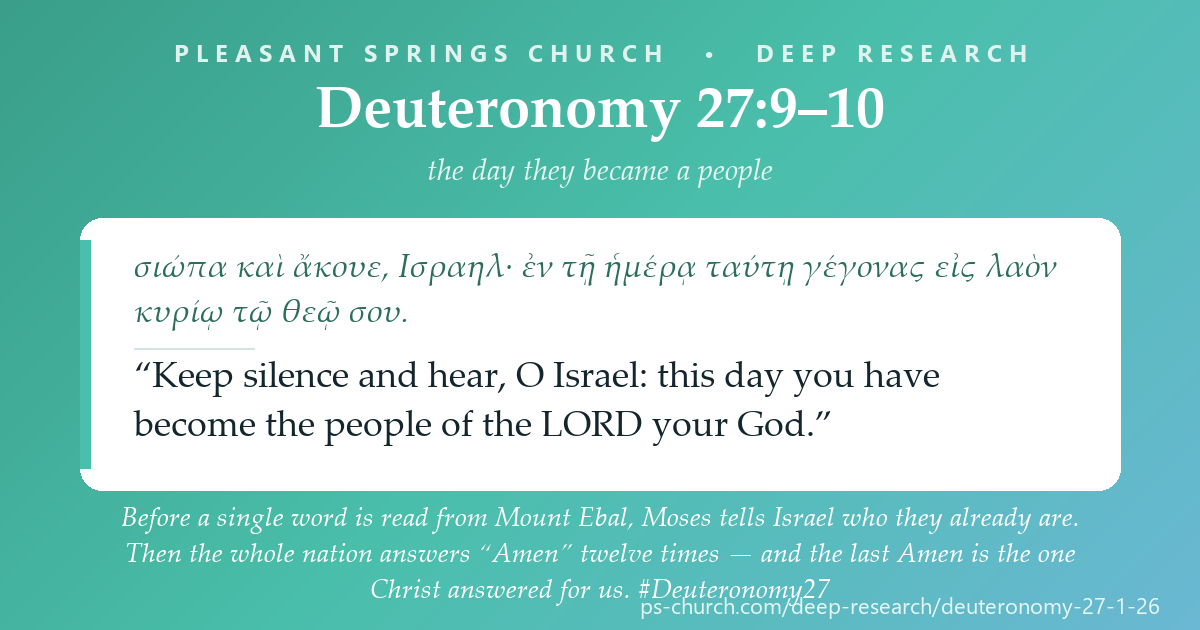
- Deuteronomy 26:16–19 — “you have declared today… and the Lord has declared today that you are a people for his treasured possession.” Read it beside 27:9, “this day you have become the people” (see Deut 26).
- Exodus 20:24–26 — the altar law behind 27:5–6: an altar of earth or of unhewn stone, “for if you wield your tool on it you profane it.” The oldest form of the same command; the ceremony at Shechem obeys it to the letter.
- Exodus 24:3–8 — the covenant at Sinai: twelve pillars, burnt offerings and peace offerings, the book read in the people’s hearing, and “All the words that the Lord has spoken we will do” (see Exodus 24). Deuteronomy 27 is the same liturgy a generation later — except that the people’s line has changed from a promise to an Amen.
- Leviticus 19:14 — “You shall not curse the deaf or put a stumbling block before the blind, but you shall fear your God” (see Leviticus 19). Note the ground given: not “because he will complain,” but fear God — the same logic as Deut 27:18.
- Deuteronomy 19:14; 16:19; 24:17 — the boundary marker, the bribe, and justice for the sojourner, the fatherless and the widow, all legislated earlier in the code and now put under oath (see Deut 19, Deut 16 and Deut 24).
- Numbers 5:19–22 — the only other place in the Torah where a curse is read aloud and the person under it answers “Amen, Amen” (see Numbers 5). There it is one woman; here it is a nation.
- Joshua 8:30–35 — the ceremony carried out: the altar of unhewn stones on Mount Ebal, a copy of the law written on the stones, the tribes divided before the ark, and the blessing and curse read to the whole assembly, “and the women, and the little ones, and the sojourners.”
- Nehemiah 8:6; 1 Chronicles 16:36; Psalm 106:48 — “and all the people answered, ‘Amen, Amen’” at the reading of the Law, and the Amen closing a psalm. The congregational voice of Deut 27 becomes a standing feature of Israel’s worship.
- Deuteronomy 28 — the blessings and curses at full length (see Deut 28), and then the covenant sworn in Moab (see Deut 29–30), where the answer to all of it is finally given: God himself will circumcise the heart (30:6).
Paul quotes this verse, and the wording matters. The Hebrew of 27:26 reads simply, “Cursed be he who does not confirm the words of this law by doing them.” The Rahlfs LXX has two pluses: ἐπικατάρατος πᾶς ἄνθρωπος ὃς οὐκ ἐμμενεῖ ἐν πᾶσιν τοῖς λόγοις τοῦ νόμου τούτου — “cursed is every person who does not remain in all the words of this law.” Gal 3:10 reads Ἐπικατάρατος πᾶς ὃς οὐκ ἐμμένει πᾶσιν τοῖς γεγραμμένοις ἐν τῷ βιβλίῳ τοῦ νόμου τοῦ ποιῆσαι αὐτά — the ESV’s “Cursed be everyone who does not abide by all things written in the Book of the Law, and do them.” So Paul’s everyone and his all things are both in the Greek Bible he read and not in the Masoretic Hebrew; his “written in the Book of the Law” draws on Deuteronomy’s own recurring phrase — “this Book of the Law” (cf. 29:20–21 · MT/LXX 29:19–20, where the chapter-29 offset bites; and 30:10, where it does not). It is worth saying plainly that some Hebrew witnesses, including the Samaritan Pentateuch, do have the word “all” here, so the LXX pluses may reflect a Hebrew text rather than a translator’s expansion. Either way, Paul is not misquoting; he is quoting the Bible in front of him. This is one of the plain reasons this library prints the Septuagint.
And then watch what he does with it. Paul does not use 27:26 to frighten anyone into trying harder. He uses it to close a door, so that he can open another one three verses later: “Christ redeemed us from the curse of the law by becoming a curse for us—for it is written, ‘Cursed is everyone who is hanged on a tree’” (Gal 3:13, quoting Deut 21:23). The twelfth Amen is answered, and it is not answered by our performance. Beale and Carson survey the debate over exactly how Paul’s argument runs; what is not in doubt is where it ends. The congregation that said Amen to the curse has been joined by someone who took it.
The commentaries, the textual criticism, and the archaeology — each in its own lane.
Craigie, Block, McConville, Tigay, Christensen, Nelson, Driver and Merrill on Deuteronomy; Kline and Weinfeld on the treaty form; Tov, Schorch, Knoppers and Müller on the Ebal/Gerizim variant; Zertal and Hawkins on the Ebal structure; Beale & Carson on Galatians.
Commentaries & studies:
- Peter C. Craigie, The Book of Deuteronomy (NICOT); Daniel I. Block, Deuteronomy (NIVAC); J. G. McConville, Deuteronomy (Apollos); Jeffrey H. Tigay, Deuteronomy (JPS); Duane L. Christensen (WBC); Richard D. Nelson, Deuteronomy (OTL); S. R. Driver (ICC); Eugene H. Merrill (NAC).
- Meredith G. Kline, Treaty of the Great King, and Moshe Weinfeld, Deuteronomy and the Deuteronomic School, on the covenant/treaty form — reported here as literary shape; the dating debate is not settled by it.
- Emanuel Tov, Textual Criticism of the Hebrew Bible (3rd ed.), on the Samaritan Pentateuch, the pre-Samaritan Qumran texts, and Deut 27:4.
- Stefan Schorch, “The Samaritan Version of Deuteronomy and the Origin of Deuteronomy”; Gary N. Knoppers, Jews and Samaritans; Reinhard Müller, “The Altar on Mount Gerizim (Deuteronomy 27:1–8)” — three careful treatments of the variant, not in agreement with each other.
- James H. Charlesworth, “What Is a Variant? Announcing a Dead Sea Scrolls Fragment of Deuteronomy,” Maarav 16 (2009) — the publication of the disputed Gerizim fragment; read alongside the doubts raised about it.
- Adam Zertal, A Nation Born: The Altar on Mount Ebal and the Birth of Israel; Ralph K. Hawkins, The Iron Age I Structure on Mt. Ebal — the excavation and a later re-evaluation; both contested.
- J. B. Pritchard, ed., Ancient Near Eastern Texts (ANET) — the Code of Hammurabi (163–180, epilogue at 178–180) and the Hittite treaties (199–206).
- G. K. Beale & D. A. Carson, eds., Commentary on the New Testament Use of the Old Testament (Galatians, on Gal 3:10–13).
Interpretation notes worth keeping:
- These are covenant sanctions, sworn by the nation on itself. Deuteronomy 27 is not a general theory of divine anger. It is the ratification clause of a covenant between the Lord and Israel, and the curses are the agreed penalty terms — agreed, out loud, by the party they fall on. Read them as anything else and you have changed the document.
- No reader may aim these at anyone. The twelve curses name no person and no people; they name acts, and the congregation applies them to itself. Using this chapter, or the one after it, to explain some other community’s suffering is both a misreading and a thing that has done real historical harm. The only person you are authorized to have in view when you say Amen here is yourself.
- The list is about what is hidden. The words “in secret” are printed twice (27:15, 24), and the reading many commentators give of the other ten — that these are the offences that slip past human enforcement — is an inference from what the acts are, not a translation (see Stage 3). This is the covenant reaching where no court reaches — which is comfort or terror depending on whether you are the one being wronged in the dark or the one doing it.
- Do not moralize the altar into a metaphor too quickly. The uncut stones and the banned iron tool are a real command with a real reason in Exod 20:25 (a worked stone is a profaned one). Whatever devotional use is made of it afterward should be labelled as devotional and should not replace the plain sense.
- The variant at 27:4 is a live question, and honesty about it is a service to the reader. Saying “the Bible says Ebal” without saying that an ancient and substantial body of witnesses says Gerizim would be tidier and less true. The MT and our LXX read Ebal; that is what we print, and we tell you what else exists.
- End where Paul ends. The twelfth curse (27:26) is the last word of the chapter but not the last word about the chapter. Galatians 3:13 is not a way of getting out of Deuteronomy 27; it is the answer Deuteronomy 27 was waiting for, and the answer Deuteronomy itself starts to give at 30:6, where God promises to circumcise the heart he had commanded them to circumcise.
A congregation under oath, and the one who took the oath’s penalty.
Name what you learned, why it matters, and one concrete response.
What should we carry away — and do?
- The law was published where everyone could see it, and said where everyone could hear it. Plaster, plain lettering, a loud voice, and a response the illiterate could give. Nothing about this covenant was designed to be the property of specialists. Ask what in your own church has quietly become unreadable to the people who are supposed to live by it.
- Twelve times, the people spoke. They did not applaud the sermon; they signed it. There is a whole doctrine of participation in that — and a warning, because you can say Amen to a sentence you have no intention of keeping. Watch what you agree to out loud.
- Almost every crime named is one nobody would catch. The boundary moved at night. The wrong directions given to a blind man. The verdict tilted against someone with no advocate. The blow struck where there was no witness. Deuteronomy 27 is a covenant with jurisdiction over your private life.
- ‘This day you have become the people’ comes before the curses, not after. The sanctions in this chapter are addressed to people who already belong. That is the difference between a covenant and a job interview.
- The last Amen has been answered. Paul quotes 27:26 in Gal 3:10 and then says, in Gal 3:13, that Christ redeemed us from the curse of the law by becoming a curse for us. Read the chapter through to the end — and then read to that end.
Step in response: take the two verses that say it out loud — 27:15 and 27:24, “in secret” — and spend ten honest minutes on the part of your life that has no witnesses. Then do one concrete thing about it this week: return something, correct a record, tell one person the truth, put back a boundary you quietly moved. And say the Amen that Deuteronomy 27 was reaching for — not the one that seals a curse on you, but the one 2 Cor 1:20 puts in your mouth: every promise of God finds its Yes in Christ, “that is why it is through him that we utter our Amen to God for his glory.”
Deuteronomy 27:9–10 · to share
LXX + ESVEvery Deep Research page traces its passage across the whole sweep — the Old Testament, the Second-Temple world between the testaments (historical witnesses, not Scripture), and the New Testament. Follow the thread:
Pleasant Springs Church — Deep Research
Research method after Michael S. Heiser’s Bible Research Method (examine dictionaries → ancient literature → important words → textual connections → academic publications → share), with the Pleasant Springs “Author & Audience” foundation. Scripture set in the Hebrew, the Greek editions named on each page and the ESV (Old Testament), and the Greek New Testament and the ESV (New Testament), per the practice of Pleasant Springs Church. Deuteronomy 27 research grounded in Craigie, Block, McConville, Tigay, Christensen, Nelson, Driver and Merrill, with Kline and Weinfeld on the treaty form (reported as the book’s literary shape, not as a settled argument about its date) and Beale & Carson on Galatians 3:10–13. Textual work on the Ebal/Gerizim variant at 27:4 follows Tov, Schorch, Knoppers, Müller and Charlesworth; the evidence is laid out on both sides and this page does not adjudicate it — the MT and the Rahlfs LXX both read Ebal, which is what we print, and the Samaritan Pentateuch, an Old Latin manuscript and other claimed witnesses read Gerizim. The Mount Ebal archaeology (Zertal; Hawkins) is reported as contested and is not used to prove the text, and the 2022 “curse tablet” claim from the same site is noted only as unaccepted by most epigraphers. ANE comparanda from the Code of Hammurabi’s epilogue (ANET 178–180) and the Hittite treaties (ANET 199–206), with the Esarhaddon succession treaty cited for form without a page number because it lies outside the copy we can verify; the Deir ʿAllā plaster inscription and the Babylonian kudurru stones are cited as witnesses, never leveled with Scripture, as are 1QS, Josephus (Ant. 4.305–308) and the Mishnah (Soṭah 7:5). Versification: Deuteronomy 27 has no MT/LXX offset — Hebrew, Rahlfs LXX and English all number 27:1–26 alike, and chapter 28 likewise; the offsets lie on either side (English 22:30 = MT/LXX 23:1, so English 23:1–25 = MT/LXX 23:2–26; English 29:1 = MT/LXX 28:69, so English 29:2–29 = MT/LXX 29:1–28). The LXX carries a thirteenth curse at 27:23 that the Hebrew does not, which is noted where it occurs. The curses are read as covenant sanctions on a covenant nation, sworn by that nation on itself; they are never aimed at any modern person, nation or group, and the chapter is closed where the canon closes it — Galatians 3:13, and the promised heart-circumcision of Deuteronomy 30:6.
Scripture quotations marked ESV are from the ESV® Bible (The Holy Bible, English Standard Version®), © 2001 by Crossway, a publishing ministry of Good News Publishers. ESV Text Edition: 2016. Used by permission. All rights reserved. The ESV text may not be quoted in any publication made available to the public by a Creative Commons license, and the ESV may not be translated in whole or in part into any other language. www.esv.org
|
Did this study bless you today? 💚 Give to Support PS Church100% of gifts go to the General Fund — thank you. |