After fifteen chapters of statutes — the chosen place, the feasts, the courts, the king, the cities of refuge, the laws of war, the gleaning left in the corner of the field — Deuteronomy’s law code ends quietly, with a farmer holding a basket. He takes the first of the fruit off ground that was not his a generation ago, carries it to the place the Lord chooses, and says out loud: “A wandering Aramean was my father. And he went down into Egypt and sojourned there, few in number… Then we cried to the Lord… and the Lord brought us out of Egypt with a mighty hand… and he brought us into this place and gave us this land” (26:5–9). It is a confession of faith, and it is a story — recited by an ordinary man who says my father and we about events centuries before he was born. Then the third-year tithe is accounted for, with the only prayer in the whole law code that asks God to “look down from your holy habitation” and bless (26:15); and then the covenant is signed by both sides at once: “You have declared today… and the Lord has declared today” (26:17–18). This study works Deuteronomy 26:1–19 — gratitude with something in your hands, memory that makes an old story yours, the poor written into the liturgy, and belonging that runs both directions. See the method →
Deuteronomy 26:1–19 (selections) — MT = LXX = English
Hebrew · LXX · ESVThe Shape of the Passage
Parallel panelsDeuteronomy 26 closes the central law code that began at chapter 12 — the one chosen place (ch 12), the tithes and the seventh-year release (chs 14–15), the feasts and the courts (ch 16), and the long chain of neighbour-laws that ends just before this chapter (chs 24–25). What follows chapter 26 is the ceremony on Ebal and Gerizim and the blessings and curses. For the firstfruits from the sanctuary side, see Leviticus 23; for the oldest form of the firstfruits command, Exodus 23.
Author
Moses, preaching on the plains of Moab. Deuteronomy is preached law — sermons delivered forty years on to the children of the generation that died in the wilderness. Its verbs are remember, hear, love, choose, today. That last one governs this chapter: hayyōm, “today,” falls four times (26:3, 16, 17, 18), and every time it is on the lips of someone making a declaration. The code does not trail off into an appendix. It ends with speech acts.
Why a law code ends in a liturgy. The book as a whole carries the shape of an ancient suzerainty treaty — preamble, historical prologue, stipulations, witnesses, blessings and curses — and 26:16–19 reads like the ratification clause at the bottom of such a document, with both parties named and both obligations stated. That observation is about the form of the book; scholars on every side of the dating question have used it, so we report the shape and leave the date where the text leaves it. What is worth noticing here is the content of the “historical prologue” Deuteronomy hands to an ordinary farmer: not a king’s résumé, but four sentences about a homeless ancestor, a brickyard, a cry, and a rescue.
Audience
People who are about to have an address. Every line of 26:1–11 presupposes a settled farm: a harvest, a first ripe fruit, a road to walk, a basket to carry. The generation being addressed has never owned a field. Their parents died in a wilderness; they themselves were born on the move. The first thing Deuteronomy tells them to do once the ground is theirs is to take part of the first crop off it and carry it away — before they eat any of it — and say out loud where it came from.
And the words are put in his mouth. Notice who speaks. Not a priest, not a Levite, not an elder at the gate: the farmer, in the first person singular, standing at the altar with produce in his hands. He says “my father,” and then, three clauses later, “the Egyptians treated us… we cried… the Lord brought us out” — about events centuries before he was born. He does not report Israel’s history; he joins it. And when he is done, the command is to rejoice, with his household, the Levite and the sojourner named in the room (26:11) — the same guest list that has run through the whole code.
Orient on firstfruits, the tithe, creeds and confessions, and covenant ratification.
Search by topic: firstfruits (bikkurim), offerings and gifts, tithe, Levite, sojourner (ger), widow and orphan, creed / confession of faith, covenant and treaty form, election, holy people, Aram / Arameans, Jacob.
Which articles are relevant?
- Anchor Bible Dictionary — “First Fruits,” “Tithe,” “Sacrifice and Offerings (OT),” “Creed,” “Covenant,” “Aram, Arameans,” “Election,” “Sojourner,” “Widow,” “Orphan.”
- Dictionary of the OT: Pentateuch — “Firstfruits,” “Tithes,” “Worship,” “Creeds,” “Covenant,” “Election,” “Aliens and Strangers,” “Poor and Poverty,” “Memory / Remembering.”
- NIDOTTE / TDOT — רֵאשִׁית (rēʾšîṯ, first / firstfruits), טֶנֶא (ṭeneʾ, basket), אָבַד (ʾāḇaḏ, perish / be lost), נָתַן (nāṯan, give), סְגֻלָּה (səḡullāh, treasured possession), שָׁקַף (šāqap, look down).
Bibliography surfaced:
- Peter C. Craigie (NICOT), Daniel I. Block (NIVAC), J. G. McConville (Apollos), Jeffrey H. Tigay (JPS), Duane Christensen (WBC), Richard Nelson (OTL), S. R. Driver (ICC), Patrick D. Miller (Interpretation), Eugene Merrill (NAC) on Deuteronomy.
- The long discussion of Deut 26:5–9 as a “credo” (Gerhard von Rad, 1938) and the substantial criticism it has drawn since — see Stage 5.
- Meredith G. Kline and Moshe Weinfeld on the treaty form; Bernard Levinson on Deuteronomy’s legal revision.
- Beale & Carson, Commentary on the NT Use of the OT (Titus; 1 Peter; 1 Corinthians).
A vassal’s recital, a farmer’s basket, and a procession with a gilded ox.
Two comparisons earn their place here. First the ancient treaty, whose “historical introduction” does exactly what 26:5–9 does. Then the later Jewish sources, which tell us what this rite actually looked like when people kept it — and how they read its hardest line.
Which parallels shed light on religion and worldview?
The historical prologue of a treaty. Second-millennium Hittite vassal treaties open with a recital of what the great king has already done for the vassal, and that recital is the ground of everything demanded afterwards. The treaty between Mursilis and Duppi-Tessub of Amurru (ANET 203–205) prints the section under the heading Historical Introduction: your grandfather Aziras submitted to my father and stayed loyal; my father “was loyal toward Aziras and his country”; when your father died I “put you in the place of your father.” Only then come the stipulations — including a tribute of “300 shekels of good, refined first-class gold weighed with standard weights,” which the historical introduction says the vassal’s father brought “year for year.” Deuteronomy 26 has the same two elements, in the same order, and inverts the tone of both. The recital is not a king’s account of his own generosity to a client prince; it is put into the mouth of a farmer, and it begins not with a dynasty but with a homeless man. And the annual gift is not gold weighed on a scale but the first ripe fruit off the ground — after which the giver sits down and eats, with a Levite and a resident foreigner at his table (26:11). The form is borrowed from the world Israel lived in; what fills it is not.
Everybody brought firstfruits. Offering the first of the harvest to the god who was thought to have given it was ordinary throughout the ancient Near East, and ANE ritual literature prescribes seasonal offerings in detail. The Hittite Instructions for Temple Officials makes the priority explicit for the temple herds: the young animals the plowmen are to have ready must be ready on time, and — “before a man has eaten from them” — carried “promptly to the presence of the gods; let the gods not wait for them” (ANET 210). Israel is not doing something unheard of, and this page will not pretend otherwise. What is unusual is the script. The offerer is not told to recite a hymn about the god’s power over the weather. He is told to recite a history — and a history in which he and his people come off badly: a wandering ancestor, slavery, and a cry for help.
What the procession looked like. The Mishnah preserves a description of the firstfruits pilgrimage that is one of the most charming passages in the whole collection (Bikkurim 3:2–6). The villages of a district gathered in one town and slept in the open square. At dawn the officer called, “Arise, let us go up to Zion, to the house of the Lord our God” (the Mishnah’s form of Jer 31:6 · LXX 38:6). An ox walked in front with its horns overlaid with gold and a crown of olive on its head, and a flute played the whole way. As they neared Jerusalem the officials of the temple came out to meet them, and every craftsman in the city stood up from his bench as they passed and said, “Our brothers, men of such and such a place, we welcome you in peace.” Even King Agrippa, the Mishnah says, would put the basket on his own shoulder and carry it into the temple court, where the Levites sang “I will extol you, O Lord, for you have drawn me up” (Ps 30:1 · MT 30:2 · LXX 29:2). Then, with the basket still on his shoulder, the man recited Deuteronomy 26 — and at “a wandering Aramean was my father” he took it down and held it by the edges while the priest put a hand underneath and waved it.
- Treaty between Mursilis and Duppi-Tessub of Amurru (ANET 203–205) and the Egyptian–Hittite treaty of Hattusilis and Ramses II (ANET 199–201) — ancient witnesses, not Scripture. The “Historical Introduction” grounding present loyalty in past benefaction; annual tribute in gold; blessings and curses; the gods invoked as witnesses. The Vassal-Treaties of Esarhaddon (ANET 534–541) supply the later Assyrian version of the same form.
- Hittite Instructions for Temple Officials (ANET 207–210 — a witness, not Scripture) — the gods’ share carried in “before a man has eaten from them” (210), and the festivals of month, year, autumn and spring kept with the cattle, sheep, loaves, beer and wine set before the gods (208). Wider ANE ritual and festival literature is collected at ANET 331–361 (Akkadian, including the Babylonian New Year programme, and Hittite). The practice of seasonal offering is shared; the recited history is not.
- Mishnah, Bikkurim 3:2–6 (rabbinic-era — a witness, not Scripture) — the procession: the night in the square, the gilded ox with its olive crown, the flute, the artisans of Jerusalem rising to greet farmers, King Agrippa with a basket on his shoulder, the Levites singing Ps 30, and the recitation with the basket still in the man’s hands.
- Mishnah, Bikkurim 1:4 — a convert brings the basket but does not recite, “since he cannot say: ‘Which the Lord has sworn to our fathers.’” Later Jewish law reversed the ruling: Maimonides (Mishneh Torah, Bikkurim 4:3) holds that the convert does recite, because God said to Abraham, “I have made you the father of a multitude of nations” (Gen 17:5) — so Abraham is father to everyone who comes in.
- The Passover Haggadah (rabbinic-era — a witness, not Scripture) — expounds Deut 26:5–8 line by line as the heart of the seder, reading the opening words as “an Aramean sought to destroy my father” and applying them to Laban. See Stage 3.
- Josephus, Antiquities 4.240–243 (Second Temple — a witness, not Scripture) — restates the law for a Roman readership: the one who brings ripe fruit is first to “bless God for that land which bare them”; every third year the tithe goes “to those that want; to women also that are widows, and to children that are orphans”; and afterwards he stands before the sanctuary and returns thanks that God delivered them from their treatment in Egypt and gave them a good land.
- Philo, Special Laws 2.215–222 (Second Temple — a witness, not Scripture) — a whole section devoted to “the Basket,” the rite of this chapter.
- The 4QDeut manuscripts (Dead Sea Scrolls — witnesses, not Scripture) — Deuteronomy is among the most-copied books at Qumran, evidence of how heavily this book was read in the Second-Temple period.
Ask most people to say what they believe and they will produce propositions: God is one, God is good, God is sovereign. Deuteronomy hands a man a basket and has him say something else entirely — a narrative, with a setting, characters, a crisis and a rescue. There is not a single abstract noun in it. It has a homeless ancestor, an emigration, a population explosion, a labour camp, a scream, a hearing, a hand and an arm, a journey, and a piece of ground with milk and honey on it. That is the confession. And it is not that Israel had no doctrine; it is that Israel’s doctrine came in the form of things that happened.
Then watch the pronouns move. He begins in the third person — he went down, he sojourned, he became a nation — and by the next sentence he has switched: “the Egyptians treated us harshly… we cried… the Lord brought us out… and he brought us into this place.” A man who was not there says us, and the law puts the word in his mouth on purpose. This is how biblical memory works: not recalling a story about other people, but standing inside one. It is the same move Israel makes every Passover — “It is because of what the Lord did for me when I came out of Egypt” (Exod 13:8) — and the same move the church makes at the Lord’s table, where bread and cup are handed to people who were not at that supper and were not at that cross, with the words “for you.”
A wicker basket, a crux, a firstfruit, a request, a verb used twice in history, and a king’s treasure.
Verse numbers on this page need no conversion: Hebrew, Rahlfs LXX and English all number Deuteronomy 26 alike, 1–19, with no offset. (Where a Psalm is cited, both numbers are given — the LXX runs one behind the Hebrew from Ps 9/10 onward.)
“Basket” — a rare word, in the whole Old Testament only here and in the blessing and curse of 28:5, 17 (“blessed shall be your basket and your kneading bowl… cursed shall be your basket”). The LXX picks an equally homely Greek word, κάρταλλος (kartallos), a tapering wicker basket. Nothing about this container is liturgical. It is what a man carries fruit in.
Three words, and the most argued-over line in the chapter. ʾāḇaḏ means to perish, be lost, go astray — used of a lost sheep (Ps 119:176 · LXX 118:176), of a lost object (Deut 22:3), of “one who is perishing” in poverty (Prov 31:6). The participle is intransitive, which is the hinge of the whole debate. See the note below.
“First, beginning, choicest” — the same word that opens Genesis. Here it is the first of the crop, brought before any of it is eaten; the LXX renders it ἀπαρχή (aparchē), the word the New Testament will use of the Spirit as a down payment (Rom 8:23) and of Christ risen as “the firstfruits of those who have fallen asleep” (1 Cor 15:20). A firstfruit is not a fraction; it is a sample that says what the rest belongs to.
“Look down” — the causative of šāqap, to lean over and gaze down from a height. It is used of God looking down from heaven on the children of man (Ps 14:2 · LXX 13:2) and in mercy from “his holy height” to hear the prisoner’s groan (Ps 102:19 · MT 102:20 · LXX 101:20), and of the Lord looking down on the Egyptian forces from the pillar of fire and cloud (Exod 14:24). Here it is a request — and it is the only prayer in Deuteronomy’s whole law code (chs 12–26) that asks God to look down and bless. LXX κάτιδε, “look down upon.”
A form found nowhere else in the Hebrew Bible — the causative of the ordinary verb “to say,” used twice in two verses and then never again. Something like “you have caused it to be said,” hence ESV “you have declared”; some connect it instead with a noun meaning “height” and render “you have exalted.” Nobody is certain. What is not uncertain is that the same rare verb is used of both parties, in the same verse-pair, on the same day: each one says the other.
“Treasured possession” — in ordinary use a king’s personal treasure, the private property he keeps apart from the crown estate (cf. 1 Chr 29:3; Eccl 2:8). Of Israel at Exod 19:5; Deut 7:6; 14:2; 26:18; Mal 3:17. The LXX coins λαὸς περιούσιος, “a people over and above,” and that exact phrase is what Paul reaches for in Titus 2:14.
‘A wandering Aramean was my father’ — three readings of three words:
The Hebrew is אֲרַמִּי אֹבֵד אָבִי, ʾărammî ʾōḇēḏ ʾāḇî — literally “an-Aramean perishing my-father.” Hebrew word order and the absence of a verb leave more than one sentence available, and the three great traditions each took a different one. This is a case where translation is interpretation, and it is worth laying the options out honestly rather than pretending the question is closed.
- 1. “A wandering Aramean was my father” (ESV, NIV; also RSV, NRSV). ʾărammî is the predicate and ʾāḇî (“my father”) the subject, with the participle describing him: my father was a homeless Aramean. The reference is to Jacob, who worked twenty years in Aram, married there, and came back with nothing he had started with. This is the reading the immediate context supports — the next clause is “and he went down into Egypt and sojourned there,” which continues a life of not having a place. NJPS translates “a fugitive Aramean”; the sense is landlessness, which is precisely the point of a confession recited by a man who now, at last, has land in his hands.
- 2. “My father abandoned Syria” (the Septuagint). Rahlfs reads Συρίαν ἀπέβαλεν ὁ πατήρ μου — the Greek translator took “Aram” as the object (Syria, the country) and the verb as transitive: my father cast off Syria, and went down to Egypt. It turns the line into an itinerary. Whatever one makes of it, it shows that the difficulty is not modern: the oldest translation we possess already found the phrase hard and made a decision about it.
- 3. “An Aramean sought to destroy my father” (the Passover Haggadah, following the Sifre; so also Rashi). Here ʾărammî is the subject — Laban the Aramean — and the participle is read as causative: he was destroying my father, Jacob. The seder builds a whole homily on it: “Go and learn what Laban the Aramean sought to do to Jacob our father.” It is a reading with enormous liturgical weight, and it has been said at Jewish tables for many centuries.
- The grammatical objection, made early and from inside the tradition. Ibn Ezra (12th c.) states it flatly on this verse: ʾōḇēḏ “is an intransitive verb. If Aramean referred to Laban then Scripture should have read maʾăḇîḏ or məʾabbēḏ” — the transitive forms. And he adds a second objection from the flow of the sentence: what would Laban’s hostility have to do with the very next words, “and he went down to Egypt”? Laban did not send Jacob to Egypt. Ibn Ezra’s own rendering is “a perishing Aramean was my father” — meaning Jacob was destitute, comparing “give strong drink to the one who is perishing” (Prov 31:6): “I did not inherit the land from my father, for my father was poor.”
- Why the ESV goes where it does. It follows the grammar (an intransitive participle describing “my father”) and it follows the sentence (landless → sojourner in Egypt → slave → given a land). “Wandering” renders the “lost, straying” end of the root’s range — the sheep of Ps 119:176 · LXX 118:176 — rather than the “dying” end. That is a judgment call, and honest translations differ on the shade. What none of the three readings changes is the point of the confession: we were nobody, and we had nothing, and everything in my hands right now was given.
The same story told over and over — and a table where it is still told.
Run three threads: the firstfruits and tithe legislation across the Torah; the recital of 26:5–9 as it recurs elsewhere in Scripture, almost word for word; and the language of 26:18–19 as the New Testament picks it up.
Which cross-references matter?
- Exodus 23:19; 34:26; Leviticus 23:9–14; Numbers 18:12–13 — the firstfruits command in its earlier forms: “the best of the firstfruits of your ground you shall bring into the house of the Lord your God,” and the sheaf waved on the day after the Sabbath (see Exodus 23 and Leviticus 23). Deuteronomy adds what none of them has: the words to say.
- Deuteronomy 14:22–29 — the third-year tithe stored up “within your towns” for the Levite, the sojourner, the fatherless and the widow, who “shall come and eat and be filled.” Deut 26:12–15 is the moment that law comes due, with a receipt read aloud (see Deut 14–15).
- Numbers 20:15–16 — Moses’ message to Edom, and almost the same sentences: “our fathers went down to Egypt… and the Egyptians dealt harshly with us… and when we cried to the Lord, he heard our voice and sent an angel and brought us out of Egypt” (see Numbers 20). The recital was evidently a fixed way of telling it.
- Deuteronomy 6:20–25 — “When your son asks you… you shall say to your son, ‘We were Pharaoh’s slaves in Egypt. And the Lord brought us out…’” The same story, in the same shape, taught to a child at home rather than said at an altar (see Deut 6).
- Joshua 24:2–13; Nehemiah 9:6–37; Psalms 105–106 · LXX 104–105; 136 · LXX 135 — the same recital at a covenant renewal, in a post-exilic confession of sin, and in the hymnbook. Israel kept saying it, in every genre it had.
- Exodus 19:5–6; Deuteronomy 7:6; 14:2; Malachi 3:17 — “a people for his treasured possession… a kingdom of priests and a holy nation” (see Exodus 19 and Deut 7). 26:18–19 is the code’s closing echo of Sinai.
- Deuteronomy 8:11–18 — “beware lest you say in your heart, ‘My power and the might of my hand have gotten me this wealth’… you shall remember the Lord your God, for it is he who gives you power to get wealth” (see Deut 8). Chapter 26 is chapter 8’s antidote, built into the calendar.
- Titus 2:14; 1 Peter 2:9–10 — “to purify for himself a people for his own possession” (λαὸν περιούσιον, the LXX phrase of Deut 26:18 exactly), and “a chosen race, a royal priesthood… a people for his own possession… once you were not a people, but now you are God’s people.”
- 1 Corinthians 15:3–8 — the earliest Christian confession we possess is also a story: “that Christ died for our sins in accordance with the Scriptures, that he was buried, that he was raised on the third day… and that he appeared” (see 1 Corinthians 15). Four verbs, in order, with witnesses.
- Ephesians 2:11–13, 19 — “remember that you were at that time separated from Christ… strangers to the covenants of promise… but now… you have been brought near… you are no longer strangers and aliens” (see Ephesians 2). A Gentile church is handed its own version of “a wandering Aramean was my father.”
The New Testament does not quote Deuteronomy 26 often, but it takes two things out of it and does not give them back. The first is a phrase. When Paul tells Titus that Christ gave himself “to redeem us from all lawlessness and to purify for himself a people for his own possession” (Titus 2:14), the Greek is λαὸν περιούσιον — the exact wording the Septuagint invented for 26:18 (and Exod 19:5; Deut 7:6; 14:2). Peter does the same thing with a chain of the same texts (1 Pet 2:9–10). The point in both places is not that the church has taken something away from Israel; it is that the thing said over Israel at the end of the law code has been said over these people too, and on the same ground: it was given.
The second is a shape. The oldest Christian confession we can reach — older than the letter that carries it — is not a definition of God’s attributes but a sequence of events with dates and witnesses (1 Cor 15:3–8). And the church’s central act of worship is a meal at which a story is told in the first person to people who were not there: “the Lord Jesus on the night when he was betrayed took bread… this is my body, which is for you” (1 Cor 11:23–26; Matt 26:26–29). The farmer at the altar saying “the Egyptians treated us harshly” and the believer at the table saying “for me” are doing the same thing, and neither of them invented it.
The commentaries, and a famous proposal about these nine verses.
Craigie, Block, McConville, Tigay, Christensen, Nelson, Driver, Miller and Merrill on Deuteronomy; Kline and Weinfeld on the treaty form; Beale & Carson on the NT use; ANET for the treaties.
Commentaries & studies:
- Peter C. Craigie, The Book of Deuteronomy (NICOT); Daniel I. Block, Deuteronomy (NIVAC); J. G. McConville, Deuteronomy (Apollos); Jeffrey H. Tigay, Deuteronomy (JPS); Duane L. Christensen (WBC); Richard D. Nelson (OTL); S. R. Driver (ICC); Patrick D. Miller (Interpretation); Eugene H. Merrill (NAC).
- Gerhard von Rad, “The Form-Critical Problem of the Hexateuch” (1938). Von Rad singled out Deut 26:5–9 (with Deut 6:20–24 and Josh 24:2–13) as a “little historical credo” — in his view an ancient cultic confession, older than the books that contain it, around which the whole Hexateuch was eventually built. It is one of the most famous proposals in twentieth-century Old Testament study, and it is much debated: later scholars (Rost, Richter, Lohfink among them) argued from the vocabulary that 26:5–9 is written in thoroughly Deuteronomic language and is therefore no older than the book it stands in. We name the proposal because any serious reader of this chapter will meet it, and we do not adopt its source-critical framework in either direction. What the text itself claims is plain enough — that Moses gave Israel words to say — and what the text plainly is remains true whichever way the dating goes: a confession in the form of a story.
- Meredith G. Kline, Treaty of the Great King, and Moshe Weinfeld on the suzerainty-treaty shape of Deuteronomy — reported here as the book’s literary form, since the argument has been run in support of both an early and a late date and does not settle it.
- Bernard M. Levinson on Deuteronomy’s relation to the earlier legal collections; studies of the firstfruits and tithe legislation across the Torah.
- J. B. Pritchard, ed., Ancient Near Eastern Texts (ANET) — the Hittite treaties (199–206), the Vassal-Treaties of Esarhaddon (534–541), the ritual and festival texts (331–361).
- G. K. Beale & D. A. Carson, eds., Commentary on the New Testament Use of the Old Testament (1 Corinthians; the Pastoral Epistles; 1 Peter).
Interpretation notes worth keeping:
- The chapter is the code’s conclusion, not an appendix. Everything from chapter 12 has been telling Israel what to do; chapter 26 tells them what to say, and then has God say something back. Read it as the end of a sermon, not as one more statute.
- Gratitude here has something in its hands. Deuteronomy does not ask the farmer to feel grateful. It tells him to take produce off his own land, carry it a long way, hand it over, and speak. Thanksgiving in this chapter is a set of physical acts performed before the harvest is enjoyed — and the gladness (26:11) comes afterward, not before.
- The poor are inside the liturgy. The Levite and the sojourner stand in the room at the firstfruits feast (26:11); the Levite, the sojourner, the fatherless and the widow are the whole content of the third-year tithe, and saying so is part of the prayer (26:12–13). A worshipper in this chapter cannot give an account of himself before God without mentioning what he did about them.
- 26:13–14 is not self-righteousness. “I have not transgressed… I have obeyed” sounds jarring to Christian ears trained on Luke 18:11. But it is a declaration about one specific, checkable obligation — the tithe was removed from the house and delivered — not a claim to be sinless. It is closer to a sworn receipt than to a boast, and the Torah’s own sacrificial system, running right alongside it, assumes the man saying it is a sinner.
- Do not over-press the mutual declaration into a symmetry between equals. 26:17–18 is beautiful precisely because the same rare verb is used of both sides — but the shape of the book is a great king binding himself to a people he chose, not two parties negotiating. The wonder is the condescension, not the parity.
- ‘High above all nations’ (26:19) is not a licence for national pride. The clause that follows says what the height is for: “that you shall be a people holy to the Lord your God.” Deuteronomy has already told this same people they were not chosen for being numerous or righteous (7:7; 9:5–6). Any use of this verse to underwrite the superiority of a modern nation, church, or ethnicity has read the sentence backwards.
- Take the story, and let it stay a story. The most transferable thing in this chapter is not a rule but a practice: rehearse out loud, in the first person, in the presence of God and with something in your hands, what you were and what was done for you. That is what the confession does; that is what a Christian does at the Lord’s table; and it is one of the few defences a comfortable person has against the delusion of 8:17.
From a basket of fruit to a sentence you can say back.
Name what you learned, why it matters, and one concrete response.
What should we carry away — and do?
- Say what you believe as a story. The oldest confession in the Bible has no abstract nouns in it — only a wandering ancestor, a labour camp, a cry, a hand, and a piece of ground. Try telling someone what God has done rather than what God is like, and see which one they remember.
- Memory is something you enter, not something you recall. The farmer says “us” about a rescue centuries older than he is. So do we, every time bread and cup are handed over with the words “for you.”
- Gratitude with something in your hands. Not a feeling summoned before a meal — a basket carried before the meal. Give first, then rejoice; the chapter is emphatic about the order.
- Your account of yourself should mention the poor. When Israel gave God a report, the whole content of it was what had reached the Levite, the sojourner, the fatherless and the widow. Nothing else was in the receipt.
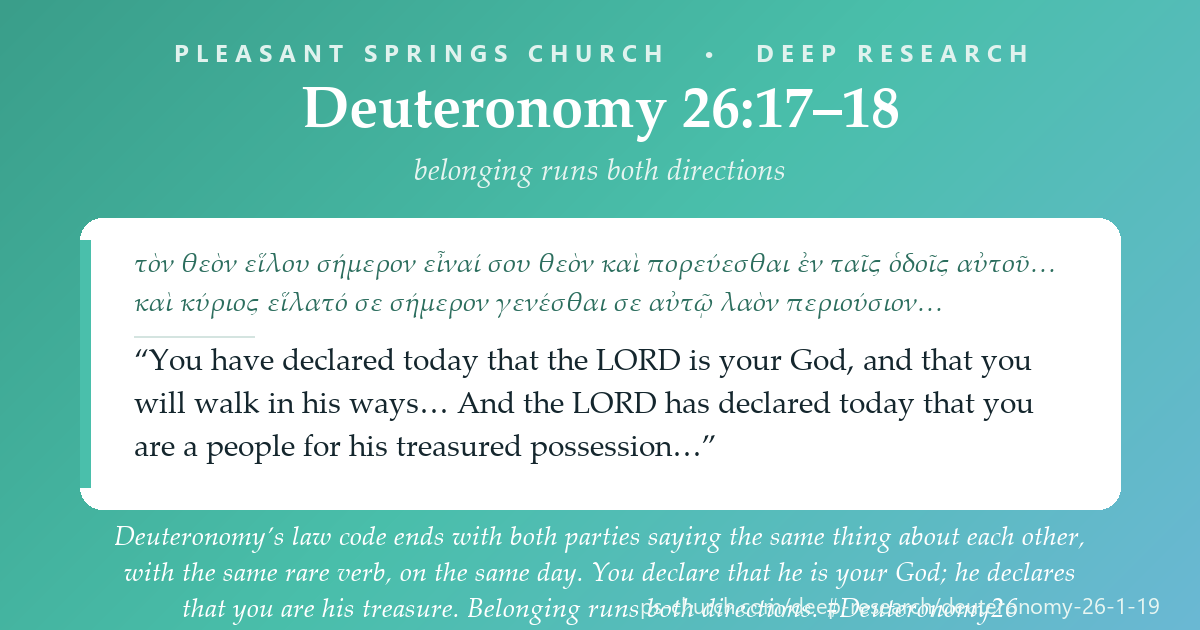
- Belonging runs both directions. “You have declared today that the Lord is your God… and the Lord has declared today that you are a people for his treasured possession.” He says something about you, out loud, on the same day you say something about him.
Step in response: write out four sentences — where you came from, what held you, what you cried about, and what he did — and say them out loud to one person this week. Then do the part with hands: give the first of something (not the leftover of it) to someone who cannot return it, before you spend the rest.
Deuteronomy 26:17–18 · to share
LXX + ESVEvery Deep Research page traces its passage across the whole sweep — the Old Testament, the Second-Temple world between the testaments (historical witnesses, not Scripture), and the New Testament. Follow the thread:
Pleasant Springs Church — Deep Research
Research method after Michael S. Heiser’s Bible Research Method (examine dictionaries → ancient literature → important words → textual connections → academic publications → share), with the Pleasant Springs “Author & Audience” foundation. Scripture set in the Hebrew, the Greek editions named on each page and the ESV (Old Testament), and the Greek New Testament and the ESV (New Testament), per the practice of Pleasant Springs Church. Deuteronomy 26 research grounded in Craigie, Block, McConville, Tigay, Christensen, Nelson, Driver, Miller and Merrill, with Kline and Weinfeld on the treaty form (reported as the book’s literary shape, not as a settled argument about its date) and Beale & Carson on the New Testament use (1 Corinthians; the Pastoral Epistles; 1 Peter). Von Rad’s famous designation of 26:5–9 as a “little historical credo” is named as a well-known and much-debated proposal, not endorsed. ANE comparanda from the Hittite treaties (ANET 199–206, esp. the “Historical Introduction” of Mursilis–Duppi-Tessub, 203–205), the Vassal-Treaties of Esarhaddon (ANET 534–541) and the ANE ritual and festival texts (ANET 331–361); Second-Temple and rabbinic witnesses from Josephus (Ant. 4.240–243), Philo (Special Laws 2.215–222), the Mishnah (Bikkurim 1:4 and 3:2–6), Maimonides (Mishneh Torah, Bikkurim 4:3), the Passover Haggadah and Ibn Ezra — all read as witnesses, never leveled with Scripture. Versification: Deuteronomy 26 has no MT/LXX offset — Hebrew, Rahlfs LXX and English all number 26:1–19 alike; the offsets in this book lie earlier (English 12:32 = MT/LXX 13:1, so English 13:1–18 = MT/LXX 13:2–19; English 22:30 = MT/LXX 23:1, so English 23:1–25 = MT/LXX 23:2–26; English 29:1 = MT/LXX 28:69), and Psalms cited here carry the LXX number alongside the English (Ps 14:2 · LXX 13:2; Ps 30:1 · MT 30:2 · LXX 29:2; Ps 102:19 · MT 102:20 · LXX 101:20; Ps 119:176 · LXX 118:176; Pss 105–106 · LXX 104–105; Ps 136 · LXX 135), as does Jeremiah (Jer 31:6 · LXX 38:6). The chapter’s promise of a place “high above all nations” is read as Deuteronomy reads it — election for holiness, granted to a people told plainly that it was not chosen for its size or its righteousness (7:7; 9:5–6) — and not as a warrant for the superiority of any modern nation, church or ethnicity.
Scripture quotations marked ESV are from the ESV® Bible (The Holy Bible, English Standard Version®), © 2001 by Crossway, a publishing ministry of Good News Publishers. ESV Text Edition: 2016. Used by permission. All rights reserved. The ESV text may not be quoted in any publication made available to the public by a Creative Commons license, and the ESV may not be translated in whole or in part into any other language. www.esv.org
|
Did this study bless you today? 💚 Give to Support PS Church100% of gifts go to the General Fund — thank you. |