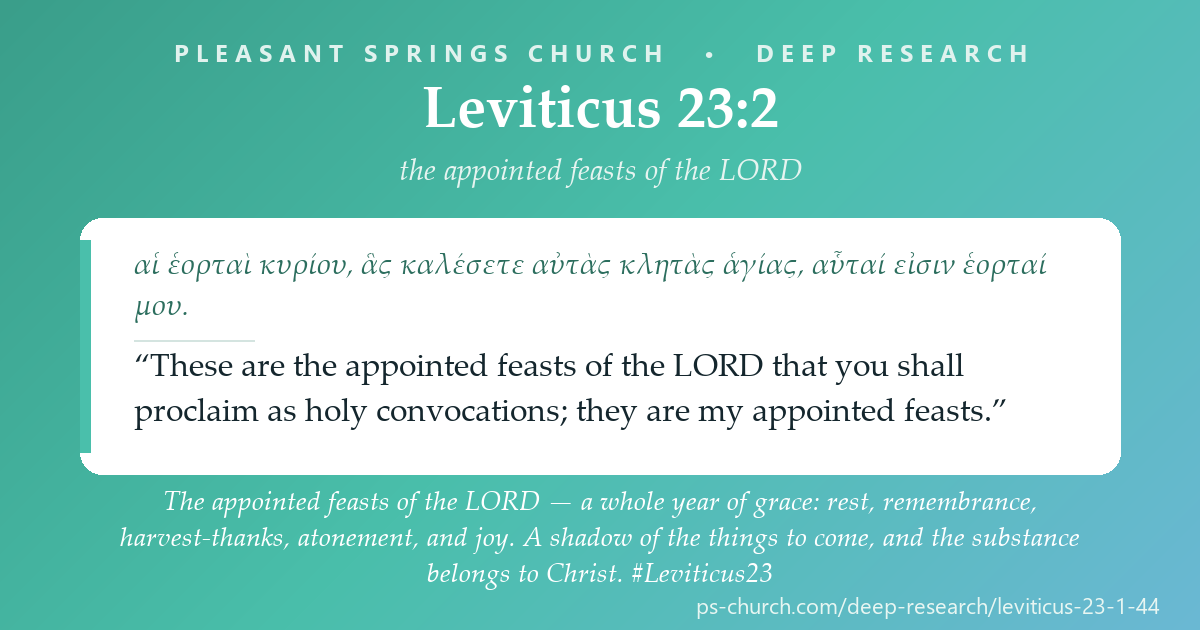
One chapter holds Israel’s whole calendar — the “appointed feasts of the Lord” (23:2). The weekly Sabbath of rest; Passover and Unleavened Bread; the first sheaf of the harvest waved before God; the Feast of Weeks with its gleanings left for the poor; the day of Trumpets; the Day of Atonement; and the joyful Feast of Booths, when Israel lived a week in shelters to remember the exodus. Sacred time as grace — a year ordered around remembrance, rest, harvest-thanks, atonement, and joy. This study works Leviticus 23:1–44, and follows the calendar the New Testament calls “a shadow of the things to come” whose “substance belongs to Christ” (Col 2:16–17). See the method →
Leviticus 23:2–43 (selections)
Hebrew · LXX · ESVThe Shape of the Passage
SequenceLeviticus 23 gathers the sacred calendar into one chapter, near the close of the Holiness Code (chs 17–26). It follows the ethics of ch 19 and re-frames the Day of Atonement of ch 16 as one feast among the appointed times — the whole year ordered around the God who dwells in the tabernacle (Exod 40).
Author
The Torah of Moses sets Leviticus 23 as Israel’s liturgical calendar. Where earlier chapters gave the sacrifices, the priesthood, and the code of holiness, this chapter gives sacred time: the “appointed feasts” (מוֹעֲדִים, môʿăḏîm) that God fixes and fills. The list is deliberately shaped — the weekly Sabbath first (23:3), then the spring cluster of Passover, Unleavened Bread, and Firstfruits; then Weeks / Pentecost; then the autumn cluster of Trumpets, the Day of Atonement, and Booths. Seven appointed times, framed by the refrain that they are “the feasts of the Lord.”
A calendar of grace. The feasts re-tell the story of redemption on a yearly loop: rest that recalls creation and exodus (Sabbath), deliverance from Egypt (Passover), the first sheaf and the full harvest given back in thanks (Firstfruits, Weeks), a day of cleansing (Atonement), and joyful dwelling in booths that remembers the wilderness. The New Testament will read this ordered time not as an end in itself but as a God-given shadow whose substance is Christ.
Audience
Israel — the whole congregation (23:2), an agrarian, pilgrim people whose year turned with barley, wheat, and the autumn ingathering. Three of these feasts drew them up to the sanctuary (Unleavened Bread, Weeks, Booths); all of them were to be kept “in all your dwelling places” and marked by rest and holy assembly. The calendar taught a redeemed people to measure their days by God’s acts, not merely by the sun and the crops.
How they heard it. To keep the feasts was to rehearse the gospel of the exodus year by year: to eat the Passover and know they were spared; to bring the firstfruits and confess that the land and the harvest were the Lord’s; to leave the gleanings and remember the poor (23:22); to fast on the Day of Atonement and be cleansed; to live a week in booths so “that your generations may know that I made the people of Israel dwell in booths when I brought them out of… Egypt” (23:43). Sacred time formed a holy memory.
Orient on the feasts, the sacred calendar, Sabbath, Passover, firstfruits, and Booths.
Search by topic: feasts / festivals, calendar, Sabbath, Passover, Firstfruits, Weeks / Pentecost, Trumpets, Day of Atonement, Booths / Tabernacles.
Which articles are relevant?
- Anchor Bible Dictionary — “Feasts and Festivals,” “Calendar,” “Passover,” “Weeks, Feast of,” “Booths, Feast of,” “Sabbath.”
- Dictionary of the OT: Pentateuch — “Festivals and Feasts,” “Sabbath,” “Calendar,” “Sacred Time,” “Agriculture.”
- NIDOTTE / TDOT — מוֹעֵד (môʿēḏ, appointed time), חַג (ḥaḡ, pilgrim feast), מִקְרָא (miqrāʾ, convocation), שַׁבָּת (šabbāṯ, Sabbath), פֶּסַח (pesaḥ, Passover).
Bibliography surfaced:
- Gordon Wenham (NICOT), Jacob Milgrom (AB), Mark Rooker (NAC) on Leviticus.
- Studies of Leviticus 23 as Israel’s festal calendar; the spring and autumn clusters; the agricultural and redemptive layers of the feasts.
- Beale & Carson, Commentary on the NT Use of the OT (1 Corinthians; Acts; Colossians; Hebrews; John).
The agricultural year, the pilgrim feasts, and their fulfillment in Christ.
Read the feasts against the ancient farming year and their Second-Temple keeping, then follow the calendar to the One the New Testament says it foreshadowed.
Which parallels shed light on religion and worldview?
A year measured by harvest — and by God. Israel’s feasts sit on the rhythm of the agricultural year: the barley harvest behind Firstfruits, the wheat harvest behind Weeks, and the autumn ingathering behind Booths. The tenth-century Gezer calendar lists these very seasons of sowing and reaping. Israel’s neighbors, too, kept new-year and harvest festivals. But Leviticus reframes the farming year: the feasts are not fertility rites to coax the gods but “the feasts of the Lord,” appointed times when a redeemed people gives the harvest back in thanks and rehearses the exodus.
How the feasts were kept. By the Second Temple the calendar had generated a rich literature of practice. Josephus describes the festivals for a Roman audience (Antiquities 3); Philo expounds their meaning allegorically (Special Laws 1–2); and the Mishnah devotes whole tractates to them — Pesachim (Passover), Menachot (the omer / firstfruits wave), Rosh Hashanah (the seventh-month new moon and Trumpets), and Sukkah (Booths). Jubilees and the Qumran texts even fought over the calendar itself — whether to reckon the feasts by a lunar or a 364-day solar year — showing how much sacred time mattered.
- The Gezer calendar (10th c. BCE inscription — a witness, not Scripture) — the agricultural months of sowing, harvest, and ingathering that underlie the pilgrim feasts.
- Josephus, Antiquities 3.237–257 (Second-Temple — a witness, not Scripture) — a running description of the appointed feasts and their offerings.
- Philo, On the Special Laws 1–2 (Second-Temple — a witness, not Scripture) — the meaning of the festivals, the Sabbath, and the sacred number seven.
- Mishnah — Pesachim, Menachot, Rosh Hashanah, Sukkah (rabbinic-era) — the detailed keeping of Passover, the omer wave, the seventh-month feasts, and Booths.
- Jubilees 6; Qumran calendrical texts (Second-Temple — witnesses, not Scripture) — the Feast of Weeks as a covenant renewal, and the disputed 364-day festival calendar.
The New Testament reads Israel’s calendar as a God-given pattern that finds its fullness in Jesus — a reading we hold as devotional and typological, on the New Testament’s own terms. Paul calls Christ “our Passover lamb,” sacrificed for us (1 Cor 5:7), and the risen Christ “the firstfruits of those who have fallen asleep” (1 Cor 15:20–23) — raised, like the waved sheaf, on the day after the Sabbath. The Spirit was poured out at Pentecost / Weeks (Acts 2), and the autumn feasts — Trumpets, Atonement, Booths — have long been read toward the consummation, when God tabernacles with his people (Rev 21:3). Paul draws the conclusion himself: the festivals are “a shadow of the things to come, but the substance belongs to Christ” (Col 2:16–17). And so the Sabbath’s rest points beyond itself: “there remains a Sabbath rest for the people of God” (Heb 4:9–10). Because the shadow has met its substance, Paul can say, “let no one pass judgment on you… with regard to a festival” (Col 2:16): the feasts are fulfilled in Christ, not re-imposed on his people as binding ritual.
The vocabulary of sacred time, harvest, and remembrance.
Watch moʿed (appointed time) and miqra qodesh (holy convocation) frame the year, and see how pesach, ʿomer, and sukkah reach toward the New Testament.
“Appointed time / feast” — a time God fixes for meeting him (LXX ἑορτή, also καιρός). The chapter’s keyword: these are not human holidays but the Lord’s own appointed times.
“Holy convocation” — a sacred assembly, a day called out for rest and worship (LXX κλητὴ ἁγία). Each feast gathers the people; sacred time makes a holy community.
“Passover” — the feast of the sparing lamb and the exodus (LXX πάσχα). Paul names Christ our pascha: “Christ, our Passover lamb, has been sacrificed” (1 Cor 5:7).
“Sheaf of firstfruits” — the first cutting of the barley, waved before God as the harvest’s pledge (LXX δράγμα ἀπαρχή). The risen Christ is called the firstfruits (ἀπαρχή) of the resurrection (1 Cor 15:20).
“Booth / shelter” — the temporary hut of branches Israel lived in for seven days (LXX σκηνή), recalling the wilderness. The same word-world as the tabernacle and the promise that God will “dwell” (tabernacle) with his people (Rev 21:3).
How the New Testament reuses the feasts:
- 1 Corinthians 5:7–8 — “Christ, our Passover lamb, has been sacrificed. Let us therefore celebrate the festival… with the unleavened bread of sincerity and truth.”
- 1 Corinthians 15:20–23 — “Christ has been raised… the firstfruits (ἀπαρχή) of those who have fallen asleep”: the waved sheaf fulfilled.
- Acts 2:1–4 — the Spirit poured out “when the day of Pentecost” (the Feast of Weeks) “arrived.”
- Colossians 2:16–17; Hebrews 4:9–10 — the feasts “a shadow… the substance belongs to Christ”; “there remains a Sabbath rest for the people of God.”
From the appointed feasts to their fulfillment in Christ and the consummation.
Trace each feast to its roots in the exodus law and forward to the New Testament’s reading of Passover, Firstfruits, Pentecost, and Booths.
Which cross-references matter?
- Exodus 12; 23:14–17; 34:18–23; Deuteronomy 16:1–17 — the older lists of the three pilgrim feasts (Unleavened Bread, Weeks, Booths) that Leviticus 23 gathers and completes.
- Numbers 28–29 — the full schedule of festival offerings that accompanies this calendar; Leviticus 16 — the Day of Atonement, here set among the feasts (see Leviticus 16).
- Leviticus 19:9–10 — the same gleaning-for-the-poor command that reappears in the feast of Weeks (23:22): sacred time and social mercy joined (see Leviticus 19).
- 1 Corinthians 5:7; 15:20–23; Acts 2; Colossians 2:16–17; Hebrews 4:9–10 — Christ our Passover and Firstfruits, the Spirit at Pentecost, the feasts a shadow whose substance is Christ, and the Sabbath rest that remains.
- John 7:2, 37–39; Zechariah 14:16–19 — Jesus at the Feast of Booths (“if anyone thirsts…”), and the prophetic vision of all nations keeping Booths before the Lord.
The New Testament does not treat Leviticus 23 as an abolished almanac but as a calendar of promise kept in Christ — a reading it presents on its own authority, and one we mark clearly as typological. The spring feasts cluster around the cross and resurrection: Christ is sacrificed as the Passover, raised as the Firstfruits on the day after the Sabbath, and fifty days later pours out the Spirit at Weeks / Pentecost, when the harvest of the nations begins (Acts 2). The autumn feasts — Trumpets, Atonement, Booths — the church has long read toward the End: the trumpet, the final atonement already secured (see Leviticus 16), and the everlasting Feast of Booths when God “will dwell (tabernacle) with them” (Rev 21:3). Paul’s own rule guards against two errors at once: because the substance has come, the feasts are not binding ritual to be re-imposed (Col 2:16); and yet, because they were a true shadow, they still teach us Christ. What Israel rehearsed each year, the church confesses fulfilled — and still awaits in its consummation.
The scholarship on the festal calendar of Leviticus 23.
Wenham and Milgrom for Leviticus; studies of the festival calendar and the agricultural year; Beale & Carson for the New Testament use.
Commentaries & studies:
- Gordon J. Wenham, The Book of Leviticus (NICOT); Jacob Milgrom, Leviticus (Anchor); Mark F. Rooker (NAC).
- Studies of the Israelite festal calendar, the spring / autumn clusters, and the relation of Leviticus 23 to Exodus 23, 34, Numbers 28–29, and Deuteronomy 16.
- G. K. Beale & D. A. Carson, eds., Commentary on the New Testament Use of the Old Testament (1 Corinthians; Acts; Colossians; Hebrews; John).
Interpretation notes worth keeping:
- Sacred time is grace, not burden. The feasts are gifts of rest, memory, and joy — a whole year ordered around the Lord’s saving acts. Even the harvest feasts are structured to return thanks and to feed the poor (23:22).
- Agricultural and redemptive layers. Each feast has a farming season (barley, wheat, ingathering) and a redemptive meaning (exodus, provision, cleansing, wilderness dwelling). Reading only one layer flattens the chapter.
- Fulfilled, not revived. The New Testament reads the feasts as a shadow fulfilled in Christ (Col 2:16–17); the typology is drawn by the apostles themselves and should be labeled as such — not used to bind the church to the ritual calendar, nor emptied of the feasts’ own Old Testament meaning.
- Toward the consummation. The autumn feasts and the promise that God will “tabernacle” with his people carry the calendar forward to the new creation (Rev 21:3); the feasts look back to the exodus and ahead to the end.
From the appointed feasts to a life ordered by grace.
Name what you learned, why it matters, and one concrete response.
What should we carry away — and do?
- Time belongs to God. Israel measured the year by the Lord’s acts, not merely the sun and the crops. Sacred time is grace — rest, remembrance, thanks, cleansing, and joy, given as a rhythm.
- The feasts point to Christ. Passover, Firstfruits, and Pentecost meet him at the cross, the empty tomb, and the outpoured Spirit; the autumn feasts look on to the day God dwells with us. They are a shadow whose substance is Christ.
- Rest that remains. The Sabbath was never the goal but the sign — “there remains a Sabbath rest for the people of God” (Heb 4:9). We keep it best by resting in the finished work of Jesus.
Step in response: let the calendar preach. Build one rhythm of grace into your week — a real Sabbath rest, a moment of firstfruits thanks before the paycheck is spent, a remembered meal that retells the gospel — and receive it not as a rule to keep but as time given back to the God who orders your days.
Leviticus 23:2 · to share
LXX + ESVEvery Deep Research page traces its passage across the whole sweep — the Old Testament, the Second-Temple world between the testaments (historical witnesses, not Scripture), and the New Testament. Follow the thread:
Pleasant Springs Church — Deep Research
Research method after Michael S. Heiser’s Bible Research Method (examine dictionaries → ancient literature → important words → textual connections → academic publications → share), with the Pleasant Springs “Author & Audience” foundation. Scripture set in the Hebrew, the Greek editions named on each page and the ESV (Old Testament), and the Greek New Testament and the ESV (New Testament), per the practice of Pleasant Springs Church. Leviticus 23 research grounded in Wenham, Milgrom, and Rooker, with Beale & Carson on the New Testament use (1 Corinthians; Acts; Colossians; Hebrews; John); the agricultural background of the Gezer calendar; and Second-Temple / rabbinic reception (Josephus, Antiquities 3; Philo, Special Laws; the Mishnah — Pesachim, Menachot, Rosh Hashanah, Sukkah; Jubilees and the Qumran calendrical texts), all read as witnesses, not Scripture. The feasts’ fulfillment in Christ is drawn on the New Testament’s own reading and labeled as typological; the feasts are held as fulfilled, not re-imposed as binding ritual, and their Old Testament meaning is not flattened.
Scripture quotations marked ESV are from the ESV® Bible (The Holy Bible, English Standard Version®), © 2001 by Crossway, a publishing ministry of Good News Publishers. ESV Text Edition: 2016. Used by permission. All rights reserved. The ESV text may not be quoted in any publication made available to the public by a Creative Commons license, and the ESV may not be translated in whole or in part into any other language. www.esv.org
|
Did this study bless you today? 💚 Give to Support PS Church100% of gifts go to the General Fund — thank you. |