The closer you come to a holy God, the higher the consecration. These two chapters raise the bar for the priests who serve at the altar (ch 21) and for the holy things and sacrifices they handle (ch 22): the priest must be whole to go up and offer, the animal must be “without blemish… perfect” — yet the priest with a defect still “may eat the bread of his God” (21:22), fed and honored, never cast out. This study works Leviticus 21:1–22:33, from the symbolism of wholeness before God to the unblemished Lamb who fulfills it, and to the day Jesus healed the blind and lame in the very temple the old rule fenced. See the method →
Leviticus 21:8–22:32 (selections)
Hebrew · LXX · ESVThe Shape of the Passage
Panels · sixfold refrainChapters 21–22 stand in the Holiness Code (Lev 17–26), where the call “be holy, for I am holy” (11:44–45) is worked out across worship, sexuality, justice, and now the priesthood itself. Having ordained Aaron’s house (ch 8–9) and warned by the fire that fell on his sons (ch 10), Leviticus now guards the holiness of those who draw nearest.
Author
The Torah of Moses addresses these chapters first to the priests and then to all Israel (21:1; 22:18). The logic is one of proximity: the closer a person or thing comes to the holy God, the higher the consecration required. So the priests, who handle the holy things, face stricter limits than ordinary Israelites — on contact with the dead (21:1–4, 11), on mourning customs (21:5), and on whom they may marry (21:7, 13–15); and the high priest, holiest of all, strictest of them (21:10–15). The refrain “I am the Lord who sanctifies” (21:8, 15, 23; 22:9, 16, 32) grounds every rule: holiness is not the priest’s achievement but God’s gift and claim.
Wholeness as symbol. The “no blemish” rule for priests (21:16–23) and for offerings (22:17–25) is about the symbolism of wholeness in what approaches a perfect God — not a verdict on the worth of a person with a disability. The text says so itself: the blemished priest “may eat the bread of his God, both of the most holy and of the holy things” (21:22). He is not exiled or shamed; he is fed at God’s own table and remains holy. Only the act of going up to offer is restricted, because the whole ritual system speaks in a visual grammar of completeness. Read rightly, the rule protects the picture without demeaning the person.
Audience
Aaron’s sons and all Israel — a people whose worship centered on a sanctuary where the holy and the common must never be confused. For the priests, these laws defined a life visibly set apart; for the congregation, they taught reverence: the animal you bring must be your best, “without blemish… perfect” (22:20–21), because God is worthy of the whole and unmaimed, not the leftover and defective (cf. Mal 1:8, 13–14). To bring a blemished offering, or to eat the holy things carelessly, was to “profane” what God had made holy (22:2, 15, 32).
How the church hears it. Christians do not bring animals to an altar, yet the chapters press home enduring truths: God is worthy of our best, not our leftovers; his name is holy and not to be profaned (22:32); and the demand for an unblemished sacrifice is answered, on the New Testament’s own reading, in Christ, “a lamb without blemish or spot” (1 Pet 1:19), who “offered himself without blemish to God” (Heb 9:14). And the very ones the old rule kept from the altar — the blind, the lame — are the ones Jesus draws in: “the blind and the lame came to him in the temple, and he healed them” (Mt 21:14).
Orient on priesthood, holiness, blemish, and the offerings.
Search by topic: priest and high priest, holiness, blemish / defect, sacrifice and offerings, profane / holy, disability in the Bible.
Which articles are relevant?
- Anchor Bible Dictionary — “Priests and Levites,” “Holiness,” “Sacrifice and Offerings,” “Blemish,” “Disability.”
- Dictionary of the OT: Pentateuch — “Priesthood,” “Holiness,” “Sacrifice and Offerings,” “Profane, Common.”
- NIDOTTE / TDOT — קָדַשׁ (qāḏaš, be holy / sanctify), מוּם (mûm, blemish), תָּמִים (tāmîm, whole / perfect), חָלַל (ḥālal, profane).
Bibliography surfaced:
- Gordon Wenham (NICOT), Jacob Milgrom (AB), Mark Rooker (NAC) on Leviticus.
- Studies of Israel’s priesthood and the “no blemish” rule; the theology of wholeness and holy space; recent disability-hermeneutics readings of Leviticus 21.
- Beale & Carson, Commentary on the NT Use of the OT (1 Peter; Hebrews).
Priestly perfection, the unblemished victim, and the God who sanctifies.
Read the priestly and sacrificial rules against ancient temple practice, weigh the “no blemish” question pastorally, then follow the unblemished offering to Christ.
Which parallels shed light on religion and worldview?
Unblemished victims across the ancient world. Ancient temples widely required that both priests and sacrifices be sound and whole; a maimed victim or a defective priest was thought unfit to approach the divine. Israel shares this ancient grammar of wholeness — but reframes it. The demand is not to flatter a fickle god but to honor the Lord who alone is holy and who himself sanctifies priest and people (21:8; 22:32). Josephus (Antiquities 3.12.2) and Philo (Special Laws 1.80–83, 166–167) both describe the requirement of a sound priest and a perfect victim; the Mishnah devotes whole tractates to the working-out — Bekhoroth catalogues priestly blemishes, Zevachim the fitness of offerings.
Pastoral care on the ‘no blemish’ priest. This law has been misread, ancient and modern, as if it declared people with disabilities less worthy before God. It says no such thing. (1) It concerns one specific act — going up to offer at the altar — within a ritual system that speaks entirely in symbols of completeness; (2) it explicitly keeps the blemished priest inside the holy circle: “he may eat the bread of his God, both of the most holy and of the holy things” (21:22); (3) the same word for “blemish” (מוּם, mûm) is used of animals, of priests, and even, elsewhere, of the whole people — it marks ritual fitness, not human value. The point is the wholeness of what pictures God at the altar, not a ranking of persons. Israel’s own Scriptures insist the vulnerable are precious to God (Lev 19:14; Ps 146:8; Isa 35:5–6), and the Qumran community, reading these rules strictly (Damascus Document 15; Temple Scroll 45), still stands in tension with that wider witness.
- Josephus, Antiquities 3.12.2 (first-century — a witness, not Scripture) — the priest must be “perfect” and free of defect to serve.
- Philo, Special Laws 1.80–83, 166–167 (first-century — a witness, not Scripture) — the unblemished priest and victim read as symbols of a soul without moral defect.
- Mishnah, Bekhoroth 7 & Zevachim (rabbinic-era) — the detailed catalogue of priestly blemishes and the fitness of offerings.
- Damascus Document 15; Temple Scroll (11Q19) 45 (Qumran — witnesses, not Scripture) — a strict Second-Temple application excluding the blemished from the sanctuary.
The offerings had to be “without blemish… perfect” (22:20–21) because they pictured something the animals could only shadow. The New Testament makes the reading explicit and its own: Christ redeemed us “with the precious blood of Christ, like that of a lamb without blemish or spot” (1 Pet 1:19, echoing the sacrificial ἄμωμον of Lev 22:21); and where bulls and goats could not cleanse the conscience, “how much more will the blood of Christ, who through the eternal Spirit offered himself without blemish to God, purify our conscience” (Heb 9:14). The perfection the law demanded of the victim was, in the end, a perfection only God could supply — a sinless offering, whole and unmaimed in obedience. And in a striking reversal, the very ones the priestly rule barred from the altar are welcomed by the true High Priest: “the blind and the lame came to him in the temple, and he healed them” (Mt 21:14), and the great banquet gathers “the poor and crippled and blind and lame” (Luke 14:21). In Christ the excluded are drawn in.
The vocabulary of holiness, blemish, wholeness, and profanation.
Watch qadash (sanctify), the pair mum / tamim (blemish / whole), and halal — the profaning of what God has made holy.
“To be holy / sanctify” — the governing verb: God sanctifies priest and people (LXX ἁγιάζω). The refrain “I am the Lord who sanctifies you” (21:8,15,23; 22:9,16,32) makes holiness God’s gift and claim, not human achievement.
“Blemish / defect” — a mark of ritual unfitness to approach the altar (LXX μῶμος), used of priests and of animals alike. It is not a measure of worth: the blemished priest still eats the holy food (21:22).
“Whole / perfect / without blemish” — the required soundness of a sacrifice (LXX ἄμωμος). The same word describes Noah and calls Abraham to be “blameless”; the NT applies ἄμωμος to Christ, “without blemish” (1 Pet 1:19; Heb 9:14).
“To profane / make common” — the opposite of sanctify: to treat as ordinary what God has set apart (LXX βεβηλόω). To bring a blemished gift, or handle the holy things carelessly, is to “profane my holy name” (22:32).
“The bread of his God” — the offerings as God’s “food” (an idiom, not a need; cf. Ps 50:12–13, LXX 49:12–13). The LXX renders it “the gifts (τὰ δῶρα) of God,” guarding against any crude notion that God eats.
How the New Testament reuses these chapters:
- 1 Peter 1:18–19 — redeemed “with the precious blood of Christ, like that of a lamb without blemish (ἀμώμου) or spot”: the unblemished victim of Lev 22:21 fulfilled.
- Hebrews 9:14 — “Christ, who through the eternal Spirit offered himself without blemish (ἄμωμον) to God”: the perfect offering the animals only shadowed.
- Matthew 21:14; Luke 14:21 — the blind and lame, barred from the old altar, are healed by Jesus in the temple and gathered to the great banquet.
- 1 Peter 2:9 — the church “a royal priesthood, a holy nation”: the priestly holiness of Leviticus stretched over all God’s people (cf. Lev 20:26).
From the unblemished offering to the perfect sacrifice, and the gospel reversal.
Trace the “without blemish” demand and the holy name from the altar, through the prophets, to Christ and his welcome of the excluded.
Which cross-references matter?
- Exodus 29:1, 38–44 — the ordination of priests and the daily lambs “without blemish”: the altar’s demand for the whole and sound (see Exodus 29).
- Leviticus 1:3, 10; 22:20–21 — every burnt and peace offering must be “without blemish… perfect” (see Leviticus 1); Malachi 1:8, 13–14 — the sin of bringing the blind and lame to the altar.
- Isaiah 52:13–53:12 — the Servant as the true, willing offering “like a lamb that is led to the slaughter” (see Isaiah 53).
- Isaiah 35:5–6; Matthew 21:14; Luke 14:21 — the day the blind see and the lame leap, and Jesus heals them in the temple and seats them at the feast.
- 1 Peter 1:19; Hebrews 9:14; 1 Peter 2:9 — the unblemished Lamb, the perfect offering, and a royal priesthood set apart (see Hebrews 4 on our great High Priest).
The New Testament does not allegorize the sacrificial code loosely; it reads it as a God-given pattern brought to its goal in Christ. Peter reaches for the exact sacrificial vocabulary — ἄμωμος, “without blemish,” the very word the LXX uses for a fit offering (Lev 22:21) — and applies it to “the precious blood of Christ” (1 Pet 1:19). Hebrews presses the contrast: the blood of bulls and goats sanctified only outwardly, but Christ “offered himself without blemish to God” and so cleanses the conscience (Heb 9:14). Where Leviticus required an unblemished animal, the gospel gives an unblemished Person — sinless, whole in obedience, the true and final offering. And the same gospel completes the picture on its human side: the priestly rule kept the blind and lame from the altar, but the perfect High Priest seeks them out — “the blind and the lame came to him in the temple, and he healed them” (Mt 21:14). The symbolism of wholeness is honored in Christ’s own perfection; the persons the symbol once excluded are gathered in by his mercy.
The scholarship on priestly holiness and the unblemished offering.
Wenham and Milgrom for Leviticus; the priesthood and disability studies for the “no blemish” rule; Beale & Carson for the NT use.
Commentaries & studies:
- Gordon J. Wenham, The Book of Leviticus (NICOT); Jacob Milgrom, Leviticus 17–22 (Anchor); Mark F. Rooker (NAC).
- Studies of Israel’s priesthood and the wholeness / holy-space theology; recent disability-hermeneutics readings of Leviticus 21 (Raphael, Olyan, Melcher).
- G. K. Beale & D. A. Carson, eds., Commentary on the New Testament Use of the Old Testament (1 Peter; Hebrews).
Interpretation notes worth keeping:
- Proximity sets the standard. The nearer the office, the higher the consecration — ordinary Israelite, priest, high priest form ascending circles of holiness (21:1–15). This is a grammar of holy space, not a hierarchy of human value.
- Blemish is ritual, not moral. מוּם marks unfitness to offer at the altar; it is never called sin, and the blemished priest keeps his rank and his food (21:22). Reading it as a verdict on disability misreads the text.
- God is worthy of the whole. The unblemished-offering law (22:17–25) is finally about giving God our best, not our defective leftovers — the sin Malachi later condemns (Mal 1:8).
- The civil penalties are Israel’s theocratic law. Where the Holiness Code prescribes death for grave profanations (e.g. Lev 20), that was the criminal law of OT Israel, not a template for the church or any modern state; the church disciplines by exhortation and, at most, exclusion from the table — not the sword.
From the whole offering to the perfect Lamb who welcomes the excluded.
Name what you learned, why it matters, and one concrete response.
What should we carry away — and do?
- God is worthy of your best. The offering had to be “without blemish… perfect.” Holiness gives God the whole and unmaimed — time, money, obedience — not the leftover and half-hearted.
- The rule honored a symbol, not a ranking. The blemished priest still ate the holy bread (21:22). God’s heart toward the disabled and vulnerable is not exclusion but welcome — and Jesus proves it, healing the blind and lame in the temple (Mt 21:14).
- Christ is the unblemished Lamb. The perfection the animals only pictured is fulfilled in him, “a lamb without blemish or spot” (1 Pet 1:19), who “offered himself without blemish to God” (Heb 9:14). What we could not bring, he became.
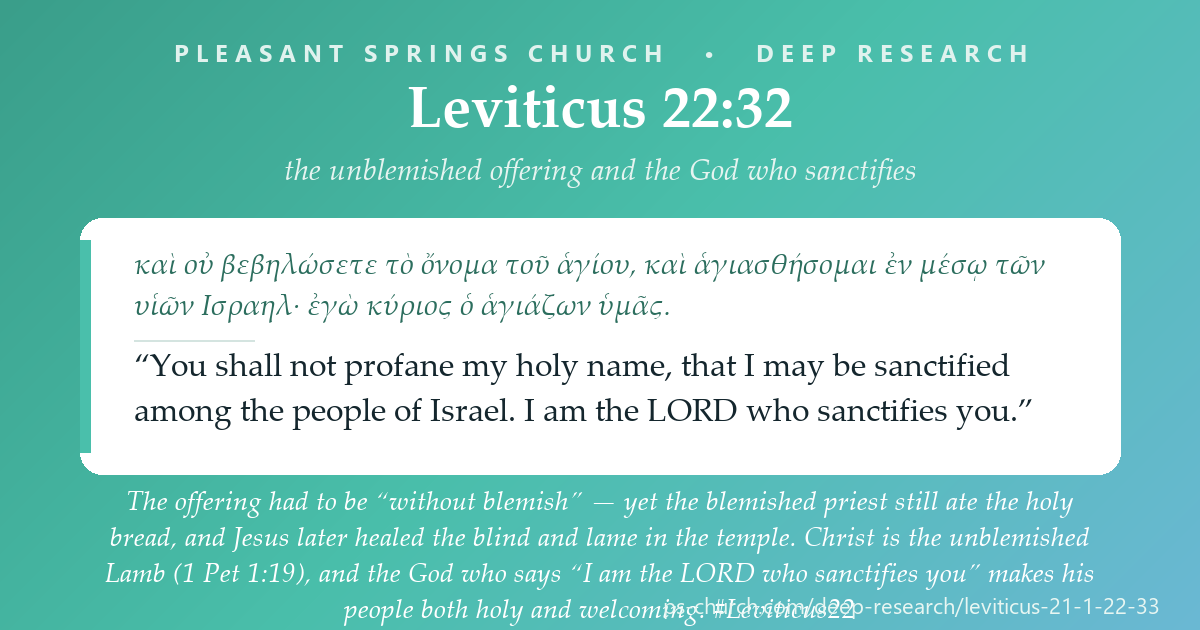
Step in response: honor God’s holy name this week in one concrete way — give him a “without blemish” offering of your best, not your leftovers, in a place you have been giving him the defective and half-hearted. And take one step toward someone the world sidelines — as Jesus did with the blind and lame in the temple — welcoming them where they have been kept at a distance. For the God who says “I am the Lord who sanctifies you” makes his people both holy and welcoming.
Leviticus 22:32 · to share
LXX + ESVEvery Deep Research page traces its passage across the whole sweep — the Old Testament, the Second-Temple world between the testaments (historical witnesses, not Scripture), and the New Testament. Follow the thread:
Pleasant Springs Church — Deep Research
Research method after Michael S. Heiser’s Bible Research Method (examine dictionaries → ancient literature → important words → textual connections → academic publications → share), with the Pleasant Springs “Author & Audience” foundation. Scripture set in the Hebrew, the Greek editions named on each page and the ESV (Old Testament), and the Greek New Testament and the ESV (New Testament), per the practice of Pleasant Springs Church. Leviticus 21–22 research grounded in Wenham, Milgrom, and Rooker, with the priesthood and disability-hermeneutics studies on the “no blemish” rule and Beale & Carson on the New Testament use (1 Peter 1; Hebrews 9). The “no blemish” priest rule read as the symbolism of wholeness in what approaches the holy God — not a verdict on the worth of persons with disabilities (the blemished priest still eats the holy food, 21:22) — with the gospel reversal noted (Mt 21:14; Luke 14:21); the unblemished offering read, on the NT’s own terms, as a devotional analogy fulfilled in Christ (1 Pet 1:19; Heb 9:14); the Holiness Code’s civil death penalties held to be OT Israel’s theocratic law, not a template for the church or any state. Second-Temple material per Josephus, Philo, the Mishnah, and the Qumran scrolls, read as witnesses, not Scripture.
Scripture quotations marked ESV are from the ESV® Bible (The Holy Bible, English Standard Version®), © 2001 by Crossway, a publishing ministry of Good News Publishers. ESV Text Edition: 2016. Used by permission. All rights reserved. The ESV text may not be quoted in any publication made available to the public by a Creative Commons license, and the ESV may not be translated in whole or in part into any other language. www.esv.org
|
Did this study bless you today? 💚 Give to Support PS Church100% of gifts go to the General Fund — thank you. |