On the day Israel’s worship began, the fire of the Lord fell in glory to accept the sacrifice — and then, when Aaron’s sons Nadab and Abihu offered “unauthorized fire” the Lord “had not commanded,” the same holy fire came out and consumed them. Moses spoke the meaning — “Among those who are near me I will be sanctified” — and Aaron held his peace. This study works Leviticus 10 with gravity and pastoral care: the seriousness of approaching a holy God his way, not our own; the priest’s calling to distinguish holy from common; and the reverence the New Testament still urges — for “our God is a consuming fire.” See the method →
Leviticus 10:1–3, 10
Hebrew · LXX · ESVThe Shape of the Passage
Ring compositionLeviticus 10 is the sober counterpoint to Leviticus 9. The glory has appeared and the fire has fallen in acceptance (9:23–24); now the same holiness that received the sacrifice confronts self-willed worship — a warning meant to be handled with gravity, not sensationalism.
Author
The Torah of Moses places this chapter at the hinge of Leviticus: the priesthood has just been ordained (ch. 8) and inaugurated (ch. 9), and the fire of the Lord has fallen in glory upon the altar. Chapter 10 shows the other edge of that same holiness. Nadab and Abihu — Aaron’s two eldest, who had gone up the mountain and seen the God of Israel (Exod 24:1, 9–11) — take their censers and offer “unauthorized fire” the Lord “had not commanded.” The narrative does not sensationalize; it states the fact soberly and moves at once to Moses’ word of interpretation (10:3).
The point is not cruelty but holiness. The text never gloats. Its concern is that the God who dwells among his people is holy, and that those who come nearest bear the highest accountability: “Among those who are near me I will be sanctified.” The presumption — doing a holy thing in a self-willed, unauthorized way — is what the chapter names, not the mere mechanics of the fire. Worship is revealed, not invented; it is received as gift, offered on God’s terms.
Audience
Israel — a people just entrusted with the tabernacle and its priesthood — heard a solemn lesson at the threshold of their worship life: the nearness of God is a mercy, and it is not to be handled casually. Aaron’s response models faith under unbearable grief: he “held his peace” (10:3) — silence that is not indifference but submission to a God he trusts even in the dark. The chapter then guards the future: no wine before service (10:9), so that the priests keep clear the God-given distinctions — holy and common, clean and unclean — and teach them to Israel (10:10–11).
How they heard it — and how the church hears it. Not as a proof-text for harshness, but as a call to reverence. The chapter ends in tenderness, not thunder: when Aaron, in grief, does not eat the sin offering, Moses hears his reasoning and “approved” (10:20) — holiness has room for a broken heart. For the church, the priesthood is fulfilled in Christ our great High Priest (Heb 4:14–16), and the whole people is now “a royal priesthood” (1 Pet 2:9) — called, like Aaron’s sons, to offer “acceptable worship, with reverence and awe, for our God is a consuming fire” (Heb 12:28–29).
Orient on holiness, priesthood, censers, and ‘strange fire.’
Search by topic: holiness, priest / priesthood, Nadab and Abihu, incense and censers, clean and unclean, the fear of the LORD.
Which articles are relevant?
- Anchor Bible Dictionary — “Nadab,” “Abihu,” “Priests and Levites,” “Holiness,” “Incense.”
- Dictionary of the OT: Pentateuch — “Holiness,” “Priesthood,” “Clean and Unclean,” “Sacred Space.”
- NIDOTTE / TDOT — קָדַשׁ (qādash, be holy), זָר (zār, strange/unauthorized), בָּדַל (bādal, distinguish/separate), דָּמַם (dāmam, be silent).
Bibliography surfaced:
- Gordon Wenham (NICOT), Jacob Milgrom (AB), Mark Rooker (NAC) on Leviticus.
- Studies of “strange fire” (ʾēsh zārāh): fire from the wrong source, the wrong time, or self-willed presumption.
- Beale & Carson, Commentary on the NT Use of the OT (Hebrews; on reverence and the consuming fire).
Worship on God’s terms, and how the ancients remembered Nadab and Abihu.
Read the “strange fire” against the ancient world’s cult, weigh the Second-Temple and rabbinic readings with care, and let the New Testament’s own call to reverence set the tone — gravity, never harshness.
Which parallels shed light on religion and worldview?
Revealed worship, not invented worship. In the surrounding cultures a priest’s art was largely improvisational — the right incantation, the shrewd gesture, the personal initiative that might move a god. Leviticus cuts against the grain: the Lord has commanded the pattern of his own worship, and the fire on the altar is his gift, kindled from heaven (9:24). Nadab and Abihu’s sin is precisely the pagan reflex — treating worship as something a priest devises — done at the holiest moment by the men who should have known best. The “strange fire” is not commanded fire (10:1); the point is presumption, the holy thing done in an unholy, self-willed way.
Not a picture of cruelty. The fire that consumes is the same fire that had just accepted Israel’s offering with joy (9:24). God’s holiness is his purity, not caprice; the deaths are stated with terrible restraint, and the chapter’s own resolution is mercy toward grief (10:19–20). Read rightly, the passage warns a casual age against approaching God on our own invented terms — and it does so soberly, never as a warrant for religious harshness toward people.
How the ancients remembered them. Later readers wrestled with the scene. Josephus reports the deaths matter-of-factly and praises Aaron’s fortitude, since he judged that his sons had perished by God’s will (Antiquities 3.208–209). Philo, reading allegorically, took Nadab and Abihu’s consumption as a soul’s ascent in the love of God — a devotional over-reading the plain text does not require. The rabbis multiplied explanations — that the brothers entered drunk (hence the wine law that follows, 10:9), or ruled on the law in Moses’ presence, or acted presumptuously — each reading trying to name the self-will the text leaves stark.
- Josephus, Antiquities 3.208–209 (first century; a witness, not Scripture) — the deaths of Aaron’s sons and Aaron’s composed submission.
- Philo, Legum Allegoriae 2.57–58; De fuga 59 (first century; a witness, not Scripture) — an allegorical reading of Nadab and Abihu; devotional, not the literal sense.
- Leviticus Rabbah 20; Sifra (rabbinic-era; witnesses, not Scripture) — the debated “sin” of the brothers: wine, presumption, ruling before Moses.
- Numbers 3:4; 26:61; 1 Chron 24:2 — the memory of Nadab and Abihu preserved in Israel’s later records: they died “before the Lord” and left no children.
The New Testament does not soften the seriousness of approaching God; it deepens it into reverence. Hebrews, having shown Christ our great High Priest through whom we “draw near” with confidence (4:14–16), still ends its call to worship exactly where Leviticus 10 stands: “let us offer to God acceptable worship, with reverence and awe, for our God is a consuming fire” (Heb 12:28–29, echoing Deut 4:24). The gospel gives boldness, not casualness. Peter tells a whole church now made “a royal priesthood” (1 Pet 2:9) to conduct itself “with fear throughout the time of your exile” (1:17). And the early church knew its own solemn moment when Ananias and Sapphira lied to the Spirit (Acts 5) — “great fear came upon the whole church.” Held together, the witness is not that God is cruel but that he is holy: the nearer we are brought — and in Christ we are brought all the way in — the more his nearness is to be honored, never presumed upon. This is devotional application of the chapter’s abiding call, grounded in the New Testament’s own words.
The vocabulary of holiness, presumption, silence, and the priest’s discernment.
Watch ʾēsh zārāh (unauthorized fire), qādash (be shown holy), Aaron’s dāmam (silence), and bādal (distinguish) — the priest’s calling to guard and teach the holy.
“Unauthorized (strange) fire” — fire that is zār, foreign / out of place / not belonging, brought in a way the Lord “had not commanded.” LXX πῦρ ἀλλότριον. The sin is presumption: the holy act done in a self-willed, unauthorized manner.
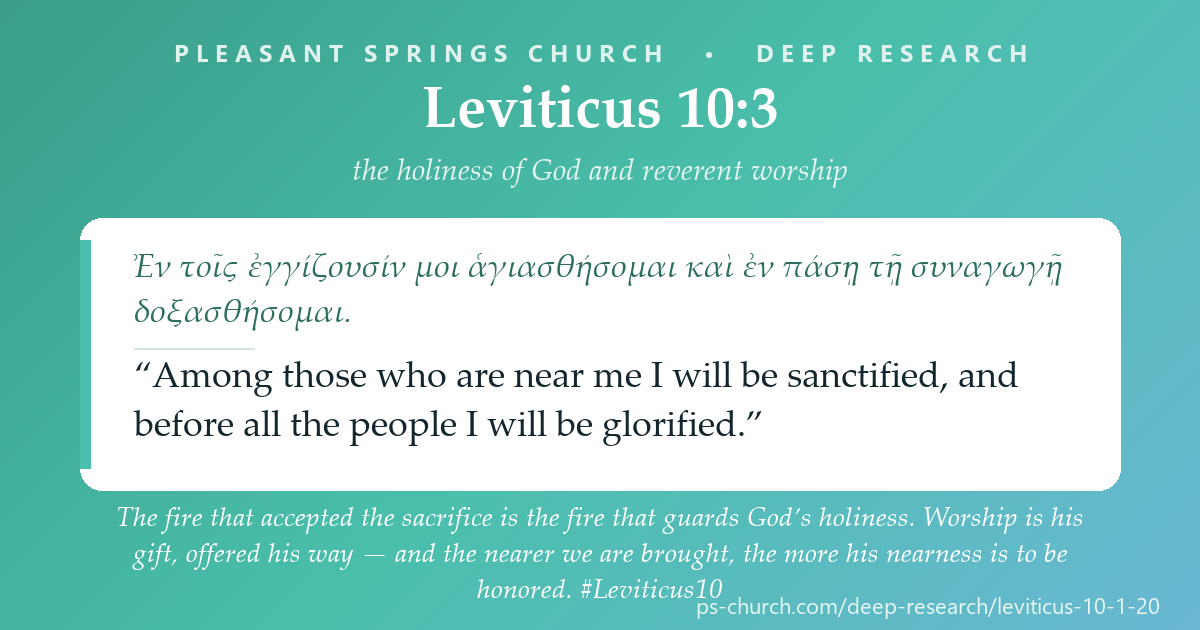
“I will be sanctified / shown holy” — qādash (niphal): God shows himself holy precisely among those who draw near. LXX ἁγιασθήσομαι. Nearness to God is privilege and accountability together.
“Those who are near me” — the priests who approach; LXX οἱ ἐγγίζοντές μοι. The closer the calling, the higher the reverence required (cf. Jas 3:1, teachers judged more strictly).
“And he held his peace” — dāmam, to be silent, still. Aaron’s wordless submission in grief — not indifference but trust in a God he will not accuse (cf. Ps 39:9, LXX 38:10; Job 1:21). LXX renders it κατενύχθη, “was stunned.”
“To distinguish / separate” — bādal, the very verb of creation’s “separating” light from darkness (Gen 1:4). LXX διαστεῖλαι. The priest’s calling: to keep clear the line between holy and common, clean and unclean — and to teach it (10:11).
How the rest of Scripture fills out the scene:
- Exodus 30:9; Leviticus 16:12–13 — the incense law and the coals taken from the altar: the ordered pattern “strange fire” violated (see the Day of Atonement).
- 1 Samuel 6:19–20; 2 Samuel 6:6–7 — Beth-shemesh and Uzzah: “Who is able to stand before the Lord, this holy God?” The same lesson in Israel’s later story.
- Ezekiel 44:23 — the priests “shall teach my people the difference between the holy and the common”: Leviticus 10:10–11 echoed by the prophets.
- Hebrews 12:28–29; 1 Peter 2:9; 1:17 — the church a royal priesthood, offering worship with reverence and awe, “for our God is a consuming fire.”
From the altar fire to the reverence of the redeemed.
Trace the holiness of God’s presence, the priest’s calling to distinguish and teach, and the New Testament’s enduring call to reverent worship.
Which cross-references matter?
- Leviticus 9:23–24 — the fire that fell in acceptance: the same holiness, two faces (see the glory appears).
- Exodus 24:1, 9–11; 28–29 — Nadab and Abihu on the mountain and among the ordained priests: privilege that made their presumption graver (see the ordination).
- Leviticus 16:1–2 — the Day of Atonement opens by recalling “the death of the two sons of Aaron”: the warning that frames Israel’s holiest rite.
- 1 Corinthians 11:27–30; Acts 5:1–11 — solemn New-Testament moments: the Lord’s Supper not to be taken lightly; “great fear” in the early church.
- Hebrews 4:14–16; 10:19–31; 12:28–29 — boldness to draw near through Christ, and reverence because our God is a consuming fire (see the great High Priest).
The tragedy of Leviticus 10 sits deliberately beside the glory of Leviticus 9, and the two must be read together. The fire that fell from before the Lord to consume the sacrifice on the altar (9:24) is the fire that comes out to consume Nadab and Abihu (10:2) — not two different fires, but one holy presence met in two different ways: as acceptance where worship is offered his way, as judgment where it is not. The chapter is not interested in gruesome detail; it is interested in the lesson Moses draws in a single breath — ‘among those who are near me I will be sanctified.’ Nearness to God is the highest privilege Israel has been given, and privilege carries weight: the priests, brought closest, are held to the clearest reverence. Yet the God of this chapter is not cruel. His holiness is the blazing purity of his goodness, not a short temper; and the same chapter that records the fire records his gentleness toward a grieving father, whose silence he honors and whose deviation from the ritual, born of sorrow, Moses accepts (10:19–20). The pastoral note for a casual age is not fear of a capricious deity but recovery of reverence: to come to God gladly, boldly, through the blood of Christ — and never carelessly, never on terms of our own devising.
The scholarship on Leviticus 10.
Wenham, Milgrom, and Rooker on Leviticus; the studies of “strange fire” and priestly holiness; Beale & Carson for the New Testament’s call to reverence.
Commentaries & studies:
- Gordon J. Wenham, The Book of Leviticus (NICOT); Jacob Milgrom, Leviticus (Anchor); Mark F. Rooker (NAC).
- Studies of ʾēsh zārāh (the source, timing, and manner of the fire) and of the wine law (10:8–11) that follows.
- G. K. Beale & D. A. Carson, eds., Commentary on the New Testament Use of the Old Testament (Hebrews).
Interpretation notes worth keeping:
- What the ‘strange fire’ was. The text says only that it was fire “he had not commanded” (10:1). Proposals — wrong source (not from the altar), wrong time, or drunken presumption (from the wine law of 10:9) — all converge on one thing: self-willed worship. The precise mechanics matter less than the presumption.
- Not a warrant for harshness. The chapter teaches the seriousness of the holy, not a temperament of severity. God’s holiness is his purity; the narrative’s restraint, and its closing mercy toward Aaron’s grief (10:19–20), guard against every cruel misuse.
- Aaron’s silence (10:3). Wayyiddom — not stoic suppression but faith that will not accuse God even in the worst grief; the LXX’s κατενύχθη (“stunned”) catches the shock, the Hebrew the submission.
- The priest’s double calling (10:10–11). To distinguish holy from common and clean from unclean, and to teach Israel — discernment and instruction together: a pattern the church inherits (2 Tim 2:15).
From the fire of holiness to the worship of reverent joy.
Name what you learned, why it matters, and one concrete response.
What should we carry away — and do?
- Worship is God’s gift, offered his way. It is not ours to invent. “Strange fire” is the holy thing done in a self-willed manner; reverence receives worship as commanded, not devised.
- Nearness carries weight. “Among those who are near me I will be sanctified.” The closer the calling — leaders especially (Jas 3:1) — the higher the accountability, and the gladder the care.
- God’s holiness is not cruelty. The fire that judges is the fire that had just accepted; and the same chapter honors a grieving father’s silence. We come boldly through Christ — and never casually.
Step in response: examine one place where you have quietly made worship about your own preference rather than God’s revealed will — and lay it down. Come to God this week both boldly, through the blood of Christ (Heb 10:19), and reverently, remembering that “our God is a consuming fire.” And where you have wept without words, take Aaron’s silence as permission: you may trust the holy God even when you cannot speak.
Leviticus 10:3 · to share
LXX + ESVEvery Deep Research page traces its passage across the whole sweep — the Old Testament, the Second-Temple world between the testaments (historical witnesses, not Scripture), and the New Testament. Follow the thread:
Pleasant Springs Church — Deep Research
Research method after Michael S. Heiser’s Bible Research Method (examine dictionaries → ancient literature → important words → textual connections → academic publications → share), with the Pleasant Springs “Author & Audience” foundation. Scripture set in the Hebrew, the Greek editions named on each page and the ESV (Old Testament), and the Greek New Testament and the ESV (New Testament), per the practice of Pleasant Springs Church. Leviticus 10 research grounded in Wenham, Milgrom, and Rooker, with Beale & Carson on the New Testament’s call to reverence; the “strange fire” (ʾēsh zārāh, 10:1) read as self-willed presumption, and the deaths handled with gravity and pastoral care — God’s holiness his purity, not cruelty; Aaron’s wayyiddom (10:3) as faith’s silence; the priest’s calling to distinguish and teach (10:10–11); Second-Temple and rabbinic memory per Josephus, Philo, and Leviticus Rabbah (read as witnesses, not Scripture); and the whole applied devotionally through Hebrews 12:28–29 and 1 Peter 2:9.
Scripture quotations marked ESV are from the ESV® Bible (The Holy Bible, English Standard Version®), © 2001 by Crossway, a publishing ministry of Good News Publishers. ESV Text Edition: 2016. Used by permission. All rights reserved. The ESV text may not be quoted in any publication made available to the public by a Creative Commons license, and the ESV may not be translated in whole or in part into any other language. www.esv.org
|
Did this study bless you today? 💚 Give to Support PS Church100% of gifts go to the General Fund — thank you. |