What God commanded in Exodus 29 is now carried out before the whole congregation. Moses washes Aaron and his sons, clothes Aaron in the high-priestly garments — ephod, breastpiece with the Urim and Thummim, the turban with its golden plate — and anoints the tabernacle and Aaron with oil. Then the sin-offering bull, the burnt-offering ram, and the ram of ordination whose blood is daubed on the right ear, thumb, and big toe of Aaron and his sons: what they hear, do, and where they walk, all claimed for God. Seven days at the tent door, and a six-fold refrain — “as the Lord commanded Moses.” No one makes himself a priest; God consecrates — a pattern fulfilled in Christ our High Priest (Heb 5:4) and the church, “a royal priesthood” (1 Pet 2:9). This study works Leviticus 8:1–36. See the method →
Leviticus 8:6, 12, 23, 35
Hebrew · LXX · ESVThe Shape of the Passage
SequenceLeviticus 8 is the ordination rite of Exodus 29 obeyed to the letter. Exodus gave the command; Leviticus records the doing — and the recurring refrain, “as the Lord commanded Moses,” is the point: worship done God’s way, not invented.
Author
The Torah of Moses has reached the moment the tabernacle was built for. The house is finished and filled with glory (Exod 40:34–38); the Lord has spoken from the tent the whole law of the offerings (Lev 1–7); now the men who will present those offerings must themselves be consecrated. Leviticus 8 is the careful execution of the ordination commanded in Exodus 29 — and the narrator is at pains to show it is done exactly, publicly, and by God’s design. The whole congregation is assembled “at the entrance of the tent of meeting” (8:3–4): this is no private induction but Israel’s public witness that its priests are made priests, by the word of the Lord.
Washed, clothed, anointed, atoned-for. The rite moves in ordered movements. Moses washes Aaron and his sons with water (8:6) — cleansing before service. He clothes Aaron in the garments of glory and beauty: the tunic, the sash, the robe, the ephod, the breastpiece into which he places the Urim and Thummim, and the turban with its golden plate, “the holy crown” (8:7–9). He anoints the tabernacle, the altar, and its vessels, and pours the oil on Aaron’s head “to consecrate him” (8:10–12; the verb is mashach, from which comes Mashiach). Then the blood: a bull as a sin offering, Aaron and his sons laying their hands on its head (8:14) — the mediators confessed as sinners first; a ram wholly burned as a burnt offering (8:18–21); and the second ram, the ram of ordination, whose blood Moses puts “on the lobe of Aaron’s right ear and on the thumb of his right hand and on the big toe of his right foot” (8:23–24), then daubs the priests and their garments with blood and anointing oil together (8:30).
Seven days at the door. The ordination is not a single ceremony but a seven-day consecration: “At the entrance of the tent of meeting you shall remain day and night for seven days… so that you do not die, for so I have been commanded” (8:35). Aaron and his sons stay put, in liminal nearness to the holy, waiting — and on the eighth day (Lev 9) the priesthood will begin and the glory will appear. Six times the chapter marks each act with its refrain: “as the Lord commanded Moses.” The obedience is the whole point.
Audience
Israel — a people learning that access to God is a gift he arranges, not a right they seize. No one in this chapter volunteers; no one appoints himself. Aaron does not robe himself — Moses robes him; Aaron does not anoint himself — Moses pours the oil; Aaron does not declare himself clean — the blood of the bull atones for him. The congregation watching learned that even the highest human mediator is a sinner who must be washed, covered, and atoned-for before he can serve — and that the whole arrangement comes down from God, step by commanded step. Later Scripture treats self-appointed priesthood as a deadly presumption (Num 16; 2 Chron 26:16–21); Leviticus 8 is the pattern it violates.
The whole person, and the greater Priest. The blood on ear, thumb, and toe taught Israel that consecration is total — not a mood but the conscription of the whole body: the ear that will hear God’s word, the hand that will do God’s work, the foot that will walk in God’s house. For the church, held as the canon’s own devotional-typological trajectory, this ordination points beyond itself. The letter to the Hebrews reads it directly: “no one takes this honor for himself, but only when called by God, just as Aaron was” (Heb 5:4). Aaron’s priesthood — which had to atone for its own sin first (8:14) and be renewed generation after generation — points to a High Priest “holy, innocent, unstained” (Heb 7:26), consecrated by God’s own oath (Heb 7:28), who needed no bull for himself and offered himself once for all. And the people washed and anointed in their priest become, in Christ, “a royal priesthood” (1 Pet 2:9) — the whole church set apart to draw near and to serve.
Orient on ordination, priesthood, the high-priestly garments, anointing, and the ordination sacrifices.
Search by topic: priesthood, ordination / consecration, high priest, priestly garments (ephod, breastpiece, Urim and Thummim, turban), anointing oil, sin offering, ordination offering (millu’im), blood rites, holiness.
Which articles are relevant?
- Anchor Bible Dictionary — “Priests and Levites,” “Ordination,” “Anointing,” “Ephod,” “Urim and Thummim,” “Sacrifice and Offerings.”
- Dictionary of the OT: Pentateuch — “Priesthood,” “Ordination,” “Aaron,” “Priestly Garments,” “Holiness,” “Sacrifices and Offerings.”
- NIDOTTE / TDOT — מִלֻּאִים (millu’im, ordination), קדשׁ (qādash, be holy / consecrate), מָשַׁח (māshach, anoint), כִּפֶּר (kipper, atone).
Bibliography surfaced:
- Gordon Wenham (NICOT), Jacob Milgrom (AB), Mark Rooker (NAC), John Hartley (WBC) on Leviticus.
- Studies of the ordination rite (Lev 8; Exod 29): the millu’im offering, the blood-mark, and the seven days of consecration.
- G. K. Beale & D. A. Carson, Commentary on the NT Use of the OT (Hebrews); studies of Hebrews’ priestly Christology.
Priestly investiture, the blood-mark, and a priesthood no one gives himself.
Read the ordination against ancient priestly custom, note how Second-Temple writers narrated Aaron’s consecration, then follow the priesthood to its fulfillment in Christ.
Which parallels shed light on religion and worldview?
Making a priest. Across the ancient Near East, priesthood was an office entered by rite — washing, robing, and installation set a man apart to handle holy things. Israel shares this grammar of investiture and bends it to its own theology. The priest is washed because he is unclean, clothed because he needs a covering not his own, anointed because the office is God’s to give — and, unlike his pagan counterparts, atoned-for by blood before he may serve. The bull is a sin offering for the priests themselves (8:14): the mediators are sinners first, and the ceremony that empowers them says so out loud.
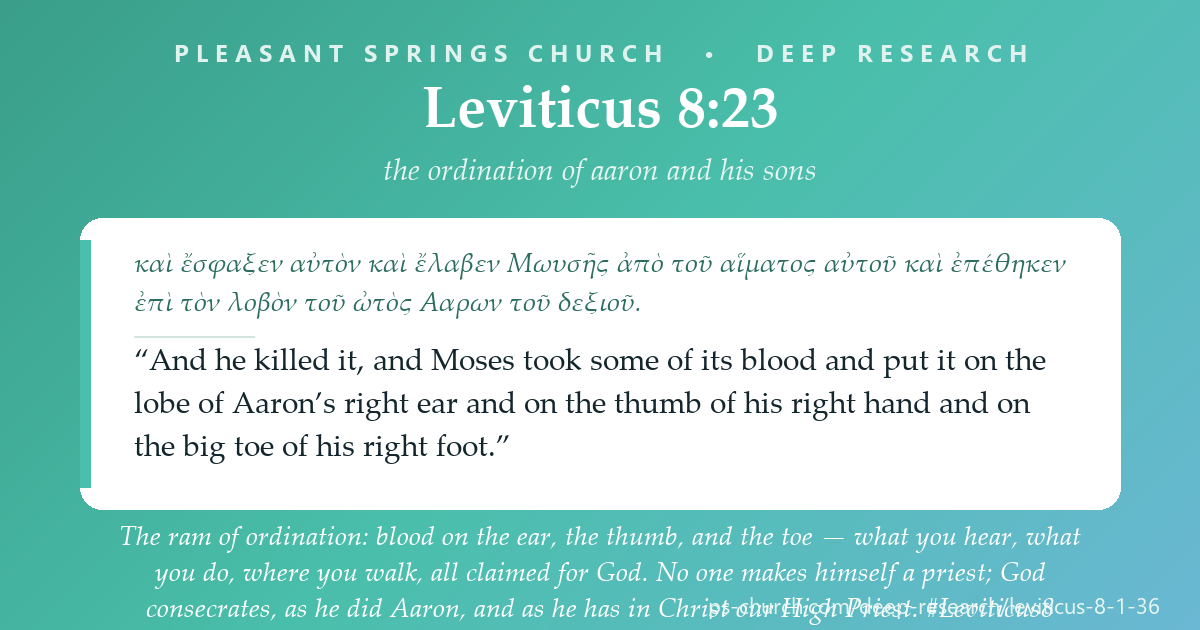
The blood on ear, thumb, and toe. The daubing of blood on the three extremities (8:23–24) is a deliberate, striking act — the same three points marked again when a healed leper is restored (Lev 14:14). To touch blood to the ear, the thumb, and the great toe is to claim the whole person: the faculty of hearing (obedience begins with a listening ear), the faculty of doing (the hand of service), and the faculty of walking (the path one treads). Consecration here is not a feeling but a total conscription of the body for God — the extremities standing for the man, and the man now belonging to the sanctuary. Read soberly: a claim on the whole life, not a magical charm.
How the rite was told. Second-Temple writers dwelt on Aaron’s consecration. Josephus (Antiquities 3.188–206) recounts the appointment of Aaron, the vesting, and the seven days of consecrating sacrifices. Philo (Life of Moses 2.143–152) narrates the washing, the robing, the anointing, and the blood placed on ear, hand, and foot, reading each as the purifying of word, deed, and life. The Mishnah tractate Yoma preserves the memory of the high priest’s seven-day separation before the Day of Atonement — an echo of the seven days of Leviticus 8. Their expositions can moralize the details, but they witness to an old and right instinct the New Testament shares: this priesthood was pointing beyond itself.
- Josephus, Antiquities 3.188–206; Philo, Life of Moses 2.143–152 — first-century Jewish accounts of the priestly consecration (witnesses to interpretation, not Scripture).
- Exodus 29:1–37 — the ordination commanded, which Leviticus 8 now performs (see the ordination of the priests).
- Mishnah, Yoma 1:1 (rabbinic-era) — the high priest sequestered seven days before Yom Kippur: the memory of Leviticus 8’s seven days of consecration.
The most striking thing about Leviticus 8 is who does not act. Aaron is the most exalted man in Israel — and in the entire chapter of his own ordination he does nothing to himself. He does not robe himself; Moses robes him. He does not anoint himself; Moses pours the oil. He does not declare himself clean; the blood of a bull atones for him. He does not even choose to be a priest; God chose him, and Moses installs him “as the Lord commanded.” This is the deliberate lesson of the rite, and Hebrews reads it out loud: ‘no one takes this honor for himself, but only when called by God, just as Aaron was’ (Heb 5:4). The Levitical priesthood is a standing rebuke to self-appointed access to God — and, honest about its own limits, a signpost past itself. For the priest who must be atoned-for before he can atone (8:14), and re-consecrated generation after generation, is a priest pointing to one who needed no bull for his own sin: a High Priest ‘holy, innocent, unstained, separated from sinners’ (Heb 7:26), ‘designated by God’ and consecrated by an oath (Heb 5:10; 7:28), who offered not a ram’s blood but his own, once for all. The Greek Old Testament even named the ram of Leviticus 8 the ram of τελείωσις, ‘perfecting’ — and Hebrews takes up the very word for what Christ has done (Heb 7:11, 28). Aaron’s ordination was preaching the gospel to anyone patient enough to watch it.
The vocabulary of consecration: ordination, anointing, holiness, the blood-mark, and the kept charge.
Watch the “filling of the hand,” the anointing that makes a mashiach, the holiness God confers, the blood on ear and hand and foot, and the six-fold refrain of obedience.
“Ordination” — literally “fillings” (from מִלֵּא יָד, “to fill the hand,” i.e. to install in office). The second ram is the ram of the fillings. LXX τελείωσις, “perfecting / consecration” — the word Hebrews reuses of Christ (Heb 7:11, 28).
“Anoint” — the oil poured on Aaron’s head, and on the tabernacle and altar, marking them set apart for God. From this root comes Mashiach / Χριστός, “Anointed One”: prophet, priest, and king were anointed; Jesus is all three. LXX χρίω.
“Consecrate” / make holy — the root קדשׁ that governs the chapter. Moses consecrates the tent, the altar, the priests, and their garments. Holiness is not achieved; it is conferred by God. LXX ἀγιάζω.
“Lobe of the ear” — touched with blood along with the thumb (בֹּהֶן יָד) and big toe (בֹּהֶן רֶגֶל). The whole person — what he hears, does, and where he walks — claimed for the holy. The same mark restores a cleansed leper (Lev 14:14). LXX λοβός.
“Charge” / duty to be kept — “performing what the Lord has charged, so that you do not die.” The seven days at the tent door are a kept watch; nearness to the holy is guarded, not casual. LXX φύλαγμα.
“As (the Lord) commanded” — the chapter’s six-fold refrain. Every act is measured against the word of God; worship is obedience, not invention. The counter-image is self-willed worship, which brings death (Lev 10:1–2).
How the New Testament reuses the priesthood:
- Hebrews 5:1–10 — every high priest is chosen from men and must offer for his own sins; “no one takes this honor for himself… just as Aaron was” — and Christ was appointed by God (see our great High Priest).
- Hebrews 7:23–28 — the many mortal priests give way to one who “holds his priesthood permanently”: “holy, innocent, unstained,” consecrated by God’s oath, offering himself once for all.
- 1 Peter 2:5, 9; Revelation 1:6; 5:10 — the whole redeemed people made “a royal priesthood,” consecrated to draw near and to declare God’s praises.
- Romans 12:1 — the believer’s body presented “a living sacrifice, holy and acceptable to God”: consecration made personal.
From the ram of ordination to a High Priest consecrated by God’s oath.
Trace the ordination, the blood-mark, and the priesthood from Exodus through Leviticus to the New Testament’s High Priest and the priesthood of all believers.
Which cross-references matter?
- Exodus 29:1–37 — the ordination commanded, which Leviticus 8 carries out word for word (see the ordination of the priests).
- Exodus 28:1–43 — the high-priestly garments woven beforehand: robed first, then consecrated (the ephod, breastpiece, Urim and Thummim, and the golden plate of 8:7–9).
- Leviticus 9:1–24; 10:1–20 — the eighth day: the priesthood begins and the glory appears — and Nadab and Abihu’s self-willed fire (see the glory appears and strange fire).
- Leviticus 14:14–18 — the same blood-mark on ear, thumb, and toe when a cleansed leper is restored: the whole person reclaimed (see the cleansing of the leper).
- Hebrews 5:1–10; 7:11–28; 1 Peter 2:9 — a High Priest called and consecrated by God, and the priesthood of all believers (see the Son who is the radiance of God’s glory).
Watch what Leviticus 8 requires of Aaron before he may lift a finger for anyone else. A bull must die as a sin offering, and Aaron and his sons must lay their hands on its head (8:14) — a confession pressed into the animal’s skull, this dies for my sin. The most sacred man in Israel begins his ministry by acknowledging that he is a sinner. That single fact governs the entire logic of the Levitical priesthood, and, held as the canon’s own trajectory, sets up its fulfillment with great clarity. Every priest after Aaron carried the same disqualification into the sanctuary: he had to atone for himself before he could atone for the people, and he had to do it again and again, because he kept sinning and kept dying. Hebrews simply reads this out loud — ‘he has no need, like those high priests, to offer sacrifices daily, first for his own sins and then for those of the people, since he did this once for all when he offered up himself’ (Heb 7:27). Here is the ordination that needed no bull: a High Priest ‘holy, innocent, unstained’ (Heb 7:26), consecrated not by another man’s hands but by God’s own oath (Heb 7:28), whose blood was not daubed on his ear and thumb and toe but poured out entire, and who walked through the true veil and sat down, the work finished. The ram of ordination pointed to a Priest who was himself the offering; and the seven days at the tent door, ending in glory on the eighth (Lev 9), whisper of a greater consecration ending in a greater glory. What Aaron received — washing, robing, anointing, atoning blood — the whole church now shares in Christ, ‘a royal priesthood’ (1 Pet 2:9), washed, clothed, and anointed to draw near.
The scholarship on the ordination of the priests.
The commentators on Leviticus 8 and its twin in Exodus 29; the studies of ordination, blood rites, and the priestly theology of Hebrews.
Commentaries & studies:
- Gordon J. Wenham, The Book of Leviticus (NICOT); Jacob Milgrom, Leviticus (Anchor); Mark F. Rooker (NAC); John E. Hartley (WBC).
- Studies of the millu’im (ordination) offering, the seven-day consecration, and the blood on ear, thumb, and toe; the high-priestly garments and the Urim and Thummim.
- G. K. Beale & D. A. Carson, eds., Commentary on the New Testament Use of the Old Testament; studies of Hebrews’ priestly Christology (Ellingworth, Cockerill).
Interpretation notes worth keeping:
- The bull and the laying on of hands (8:14). The pressed hand identifies the offerer with the victim — substitution, not mere donation. The priest begins as a confessed sinner needing atonement (cf. Heb 5:3).
- The blood on ear, thumb, and toe (8:23–24). A total-person consecration, echoed at the leper’s cleansing (Lev 14:14). Read soberly as claiming the whole man for holy service, not as a magical rite.
- “As the Lord commanded Moses” (6×). The refrain is theological, not filler: worship is measured by God’s word. The dark counter-image stands in the very next chapter — Nadab and Abihu’s self-willed fire (Lev 10:1–2). Exact obedience is reverence, not legalism.
- The seven days (8:33–35). A liminal consecration “so that you do not die” — nearness to the holy is guarded and serious, not casual. The eighth day (Lev 9) brings the priesthood into action and the glory into view.
- Devotional typology, disciplined. The Aaron→Christ priesthood reading is the text’s own trajectory in Hebrews (5:4; 7:11, 28), not allegory pressed onto every clasp — the house discipline for typology throughout this library.
From a seven-day ordination to a whole life consecrated.
Name what you learned, why it matters, and one concrete response.
What should we carry away — and do?
- No self-appointed access to the holy. Aaron did nothing to himself — he was washed, clothed, anointed, and atoned-for by another’s hand and God’s command. “No one takes this honor for himself” (Heb 5:4). Grace, not presumption, brings us near.
- The whole person is consecrated. Blood on ear, thumb, and toe — what you hear, what you do, where you walk, all claimed for God. Consecration is bodily and total, not a feeling (Rom 12:1).
- Christ is our consecrated High Priest. The priest who needed a bull for his own sin pointed past himself to one “holy, innocent, unstained,” consecrated by God’s oath, who offered himself once for all — and made his washed, anointed people “a royal priesthood” (1 Pet 2:9).
Step in response: present yourself this week as “a living sacrifice, holy and acceptable to God” (Rom 12:1) — and make it concrete along the lines of the blood-mark: consecrate your ear (what you will listen to), your hand (one task done as unto God), and your foot (one place you will — or will not — walk). Then draw near not on your own credentials but through the great High Priest who was consecrated for you, and rest in the wonder that you, washed and anointed in him, belong wholly to God.
Leviticus 8:23 · to share
LXX + ESVEvery Deep Research page traces its passage across the whole sweep — the Old Testament, the Second-Temple world between the testaments (historical witnesses, not Scripture), and the New Testament. Follow the thread:
Pleasant Springs Church — Deep Research
Research method after Michael S. Heiser’s Bible Research Method (examine dictionaries → ancient literature → important words → textual connections → academic publications → share), with the Pleasant Springs “Author & Audience” foundation. Scripture set in the Hebrew, the Greek editions named on each page and the ESV (Old Testament), and the Greek New Testament and the ESV (New Testament), per the practice of Pleasant Springs Church. Leviticus 8:1–36 research grounded in Wenham, Milgrom, Rooker, and Hartley, with Beale & Carson on the New Testament use; the ordination read as the execution of Exodus 29 (the millu’im / τελείωσις, “ordination / perfecting,” the anointing, and the blood on ear, thumb, and toe of 8:23–24, echoed at Leviticus 14:14); the six-fold refrain “as the Lord commanded Moses” (8:9, 13, 17, 21, 29, 36) noted as the theology of obedient worship, with the self-willed counter-image in Leviticus 10:1–2; the priest’s own sin offering (8:14) and the seven-day consecration (8:33–35) read with Hebrews 5:1–10 and 7:11–28; Second-Temple exposition per Josephus (Antiquities 3) and Philo (Life of Moses 2), and the seven-day separation in Mishnah Yoma, read as witnesses, not Scripture; and the Aaron→Christ priesthood and the church as “a royal priesthood” (1 Pet 2:9) held as the canon’s own devotional-typological trajectory (Heb 5:4; 7:11, 28), per the house discipline for typology.
Scripture quotations marked ESV are from the ESV® Bible (The Holy Bible, English Standard Version®), © 2001 by Crossway, a publishing ministry of Good News Publishers. ESV Text Edition: 2016. Used by permission. All rights reserved. The ESV text may not be quoted in any publication made available to the public by a Creative Commons license, and the ESV may not be translated in whole or in part into any other language. www.esv.org
|
Did this study bless you today? 💚 Give to Support PS Church100% of gifts go to the General Fund — thank you. |