The glory had filled the tabernacle, and the first thing the indwelling God did was speak: the Lord called to Moses from the tent of meeting and gave the offerings — the way a sinful people may draw near. First came the burnt offering (ʻōlāh, “that which ascends”): a male without blemish — or, for the poor, a bird — on whose head the offerer laid his hand, and which was burned whole, ascending as “a food offering with a pleasing aroma to the Lord.” This study works Leviticus 1:1–17 — total consecration, substitution, and atonement — toward its fulfillment in Christ, who “offered himself without blemish to God.” See the method →
Leviticus 1:1, 3, 4, 9, 14
Hebrew · LXX · ESVThe Shape of the Passage
Parallel panelsLeviticus picks up the moment Exodus ends: the glory has filled the tabernacle (Exod 40:34–38), and the first thing the indwelling God does is speak — teaching a redeemed people how to come near without being consumed. The manual begins with the burnt offering.
Author
The Torah of Moses joins Leviticus seamlessly to Exodus. Exodus closed with the glory-cloud settling on the finished tent, so dense that “Moses was not able to enter” (Exod 40:35). Leviticus 1:1 answers the impasse: the Lord calls to Moses from within the tent and begins to give the offerings — the God-provided way a sinful people may approach a holy presence. The Hebrew opening word, wayyiqrā’ (“and he called”), gives the book its Hebrew name; the whole book is, first of all, an invitation to draw near.
Why the burnt offering comes first. Of the five offerings (chs 1–7), the burnt offering heads the list because it is the most complete: the entire animal is consumed on the altar, nothing eaten by priest or offerer. It is the picture of a life given wholly to God. The instructions descend by ability — herd (1:3–9), flock (1:10–13), and birds for the poor (1:14–17) — so that no worshiper, however small his means, is shut out of the way to God.
Audience
Israel — a redeemed people encamped around the tabernacle, needing a way to express whole-hearted consecration and to be accepted before a holy God. The burnt offering was the daily, standing sacrifice (the tamid, morning and evening, Exod 29:38–42), the background rhythm of Israel’s worship. Every Israelite watched the smoke ascend and learned that drawing near costs a life, that the offerer’s hand on the head means “this in my place,” and that acceptance is God’s gracious gift: “it shall be accepted for him to make atonement for him” (1:4).
How they heard it. The rite is deliberately physical — hand laid, blood dashed, flesh washed, flame rising — because it teaches with the body what the heart must learn: sin is costly, substitution is real, and God has provided the way. The repeated refrain “a pleasing aroma to the Lord” (1:9, 13, 17) is the note of acceptance: the offering, rightly brought, is received. Israel offered it not to earn God’s love but because they were already his — consecration answering redemption.
Orient on sacrifice, the burnt offering, blood, and atonement.
Search by topic: sacrifice and offerings, burnt offering / olah, laying on of hands, blood, atonement, altar, clean and unclean.
Which articles are relevant?
- Anchor Bible Dictionary — “Sacrifice and Sacrificial Offerings,” “Burnt Offering,” “Atonement,” “Altar,” “Blood.”
- Dictionary of the OT: Pentateuch — “Sacrifices and Offerings,” “Atonement,” “Holiness,” “Priests and Levites.”
- NIDOTTE / TDOT — עֹלָה (ʻōlāh, burnt offering / that which ascends), כָּפַר (kāp̄ar, atone), סָמַךְ (sāmak, lay/lean the hand), תָּמִים (tāmîm, unblemished).
Bibliography surfaced:
- Gordon Wenham (NICOT), Jacob Milgrom (AB), Mark Rooker (NAC), John Hartley (WBC) on Leviticus.
- Studies of the sacrificial system: the graduated offerings, the meaning of the laid-on hand, and “a pleasing aroma.”
- Beale & Carson, Commentary on the NT Use of the OT (Hebrews; Ephesians 5; Romans 12).
Whole burnt offerings, the hand on the head, and grace scaled to the poor.
Read the burnt offering against ancient whole-burnt sacrifice, weigh what the laid-on hand means, and follow the rising smoke and the shed blood to the New Testament.
Which parallels shed light on religion and worldview?
The whole burnt offering in the ancient world. Many ancient peoples knew the holocaust — a sacrifice burned entire, giving the whole victim to the deity rather than sharing it as a meal (Greek ὁλόκαυστον, whence the LXX’s ὁλοκαύτωμα). Leviticus works within this cultural form but reframes it: the Lord himself specifies the rite, the animal must be flawless and the offerer’s own, and the point is not to feed a hungry god (Ps 50:12–13; LXX 49:12–13) but to picture a worshiper wholly consecrated and graciously accepted. The “pleasing aroma” is anthropomorphic shorthand for God receives this, not divine appetite.
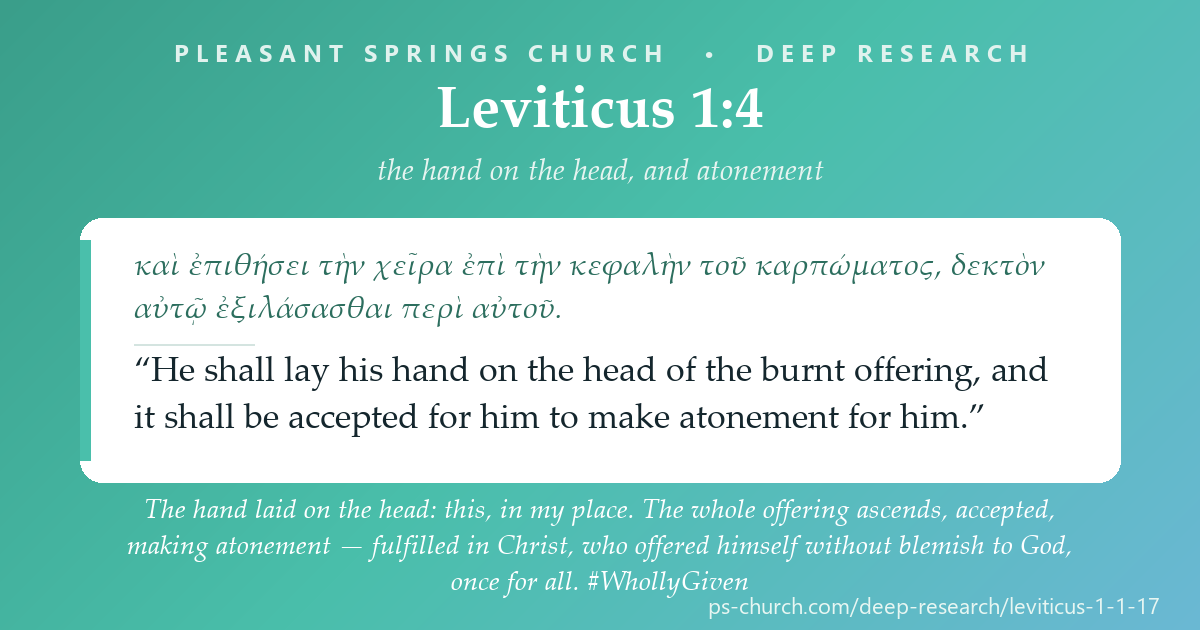
The hand laid on the head. The offerer “leans” his hand (סָמַךְ, sāmak, a firm pressing, not a light touch) on the victim’s head (1:4). Within Leviticus the gesture signals identification — this animal stands in my place — and so the burnt offering “makes atonement for him.” The same gesture, doubled and with confession, sends Israel’s sin away on the Day of Atonement (see Leviticus 16:21). Substitution is not a later Christian imposition on the text; it is written into the rite from the first chapter.
Grace scaled to ability. The chapter descends deliberately: a bull for those with herds, a sheep or goat for those with flocks, and — for those with neither — “turtledoves or pigeons” (1:14), the offering of the poor. The same graded mercy later lets the poorest bring the cheapest offering (Lev 5:7–13; 12:8 — the offering Mary and Joseph brought, Luke 2:24). The way to God is costly, but it is never priced beyond the reach of the humble; grace excludes no one.
- Josephus, Antiquities 3.9 (3.226–227) — describes the ὁλοκαύτωσις, the whole burnt offering consumed entirely on the altar: a Second-Temple witness to the rite’s practice.
- Philo, Special Laws 1.196–211 — reads the burnt offering as the gift of the whole to God, symbolizing total dedication and thanksgiving (a witness to how Hellenistic Judaism understood ʻōlāh).
- Mishnah, Zevachim (rabbinic-era) — the tractate on animal sacrifices preserves the detailed procedure of the burnt offering and the sprinkling of blood.
- Genesis 8:20; 22:2, 13 — Noah’s and Abraham’s burnt offerings: the ʻōlāh long precedes Sinai; Leviticus regulates an ancient act of worship.
Hebrews reads the whole sacrificial system as a God-given shadow fulfilled in Christ. The burnt offering, given entirely to God, pictures a life wholly consecrated — and the New Testament finds that whole-hearted offering perfected in Jesus, who “through the eternal Spirit offered himself without blemish to God” (Heb 9:14; cf. the unblemished victim of 1:3). Where the burnt offering rose as “a pleasing aroma,” Paul says “Christ loved us and gave himself up for us, a fragrant offering and sacrifice to God” (Eph 5:2 — the same LXX phrase, ὀσμὴ εὐωδίας). And because the animal sacrifices could not finally “take away sins” (Heb 10:4), their endless repetition pointed beyond themselves to the one who “offered for all time a single sacrifice for sins” (Heb 10:12). Handled soberly: the whole rite turns on the truth of Leviticus 17:11 — “the life of the flesh is in the blood… it is the blood that makes atonement” — God’s gracious provision, not a payment wrung from him.
The vocabulary of ascent, substitution, and acceptance.
Watch ʻōlāh (that which ascends), the laid-on hand, the unblemished victim, kaphar (atone), and the “pleasing aroma” of acceptance that Paul reuses for Christ.
“Burnt offering” — literally “that which ascends” (from עָלָה, ʻālāh, to go up), for the whole animal goes up in smoke. The LXX renders it ὁλοκαύτωμα, “wholly burned” — the picture of a life given entire, nothing kept back (cf. Rom 12:1).
“He shall lay his hand” — a firm pressing, not a touch. The offerer identifies himself with the victim: this, in my place. The gesture makes the burnt offering count “for him,” and reappears (doubled, with confession) on the Day of Atonement (Lev 16:21).
“Without blemish” — whole, sound, unflawed (LXX ἄμωμος). Only the flawless may be offered; the New Testament calls Christ the lamb “without blemish” (ἄμωμος, 1 Pet 1:19; Heb 9:14).
“To atone” — to cover / wipe clean / ransom (LXX ἐξιλάσκομαι). Even the wholly-given burnt offering “makes atonement,” joining consecration to cleansing; atonement is God’s provision (Lev 17:11), not the worshiper’s achievement.
“A pleasing aroma” — the note of acceptance: the offering is received (LXX ὀσμὴ εὐωδίας). Not divine appetite (Ps 50:12–13; LXX 49:12–13) but divine welcome — the very phrase Paul lifts for Christ’s self-giving (Eph 5:2).
“Food offering” (older “offering by fire”) — a gift given over to God on the altar. It marks the offering as belonging wholly to him, transferred from the worshiper’s hand into the ascending flame.
How the New Testament reuses the burnt offering:
- Hebrews 9:11–14; 10:1–14 — Christ “offered himself without blemish to God” and “offered for all time a single sacrifice for sins”; the animal offerings could not “take away sins.”
- Ephesians 5:2 — “Christ loved us and gave himself up for us, a fragrant offering and sacrifice to God” (ὀσμὴ εὐωδίας, the burnt offering’s own phrase).
- Romans 12:1 — “present your bodies as a living sacrifice, holy and acceptable to God”: the burnt offering’s whole-hearted consecration, now a life laid on the altar (see Romans 5).
- 1 Peter 1:18–19; 2:5 — redeemed by “a lamb without blemish”; the church a holy priesthood offering “spiritual sacrifices” (cf. Heb 13:15–16).
From the ascending smoke to the once-for-all offering of Christ.
Trace the whole-burnt gift, the unblemished substitute, and the pleasing aroma across the canon — and set the burnt offering beside the other four.
Which cross-references matter?
- The five offerings (Leviticus 1–7). Burnt = total consecration (this study); grain (ch 2) = dedication of work and thanks; peace (ch 3) = fellowship and communion; sin / purification (4:1–5:13) = cleansing; guilt / reparation (5:14–6:7) = restitution; with the priests’ manual (6:8–7:38). Each teaches a facet of the one offering of Christ.
- Exodus 29:15–18, 38–42 — the burnt offering at the priests’ ordination and the daily tamid: the standing rhythm of Israel’s worship (Exod 40:34–38 sets the scene).
- Leviticus 17:11 — “the life of the flesh is in the blood… it is the blood that makes atonement”: why blood is central, and that atonement is God’s gift (“I have given it to you upon the altar”).
- Isaiah 53:6–12 — the Suffering Servant on whom “the Lord has laid the iniquity of us all”: substitution written large.
- Hebrews 9:14; 10:5–10; Romans 3:25 — the offerings fulfilled and rendered obsolete for atonement by the once-for-all sacrifice of Christ (see Romans 3:21–26).
The New Testament does not discard the burnt offering; it reads it as a God-given pattern brought to completion. Hebrews takes up its very language: the victim “without blemish” (Lev 1:3) becomes Christ who “offered himself without blemish to God” (Heb 9:14); the endlessly repeated ascent of animal smoke — which “can never… make perfect those who draw near” (Heb 10:1) — is answered by the one who “offered for all time a single sacrifice for sins” (Heb 10:12). Paul reaches for the altar’s own idiom, “a fragrant offering” (Eph 5:2), and turns it toward the worshiper: “present your bodies as a living sacrifice” (Rom 12:1). So the burnt offering’s two notes — whole-hearted consecration and gracious acceptance — are held together in Christ: he is the whole offering that ascends, accepted on our behalf, and the church, no longer repeating the altar’s blood, offers the “spiritual sacrifices” of praise, self-giving, and mercy (Heb 13:15–16; 1 Pet 2:5). Held as devotional analogy grounded in the New Testament’s own reading, the shape is unmistakable: the flame that once consumed a bull now warms a life laid down.
The scholarship on the burnt offering and the sacrificial system.
Wenham, Milgrom, and Hartley for Leviticus; the sacrifice studies for the burnt offering and the laid-on hand; Beale & Carson for the NT use.
Commentaries & studies:
- Gordon J. Wenham, The Book of Leviticus (NICOT); Jacob Milgrom, Leviticus 1–16 (Anchor); Mark F. Rooker (NAC); John E. Hartley (WBC).
- Studies of the ʻōlāh and the sacrificial system; the meaning of sāmak (the laid-on hand) and of “a pleasing aroma.”
- G. K. Beale & D. A. Carson, eds., Commentary on the New Testament Use of the Old Testament.
Interpretation notes worth keeping:
- Consecration and atonement. The burnt offering is chiefly the gift of the whole to God (consecration), yet 1:4 also names it as making atonement — the two are not rivals. A life truly given is a life graciously accepted.
- ‘Pleasing aroma’ is acceptance, not appetite. The phrase means the offering is received; Scripture explicitly denies that God hungers (Ps 50:12–13; LXX 49:12–13). Read the anthropomorphism as welcome, and do not press it into a picture of a god who must be fed or bribed.
- Grace, not works-righteousness. Israel offered as a redeemed people, not to purchase God’s favor; atonement is his provision (17:11). The graded offering for the poor guards the point — the way to God is priced for the humble, never for the rich alone.
- Typology, disciplined. The Christ-fulfillment is read from the New Testament’s own use (Heb 9:14; 10:5–10; Eph 5:2), labeled devotional analogy — not allegory imposed on every detail. The house discipline throughout this library.
From the rising smoke to a life wholly given.
Name what you learned, why it matters, and one concrete response.
What should we carry away — and do?
- Drawing near costs a life. The first word of Leviticus is a call to come near — and the first offering is a whole life given up. Sin is costly; God provides the way; acceptance is his gift, not our achievement.
- Christ is the whole offering. Unblemished, wholly given, a fragrant offering to God — he “offered himself without blemish” once for all. What rose yearly in animal smoke, he finished at the cross.
- Grace excludes no one. Herd, flock, or a single bird for the poor — the altar was open to the humblest hands. The gospel keeps that shape: the way to God is priced for everyone.
Step in response: take Romans 12:1 as this chapter’s echo and “present your body as a living sacrifice” — name one area you have been keeping back from God (time, money, a relationship, a habit) and lay your hand on it, so to speak, giving it over whole. Then live this week as one already accepted in the offering of Christ — a life ascending as a pleasing aroma, in praise, self-giving, and mercy (Heb 13:15–16).
Leviticus 1:4 · to share
LXX + ESVEvery Deep Research page traces its passage across the whole sweep — the Old Testament, the Second-Temple world between the testaments (historical witnesses, not Scripture), and the New Testament. Follow the thread:
Pleasant Springs Church — Deep Research
Research method after Michael S. Heiser’s Bible Research Method (examine dictionaries → ancient literature → important words → textual connections → academic publications → share), with the Pleasant Springs “Author & Audience” foundation. Scripture set in the Hebrew, the Greek editions named on each page and the ESV (Old Testament), and the Greek New Testament and the ESV (New Testament), per the practice of Pleasant Springs Church. Leviticus 1:1–17 research grounded in Wenham, Milgrom, Rooker, and Hartley, with Beale & Carson on the New Testament use; the whole burnt offering (ʻōlāh / ὁλοκαύτωμα) read against ancient holocaust sacrifice and the graded provision for the poor (1:14; cf. Lev 5:7; 12:8; Luke 2:24); the laid-on hand (sāmak, 1:4) as identification and substitution; “a pleasing aroma” (ὀσμὴ εὐωδίας) as acceptance, not appetite (Ps 50:12–13; LXX 49:12–13); Philo (Spec. Laws 1), Josephus (Ant. 3), and the Mishnah (Zevachim) read as historical witnesses, not Scripture; and the Christ-fulfillment (Heb 9:14; 10:5–10; Eph 5:2; Rom 12:1) held as devotional analogy on the New Testament’s own reading — per the house discipline for typology.
Scripture quotations marked ESV are from the ESV® Bible (The Holy Bible, English Standard Version®), © 2001 by Crossway, a publishing ministry of Good News Publishers. ESV Text Edition: 2016. Used by permission. All rights reserved. The ESV text may not be quoted in any publication made available to the public by a Creative Commons license, and the ESV may not be translated in whole or in part into any other language. www.esv.org
|
Did this study bless you today? 💚 Give to Support PS Church100% of gifts go to the General Fund — thank you. |