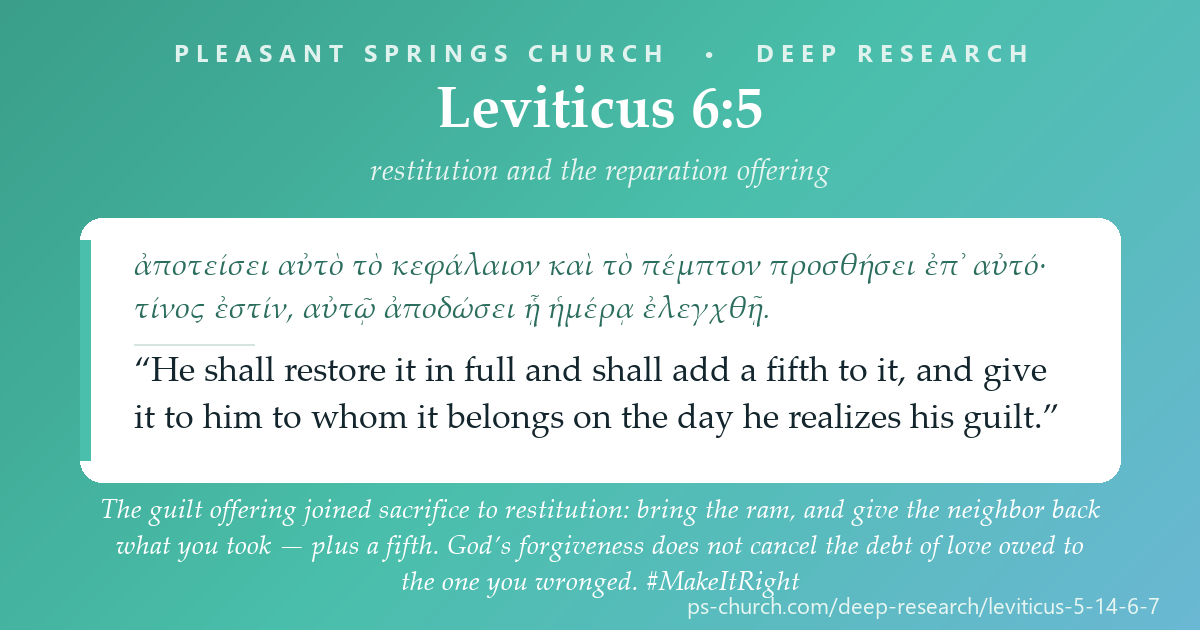
The last of Leviticus’ five offerings will not let worship stay at the altar. For a breach of faith — against the Lord’s holy things, or against a neighbor by fraud, robbery, or a lie about a deposit — the guilt offering (asham) demands two things at once: a ram without blemish and restitution. Restore what you took in full, “and add a fifth to it” (6:5); only then “the priest shall make atonement for him… and he shall be forgiven.” Wronging a neighbor is a sin against God; God’s forgiveness does not cancel the debt to the person harmed — it sends you to pay it. This study works Leviticus 5:14–6:7. See the method →
Leviticus 5:15; 6:2, 5, 7 (selections)
Hebrew · LXX · ESVThe Shape of the Passage
Parallel panelsLeviticus catalogs five offerings (chs 1–7); this passage closes the list with the one offering that will not let worship stay vertical — it sends the forgiven sinner back to the neighbor he wronged, wallet in hand. See the sister offerings: the burnt, grain, peace, and sin offerings.
Author
The Torah of Moses gives Israel, at Sinai, a God-ordained system of atonement (Lev 1–7). Four offerings have been named; the fifth is the guilt offering (asham), also called the reparation offering. It is triggered by maʿal — a “breach of faith,” an act of sacrilege or treachery. Two spheres are in view: unfaithfulness in “the holy things of the Lord” — using or withholding what belonged to the sanctuary, even unwittingly (5:14–16) — and defrauding a neighbor over a deposit, a pledge, a robbery, extortion, or a lost thing lied about under oath (6:1–7).
Sacrifice bound to restitution. What sets the asham apart is that the ram alone does not settle the case. The offender must first (or with the sacrifice) make it right: “he shall restore it in full and shall add a fifth to it, and give it to him to whom it belongs” (6:5). The added fifth — a twenty-percent surcharge — is restoration beyond mere repayment, a tangible sign that repentance costs the penitent more than the theft gained. Only then does “the priest… make atonement for him before the Lord, and he shall be forgiven” (6:7).
Audience
Israel — a people learning that holiness reaches into ledgers and lost property, not just altars. The stunning claim of 6:2 is that defrauding your neighbor is a “breach of faith against the Lord.” Horizontal wrongs are vertical too: to rob a person made in God’s image, or to swear falsely over a pledge, is to sin against God himself. So the remedy runs in both directions at once — blood on the altar and money back in the neighbor’s hand.
How they heard it. The asham taught that God takes both sacrilege and fraud with deadly seriousness — even a wrong done “unwittingly” in holy things carries real guilt (5:17–19) — and that his forgiveness is gracious but never cheap. It does not dissolve the obligation to the one harmed; it produces it. Numbers 5:5–8 would later extend the rule: confess the sin, restore the principal, add the fifth, give it to the wronged party (or, if none remains, to the priest). Grace and justice walk together.
Orient on the guilt offering, breach of faith, restitution, and atonement.
Search by topic: guilt/reparation offering (asham), sacrifice and offerings, maʿal / breach of faith, restitution, atonement, forgiveness.
Which articles are relevant?
- Anchor Bible Dictionary — “Sacrifice and Sacrificial Offerings,” “Guilt Offering,” “Atonement,” “Restitution.”
- Dictionary of the OT: Pentateuch — “Sacrifices and Offerings,” “Guilt,” “Atonement,” “Holiness.”
- NIDOTTE / TDOT — אָשָׁם (ʾāšām, guilt/reparation offering), מַעַל (maʿal, breach of faith), שָׁלַם (šālam, make whole/restore), כָּפַר (kāp̄ar, atone).
Bibliography surfaced:
- Gordon Wenham (NICOT), Jacob Milgrom (AB), Mark Rooker (NAC), Baruch Levine (JPS) on Leviticus.
- Studies of the asham as the “reparation offering” (Milgrom), the meaning of maʿal, and the added fifth (Num 5:5–8).
- Beale & Carson, Commentary on the NT Use of the OT (Hebrews; Isaiah 53 in the Gospels).
Sacrilege, fraud, and the offering that made the sinner pay it back.
Read the reparation offering against ancient temple-property law and civil restitution, then follow the asham to Isaiah’s Servant and the New Testament.
Which parallels shed light on religion and worldview?
Debt to the holy, debt to the neighbor. Ancient Near Eastern law codes penalized theft and false claims heavily, and temple property was fenced with special sanctions — misusing what belonged to a god was a grave offense. Leviticus works within that world but re-centers it: the sanctuary’s holy things belong to the Lord, and — more startling — the neighbor’s deposit and pledge are protected by the same holiness. To defraud a person is a maʿal, a sacrilege, “against the Lord” (6:2). The horizontal and the vertical are welded together.
Restitution plus a fifth. The asham is the one sacrifice that hinges on money changing hands. The wronged party is made whole (the principal) and then given twenty percent more — the “added fifth” (6:5; the rabbis’ keren va-chomesh, “principal and a fifth”). This is not a fine paid to the temple but reparation paid to the victim: forgiveness before God and reconciliation with the neighbor are not allowed to come apart. Numbers 5:5–8 makes the confession explicit and directs the payment to the wronged (or, failing an heir, to the priest).
- Ancient Near Eastern law (e.g. the Laws of Hammurabi on deposits and theft) — heavy penalties for false claims and misappropriated property: the shared legal furniture Leviticus reframes as covenant holiness.
- Mishnah, tractate Zevachim (rabbinic-era) — the detailed halakhah of the animal offerings, including the asham; the “principal and a fifth” restitution is worked out in the civil-law tradition (cf. Bava Kamma).
- Josephus, Antiquities 3.230–232 — describes the sin and trespass (guilt) offerings and the priest’s role in atonement.
- Philo, On the Special Laws 1 (on the offerings) — the trespass offering, with restitution and open confession before the sacrifice for wrongs against a neighbor.
Isaiah says of the Suffering Servant: “when his soul makes an offering for guilt” — literally, when his soul is made an אָשָׁם (asham) — “he shall see his offspring… and the will of the Lord shall prosper in his hand” (Isa 53:10; see the Suffering Servant). The reparation offering finds its fulfillment in a person: Christ is the guilt offering who repays what he never took — the Servant who could echo the psalmist, “What I did not steal must I now restore?” (Ps 69:4) — making reparation for the debt of human sin (a classic reading of Christ as the true asham, resting on Isa 53:10 and Heb 9–10, held as devotional analogy, not the psalm’s literal sense). Hebrews states the logic plainly: “it is impossible for the blood of bulls and goats to take away sins” (Heb 10:4), so the offerings pointed beyond themselves; Christ “offered for all time a single sacrifice for sins” (Heb 10:12). And because his one offering atones, the fruit it produces in the forgiven is exactly what the asham required: restitution and reconciliation. “If you… remember that your brother has something against you… first be reconciled to your brother, and then come and offer your gift” (Matt 5:23–24).
The vocabulary of guilt, breach of faith, restitution, and atonement.
Watch asham (guilt/reparation, and the Servant of Isa 53:10), maʿal (breach of faith), šillam (restore in full), the added fifth, and kipper (atone).
“Guilt / reparation offering” — the sacrifice that repairs a debt; also the noun for the guilt incurred and the restitution owed. The LXX renders it πλημμέλεια (a fault requiring amends). Isaiah applies the very word to the Servant: “when his soul makes an asham” (Isa 53:10).
“Breach of faith” — treachery, sacrilege, an act of unfaithfulness. Used both for misusing the Lord’s holy things and for defrauding a neighbor — because wronging a person is a maʿal “against the Lord” (6:2).
“Restore in full / make restitution” — the intensive (Piel) of šālam, the root of šālōm: to make whole again. Reparation is peace-making with the one wronged; forgiveness bears fruit in restored relationship.
“A fifth” — the added twenty percent, paid on top of the principal. Restoration that goes beyond repayment: the penitent surrenders more than the wrong ever gained (cf. Zacchaeus’ fourfold, Luke 19:8).
“Make atonement” — to cover/wipe clean (LXX ἐξιλάσκομαι); with it comes וְנִסְלַח (wenislaḥ), “and he shall be forgiven.” Atonement is God’s gracious provision on the altar, not a wage the sinner earns.
How the rest of Scripture fills out the offering:
- Numbers 5:5–8 — the rule restated with confession: restore the principal, add the fifth, give it to the wronged (or to the priest if no kinsman remains).
- Isaiah 53:10–12 — the Servant made an asham, who “bore the sin of many”: the reparation offering fulfilled in a person (see the Suffering Servant).
- Luke 19:8–9 — Zacchaeus: “if I have defrauded anyone of anything, I restore it fourfold” — the asham’s fruit in a repentant heart.
- Matthew 5:23–24 — “first be reconciled to your brother, and then… offer your gift”: worship God stops to make it right with the neighbor.
- Hebrews 10:1–14 — the offerings could not “take away sins”; Christ “offered for all time a single sacrifice” (see our great High Priest).
From a ram and a repaid debt to the cross and its fruit.
Trace the reparation offering forward: the asham of Isaiah 53, the atonement of the New Testament, and the restitution repentance still bears.
Which cross-references matter?
- Leviticus 4:1–5:13 — the sin (purification) offering, the asham’s near neighbor: sin defiles and must be purged; here it also defrauds and must be repaid (see the sin offering).
- Leviticus 16:1–34; 17:11 — the Day of Atonement, and “it is the blood that makes atonement”: why the offerings center on blood (see the Day of Atonement).
- Isaiah 53:4–12 — the Servant as asham, who “bore the sin of many”: the offering personified.
- Luke 19:1–10; Matthew 5:23–24; Philemon 18–19 — restitution and reconciliation as the fruit of grace, not its price.
- Romans 3:24–26; Hebrews 9–10 — the offerings fulfilled and rendered obsolete for atonement by Christ’s once-for-all sacrifice (see the righteousness of God).
Jacob Milgrom argued at length that the asham is best called the “reparation offering,” the sacrifice for maʿal — sacrilege or breach of trust — where the wrong has a measurable value that must be restored. Its genius is that it refuses to let atonement float free of amends. The forgiven robber cannot simply lay a ram on the altar and walk away with his neighbor still out of pocket; the ledger must be squared, and squared with interest. The New Testament does not dissolve this logic — it deepens it. Christ is the true reparation offering (Isa 53:10), whose single sacrifice does what “the blood of bulls and goats” never could (Heb 10:4, 12); and precisely because it is finished at the cross, it goes to work in the forgiven. The tax collector who meets Jesus does not offer a ram — he empties his purse: “if I have defrauded anyone of anything, I restore it fourfold” (Luke 19:8), and Jesus answers, “today salvation has come to this house.” That is the asham’s afterlife in the Gospel: not works that earn forgiveness, but restitution that proves it — repentance with its hands full. The church does not repeat the ram; it offers the “spiritual sacrifices” of praise and mercy (Rom 12:1; Heb 13:15–16; 1 Pet 2:5) — and, when it has wronged a neighbor, it still goes and makes it right.
The scholarship on the guilt/reparation offering.
Wenham, Milgrom, Rooker, and Levine on Leviticus and the asham; Beale & Carson for the New Testament use of Isaiah 53 and Hebrews.
Commentaries & studies:
- Gordon J. Wenham, The Book of Leviticus (NICOT); Jacob Milgrom, Leviticus (Anchor); Mark F. Rooker (NAC); Baruch A. Levine (JPS).
- Studies of the asham as the “reparation offering,” of maʿal (sacrilege / breach of faith), and of the added-fifth restitution (Lev 6:5; Num 5:5–8).
- G. K. Beale & D. A. Carson, eds., Commentary on the New Testament Use of the Old Testament (Isaiah 53; Hebrews).
Interpretation notes worth keeping:
- Guilt even when ‘unwitting’ (5:17–19). The asham covers wrongs done without realizing it: real guilt is incurred, and real atonement is provided. Ignorance mitigates culpability but does not erase the breach.
- Horizontal is vertical (6:2). Defrauding a neighbor is a “breach of faith against the Lord.” Sin against people is sin against God (cf. Ps 51:4; Gen 39:9) — and so requires both sacrifice and reparation.
- Restitution before (or with) the sacrifice. The added fifth (6:5) is paid to the victim, not the temple. Forgiveness from God does not cancel the obligation to make the neighbor whole; grace produces restitution, it does not replace it.
- Grace, not merit. Atonement is God’s provision — “the priest shall make atonement for him… and he shall be forgiven” (6:7). The asham is not a works-transaction that buys off God, but a shadow of the once-for-all sacrifice to come (Heb 10:1–14).
- Devotional typology, labeled. Christ as the true reparation offering rests on the New Testament’s own reading (Isa 53:10; Heb 9–10), held as fulfillment, not fanciful allegory — the house discipline for typology throughout this library.
From a repaid debt to a reconciled brother.
Name what you learned, why it matters, and one concrete response.
What should we carry away — and do?
- Sin against people is sin against God. Fraud, a broken pledge, a lie about a deposit — the asham calls these a “breach of faith against the Lord” (6:2). There is no purely private wrong.
- Forgiveness and restitution belong together. The ram atones; the money goes back — with a fifth added. God’s pardon does not cancel your debt to the neighbor; it sends you to pay it.
- Christ is our guilt offering. The asham of Isaiah 53:10, whose one sacrifice does what animal blood never could (Heb 10:4, 12) — and whose grace, at work in us, looks like Zacchaeus emptying his purse.
Step in response: ask the Lord to bring to mind one concrete wrong you have never made right — a debt unpaid, something taken or withheld, a reputation damaged, a promise broken. Receive Christ’s atonement for it; then go and make restitution: restore what you can, and add the fifth of generosity beyond the minimum. If worship this week reminds you that a brother has something against you, leave your gift at the altar and be reconciled first (Matt 5:23–24).
Leviticus 6:5 · to share
LXX + ESVEvery Deep Research page traces its passage across the whole sweep — the Old Testament, the Second-Temple world between the testaments (historical witnesses, not Scripture), and the New Testament. Follow the thread:
Pleasant Springs Church — Deep Research
Research method after Michael S. Heiser’s Bible Research Method (examine dictionaries → ancient literature → important words → textual connections → academic publications → share), with the Pleasant Springs “Author & Audience” foundation. Scripture set in the Hebrew, the Greek editions named on each page and the ESV (Old Testament), and the Greek New Testament and the ESV (New Testament), per the practice of Pleasant Springs Church. Leviticus 5:14–6:7 research grounded in Wenham, Milgrom (the asham as the “reparation offering”), Rooker, and Levine, with Beale & Carson on the New Testament use of Isaiah 53 and Hebrews; the offering read as the God-given system of atonement for OT Israel — the costliness of sin, the necessity of shed blood (Lev 17:11), and here the binding of forgiveness to restitution (the added fifth, 6:5; cf. Num 5:5–8) — a type and shadow fulfilled and rendered obsolete for atonement by Christ’s once-for-all sacrifice (Heb 10:1–14), the true guilt offering (Isa 53:10) whose grace bears the fruit of restitution and reconciliation (Luke 19:8; Matt 5:23–24). Christ-typology held as devotional analogy on the New Testament’s own readings, per the house discipline. Versification per the ESV (English 6:1–7 = Hebrew/LXX 5:20–26).
Scripture quotations marked ESV are from the ESV® Bible (The Holy Bible, English Standard Version®), © 2001 by Crossway, a publishing ministry of Good News Publishers. ESV Text Edition: 2016. Used by permission. All rights reserved. The ESV text may not be quoted in any publication made available to the public by a Creative Commons license, and the ESV may not be translated in whole or in part into any other language. www.esv.org
|
Did this study bless you today? 💚 Give to Support PS Church100% of gifts go to the General Fund — thank you. |