The instruction turns from the worshipper to the priests — how the five offerings are to be handled at the altar. At its head stands a fire that must never go out, fed “every morning” before the Lord (6:12–13). Around it: the sin offering that is “most holy,” whose holiness spreads to what it touches; the guilt offering; and the peace offering in three keys — thanksgiving, vow, and freewill — with the wave breast and thigh for the priests, and a solemn ban on eating fat or blood. This study works Leviticus 6:8–7:38 — the dignity and danger of handling holy things — and follows it to Christ our High Priest and the church’s unceasing sacrifice of praise. See the method →
Leviticus 6:12–13; 6:27; 7:12; 7:37–38 (selections)
Hebrew · LXX · ESVThe Shape of the Passage
Parallel panelsThe first offering-laws (Lev 1–5) spoke to the worshipper — what to bring, and how. This section (6:8–7:38) turns to the priests — how to handle at the altar what has been brought. Same offerings, seen from the sanctuary side.
Author
The Torah of Moses arranges Leviticus 1–7 as a diptych. Chapters 1–5 present the five offerings as the worshipper meets them (“When any one of you brings an offering…”). Then, marked by a fresh formula — “Command Aaron and his sons” (6:9) — the same five are run through again as a priests’ manual: what the priest does with the fire, the ash, the portions, the blood, and the fat. It is liturgy from behind the veil — the choreography of drawing near a holy God without being consumed. (In the Hebrew Bible this priestly section is numbered 6:1–7:38; English versions, following an older division, call its opening 6:8. The content is one; only the verse-count differs.)
The perpetual fire. At the head of the manual stands an image the whole book will not let go: the altar fire that the priest feeds “every morning” and that must never go out (6:12–13). Worship is not an event but a continuity — a flame tended before the Lord without a break, day and night, generation after generation. Around it the section teaches the dignity and danger of holy things: the sin offering is “most holy,” and its holiness is catching — “whatever touches its flesh shall be holy” (6:27) — so the vessels and garments must be handled with care. To live at the altar is a privilege soaked in reverence.
Audience
Aaron and his sons first — and through them all Israel, who needed to know that the men handling their offerings did so under exact, God-given order. The priests lived from the altar: named portions of the grain, sin, guilt, and peace offerings were their food (6:16–18, 26; 7:6–10, 31–36) — “those who serve the altar share in the sacrificial offerings” (cf. 1 Cor 9:13). Yet the same manual fenced the holy with warnings: eat the priests’ portions in a holy place, on the day appointed; and Israel as a whole was under a solemn ban — eat no fat and no blood (7:22–27), for the fat is the Lord’s and “the life… is in the blood” (17:11).
How they heard it. The peace offering came in three keys — thanksgiving (tôḏāh), vow, and freewill (7:11–16) — and of these the thanksgiving was the song of the redeemed: bread and meat shared before God in gladness, “let them… tell of his deeds in songs of joy” (Ps 107:22; 116:17). Israel learned that worship is both costly and joyful: sin is taken seriously at the altar, and mercy received is answered with praise. Every morning the fire was fed; every thanksgiving the table was spread; and the whole rhythm whispered that God had made a way to be near him — a way that pointed beyond itself.
Orient on the offerings, the altar fire, the priestly portions, and holiness.
Search by topic: sacrifice and offerings, priesthood, altar, holiness, peace offering / todah, blood and fat, most holy.
Which articles are relevant?
- Anchor Bible Dictionary — “Sacrifice and Sacrificial Offerings,” “Priests and Levites,” “Altar,” “Holiness.”
- Dictionary of the OT: Pentateuch — “Sacrifices and Offerings,” “Priesthood,” “Holiness,” “Blood.”
- NIDOTTE / TDOT — תּוֹרָה (tôrāh, instruction/law), תּוֹדָה (tôḏāh, thanksgiving), קֹדֶשׁ קָדָשִׁים (qōḏeš qŏḏāšîm, most holy), קָדַשׁ (qāḏaš, be holy), תְּנוּפָה (tənûp̄āh, wave offering).
Bibliography surfaced:
- Gordon Wenham (NICOT), Jacob Milgrom (AB), Mark Rooker (NAC) on Leviticus.
- Studies of the tôḏāh (thanksgiving) offering and the “sacrifice of praise” behind Ps 116; Heb 13:15.
- Beale & Carson, Commentary on the NT Use of the OT (Hebrews; 1 Peter 2).
The perpetual fire, the priests' table, and the ban on fat and blood.
Read the priests’ manual against ancient temple practice — then follow the never-dying fire and the thanksgiving offering toward their fulfillment in Christ and the church.
Which parallels shed light on religion and worldview?
A fire that never goes out. Ancient temples across the Near East kept perpetual hearths, and priesthoods were sustained from the god’s table. Leviticus works within that world — a tended altar-flame, priests who eat named portions — but reframes it entirely. The fire is not a god’s hunger to be fed; it is the sign of unceasing worship and atonement before the living Lord, kindled originally by God himself (9:24) and now guarded by human hands morning by morning (6:12–13). The priests do not feed a deity; they keep a covenant flame.
Holiness that spreads. The manual insists the most holy offerings are “contagious”: “whatever touches” the sin offering’s flesh “shall be holy” (6:27; cf. 6:18), the vessels must be scoured or broken, splashed garments washed in a holy place. In a world anxious about impurity spreading, Israel is taught that in the sanctuary holiness is the active power — the altar sanctifies what touches it. This is the danger and dignity of the priestly life: to handle the holy is to be claimed by it, and to be careless with it is deadly (cf. 10:1–3).
The thanksgiving (todah). Among the peace offerings, the tôḏāh stands out (7:12–15): unlike the burnt offering it was eaten — a shared meal of bread and meat before God, brought by one who had been delivered, and eaten the same day in gladness. It became Israel’s enacted psalm of rescue: “Let them offer sacrifices of thanksgiving, and tell of his deeds in songs of joy” (Ps 107:22); “I will offer to you the sacrifice of thanksgiving” (Ps 116:17). The costly offerings deal with sin; the thanksgiving answers mercy with praise — the two poles of all true worship.
- Mishnah, Zevachim & Menachot (rabbinic-era) — the tractates that preserve, in fine detail, the handling of animal and grain offerings the priests were taught here.
- Josephus, Antiquities 3.224–236 — a first-century description of the daily offerings and the perpetual altar fire.
- Philo, Special Laws 1.145–end — the priestly portions and the meaning of the offerings, read by a Hellenistic Jew.
- Psalm 107:22; 116:17 — the thanksgiving (tôḏāh) sacrifice sung: worship as answered rescue.
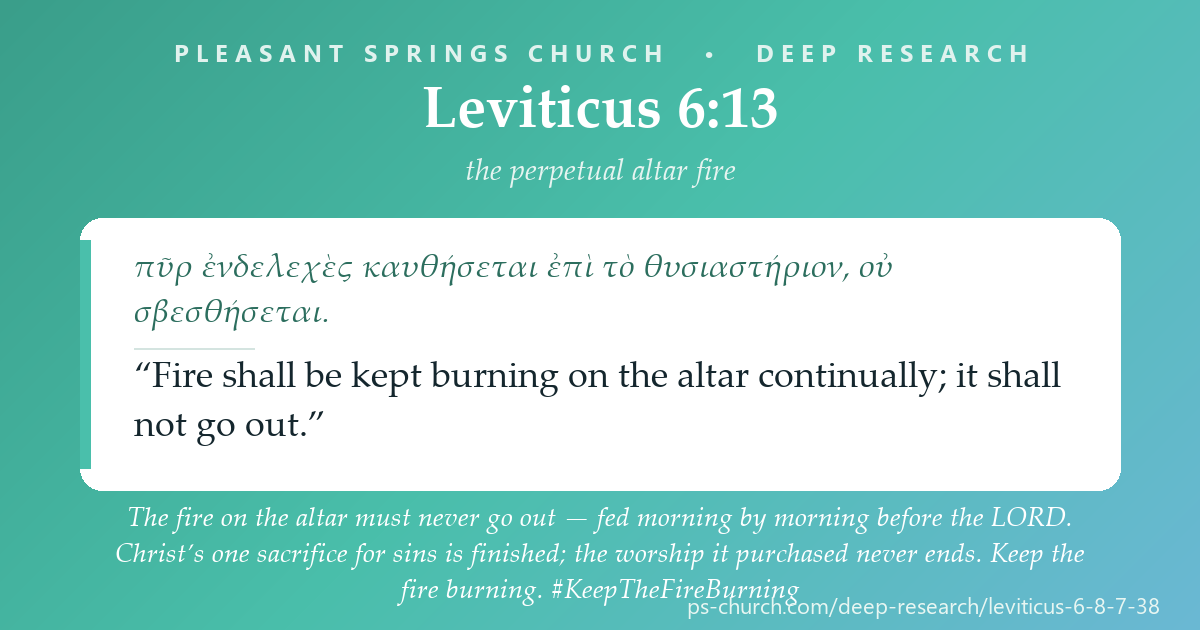
The image at the head of the manual has never stopped burning in the church’s imagination: a flame the priest feeds every morning and that must not be allowed to die (6:12–13). Held as devotional analogy — not as the passage’s literal sense — it gathers up a whole theology of unceasing worship. The atonement it served pointed to the one who “always lives to make intercession” for us (Heb 7:25). The Spirit who fell as “tongues as of fire” (Acts 2:3) is not to be quenched (1 Thess 5:19). And the church is taught to “pray without ceasing” (1 Thess 5:17), tending on the altar of the heart a devotion that outlasts every mood and morning. What Aaron did with wood and coals, the believing community does with prayer and praise: keep the fire. The one sacrifice for sins is finished (Heb 10:12); the worship it purchased never ends.
The vocabulary of the altar: perpetual fire, thanksgiving, most holy, and the priests' portion.
Watch the never-dying fire, the tôḏāh that becomes the church’s “sacrifice of praise,” and the holiness that spreads from the altar.
“Perpetual fire” — the altar flame “kept burning continually… it shall not go out.” Tāmîḏ (“continually”) is the word for Israel’s unbroken worship: the daily offering, the bread of the Presence, the never-dying fire.
“Thanksgiving” — the peace offering of the rescued, an eaten meal of praise (LXX αἴνεσις). Behind Ps 116:17 (LXX 115:8) and Heb 13:15’s “sacrifice of praise… the fruit of lips.”
“Most holy” — the grain, sin, and guilt offerings belong wholly to the sanctuary sphere; eaten only by the priests, only in a holy place. The superlative of holiness.
“To be / become holy” — holiness here is active: “whatever touches” the most holy offering “shall be holy.” The altar sanctifies what it touches (cf. Mt 23:19).
“Wave offering” — the breast “waved” before the Lord and, with the thigh, given to the priests as their portion: those who serve the altar share the altar (1 Cor 9:13).
“Law / instruction” — each offering has its tôrāh, and 7:37 sums them as one: “This is the tôrāh…” Not cold regulation but taught, revealed order for drawing near.
How the New Testament takes up the offerings:
- Hebrews 9:1–14; 10:1–14 — “it is impossible for the blood of bulls and goats to take away sins”; Christ “offered for all time a single sacrifice for sins” — the offerings fulfilled and their repetition ended.
- Hebrews 13:10–16 — “we have an altar”; through Christ we offer “a sacrifice of praise… the fruit of lips” (the tôḏāh) and the sacrifices of doing good and sharing.
- Romans 12:1 — “present your bodies as a living sacrifice, holy and acceptable to God”: the offering transfigured into a whole life.
- 1 Peter 2:5 — the church “a holy priesthood, to offer spiritual sacrifices acceptable to God through Jesus Christ.”
From the altar fire and the priests' table to the one sacrifice and the spiritual offerings.
Trace the fire, the blood, the guilt offering, and the thanksgiving through the canon to Christ and the worshipping church.
Which cross-references matter?
- Exodus 29:38–42 — the daily (tāmîḏ) burnt offering the altar fire served; and the priests’ ordination the manual assumes (see the ordination of the priests).
- Leviticus 9:24; 10:1–3 — the fire that God himself kindled, and the deadly seriousness of handling it wrongly — why the manual is so exact.
- Leviticus 17:11 — “the life of the flesh is in the blood… it is the blood that makes atonement”: the ground of the ban on eating blood (7:26–27), fulfilled on the Day of Atonement (see the Day of Atonement).
- Isaiah 53:10 — the Servant’s soul made an “offering for guilt” (ʾāšām): the guilt offering personified (see the Suffering Servant).
- Psalm 107:22; 116:17; Hebrews 13:15; 1 Peter 2:5; Romans 12:1 — the thanksgiving offering becomes the church’s sacrifice of praise and self-giving.
The New Testament reads the whole sacrificial system as a God-given shadow whose substance is Christ (Heb 10:1). Every category in this manual finds its meaning there: the burnt offering, wholly consumed, images total consecration — answered by the Son who gave himself entirely (Eph 5:2); the grain offering, the dedication of work and thanks; the sin offering, purification, and the guilt offering, reparation — both met when the Servant’s soul was made “an offering for guilt” (Isa 53:10); the peace offering, fellowship and communion, its thanksgiving-meal fulfilled at the table of the Lord. Hebrews is emphatic that these could never, by their own blood, “take away sins” (10:4); their endless repetition was itself the sign that the final sacrifice was still to come. When it came, Christ “offered for all time a single sacrifice for sins” (10:12) and rendered the altar of bulls and goats obsolete for atonement. The church does not repeat the offerings; it lives from the one that fulfilled them — and answers with “spiritual sacrifices” (1 Pet 2:5): praise, self-giving, mercy (Heb 13:15–16; Rom 12:1). The provision God once scaled even to the poor (Lev 5:7, 11) shows the grace at the root of it all: atonement is never earned; it is given — “I have given it to you upon the altar to make atonement” (17:11).
The scholarship on the priestly offering-laws.
Wenham and Milgrom for Leviticus; the studies of the peace offering and the todah; Beale & Carson for the NT use.
Commentaries & studies:
- Gordon J. Wenham, The Book of Leviticus (NICOT); Jacob Milgrom, Leviticus 1–16 (Anchor); Mark F. Rooker (NAC).
- Studies of the peace / fellowship offering and its tôḏāh, neḏer (vow), and neḏāḇāh (freewill) kinds; the priestly portions and the perpetual fire.
- G. K. Beale & D. A. Carson, eds., Commentary on the New Testament Use of the Old Testament (Hebrews; 1 Peter).
Interpretation notes worth keeping:
- The English–Hebrew verse offset. This priestly section is Hebrew 6:1–7:38 but English 6:8–7:38; the earlier guilt-offering paragraph (English 5:14–6:7) is Hebrew 5:14–26. The text is identical — only the chapter break differs.
- Holiness is ‘contagious.’ “Whatever touches” the most holy becomes holy (6:18, 27) — not magic but the sanctuary’s logic: the altar consecrates what it claims. Handle the holy with reverence, or not at all.
- The ban on fat and blood (7:22–27) is not dietary fastidiousness: the fat is the Lord’s choicest portion given up to him, and the blood is the life reserved for atonement (17:11). Both belong to God, not the table.
- Priests live from the altar. The named portions (6:16–18, 26; 7:31–36) are God’s ordered provision for those who serve — the principle Paul applies to gospel ministry (1 Cor 9:13–14).
From the fire that never goes out to a life of unceasing praise.
Name what you learned, why it matters, and one concrete response.
What should we carry away — and do?
- Keep the fire. The altar flame was fed every morning and never allowed to die. Worship is not an event but a continuity — a devotion tended daily that outlasts every mood.
- Handle the holy with reverence. The most holy offerings were “contagious” with holiness. To serve God is a dignity soaked in care; never treat the sacred casually.
- Answer mercy with praise. The thanksgiving (tôḏāh) turned rescue into a shared meal of joy. Through Christ we still “offer a sacrifice of praise… the fruit of lips” (Heb 13:15).
Step in response: the offerings are finished — Christ “offered for all time a single sacrifice for sins” (Heb 10:12) — but the worship they served goes on. This week, tend your fire: begin each morning with a fixed act of praise, so the flame does not go out. Bring one deliberate tôḏāh — name a specific rescue and thank God aloud for it. And offer the sacrifices that please him now: “do good and… share what you have” (Heb 13:16), presenting your body “as a living sacrifice” (Rom 12:1).
Leviticus 6:13 · to share
LXX + ESVEvery Deep Research page traces its passage across the whole sweep — the Old Testament, the Second-Temple world between the testaments (historical witnesses, not Scripture), and the New Testament. Follow the thread:
Pleasant Springs Church — Deep Research
Research method after Michael S. Heiser’s Bible Research Method (examine dictionaries → ancient literature → important words → textual connections → academic publications → share), with the Pleasant Springs “Author & Audience” foundation. Scripture set in the Hebrew, the Greek editions named on each page and the ESV (Old Testament), and the Greek New Testament and the ESV (New Testament), per the practice of Pleasant Springs Church. Leviticus 6:8–7:38 research grounded in Wenham, Milgrom, and Rooker, with Beale & Carson on the New Testament use; the priests’ manual read as the sanctuary-side companion to Leviticus 1–5, with the perpetual fire (6:12–13), the “contagious” holiness of the most holy offerings (6:18, 27), the peace offering’s tôḏāh / vow / freewill kinds (7:11–16), and the ban on fat and blood (7:22–27); the offerings held as God-given types fulfilled and rendered obsolete for atonement by the once-for-all sacrifice of Christ (Heb 9–10), the church now offering “spiritual sacrifices” of praise and self-giving (Heb 13:15–16; 1 Pet 2:5; Rom 12:1) — typology labeled as devotional analogy per the house discipline. The Hebrew numbers this section 6:1–7:38; ESV/English verse numbers are cited throughout.
Scripture quotations marked ESV are from the ESV® Bible (The Holy Bible, English Standard Version®), © 2001 by Crossway, a publishing ministry of Good News Publishers. ESV Text Edition: 2016. Used by permission. All rights reserved. The ESV text may not be quoted in any publication made available to the public by a Creative Commons license, and the ESV may not be translated in whole or in part into any other language. www.esv.org
|
Did this study bless you today? 💚 Give to Support PS Church100% of gifts go to the General Fund — thank you. |