“But now.” After proving all humanity guilty before God, Paul turns the corner with two words — and the gospel breaks open. A righteousness of God is revealed apart from law-keeping, given freely to all who believe: sinners are “justified by his grace as a gift, through the redemption” in Christ, “whom God put forward as a propitiation by his blood.” And it answers theology’s deepest question — how a holy God can forgive the guilty and stay holy: “that he might be just and the justifier of the one who has faith in Jesus.” This study works Romans 3:21–26 — the heart of Paul’s gospel. See the method →
Romans 3:21, 23–26
Greek NT · ESVThe Shape of the Passage
InclusioSix verses at the center of Romans — and, many would say, of the whole Bible. Paul answers the question his first three chapters have made unavoidable: if God is just and every human is guilty, how can anyone be saved? The answer is the gospel: God justifies the ungodly, justly, through the blood of his Son.
Author
Paul has spent 1:18–3:20 shutting every mouth: Jew and Greek alike are “under sin,” and “by works of the law no human being will be justified.” Then, at 3:21, the hinge: “But now… the righteousness of God has been manifested.” This “righteousness of God” is both God’s own justice and the righteous standing he gives — a gift received “through faith in Jesus Christ, for all who believe.” The verb Paul uses for “justify” (dikaioō) is a courtroom word: to declare righteous, to acquit — not to make a person gradually good, but to pronounce a verdict. And the verdict is “by his grace as a gift” (dōrean), “through the redemption” that cost the blood of Christ.
The mercy seat set forth. The load-bearing word is hilastērion (3:25). It means the turning-away of wrath — a propitiation, not a mere wiping-clean — and it is the very word the Greek Old Testament uses for the “mercy seat,” the golden lid of the ark where, on the Day of Atonement, blood was sprinkled and God met his people (Lev 16; see the Day of Atonement). What was once hidden in the Holy of Holies, God has now “put forward” — publicly displayed — in Christ crucified. The cross is the true mercy seat, where blood, wrath, and mercy meet.
Audience
The church at Rome — Jews and Gentiles together — and everyone who has ever asked how a guilty person can stand before a holy God. Paul’s answer levels everyone (“all have sinned”) and lifts everyone (“all who believe”): there is no other way in, and the way in is open to any who trust Christ.
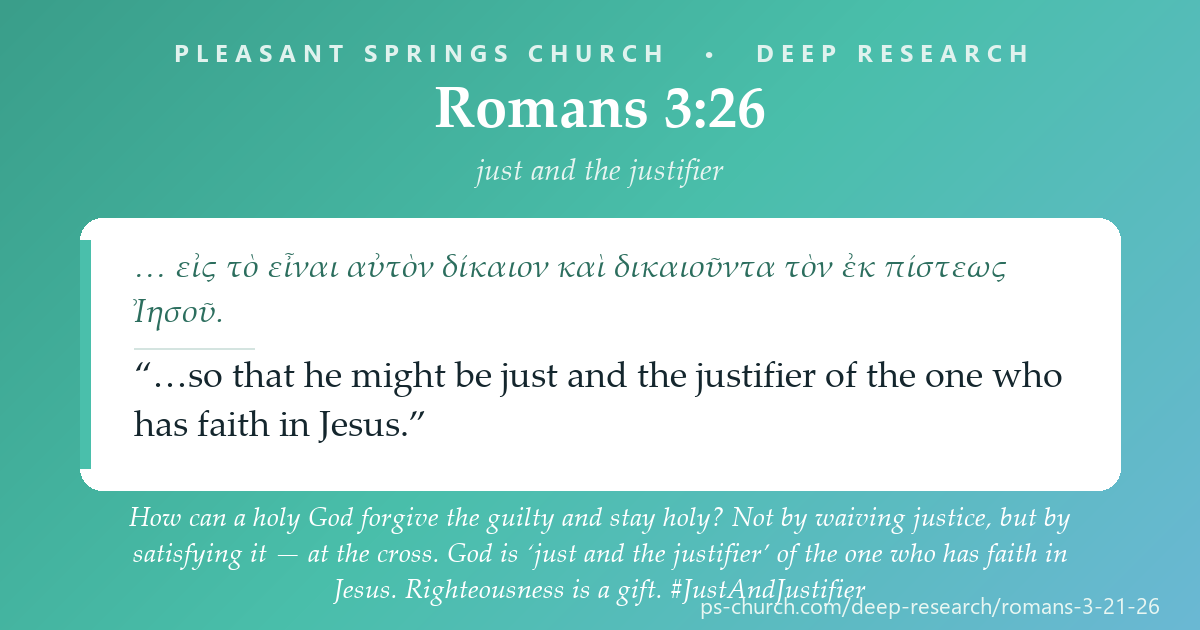
Just and the justifier. The climax (3:26) is the sentence the whole passage exists to say. God had, in his patience, “passed over former sins” — and that left a question hanging over his justice: how can he let the guilty go? The cross answers it. God does not forgive by pretending sin does not matter; he forgives by bearing it himself in his Son, so that he can be at once “just” — his justice fully satisfied — “and the justifier” of the one who has faith in Jesus. Grace, here, is not the suspension of justice but its satisfaction.
Orient on righteousness, justification, propitiation, redemption, and the mercy seat.
Search by topic: righteousness / justification, propitiation / expiation, redemption, mercy seat / Day of Atonement, faith.
Which articles are relevant?
- Anchor Bible Dictionary — “Justification,” “Righteousness,” “Expiation/Propitiation,” “Redemption,” “Mercy Seat.”
- Dictionary of Paul and His Letters — “Justification,” “Righteousness of God,” “Death of Christ,” “Expiation, Propitiation.”
- NIDNTT / TDNT — δικαιόω (dikaioō, justify), ἱλαστήριον (hilastērion, propitiation/mercy seat), ἀπολύτρωσις (apolytrōsis, redemption).
Bibliography surfaced:
- C. E. B. Cranfield (ICC), Douglas Moo (NICNT), Thomas Schreiner (BECNT), James Dunn (WBC), Leon Morris on Romans.
- Leon Morris, The Apostolic Preaching of the Cross (on hilastērion as propitiation); studies of justification.
- Beale & Carson, Commentary on the NT Use of the OT (Romans).
The mercy seat, the turning-away of wrath, and how God stays just.
Read the Day-of-Atonement background behind hilastērion, then weigh propitiation and the “just and justifier” resolution.
Which parallels shed light on religion and worldview?
Propitiation, not merely expiation. The pivotal word hilastērion has been fought over. Some (following C. H. Dodd) wanted it to mean only expiation — the cleansing of sin — on the grounds that a God of wrath is beneath the dignity of the New Testament. But Paul has spent chapters 1–3 establishing exactly that: “the wrath of God is revealed from heaven against all ungodliness” (1:18), and believers will be “saved by him from the wrath of God” (5:9). So the word keeps its fuller sense: Christ’s blood turns God’s righteous wrath away from sinners — a propitiation — even as it cleanses their sin. Wrath here is not divine temper but God’s settled, holy opposition to evil; and the wonder is that God provides the very propitiation that answers it.
The true mercy seat. The same Greek word, in the Greek Old Testament, names the kapporet — the “mercy seat,” the gold cover of the ark of the covenant, sprinkled with blood on the Day of Atonement (Lev 16; Exod 25:17–22). Once a year, out of sight in the Holy of Holies, the high priest brought blood there, and God met his people in mercy. Paul says God has now “put forward” — displayed in the open — the true mercy seat: Christ crucified. Not a lid of gold in the dark, but the Son of God lifted up in the daylight of history, the place where God’s presence and the sinner’s guilt finally meet and are reconciled by blood.
How God can be just and forgive. The passage exists for one sentence: “that he might be just and the justifier” (3:26). This is the problem the whole Bible has been building toward. God had “passed over former sins” (3:25) — Abraham, David, all the forgiven of the old covenant — and in doing so left a question over his own justice: how can the Judge of all the earth let the guilty go free? A human judge who acquits the guilty is corrupt. The cross is God’s answer. He does not lower the bar or look away; he bears the penalty himself, in his Son, so that his justice is fully honored and the sinner is fully acquitted. This is why the atonement can never be caricatured as an angry Father punishing an unwilling Son: it is God who “put forward” the propitiation, out of his own love (5:8; 1 John 4:10), and the Son who lays down his life “of my own accord” (John 10:18). One God, one saving will, one costly grace.
- Leviticus 16:2, 13–15; Exodus 25:17–22 — the mercy seat (hilastērion/kapporet) sprinkled with blood on the Day of Atonement: the background to Rom 3:25 (see the Day of Atonement).
- Isaiah 53:5–6, 11–12 — the Servant pierced for our transgressions, who makes “many to be accounted righteous”: substitution and justification (see the Suffering Servant).
- Habakkuk 2:4; Genesis 15:6; Psalm 143:2 — “the righteous shall live by faith”; “he believed the Lord… counted… as righteousness”; “no one living is righteous before you”: the faith-righteousness Paul expounds (see the righteous shall live by faith).
The word propitiation has fallen on hard times, and it is worth recovering, because losing it costs more than a syllable. The objection runs that propitiation belongs to paganism — a nervous worshiper bribing an angry deity into a better mood — and has no place in the religion of a loving God. But that objection mistakes the whole shape of the gospel. In paganism the worshiper propitiates the god; in the gospel God propitiates himself. It is not that a reluctant Father is talked round by a merciful Son; it is that the one God, in holy love, provides in his own Son the sacrifice that answers his own righteous wrath against sin. “God put forward” the propitiation — the initiative is entirely his, and its motive is love (“God shows his love for us in that while we were still sinners, Christ died for us”). So the two things the modern mind wants to hold apart — that God is love and that God is holy — meet at the mercy seat and are shown to be one. The cross is where God’s wrath against sin and God’s love for the sinner are both fully expressed, and neither is compromised. Take away propitiation, and you are left with a God who forgives by shrugging — which is to say, a God who does not take sin, or the sinner, seriously. Keep it, and you have the God of the gospel: just, and the justifier of the ungodly.
The vocabulary of righteousness, justification, and propitiation.
Watch the forensic “justify,” the wrath-averting “propitiation”/mercy seat, and the free gift dōrean.
“The righteousness of God” — the theme (also 1:17). Both God’s own justice (he shows himself just, 3:25–26) and the righteous standing he gives the believer (received through faith, 3:21–22). A righteousness that comes from God, apart from law-keeping.
“To justify” — a forensic verb: to declare righteous, to acquit, not to make gradually good. The climactic wordplay dikaion kai dikaiounta (“just and the justifier,” 3:26) shows God is both the righteous Judge and the one who acquits. Justification is a declared status, received by faith.
“Propitiation; mercy seat” — that which turns away wrath (not merely cleanses sin), and the Greek OT word for the kapporet, the blood-sprinkled mercy seat of the ark (Lev 16). Christ is the true mercy seat, publicly set forth — where blood turns wrath away and meets the sinner with mercy.
“Redemption” — deliverance secured by a ransom-price (lytron); echoes the exodus and the freeing of slaves. Justification rests on a costly liberation, paired with “grace” and “as a gift”: the price was paid by God, received freely by the sinner.
“Freely, as a gift, without cost” — justification is gratis, at no charge to the receiver, with no prior merit. Sharpens sola gratia: given without any cause in the sinner.
“Passing over” — a rare word (NT only here), distinct from aphesis (“remission/forgiveness”). God, in his forbearance, deferred the reckoning of former sins — leaving a question over his justice that the cross now answers.
How the New Testament fills out justification:
- Romans 1:16–17; 4:1–8, 22–25 — the righteous shall live by faith; Abraham and David justified by faith apart from works “counted” to them: the argument 3:21–26 opens.
- Romans 5:1, 9; 8:1, 33–34 — “justified by faith, we have peace”; “saved from the wrath”; “no condemnation”; “God who justifies”: the fruit of this verdict (see peace with God).
- Galatians 2:16; Philippians 3:9; 2 Corinthians 5:21 — justified by faith, not works of the law; “a righteousness… from God… by faith”; “that we might become the righteousness of God”: the same gospel.
- Ephesians 2:8–9; Titus 3:5–7 — “by grace… through faith… not a result of works”; “justified by his grace”: grace and faith, not merit.
From the mercy seat to the cross where God is just and justifier.
Trace the atonement from the Day-of-Atonement mercy seat, through the Servant, to the free gift of righteousness by faith.
Which cross-references matter?
- Leviticus 16; Exodus 25:17–22; Isaiah 53 — the mercy seat and the atoning blood; the Servant who justifies many: the propitiation foreshadowed (see the Day of Atonement, the Servant).
- Genesis 15:6; Habakkuk 2:4; Psalm 32:1–2 — “counted… as righteousness”; “the righteous shall live by faith”; “blessed… against whom the Lord counts no iniquity”: justification by faith in the OT (see the covenant cut, Habakkuk 2:4).
- Romans 4–5; 8:1, 30–34 — the exposition of justification; peace and no-condemnation: where 3:21–26 leads (see Romans 5, no separation).
- 2 Corinthians 5:18–21; 1 John 2:2; 4:10 — the ministry of reconciliation; “he is the propitiation for our sins”; “God… sent his Son to be the propitiation”: the cross as God’s loving initiative.
- Hebrews 9:5, 11–14, 24–28 — the mercy seat; Christ entering the true holy place with his own blood, “once for all”: the propitiation completed.
Everything in these verses turns on the phrase Paul repeats like a refrain: “the righteousness of God.” It is easy to hear it as bad news — God’s standard, against which we fall short — and 3:23 says exactly that. But Paul means something more astonishing. The “righteousness of God” that is now revealed is not only the justice we could never meet; it is a righteousness God gives, a standing before him that comes as a gift to the one who believes. This is the Reformation’s great rediscovery, and it hangs on the little verb “justify.” It is a courtroom word, not a hospital word: to justify is to declare a verdict, not to administer a cure. God does not first make the sinner good and then accept him; he accepts the ungodly on the basis of Christ’s blood, and reckons them righteous while they are still sinners — and out of that verdict, transformation flows. Two errors lie on either side. One turns justification back into a reward for goodness, and loses grace. The other treats the verdict as a legal fiction, as if God simply pretends. But it is no fiction: it rests on a real atonement, a real propitiation, real blood. God can declare the guilty righteous because the guilt has really been borne. That is why the passage ends not with a soft word but a strong one — “just, and the justifier” — and why the gospel is not that God overlooks sin, but that he has dealt with it, at the cost of his Son, so that he can welcome sinners home without ceasing to be holy.
The scholarship on Romans 3:21-26.
The commentators on Romans 3; the studies of justification, propitiation, and the ‘faith of/in Christ’ debate.
Commentaries & studies:
- C. E. B. Cranfield (ICC), Douglas J. Moo (NICNT), Thomas R. Schreiner (BECNT), James D. G. Dunn (WBC), Leon Morris, Richard Longenecker on Romans.
- Leon Morris, The Apostolic Preaching of the Cross; studies of the pistis Christou debate (Hays, Dunn) and the mercy-seat reading of hilastērion.
- G. K. Beale & D. A. Carson, eds., Commentary on the NT Use of the OT.
Interpretation notes worth keeping:
- Justification is declared, not infused. Dikaioō is forensic — a verdict of “righteous,” received by faith, grounded in Christ’s atonement. Not a legal fiction (it rests on real blood), not a reward for works. Sola fide, sola gratia.
- Propitiation, not merely expiation. Keep the wrath-averting sense of hilastērion (5:9, “saved from the wrath”) — while noting the mercy-seat background (Lev 16). Sin is expiated and wrath is propitiated.
- Not divine child abuse. God (the Father) “put forward” the propitiation out of love (5:8; 1 John 4:10), and the Son gave himself willingly (John 10:18) — one triune God, one saving will.
- Just and justifier. God does not waive justice to forgive; he satisfies it in Christ’s blood, so he remains just while acquitting the guilty (3:26) — the theological heart of the passage.
- ‘Faith in Christ,’ a flagged debate. The ESV reads “faith in Jesus Christ” (objective genitive); note the “faithfulness of Christ” reading (subjective; Hays, Wright) honestly — an interpretive, not a text-critical, question.
From the guilty dock to the free gift of righteousness.
Name what you learned, why it matters, and one concrete response.
What should we carry away — and do?
- Righteousness is a gift, not a wage. You cannot earn your standing before God; you can only receive it. “Justified by his grace as a gift” — the ground is Christ’s blood, the instrument is faith, the cost to you is nothing.
- The cross took God’s wrath seriously. Propitiation means your sin was not shrugged off but borne. The God who is love is also holy — and at the mercy seat both are fully honored.
- God is just and your justifier. You are not forgiven by a God who bends the rules but by a God who kept them — who satisfied his own justice in his Son so he could welcome you home.
Step in response: stop trying to earn what God gives freely — rest your standing before him entirely on Christ set forth as the propitiation, received by faith. And when guilt over “former sins” accuses you, answer it at the mercy seat: God is just, and the justifier of the one who has faith in Jesus — and that one is you.
Romans 3:26 · to share
Greek NT + ESVEvery Deep Research page traces its passage across the whole sweep — the Old Testament, the Second-Temple world between the testaments (historical witnesses, not Scripture), and the New Testament. Follow the thread:
Pleasant Springs Church — Deep Research
Research method after Michael S. Heiser’s Bible Research Method (examine dictionaries → ancient literature → important words → textual connections → academic publications → share), with the Pleasant Springs “Author & Audience” foundation. Scripture set in the Hebrew, the Greek editions named on each page and the ESV (Old Testament), and the Greek New Testament and the ESV (New Testament), per the practice of Pleasant Springs Church. Romans 3:21–26 research grounded in Cranfield, Moo, Schreiner, Dunn, and Morris, with Beale & Carson on the OT background; justification read as a forensic verdict (declared, not infused; sola fide/sola gratia, not a legal fiction); hilastērion as wrath-averting propitiation and the Levitical mercy seat; the atonement as the triune God’s own loving provision (not the Father coercing the Son); “just and the justifier” as the satisfaction (not the waiving) of justice; the pistis Christou genitive flagged as an interpretive debate (ESV: “faith in Jesus Christ”).
Scripture quotations marked ESV are from the ESV® Bible (The Holy Bible, English Standard Version®), © 2001 by Crossway, a publishing ministry of Good News Publishers. ESV Text Edition: 2016. Used by permission. All rights reserved. The ESV text may not be quoted in any publication made available to the public by a Creative Commons license, and the ESV may not be translated in whole or in part into any other language. www.esv.org
|
Did this study bless you today? 💚 Give to Support PS Church100% of gifts go to the General Fund — thank you. |