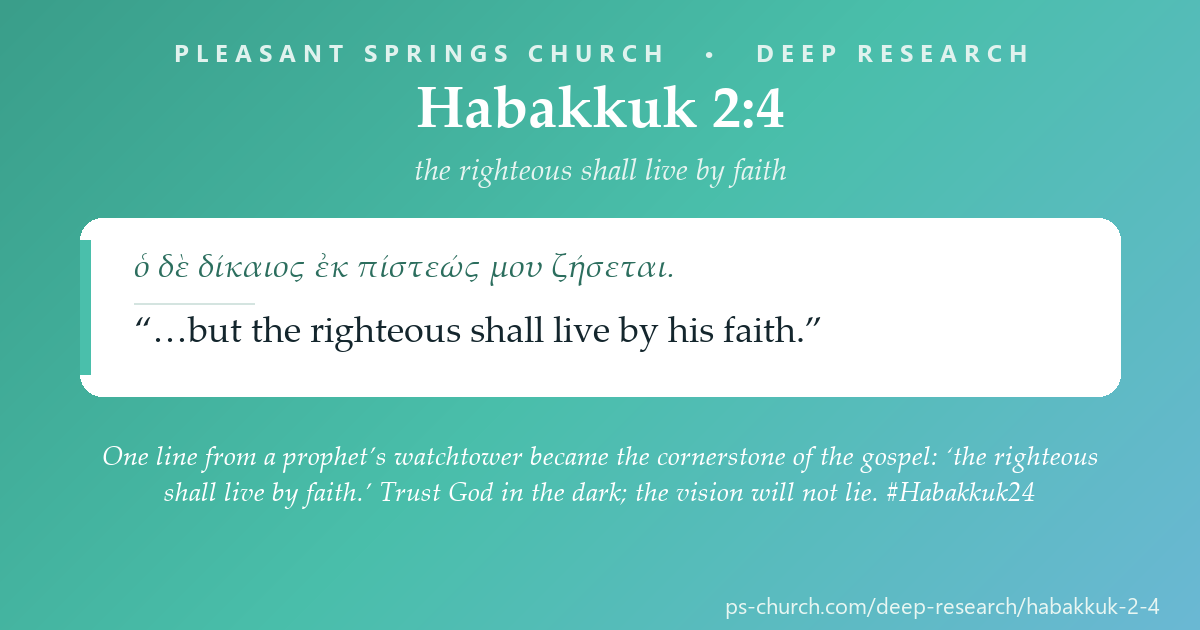
The righteous shall live by his faith.” From a prophet’s watchtower, on the eve of the Babylonian catastrophe, comes one short line that would become a hinge of the whole Bible. But whose faith — and faith or faithfulness? The Hebrew reads “his,” the Greek “my,” and Paul quotes it with no pronoun at all, making it the cornerstone of the gospel in Romans and Galatians. This study lays every witness side by side — Hebrew, Greek, the Dead Sea Scrolls, and the New Testament — and holds together the original crisis and the doctrine of justification by faith. See the method →
Habakkuk 2:3–4
Hebrew · LXX · ESVThe Shape of the Passage
SequenceHabakkuk wrestles with God on the eve of the Babylonian crisis (late 7th c. BC): why does God use a crueler nation to punish a wicked one? God’s answer — wait for the vision; the righteous will live by faith — became, through Paul, a cornerstone of the gospel.
Author
The prophet Habakkuk does not preach at the people; he argues with God. Judah is violent and lawless — why does God not act (1:2–4)? God answers: he is raising up the Babylonians (Chaldeans) to judge (1:5–11). That answer horrifies the prophet: how can a holy God use a nation more wicked than Judah (1:12–17)? He climbs his watchtower to wait for a reply (2:1). God’s answer comes as an oracle to be written plainly: the vision has an appointed time; the proud are inwardly crooked; but “the righteous shall live by his faith” (2:2–4).
Faith in the dark. In its first setting, emunah is steady, trusting faithfulness — the loyal endurance that clings to God’s word when judgment delays and evil seems to win. The book ends with Habakkuk’s great confession: though the fig tree does not blossom, “yet I will rejoice in the Lord” (3:17–18). That is emunah in action.
Audience
Judah on the edge of catastrophe — believers who must live through a disaster they cannot stop and do not understand. To them the word is not an explanation but a summons: while the arrogant collapse under their own pride, the righteous survive by trusting God and staying faithful to him. Wait; the vision will not lie.
How it was read. This one line traveled remarkably. The Greek translators rendered it of God’s faithfulness (“my faith”). The Qumran community read it of loyalty to Torah and their Teacher. Paul heard in it the heart of the gospel — justification by faith, apart from works of the law — and built Romans and Galatians on it. Hebrews used it to steel a wavering church against shrinking back.
Orient on faith/faithfulness, the righteous, and Habakkuk’s theodicy.
Search by topic: faith, faithfulness, righteousness, justification, Habakkuk, theodicy.
Which articles are relevant?
- Anchor Bible Dictionary — “Habakkuk,” “Faith,” “Righteousness,” “Justification.”
- Dictionary of the OT: Prophets — “Habakkuk, Book of,” “Faith,” “Theodicy,” “Day of the Lord.”
- NIDOTTE / TDOT — אֱמוּנָה (ʾĕmûnâ, faithfulness/faith), צַדִּיק (ṣaddîq, righteous), חָיָה (ḥāyâ, live), חָזוֹן (ḥāzôn, vision).
Bibliography surfaced:
- O. Palmer Robertson (NICOT), J. J. M. Roberts (OTL), Francis Andersen (Anchor Bible), F. F. Bruce on Habakkuk.
- Douglas Moo, The Epistle to the Romans (NICNT); Richard Hays on Paul’s use of Habakkuk 2:4.
- Studies of the Qumran Pesher Habakkuk (1QpHab); Beale & Carson, NT Use of the OT.
One line, four readings: Hebrew, Greek, Qumran, and Paul.
Lay the witnesses side by side honestly. Then let the original crisis and the gospel trajectory both stand.
Which parallels shed light on religion and worldview?
The word that carries it all. Hebrew emunah covers a range English splits in two: firm, reliable faithfulness and trusting faith. In Habakkuk’s crisis the accent falls on steadfast loyalty — the righteous person holds on to God when everything shakes. But that loyal holding-on is faith; the two are not opposites but one posture of the heart toward God. The translations that follow are not errors but readings drawing out different facets of the one word.
Four honest witnesses. (1) The Hebrew (MT): “the righteous shall live by his faith(fulness)” — the believer’s own trust. (2) The Greek (LXX, Vaticanus): “by my faith(fulness)” — grounding the righteous life in God’s faithfulness; a second Greek manuscript (Alexandrinus) reads “my righteous one shall live by faith.” (3) The Qumran pesher (1QpHab) keeps the Hebrew “his faithfulness” and interprets it of the Torah-keeping community “faithful” to their Teacher of Righteousness — a Second-Temple witness to how the verse was read, not Scripture, and not about Christ. (4) Paul (Rom 1:17; Gal 3:11) quotes it with no pronoun: “the righteous shall live by faith.” Each witness is shown here; none is hidden to make the case simpler.
- Habakkuk 2:2–3; 3:17–19 — the vision that “awaits its appointed time”; the closing confession of faith when the harvest fails.
- Genesis 15:6 — Abram “believed the Lord, and he counted it to him as righteousness”: Paul’s companion text for faith-righteousness.
- 1QpHab VII–VIII (Pesher Habakkuk), c. 1st c. BC (Dead Sea Scrolls — a Second-Temple witness, not Scripture) — reads “his faithfulness” of loyalty to Torah and the Teacher of Righteousness.
- The Septuagint of Habakkuk — “by my faith(fulness)” (Vaticanus) / “my righteous one… by faith” (Alexandrinus); Hebrews 10:37–38 quotes the Greek, following the ‘my righteous one’ form and adding ‘if he shrinks back.’
Paul makes Habakkuk 2:4 the thesis text of Romans: “For in it the righteousness of God is revealed from faith for faith, as it is written, ‘The righteous shall live by faith’” (Rom 1:17; also Gal 3:11). He quotes it without a pronoun — neither “his” nor “my” — letting the bare statement carry his gospel: a person is justified before God not by works of the law but by faith. This is not a misreading of Habakkuk but a faithful unfolding of it. Habakkuk’s call to trust God and stay loyal in the dark is exactly the posture Paul names faith; what the prophet applied to surviving the Babylonian crisis, Paul carries to its root — the righteous are righteous, and live, on the footing of faith. Hebrews then quotes the fuller Greek to a tempted church: “my righteous one shall live by faith, and if he shrinks back, my soul has no pleasure in him” (Heb 10:38) — showing that living faith and persevering faithfulness are one thing, not two. The line the Reformers rediscovered here — justification by faith alone — stands in a genuine line from the prophet’s watchtower to the apostle’s gospel.
The vocabulary of faith, righteousness, and life.
Hold emunah/pistis in its full range — faith and faithfulness are one posture, not rivals.
“Faithfulness / faith” — firmness, steadiness, reliability; the loyal trust that holds to God. The Greek renders it pistis, which likewise means both faith and faithfulness.
“By his faith(fulness)” — the Hebrew’s reading: the righteous person’s own trust. The LXX reads “by my faithfulness”; Paul quotes with no pronoun.
“Righteous” — the one in right standing and conduct before God, set against the “puffed up” and crooked of the same verse; the subject of “shall live.”
“Faith / faithfulness” — the Greek word carrying both senses; the term Paul builds his doctrine of justification upon (whether “faith in Christ” or “the faithfulness of Christ” is a live scholarly debate).
How the New Testament reuses Habakkuk 2:4:
- Romans 1:17 — “The righteous shall live by faith”: the thesis of Romans, the righteousness of God from faith to faith.
- Galatians 3:11 — “no one is justified before God by the law… ‘The righteous shall live by faith’”: faith against works of the law.
- Hebrews 10:37–38 — the fuller Greek (with Hab 2:3): “my righteous one shall live by faith, and if he shrinks back…”: perseverance.
- Genesis 15:6; Romans 4 — Abraham’s faith counted as righteousness: the pattern behind Paul’s reading.
From the watchtower to the gospel of justification by faith.
Trace “live by faith” from Habakkuk’s crisis through Qumran and the LXX into Paul and Hebrews.
Which cross-references matter?
- Habakkuk 2:1–5; 3:16–19 — the vision awaited on the watchtower; the confession of faith when all fails.
- Genesis 15:6; Isaiah 7:9; 28:16 — believing God counted as righteousness; “if you are not firm in faith”; “whoever believes will not be in haste.”
- Romans 1:16–17; 3:21–26; Galatians 3:6–14 — justification by faith apart from works of the law, with Habakkuk 2:4 as anchor.
- Hebrews 10:32–39; 11:1–40 — “do not shrink back”; the great roll-call of those who lived by faith.
- Ephesians 2:8–9; Philippians 3:9 — saved by grace through faith; a righteousness “that comes through faith in Christ.”
Interpreters have long debated how Paul reads Habakkuk 2:4 — and even how to punctuate his quotation (“the righteous shall live by faith” or “the one who is righteous by faith shall live”). What is not in doubt is that Paul found in this verse the scriptural charter of his gospel: God reckons a person righteous through faith, and that righteous person truly lives. He drops the pronoun the Hebrew and Greek supply, so the statement stands in its widest form. This does not erase the original: Habakkuk’s summons to trusting, loyal endurance under judgment is the seed of which Paul’s doctrine is the flower. A scholarly debate remains over whether Paul’s “pistis” language sometimes means “the faithfulness of Christ” rather than “faith in Christ” — a question worth flagging, not settling here. Either way, faith and faithfulness are not opposed: Hebrews quotes the same verse to warn against shrinking back, and the letter’s eleventh chapter defines the faith that justifies as the faith that endures. From a prophet’s watchtower in a doomed city to the heart of the gospel, one line holds: the righteous shall live by faith.
The scholarship on Habakkuk 2:4.
The commentators on Habakkuk; the studies of Paul’s use, the LXX, and the Qumran pesher.
Commentaries & studies:
- O. Palmer Robertson (NICOT), J. J. M. Roberts (OTL), Francis I. Andersen (Anchor Bible), F. F. Bruce on Habakkuk.
- Douglas J. Moo, The Epistle to the Romans (NICNT); Richard B. Hays, The Faith of Jesus Christ.
- Studies of 1QpHab (Pesher Habakkuk); G. K. Beale & D. A. Carson, eds., Commentary on the NT Use of the OT.
Interpretation notes worth keeping:
- The pronoun, honestly. MT “his faith”; LXX “my faith” (Alexandrinus “my righteous one… by faith”); Paul quotes with none. Show all three rather than harmonizing them away.
- Faith and faithfulness. Emunah/pistis holds both senses; the original stress on loyal endurance and Paul’s stress on trusting faith are facets of one thing, not a contradiction.
- Original context and trajectory. Honor the 7th-century Babylonian crisis meaning and the Pauline gospel development; the Reformation reading is a faithful unfolding, not a reversal.
- Qumran is a witness, not Scripture. 1QpHab shows one Second-Temple reading (loyalty to Torah and the Teacher); it is not about Christ and does not norm the text.
From the watchtower in the dark to your own faith.
Name what you learned, why it matters, and one concrete response.
What should we carry away — and do?
- Faith is how the righteous live. Not a one-time transaction only, but a whole life-posture — trusting God and staying loyal to him, especially when his answers are slow and the world seems to be winning.
- God’s slow promises are sure. “If it seems slow, wait for it; it will surely come.” The vision has an appointed time. Waiting faith is not wasted faith.
- The gospel stands on this line. The righteous are justified and live by faith — Paul’s cornerstone, the Reformation’s rediscovery, and still the ground a sinner stands on before God.
Step in response: name the place where God seems slow to you, and choose Habakkuk’s posture — climb the watchtower, write the promise plainly, and wait in faith rather than shrinking back. Rest your standing before God not on your performance but on the faith by which the righteous live.
Habakkuk 2:4 / Romans 1:17 · to share
ESVEvery Deep Research page traces its passage across the whole sweep — the Old Testament, the Second-Temple world between the testaments (historical witnesses, not Scripture), and the New Testament. Follow the thread:
Pleasant Springs Church — Deep Research
Research method after Michael S. Heiser’s Bible Research Method (examine dictionaries → ancient literature → important words → textual connections → academic publications → share), with the Pleasant Springs “Author & Audience” foundation. Scripture set in the Hebrew, the Greek editions named on each page and the ESV (Old Testament), and the Greek New Testament and the ESV (New Testament), per the practice of Pleasant Springs Church. Habakkuk 2:4 research grounded in Robertson, Roberts, Andersen, and Bruce, with Moo and Hays on Paul’s use; the LXX and 1QpHab as translation/Second-Temple witnesses; the pistis Christou debate flagged, not adjudicated.
Scripture quotations marked ESV are from the ESV® Bible (The Holy Bible, English Standard Version®), © 2001 by Crossway, a publishing ministry of Good News Publishers. ESV Text Edition: 2016. Used by permission. All rights reserved. The ESV text may not be quoted in any publication made available to the public by a Creative Commons license, and the ESV may not be translated in whole or in part into any other language. www.esv.org
|
Did this study bless you today? 💚 Give to Support PS Church100% of gifts go to the General Fund — thank you. |