Habakkuk 2:4 stands behind three different New Testament verses, and measured for shared wording they come out in an order most readers would not predict. Hebrews 10:38 shares nine consecutive words with the CATSS row. Romans 1:17 shares five. Galatians 3:11 shares three. The deepest match is with the verse that takes the first half of Habakkuk 2:4 — the half about drawing back, which Romans and Galatians leave out entirely. And then there is the possessive. The Hebrew has the righteous living by his faith; the Greek row by my faith; Hebrews has my righteous one living by faith; and Romans and Galatians have no possessive at all. Four texts, four placements, one pronoun. The page prints all four and orders none of them. See the method →
Habakkuk 1:1–3:19 (selections)
Hebrew · Greek (CATSS, Rahlfs’ Septuaginta) · ESV⚠️ And one verse of this book stands behind three New Testament verses. Habakkuk 2:4 measures 9 against Hebrews 10:38, 5 against Romans 1:17 and 3 against Galatians 3:11 — and the possessive lands somewhere different in every one of the four texts.
The Shape of the Passage
Sequence — two complaints, two answers, and a psalmHabakkuk is the one prophet in the Twelve who spends the book arguing with God rather than delivering messages to anyone else. There is no thus says the Lord aimed at a nation until chapter 2, and no audience is ever named. The second person singular through most of chapter 1 is God.
Author
1:1 calls it a massa, an oracle or burden, and 3:1 calls chapter 3 a tefillah, a prayer. Two genre labels inside one short book, and the second one comes with musical directions: according to Shigionoth at the head and to the choirmaster: with stringed instruments at the foot.
Nothing dates the book. No king, no year. The Chaldeans of 1:6 are the only historical handle, and what to do with it is a question this page does not enter.
Audience
The complaint is on behalf of people who never speak. 1:4 has the law paralysed and justice never going out; 1:13 has the wicked swallowing the more righteous. The prophet argues for them and God answers him, not them.
And the book ends in the first person singular. “Yet I will rejoice… I will take joy in the God of my salvation.” Whatever was resolved, it is resolved in the one who was complaining.
Orient on the Chaldeans, the watchtower, and a psalm inside a prophet.
Search by topic: Habakkuk, book of; theodicy in the prophets; Chaldeans; Shigionoth; selah; faith and faithfulness (emunah); Habakkuk at Qumran.
Which articles are relevant?
- Anchor Bible Dictionary — “Habakkuk, Book of,” “Chaldeans,” “Theodicy,” “Pesher Habakkuk.”
- Dictionary of the OT: Prophets (IVP) — “Habakkuk: Book of,” “Faith,” “Lament,” “Theophany.”
- Dictionary of NT Use of the OT (Beale & Carson) — on Romans 1:17, Galatians 3:11, Hebrews 10:37–38 and Acts 13:41.
- NIDOTTE — אֱמוּנָה, צַדִּיק, חָזוֹן, חָמָס.
The numbering needs no table
Habakkuk carries no Hebrew/English verse offset at any point. Masoretic, CATSS and the ESV all run 17 / 20 / 19 — 56 verses. Verified from content at each chapter seam rather than assumed. Of the twelve Minor Prophets, seven carry an offset somewhere and five do not; Habakkuk is one of the five, along with Amos, Obadiah, Zephaniah and Haggai.
One verse, three New Testament partners, three different depths.
Habakkuk 2:4 measured against each of the three
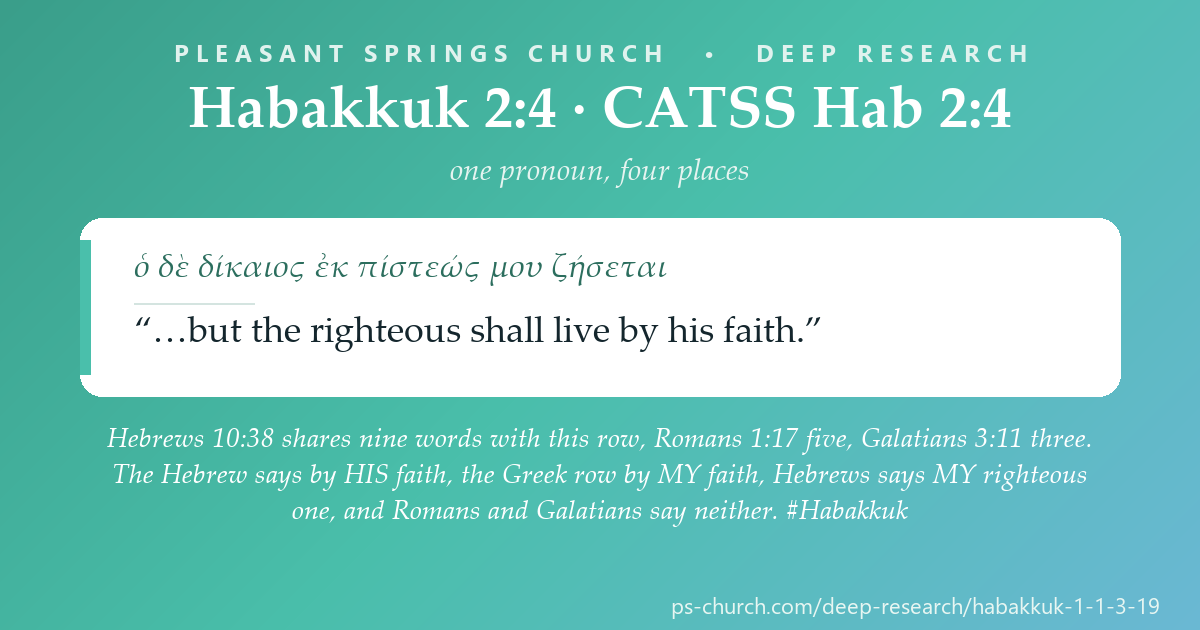
The CATSS row reads: ἐὰν ὑποστείληται οὐκ εὐδοκεῖ ἡ ψυχή μου ἐν αὐτῷ · ὁ δὲ δίκαιος ἐκ πίστεώς μου ζήσεται
| New Testament verse | run | the shared words | which half of Habakkuk 2:4 |
|---|---|---|---|
| Hebrews 10:38 | 9 | ἐὰν ὑποστείληται οὐκ εὐδοκεῖ ἡ ψυχή μου ἐν αὐτῷ | the first |
| Romans 1:17 | 5 | ὁ δὲ δίκαιος ἐκ πίστεως | the second |
| Galatians 3:11 | 3 | δίκαιος ἐκ πίστεως | the second |
Hebrews 10:38 carries both halves; Romans and Galatians carry only the second. The deepest run is therefore on the material the other two do not use at all. And Hebrews prints the two halves in the opposite order to the row: it opens with the righteous living by faith and continues with the drawing back.
Checked from both ends: against all 7,927 New Testament verses, Habakkuk 2:4 reaches 9 with Hebrews 10:38 and with nothing else — tie band one, and the next depths are a single verse at 5 and a single verse at 4. Against all 30,348 CATSS verse units, Hebrews 10:38 reaches 9 with Habakkuk 2:4 and nothing else. The nine-word string stands in exactly one verse unit and one New Testament verse. ⚠️ Re-run on 2026-08-30 over the enlarged corpus and unchanged: when this paragraph was first written the scope was 23,061 units in 44 files; Exodus, Leviticus, Numbers, Joshua and the deuterocanon have since been added, taking the shelf to 30,637 units held in 64 files, of which 30,348 are screened — the Odes are set aside — and Hebrews 10:38 still finds Habakkuk 2:4 and nothing else. It found nothing else with the Odes in either.
The possessive, in four texts
One pronoun, and no two of these four put it in the same place.
| the clause | whose | |
|---|---|---|
| Hebrew 2:4 | וְצַדִּיק בֶּאֱמוּנָתוֹ יִחְיֶה | by his faith |
| CATSS row | ὁ δὲ δίκαιος ἐκ πίστεώς μου ζήσεται | by my faith |
| Hebrews 10:38 | ὁ δὲ δίκαιός μου ἐκ πίστεως ζήσεται | my righteous one |
| Romans 1:17 & Galatians 3:11 | ὁ δὲ δίκαιος ἐκ πίστεως ζήσεται | — no possessive |
The Hebrew attaches it to the faith and makes it the righteous man’s. The Greek row attaches it to the faith and makes it God’s. Hebrews attaches it to the righteous one. Romans and Galatians attach it to nothing. All four readings are printed here as their files have them, and the page does not order them, date them, or say what produced any of them.
What the rest of the book returns
All 56 CATSS rows of Habakkuk against all 7,927 verses of the Greek New Testament.
| run reached | rows of the 56 |
|---|---|
| 2 or more | 55 |
| 3 or more | 32 |
| 4 or more | 9 |
| 6 or more | 3 |
| 7 or more | 2 |
| 9 | 1 |
Three rows sit at the top and each has a tie band of one on the New Testament side: 2:4 with Hebrews 10:38 at nine, 1:5 with Acts 13:41 at seven, and 3:18 with Luke 1:47 at six. Nothing in the book reaches five or eight at all.
⚠️ Nine is deep for Habakkuk and not for the corpus. The same screen over all 30,348 screened verse units goes deeper elsewhere, and here is the whole top of the shelf as it now stands:
| CATSS row | New Testament verse | run | band |
|---|---|---|---|
| Isaiah 6:10 | Matthew 13:15 · Acts 28:27 | 24 | 2 |
| Isaiah 54:1 | Galatians 4:27 | 23 | 1 |
| LXX Jeremiah 38:32 · MT/English 31:32 | Hebrews 8:9 | 23 | 1 |
| LXX Jeremiah 38:34 · MT/English 31:34 | Hebrews 8:11 | 23 | 1 |
| Deuteronomy 6:5 | Mark 12:30 | 21 | 1 |
| Isaiah 53:8 | Acts 8:33 | 20 | 1 |
| Psalm 2:2 | Acts 4:26 | 20 | 1 |
| LXX Psalm 15:9 · MT/ESV 16:9 | Acts 2:26 | 20 | 1 |
| LXX Psalm 44:8 · MT/ESV 45:6–7 | Hebrews 1:9 | 20 | 1 |
| LXX Joel 3:1 · MT/ESV 2:28 | Acts 2:17 | 19 | 1 |
| Amos 9:12 | Acts 15:17 | 14 | 1 |
| Jonah 2:1 | Matthew 12:40 | 12 | 1 |
⚠️ A ROW STOOD IN THAT TABLE FOR ONE DAY AND HAS BEEN TAKEN OUT. IT IS NAMED HERE RATHER THAN DELETED.
Between the corpus fetch of 30 August 2026 and the exclusion of the Odes, this table carried an eleventh row — Odes 9:48 against Luke 1:48, a run of 18 at a tie band of 1, sitting between Joel and Amos — the twelfth-deepest Old-Testament-to-New-Testament pair on the whole shelf, with exactly eleven above it. It was Luke matching Luke. The Greek Odes are fourteen canticles appended to the Psalter in the great codices for liturgical use, and Ode 9 is the Magnificat and the Benedictus — Luke chapter 1 itself, excerpted for the daily office and copied back into a Greek Old Testament manuscript. Eighteen consecutive words is a very deep run on this shelf: screened from the New Testament side, exactly eleven pairs in the whole corpus go deeper, and every one of them is in the table above. A page that had reported it without opening the file would have printed a Gospel’s deepest Old Testament contact and been measuring the Gospel against itself.
How it was caught, since that is the part worth having. The run was flagged because it was implausibly clean: eighteen words unbroken, at a tie band of one, in a book nobody had checked, in a verse of Luke with no known Old Testament source. Opening the CATSS file settled it in a line — Ode 9 is headed with the Magnificat. The instrument was working perfectly. It found a real, exact, eighteen-word agreement between two files on this disk. What it could not know is that the two files are the same text. That is the standing hazard of a corpus screen and the reason every deep run on this shelf is opened by eye before it is printed.
The Odes are now excluded from anything this shelf calls “the Greek Old Testament”, for that reason and for a second: ten of the fourteen canticles are second copies of passages already in the corpus — Ode 1 is Exodus 15, Ode 2 Deuteronomy 32, Ode 3 1 Samuel 2, Ode 4 is Habakkuk 3, Ode 5 Isaiah 26, Ode 6 Jonah 2, Odes 7 and 8 Daniel (Th) 3, Ode 10 Isaiah 5, Ode 11 Isaiah 38 — so a verse standing once appears to stand twice and any tie band touching a canticle is doubled. They stay on the disk, they are still read, and Ode 4 is discussed at length in stage 3 as what it is: a second copy of this book’s third chapter. They are not counted as an Old Testament witness against the New. The shelf holds 30,637 verse units in 64 files and screens 30,348 of them; the difference is exactly the 289 units of the Odes.
⚠️ This table has been corrected three times, and the page prints every correction rather than swapping numbers in silence. When this page was first written the Greek Old Testament held here was 35 files and 18,183 verse units, and Deuteronomy 6:5 at 21 was the deepest run on the shelf. 2026-08-19: Isaiah, Jeremiah, Lamentations, Ezekiel and both Greek Daniels were added — 44 files, 23,061 verse units — and Deuteronomy 6:5 stopped being the deepest: Isaiah 6:10 reached 24 against Matthew 13:15 and LXX Jeremiah 38:34 reached 23 against Hebrews 8:11. 2026-08-30: Exodus, Leviticus, Numbers, Joshua (A and B) and the whole deuterocanon were added — 64 files, 30,637 verse units held. The top of the table did not change hands again: Isaiah 6:10 is still first at 24. What the enlargement added was three new rows above Amos — Isaiah 54:1 / Galatians 4:27 and Jeremiah 38:32 / Hebrews 8:9, both at 23, which were already on disk and are here because the table was re-derived rather than patched; and Odes 9:48 / Luke 1:48 at 18, which is the artefact described above and has since been removed. 2026-08-31: the Odes were taken out of the screening corpus — 64 files still, 30,637 units held, 30,348 screened — and the Odes row left the table. No other row moved. Nothing measured about Habakkuk changed at either enlargement: every Habakkuk figure on this page is measured against the Greek New Testament, which did not grow, and each was re-run both times and held.
What the measurement is, and its scope. Contiguous runs of word forms, Greek against Greek: the CATSS FORM column (cols 0–24, beta-code transliterated) across 30,348 verse units screened — 30,637 held in 64 .mlxx files, less the 289 units of the Odes, against the MorphGNT surface-word column across 7,927 verses in 27 files. Both sides lowercased, accents and breathings dropped, final sigma folded, then filtered to Greek letters — the same filter on both corpora. Word forms, never lemmas. Every CATSS file is now held here and there is no Greek Old Testament gap left on this disk — the Major Prophets arrived 2026-08-19, and Exodus, Leviticus, Numbers, Joshua (A and B), Judith, Tobit (BA and S), Wisdom, Baruch, the Letter of Jeremiah, 2–4 Maccabees, Susanna, Bel, Odes and Psalms of Solomon on 2026-08-30. Every figure in this section was re-run against the enlarged corpus. It says nothing about which text is prior and nothing about citation.
Where the columns address different people.
1:5 — nations or scoffers
The opening word of God’s first answer is addressed to different hearers in the two columns.
| the address | |
|---|---|
| Hebrew 1:5 | רְאוּ בַגּוֹיִם — look among the nations |
| CATSS row | ἴδετε οἱ καταφρονηταί — look, you scoffers |
| Acts 13:41 | ἴδετε οἱ καταφρονηταί |
The seven-word run between the row and Acts 13:41 comes later in the verse — ὃ οὐ μὴ πιστεύσητε ἐάν τις ἐκδιηγῆται — but the address at the front is the more visible difference, and it is a mutual maximum: Acts 13:41’s deepest partner among all 30,348 screened verse units is this row, and this row’s deepest among all 7,927 New Testament verses is that verse — re-run 2026-08-30 over the enlarged corpus, both bands still one.
The same Greek root turns up again at 1:13, where the row has ἐπὶ καταφρονοῦντας for the Hebrew בּוֹגְדִים, traitors.
3:18, a tie the screen could not break — and the corpus that broke it the wrong way
Six words of Habakkuk 3:18 stand in Luke 1:47 — and so do six words of Micah 7:7.
ἐπὶ τῷ θεῷ τῷ σωτῆρί μου. Screened against the 23,061 CATSS verse units this page was written against, Luke 1:47 reached six with two of them, tied: Habakkuk 3:18 and Micah 7:7. The screen did not separate them and this page did not either. In the other direction, Habakkuk 3:18’s deepest New Testament partner was Luke 1:47 alone — one-to-one from the Habakkuk side, two-to-one from the Luke side, which is exactly the kind of asymmetry a maximum reported from one direction hides.
★ On 2026-08-30 the shelf grew to 64 files and 30,637 verse units, and for one day the screen came back with a different answer — a wrong one. The page prints what it said, on what corpus, and what it says now.
| Luke 1:47, screened against… | deepest run | tie band | the partner(s) |
|---|---|---|---|
| 23,061 units, 44 files — what this page said | 6 | 2 | Habakkuk 3:18 · Micah 7:7 |
| 30,637 units, 64 files, Odes included — what it returned for one day, and it was wrong | 11 | 1 | Odes 9:47 |
| 30,348 units, 64 files, Odes set aside — what it returns now | 6 | 2 | Habakkuk 3:18 · Micah 7:7 |
⚠️ And Odes 9:47 is Luke 1:47. The Greek Odes are fourteen canticles appended to the Psalter in the great codices for liturgical use, and Ode 9 is the Magnificat followed by the Benedictus — Luke chapter 1 itself, lifted out of the Gospel and copied into a Greek Old Testament manuscript. The eleven-word “match” is Luke against Luke. It is not a parallel, it is not a source, and it tells you nothing whatever about Habakkuk. The Odes are held on this shelf as a measurement WITNESS and not as Scripture — the same standing Psalm 151 and Jubilees have here — and this page names them every time they appear.
So the finding survives, and it survives on a stated exclusion rather than on an accident of what the disk happened to hold. With Ode 9 set aside as what it is, the tie is exactly where it was: Habakkuk 3:18 and Micah 7:7, six words each, and the screen still does not separate them. That is a better position than the page was in before, because before, the tie held only because the corpus was short of a book nobody had checked.
⚠️ The exclusion is now the shelf’s default and not this page’s special pleading, which matters. For one day — between the fetch of 30 August 2026 and the exclusion — the top line of that table was the live answer, and the live answer was that Luke 1:47’s deepest Old Testament partner was Luke 1:47. The Odes have since been removed from everything this shelf calls the Greek Old Testament: 30,637 units held in 64 files, 30,348 screened, the 289-unit difference being the canticles. The page no longer has to argue for setting Ode 9 aside in the middle of a paragraph; the screen no longer sees it. Both states are printed above because a reader is entitled to know that the instrument returned Luke against Luke and how long it took to notice.
And with the canticles out, Luke 1:48 has an answer worth printing too. The verse the Odes were matching at eighteen — ὅτι ἐπέβλεψεν ἐπὶ τὴν ταπείνωσιν τῆς δούλης αὐτοῦ — reaches 5 against the screened corpus, tie band 1, and its partner is CATSS 1 Kingdoms 1:11 (= 1 Samuel 1:11): Hannah’s vow at Shiloh, if you will indeed look on the humiliation of your servant. That is a real Old Testament contact and the eighteen-word one was not. The page reports the five and does not build anything on it: five words at a band of one is a signal, not a citation, and Luke does not flag it as a quotation.
★ And the shelf now holds Habakkuk 3 twice
Ode 4 of the Greek Odes is headed προσευχὴ Αμβακουμ — the prayer of Habakkuk — and it is this chapter.
Odes 4:18 and CATSS Habakkuk 3:18 are the same nineteen Greek words in the same order: ἐγὼ δὲ ἐν τῷ κυρίῳ ἀγαλλιάσομαι χαρήσομαι ἐπὶ τῷ θεῷ τῷ σωτῆρί μου, a run of thirteen after normalisation with nothing broken anywhere in it. Habakkuk 3 was taken into the church’s daily prayer as a canticle, and the copy in the canticles is on this disk now alongside the copy in the book.
Which is why the four-place count for the phrase reads as it does. ἐπὶ τῷ θεῷ τῷ σωτῆρί μου stood in four of the 30,637 verse units held — and the four were two verses. Habakkuk 3:18 and Micah 7:7 are the two; Odes 4:18 is Habakkuk 3:18 again and Odes 9:47 is Luke 1:47. A count that did not say so would have been a false four. Screened now, over the 30,348 units that exclude the canticles, the count is two — Habakkuk 3:18 and Micah 7:7, which is what the phrase was always worth. ⚠️ This is exactly the doubling the exclusion exists to prevent, and it happened to be visible here because the duplicated canticle is this book’s own third chapter.
Ode 4 is still on the disk and is still worth reading. Habakkuk 3 was taken into the church’s daily prayer, and the fact that the copy in the canticles is word for word the copy in the book is a fact about transmission that this page is glad to have. It is simply not a second witness, and a rarity count that treats it as one is counting the same verse twice.
Two more places the columns carry different words
| verse | Hebrew | CATSS Greek row |
|---|---|---|
| 2:2 | הַלֻּחוֹת — the tablets, plural | πυξίον — a boxwood tablet, singular |
| 2:14 | יְכַסּוּ עַל־יָם — cover the sea | κατακαλύψει αὐτούς — will cover them |
| 3:2 | בְּקֶרֶב שָׁנִים — in the midst of years | ἐν μέσῳ δύο ζῴων — between two living creatures |
Each is printed as its file has it. Why any of them stands as it does is not something these columns can settle. The third has had a long afterlife in Christian art and none of that is measured here.
Two consecutive rows, two consecutive verses.
Hebrews 10:37–38 takes Habakkuk 2:3–4 in order
The two deepest Habakkuk rows in chapter 2 land on two consecutive verses of Hebrews, in the same sequence.
| CATSS row | New Testament verse | run |
|---|---|---|
| Habakkuk 2:3 | Hebrews 10:37 | 4 |
| Habakkuk 2:4 | Hebrews 10:38 | 9 |
Habakkuk 2:3 ends ὅτι ἐρχόμενος ἥξει καὶ οὐ μὴ χρονίσῃ and Hebrews 10:37 carries four of those words. The page reports the sequence and does not explain it — that two adjacent rows match two adjacent verses is what the columns show.
Why Romans and Galatians measure short
Neither is a short quotation; both are short runs, and for different reasons.
Romans 1:17 reads ὁ δὲ δίκαιος ἐκ πίστεως ζήσεται — six words, of which five run unbroken against the row. The break is the row’s μου between πίστεως and ζήσεται.
Galatians 3:11 reads ὁ δίκαιος ἐκ πίστεως ζήσεται — without δέ, so the run starts one word later and reaches three.
One particle and one pronoun account for the whole difference between five and three — a pattern this shelf has met before, most sharply at Joel 3:5, where a single ἄν against ἐάν moved a run from seven to five.
Where this page is weakest, and what was not reached.
The limits
Run length is not importance. That Hebrews 10:38 measures nine and Galatians 3:11 measures three says which text reproduces more consecutive word forms of this particular Greek column. It says nothing about which use of the verse mattered more to anyone, and the page makes no such claim.
The scope is 64 Greek Old Testament files — and that is now the whole of the Greek Old Testament as CATSS transmits it, with no file missing. Isaiah, Jeremiah, Lamentations, Ezekiel and both Greek Daniels were added on 2026-08-19; Exodus, Leviticus, Numbers, Joshua (A and B), Judith, Tobit (BA and S), Wisdom, Baruch, the Letter of Jeremiah, 2–4 Maccabees, Susanna, Bel, Odes and Psalms of Solomon on 2026-08-30 — 44 files and 23,061 units → 64 files and 30,637 held, of which 30,348 are screened: the Odes were removed from the screening corpus on 2026-08-31 because two of the canticles are New Testament text and ten are second copies of passages already counted. Every “only” on this page was re-run against the enlarged corpus and again after the exclusion. All held. The one that wobbled is set out in stage 3: for a single day Luke 1:47’s two-way tie was displaced by Ode 9 — which is Luke 1 itself — and with the canticles out it is a two-way tie again. Every “only” here means on the CATSS FORM column across those files.
And 2:4 is one of the most contested verses in the Hebrew Bible. Whether אֱמוּנָה is best rendered faith or faithfulness, and how the Qumran pesher on Habakkuk reads it, are questions with large literatures. None of that was consulted. This page reports four columns and stops.
What could not be checked at all
No Hebrew or Greek critical apparatus. No Qumran material — which is a particularly sharp omission here, since 1QpHab is a running commentary on Habakkuk 1–2 and quotes 2:4 directly, and the Minor Prophets scroll from Nahal Hever bears on the Greek of these books. Neither was consulted. No Targum, Syriac, Vulgate, Aquila, Symmachus or Theodotion, and no text-critical work on the Hebrews 10:38 manuscript tradition, which varies at exactly the possessive discussed above.
And nothing about the date or the Chaldeans. A word count cannot touch them.
One pronoun, four places.
The half Romans and Galatians leave out is the half that matches
Habakkuk 2:4 is two halves. Romans and Galatians take the second. Hebrews takes both, and the nine words it shares with the CATSS row are all from the first — the half about drawing back, which is the part of the verse least often heard.
Nine words, and each verse is the other’s deepest match: no other of the 7,927 New Testament verses reaches nine against that row, and no other of the 30,348 verse units reaches nine against that verse — re-run on 2026-08-30 against the enlarged corpus and unchanged.
And then the pronoun. The Hebrew says the righteous will live by his faith. The Greek row says by my faith. Hebrews says my righteous one will live by faith. Romans and Galatians say the righteous will live by faith, and leave the pronoun out. Four texts, one small word, four different homes for it — and a great deal of what has been built on this verse depends on which of the four you are reading.
Eighth study on the Minor Prophets shelf, and the whole of Habakkuk in one page. Five books complete: Hosea, Joel, Amos, Jonah, Habakkuk.
Every Deep Research page traces its passage across the whole sweep — the Old Testament, the Second-Temple world between the testaments (historical witnesses, not Scripture), and the New Testament. Follow the thread:
Pleasant Springs Church — Deep Research
Research method after Michael S. Heiser’s Bible Research Method (examine dictionaries → ancient literature → important words → textual connections → academic publications → share), with the Pleasant Springs “Author & Audience” foundation. Scripture set in the Hebrew, the Greek editions named on each page and the ESV (Old Testament), and the Greek New Testament and the ESV (New Testament), per the practice of Pleasant Springs Church. Habakkuk research grounded in Andersen (Habakkuk, Anchor), Roberts (OTL), Smith (WBC) and Haak. Text: Hebrew from the Masoretic text as printed in the editions consulted — Sefaria’s Miqra according to the Masorah; no critical apparatus was consulted for the Hebrew. Greek from Rahlfs’ Septuaginta as digitized by CATSS; Greek New Testament from the SBL edition. The standing caution for this shelf applies: these pages say “the CATSS Greek row reads…” and never call a Greek reading early or late. ✅ VERSE NUMBERING — checked, and clean throughout. Masoretic, CATSS and ESV all run 17 / 20 / 19 across Habakkuk, 56 verses, so every reference on this page means the same thing in all three. Verified against content, not assumed. ⚠️ The run measurement, in full. Greek against Greek. CATSS FORM column (cols 0–24), beta-code transliterated first; MorphGNT field 6, the normalised word (the column that already resolves elision and the movable nu). Both sides lowercased, accents and breathings dropped, final sigma folded, then filtered to Greek letters — the same filter applied to both corpora. Contiguous runs of whole word FORMS, never lemmas. Corpus: 30,348 CATSS verse units screened across 64 .mlxx files — the shelf holds 30,637 and sets aside the 289 units of the Odes — and 7,927 verses across 27 MorphGNT files. Exhaustive and deterministic — nothing sampled, so no seed applies. ⚠️ THE CORPUS GREW ON 2026-08-30 AND ONE FINDING ON THIS PAGE CHANGED. Exodus, Leviticus, Numbers, Joshua (A and B) and the deuterocanon — Judith, Tobit (BA and S), Wisdom, Baruch, the Letter of Jeremiah, 2–4 Maccabees, Susanna, Bel, Odes and Psalms of Solomon — took the Greek Old Testament shelf from 44 files / 23,061 verse units to 64 files / 30,637. Every Habakkuk figure held, because every Habakkuk figure is measured against the Greek New Testament and the New Testament did not grow. What changed is on the Luke side, and it changed back. This page said Luke 1:47 had two deepest partners among the Greek Old Testament units, Habakkuk 3:18 and Micah 7:7, tied at six. Against all 30,637 units, Odes included, Luke 1:47 had one deepest partner, Odes 9:47, at eleven — and Ode 9 is the Magnificat, which is to say Luke 1 itself, excerpted as a liturgical canticle and copied into a Greek Old Testament manuscript. On 2026-08-31 the Odes were removed from the screening corpus — 30,637 units held, 30,348 screened — and the original finding is exactly as it was: six words, two partners, no separation. The same corpus also gave this page a second thing it did not have: Ode 4 is προσευχὴ Αμβακουμ, and Odes 4:18 is CATSS Habakkuk 3:18 word for word. Both are set out in stage 3. ⚠️ The deuterocanonical books and the Odes are held here as measurement WITNESSES and NOT as Scripture, the same standing Psalm 151 and Jubilees have on this shelf, and this page names the book every time a hit lands in one. ⚠️ Every maximum is printed with its tie band, checked on both sides — and one of them is not one-to-one. Habakkuk 2:4 / Hebrews 10:38 at 9 and Habakkuk 1:5 / Acts 13:41 at 7 are tie bands of one in both directions. Habakkuk 3:18 / Luke 1:47 at 6 is not: from the Luke side the band has two members, Habakkuk 3:18 and Micah 7:7, and the screen does not separate them — once Ode 9, which is the Magnificat itself, is set aside as a witness rather than counted as an Old Testament partner. That asymmetry, and that exclusion, are stated in stage 3 rather than reported as a clean pair. ⚠️ “Deepest” means deepest in Habakkuk. The same screen over all 30,348 screened verse units goes deeper elsewhere — Isaiah 6:10 against Matthew 13:15 and Acts 28:27 at 24 (tie band two), Isaiah 54:1 against Galatians 4:27 at 23, LXX Jeremiah 38:32 and 38:34 · MT/English 31:32 and 31:34 against Hebrews 8:9 and 8:11 at 23, Deuteronomy 6:5 against Mark 12:30 at 21, Isaiah 53:8 against Acts 8:33 and Psalm 2:2 against Acts 4:26 at 20, Joel 3:1 against Acts 2:17 at 19, Amos 9:12 against Acts 15:17 at 14, Jonah 2:1 against Matthew 12:40 at 12. ⚠️ An eleventh row stood in that list for one day and is gone: Odes 9:48 against Luke 1:48 at 18, which is not a parallel at all but Luke quoted back out of a liturgical canticle. It is named here rather than deleted, because the reader is owed the fact that this instrument can return a Gospel matching itself at eighteen consecutive words, and that it took opening the file to see it. Across the 56 Habakkuk rows: 55 reach two or more, 32 three, 9 four, 3 six, 2 seven, 1 nine, and none reaches five or eight — unchanged at both enlargements. ⚠️ Run length is not importance, and the page says so. That Hebrews measures nine and Galatians three is a statement about consecutive matching word forms in one Greek column. It is not a ranking of how much any of these verses matters. ⚠️ Direction of influence is never asserted. Nothing here says which text is prior, that anyone quoted, adapted, followed or altered anything, or why any reading stands as it does — including the four placements of the possessive at 2:4, the address at 1:5 (nations against scoffers), and the clause at 3:2 that stands in one column and not the other. All are printed side by side and left there. Typology is handled per the house position: what the text says, what the New Testament itself draws, and what we see from this side of the cross — with the seeing left to the reader.
Scripture quotations marked ESV are from the ESV® Bible (The Holy Bible, English Standard Version®), © 2001 by Crossway, a publishing ministry of Good News Publishers. ESV Text Edition: 2016. Used by permission. All rights reserved. The ESV text may not be quoted in any publication made available to the public by a Creative Commons license, and the ESV may not be translated in whole or in part into any other language. www.esv.org
|
Did this study bless you today? 💚 Give to Support PS Church100% of gifts go to the General Fund — thank you. |