Seven brothers and their aged mother are brought before a king who means them to eat what their law forbids; in these eleven chapters each brother refuses and dies, the mother urges them on and dies after them, and the author argues from all eight that ὁ εὐσεβὴς λογισμὸς, devout reason, is master of the passions. Measured against the whole Greek New Testament (SBLGNT), the deepest contact in all 479 verses of 4 Maccabees is its last one: ᾧ ἡ δόξα εἰς τοὺς αἰῶνας τῶν αἰώνων αμην, to whom be the glory for ever and ever, amen — nine words that Galatians 1:5 and 2 Timothy 4:18 carry exactly and that no other unit of the 30,348 Greek Old Testament units screened here carries at all. The sentence about the brothers’ blood and ἱλαστηρίου (17:22) shares no two consecutive words with Romans 3:25 — the forms in common are two single words, διὰ and τῶν, while that noun and the noun for blood stand in both verses in different cases — and with Hebrews 9:5 not one word-form. Measured too: the seven deaths share no more than three consecutive words with 2 Maccabees 7, which tells the same deaths; the mother’s last speech names five passages of Scripture, and only one of them (the first half of Psalm 34:19) stands word for word inside a single verse of the Greek held here; and the only English of this book on this disk agrees, at 17:22 among other places, with a different Greek text from the one printed beside it. It is not Scripture for us: 4 Maccabees is filed with the Apocrypha, and nothing taught here rests on it. See the method →
4 Maccabees is a Jewish discourse in Greek, an argument that devout reason rules the passions, proved from the deaths of Eleazar, the seven brothers and their mother under Antiochus IV. It is commonly dated somewhere in the first century or early second century AD (reported, Stage 2). It is not in the Hebrew Bible, the Roman Catholic canon or the King James Apocrypha; it stands in two of the great Greek codices and, by the summary quoted in Stage 2, in an appendix in Greek Orthodox Bibles (both reported, not checked). It is not Scripture for us. We read it as a witness to how faithful death was spoken of in the Jewish world around the New Testament, and we test everything by the canon.
On the violence. These chapters describe the torture and killing of a family in detail. This page quotes the speeches, the epitaph and the argument, not the descriptions, and names the deaths only as far as the measurement requires. On 17:21–22. The page reports what that sentence says and how its words are distributed, and makes no identification between it and the New Testament’s teaching on the death of Christ.
⚠️ What this page can and cannot measure — read this first.
HELD: the Greek of 4 Maccabees in full (CATSS 4Macc.mlxx, Rahlfs’s text, 479 rows, 18 chapters, every label parsing); the whole Greek Old Testament as CATSS holds it, 30,348 verse units screened of 30,637 held (the Odes are left out of every screen by house rule, because they duplicate canonical canticles and Luke 1–2); the Greek New Testament (SBLGNT, 7,927 verses); and one English, the anonymous Bagster translation of c. 1900 (483 rows).
NOT HELD: any Hebrew or Aramaic 4 Maccabees — the book is not in the Tanakh, and the Masoretic corpus on this disk has 39 books and no Apocrypha; any critical apparatus, so no manuscript reading behind any line was checked; a Latin — the Clementine Vulgate has no 4 Maccabees; a King James text — the 1769 Apocrypha has none; an ESV 4 Maccabees — none is held or licensed here.
HELD BUT NOT USED AS A COLUMN: two other Greek texts of the book, both in poor digital form — the Greek column of the 1900 Bagster volume (as uncorrected OCR of a scan) and a Greek text filed in the corpus directory under the name Swete, with no provenance file (called “the Swete file” below). Neither is printed or screened. They are used only to show which Greek the English column agrees with, at named places (Stage 5).
CONSEQUENCE: every number below is Greek against Greek — contiguous runs of whole word forms, with the tie band beside every run. A run finds shared wording. It cannot see allusion. Greek-to-Greek runs use one normaliser throughout, the one the shelf’s New Testament screen uses (it treats a movable nu, and ou/ouk/ouch, ek/ex, as one form); where the stricter form-for-form reading gives a different number, both are printed.
4 Maccabees 8–18 — eleven lines, two columns
Greek: CATSS (Rahlfs) · English: anonymous translation in Bagster’s Septuagint with Apocrypha (c. 1900), public domainThe English label is one behind the Greek. The 1900 English edition ends its chapter 7 two sentences later than this Greek text does — its 7:24–25 are the Greek 8:1 and the first half of 8:2 — so through chapter 8 the English numbers run one short, and two short by the chapter’s last verse. Seven brothers and an aged mother.
Eng 9:24 “by which means our just and paternal Providence, becoming merciful to the nation, will punish the pestilent tyrant.”
The first brother’s last words, and the English begins this sentence one verse early, at the end of its 9:23. Two words here recur in the book: ἵλεως, merciful (6:28, 8:14, 9:24, 12:17 in this book), and πρόνοια, providence (9:24, 13:19, 17:22 — where it saves Israel).
The youngest brother’s prayer. 2 Maccabees 7:37 gives the youngest the same request — ἐπικαλούμενος τὸν θεὸν ἵλεως ταχὺ τῷ ἔθνει γενέσθαι — and the two sentences share two consecutive words, τῷ ἔθνει. The English label is one ahead here: the English divides Greek 12:14 into two verses, so from Greek 12:15 to the end of the chapter its numbers run one higher.
The refrain, after seven deaths. εἰ δὲ τοίνυν opens two rows in the whole book — this one and 16:1 — and τῶν παθῶν ὁ εὐσεβὴς λογισμός stands in four of its 479: 1:1, 7:16, 13:1, 16:1. The thesis of the first verse, restated at the two seams. See the diagram below.
The deepest New Testament run in the mother’s chapters is here, and it is a list of names: six words with Luke 13:28. Luke 20:37–38 sets the same three names beside the sentence πάντες γὰρ αὐτῷ ζῶσιν [our literal gloss: for all live to him]; against 20:38 the run is one word, against 20:37 two. See Stage 4.
The epitaph, introduced at 17:8 as what it would be worth inscribing on their tomb. An aged priest — Eleazar, chapters 5–7 — an aged woman, seven sons. Its deepest run with any New Testament verse is two words (καὶ γυνὴ in five of the six verses, καὶ ἑπτὰ in Revelation 4:5; tie band 6), and with any other Greek Old Testament unit two (ἱερεὺς καὶ and others, tie band 109): the epitaph’s wording is its own.
4 Macc 17:22 (CATSS) καὶ διὰ τοῦ αἵματος τῶν εὐσεβῶν ἐκείνων καὶ τοῦ ἱλαστηρίου τοῦ θανάτου αὐτῶν ἡ θεία πρόνοια τὸν Ισραηλ προκακωθέντα διέσωσεν17:21–22Eng 17:21 “and that the tyrant was punished, and their country purified.”
Eng 17:22 “For they became the antipoise to the sin of the nation; and the Divine Providence saved Israel, aforetime afflicted, by the blood of those pious ones, and their propitiatory death.”
The English here does not agree with the Greek printed beside it, and the page will not hide it. (1) Division: the English ends its 17:21 at “purified” and opens 17:22 with the ἀντίψυχον clause that the CATSS text has in 17:21. (2) Reading: the CATSS row prints the article twice — τοῦ ἱλαστηρίου τοῦ θανάτου αὐτῶν, the ἱλαστήριον of their death, a noun — while the English reads “their propitiatory death”, an adjective. The Greek column printed beside this English in the 1900 Bagster volume, and the Greek text filed on this disk as Swete, both lack the second article (both checked by the self-check; neither is printed, see Stage 5). ἀντίψυχον stands in two of the 30,348 Greek Old Testament units, both in this book (6:29, 17:21); διὰ τοῦ αἵματος, through the blood, in one — this verse.
Five words that stand once in each of the two Greek corpora held here. ὑμᾶς ἔτι ὢν σὺν ὑμῖν, you, while still being with you: in the 30,348 Greek Old Testament units only here, and in the 7,927 New Testament verses only Luke 24:44. The mother is speaking of the dead father who taught them the law and the prophets. See Stage 4.
Word for word. The five words after Δαυιδ λέγοντα stand in Psalm 33:20 (34:19 in English Bibles) and in no other Greek Old Testament unit: πολλαὶ αἱ θλίψεις τῶν δικαίων. They are the first half of the Psalm’s verse; the half that promises rescue is not carried.
Three words, then a different sentence. Proverbs 3:18 in the Greek reads ξύλον ζωῆς ἐστι πᾶσι τοῖς ἀντεχομένοις αὐτῆς [our literal gloss: a tree of life it is to all who hold fast to her]. The two share ξύλον ζωῆς ἐστιν (ἐστι in Proverbs, without the movable nu) and then part: to those who do his will is not in Proverbs, and ποιοῦσιν αὐτοῦ τὸ θέλημα stands in no other Greek Old Testament unit. And the English has “to all”, which this Greek row lacks — the 1900 volume’s own Greek column has the word.
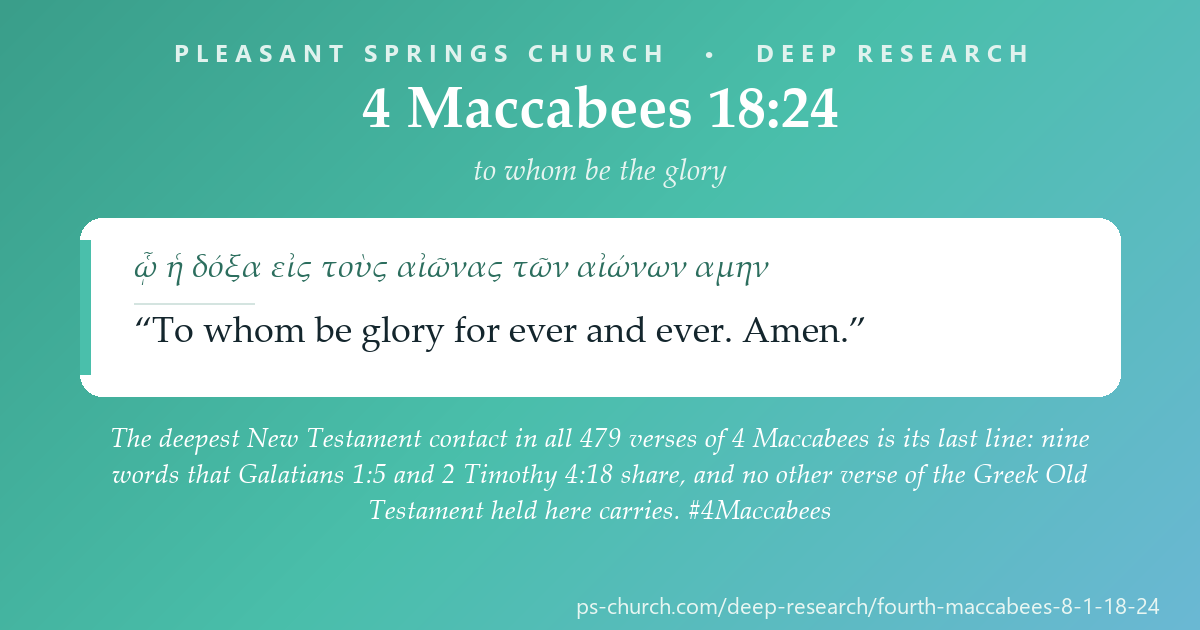
The last verse of the book, and its deepest contact with the New Testament. Nine words, Galatians 1:5 and 2 Timothy 4:18, and no other unit of the 30,348 Greek Old Testament units carries them — nor even the first three, ᾧ ἡ δόξα. See Stage 4.
Versification — stated, as on every page here, including where the usual frame does not exist.
There is no Masoretic text of 4 Maccabees; the book is not in the 1769 King James Apocrypha or the Clementine Vulgate; and no ESV of it is held or licensed here — so there is no MT/LXX/ESV offset to report; the shelf’s versification table has no entry for the book. The offsets that do exist are between the Greek printed and the English printed, and every one was found by reading the English against the Greek:
• Shape. Greek (CATSS): 479 rows; this range 8:1–18:24 is 277 rows (29 · 32 · 20 · 25 · 19 · 27 · 20 · 32 · 25 · 24 · 24). English: 483 rows; the same content is English 7:24–18:24, 281 rows (chapters 8–18: 27 · 32 · 21 · 27 · 20 · 27 · 20 · 32 · 25 · 24 · 24).
• Read row by row. Every one of the 277 Greek rows was read against the English. 224 have an English row with the same label and the same content; 29 more have the same content under a different label (24 in chapter 8, 5 in chapter 12); the other 24 are divided differently; and 3 English rows have no CATSS row at all. The places:
• Chapter 7/8. Greek 8:1 = English 7:24; Greek 8:2 = English 7:25 + 8:1; Greek 8:3–4 = English 8:2–3; Greek 8:5 = English 8:4 + the start of 8:5; Greek 8:6 = the rest of English 8:5; Greek 8:7–27 = English 8:6–26; Greek 8:28–29 = English 8:27.
• Rows only the English has. English 10:3a, 11:6a, 11:6b (eBible’s labels; the 1900 print numbers them 10:4, 11:7, 11:8). The CATSS labels skip 10:4 and 11:7–8: chapter 10 has 20 Greek rows and 21 English, chapter 11 has 25 and 27.
• Chapter 10. Greek 10:8 begins at the end of English 10:7 (“and then haled him to the wheel”).
• Chapter 12. Greek 12:2 = English 12:2 + 12:3; Greek 12:3 + 12:4 = English 12:4; Greek 12:14 = English 12:14 + 12:15; Greek 12:15–19 = English 12:16–20.
• Same count, different division — agreement of count is not agreement of division: Greek 9:24 begins at the end of English 9:23; Greek 16:12 begins at the end of English 16:11; Greek 17:21 runs into English 17:22; Greek 18:5 = English 18:5 + 18:6, Greek 18:6–7 = English 18:7, Greek 18:9 begins at the end of English 18:8; Greek 18:18 + the first five words of 18:19 = English 18:18. Chapters 13, 14 and 15 align row for row. Not counted as divisions: a single verb of speaking that the English puts on the other side of a boundary (“saying” at the end of English 9:22, “he said” at the end of 11:11).
• Canonical verses cited are given in the Greek Old Testament’s own numbering, with the English number where it differs: Psalm 33:20 (English 34:19), Psalm 83:5 (English 84:4), 4 Kingdoms 13:23 (2 Kings 13:23), Exodus 38:5, 38:7 and 38:8 (English 37:6, 37:8 and 37:9), Joshua 9:2e in the B text (English 8:34), Daniel 6:8 in the Old Greek (English 6:7). Daniel 3:24 in the Old Greek is a verse of the Greek addition to chapter 3; English Daniel 3:24 is the Greek 3:91. Every other canonical verse cited has the same number in English Bibles (checked against the Berean Standard Bible held on this disk, which is not quoted).
The Shape of the Passage
Two panels and a close, hinged on a measured refrain — a sequence, not a chiasmThis is NOT offered as a chiasm. The two panels do not run in the same order — the brothers’ denial comes before their deaths, the mother’s after her praise — and nothing in the close mirrors the opening. The diagram claims the refrain and the paired devices it can count, and no more.
⚠️ Where this page sits. 4 Maccabees is not in the Hebrew Bible, the Roman Catholic canon or the King James Apocrypha. This library reads it as a Second-Temple witness and files it under Apocrypha. Nothing taught at Pleasant Springs rests on it.
Author
Anonymous, and in these chapters an orator more than a narrator. He tells the deaths in seven numbered scenes and then stops to argue: the refrain at 13:1 and 16:1 is a philosopher’s therefore. He turns and speaks to the mother — ὦ μήτηρ at 15:29, 16:14 (ὦ μῆτερ), 17:2 and 17:4 — and twice he sets out the speech his characters might have made and did not make (8:16–26; 16:5–11), and then says so (8:27; 16:12).
He writes in Greek, and says when his characters do not: the mother urges her last son on τῇ Εβραί̈δι φωνῇ (12:7) and speaks to her sons ἐν τῇ Εβραί̈δι φωνῇ (16:15). Measured: the phrase stands in those two Greek Old Testament units and no others.
Audience
Jews, addressed as Abraham’s children. The last chapter turns from the dead to the living: ὦ τῶν Αβραμιαίων σπερμάτων ἀπόγονοι παῖδες Ισραηλῖται — O offspring of the seed of Abraham, Israelite children — obey this law (18:1). The epitaph is offered τοῖς ἀπὸ τοῦ ἔθνους εἰς μνείαν, for a memorial to those of the nation (17:8).
Listeners to an argument. The narrator speaks to them in the first person plural — καίτοι λογισώμεθα, yet let us consider (8:16) — and offers the deaths as proof of his thesis. The same deaths are told as history in 2 Maccabees 6–7, and Stage 4 measures how little wording the two tellings share.
Previous: 4 Maccabees 1:1–7:23 (the thesis and Eleazar). This page completes the book.
Orient on the book, on Maccabean martyrdom, and on the vocabulary of 17:21–22.
Search by topic: Maccabees, Fourth Book of; martyr, martyrdom; Antiochus IV Epiphanes; atonement in Second-Temple Judaism; hilasterion / mercy seat; Stoicism and Hellenistic Judaism.
Which articles are relevant?
- Where to look — the Anchor Bible Dictionary, the Eerdmans Dictionary of Early Judaism and the IVP Dictionary of New Testament Background, under the topics above: the Books of Maccabees (4 Maccabees in particular), martyrdom, the mercy seat, atonement and expiation, Hellenistic Judaism. These are topics to look up, not quoted article titles; titles differ from one dictionary to the next, and none was consulted for this page.
- On the text — any article that says which Greek it cites. The English printed here agrees, at the places checked, with a Greek text that differs from the one printed beside it, and at 17:22 the difference falls on the word at the centre of the sentence (see Stage 5).
Bibliography surfaced:
- David A. deSilva, 4 Maccabees: Introduction and Commentary on the Greek Text in Codex Sinaiticus (Septuagint Commentary Series, Brill, 2006).
- David A. deSilva, 4 Maccabees (Guides to Apocrypha and Pseudepigrapha, Sheffield, 1998).
- Moses Hadas, The Third and Fourth Books of Maccabees (1953).
- H. Anderson, “4 Maccabees,” in J. H. Charlesworth, ed., The Old Testament Pseudepigrapha, vol. 2 (1985).
- Jan Willem van Henten, The Maccabean Martyrs as Saviours of the Jewish People: A Study of 2 and 4 Maccabees (1997).
- NETS (the New English Translation of the Septuagint), 4 Makkabees. Not the edition quoted here; named as the obvious next step for a reader.
- Named, not consulted for this page — see Stage 5.
The same family in another book, two lists of the faithful, and a book called by two names.
Where a text is held on this disk it is measured. Where it is not, it was read online on 2026-10-09 and again on 2026-10-10 at the source named, and is reported, not measured.
The same family in 2 Maccabees 7 — what the two tellings share and do not:
- The language they speak. 2 Maccabees has them speak τῇ πατρίῳ φωνῇ, in the ancestral voice — five Greek Old Testament units carry the phrase, all in 2 Maccabees (7:8, 7:21, 7:27, 12:37, 15:29). 4 Maccabees says τῇ Εβραί̈δι φωνῇ, in the Hebrew voice — two units, both in 4 Maccabees (12:7, 16:15). The same detail, and no shared wording for it.
- The mother’s argument. In 2 Maccabees 7:28 she tells her last son that God made heaven and earth οὐκ ἐξ ὄντων [our literal gloss: not out of things that were]. No row of 4 Maccabees carries those three words. Her speeches here argue from Abraham, Daniel and the three in the furnace (16:20–21) and from the Scriptures her husband read (18:10–19).
- The mother’s death. 2 Maccabees gives it one clause, ἐσχάτη δὲ τῶν υἱῶν ἡ μήτηρ ἐτελεύτησεν [our literal gloss: last of the sons the mother died] (7:41). 4 Maccabees 17:1 reports, as some of the guards said, that she threw herself into the fire so that no one should touch her body. The page reports both accounts and adds nothing to either.
- Measured as wording: see Stage 4 — the deepest run between the seven deaths here and the forty-two verses of 2 Maccabees 7 is three words, the same depth a chapter about a battle reaches.
Two lists of the faithful, and a third:
- 1 Maccabees 2:51–60 (held) — Mattathias on his deathbed names Abraham, Joseph, Phinehas, Joshua, Caleb, David, Elijah, Ανανιας Αζαριας Μισαηλ and Daniel. 4 Maccabees 16:20–21 and 18:11–13 name Abraham, Isaac, Abel and Cain, Joseph, τὸν ζηλωτὴν Φινεες, the three in the fire, and Daniel. Names in common: Abraham, Joseph, Phinehas, the three, Daniel. Wording in common: the deepest run between the two lists is three words (ὁ πατὴρ ἡμῶν, our father, said of Abraham at 16:20 and of Phinehas at 1 Maccabees 2:54), and 18:11–13 against 1 Maccabees 2:49–64 reach one word at most.
- Hebrews 11 (SBLGNT) — of the names in these two lists of 4 Maccabees it has Abel and Cain (11:4), Abraham (11:8, 17), Isaac (11:9, 17, 18, 20) and Joseph (11:21, 22). It names neither Phinehas, nor the three, nor Daniel; at 11:33–34 it speaks of those who ἔφραξαν στόματα λεόντων [our literal gloss: stopped mouths of lions] and ἔσβεσαν δύναμιν πυρός [our literal gloss: quenched the power of fire] without naming them.
- The epithet. 4 Maccabees calls Phinehas τὸν ζηλωτὴν, the zealot. Measured: the noun stands in eight Greek Old Testament units; in two it names a man, 2 Maccabees 4:2 and this verse, and in the other six it is said of God (Exodus 20:5, 34:14; Deuteronomy 4:24, 5:9, 6:15; Nahum 1:2).
The book under another name, and its standing:
- Eusebius, Church History 3.10.6 (not held; read online in Arthur Cushman McGiffert’s translation at New Advent, 2026-10-09 and 2026-10-10), of Josephus: “Another work of no little merit has been produced by the same writer, On the Supremacy of Reason, which some have called Maccabaicum…” Reported as Eusebius’s attribution; the page neither adopts nor tests it.
- Date and canon (not held; the Wikipedia article “4 Maccabees,” read 2026-10-09 and 2026-10-10, summarising the scholarship): the book is “generally dated between 20 and 130 CE”; it is in Codex Sinaiticus and Codex Alexandrinus but not Codex Vaticanus; “Historically, the Greek Orthodox Church and the Georgian Orthodox Church printed 4 Maccabees in their Bibles together with the rest of the Old Testament, but this did not entail that they officially considered 4 Maccabees ‘canonical.’ More recently, the Greek Church moved it to an appendix and a recent Georgian Bible marks it as ‘noncanonical.’” By the same summary, it is absent from the Roman Catholic and Protestant Bibles; and the last chapter “differs from the earlier chapters in style,” which the article reports some take as a sign of a later addition, a view it also reports as disputed. Every one of these is reported, not checked. What is checked: no 4 Maccabees in the Clementine Vulgate or the 1769 King James Apocrypha on this disk.
- Philosophy and the games. The book’s word for reason, λογισμός, in its inflected forms stands 115 times in the Greek Old Testament held here and 73 of them are in 4 Maccabees; chapter 17 describes the deaths as a contest with its prize-giver, athletes and crown (17:11–16). The book is commonly read against Greek philosophical, especially Stoic, talk of reason and the passions. Counted here; the philosophical reading is reported, not tested.
A word for the ark’s cover, a word found only here, and the book’s last word.
Every count below is over the CATSS Greek Old Testament files held here — 30,348 verse units screened, the Odes excluded — and the 7,927 verses of the SBLGNT. It is not a count over ‘the Septuagint’. Counts are of word tokens unless the sentence says units or verses.
28 tokens in 21 of the 30,348 Greek Old Testament units. Sixteen of the units are in the Pentateuch (Exodus 25:17–22, 31:7, 35:12, 38:5, 38:7, 38:8; Leviticus 16:2, 13–15; Numbers 7:89), where it is the cover of the ark; three are Ezekiel 43:14, 17 and 20, where it is a ledge of the altar (43:14 has a great one and a small one); one is Amos 9:1, struck at the altar; and one is 4 Maccabees 17:22, the only unit where it is said of a death. The Greek New Testament has it twice: Romans 3:25 and Hebrews 9:5, where it is the ark’s cover under the cherubim. A word for blood stands in the same verse five times: Leviticus 16:14 and 16:15, Ezekiel 43:20, 4 Maccabees 17:22, Romans 3:25.
Two units in the whole Greek Old Testament held here, both in this book: Eleazar’s prayer at 6:29 and 17:21. None in the Greek New Testament. It is ἀντίψυχον — as it were a life-in-exchange — for τῆς τοῦ ἔθνους ἁμαρτίας, the sin of the nation, and those four words stand in no other unit either.
115 tokens in the Greek Old Testament held here; 73 of them in 4 Maccabees, only 17 in these eleven chapters — the argument is front-loaded into chapters 1–7. Two in the Greek New Testament. The phrase ὁ εὐσεβὴς λογισμὸς is the book’s thesis and its refrain (see the diagram).
Eight tokens of the family in the Greek Old Testament held here, all in 4 Maccabees, all between 14:13 and 16:3 — the mother’s panel and nowhere else. The New Testament has the family once, Titus 2:4. Its counterpart in the brothers’ panel, φιλαδελφίαν, is one of six tokens of its family in the Greek Old Testament, five of them 4 Maccabees 13:21–15:10.
One token in the 30,348 Greek Old Testament units, here; none in the New Testament. The English column: “the mother of seven”. Elsewhere the book calls her μήτηρ ἔθνους, mother of a nation (15:29).
Nine tokens in eight of the 30,348 Greek Old Testament units — and two of the eight are the last verses of 3 Maccabees (7:23) and 4 Maccabees (18:24). The Greek New Testament has it 128 times. (Tobit 8:8 is counted in each of its two Greek texts.) CATSS prints the word without accent or breathing, here and in every Greek Old Testament unit that has it; the page prints what the file holds.
Counted here, not assumed:
- The book’s vocabulary of piety and pain. The euseb- family (piety): 96 Greek Old Testament tokens, 60 in 4 Maccabees, 46 of them in chapters 8–18; New Testament 22. The basan- family (torment, and the instruments of it): 99 Greek Old Testament tokens, 69 in 4 Maccabees, 57 in these chapters; New Testament 22. The count takes the family wherever it stands in a word, so it includes the augmented ἐβασανίζετο (15:22) and the compound προβασανισθέντι (8:5, 10:16), which a search on the opening letters alone misses (it finds 90, 66 and 54). It sets aside 61 Greek Old Testament tokens and 4 New Testament ones that merely contain the same letters: the place-name Bashan (Basan) and its region (Basanitis), and compound verbs in -bibazō. The noun ὑπομονῆς, endurance: 25 Greek Old Testament tokens, 11 in 4 Maccabees; 32 in the New Testament.
- The vocative ὦ. Thirty in these eleven chapters, in the mouths of the tyrant, the brothers, the mother and the narrator; four of them are ὦ μήτηρ or ὦ μῆτερ, the narrator speaking to the mother (15:29, 16:14, 17:2, 17:4).
- ἡ θεία πρόνοια, the divine providence, the subject of the sentence at 17:22: in no other Greek Old Testament unit. τοῦ θανάτου αὐτῶν, of their death: in one other, Sirach 27:29.
- The furnace and the den, named not quoted. Ανανιας καὶ Αζαριας καὶ Μισαηλ (16:21) stands word for word in Daniel 3:24 in the Old Greek and in no other unit; the den is ἐν λάκκῳ λεόντων (18:13), three words that stand in no other Greek Old Testament unit.
The deepest run is a nine-word doxology ending in amen. The verse with ἱλαστηρίου shares no two consecutive words with Romans 3:25.
Every row of 4 Maccabees 8–18 screened against all 7,927 verses of the SBLGNT: contiguous runs of whole word forms, accents and breathings dropped, the two editions’ spelling equivalences applied. The tie band — how many New Testament verses reach the same depth — is printed beside every run, and so is the reverse: how many of the 30,348 Greek Old Testament units reach that same depth with the New Testament verse. On this screen a row scores one if it shares any single word; a zero would mean no shared word at all. The Greek-to-Greek comparisons further down (the Scripture in the mother’s speech, 2 Maccabees, Hebrews 11:35) use the same normaliser; against “the rest of the Greek Old Testament” means the 30,348 screened units less the 479 rows of 4 Maccabees itself, 29,869.
The distribution, all 277 rows:
Across the 277 CATSS rows against the 7,927 verses of the Greek New Testament: 260 reach two, 99 reach three, 13 reach four, 4 reach five, 2 reach six, 1 reaches nine, and nothing reaches ten. Seventeen rows share no two consecutive words with any New Testament verse.
By chapter, the deepest run: 8, three · 9, three · 10, three · 11, three · 12, four · 13, five · 14, three · 15, four · 16, six · 17, three · 18, nine. The seven deaths (9:10–12:19, 87 rows) reach no deeper than four; chapter 17, with ἀντίψυχον and ἱλαστηρίου, no deeper than three.
Every row that reaches four or more, all thirteen, with the band from both sides:
| 4 Macc | Shared words | New Testament | Run | NT band | Greek OT units reaching the same depth with that NT verse | What it is |
|---|---|---|---|---|---|---|
| 18:24 | ᾧ ἡ δόξα εἰς τοὺς αἰῶνας τῶν αἰώνων αμην | Galatians 1:5 · 2 Timothy 4:18 | 9 | 2 | 1 · 1 | A doxology — and this verse is the only Greek Old Testament unit either NT verse meets at nine. |
| 16:25 | Αβρααμ καὶ Ισαακ καὶ Ιακωβ καὶ | Luke 13:28 | 6 | 1 | 3 | Three names. Exodus 6:8 and 4 Kingdoms 13:23 carry the same six. |
| 13:17 | Αβρααμ καὶ Ισαακ καὶ Ιακωβ | Matthew 8:11 · Luke 13:28 · Acts 3:13 · Acts 7:32 | 5 | 4 | 18 · 18 · 30 · 23 | The same names: a formula from both sides. |
| 18:10 | ὑμᾶς ἔτι ὢν σὺν ὑμῖν | Luke 24:44 | 5 | 1 | 7 | The five words stand in no other unit of either corpus; see below. |
| 12:8 | καὶ τοῖς σὺν αὐτῷ | Mark 2:26 | 4 | 1 | 49 | And to those with him. |
| 12:18 | καὶ ἐν τῷ νῦν | Romans 11:5 | 4 | 1 | 3 | And in the present… |
| 13:3 | δὲ οὐχ οὕτως ἀλλὰ | Luke 22:26 | 4 | 1 | 1 | Band 1 both ways, and an accident: but not so. |
| 13:13 | ἐξ ὅλης τῆς καρδίας | Mark 12:30 · Mark 12:33 · Luke 10:27 | 4 | 3 | 42 · 17 · 50 | With all the heart: Deuteronomy 6:5 meets Mark 12:30 at 21. |
| 13:15 | τὴν ἐντολὴν τοῦ θεοῦ | Matthew 15:3 · Mark 7:8 · Mark 7:9 | 4 | 3 | 5 · 2 · 2 | The commandment of God. 16:24 measures the same. |
| 15:9 | ἀλλὰ καὶ διὰ τὴν | Romans 13:5 | 4 | 1 | 1 | Band 1 both ways, and a connective. |
| 15:22 | ἡ μήτηρ τῶν υἱῶν | Matthew 20:20 · Matthew 27:56 | 4 | 2 | 1 · 1 | A mother of sons, and an accident: in Matthew she is the mother of Zebedee’s. |
| 16:20 | ὁ πατὴρ ἡμῶν Αβρααμ | John 8:39 | 4 | 1 | 1 | Band 1 both ways: our father Abraham, in a sentence about Isaac. |
| 16:24 | τὴν ἐντολὴν τοῦ θεοῦ | Matthew 15:3 · Mark 7:8 · Mark 7:9 | 4 | 3 | 5 · 2 · 2 | As 13:15. |
The deepest run in the whole book — and what it is:
4 Maccabees 18:24 → Galatians 1:5 and 2 Timothy 4:18 — nine words, tie band 2. ᾧ ἡ δόξα εἰς τοὺς αἰῶνας τῶν αἰώνων αμην [our literal gloss: to whom be the glory for the ages of the ages, amen]. Galatians 1:5: ᾧ ἡ δόξα εἰς τοὺς αἰῶνας τῶν αἰώνων ἀμήν. 2 Timothy 4:18 ends with the same nine: ᾧ ἡ δόξα εἰς τοὺς αἰῶνας τῶν αἰώνων ἀμήν.
From the other side the band is 1: of the 30,348 Greek Old Testament units, this verse is the only one either New Testament verse meets at nine. Where uniqueness begins: ᾧ ἡ δόξα — three words — already stands in one Greek Old Testament unit (this one) and three New Testament verses of the SBLGNT (Galatians 1:5, 2 Timothy 4:18, Hebrews 13:21); εἰς τοὺς αἰῶνας τῶν αἰώνων αμην in one Greek Old Testament unit and eight New Testament verses. Shorter pieces of it are not rare: εἰς τοὺς αἰῶνας τῶν αἰώνων stands in three Greek Old Testament units (Psalm 83:5, Tobit S 14:15, this verse) and eighteen New Testament verses, and the row’s deepest run with any other Greek Old Testament unit is five words, tie band 3 — that phrase in Psalm 83:5 (Psalm 84:4 in English Bibles) and Tobit S 14:15, and ἡ δόξα εἰς τοὺς αἰῶνας in 1 Esdras 5:58. The Odes, held but not screened, carry none of the three phrases above.
Every New Testament count on this page is the SBLGNT’s, and two of these figures depend on it. The SBLGNT apparatus, held here for Romans, shows that this edition does not print Romans 16:25–27, which Westcott–Hort, Tregelles and NA28 print, with hō hē doxa eis tous aiōnas, amēn at 16:27: in those editions the first three words stand in four New Testament verses, while the nine-word count does not move (16:27 lacks tōn aiōnōn). And the SBLGNT’s Hebrews 13:21 ends εἰς τοὺς αἰῶνας ἀμήν, without tōn aiōnōn. Whether other editions read those two words there — which would make Hebrews 13:21 a third verse carrying all nine, and the band 3 — was not checked: the apparatus for Galatians, 2 Timothy and Hebrews is not on this disk.
So the deepest contact in 479 verses is a doxology — a closing formula, not an argument. Its last six words, for ever and ever, amen, stand in eight New Testament verses and in no other Greek Old Testament unit held here. The page does not say who had it from whom; a liturgical ending can be common property, and whether this verse belongs to the book’s earliest form is not something this disk can check (Stage 5).
Five words, and nowhere else in either corpus:
4 Maccabees 18:10 → Luke 24:44 — five words, tie band 1. The mother, of their dead father: ὃς ἐδίδασκεν ὑμᾶς ἔτι ὢν σὺν ὑμῖν τὸν νόμον καὶ τοὺς προφήτας [our literal gloss: who used to teach you, while he was still with you, the law and the prophets]. The risen Jesus, in Luke: Οὗτοι οἱ λόγοι μου οὓς ἐλάλησα πρὸς ὑμᾶς ἔτι ὢν σὺν ὑμῖν [our literal gloss: these are my words which I spoke to you while I was still with you], and he goes on to what is written ἐν τῷ νόμῳ Μωϋσέως καὶ προφήταις καὶ ψαλμοῖς [our literal gloss: in the law of Moses and the prophets and the psalms].
Measured: ὑμᾶς ἔτι ὢν σὺν ὑμῖν stands in one of the 30,348 Greek Old Testament units and one of the 7,927 New Testament verses, and those are the two. But from Luke’s side the band is not 1: seven Greek Old Testament units reach at least five words with Luke 24:44, and one of the seven, Joshua 9:2e in the B text, reaches six — πάντα τὰ γεγραμμένα ἐν τῷ νόμῳ [our literal gloss: all the things written in the law], a formula. This verse is the only one of the seven that meets Luke on these five words.
Beyond the five, the engine sees nothing: 4 Maccabees has τὸν νόμον καὶ τοὺς προφήτας in the accusative, Luke has the law and the prophets in the dative, and different forms do not match. The mother then names texts from Moses, the prophets, David’s hymns and Solomon’s proverbs (18:11–19); Luke’s list is the law, the prophets and the psalms. Five common words in a common construction, in two sentences that recall teaching given while the teacher was still present — and no evidence on this disk of who, if anyone, knew the other. Measured, and not explained.
17:21–22 against Romans 3:25 and Hebrews 9:5:
Romans 3:25: ὃν προέθετο ὁ θεὸς ἱλαστήριον διὰ πίστεως ἐν τῷ αὐτοῦ αἵματι εἰς ἔνδειξιν τῆς δικαιοσύνης αὐτοῦ διὰ τὴν πάρεσιν τῶν προγεγονότων ἁμαρτημάτων [our literal gloss: whom God set forth as a ἱλαστήριον through faith, in his blood, for a demonstration of his righteousness…]. Hebrews 9:5: ὑπεράνω δὲ αὐτῆς Χερουβὶν δόξης κατασκιάζοντα τὸ ἱλαστήριον περὶ ὧν οὐκ ἔστιν νῦν λέγειν κατὰ μέρος [our literal gloss: and above it cherubim of glory overshadowing the ἱλαστήριον; of which we cannot now speak in detail].
Measured: 17:22 against Romans 3:25 is a run of one word. The word-forms the two verses have in common are two single words, διὰ and τῶν, adjacent in neither verse. Both verses also carry the noun ἱλαστήριον and the noun for blood, each in a different case (ἱλαστηρίου / ἱλαστήριον, αἵματος / αἵματι), and the engine, which matches forms, does not count them. 17:21 against Romans 3:25: one. 17:22 against Hebrews 9:5: zero — not one word-form in common, because the one content word the two verses share stands in different cases (ἱλαστηρίου / ἱλαστήριον). What links these verses is vocabulary, not a phrase.
17:22’s own deepest New Testament run is three words, tie band 4: διὰ τοῦ αἵματος, through the blood, with Acts 20:28, Ephesians 1:7 and Colossians 1:20 (and τοῦ αἵματος τῶν with Revelation 17:6). From the other side it is not distinctive: at three words, Ephesians 1:7 meets 7 of the 30,348 Greek Old Testament units, Acts 20:28 meets 44, Revelation 17:6 59 and Colossians 1:20 283. The exact three words διὰ τοῦ αἵματος stand in one Greek Old Testament unit, this one. Three common Greek words; the page reports the distribution and draws nothing from it. 17:21 reaches only two words with any New Testament verse (tie band 189).
Against the rest of the Greek Old Testament, 17:22 also reaches three words, tie band 4, and one of the four is Ezekiel 43:14, where τοῦ ἱλαστηρίου τοῦ is said of a ledge of the altar. The verse’s wording is, by this measure, its own.
It will say what the Greek reads. The sons became ὥσπερ ἀντίψυχον, as it were a life-in-exchange, for the sin of the nation; and through the blood of those pious ones and τοῦ ἱλαστηρίου τοῦ θανάτου αὐτῶν the divine providence τὸν Ισραηλ προκακωθέντα διέσωσεν, preserved Israel, which had been afflicted before. It will say how the words are distributed, as above and in Stage 3.
It will not identify this sentence with the New Testament’s teaching about the death of Christ, nor set one against the other. That is a question of meaning, which the run engine cannot reach, and on which this church reads Romans 3:21–26 from Romans (see the Romans 3:21–26 study). What the measurement shows is narrow: two nouns in common with Romans 3:25 (ἱλαστήριον and blood) and one with Hebrews 9:5 (ἱλαστήριον), each in a different case, and no shared phrase.
⚠️ The page’s own counter-examples — where depth and meaning come apart:
16:25 → Luke 13:28 — six words, tie band 1, the deepest run in the mother’s chapters. Αβρααμ καὶ Ισαακ καὶ Ιακωβ καὶ — and Ἀβραὰμ καὶ Ἰσαὰκ καὶ Ἰακὼβ καὶ. A list of names, which Exodus 6:8 and 4 Kingdoms 13:23 carry too. Now the sentence around it: οἱ διὰ τὸν θεὸν ἀποθνῄσκοντες ζῶσιν τῷ θεῷ [our literal gloss: those who die for God's sake live to God]. Luke 20:37–38 names the same three and says πάντες γὰρ αὐτῷ ζῶσιν [our literal gloss: for all live to him] — and against Luke 20:38 the run is one word. The deep run is the formula; the shared thought measures one. ζῶσιν τῷ θεῷ stands in two Greek Old Testament units, both 4 Maccabees (7:19, 16:25), and in no New Testament verse.
15:22 → Matthew 20:20 and 27:56 — ἡ μήτηρ τῶν υἱῶν, the mother of the sons, four words, band 2 one way and 1 the other. Here she is the mother of the seven, tormented with them; in Matthew she is the mother of Zebedee’s sons. And 13:3 → Luke 22:26 (δὲ οὐχ οὕτως ἀλλὰ, but not so) and 15:9 → Romans 13:5 (ἀλλὰ καὶ διὰ τὴν) are band 1 from both sides and mean nothing. The page prints them so that a band of 1 is not read as more than it is.
The mother’s Scripture, measured against the Greek it names:
Against the 29,869 other Greek Old Testament units, 4 Maccabees 8–18 reaches: 268 rows two words, 122 three, 24 four, 9 five, 2 six, 1 eight, and nothing nine. (Read form for form, without folding the movable nu: 121 three and 23 four; nothing else changes.) The deepest row is 17:19, where the narrator says καὶ γάρ φησιν ὁ Μωυσῆς [our literal gloss: for Moses also says]. The deepest Greek Old Testament contact is where the text names its source; the deepest New Testament contact is a doxology that ends in amen.
18:14–19 names five texts. The three rows before them only name people — Abel and Cain, Isaac, Joseph, Phinehas, the three, Daniel (18:11–13) — and against the Greek Old Testament they reach four words at most, all of them small words. The rows that carry words are these (with 17:19, which the narrator introduces the same way):
| 4 Macc | Named | The Greek it names (CATSS) | Run | Band | Verdict |
|---|---|---|---|---|---|
| 17:19 | Moses says | Deuteronomy 33:3: καὶ πάντες οἱ ἡγιασμένοι ὑπὸ τὰς χεῖράς σου | 8 | 1 | Word for word, eight words, which stand in these two units only. The next row, 17:20, opens with καὶ οὗτοι, and these, which are also the next two words of Deuteronomy 33:3 — two common words, together in 84 of the 30,348 Greek Old Testament units. |
| 18:14 | the writing of Isaiah | Isaiah 43:2: καὶ ἐὰν διέλθῃς διὰ πυρός οὐ μὴ κατακαυθῇς φλὸξ οὐ κατακαύσει σε | 4 | 1 | Word for word only at the end: φλὸξ οὐ κατακαύσει σε. Before it, the same words in another order, with κἂν for Isaiah’s καὶ ἐὰν, and Isaiah’s middle clause, you shall not be burned, absent. |
| 18:15 | David the hymn-writer | Psalms 33:20: πολλαὶ αἱ θλίψεις τῶν δικαίων | 5 | 1 | Word for word, the first half of the verse (Psalm 34:19 in English Bibles). |
| 18:16 | Solomon | Proverbs 3:18: ξύλον ζωῆς ἐστι πᾶσι τοῖς ἀντεχομένοις αὐτῆς | 3 | 1 | Three words, then a different sentence. The third word differs only by a movable nu (ἐστιν / ἐστι), which this page’s normaliser folds. Read form for form without that fold, the run is two words and 87 units reach it. ESV, translating the Hebrew: “She is a tree of life to those who lay hold of her; those who hold her fast are called blessed.” |
| 18:17 | Ezekiel | Ezekiel 37:3: εἰ ζήσεται τὰ ὀστᾶ ταῦτα | 4 | 2 | Two adjacent verses in one question: 37:3’s question, with the words τὰ ὀστᾶ τὰ ξηρά, the dry bones, which stand in 37:4, inside it. The band of 2 is those two verses. |
| 18:19 | the song which Moses taught (18:18) | Deuteronomy 32:39: ἐγὼ ἀποκτενῶ καὶ ζῆν ποιήσω | 5 | 3 | Three verses of Deuteronomy in one sentence: five words of the song (32:39), then αὕτη ἡ ζωὴ ὑμῶν (32:47, after the song ends), then καὶ ἡ μακρότης τῶν ἡμερῶν (30:20, before it begins). Each piece is word for word, and the band of 3 is those three verses. |
So, of the five in the mother’s speech: one word for word (the psalm); two that match pieces of more than one verse, each piece word for word (Ezekiel 37:3–4; Deuteronomy 32:39, 32:47 and 30:20); one word for word only at its end (Isaiah); and one that shares three words and then reads something else (Proverbs). The narrator’s line at 17:19 is word for word. For all six rows the text named is where the measurement finds the row’s deepest Greek Old Testament contact, and nothing else reaches that depth: band 1 four times, and for Ezekiel and the song the band is the named book’s own verses. Whether a line differs because it was recited, or because it was read in a Greek text unlike this one, the page cannot tell — the measurement can say only how close each line stands to the Greek held here.
The names in 18:11–13, measured against the chapters they recall — none is quoted, and none comes closer than two words. Abel slain by Cain, against Genesis 4: one word. Isaac, against Genesis 22: two at most, among them Ισαακ καὶ; and the participle ὁλοκαρπούμενον, offered whole, stands in no other Greek Old Testament unit, while Genesis 22 has the noun of the same family six tokens over (ὁλοκάρπωσιν at 22:2; also 22:3, 6, 7, 8, 13). Joseph ἐν φυλακῇ, in prison, against Genesis 39–42: two at most, and those two words are one such pair — Genesis 40:3, 41:10, 42:17 and 42:30 have them. Phinehas, against Numbers 25: one word; Numbers 25:11 has the verb and noun of zeal, not the title ζηλωτὴν. The three, against Daniel 1–3 in either Greek: two at most, among them καὶ Μισαηλ. Daniel, against Daniel 6 in either Greek: at most two — the Old Greek says εἰς τὸν λάκκον τῶν λεόντων, with the articles, where 18:13 has ἐν λάκκῳ λεόντων. Named, not quoted.
2 Maccabees 7 — the same seven, measured as contact and not as dependence:
Every row of 4 Maccabees 8–12 (125 rows) against every row of 2 Maccabees 7 (42): all 125 reach one, 72 reach two, 4 reach three, and nothing reaches four. The four threes are τοῖς ἀδελφοῖς σου (10:13 / 7:29), καὶ ἐπὶ τοῖς (10:2 / 7:6), ἦγον ἐπὶ τὸν (10:8 / 7:7) and καὶ τὸ πνεῦμα (11:11 / 7:23). The first is a fair sample: in 2 Maccabees the mother tells her youngest son to accept death so that she may receive him back σὺν τοῖς ἀδελφοῖς σου, with your brothers; in 4 Maccabees the guards tell the fourth son not to share τοῖς ἀδελφοῖς σου their madness.
The control. The same 125 rows against other chapters of 2 Maccabees that tell other things: against chapter 15 (Nicanor’s defeat, 39 rows), also 4 rows reach three and none four; against chapter 8, 2 rows reach three; chapter 9, none; chapter 10, one; chapter 12, two. Against chapter 6, Eleazar’s chapter, one row reaches four — τῆς ἡλικίας καὶ τῆς, of age and of, at 8:10. The seven deaths share no more consecutive wording with the chapter that tells the same seven deaths than with a chapter about a battle.
Depth is not rarity, so the threes were counted across the whole Greek Old Testament too. Of the four with chapter 7, two are common strings (καὶ ἐπὶ τοῖς stands in 13 of the 30,348 units, καὶ τὸ πνεῦμα in 19) and two are rare: τοῖς ἀδελφοῖς σου stands in three units (Genesis 45:17 and these two), and ἦγον ἐπὶ τὸν in two, 2 Maccabees 7:7 and 4 Maccabees 10:8. But the battle chapter has as many rare threes: three of its four (καὶ εἰ μὲν, τὰ τῆς ἀρετῆς, τὸν τρόπον καὶ) stand in two units each. The one shared string with the same thing in it is ἦγον ἐπὶ τὸν: a brother led to torment, ἦγον ἐπὶ τὸν ἐμπαιγμὸν [our literal gloss: they led him to the mockery] in one book and ἦγον ἐπὶ τὸν τροχόν [our literal gloss: they led him to the wheel] in the other. Three words, two units; the page reports it and does not build on it.
The 2 Maccabees 6–10 study on this shelf measured the same from the other side: nothing in 2 Maccabees 6–7 reaches five with any row of 4 Maccabees. The measurement says how much wording is shared; it does not say that either author had the other’s text.
Hebrews 11:35 against both books:
ἔλαβον γυναῖκες ἐξ ἀναστάσεως τοὺς νεκροὺς αὐτῶν ἄλλοι δὲ ἐτυμπανίσθησαν οὐ προσδεξάμενοι τὴν ἀπολύτρωσιν ἵνα κρείττονος ἀναστάσεως τύχωσιν [our literal gloss: women received their dead by resurrection; and others were tortured, not accepting the release, that they might attain a better resurrection]
Measured: against all 479 rows of 4 Maccabees, Hebrews 11:35 reaches one word, never two; against all 555 rows of 2 Maccabees, also one. The 2 Maccabees 6–10 study found what Hebrews 11:35 shares with 2 Maccabees instead: two families of words, the tympan- of its verb (the noun τύμπανον at 2 Maccabees 6:19 and 6:28) and the noun anastasis, resurrection (ἀνάστασις, 7:14). Re-measured here: 4 Maccabees has no tympan- word and no form of anastasis in any of its 479 rows; the only word of the whole anist-/anast- family in the book is ἐξανίσταιτο (6:8), of Eleazar made to get up when he falls. The book that retells these deaths at the greatest length has neither of the two words in Hebrews 11:35 that the 2 Maccabees study traced.
The whole book, as a closing summary:
All 479 rows of 4 Maccabees against the 7,927 New Testament verses: 451 reach two, 153 reach three, 19 reach four, 5 reach five, 2 reach six, 1 reaches nine, and nothing reaches ten. Thirteen of the nineteen fours, and four of the five fives, are in chapters 8–18; the fifth five is 7:19, the patriarchs’ names again. No New Testament verse in the table above names 4 Maccabees as the source of the wording it shares with it — checked by reading, since the engine does not look for citation formulas; Mark 12:30 and Luke 10:27 give their four shared words inside the commandment of Deuteronomy 6:5 — and the runs give no sign that one should: the book’s two deepest contacts are a doxology and a list of names, and its one five-word contact found in no other verse of either corpus is an ordinary construction in a sentence about a teacher.
What this page could not check, which Greek the English agrees with, and where the page is weakest.
This is the section that makes the shelf trustworthy. Read it before quoting anything above.
⚠️ The English column agrees with a different Greek text — shown, not assumed:
The 1900 Bagster volume prints its own Greek beside this English, and it is not the CATSS (Rahlfs) text printed here. A scan of that volume is held as uncorrected OCR, and the Swete file (no provenance file, visible OCR damage) is a third Greek text of the book. Neither is printed or screened; their readings are given below in transliteration. The self-check reads both at the places below and confirms each statement.
- 17:22. CATSS: τοῦ ἱλαστηρίου τοῦ θανάτου αὐτῶν, the article twice. The 1900 Greek column and the Swete file: no article before θανάτου — which makes the word an adjective, and the English says “their propitiatory death”.
- 17:21–22, the division. The Swete file ends 17:21 at καθαρισθῆναι and opens 17:22 with ὥσπερ ἀντίψυχον, exactly where the English divides.
- 18:16. CATSS has no word for all before τοῖς ποιοῦσιν (Proverbs 3:18 has πᾶσι); the 1900 Greek column and the Swete file have pasin, and the English has “to all those”.
- 18:6. CATSS: καὶ ταῦτα τὰ δικαιώματα [our literal gloss: these ordinances too]. The 1900 Greek column and the Swete file read hē dikaia, the righteous one; the English (its 18:7): “the righteous mother”.
- 9:8. CATSS ends the verse καὶ ἐσόμεθα παρὰ θεῷ δι' ὃν καὶ πάσχομεν [our literal gloss: and we shall be with God, for whose sake we also suffer]; the English and the Swete file lack the clause, and the Swete file’s verb is oisomen where CATSS has ἕξομεν (the English: “shall bear off”).
- 10:4, 11:7, 11:8. CATSS has no rows with these labels. The English has three sentences there (eBible labels them 10:3a, 11:6a, 11:6b; the 1900 print numbers them 10:4, 11:7, 11:8), and the Swete file has Greek for all three.
- Four more, found while aligning every row — in each the English and the Swete file agree against CATSS. 8:2: CATSS ἐκ τῆς λείας [our literal gloss: from the spoil]; Swete ek tēs hēlikias; the English “the adult Hebrews” (English 8:1). 9:2: CATSS συμβούλῳ Μωυσεῖ [our literal gloss: Moses as counsellor]; Swete symboulō kai gnōsei; the English “take knowledge for our guide”. 11:5: the English opens “Does it seem evil to thee”, Swete ē kakon soi dokei, and CATSS has no such words. 12:16: CATSS ἀριστείας [our literal gloss: valour]; Swete martyrias; the English “testimony” (English 12:17).
- 18:19, and the limit of the method. The English reads “This is our life, and the length of our days”. CATSS has ὑμῶν (your) and μακρότης (length); the 1900 Greek column, as OCR, reads hēmōn (our) and makariotēs (blessedness); the Swete file hymōn and makariotēs. So the English agrees with the 1900 Greek column in one word, with CATSS in the other, and with the Swete file in neither — or an OCR has misread a letter. This disk cannot tell which.
Consequence: where the two columns disagree, the page flags it; but the readings were not collated against a critical text — every row of the two columns was read side by side to align them, and readings were noted where they showed. There may be more.
⚠️ A fault in the shelf’s own verse map — reported, not buried:
The provenance file for this English says that English 12:16 + 12:17 = Greek 12:16, and English 12:18–20 = Greek 12:17–19. The first half is wrong. Read by content: English 12:14 and 12:15 together are Greek 12:14 (σὺ δὲ κακῶς οἰμώξεις is the English 12:15, “But thou shalt groan”); English 12:16 is Greek 12:15; English 12:17 is Greek 12:16. The second half (English 12:18–20 = Greek 12:17–19) is right. The file also misses two redivisions in the chapters it does map — Greek 12:2–4 and Greek 10:7–8 — and it says chapters 9 and 13–18 align because their counts and first and last verses agree, which is true, while inside them the English divides differently at 9:23–24, 16:11–12, 17:21–22, 18:5–9 and 18:18–19. The full mapping, as read, is in the Versification note above. Reported for the file’s owner; not patched from this page.
⚠️ What this page could NOT check:
- Anything Hebrew or Aramaic. 4 Maccabees is not in the Masoretic corpus, so the acrostic and Hebrew-parallel screens cannot run on it. That the book was composed in Greek is the common view; it is reported, not tested.
- Any manuscript evidence. No critical apparatus is held. Which manuscripts read the second article at 17:22, or carry 10:4 and 11:7–8, is not known to this page. The two other Greek texts on disk are digitisations of printed editions, not of manuscripts.
- Whether chapter 18 and its doxology belong to the book’s earliest form. The Wikipedia article reports a debate over whether the last chapter is a later addition. The page’s headline rests on 18:24, and nothing here can settle that. All three Greek texts on this disk carry the doxology; that is all that is checked.
- The commentaries. deSilva, Hadas, Anderson and van Henten are named in Stage 1 and were not consulted. Neither was any commentary on Romans 3:25, Luke 24:44 or Galatians 1:5.
- Eusebius and the Wikipedia summary were read online on 2026-10-09 and again on 2026-10-10, and are reported, not measured: the date of the book, its manuscripts, its canon standing, the Josephus attribution, the Stoic reading.
- Allusion. The run engine sees consecutive identical word forms. A run of one between 17:22 and Romans 3:25 is not a finding that the two are unrelated, and a run of five between 18:10 and Luke 24:44 is not a finding that they are related.
⚠️ Where this page is weakest:
- Its headline is a formula. Nine words of doxology are the deepest contact in the book, and a doxology is exactly the kind of wording that travels without anyone reading anyone. The page says so in the same breath as the number.
- Its rarest contacts are small. Through the blood (three words) stands in no other Greek Old Testament unit, you, while still being with you (five) in no other unit of either corpus, and they led him to the (three) in two units. A larger body of Greek would very likely find them elsewhere; this page does not hold one.
- The English is quotation, and agrees with a different Greek. It is the only English of the book on disk, it is printed with its own labels, and the section above shows eight readings in which its Greek is not the Greek beside it, one place where the two divide a sentence differently, three sentences the Greek beside it lacks, and one place it cannot resolve. It is a weaker column and it is marked as one.
- The 2 Maccabees comparison is forms-only, and a retelling in its own words scores low by design. The control chapters are similar in size, not identical, and the rarity test above is a count of units, not a judgement of which strings mean something.
- One normaliser choice moves a verdict. Solomon’s line at 18:16 is three words with Proverbs 3:18 and band 1 when a movable nu is folded, two words and band 87 when it is not. The page prints both; it chose the fold because the shelf’s New Testament screen and its verse-pair tool use it.
- The structure diagram claims only what it counts: one refrain, two paired devices, two love-words. The panel reading around them is a reading.
Commentaries & studies:
- David A. deSilva, 4 Maccabees: Introduction and Commentary on the Greek Text in Codex Sinaiticus (Brill, 2006).
- David A. deSilva, 4 Maccabees (Sheffield, 1998).
- Moses Hadas, The Third and Fourth Books of Maccabees (1953).
- H. Anderson, “4 Maccabees,” in The Old Testament Pseudepigrapha, vol. 2 (1985).
- Jan Willem van Henten, The Maccabean Martyrs as Saviours of the Jewish People (1997).
- Eusebius, Church History 3.10.6 (McGiffert, NPNF) — read online.
A mother who recalls her husband’s Scripture, and a book that ends in words the New Testament’s letters use.
Name what you learned, why it matters, and one concrete response.
What should we carry away — and do?
- Depth is not weight. The deepest New Testament contact in 4 Maccabees is a nine-word doxology ending in amen; the sentence about blood and ἱλαστηρίου shares no two consecutive words with Romans 3:25, though both verses carry that noun and the noun for blood, in different cases. Measure before you repeat a parallel, in either direction.
- The same story, none of the same sentences. The seven deaths here share no more consecutive wording with 2 Maccabees 7 than with a chapter about a battle. Two tellings of one event can share almost no words; a count of shared words measures wording, not whether the event happened or who knew whom.
- Her lines of Scripture are close, and not always word for word. One of the five in her speech stands word for word inside one verse of the Greek held here; two more match exact pieces of more than one verse; one meets its text word for word only at the end (Isaiah), and one shares three words and then reads something else (Proverbs). In this book the father reads and teaches the Scriptures to his sons, and at the end the mother recalls them to the sons.
- Not Scripture, and read as a witness. This book shows how a Jewish writer, commonly dated to the first or early second century, spoke about faithful deaths. For what the death of Christ accomplished, this church goes to the New Testament itself.
- One concrete response. The father in 18:10 taught his children the law and the prophets ἔτι ὢν σὺν ὑμῖν, while he was still with them. This week, read Psalm 34 aloud at home — the psalm whose line, by the mother’s account at 18:15, their father sang to them.
4 Maccabees 18:24 · to share
Greek (CATSS) · English: anonymous translation in Bagster’s Septuagint with Apocrypha (c. 1900), public domainEvery Deep Research page traces its passage across the whole sweep — the Old Testament, the Second-Temple world between the testaments (historical witnesses, not Scripture), and the New Testament. Follow the thread:
Pleasant Springs Church — Deep Research
Research method after Michael S. Heiser’s Bible Research Method (examine dictionaries → ancient literature → important words → textual connections → academic publications → share), with the Pleasant Springs “Author & Audience” foundation. Scripture set in the Hebrew, the Greek editions named on each page and the ESV (Old Testament), and the Greek New Testament and the ESV (New Testament), per the practice of Pleasant Springs Church. ⚠️ Status: 4 Maccabees is not part of the Protestant canon, nor of the Roman Catholic, and is absent from the Hebrew Bible; by the summary quoted on this page, the Greek Orthodox Church, which once printed it in its Bibles, moved it to an appendix. This study is filed under Apocrypha and nothing taught at Pleasant Springs rests on it. Greek text: the CATSS morphologically analysed Septuagint (Rahlfs), quoted at verse level with attribution; every row count, word count, run depth and tie band was re-derived from 4Macc.mlxx and the other CATSS files for this study. Greek New Testament: SBLGNT via MorphGNT. English: the anonymous translation printed in Bagster’s Septuagint with Apocrypha (London, c. 1900), made for that edition and not Brenton’s own; public domain, quoted from eBible.org’s verse-per-line digitisation held on this disk; every English line is read from that file when the page is built and checked against it by the page’s self-check. No ESV of 4 Maccabees is held or licensed here, and the 1769 King James Apocrypha and the Clementine Vulgate do not contain it; New Testament and Greek Old Testament verses are given in Greek with our own literal gloss, marked as such, except Proverbs 3:18 (ESV, from the copy held here). Checked online, 2026-10-09 and 2026-10-10: Eusebius, Church History 3.10.6 (New Advent) and the Wikipedia article “4 Maccabees.” Direction of influence is nowhere asserted.
Scripture quotations marked ESV are from the ESV® Bible (The Holy Bible, English Standard Version®), © 2001 by Crossway, a publishing ministry of Good News Publishers. ESV Text Edition: 2016. Used by permission. All rights reserved. The ESV text may not be quoted in any publication made available to the public by a Creative Commons license, and the ESV may not be translated in whole or in part into any other language. www.esv.org
|
Did this study bless you today? 💚 Give to Support PS Church100% of gifts go to the General Fund — thank you. |