Fourth Maccabees opens like a lecture. Its first sentence announces a most philosophical proof — that ὁ εὐσεβὴς λογισμός, devout reason, is master of the passions — and its first seven chapters make the case twice: with definitions and with Joseph, Moses, Jacob and David, and then with the death of an old priest named Eleazar under Antiochus IV. The same death is told in 2 Maccabees 6:18–31, and both Greek accounts are on this disk. Set row against row, they share four consecutive words exactly twice — both times about the old man’s age, and both times the words 2 Maccabees gives its narrator, 4 Maccabees gives the king. What the book does repeat is its own phrase: devout reason, seven times, and nowhere else in the Greek Old Testament held here. It is not Scripture for us; it is filed with the Apocrypha, and nothing taught here rests on it. There is no Hebrew, no ESV, no King James and no Vulgate text of this book; the English beside the Greek is an anonymous translation printed by Bagster about 1900, and the page says what that costs. See the method →
4 Maccabees is a Jewish discourse in Greek — part philosophical argument, part praise of martyrs. The Bagster introduction held on this disk calls it “more probably the work of an Alexandrian Jew written during the century before the fall of Jerusalem”; the Wikipedia summary named below calls it “a book written in Koine Greek” and dates it “between 20 and 130 CE”. The commentaries named in Stage 5 were not consulted. It is not in the Hebrew Bible, not in the Roman Catholic canon, and not among the Apocrypha of the King James Bible; Rahlfs’ Septuagint, the edition the Greek on this page encodes, prints it. On its standing elsewhere this page follows one named summary, the Wikipedia article “4 Maccabees” (read 10 October 2026), and checks none of its claims (the quotations were re-read against the live article on 10 October 2026, but it is not saved on this disk, so they are NOT VERIFIABLE FROM LOCAL CORPORA): the Greek and Georgian churches “printed 4 Maccabees in their Bibles together with the rest of the Old Testament”, “but this did not entail that they officially considered 4 Maccabees ‘canonical’”; “the Greek Church moved it to an appendix and a recent Georgian Bible marks it as ‘noncanonical’”; and “the Syriac, Coptic, and Ethiopic language Oriental Orthodox Churches do not include the book as canonical either.” So, by that summary, it has been printed in some Bibles and is officially canonical in none of the churches the article names. It is not Scripture for us. We read it the way we read the other Second-Temple books — as a window into the world the New Testament was written in, here into how a Greek-speaking Jew defended the Law in the language of the philosophers. The book describes torture in detail; this page describes it only as far as the argument needs, and tests everything by the canon.
⚠️ What this page can and cannot measure — read this first.
HELD: the Greek of 4 Maccabees in full (CATSS 4Macc.mlxx, 479 rows in 18 chapters, every label parsing; this study is its first 202 rows); the Greek of 2 Maccabees (555 rows), which tells Eleazar’s death at 6:18–31; the whole Greek Old Testament as CATSS files (30,348 units screened, the Odes excluded by house rule); the Greek New Testament (7,927 verses, SBLGNT); and the English named in the column above (483 rows).
NOT HELD: any Hebrew or Aramaic 4 Maccabees — none is known, and the Wikipedia summary named above calls it “a book written in Koine Greek” (reported, not measured; the commentaries were not consulted); a Latin 4 Maccabees — the Clementine Vulgate on this disk has no 3 or 4 Maccabees; a King James text — the 1769 KJV Apocrypha does not contain the book; an ESV; the Syriac; and any manuscript or critical apparatus — the CATSS file is Rahlfs’ running text only.
CONSEQUENCE: every Hebrew-side screen this shelf owns is impossible here; everything measured on this page is Greek against Greek, contiguous runs of whole word forms, and it finds verbatim contact — not allusion, not paraphrase, not dependence.
4 Maccabees 1:1–7:23 — fourteen rows
Greek: 4 Macc (CATSS), the whole row every time · English: anonymous translation in Bagster’s Septuagint with Apocrypha (c. 1900), public domain · English label printed on every lineThe proposition, and the first of seven. The three words ὁ εὐσεβὴς λογισμός — devout reason — stand seven times in the 30,348 Greek Old Testament units screened here, and all seven are in this book. The English renders them “religious reasoning.”
The plan of the whole book in one sentence: Eleazar, the seven brothers, their mother. This study ends with Eleazar; the brothers begin at Greek 8:1.
λέγει γοῦν ὁ νόμος — the law says. The seven bold words are the deepest run anywhere in these chapters against the rest of the Greek Old Testament: Exodus 20:17 and Deuteronomy 5:21, tie band 2. And it is a place where the book itself names its source: the commandment’s first seven words and its last five (ὅσα τῷ πλησίον σού ἐστιν), joined by nor, and none of the list of house, field, servants and beasts that stands between them in Exodus and Deuteronomy.
Introduced with λέγων — saying. Four words, tie band 1 among the Greek Old Testament units outside 4 Maccabees: Genesis 49:7. Seen from Genesis 49:7, four words is a tie with three prophetic lines (band 4).
Two young soldiers. In Greek 2 Kingdoms (= 2 Samuel) 23:16 they are οἱ τρεῖς δυνατοὶ, the three mighty men. Across 4 Maccabees 3:6–18 — thirteen rows — not one shares two consecutive words with 2 Kingdoms 23:13–17.
ἔσπεισεν, he poured out: one of the very few words 4 Maccabees’ telling shares with both canonical accounts. They pour it out τῷ κυρίῳ, to the Lord; 4 Maccabees, τῷ θεῷ, to God.
Four words shared with 2 Maccabees 3:3, which reads Σέλευκον τὸν τῆς Ἀσίας βασιλέα — tie band 1 seen from either book. 2 Maccabees gives the king no epithet; 4 Maccabees calls him Νικάνορα.
Antiochus speaking. The bold words are one of the only two places where 4 Maccabees 5–7 and 2 Maccabees 6:18–31 share four words in a row — tie band 1 seen from either side. In 2 Maccabees 6:18 they are the narrator’s (Eleazar προβεβηκὼς τὴν ἡλικίαν καὶ τὴν πρόσοψιν τοῦ προσώπου κάλλιστος, advanced in age, and in the look of his face most handsome); here they are the king’s. And note the English numbering: its verse 5:6 carries Greek 5:6 and 5:7 together.
The king again — and the second four-word contact, with 2 Maccabees 6:23 (band 1 from this side; band 2 from the other, whose second partner is 4 Maccabees 8:10, the king again, to the seven brothers). 2 Maccabees’ narrator says of Eleazar λογισμὸν ἀστεῖον ἀναλαβὼν καὶ ἄξιον τῆς ἡλικίας, having taken up a noble reasoning, and one worthy of his age; here the king tells him ἄξιον τῆς ἡλικίας ἀναλαβὼν νοῦν, taking up a mind worthy of your age. The noun in 2 Maccabees’ sentence is λογισμὸν — the word 4 Maccabees is built on. 2 Maccabees has it twice in all, both of its martyrs: here, and of the mother of the seven at 7:21. Both carry ἀναλαβὼν right beside the run — 2 Maccabees before it, 4 Maccabees after it — which is why the run stops at four.
ἐγκράτεια, self-control: its only occurrence in the 30,348 Greek Old Testament units screened here. The Greek New Testament has the noun four times (Acts 24:25; Galatians 5:23; 2 Peter 1:6, twice).
Eleazar’s prayer for his people. καθάρσιον stands nowhere else in the Greek Old Testament held here; ἀντίψυχον only here and at 17:21. Neither word is in the Greek New Testament. The prayer asks that one man’s death be accepted for a nation; that is a claim about atonement, and the page records what the Greek says without adopting it. Stage 4 prints what the screen finds when this verse is set beside the New Testament.
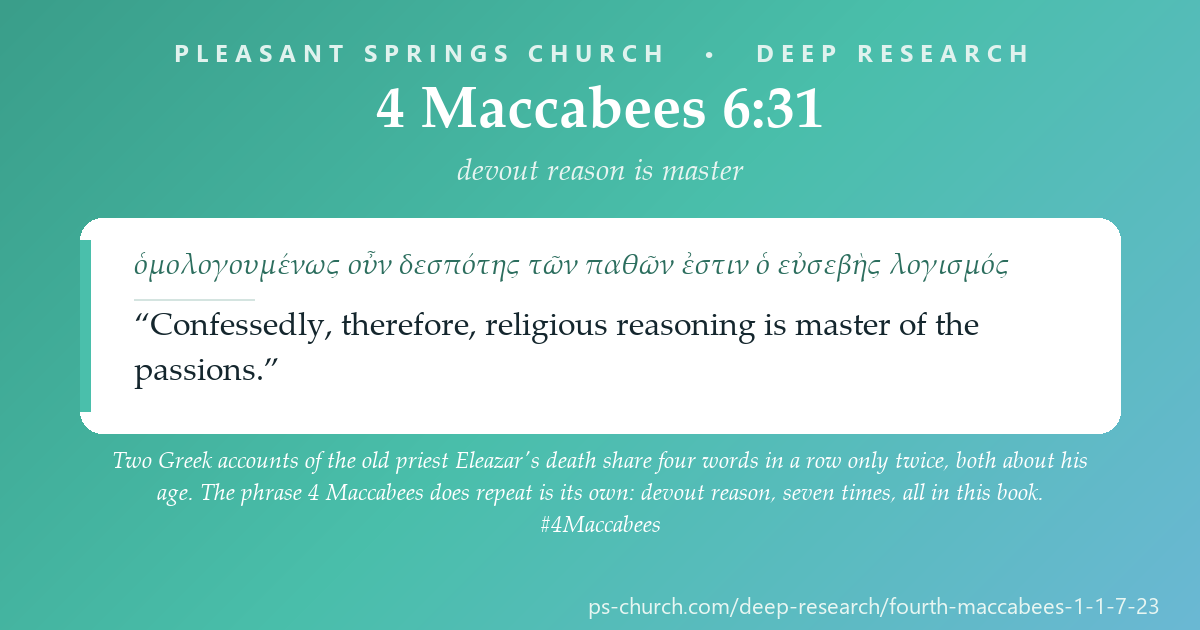
The formula returns — the second of seven — as soon as Eleazar is dead. ὁμολογουμένως, confessedly, stands three times in the Greek Old Testament held here, all in 4 Maccabees, and each introduces a conclusion drawn from tortures unto death (6:31, 7:16, 16:1) — Eleazar’s twice, and at 16:1 the seven brothers’, which their mother endured seeing.
The third of seven, and the second “confessedly” — the close of the case built on the old priest.
The deepest New Testament run anywhere in these seven chapters is in this verse — and it is five words of names, Αβρααμ καὶ Ισαακ καὶ Ιακωβ, tie band 4 (Matthew 8:11, Luke 13:28, Acts 3:13, 7:32). Every one of those four reaches six words with some other Greek Old Testament verse. The clause ζῶσιν τῷ θεῷ, they live to God, shares one word with Luke 20:38.
⚠️ The English label is printed on every line because it is not always the Greek one. The two agree on the verse count in chapters 1–6, but at Greek 5:7 the English verse carrying the sentence is numbered 5:6. The Versification note below gives every place in these chapters where the two divide differently.
Versification — stated, as on every page here, and here it is a third kind.
There is no Masoretic text and no ESV, so there is no MT/LXX/ESV offset to report. What exists is two witnesses, counted:
• Greek (CATSS 4Macc.mlxx): 479 rows, 1:1–18:24, no lettered, conflated or verse-only labels. This study is 1:1–7:23: 202 rows, 35·24·21·26·38·35·23, and 3,346 Greek words.
• English (Bagster, c. 1900, eBible text): 483 rows; chapters 1–7 run 35·24·21·26·38·35·25. The English puts the chapter break two verses later: its 7:24–25 carry Greek 8:1 and the first half of Greek 8:2. So this study, Greek 1:1–7:23, is English 1:1–7:23, and the next one begins at Greek 8:1 = English 7:24.
• Same count is not same division. Inside the range, 192 of the 202 labels carry the same sentence in both. The other ten: English 2:12 carries Greek 2:12 and 2:13, and Greek 2:14 is split across English 2:13–14; English 5:6 carries Greek 5:6 and 5:7, English 5:7 and 5:8 are Greek 5:8 and 5:9, and Greek 5:10 is split across English 5:9–10; and the last three words of Greek 6:34, ἐπεὶ καὶ γελοῖον, open English 6:35 (Ridiculous would it be…).
• No Latin and no King James: the Clementine Vulgate has no 3 or 4 Maccabees, and the 1769 KJV Apocrypha has no 4 Maccabees; there is no third count to give.
Outside this range, eBible’s English carries three rows the Greek file does not (10:3a, 11:6a, 11:6b — the 1900 print numbers them 10:4, 11:7, 11:8) and splits Greek 12:16 into two verses; the next study reports those.
The Shape of the Passage
A sequence with a measured refrain — not a chiasmAnd the adjective keeps a pattern the page did not expect. Counting the subject form λογισμός (nominative singular): in chapters 1–3 it stands 28 times and is called devout once, in the opening sentence; in chapters 4–18 it stands 8 times and is called devout 6 times. Chapters 4 and 5 have no nominative λογισμός at all. While the book is defining terms, reason is plain reason; after the first death it is devout in six of its eight appearances.
This is NOT offered as a chiasm. The movement is argument, history, trial, death, praise — one way, not out and back — and the only repeated element the page can count is the formula that marks each conclusion.
⚠️ Where this page sits. 4 Maccabees is not in the Hebrew Bible, the Roman Catholic canon or the Protestant Apocrypha. This library reads it as a Second-Temple witness and files it under Apocrypha. Nothing taught at Pleasant Springs rests on it.
Author
Anonymous, and a speaker before he is a narrator. He announces a most philosophical proposition and advises his hearers to attend to philosophy (1:1); he says as I said (2:18) and the occasion now calls us (3:19); and in chapter 7 he stops narrating and addresses the dead priest directly — O priest worthy of the priesthood (7:6).
He argues from the Torah without leaving it. The Tenth Commandment (2:5), the release of debts in the seventh year (2:8), the gleaning laws (2:9), Jacob’s curse on Simeon and Levi (2:19). And he argues in the vocabulary of Greek philosophy — the four virtues (1:18), the definition of wisdom as knowledge of divine and human things and their causes (1:16). Stage 3 counts how unusual that vocabulary is in the Greek Old Testament.
Eusebius and Jerome credited Josephus with a work On the Sovereignty of Reason; later scholarship has generally rejected that attribution, and the book is “generally dated between 20 and 130 CE” — both as summarised in the Wikipedia article “4 Maccabees” (read 10 October 2026; not saved on this disk, so NOT VERIFIABLE FROM LOCAL CORPORA). The Bagster introduction that is held says “Eusebius and Jerome attributed this book to Josephus, but it does not resemble his style”. Reported, not measured: nothing on this page rests on either.
Audience
Greek-speaking Jews who keep the food laws. The test case for reason is not a philosopher’s abstraction but a plate of pork (5:2): the first demonstration turns on forbidden meats (1:33–34), and Eleazar dies for refusing them.
People who need to hear that obedience is not irrational. The king’s charge is precisely that it is: you do not seem to me to philosophize (5:7), wake up from your foolish philosophy (5:11). The whole book is the answer to that sentence.
Called children of Abraham. Eleazar uses the name twice (6:17, 6:22), and chapter 7 brings in Abraham, Isaac and Jacob living to God (7:19).
Orient on the book, on its genre, and on its relation to 2 Maccabees.
Search by topic: 4 Maccabees; Maccabean martyrs; Eleazar the scribe; Antiochus IV Epiphanes; Hellenistic Judaism; Stoicism; the passions; noble death; Jason of Cyrene.
Which articles are relevant?
- Anchor Bible Dictionary — its entry on 4 Maccabees, and on Antiochus IV and on the Hasmonean period. Not consulted for this page.
- Eerdmans Dictionary of Early Judaism — its entries on 4 Maccabees and on martyrdom (exact titles not checked). Not consulted for this page.
- Any article on the four cardinal virtues in Hellenistic Judaism — because 1:18 and 5:23–24 (Stage 2) differ on what the fourth one is.
- On the Greek text — an article that names its manuscripts. This page measures Rahlfs’ running text and holds no manuscript and no apparatus.
Bibliography surfaced (none of it consulted here; see Stage 5):
- David A. deSilva, 4 Maccabees: Introduction and Commentary on the Greek Text in Codex Sinaiticus (Brill, 2006).
- Moses Hadas, The Third and Fourth Books of Maccabees (1953) — Greek text with English translation.
- Hugh Anderson, “4 Maccabees,” in J. H. Charlesworth (ed.), The Old Testament Pseudepigrapha, vol. 2 (1985).
- Jan Willem van Henten, The Maccabean Martyrs as Saviours of the Jewish People: A Study of 2 and 4 Maccabees (Brill, 1997).
- R. H. Charles (ed.), The Apocrypha and Pseudepigrapha of the Old Testament, vol. 2 (1913), which includes 4 Maccabees in English.
A Jewish argument in Greek philosophical dress, and a second account of the same death.
Every parallel below that is marked held is on this disk and was measured; anything else is reported and labelled.
Which parallels shed light on the world of the text?
- 2 Maccabees 6:18–31 (held; a witness, not Scripture) — the other Greek account of Eleazar: the same king, the same pork, the same offer to pretend (2 Macc 6:21 ὑποκριθῆναι; 4 Macc 6:15 ὑποκρινόμενος), the same concern for the young (2 Macc 6:24, 28, 31; 4 Macc 6:19). 2 Maccabees says of itself that it condenses an earlier history: ὑπὸ Ἰάσωνος τοῦ Κυρηναίου δεδηλωμένα διὰ πέντε βιβλίων [our literal gloss: set out by Jason of Cyrene in five books] (2:23). Whether 4 Maccabees knew 2 Maccabees, or Jason, or neither, is argued in the commentaries; this page measures the wording the two surviving texts share (Stage 4) and decides nothing about sources.
- 2 Maccabees 3 (held) — the attempt on the temple treasury. In 2 Maccabees the man who enters and is struck down is Heliodorus, named 13 times in 2 Maccabees 3:7–5:18; in 4 Maccabees 4 it is Apollonius, named 6 times, and Heliodorus is not named at all. 2 Maccabees has a horse with a terrifying rider (3:25); 4 Maccabees has οὐρανόθεν ἔφιπποι προυφάνησαν ἄγγελοι [our literal gloss: from heaven, angels on horseback appeared].
- Wisdom of Solomon 8:7 (held; a witness) — the Greek four virtues, σωφροσύνην γὰρ καὶ φρόνησιν ἐκδιδάσκει δικαιοσύνην καὶ ἀνδρείαν [our literal gloss: for she teaches self-control and prudence, justice and courage]. 4 Maccabees 1:18 names the same four: φρόνησις καὶ δικαιοσύνη καὶ ἀνδρεία καὶ σωφροσύνη. But when Eleazar answers the king (5:23–24) he too says our philosophy teaches four — σωφροσύνην, ἀνδρείαν, δικαιοσύνην — and the fourth is εὐσέβειαν, piety, where the author’s own list had prudence. Measured on the three rows; the page does not say what the substitution means.
- Greek philosophy (reported) — the definition of wisdom at 1:16, γνῶσις θείων καὶ ἀνθρωπίνων πραγμάτων καὶ τῶν τούτων αἰτιῶν [our literal gloss: knowledge of divine and human matters and of their causes], is commonly identified as the Stoic definition, and Cicero is commonly cited for it in Latin (On Duties 2.5). No Greek or Latin philosophical text is held on this disk; this is reported from outside, not checked.
- Daniel 1 (held, both Greek texts) — another young Jew refusing the king’s food. Measured against 4 Maccabees 5–7, neither Greek Daniel 1 shares more than two consecutive words with any row (Stage 4, table).
- The canonical examples (held) — Genesis 39 (Joseph), Numbers 16 (Dathan and Abiram), Genesis 49 (Jacob), 2 Samuel 23 and 1 Chronicles 11 (David). Joseph’s verse (2:2) shares no two consecutive words with any Greek Old Testament unit outside 4 Maccabees. Moses’ verse (2:17) shares Δαθαν καὶ Αβιρων with seven Greek Old Testament units outside 4 Maccabees, and nothing longer (tie band 7): Numbers 16:1, 16:12, 16:25 and 16:27, Numbers 26:9, Deuteronomy 11:6 and Sirach 45:18 — the two names and the word between them, every time.
The vocabulary of a philosophy lecture, in a corpus that otherwise barely has it.
Every count is over the CATSS Greek Old Testament files held here — 30,348 units screened, the Odes excluded — and the 7,927 verses of the Greek New Testament. It is not a count over “the Septuagint”, and tokens are tokens: a word twice in one verse counts twice. The word counts are of the dictionary word, every inflected form, read from the lemma column CATSS and MorphGNT each carry, and cross-checked against the forms themselves.
73 occurrences in 4 Maccabees, 56 of them in chapters 1–7. Across the 30,348 Greek Old Testament units screened here the word occurs 115 times — so this one book holds nearly two thirds of them; next come Jeremiah (8) and Wisdom (7). The Greek New Testament has it twice (Romans 2:15; 2 Corinthians 10:4). Chapter 4, the history, does not use it once.
The noun occurs 62 times in 4 Maccabees (45 in chapters 1–7) and twice in the rest of the Greek Old Testament held here — once in Job, once in Proverbs. The Greek New Testament has the noun three times (Romans 1:26; Colossians 3:5; 1 Thessalonians 4:5). Counted on the accented forms: unaccented, the genitive plural is indistinguishable from the participle of the verb to suffer, which 2 Maccabees 9:28 and 1 Peter 4:1 use.
46 of the 57 occurrences of the noun in the Greek Old Testament held here are in 4 Maccabees (11 in chapters 1–7). The Greek New Testament has it 15 times, 8 of them in 1 Timothy; the fifteenth, 2 Peter 3:11, is its only plural — a form a search on the singular endings misses, which is why these counts are taken from the lemma columns. Printed here in the accusative, as Eleazar uses it at 5:24.
One occurrence in the 30,348 Greek Old Testament units screened here — 4 Maccabees 5:34, where Eleazar addresses it: I will not forswear you, beloved self-control. The Greek New Testament has it four times, in three verses (Acts 24:25; Galatians 5:23; 2 Peter 1:6, twice) — in Galatians 5:23 it closes the list of the fruit of the Spirit.
Five occurrences in the 30,348 Greek Old Testament units screened here, and all five are in these seven chapters: the author’s opening (1:1); the king’s φλυάρου φιλοσοφίας [our literal gloss: babbling philosophy] (5:11); Eleazar’s reply, you mock our philosophy (5:22); the author to Eleazar, θείας φιλοσοφίας [our literal gloss: divine philosophy] (7:9); and the whole rule of philosophy (7:21). The Greek New Testament has it once, διὰ τῆς φιλοσοφίας καὶ κενῆς ἀπάτης [our literal gloss: through philosophy and empty deceit] (Colossians 2:8). The king and the priest use the same word eleven verses apart, the one to dismiss what the other defends. Printed here in the accusative, as Eleazar uses it at 5:22.
Three occurrences in the Greek Old Testament held here, all in 4 Maccabees (6:31, 7:16, 16:1), and each introduces a conclusion drawn from tortures unto death — Eleazar’s twice, and at 16:1 the seven brothers’, which their mother endured seeing. One in the Greek New Testament: 1 Timothy 3:16, ὁμολογουμένως μέγα ἐστὶν τὸ τῆς εὐσεβείας μυστήριον — confessedly great is the mystery of godliness (our gloss). The adverb is shared, and each sentence goes on to a word of the same family — the adjective devout in 4 Maccabees, the noun godliness in 1 Timothy. The run engine measures one word, and the page asserts no connection.
Counted here, not assumed:
- The subject word, by chapter. Nominative λογισμός: 36 tokens in the book. Chapters 1–3: 28, devout once (1:1). Chapters 4–18: 8, devout six times. The two exceptions after chapter 3 are 7:1 (the reason of our father Eleazar) and 14:11.
- The English and the Greek do not count the formula alike — and part of the reason is the Greek. In these seven chapters the English reads “religious reasoning” at five labels (1:1, 1:7, 6:31, 7:4, 7:16); Rahlfs’ Greek has ὁ εὐσεβὴς λογισμός at three (1:1, 6:31, 7:16). At 7:4 the Greek has the noun piety in the genitive. At 1:7 Rahlfs has no adjective — but the Greek column printed beside this English in the 1900 Bagster volume does: its 1:7 ends with the full formula (read from the scan’s OCR, and not printed here, because that OCR is the only copy held). So at 1:7 the English agrees with the Greek printed beside it in its own volume and not with Rahlfs, and the count of seven on this page is a count of Rahlfs’ text, not of every Greek text of the book.
- Eleazar is named 14 times in 4 Maccabees, 11 of them in chapters 1–7; 2 Maccabees 6:18–31 names him twice (6:18, 6:24).
- Who is struck down at the treasury. Heliodorus: 0 in 4 Maccabees, 13 in 2 Maccabees 3:7–5:18. Apollonius: 6 in 4 Maccabees 4.
- The vocative ὦ occurs six times in chapters 1–7: the king to Eleazar (5:6), Eleazar to the children of Abraham (6:22), and the author to Eleazar four times (7:6, 7:7, 7:10, 7:15).
- Ιουδαϊσμόν (Judaism, 4:26) — five tokens in the Greek Old Testament held here, four in 2 Maccabees and this one; twice in the New Testament, both Galatians 1:13–14.
- εἰδωλοθύτων (food offered to idols, 5:2) — once in the Greek Old Testament held here, and it is this verse; nine times in the Greek New Testament (Acts 15 and 21, 1 Corinthians 8 and 10, Revelation 2).
- σωφροσύνη (self-mastery) — all six of 4 Maccabees’ uses are in chapters 1–7; the rest of the Greek Old Testament held here has three.
Two accounts of one death, four words in common — and whose mouth they are in.
Every row of 4 Maccabees 1:1–7:23 screened against the rest of the Greek Old Testament and against all 7,927 verses of the Greek New Testament. Contiguous runs of whole word forms; the tie band — how many target units reach the same depth — is printed beside every run, and from the other side as well: how many units the target verse itself reaches that depth with. Where single words are not counted (the Eleazar and David comparisons), a 0 means no two consecutive words shared; elsewhere a 1 means only single words are shared.
The Greek Old Testament, as a whole:
The 202 rows against the 29,869 Greek Old Testament units outside 4 Maccabees (30,348 screened, less this book’s own 479): 197 reach two, 86 reach three, 14 reach four, 2 reach six, 1 reaches seven, and nothing reaches eight. Five rows share no two consecutive words with anything — Joseph’s verse (2:2) among them.
The deepest run is a place where the book itself names its source — the law says (2:5, seven words). The next is the names of the patriarchs (7:19, six). Of the twelve rows whose deepest run is exactly four, one more is introduced by the book as someone’s words — Jacob saying (2:19). Every row reaching four, accounted for:
| 4 Macc row | run | band (Greek OT units outside 4 Macc) | where | seen from the other side (that unit, its own book excluded) | what it is |
|---|---|---|---|---|---|
| 2:5 | 7 | 2 | Exodus 20:17, Deuteronomy 5:21 | those two share 44 words with each other | introduced: ‘the law says’ |
| 7:19 | 6 | 1 | Genesis 50:24 | outside Genesis, Genesis 50:24 reaches 7, with Jeremiah 16:13 | the patriarchs’ names, a formula |
| 2:19 | 4 | 1 | Genesis 49:7 | band 4 (with three prophetic lines) | introduced: Jacob ‘saying’ |
| 5:7 | 4 | 1 | 2 Maccabees 6:18 | band 1 | same scene: Eleazar’s age |
| 5:11 | 4 | 1 | 2 Maccabees 6:23 | band 2 (both 4 Maccabees) | same scene: Eleazar’s age |
| 3:20 | 4 | 1 | 2 Maccabees 3:3 | band 1 | same king |
| 5:25 | 4 | 1 | 2 Maccabees 7:23 | band 1 | the Creator of the world |
| 4:3 | 4 | 2 | 2 Maccabees 8:8, 3 Maccabees 7:11 | band 5 | the king’s affairs, a formula |
| 4:16 | 4 | 1 | 1 Maccabees 11:59 | band 1 | coincidence: a king appoints a brother |
| 5:30 | 4 | 1 | Psalms of Solomon 2:14 | band 1 | coincidence: and my entrails |
| 4:5 | 4 | 1 | Jeremiah 26:16 (CATSS numbering; Hebrew and English 46:16) | Jeremiah’s row reaches 5 elsewhere, band 8 | to our homeland, grammar |
| 2:21 | 4 | 3 | Genesis 1:27, 2:7, 2:15 | — | God … the human being |
| 6:26 | 4 | 11 | eleven units | — | formula |
| 4:11 | 4 | 24 | twenty-four units | — | formula |
Read the last column as the page’s reading of each line, not as a measurement. Two rows are tie band 1 seen from both books and are plainly coincidence — 4:16 and 1 Maccabees 11:59 (each a king installing someone’s brother), 5:30 and Psalms of Solomon 2:14 (and my entrails). The page prints them so that “band 1 both ways” is not read as more than it is.
Eleazar, twice told — measured as contact, not as dependence:
4 Maccabees 5:1–7:23 is 96 rows and 1,441 words; 2 Maccabees 6:18–31 is 14 rows and 347 words. With single words not counted: 64 of the 96 rows share no two consecutive words with 2 Maccabees’ account; 28 share two; 2 share three; 2 share four; nothing shares five. From the other side, the 14 verses of 2 Maccabees: one shares nothing (6:27), ten share two, one shares three (6:31, τοῦτον τὸν τρόπον, in this way), two share four. For 75 of the 96 rows, some unit elsewhere in the Greek Old Testament shares a longer run than anything in 2 Maccabees 6:18–31 does; of the 21 rows for which Eleazar’s other account is as close as anything screened, two are the fours — and three (5:35, 6:3, 6:10) are rows that share no two consecutive words with any unit at all. Only five rows find nothing elsewhere in the Greek Old Testament as close as 2 Maccabees 6:18–31: 5:7, 5:11, 5:14, 6:1 and 7:15.
Is that more than any fourteen verses of 2 Maccabees would share with these chapters? The page measured it, and the answer is in two parts. 2 Maccabees can be cut into 542 overlapping windows of fourteen verses, the length of Eleazar’s passage, one starting at each verse; the same 96 rows were screened against every one. By bulk, Eleazar’s window is among the closest and is not the closest: 32 rows share two words in a row where the median window manages 19, but four windows have more — 2 Maccabees 3:28–4:1 has 34, and 3:29–4:2, 8:25–9:2 and 8:31–9:8 have 33 — and none of them is about Eleazar. At three words in a row it has 4 rows, tied with six windows, all inside the run of letters at 2 Maccabees 11:18–36. What no other stretch of the book has is two rows reaching four: only the nine windows that contain both 6:18 and 6:23 do. Set beside them, passages that tell other parts of the persecution:
| the 96 rows of 4 Maccabees 5:1–7:23 against… | words | rows sharing 2+ consecutive | 3+ | 4+ | deepest |
|---|---|---|---|---|---|
| 2 Maccabees 6:18–31 (Eleazar) | 347 | 32 | 4 | 2 | 4 |
| the median of all 542 fourteen-verse windows of 2 Maccabees | 299 | 19 | 0 | 0 | 2 |
| 2 Maccabees 3:28–4:1 (Heliodorus carried out; Simon’s slander) — the window with the most rows at two | 305 | 34 | 0 | 0 | 2 |
| 2 Maccabees 11:18–31 (the letters of Lysias and the king) — tied for the most rows at three | 234 | 22 | 4 | 0 | 3 |
| 2 Maccabees 1:1–14 (the festival letter) — the deepest run | 295 | 11 | 1 | 1 | 5 |
| 2 Maccabees 6:1–17 (the decree, the temple profaned) | 331 | 9 | 0 | 0 | 2 |
| 1 Maccabees 1:41–64 (the decree, the refusals) | 349 | 14 | 0 | 0 | 2 |
| Daniel 1, Old Greek (the king’s food refused) | 515 | 17 | 0 | 0 | 2 |
| Daniel 1, Theodotion | 498 | 15 | 0 | 0 | 2 |
| 2 Maccabees 7 (the seven brothers) | 876 | 40 | 1 | 1 | 4 |
And the deepest run between these 96 rows and the whole of 2 Maccabees is not in Eleazar’s story at all. It is five words, Αβρααμ καὶ Ισαακ καὶ Ιακωβ, against 2 Maccabees 1:2 — διαθήκης αὐτοῦ τῆς πρὸς Αβρααμ καὶ Ισαακ καὶ Ιακωβ [our literal gloss: his covenant, the one with Abraham and Isaac and Jacob], in the festival letter at the head of the book. Depth alone would have pointed to the wrong chapter; that is why the page reports the distribution and not only the maximum.
So the two accounts touch — and at their closest they share four words, exactly twice. Run the whole of 4 Maccabees, all 479 rows, against 2 Maccabees 6:18–31 and there are three four-word contacts and none longer: τὴν ἡλικίαν καὶ τὴν (5:7 ↔ 6:18), καὶ ἄξιον τῆς ἡλικίας (5:11 ↔ 6:23), and τῆς ἡλικίας καὶ τῆς (8:10 ↔ 6:23, in the next study). All three carry the noun for age — ἡλικίαν at 5:7, ἡλικίας at 5:11 and 8:10. Each of the two four-word sequences in these chapters stands in exactly two of the 30,348 units screened: one in each account.
And all three, in 4 Maccabees, are spoken by the king — 5:7 and 5:11 to Eleazar, 8:10 to the seven brothers — while in 2 Maccabees both 6:18 and 6:23 are the narrator’s description of Eleazar. At 6:18 the narrator introduces him advanced in age; at 6:23 the narrator says he took up a reasoning worthy of his age. In 4 Maccabees the same words are the king’s persuasion: I respect your age and your grey hair; take up a mind worthy of your age. Which text was written first, and whether either author had the other’s, the measurement does not say, and neither does this page. What it can say is where the shared words stand in each book, and whose voice they are in.
Outside Eleazar’s passage, these seven chapters touch the rest of 2 Maccabees at four words or more five times: the patriarchs at five (7:19 ↔ 1:2, above), and at four τὸν τῆς Ἀσίας βασιλέα (3:20 ↔ 3:3, the king), τοῖς τοῦ βασιλέως πράγμασιν, the king’s affairs (4:3 ↔ 8:8; 3 Maccabees 7:11 has it too), εἰς τὸν οὐρανὸν καὶ (4:11 ↔ 7:28, a sequence 24 units outside 4 Maccabees share), and ὁ τοῦ κόσμου κτίστης, the Creator of the world (5:25 ↔ 7:23). Two of those stand in exactly two Greek Old Testament units, one in each book: the king of Asia, and the Creator of the world — which in 2 Maccabees the mother of the seven says, and in 4 Maccabees Eleazar.
David’s thirst — an account that shares no two words in a row with 2 Samuel 23:13–17:
4 Maccabees 3:6–18, thirteen rows, against Greek 2 Kingdoms (= 2 Samuel) 23:13–17: not one row shares two consecutive words. Against 1 Chronicles 11:15–19 one row does — Δαυιδ τοῦ (3:6), which in 4 Maccabees is of David the king and in Chronicles is David [would not] drink: a name and an article. Two content words are shared, and they are the story’s skeleton: the name, and ἔσπεισεν, he poured out.
And the details differ. The canonical accounts have three men and the well of Bethlehem by the gate; 4 Maccabees has two young soldiers, an enemy spring, and no Bethlehem at all — the name does not occur in 4 Maccabees. A forms-only screen scores a paraphrase at zero by design: this is not evidence that the author did not know 2 Samuel, and the book names David. What it shows is that the story is told here in words of its own.
The New Testament — the distribution, both ways:
The 202 rows against 7,927 verses of the Greek New Testament: 191 reach two, 54 reach three, 6 reach four, 1 reaches five, and nothing reaches six. Eleven rows share no two consecutive words with any verse.
The deepest is 7:19, five words, tie band 4 — and they are Αβρααμ καὶ Ισαακ καὶ Ιακωβ. Seen from the New Testament side it dissolves: Matthew 8:11 reaches six with 2 Kings 13:23 (4 Kingdoms in the Greek); Luke 13:28 reaches six with three units; Acts 3:13 and 7:32 reach six with 1 Kings 18:36 (3 Kingdoms) and 1 Chronicles 29:18. The five-word sequence itself stands in 18 Greek Old Testament units.
7:11 → John 5:21 and 5:26 — four words, band 2 on the New Testament side; and seen from John, band 1: 4 Maccabees 7:11 is the deepest Greek Old Testament contact either verse has. The four words are ὥσπερ γὰρ ὁ πατὴρ — for just as the father. In John it is the Father who raises the dead (5:21) and has life in himself (5:26); in 4 Maccabees it is father Aaron running with his censer. The sequence stands once in the Greek Old Testament held here and twice in the New Testament, and it is grammar.
And 6:29 → 2 Corinthians 1:23, three words, band 1 both ways: τὴν ἐμὴν ψυχήν. Eleazar prays take my life in exchange for theirs; Paul calls God as witness upon my soul. The deepest New Testament contact of the martyr’s prayer is an oath formula.
Two more band-1 fours are of the same kind: 2:16 → Matthew 6:32, πάντα γὰρ ταῦτα τὰ (for all these things; Matthew 6:32 is band 2 seen from its side), and 7:1 → Acts 4:25, ὁ τοῦ πατρὸς ἡμῶν (of our father; Acts 4:25 reaches six with Psalm 2:1, which it quotes with a formula).
The links a reader might expect — measured:
- 7:19 → Luke 20:38 — run of ONE. 4 Maccabees: those who believe they do not die to God, as our patriarchs Abraham and Isaac and Jacob did not, but live to God. Luke 20:37–38: the God of Abraham, Isaac and Jacob is God of the living, πάντες γὰρ αὐτῷ ζῶσιν — for all live to him (our gloss). The same three names (Luke 20:37) and the same verb; the run engine finds one word in a row. ζῶσιν τῷ θεῷ stands in no New Testament verse.
- 6:29 → Mark 10:45 — run of ONE. Eleazar’s prayer and δοῦναι τὴν ψυχὴν αὐτοῦ λύτρον ἀντὶ πολλῶν (to give his life a ransom for many, our gloss) share single words — and, the, life — and never two in a row. This page draws no line from Eleazar to the cross; the text of 4 Maccabees does not draw one, and no measurement here would support one.
- 5:34 → Galatians 5:23 — run of ONE. The two verses share ἐγκράτεια and a negative, and never two words in a row.
- 6:31 and 7:16 → 1 Timothy 3:16 — run of ONE each. The adverb confessedly is shared, and the only other word in common is is; never two in a row.
- 2:5 → Romans 7:7 — run of TWO. Both cite the Tenth Commandment, both with the law as the speaker: ὁ νόμος ἔλεγεν Οὐκ ἐπιθυμήσεις. Paul stops after two words of the commandment; 4 Maccabees goes on for seven. The run is two because Paul’s verb stands between. And the commandment row’s deepest New Testament run is not Romans 7:7 at all: it is three words, τὴν γυναῖκα τοῦ, the wife of, band 2 — Mark 6:18 (Herod and his brother’s wife) and Revelation 21:9 (the bride, the wife of the Lamb).
It settles that no New Testament verse carries wording from 4 Maccabees 1–7 at a depth that reads as citation. The deepest New Testament run is a list of three names, and every link a reader might reach for measures one or two words.
It does not settle that the book was unread. The screen cannot see a shared idea: a righteous death accepted for others, the patriarchs alive to God, piety as the master virtue. Those are real questions about the first century, and they are questions for the commentaries named in Stage 5, not for a counter of consecutive words.
And it settles one thing about 4 Maccabees itself: where these chapters carry six or more words of another Greek text, they name their source (2:5) or the patriarchs (7:19); their contact with 2 Maccabees’ telling of the same stories stops at four (its one five-word contact with that book is the patriarchs’ names, 7:19 ↔ 2 Maccabees 1:2, in the festival letter). The phrase the book repeats is its own — found in no other unit of the corpora held here.
What this page could not check, where it is weakest, and what the tooling got wrong.
This is the section that makes the shelf trustworthy.
⚠️ What this page could NOT check:
- Any Semitic original. None is known, and none is held. The statement that the book was composed in Greek is reported from the Wikipedia summary named above, not measured here; the Bagster introduction held on this disk does not say so, and the commentaries were not consulted.
- The manuscripts. Codex Sinaiticus and Codex Alexandrinus are reported to carry the book and Codex Vaticanus not to (the Wikipedia summary named in the frame above); none is held, and the CATSS file is Rahlfs’ running text without its apparatus. Every Greek word above is Rahlfs’ reading; where the manuscripts differ, this page cannot see it.
- The commentaries. deSilva, Hadas, Anderson, van Henten and the Charles volume were not consulted for this page. The dating, the Josephus attribution, the Stoic identification of 1:16 and the question of sources behind 2 Maccabees are all reported, not checked.
- The canon standing. Everything this page says about which churches print or receive 4 Maccabees is quoted from one summary, the Wikipedia article “4 Maccabees” read on 10 October 2026 and not saved on this disk (so its wording is NOT VERIFIABLE FROM LOCAL CORPORA), and is reported, not checked against any church’s own documents. What is checked: the Clementine Vulgate on this disk has no 3 or 4 Maccabees, and the 1769 King James Apocrypha has no 4 Maccabees.
- Whether the English is a faithful copy of the 1900 print. The page quotes eBible’s digitisation. A scan of the Bagster printing is held, as uncorrected OCR; the self-check finds every English line printed here in that OCR, all but one at 95% or more of its letters in order; the exception (3:20) is a sentence the scan breaks across a page. A spot-check against a second digitisation, not a collation.
- Allusion, paraphrase and dependence. The run engine sees consecutive identical word forms and nothing else. A zero against 2 Samuel 23:13–17 is not a finding that the author did not know 2 Samuel.
⚠️ Where this page is weakest:
- The English is the weakest column on the page. It is an anonymous translation, about a century and a quarter old, and in its own volume it stands beside a Greek text that is not the one measured here — at 1:7 the 1900 volume’s Greek carries the formula and Rahlfs’ does not, and the English has it (Stage 3). Read the Greek column for the counts; read the English for the sense.
- The count of seven is Rahlfs’ count. No manuscript is held, and the one other Greek text of the book on this disk is OCR of the 1900 volume, which shows the formula at least once where Rahlfs does not. A different edition could give a different number.
- The English and Greek divide some verses differently — three places in these chapters (see the Versification note). The page aligns by content and prints the English label on every line; a reader quoting this English by verse number should check which Greek row the sentence belongs to.
- The control is a choice of window. Every fourteen-verse stretch of 2 Maccabees was screened, so nothing in that book was left out; but fourteen verses is this page’s choice (it matches Eleazar’s passage), the windows vary in length from 206 to 383 words, and the rest of the Greek Old Testament was screened row by row, not in windows. What does not depend on the choice is the ceiling against Eleazar’s passage: four words, three times in the whole of 4 Maccabees, all about age.
- “Whose voice” is a reading. That 5:7 and 5:11 stand inside Antiochus’ speech (opened at 5:5, ὁ Ἀντίοχος ἔφη) and that 2 Maccabees 6:18 and 6:23 are narration is read off the text, not computed; the reader can check it in two minutes.
- The structure counts one formula. The sequence is the book’s own; the refrain is measured; nothing in the diagram is offered as a chiasm.
Found while building this page — reported, not fixed:
- The corpus loader’s own documentation is out of date. corpora.kjv_book says that 3 and 4 Maccabees have no English on this disk; since 9 October 2026 they do, in the witness folder this page quotes. The function correctly raises for 4 Maccabees — the KJV has no such book — but its explanation now sends a reader the wrong way.
- There is no loader for that English. The witness files are registered by path only, so this builder reads the tab-separated file itself and its self-check reads it again, independently.
- The English file’s recorded verse mapping is incomplete. Its provenance note lists the chapter 7/8 boundary and three lettered rows, and says chapters 1–6 have the same counts as the Greek with first and last verses aligned. Inside those chapters the division differs at three further places (2:12–14, 5:6–10, 6:34–35; see the Versification note), found here by reading the columns against each other. Where the 1900 scan’s verse numbers survive its OCR (at 5:5–7), they agree with eBible’s — the print, too, numbers For wherefore, since nature… 5:7. Equal counts hid them.
- A count this page first got wrong. Counted on the singular endings, piety came out at 14 in the Greek New Testament; the lemma column gives 15, because 2 Peter 3:11 has the plural. Every word count on the page is now taken from the lemma columns and checked against the forms.
Commentaries & studies:
- David A. deSilva, 4 Maccabees: Introduction and Commentary on the Greek Text in Codex Sinaiticus (2006). Not held.
- Moses Hadas, The Third and Fourth Books of Maccabees (1953). Not held.
- Hugh Anderson, “4 Maccabees,” in The Old Testament Pseudepigrapha, vol. 2 (1985). Not held.
- Jan Willem van Henten, The Maccabean Martyrs as Saviours of the Jewish People (1997) — on 2 and 4 Maccabees together. Not held.
- The Septuagint Version of the Old Testament and Apocrypha (London: Samuel Bagster, c. 1900) — the source of the English printed here; held as a scan for spot-checks.
An old man, a plate of pork, and the words for his age.
Name what you learned, why it matters, and one concrete response.
What should we carry away — and do?
- Two tellings, one death, their own words. 4 Maccabees and 2 Maccabees tell Eleazar’s death with the same people and the same choices, and share four words in a row only where they speak of his age. Two accounts of one death can agree on what happened and still be told in different words.
- The praise and the persuasion are the same words. The same four words stand in one book as the narrator’s praise of the old man and in the other as the king’s pressure on him. The words that honour faithfulness can be used to tempt it.
- The links a reader might expect are thin; the book’s own sentence is not. Nothing here reads as a New Testament quotation. What the book repeats is its proposition — and after the first death it calls reason devout in six of its eight appearances.
- A witness, read as a witness. 4 Maccabees is not Scripture for us. It shows how one Greek-speaking Jew argued that obeying God’s law is the most reasonable thing a person can do — and it is tested, like everything else, by the canon.
- One concrete response. Eleazar would not even pretend to eat (6:15–19), because of what the young would learn from it. Name one small pretence this week that someone younger is watching you make — and drop it.
4 Maccabees 6:31 · to share
Greek (CATSS) · English: anonymous translation in Bagster’s Septuagint with Apocrypha (c. 1900), public domainEvery Deep Research page traces its passage across the whole sweep — the Old Testament, the Second-Temple world between the testaments (historical witnesses, not Scripture), and the New Testament. Follow the thread:
Pleasant Springs Church — Deep Research
Research method after Michael S. Heiser’s Bible Research Method (examine dictionaries → ancient literature → important words → textual connections → academic publications → share), with the Pleasant Springs “Author & Audience” foundation. Scripture set in the Hebrew, the Greek editions named on each page and the ESV (Old Testament), and the Greek New Testament and the ESV (New Testament), per the practice of Pleasant Springs Church. ⚠️ Status: 4 Maccabees is not part of the Protestant canon, nor of the Roman Catholic, and is absent from the Hebrew Bible; by the Wikipedia summary quoted above (read 10 October 2026), the Greek and Georgian churches have printed it without officially counting it canonical, and the Greek Church moved it to an appendix. This study is filed under Apocrypha and nothing taught at Pleasant Springs rests on it. Greek text: the CATSS morphologically analysed Septuagint (Rahlfs), quoted at verse level with attribution; every row, run, band and count on this page was re-derived from the CATSS files and the SBLGNT for this study. English: the anonymous translation printed in Bagster’s Septuagint with Apocrypha (London, c. 1900) — not Brenton’s own; the introduction eBible reproduces from that edition says 3 and 4 Maccabees “have been translated for this edition” — public domain, quoted verbatim from the eBible verse-per-line text held here with its provenance. There is no ESV, King James or Vulgate text of 4 Maccabees, so the English is quotation from a named public-domain edition, not a licensed parallel, and its verse label is printed on every line because it is not always the Greek one. ⚠️ NOT HELD: any Semitic original, any manuscript or apparatus, and the commentaries named in Stage 5. Direction of influence is nowhere asserted.
Scripture quotations marked ESV are from the ESV® Bible (The Holy Bible, English Standard Version®), © 2001 by Crossway, a publishing ministry of Good News Publishers. ESV Text Edition: 2016. Used by permission. All rights reserved. The ESV text may not be quoted in any publication made available to the public by a Creative Commons license, and the ESV may not be translated in whole or in part into any other language. www.esv.org
|
Did this study bless you today? 💚 Give to Support PS Church100% of gifts go to the General Fund — thank you. |