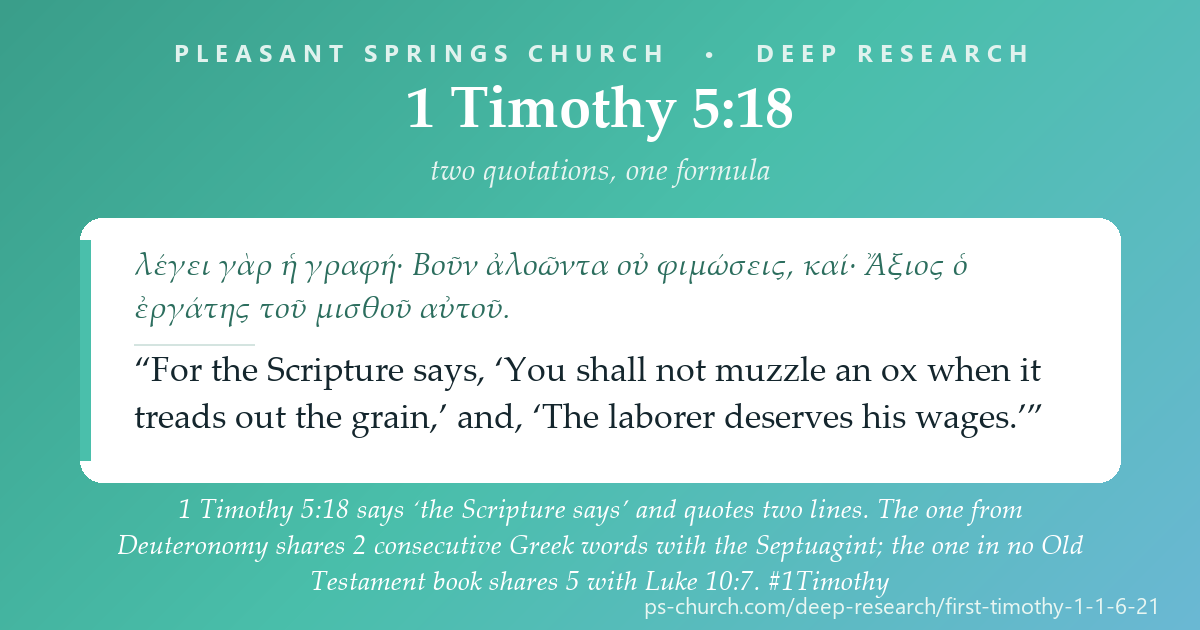
At 1 Timothy 5:18 the letter writes the Scripture says and then quotes two lines. The first is Deuteronomy 25:4 and everyone knows it. The second — the laborer deserves his wages — is in no Old Testament book at all, and it stands word for word in Luke 10:7. So we measured both halves against the corpora on this disk, expecting the Old Testament half to be the deeper contact. It is not. The Septuagint of Deuteronomy 25:4 reads οὐ φιμώσεις βοῦν ἀλοῶντα; 1 Timothy has the same four words in the other order, so the longest run of consecutive words shared with the Greek Old Testament is two. The second line shares five consecutive words with Luke 10:7 — ὁ ἐργάτης τοῦ μισθοῦ αὐτοῦ — and across all 7,927 verses of the Greek New Testament no third verse carries them. A tie band of one. Which came first, and whether either is drawing on the other, is not something a word count can tell you, and this page does not say. It says what is measurable: under one the Scripture says, the deeper verbatim contact is with a Gospel. See the method →
1 Timothy 1:1–6:21 (selections)
Greek New Testament (SBLGNT / MorphGNT) · ESV★ And one row here was not what we expected. At 5:18 the letter says the Scripture says and quotes two lines. The line everyone can place — Deuteronomy 25:4 — shares two consecutive Greek words with the Septuagint of that verse. The line nobody can place in any Old Testament book shares five with Luke 10:7, and no other verse in the New Testament carries them. Stage 4 gives the full measurement, the tie bands, and the counter-examples.
The Shape of the Passage
Inclusio around a sequence — the same rare verb at both endsThis letter is the one book of the New Testament whose authorship is argued mostly from a word count — so this page ran the count itself rather than repeating one. The result is below, with the control that matters and the one tagging artefact it contains.
Author
The letter names Paul in its first word. Παῦλος ἀπόστολος Χριστοῦ Ἰησοῦ — four words that open 2 Corinthians, Ephesians, Colossians and 2 Timothy in exactly the same order. That is the page’s starting point and its position.
And the vocabulary really is unusual. Counted here, from the MorphGNT lemma column: 66 lemmas in 1 Timothy occur nowhere else in the Greek New Testament, in a letter of 1,591 words. That is 41 per thousand. The highest undisputed Pauline letter is Philippians at 25. The count is real. What it proves is a separate question — and the honest control cuts against the easy conclusion: the two shortest Pauline letters outside the Pastorals, Philemon (334 words) and 2 Thessalonians (820), come in at 21 and 10. Shortness alone does not raise the number. Subject matter might; a secretary might; a different decade might. The count cannot choose between them.
Audience
One man, in one named city, with a plural at the end. 1:3 places Timothy at Ephesus while the writer goes to Macedonia. Everything in between is addressed to him in the singular — charge, command, guard, all second-person singular. Then the letter’s closing words are Ἡ χάρις μεθ’ ὑμῶν — grace be with you, plural. A letter to one man that expects a room to be listening.
And it is a letter about a church that already has a problem. Named in the text: people teaching a different doctrine (1:3), myths and endless genealogies (1:4), two men handed over to Satan (1:20), widows on a list and widows off it (5:9–11), elders under accusation (5:19), and money (6:5–10, 6:17–19). This is not a treatise. It is a letter written because something had gone wrong.
Orient on Ephesus, on the Pastoral Epistles as a group, and on what a “faithful saying” is.
Search by topic: Timothy, First Letter to; Pastoral Epistles; Ephesus; overseer / bishop; deacon; widows in the early church; godliness (eusebeia); hapax legomena and authorship; household codes; ransom.
Which articles are relevant?
- Anchor Bible Dictionary — “Timothy, First Epistle to,” “Pastoral Epistles,” “Ephesus,” “Bishop,” “Deacon,” “Widow.”
- Dictionary of Paul and His Letters (IVP) — “Pastoral Letters,” “Pseudepigraphy,” “Church Order and Government,” “Households and Household Codes.”
- Dictionary of the Later New Testament (IVP) — “Creeds and Hymns,” “Godliness, Religion,” “Faithful Sayings.”
- New International Dictionary of NT Theology and Exegesis — εὐσέβεια, μεσίτης, λύτρον, παραθήκη, ἐπίσκοπος.
- Dictionary of NT Use of the OT (Beale & Carson) — on 1 Timothy 5:18 and 1 Corinthians 9:9, the two New Testament uses of Deuteronomy 25:4.
Settle the numbering — there is nothing to convert here
A New Testament letter has no Hebrew column and no Septuagint column of its own. The Greek printed on this page is the language the letter was composed in, not a translation of a Hebrew original. What still has to be checked is whether the verse divisions agree, and here they do.
| 1 | 2 | 3 | 4 | 5 | 6 | total | |
|---|---|---|---|---|---|---|---|
| SBL Greek NT | 20 | 15 | 16 | 16 | 25 | 21 | 113 |
| ESV | 20 | 15 | 16 | 16 | 25 | 21 | 113 |
| Public-domain English text (on disk) | 20 | 15 | 16 | 16 | 25 | 21 | 113 |
Counted from the corpora themselves, not from a table: 113 verse units in the MorphGNT file, and 113 addressable verses in the public-domain English text held here. No ESV file for 1 Timothy is held on this disk, so the ESV row above is the printed edition’s own divisions rather than a count. Every reference on this page therefore means the same verse in every edition. Old Testament pages on this shelf frequently do not have that luxury — Nahum carries a one-verse offset in two of its three chapters — which is exactly why the question is asked every time.
One passage on this page does cross the offset question
1 Timothy 5:18 quotes Deuteronomy 25:4, and Deuteronomy is a book where the Hebrew and Greek verse numbers do line up at that point — Masoretic 25:4, CATSS Greek 25:4, ESV 25:4 are the same verse. The quotation is measured against CATSS Deuteronomy 25:4 and nothing was converted.
A Greek virtue-word, a Roman legal word, and the city the letter names.
εὐσέβεια is not a Septuagint Torah word. It is a Wisdom word — and this letter is soaked in it.
Counted across the Greek Old Testament files held on this disk — 30,637 verse units in 64 CATSS files — the εὐσεβ- group occurs 96 times.
| book | occurrences | |
|---|---|---|
| 4 Maccabees | 60 | witness, not Scripture |
| Sirach | 15 | witness, not Scripture |
| Isaiah | 6 | |
| Proverbs | 4 | |
| 2 Maccabees | 4 | witness, not Scripture |
| 3 Maccabees | 2 | witness, not Scripture |
| 1 Esdras · Judith · Wisdom · Susanna · Psalms of Solomon | 1 each | witnesses, not Scripture |
| every other file held here | 0 |
The claim in the heading is now much stronger than when it was first printed, and for two reasons.
First, the whole Greek Pentateuch is on this disk now — Genesis, Exodus, Leviticus, Numbers and Deuteronomy, 5,801 verse units — and the εὐσεβ- group occurs in it zero times. When this page was written, three of those five books were missing, so ‘not a Torah word’ was an inference from a partial Torah. It is now a measurement over the complete one.
Second, of the 96 occurrences, 86 stand in books this shelf treats as witnesses and not as Scripture — 4 Maccabees, Sirach, 2 and 3 Maccabees, 1 Esdras, Judith, Wisdom, Susanna, the Psalms of Solomon. Only ten stand in books the shelf prints as Scripture, and all ten are in Isaiah and Proverbs. The word is Hellenistic-Jewish before it is anything else.
Printed until 30 August 2026: “Counted across the Greek Old Testament files held on this disk — 23,061 verse units — the εὐσεβ- group occurs 26 times… The corpus is 44 CATSS files and it is not the whole Septuagint: Exodus, Leviticus, Numbers, Joshua, Wisdom, Judith, Tobit, 2–4 Maccabees, Baruch and the Psalms of Solomon are NOT held, and 4 Maccabees in particular is a book whose entire argument turns on this word. The count above is a count of what could be searched, and 4 Maccabees would raise it sharply.”
All twenty of those files arrived on 30 August 2026, and the prediction was exactly right. The count went from 26 to 96. 4 Maccabees alone carries 60 — more than twice the entire previous corpus total. A page that had merely printed 26 and moved on would have been wrong by a factor of nearly four; a page that named its own gap was recoverable, and this is what recovering it looks like.
What did NOT change is the finding. Every one of the seventy new occurrences is in a deuterocanonical witness. Not one is in Exodus, Leviticus, Numbers or Joshua — the four canonical books that arrived in the same batch. The enlarged corpus moved the number sharply and left the conclusion standing: this is a Wisdom-and-Hellenistic-piety word, not a Torah word.
Against that, 1 Timothy uses the group nine times in 1,591 words — 2:2, 3:16, 4:7, 4:8, 5:4, 6:3, 6:5, 6:6 and 6:11. The whole Greek New Testament has 22 occurrences; nine of them are here, five are in 2 Peter and four in Acts. No other book has more than five.
παραθήκη — the word for something left with you that is not yours
6:20 tells Timothy to guard the παραθήκη. The noun occurs three times in the New Testament and all three are in these two letters: here, and 2 Timothy 1:12 and 1:14. In wider Greek it is the ordinary word for a deposit placed with a trustee — goods or money handed over for safekeeping, to be returned intact.
That last sentence is reported from lexica and reference works. No documentary papyri were consulted for this page, and the papyri are precisely where the commercial usage would be demonstrated. Stage 5 says so again.
Ephesus, and what the letter does and does not say about it
The letter names the city once, at 1:3. It does not mention Artemis, the temple, the silversmiths, or anything else Acts 19 makes famous about Ephesus. What it does describe is internal: teachers of a different doctrine, myths and genealogies, ascetic rules about marriage and food (4:3), a register of widows, and disputes about words.
So a study that reads Artemis into 2:12 is importing a background the letter never supplies. That background may still be right — the city was what it was. But it is an argument from outside the text, and this page keeps the two apart.
Seven words, each of them counted rather than characterised.
Counts are of NORMALISED word forms over the SBL Greek New Testament as digitised by MorphGNT (7,927 verses), and over the 64 CATSS Greek Old Testament files held here (30,637 verse units). Word forms and lemmas are counted separately and the page says which.
2 occurrences in the whole Greek New Testament — 1 Timothy 1:3 and 6:3, and nowhere else. The letter’s frame.
The εὐσεβ- group: 22 in the Greek NT, 9 of them in 1 Timothy. In the local Greek OT, 96 — 60 in 4 Maccabees and 15 in Sirach, both witnesses and not Scripture; 0 in the whole Greek Pentateuch.
1 occurrence in the Greek New Testament (2:6) and 0 in the Greek Old Testament held here. The plain λύτρον is commoner; this compound is not.
1 occurrence in the Greek New Testament (2:12, the verb αὐθεντεῖν). The VERB is still 0 in the Greek Old Testament held here, but the word group is no longer 0: two cognate nouns arrived with the deuterocanon on 30 Aug 2026 — Wisdom 12:6 αὐθέντας and 3 Maccabees 2:29 αὐθεντίαν, both witnesses, not Scripture.
Exactly 5 verses carry this three-word sequence: 1 Timothy 1:15, 3:1 and 4:9, 2 Timothy 2:11, Titus 3:8. No other book of the New Testament uses it.
3 occurrences, all in these two letters — 1 Timothy 6:20, 2 Timothy 1:12 and 1:14. The last thing the letter asks of Timothy.
The noun occurs once (6:10); the adjective at Luke 16:14 and 2 Timothy 3:2. And the Greek says a root, not the root — there is no article.
The sixty-six, and the artefact inside the count
Counted from the MorphGNT lemma column over all 27 books: 66 lemmas occur in 1 Timothy and in no other book of the Greek New Testament and only once in it. Widen the test to lemmas found only in 1 Timothy at any frequency and the figure is 75. Both counts are given because they answer different questions.
⚠️ One entry in the raw list is a tagging artefact, and the page removes it rather than banking it. MorphGNT tags the adverbial πρῶτον at 1 Timothy 5:4 with the lemma πρῶτον, while the other 64 occurrences of the same surface form across the New Testament are tagged πρῶτος. That is a decision about parts of speech, not a rare word. The raw screen returned 67 and 76; the figures printed everywhere on this page are 66 and 75, with that one row struck out.
Some of the sixty-six, so the reader can judge the class of word for themselves: γραώδης (old-womanish, 4:7), στόμαχος (stomach, 5:23), ὑδροποτέω (to drink water, 5:23), καυστηριάζω (to brand with a hot iron, 4:2), τεκνογονέω (to bear children, 5:14), ξενοδοχέω (to show hospitality, 5:10), ἀνδραποδιστής (slave-trader, 1:10), ἀπρόσιτος (unapproachable, 6:16). These are not theological neologisms. They are the words a letter needs when it stops to talk about widows, digestion and household management.
Every verse of 1 Timothy screened against the rest of the Greek New Testament and against the Greek Old Testament held here — with the tie band beside every run.
Greek against Greek. MorphGNT field 6, the normalised word form (the column that already resolves elision and the movable nu), lowercased with accents and breathings dropped and final sigma folded; the CATSS FORM column put through the same filter after beta-code transliteration. Word forms, never lemmas. Contiguous runs only. The tie band is how many other verses reach the same depth; a run without its band is misleading.
First, the counter-examples — because the deepest number in this book proves nothing
The single deepest run 1 Timothy has anywhere in the Greek New Testament is twelve consecutive words, and it is a letter greeting.
| 1 Timothy | against | run | tie band | what it is |
|---|---|---|---|---|
| 1:2 | 2 Timothy 1:2 | 12 | 1 | The salutation. grace, mercy, peace from God the Father and Christ Jesus our Lord — a form, twice used. |
| 1:17 | Galatians 1:5 · Philippians 4:20 · 2 Timothy 4:18 | 7 | 3 | A doxology. Deep, and shared with three verses at once. |
| 6:14 | Acts 15:26, Romans 5:1 and 32 others | 5 | 34 | of our Lord Jesus Christ. Five words in a band of thirty-four is a formula, not a contact. |
Print those first and the reader is properly warned: depth alone is not evidence of quotation. A greeting, a doxology and a title can all run deep because they are fixed forms. What makes a run interesting is depth with a narrow band and a reason to look.
Now 1 Timothy 5:18 — two quotations, one the Scripture says
The verse reads: λέγει γὰρ ἡ γραφή· Βοῦν ἀλοῶντα οὐ φιμώσεις, καί· Ἄξιος ὁ ἐργάτης τοῦ μισθοῦ αὐτοῦ.
| half | compared with | longest run | tie band |
|---|---|---|---|
| the ox | CATSS Deuteronomy 25:4 (οὐ φιμώσεις βοῦν ἀλοῶντα) | 2 — βοῦν ἀλοῶντα | — |
| the laborer | Luke 10:7 | 5 — ὁ ἐργάτης τοῦ μισθοῦ αὐτοῦ | 1 |
| the laborer | Matthew 10:10 | 2 — ὁ ἐργάτης | — |
Three separate exhaustive searches back this up.
- The two-word sequence βοῦν ἀλοῶντα occurs once in 30,637 verse units of the local Greek Old Testament (Deuteronomy 25:4) and twice in the 7,927 verses of the Greek New Testament (1 Corinthians 9:9 and 1 Timothy 5:18).
- The five-word sequence ὁ ἐργάτης τοῦ μισθοῦ αὐτοῦ occurs in exactly two verses of the Greek New Testament: Luke 10:7 and 1 Timothy 5:18. That is the tie band of one.
- Matthew 10:10 has the same saying with a different noun — τῆς τροφῆς, his food, not τοῦ μισθοῦ, his wages. 1 Timothy’s wording is Luke’s and not Matthew’s.
- And the negative is measured, not assumed. The sequence ἄξιος ὁ ἐργάτης occurs zero times in the 30,637 verse units of Greek Old Testament held here. That negative was re-run on 30 August 2026 against the enlarged corpus and it survived — the twenty files this page used to name as missing, Exodus, Leviticus, Numbers, Joshua and Wisdom among them, are all here now, and none of them carries the sequence. It is still a negative on the CATSS files and not on the whole Septuagint tradition, but it is no longer a negative with the Pentateuch missing from it.
- 🔄 One figure here did move, and it moved against the page. The deepest run the whole second half reaches anywhere in the Greek Old Testament is still three — τοῦ μισθοῦ αὐτοῦ — but the tie band was 1 on the 44-file corpus and is 2 on the 64-file corpus. Sirach 11:18 (a witness, not Scripture) is now joined by Exodus 22:14, and that is not a stray match: it is the hired-worker clause of the Covenant Code — ἔσται αὐτῷ ἀντὶ τοῦ μισθοῦ αὐτοῦ, it shall be to him in place of his wages. The nearest thing in the Torah to ‘the labourer deserves his wages’ was invisible to this page for as long as Greek Exodus was off the disk.
⚠️ What this does NOT establish. It does not establish that 1 Timothy is quoting Luke’s Gospel, or that Luke is quoting 1 Timothy, or that either had the other in front of him. A saying of Jesus circulating in a fixed Greek form would produce exactly this measurement, and so would a written source both used. This shelf never asserts direction of influence. What is measurable is the shape of the contact, and the shape is: the identifiable Old Testament quotation is the looser of the two.
The other New Testament use of Deuteronomy 25:4 — and it is looser still
1 Corinthians 9:9 quotes the same verse with an explicit formula: ἐν γὰρ τῷ Μωϋσέως νόμῳ γέγραπται, for it is written in the law of Moses. The SBL edition then prints Οὐ κημώσεις βοῦν ἀλοῶντα.
So the two New Testament citations of one short Septuagint line diverge from it in opposite directions. 1 Timothy keeps all four words and changes the order. 1 Corinthians keeps the order and changes the verb — κημόω instead of φιμόω. Counted across the whole Greek New Testament, κημόω occurs once, in that verse. Neither citation reproduces more than two consecutive words of the Greek Old Testament as this corpus holds it.
The SBL editors mark their reading at 1 Corinthians 9:9 with an apparatus siglum, which means there is a competing reading — φιμώσεις, the Septuagint’s own verb. If that reading is right, 1 Corinthians matches the Septuagint word for word and the contrast above collapses on that side. The page prints the reading its corpus holds and names the alternative rather than hiding it.
The whole book, screened
All 113 verses of 1 Timothy against the other 7,814 verses of the Greek New Testament.
Across the 113 rows: 106 reach two consecutive shared words, 57 reach three, 25 reach four, 9 reach five, 5 reach six, 4 reach seven, one reaches twelve, and nothing reaches thirteen. Seven rows reach only one — that is, they share isolated words and no two-word sequence at all with any other verse in the New Testament.
Against the Greek Old Testament screened here, the profile is much flatter: over the 30,348 verse units screened (of 30,637 held in 64 CATSS files), 103 of the 113 rows reach two, 47 reach three, 6 reach four, and one goes further. It is 1:17 — εἰς τοὺς αἰῶνας τῶν αἰώνων and the words either side — running to seven consecutive words, tie band one, against 4 Maccabees 18:24 (a witness, not Scripture), and it is doxological language, not a citation. ⚠️ Re-run 2026-09-24. Until then this paragraph still gave the 44-file screen, which the 30 August re-run missed: 100 of the 113 rows reaching two, 38 three, 4 four, and one reaching five — 1:17 against CATSS Psalm 83:5 (Masoretic 84:5, English 84:4), band one. Re-running that 44-file screen today reproduces every one of those figures except the first, which comes out 101; the 100 is left as first printed. 4 Maccabees, which carries the whole doxology, arrived on 30 August. 1 Timothy quotes the Old Testament with a citation formula exactly once, at 5:18.
That is a statement about citation formulae, not about dependence. The letter leans on Genesis 2–3 at 2:13–14 and on the two-or-three-witnesses rule of Deuteronomy 19:15 at 5:19 without flagging either, and a run-screen cannot see an allusion that shares no consecutive Greek words. The method finds verbatim contact; the absence of a run is not the absence of a source.
And the Pastorals against each other
Screened against 2 Timothy alone, 14 of 1 Timothy’s 113 rows reach four consecutive words or more; against Titus alone, 7 do. The deepest against 2 Timothy is the greeting at twelve; the deepest against Titus is the same greeting at eight (Titus 1:4). After the greetings, the shared runs are the trustworthy-saying formula (1:15 and 4:9 against Titus 3:8; 3:1 against 2 Timothy 2:11), τοῦ σωτῆρος ἡμῶν θεοῦ at 2:3 against three verses of Titus, and the vice-list at 3:3 against Titus 1:7.
Shared formulae between three short letters addressed to two co-workers are what anyone would expect on any account of their origin. The numbers are reported; no conclusion about authorship is drawn from them here.
Where this page is weakest, and what was not reached.
The limits of the 5:18 finding
The measurement is sound; the inference from it is narrow. Runs of consecutive normalised word forms detect verbatim contact. They do not detect allusion, they do not detect paraphrase, and a reordering of the same four words — which is exactly what 1 Timothy 5:18 does to Deuteronomy 25:4 — is invisible to the method as quotation even though any reader can see it. The run of two is a true number and a misleading one if it is read as distance rather than as word order. The page says both.
The 1 Corinthians 9:9 reading is contested and the finding partly rests on it. SBLGNT prints κημώσεις with an apparatus marker. No critical apparatus was consulted here; the alternative was identified from the siglum in the text file, not from the evidence behind it.
Only one Greek Old Testament edition was searched. CATSS, following Rahlfs. The Deuteronomy of Codex Alexandrinus, of the Hexaplaric recension, or of any other line could read the words in 1 Timothy’s order, in which case the run of two is an artefact of which edition sits on this disk. That possibility is not remote and it was not checked.
The vocabulary count, and what it cannot settle
The hapax count is a real count and a weak argument, in both directions. 66 words in 1,591 is a genuine measurement. It does not establish that Paul did not write this letter, and the shelf's position is stated in the Author panel above — the letter names him. It also does not establish that he did. Subject matter, a secretary, an interval of years and a change of opponent would each raise the number, and the count cannot distinguish them.
The comparison table is uncorrected for tagging artefacts in the other books. One was found and removed in 1 Timothy (the πρῶτον row at 5:4). The same class of artefact almost certainly exists in Romans and 1 Corinthians and was not hunted there. At the scale of the gap being reported — 41 per thousand against Philippians’ 25 — a handful of artefacts would not reverse the ordering, but the table should be read as indicative, not as a published statistic.
And this page did not attempt the harder tests. P. N. Harrison’s study and the stylometric literature that followed it measure particles, connectives and sentence structure, not just rare nouns. None of that was run here. Nothing on this page replicates or refutes it.
What could not be checked at all
No Greek critical apparatus, for any verse. No manuscript evidence for the ὅς / Θεός variant at 3:16 beyond the reading SBLGNT prints. No documentary papyri, which is where παραθήκη and αὐθεντέω would actually be tested. No Apostolic Fathers — Polycarp’s letter to the Philippians overlaps this material and is not held here. No Josephus and no Philo. 4 Maccabees, which this page used to name as the single most important missing book for the εὐσέβεια count, arrived on 30 August 2026 and is measured now — see stage 2, where it turned 26 occurrences into 96. No inscriptions from Ephesus.
And the meaning of αὐθεντέω at 2:12 is not settled here and cannot be settled from this corpus. One occurrence in the New Testament. 🔄 This page used to add ‘zero in the Greek Old Testament held here’, and on the 44-file corpus that was true. On the 64-file corpus it is not. The verb αὐθεντέω is still unattested in the Greek Old Testament held here, but two cognate NOUNS now stand in it: Wisdom 12:6, αὐθέντας — parents who are the perpetrators, in the passage on child sacrifice — and 3 Maccabees 2:29, αὐθεντίαν, of a royal absolute authority. Both books are witnesses on this shelf, not Scripture, and they are named because Wisdom 12:6 is one of the standing data points in the scholarly argument about 2:12 — it was being cited against this page from outside while the page could not see it. Two nouns in two Hellenistic-Jewish books still do not settle the force of a verb in Ephesus. The argument still runs mainly on classical and documentary evidence outside anything on this disk, and the honest change is from “zero, and the evidence is all elsewhere” to “two, both nouns, both in witnesses, and the evidence is still mostly elsewhere.” A page that reported a count and then announced a meaning would be overreaching, and this one stops at the count.
Reading list
- I. Howard Marshall, The Pastoral Epistles (ICC, 1999).
- William D. Mounce, Pastoral Epistles (WBC 46, 2000).
- Luke Timothy Johnson, The First and Second Letters to Timothy (Anchor Bible 35A, 2001).
- Philip H. Towner, The Letters to Timothy and Titus (NICNT, 2006).
- P. N. Harrison, The Problem of the Pastoral Epistles (Oxford, 1921) — the study that put the vocabulary question on the table.
- Armin D. Baum, “Semantic Variation within the Corpus Paulinum,” Tyndale Bulletin 59 (2008) — on how much genre alone moves these counts.
- None of these were consulted for the measurements on this page, which were run on the text files named in the footer.
One sentence, two quotations, and a surprise inside it.
What the Scripture says
1 Timothy is a short, practical, occasionally awkward letter written because a church had a problem. It stops to describe how to keep a list of widows. It stops to tell a young man to take some wine for his stomach. It uses sixty-six words no other book of the New Testament uses, and most of them are not lofty — they are the words you need when you are talking about hospitality, childbearing, slave-traders and digestion.
And once, in the middle of the practical stretch, it says the Scripture says and quotes two lines. One is Deuteronomy. One is not in the Old Testament at all. The letter sets them side by side under a single formula and does not distinguish them.
We went looking for the Deuteronomy half to be the strong contact, and it is the weak one. Four words from the Septuagint, reordered, so only two run consecutively. The other half runs five straight words with Luke 10:7 and with nothing else in the New Testament. The measurement will not tell you who read whom. It will tell you that when this letter reached for something everyone in the room would recognise, the words that came out in their fixed order were the words of Jesus about a worker and his pay.
New Testament shelf: this is the whole of 1 Timothy, all six chapters, 113 verses, Greek New Testament and ESV.
Every Deep Research page traces its passage across the whole sweep — the Old Testament, the Second-Temple world between the testaments (historical witnesses, not Scripture), and the New Testament. Follow the thread:
Pleasant Springs Church — Deep Research
Research method after Michael S. Heiser’s Bible Research Method (examine dictionaries → ancient literature → important words → textual connections → academic publications → share), with the Pleasant Springs “Author & Audience” foundation. Scripture set in the Hebrew, the Greek editions named on each page and the ESV (Old Testament), and the Greek New Testament and the ESV (New Testament), per the practice of Pleasant Springs Church. 1 Timothy research grounded in Marshall (ICC), Mounce (WBC), Johnson (Anchor) and Towner (NICNT), with Harrison (1921) named as the origin of the vocabulary question. Text: Greek New Testament from the SBL edition as digitized by MorphGNT; Greek Old Testament from Rahlfs’ Septuaginta as digitized by CATSS. ⚠️ VERSE NUMBERING — there is no offset in this book. The SBL Greek New Testament and a public-domain English text consulted as a versification witness both run 20 / 15 / 16 / 16 / 25 / 21 = 113 verses, counted from the files themselves, and the ESV prints the same divisions — no ESV file for 1 Timothy is held here. Every reference on this page means the same verse in every edition. Stated because this shelf states it everywhere, including where there is nothing to convert. ⚠️ The measurement, in full. Greek against Greek. MorphGNT field 6, the normalised word form; the CATSS FORM column (cols 0–24) beta-code transliterated first. Both sides lowercased, accents and breathings dropped, final sigma folded, then filtered to Greek letters — the same filter applied to both corpora. Word forms, never lemmas, except where the page says ‘lemma’ explicitly, which is the vocabulary count. Corpus: the 113 MorphGNT rows of 1 Timothy against 7,814 other New Testament verses across 27 files, and against 30,637 verse units across 64 CATSS files. Exhaustive and deterministic; nothing sampled, so no seed applies. ⚠️ The book’s deepest run is a formula and the page says so first. 1 Timothy 1:2 against 2 Timothy 1:2, twelve consecutive words, tie band of one — and it is a letter greeting. 1:17 reaches seven in a band of three and is a doxology. Depth alone is not evidence of quotation. ⚠️ The vocabulary count carries one struck-out row. The raw lemma screen returned 67 New Testament hapax legomena and 76 1 Timothy-exclusive lemmas. MorphGNT tags the adverbial πρῶτον at 5:4 with its own lemma while tagging the other 64 occurrences of that surface form πρῶτος; that row is a part-of-speech decision, not a rare word, and it is removed. The figures printed on this page are 66 and 75. The comparison against the other twelve Pauline letters was NOT corrected for the same class of artefact in those books. ⚠️ Not measured here. No critical apparatus for any verse, including the ὅς / Θεός variant at 3:16 and the κημώσεις / φιμώσεις variant at 1 Corinthians 9:9, both of which this page’s argument touches. No documentary papyri. No Apostolic Fathers. ⚠️ Corpus history, because four printed figures moved. This page was first built against 44 CATSS files, 23,061 verse units, and printed at stage 6 that “4 Maccabees, Wisdom, Judith, Tobit, 2–4 Maccabees, Baruch and the Psalms of Solomon are not on this disk, and the εὐσέβεια count would change if they were.” All twenty missing files, plus Exodus, Leviticus, Numbers and Joshua, arrived on 30 August 2026, taking the shelf to 64 files, 30,637 verse units. Every screen on this page was re-run. Four figures moved: the εὐσεβ- count from 26 to 96 (60 of them in 4 Maccabees); αὐθεντ- from a printed zero to two (Wisdom 12:6, 3 Maccabees 2:29 — both nouns, both witnesses, the verb still zero); the tie band on the deepest Old Testament run of 5:18b from 1 to 2 (Exodus 22:14 joining Sirach 11:18); and the scope sentence itself. Two negatives were re-run and held: ἄξιος ὁ ἐργάτης is still zero, and ἀντίλυτρον is still zero, both now over 30,637 units instead of 23,061. ⚠️ Deuterocanonical books are witnesses, not Scripture. 4 Maccabees, Sirach, Wisdom, Judith, 1–3 Maccabees, Susanna, 1 Esdras and the Psalms of Solomon are measured against on this page and are labelled as witnesses every time a count or a hit lands in one. They are measurement partners; the shelf does not print them as Scripture. ⚠️ Direction of influence is never asserted. Nothing here says that 1 Timothy is quoting Luke, that Luke is quoting 1 Timothy, or that either knew the other’s book. Five shared words in a tie band of one is a shape, not a lineage. Typology is handled per the house position: what the text says, what the New Testament itself draws, and what we see from this side of the cross — with the seeing left to the reader.
Scripture quotations marked ESV are from the ESV® Bible (The Holy Bible, English Standard Version®), © 2001 by Crossway, a publishing ministry of Good News Publishers. ESV Text Edition: 2016. Used by permission. All rights reserved. The ESV text may not be quoted in any publication made available to the public by a Creative Commons license, and the ESV may not be translated in whole or in part into any other language. www.esv.org
|
Did this study bless you today? 💚 Give to Support PS Church100% of gifts go to the General Fund — thank you. |