Nahum opens with a hymn that is working its way down the Hebrew alphabet, and it gets halfway. Aleph, beth, gimel — then a letter missing — he, waw, zayin, chet, tet, and it breaks off at kaph. Eleven letters into twenty-two, the acrostic stops and the book goes on without it. Two more things this page can show rather than assert. The verse everyone pairs with the New Testament — the feet of him who brings good news, which is 1:15 in English and 2:1 in Hebrew and Greek — shares exactly two words with Romans 10:15 when the two are measured, because Paul is quoting Isaiah 52:7 and not this verse. And the word בְּלִיַּעַל, Belial, stands twice in Nahum and nowhere else in the Twelve — and the Greek column does not have it in either place. See the method →
Nahum 1:1–3:19 (selections, Hebrew numbering)
Hebrew · Greek (CATSS, Rahlfs’ Septuaginta) · ESV⚠️ So “Nahum 1:15” and “Nahum 2:1” can be the same verse. The feet on the mountains is 1:15 if you are holding an English Bible and 2:1 if you are reading the Hebrew or the Greek.
The Shape of the Passage
Sequence — a half-finished acrostic, two portraits, and a questionNahum is one of the few prophetic books whose date can be bracketed from its own contents. It speaks of the fall of Thebes as something that has already happened (3:8) and of the fall of Nineveh as something still to come. Those two events are fixed points in Assyrian and Babylonian records, and between them lies the window the book was written in.
Author
A name and a town nobody can find. נַחוּם is from the root נחם, to comfort — which is a striking name for the man who wrote this book. הָאֶלְקֹשִׁי, the Elkoshite, places him at Elkosh; the site is unidentified and has been located in Galilee, in Judah and in Assyria by different traditions.
The name reaches the New Testament, and it is not this man. Ναούμ occurs once in the Greek New Testament — Luke 3:25, in the genealogy of Jesus. The same verse also contains Ἀμώς, and that is not the prophet either.
Audience
Addressed to Nineveh, written for Judah. The oracle speaks to the city in the second person for most of three chapters. But 1:12–13 and 2:1 turn and speak to Judah — keep your feasts, fulfil your vows — and that is the audience holding the scroll.
A hearer under an empire. Assyria had held the region for over a century by the time this was written; Judah had been a vassal since Ahaz. The book is addressed to people who had never known a world in which Nineveh could fall. It says it is going to.
Orient on Nineveh, on acrostics, and on a one-verse offset that catches people out.
Search by topic: Nahum, book of; Nineveh; Assyria; Thebes / No-Amon; acrostic; Belial; oracles against the nations; chapter and verse divisions, history of.
Which articles are relevant?
- Anchor Bible Dictionary — “Nahum, Book of,” “Nineveh,” “Assyria,” “Thebes,” “Belial,” “Acrostics.”
- Dictionary of the OT: Prophets (IVP) — “Nahum, Book of,” “Assyria, Assyrians,” “Divine Warrior,” “Theophany.”
- NIDOTTE — נָקַם, מָעוֹז, בְּלִיַּעַל, בָּשַׂר.
- Dictionary of NT Use of the OT (Beale & Carson) — on Romans 10:15, and on the Isaiah 52:7 background it treats there.
Settle the numbering — one verse, and it moves the chapter break
Nahum’s offset is small and it lands on the book’s most quoted verse, which is why it catches people out.
| ch 1 | ch 2 | ch 3 | total | |
|---|---|---|---|---|
| Masoretic & CATSS | 14 | 14 | 19 | 47 |
| ESV | 15 | 13 | 19 | 47 |
English 1:15 = MT/LXX 2:1. English 2:1–13 = MT/LXX 2:2–14. Chapter 3 is identical in all three. The Hebrew closes chapter 1 at verse 14 and opens chapter 2 with the messenger on the mountains; the English keeps the messenger in chapter 1 as its fifteenth verse. Established from content at the seam: the Hebrew 2:1 and the English 1:15 are word for word the same sentence.
Practical consequence: a commentary that discusses “Nahum 2:1” may be discussing the war-cry the scatterer has come up (if it is following English numbering) or the herald of peace (if it is following Hebrew). This page always gives both numbers where they differ.
Two cities that fell, and a date the book can carry.
The acrostic, letter by letter
Nahum 1:2–8 is an alphabetic poem that does not finish. Here is what can actually be pointed to in the Masoretic text as this page has it.
| letter | where | the word |
|---|---|---|
| א aleph | 1:2a | אֵל קַנּוֹא |
| ב beth | 1:3b | בְּסוּפָה |
| ג gimel | 1:4a | גּוֹעֵר |
| ד dalet | — | absent. The colon that would carry it, 1:4b, begins אֻמְלַל. Editors have proposed emendations; this page has none to offer and simply reports the gap. |
| ה he | 1:5a | הָרִים |
| ו waw | 1:5b | וַתִּשָּׂא |
| ז zayin | 1:6a | זַעְמוֹ (second word of the colon) |
| ח chet | 1:6b | חֲמָתוֹ |
| ט tet | 1:7a | טוֹב |
| י yod | 1:7b | וְיֹדֵעַ — present only if the conjunction is set aside. That is a common suggestion and it is a suggestion, not a reading of the text as it stands. |
| כ kaph | 1:8a | כָּלָה — and there it stops. |
Nine letters stand in the text without any help; dalet is missing; yod needs a conjunction ignored; and nothing after kaph continues the pattern. The book runs for another thirty-nine verses without a further alphabetic line. Why it stops at the middle of the alphabet is a question with a large literature — damage, deliberate design, an acrostic never completed — and this page takes no position. It reports what the letters do.
Note what an acrostic is not. It is a feature of the Hebrew consonants only. No translation can carry it and the Greek column does not have it at all — a reader working from the Septuagint or from English has no way of seeing that these seven verses are shaped this way.
Thebes fell, and that dates the book
Nahum 3:8 asks Nineveh whether she is better than No-Amon — Thebes — and speaks of Thebes’ fall as accomplished.
| event | date | how the book speaks of it |
|---|---|---|
| Ashurbanipal sacks Thebes | 663 BC | past — she became an exile; she went into captivity (3:10) |
| Nineveh falls to the Medes and Babylonians | 612 BC | future — the whole book |
That gives a window of about fifty years, and it is one of the tighter datings anywhere in the prophets — not because a heading supplies it, as in Hosea or Micah, but because the book’s own argument depends on one fall having happened and the other not yet.
The house caution about ANE material applies here. The dates above come from Assyrian and Babylonian sources read through standard chronologies; no cuneiform text was consulted for this page, and the Babylonian Chronicle account of Nineveh’s fall is named here only as the kind of evidence the dating rests on, not as something checked.
Belial — a common noun in Nahum, a proper name later
The word בְּלִיַּעַל stands 27 times in the Hebrew Bible. Two of them are in Nahum — 1:11 and 2:1 — and those are the only two in the whole of the Twelve.
In Nahum it functions as a common noun: a counsellor of worthlessness (1:11), the worthless one shall no more pass through you (2:1). The Greek column has neither. At 1:11 the row reads λογιζόμενος ἐναντία, reckoning hostile things; at 2:1 the row has εἰς παλαίωσιν, into wearing out, in that slot, and does not carry the word over.
By the Second-Temple period the word had become a name. In the Qumran scrolls — the War Scroll and the Community Rule among them — Belial is a personal adversary with an army and a lot. And in the New Testament the word appears once, as a name, spelled with an r: Βελιάρ at 2 Corinthians 6:15, what accord has Christ with Belial?
What is and is not being claimed. A word that Nahum uses of a human enemy is used as a proper name in later Jewish writing and once by Paul. That is a development in usage, not a chain of quotation — nothing here says Paul is reading Nahum, and nothing says the Qumran usage came from these two verses. The page notes that the two Nahum verses are the only places in the Twelve the word occurs at all.
A fortress that is not in the Greek, a scatterer who is a rescuer, and a question that became two commands.
Nahum 1:1, βιβλίον. The only superscription in the Twelve to call its own contents a written book — checked across all twelve opening verses. The others announce a word, a vision, an oracle or a date.
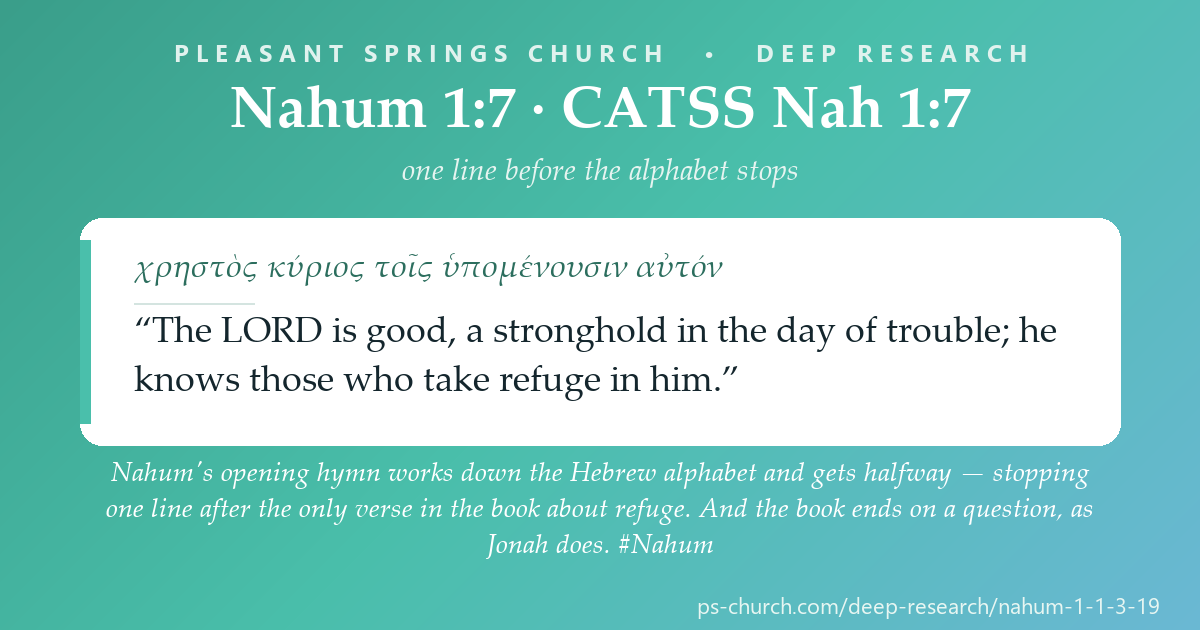
Nahum 1:7, the Lord is good, a stronghold in the day of trouble. The Greek row has no fortress: τοῖς ὑπομένουσιν αὐτόν, to those who wait for him. The Hebrew gives a place to shelter in; the row gives the people who hold out.
Nahum 2:2 (ESV 2:1), the one who has come up against you. The row puts ἐμφυσῶν, one blowing, in this slot, and where the Hebrew says guard the rampart it has ἐξαιρούμενος ἐκ θλίψεως, one delivering out of affliction — an attacker in one column and a rescuer in the other, in the same clause.
Nahum 1:11 and 2:1 (ESV 1:15) — the only two occurrences in the Twelve, out of 27 in the Hebrew Bible. Absent from the Greek column in both places. Later a proper name at Qumran, and Βελιάρ once in the New Testament, 2 Corinthians 6:15.
Nahum 2:1 (ESV 1:15). The Greek row renders it εὐαγγελιζομένου — the verb the New Testament uses for preaching the gospel. The word is the same one Isaiah 52:7 uses, which is what Romans 10:15 is quoting.
The three-times verb, and the fourth one
Nahum 1:2 says avenging three times in a single verse, and both columns keep all three. The Hebrew has נֹקֵם three times; the row has ἐκδικῶν three times. Then comes a fourth participle, and there the columns part: וְנוֹטֵר, and keeping — the Hebrew idiom for holding on to anger — against ἐξαίρων, and removing.
The difference is not small. In the Hebrew, God keeps the wrath; in the row, God takes the enemies away. The page prints both and offers no account of how the second reading arose.
The verse everyone links to Romans, measured.
The feet on the mountains and Romans 10:15
Nahum 2:1 (ESV 1:15) and Isaiah 52:7 say almost the same thing, and Romans 10:15 quotes one of them. Measured against the Greek New Testament, this row does not reach Romans at all.
| comparison | longest shared run | the words |
|---|---|---|
| CATSS Nahum 2:1 vs its deepest New Testament partner | 3 | ἐπὶ τὰ ὄρη — at Matthew 18:12 and Matthew 24:16, a tie band of two |
| CATSS Nahum 2:1 vs Romans 10:15 | 2 | οἱ πόδες |
Two words. And the two verses Nahum 2:1 does reach at three are the lost-sheep parable and the flee-to-the-mountains saying, neither of which has anything to do with a herald of peace. The shared words are on the mountains, and that is all they are.
The reason is not obscure: Paul is quoting Isaiah 52:7, not Nahum — and as of 19 August 2026 this page can measure the Isaiah side instead of citing it. Greek Isaiah was added to this shelf on that date. What follows was run for this page, not taken from a commentary.
| comparison | longest shared run | the words |
|---|---|---|
| CATSS Isaiah 52:7 vs Romans 10:15 | 1 | ὡς |
| CATSS Nahum 2:1 vs Romans 10:15 | 2 | οἱ πόδες |
Paul is copying neither Greek column, and on contiguous run Nahum actually scores higher than Isaiah. That is why a run screen could not settle this on its own. What Romans 10:15 shares with Isaiah is vocabulary, not sequence. Romans reads ὡς ὡραῖοι οἱ πόδες τῶν εὐαγγελιζομένων τὰ ἀγαθά, and the two words in that line which are neither feet nor bringing good news both point away from this verse. ἀγαθά, good things, stands in Greek Isaiah 52:7 and in Romans 10:15; it stands nowhere in Greek Nahum at all — not in 2:1 and not in any of the book’s 47 rows, and the Hebrew of Nahum 2:1 has no טוֹב either, where Isaiah 52:7 does. Romans’ ὡραῖοι, beautiful, shares its root with the ὡς ὥρα that opens Greek Isaiah 52:7, and that root is likewise absent from the whole of Greek Nahum; the Hebrew side is the same shape — Isaiah 52:7 opens מַה נָּאווּ, how beautiful, where Nahum 2:1 opens הִנֵּה, behold.
So the screen and the vocabulary answer different questions, and only together do they settle it. Every distinctive word of Romans 10:15 is available from Isaiah 52:7 and not one of them is available from this verse — which is exactly what a contiguous-run screen, counting sequence rather than stock, could not see.
Why it matters for how these pages are read. Nahum 1:15 is preached alongside Romans 10:15 constantly, and the pairing is thematically sound — the same picture of a runner cresting a hill with news. What the measurement shows is that the pairing runs through Isaiah, not through this verse, and a page that reported only the theme would not have been able to say which.
Where Nahum does reach the New Testament
Across all 47 CATSS rows against all 7,927 verses of the Greek New Testament, Nahum’s deepest run is five, and two rows reach it.
| row | deepest NT partner | run | tie band | the shared words |
|---|---|---|---|---|
| Nah 3:4 | Revelation 19:2 | 5 | 1 | ἐν τῇ πορνείᾳ αὐτῆς καί |
| Nah 3:5 | Revelation 4:8, 19:6, 21:22, 1:8 | 5 | 4 | κύριος ὁ θεὸς ὁ παντοκράτωρ |
| Nah 3:16 | Hebrews 11:12 | 4 | 1 | τὰ ἄστρα τοῦ οὐρανοῦ |
| Nah 3:13 | Acts 7:3 | 4 | 1 | τῆς γῆς σου καί |
| Nah 3:18 | Matthew 18:12 | 4 | 1 | ἐπὶ τὰ ὄρη καί |
The two deepest rows are both in Revelation, and they are two different kinds of thing. Nahum 3:5’s five words are a divine title, and not the usual Greek rendering of Lord of hosts — across the 64 Greek Old Testament files held here κύριος παντοκράτωρ stands 90 times and κύριος ὁ θεὸς ὁ παντοκράτωρ 13, and most of those 13 render the longer Hebrew יְהֹוָה אֱלֹהֵי צְבָאוֹת rather than the יְהֹוָה צְבָאוֹת that stands here. Revelation uses the five-word form of God repeatedly. ⚠️ This count has now been corrected twice, and the page keeps both corrections on the record. When this page first went up the Greek shelf held 35 files and the figure printed here read 79. Greek Isaiah, Jeremiah, Lamentations, Ezekiel and both Greek Daniels were added on 19 August 2026, and re-running the same search over all 44 files returned 88 — all nine of the new occurrences in Greek Jeremiah. On 30 August 2026 the remaining twenty CATSS files arrived — Exodus, Leviticus, Numbers, Joshua and the deuterocanon — taking the shelf to 64 files, 30,637 verse units, and the same search now returns 90. Both new occurrences are in Judith, which is a witness on this shelf and not Scripture (Judith 16:5 and 16:17, both in Judith’s victory hymn), so the count over the books this shelf prints as Scripture is still 88. The sequence is 79 → 88 → 90, and each step is named rather than quietly replaced. The thirteen five-word occurrences have not moved through either growth: ten in Amos, plus Hosea 12:6, Nahum 3:5 and Zechariah 10:3. Neither the Major Prophets nor the Pentateuch nor the deuterocanon contributes one. A tie band of four says as much. Nahum 3:4’s five words have a tie band of one: ἐν τῇ πορνείᾳ αὐτῆς καί stands in Revelation 19:2 and in no other verse of the New Testament.
Nineveh is the prostitute in Nahum 3:4; Babylon is the great prostitute in Revelation 17–19. The page reports five shared words and a tie band of one, and does not call it a citation — Revelation nowhere signals a quotation here, and the imagery of the city-as-harlot is not peculiar to Nahum. Across the 47 rows: 44 reach two, 28 reach three, 5 reach four, 2 reach five.
Where this page is weakest, and what was not reached.
The limits
The Isaiah half of the Romans 10:15 question is no longer a gap — it has been measured, and this page has been corrected accordingly. Greek Isaiah, Jeremiah, Lamentations, Ezekiel and both Greek Daniels were added to this shelf on 19 August 2026, taking it from 35 files to 44. Two things on this page changed as a result. Stage 4 no longer rests the Isaiah claim on the commentaries: Isaiah 52:7 measures a contiguous run of one against Romans 10:15 while Nahum 2:1 measures two, and the case for Isaiah turns out to rest on shared vocabulary — ἀγαθά and the ὡρ- root, both in Isaiah 52:7 and both absent from every row of Greek Nahum. And a count in stage 4 was simply wrong: κύριος παντοκράτωρ was reported as standing 79 times across the Greek Old Testament files held here; over the 44 files it stands 88, the nine new ones all in Greek Jeremiah. And it moved once more. On 30 August 2026 the last twenty CATSS files arrived — Exodus, Leviticus, Numbers, Joshua and the deuterocanon — taking the shelf to 64 files, 30,637 verse units, and the figure is now 90, the two additions both in Judith and therefore both in a witness rather than in Scripture. 79, then 88, then 90 — every one of them still printed here. Nothing else on this page moved: the acrostic is Hebrew, the Romans 10:15 comparison is against Greek Isaiah and Greek Nahum, and Nahum’s own 47 rows are screened against the Greek New Testament, which did not change.
The acrostic is reported and not explained. Whether the poem was damaged, deliberately partial, or never alphabetic beyond kaph is argued at length, and the arguments turn on emendation. This page prints the letters it can see and the two it cannot.
And the hardest thing about this book is not textual. Nahum is a poem about the destruction of a city, and it is glad about it. Readers have found that hard since at least the fourth century. The page does not soften it, and it does not preach it — it notes only that the book itself sets the joy inside a frame: the Lord is good, a stronghold in the day of trouble (1:7), and the last word is a question rather than a cheer.
What could not be checked at all
No Hebrew or Greek critical apparatus. No Qumran material — and this is a real gap for Nahum in particular, since the Nahum Pesher (4Q169) is one of the better-known commentaries from Qumran and none of it was consulted. No Targum, Syriac, Vulgate, Aquila, Symmachus or Theodotion. No cuneiform sources on the fall of Thebes or of Nineveh.
Elkosh is unidentified and the page leaves it that way. Traditions place it in Galilee, in southern Judah and near Mosul. None of them can be checked from the text.
Reading list
- Duane L. Christensen, Nahum (Anchor Yale Bible 24F).
- Klaas Spronk, Nahum (Historical Commentary on the Old Testament).
- O. Palmer Robertson, The Books of Nahum, Habakkuk, and Zephaniah (NICOT).
- Michael H. Floyd, Minor Prophets, Part 2 (FOTL XXII).
- None of these were consulted for the measurements on this page, which were run on the text files named in the footer.
A poem that stops, and a book that asks.
Half an alphabet
The hymn starts at aleph and works down: a jealous God, a whirlwind, a rebuke to the sea, mountains quaking, the earth heaving, wrath poured out like fire. Then, at tet, it says the one thing in the book that is not about ruin — the Lord is good, a stronghold in the day of trouble; he knows those who take refuge in him — and a letter later the alphabet stops.
Eleven letters out of twenty-two. Nobody can say from the text why. What can be said is where it stopped: one line past the sentence about refuge.
And the book itself does not finish either. Nahum is the only book of the Twelve besides Jonah that ends on a question — upon whom has not come your unceasing evil? — and the two of them are about the same city. Jonah’s question is God asking whether he should spare Nineveh. Nahum’s is the world asking whether anyone escaped it. The same city, and the Twelve keeps both questions.
Tenth whole book of the Twelve on this shelf. Ten complete: Hosea, Joel, Amos, Obadiah, Jonah, Micah, Nahum, Habakkuk, Haggai, Malachi. Two to go — Zephaniah and Zechariah.
Every Deep Research page traces its passage across the whole sweep — the Old Testament, the Second-Temple world between the testaments (historical witnesses, not Scripture), and the New Testament. Follow the thread:
Pleasant Springs Church — Deep Research
Research method after Michael S. Heiser’s Bible Research Method (examine dictionaries → ancient literature → important words → textual connections → academic publications → share), with the Pleasant Springs “Author & Audience” foundation. Scripture set in the Hebrew, the Greek editions named on each page and the ESV (Old Testament), and the Greek New Testament and the ESV (New Testament), per the practice of Pleasant Springs Church. Nahum research grounded in Christensen (Nahum, Anchor Yale), Spronk (HCOT), Robertson (NICOT) and Floyd (FOTL). Text: Hebrew from the Masoretic text as printed in the editions consulted — Sefaria’s Miqra according to the Masorah; no critical apparatus was consulted for the Hebrew. Greek from Rahlfs’ Septuaginta as digitized by CATSS; Greek New Testament from the SBL edition. The standing caution for this shelf applies: these pages say “the CATSS Greek row reads…” and never call a Greek reading early or late. ⚠️ VERSE NUMBERING — a one-verse offset in chapters 1 and 2 only. Masoretic and CATSS Nahum run 14 / 14 / 19 = 47 verses; the ESVruns 15 / 13 / 19 = 47. English 1:15 = MT/LXX 2:1, and English 2:1–13 = MT/LXX 2:2–14. Chapter 1 verses 1–14 and the whole of chapter 3 carry the same numbers in all three columns. Established from content at the seam. ⚠️ The acrostic, as reported. Nine letters — aleph, beth, gimel, he, waw, zayin, chet, tet, kaph — carry successive cola in 1:2–8 with no emendation, though three of them are not the first word of their colon: beth is the second word of 1:3b, zayin the second word of 1:6a, and kaph the third word of 1:8a. Dalet is absent. Yod is present only if the conjunction on וְיֹדֵעַ at 1:7b is set aside, which is a proposal and is labelled as one. Nothing after kaph continues the pattern. The page takes no position on why the acrostic stops, and reproduces no editor’s reconstruction. ⚠️ The Greek measurement, in full. Greek against Greek. CATSS FORM column (cols 0–24), beta-code transliterated first; MorphGNT field 6, the normalised word (the column that already resolves elision and the movable nu). Both sides lowercased, accents and breathings dropped, final sigma folded, then filtered to Greek letters — the same filter applied to both corpora. Word forms, never lemmas. Corpus: the 47 CATSS rows of Nahum against 7,927 verses across 27 MorphGNT files. Exhaustive and deterministic; nothing sampled, so no seed applies. ⚠️ Isaiah is now measured, and this page was corrected on 19 August 2026. Greek Isaiah, Jeremiah, Lamentations, Ezekiel and both Greek Daniels were added to this shelf on that date, taking it from 35 files to 44, and the remaining twenty — Exodus, Leviticus, Numbers, Joshua and the deuterocanon — on 30 August 2026, taking it to 64 files and 30,637 verse units, and the Isaiah side of the Romans 10:15 question no longer rests on the commentaries. Measured: Isaiah 52:7 vs Romans 10:15, a contiguous run of one (ὡς); Nahum 2:1 vs Romans 10:15, a run of two (οἱ πόδες) — Paul copies neither Greek column in sequence, and what ties Romans to Isaiah is vocabulary: ἀγαθά and the ὡρ- root stand in Isaiah 52:7 and in neither column of Nahum 2:1, nor anywhere else in Greek Nahum. The Nahum side is unchanged — two shared words with Romans 10:15, and a deepest New Testament run of three that lands in Matthew. One count on this page moved with the larger shelf: κύριος παντοκράτωρ, reported as 79 over 35 files, stood 88 over 44 and stands 90 over 64 — the last two occurrences being in Judith, a witness and not Scripture, so the count over the books this shelf prints as Scripture remains 88. Every one of the three figures is printed rather than replaced. Deuterocanonical books are measurement partners on this shelf and are labelled as witnesses wherever a hit lands in one. ⚠️ Direction of influence is never asserted. Nothing here says that Revelation is quoting Nahum, that Paul is reading Nahum, that the Qumran usage of Belial derives from these two verses, or what produced any reading — including the missing fortress at 1:7, the scatterer and the rescuer at 2:2, and the two commands where the Hebrew asks a question at 3:8. Typology is handled per the house position: what the text says, what the New Testament itself draws, and what we see from this side of the cross — with the seeing left to the reader.
Scripture quotations marked ESV are from the ESV® Bible (The Holy Bible, English Standard Version®), © 2001 by Crossway, a publishing ministry of Good News Publishers. ESV Text Edition: 2016. Used by permission. All rights reserved. The ESV text may not be quoted in any publication made available to the public by a Creative Commons license, and the ESV may not be translated in whole or in part into any other language. www.esv.org
|
Did this study bless you today? 💚 Give to Support PS Church100% of gifts go to the General Fund — thank you. |