The Lord is good, a stronghold in the day of trouble.” Nahum — whose name means “comfort” — announces the fall of Nineveh, the brutal empire that had terrorized the nations. Its two great verses hold together what our age pulls apart: God good and just, a refuge for the oppressed and the end of the oppressor (1:7); and then the runner on the mountains — “the feet of him who brings good news, who publishes peace” (1:15) — the very line, and the very word, that becomes the New Testament’s gospel. This study works Nahum 1:7 and 1:15 from the stronghold to the good news of peace. See the method →
Nahum 1:7; 1:15 (English) — 1:15 = MT/LXX 2:1
Hebrew · LXX · ESVThe Shape of the Passage
Ring compositionNahum prophesies the fall of Nineveh (which came in 612 BC) — the capital of Assyria, the empire that had crushed the northern kingdom and terrorized the nations. A century earlier Nineveh had repented under Jonah; now, returned to violence, it faces judgment. See the mercy it once received in Jonah.
Author
Nahum — the name means “comfort” — brings a hard comfort: the end of an oppressor. Assyria’s cruelty was legendary (its own kings boasted of flaying and impaling their captives), and Nahum announces that God has seen it. His opening hymn (1:2–8), a partial alphabetic acrostic, holds together two truths that our age likes to separate: the Lord is “slow to anger and great in power” and “will by no means clear the guilty” (1:3), and he is “good, a stronghold in the day of trouble” (1:7).
Good news from the fall of an empire. To Judah, trembling under Assyria, the collapse of Nineveh is gospel: “the feet of him who brings good news, who publishes peace” run over the mountains (1:15). The tyrant is cut off; the festivals can resume. It is the same image Isaiah used of the end of exile (Isa 52:7) — the herald of peace — and the root of the New Testament’s word for the good news of Christ.
Audience
Judah, oppressed and afraid — and every believer who has wondered whether cruelty simply wins. Nahum is comfort to the victims: God is a refuge for those who take shelter in him (1:7), and no empire of violence is beyond his reckoning. The book is not vindictive gloating; it is the assurance that the God who is good is also just.
How it is read. Nahum’s “good news of peace” (1:15) belongs to a family of texts — with Isaiah 52:7 — that the Second-Temple community already read of an awaited herald (the Dead Sea Scrolls’ 11QMelchizedek applies Isaiah’s herald to an anointed messenger). Paul takes up that same “beautiful feet” line for the preachers of the gospel (Rom 10:15), and holds God’s “kindness and severity” together (Rom 11:22) exactly as Nahum does.
Orient on Nineveh, the day of trouble, refuge, and the herald of good news.
Search by topic: Nahum, Nineveh / Assyria, refuge, day of the LORD, good news / gospel, peace.
Which articles are relevant?
- Anchor Bible Dictionary — “Nahum,” “Nineveh,” “Assyria,” “Peace.”
- Dictionary of the OT: Prophets — “Nahum, Book of,” “Day of the Lord,” “Wrath,” “Good News.”
- NIDOTTE / TDOT — מָעוֹז (māʿôz, stronghold), חָסָה (ḥāsâ, take refuge), מְבַשֵּׂר (məḇaśśēr, herald of good news), שָׁלוֹם (šālôm, peace).
Bibliography surfaced:
- O. Palmer Robertson (NICOT, Nahum, Habakkuk, Zephaniah), J. J. M. Roberts (OTL), Duane Christensen (Anchor Yale, Nahum), Tremper Longman III (in McComiskey).
- Richard D. Patterson (Wycliffe); studies of the Nahum 1 acrostic and the Isaiah 52:7 / Nahum 1:15 “good news” parallel.
- Beale & Carson, NT Use of the OT (Romans 10:15).
Goodness and justice, the herald of peace, and the word that became ‘gospel.’
Hold Nahum’s goodness and judgment together, weigh the Greek divergences, then follow the “good news of peace” into the New Testament.
Which parallels shed light on religion and worldview?
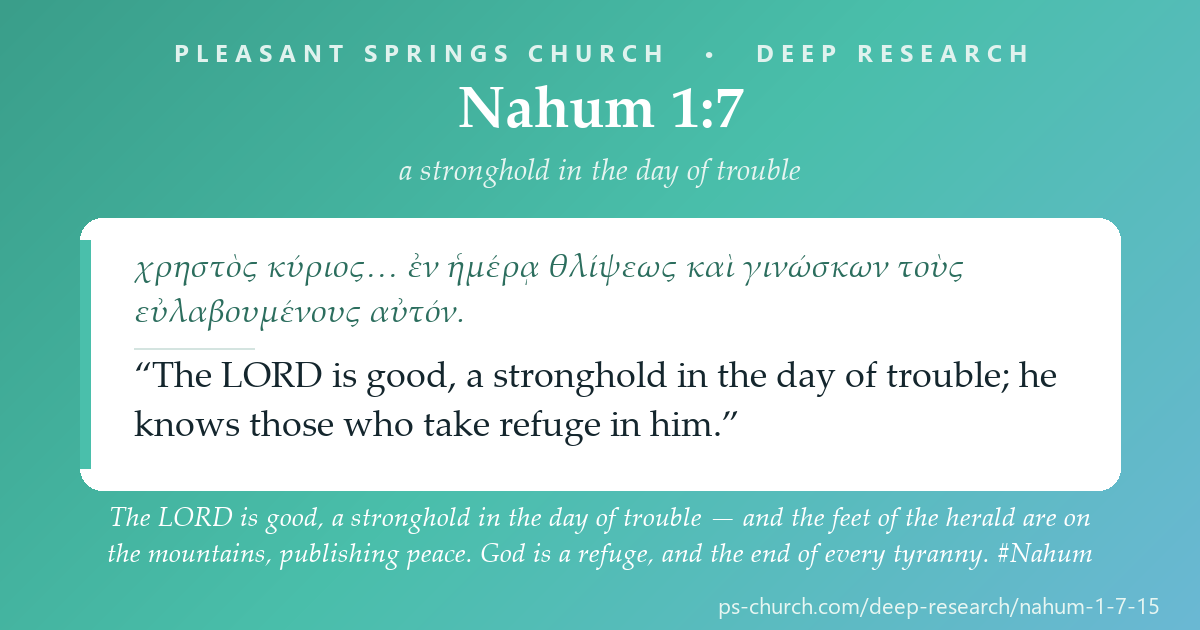
Good and just. Nahum refuses to choose between a kind God and a just one. The same Lord who is “a stronghold in the day of trouble” and “knows those who take refuge in him” (1:7) is the one whose patience with Nineveh has run out. This is not two Gods but one: his goodness to the oppressed is his justice on the oppressor. (The Greek reads 1:7 a little differently — “good to those who wait for him… those who fear him” — softening “stronghold” and “take refuge” into “wait” and “fear”; the sense of refuge in God is the same, and this study shows both.)
The feet of good news. In the ancient world a runner carried news of a battle’s outcome over the hills to the waiting city; the sight of his feet on the ridge meant the war was decided. Nahum 1:15 pictures that runner announcing Nineveh’s fall: “the feet of him who brings good news, who publishes peace!” The Hebrew verb is bśr (to herald good news); the Greek renders it εὐαγγελίζομαι — the very word that becomes the New Testament’s “preach the gospel.” The line is nearly word-for-word Isaiah 52:7, and it is Isaiah’s form that Paul quotes; but Nahum sets the same “gospel of peace” in the concrete key of an oppressor overthrown.
- Isaiah 52:7 — “How beautiful upon the mountains are the feet of him who brings good news… who publishes peace”: the twin herald-oracle, verbally almost identical to Nahum 1:15.
- Exodus 34:6–7; Nahum 1:3 — the grace-formula (“slow to anger”) with its other edge (“will by no means clear the guilty”): God’s goodness and justice together (see Exodus 34).
- 11QMelchizedek (11Q13) (Dead Sea Scrolls — a Second-Temple witness, not Scripture) — reads Isaiah’s “herald” of good news as an anointed messenger: the good-news-messenger awaited before Christ (see Isaiah 61).
- The partial acrostic of Nahum 1:2–8 — an alphabetic hymn (aleph toward kaph) of the Lord’s power in judgment and refuge, with 1:7 at its center.
Paul lifts the herald of Nahum 1:15 and Isaiah 52:7 straight into the gospel: “How are they to hear without someone preaching?… As it is written, ‘How beautiful are the feet of those who preach the good news!’” (Rom 10:15). He quotes the wording of Isaiah, but the image is the same one Nahum uses — a runner on the mountains announcing that the war is won and peace has come. What was once the news of an empire’s fall becomes the news of sin and death defeated: the true good news of peace, made “by the blood of his cross” (Col 1:20). And Nahum’s hard duality — the Lord good and just — is exactly the balance Paul strikes: “note then the kindness and the severity of God” (Rom 11:22). The comfort of Nahum is not that God enjoys destroying the wicked but that he will not let cruelty stand forever; the oppressor is cut off so that the herald of peace can run. A word of care: the fall of ancient Nineveh is God’s judgment on one empire’s violence — it is never a warrant against any modern people, only a promise that the God who is a refuge is also the end of every tyranny.
The vocabulary of refuge, the herald, and peace.
Watch the runner’s feet — the word that becomes “gospel.”
“Good” — “The Lord is good.” The center of the acrostic hymn: his goodness is not opposed to his justice but is its ground — goodness to the oppressed, judgment on the oppressor.
“Stronghold, refuge” — a fortified place of safety “in the day of trouble.” The Greek renders the line “good to those who wait for him,” but the sense of taking shelter in God is shared.
“Take refuge” — “he knows those who take refuge in him.” The Psalter’s word for fleeing to God for shelter; to be “known” by him is to be kept.
“Herald of good news” — the runner who announces victory and peace. The Greek renders it εὐαγγελιζόμενος — the root of gospel; the word Paul takes up in Romans 10:15.
“Peace” — wholeness, the end of the war. The herald “publishes peace”: the oppressor cut off means rest for God’s people, fulfilled in the peace of Christ (Eph 2:14–17).
How the New Testament carries these themes:
- Romans 10:15 — “How beautiful are the feet of those who preach the good news!” (quoting Isaiah 52:7, the twin of Nahum 1:15): the herald become the gospel preacher.
- Ephesians 6:15; Acts 10:36 — “the gospel of peace”; “preaching good news of peace through Jesus Christ”: the herald’s message fulfilled.
- Romans 11:22 — “the kindness and the severity of God”: Nahum’s goodness-and-justice, held together.
- 2 Corinthians 6:15 — “what accord has Christ with Belial (Beliar)?”: Nahum’s “worthless one” (belial, 1:15) become a name for the adversary.
From the fall of an empire to the gospel of peace.
Trace the herald of good news from Nahum and Isaiah into the preaching of Christ.
Which cross-references matter?
- Isaiah 52:7–10; 40:9; 61:1 — the herald of good news and peace; the good-news trajectory of Isaiah (see Isaiah 61).
- Nahum 1:2–8; Exodus 34:6–7 — the acrostic hymn; the Lord slow to anger yet not clearing the guilty (see Exodus 34).
- Jonah 3–4; Matthew 12:41 — Nineveh’s earlier repentance under Jonah: mercy offered before judgment fell (see Jonah).
- Romans 10:15; Ephesians 6:15; Colossians 1:20 — the beautiful feet; the gospel of peace; peace made by the blood of the cross.
- Romans 11:22; Revelation 19:1–2 — God’s kindness and severity; heaven’s praise at the fall of the oppressor.
Nahum troubles readers who want only a gentle God, but it is precisely its hard edge that makes its comfort real. A God who never judged cruelty would be no refuge for its victims; the “stronghold in the day of trouble” (1:7) is trustworthy only because he is also the God who ends the trouble. The book’s two famous verses belong together: the Lord is good (1:7), and therefore the herald of peace can run (1:15). Nahum sets this in the fall of one historical empire, but the pattern reaches to the cross and beyond: evil is not ignored but defeated, and out of that defeat comes the gospel of peace. Care must be taken not to turn Nahum into a weapon — it judges an ancient tyranny, not any modern people — but its assurance stands for every generation that has feared the wicked will simply win: they will not. The feet on the mountains are bringing good news, and the God who is a refuge is also the end of every Nineveh.
The scholarship on Nahum 1.
The commentators on Nahum; the studies of the acrostic and the Isaiah-52:7 parallel.
Commentaries & studies:
- O. Palmer Robertson (NICOT, Nahum, Habakkuk, Zephaniah), J. J. M. Roberts (OTL), Duane L. Christensen (Anchor Yale, Nahum), Tremper Longman III (in McComiskey, The Minor Prophets).
- Richard D. Patterson (Wycliffe); Klaas Spronk (HCOT); studies of the Nahum 1:2–8 acrostic and the Nahum 1:15 / Isaiah 52:7 herald.
- G. K. Beale & D. A. Carson, eds., Commentary on the NT Use of the OT (Romans 10:15).
Interpretation notes worth keeping:
- Versification. English Nahum 1:15 = Hebrew/Greek 2:1 (the Hebrew begins chapter 2 at the “good news” verse); 1:7 is the same in all traditions. A reader checking BHS should not look for a “Nahum 1:15.”
- Goodness and justice. 1:7 (refuge) and the judgment of Nineveh are one message; Nahum (“comfort”) is comfort to the oppressed, not vindictive gloating — and no warrant against any modern people.
- The gospel link, stated precisely. Nahum 1:15 shares the “good news of peace” line with Isaiah 52:7; Paul quotes Isaiah in Romans 10:15, but the shared euangeliz- word-field is the real root of “gospel.”
- Greek divergences. The LXX reads 1:7 as “good to those who wait… who fear him” and lacks “the worthless” (belial) in 1:15; disclose them rather than smoothing.
From a refuge in trouble to the good news of peace.
Name what you learned, why it matters, and one concrete response.
What should we carry away — and do?
- God is good — and just. You do not have to choose between a tender God and a righteous one. His goodness to you and his justice on evil are the same love from two sides.
- He is a stronghold in trouble. “He knows those who take refuge in him.” In the day of trouble the safest place is not a stronger self but a stronger God.
- The feet are on the mountains. The news that a tyrant fell became the news that sin and death are defeated. You carry the gospel of peace; your feet, too, are beautiful when they run with it.
Step in response: in whatever “day of trouble” you are facing, take refuge — run to the stronghold rather than white-knuckling your own strength. And because the herald’s feet are beautiful, carry the good news of peace to one person this week who is still under the fear that cruelty wins: tell them the war is decided in Christ.
Nahum 1:7 · to share
ESVEvery Deep Research page traces its passage across the whole sweep — the Old Testament, the Second-Temple world between the testaments (historical witnesses, not Scripture), and the New Testament. Follow the thread:
Pleasant Springs Church — Deep Research
Research method after Michael S. Heiser’s Bible Research Method (examine dictionaries → ancient literature → important words → textual connections → academic publications → share), with the Pleasant Springs “Author & Audience” foundation. Scripture set in the Hebrew, the Greek editions named on each page and the ESV (Old Testament), and the Greek New Testament and the ESV (New Testament), per the practice of Pleasant Springs Church. Nahum 1:7, 15 research grounded in Robertson, Roberts, Christensen, and Longman, with Beale & Carson on Romans 10:15; the Isaiah 52:7 parallel and 11QMelchizedek as canonical/Second-Temple witnesses to the herald of good news.
Scripture quotations marked ESV are from the ESV® Bible (The Holy Bible, English Standard Version®), © 2001 by Crossway, a publishing ministry of Good News Publishers. ESV Text Edition: 2016. Used by permission. All rights reserved. The ESV text may not be quoted in any publication made available to the public by a Creative Commons license, and the ESV may not be translated in whole or in part into any other language. www.esv.org
|
Did this study bless you today? 💚 Give to Support PS Church100% of gifts go to the General Fund — thank you. |