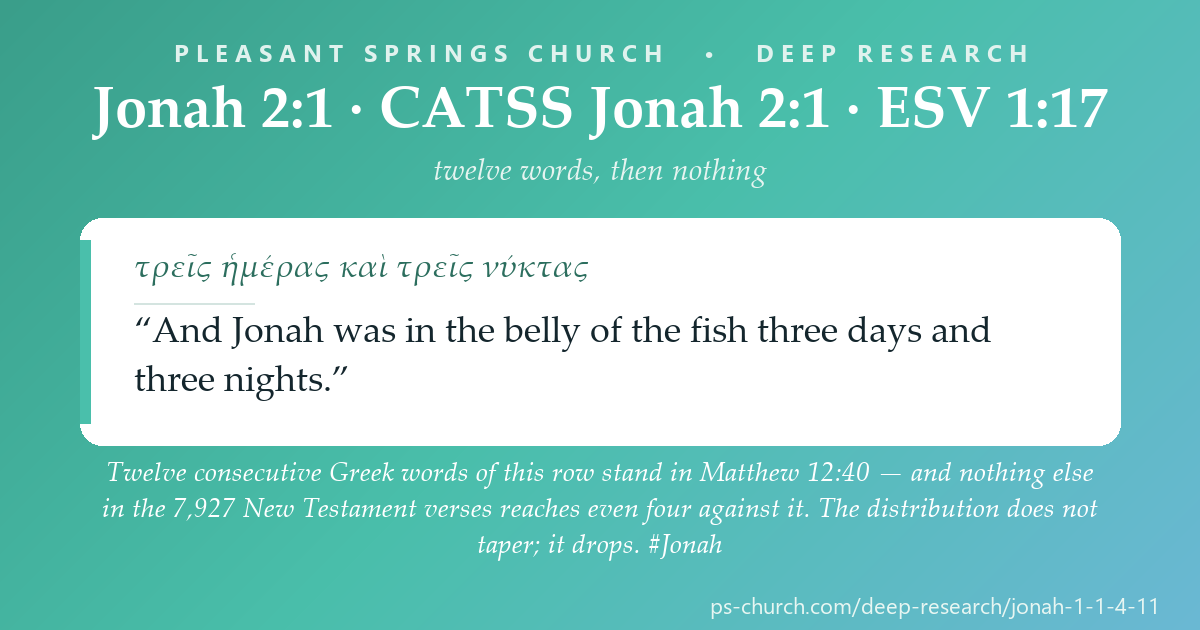
Twelve consecutive Greek words of the CATSS row at Jonah 2:1 stand unbroken in Matthew 12:40 — ἦν Ιωνας ἐν τῇ κοιλίᾳ τοῦ κήτους τρεῖς ἡμέρας καὶ τρεῖς νύκτας — and each verse is the other's single deepest match: no other of the 7,927 New Testament verses reaches 12 against that row, and no other of the 30,348 screened CATSS verse units reaches 12 against that verse. The string stands once in each corpus. What is most striking is the gap underneath it. Screen Jonah 2:1 against the whole Greek New Testament and the distribution runs: one verse at twelve, then nothing at all until four verses at three. Nothing in the New Testament reaches even four against this row except the one that reaches twelve. And one verse later, where the Hebrew has forty days, the Greek row has three. See the method →
Jonah 1:1–4:11 (selections, Hebrew numbering)
Hebrew · Greek (CATSS, Rahlfs’ Septuaginta) · ESV⚠️ And that row carries twelve words of Matthew 12:40. Nothing else in the New Testament reaches even four against it.
The Shape of the Passage
Sequence — down, down, and a question left openJonah is the only one of the Twelve that is a narrative about a prophet rather than a collection of his oracles. Its total preaching content is one sentence, at 3:4. Everything else is story — and the prophet is the character who comes off worst in it.
Author
The book never says who wrote it, and Jonah is named in the third person throughout. 2 Kings 14:25 mentions a Jonah son of Amittai in the reign of Jeroboam II, which is the only other place the name appears in the Hebrew Bible.
Its Hebrew is unusually full of Aramaic-looking forms, which is one of the standard arguments in the dating debate. That debate is not something a word count can enter, and this page does not.
Audience
Everyone in the book except the prophet behaves well. The sailors pray, cast lots reluctantly, and try to row back to land before throwing him over. The Ninevites repent on five words. The plant, the worm and the wind all obey.
And it ends on a question addressed to Jonah that he never answers. Which leaves the question with whoever is reading — the only book in the Twelve built that way.
Orient on Nineveh, the fish, and one verse seam.
Search by topic: Jonah, book of; Nineveh; sign of Jonah; repentance in the prophets; Tarshish; chapter and verse divisions, history of.
Which articles are relevant?
- Anchor Bible Dictionary — “Jonah, Book of,” “Nineveh,” “Tarshish,” “Repentance.”
- Dictionary of the OT: Prophets (IVP) — “Jonah: Book of,” “Prophecy and Repentance,” “Nations.”
- Dictionary of NT Use of the OT (Beale & Carson) — on Matthew 12:39–41 and Luke 11:29–32.
- NIDOTTE — נָחַם, חוּס, דָּג, קָרָא.
Settle the numbering — the seam falls on the verse everyone cites
Jonah has one Hebrew/English offset, and it lands exactly on the fish.
| Hebrew & CATSS | ESV | opening words |
|---|---|---|
| 1:16 | 1:16 | then the men feared the Lord exceedingly… |
| 2:1 | 1:17 | and the Lord appointed a great fish… |
| 2:2 | 2:1 | then Jonah prayed to the Lord his God… |
| 2:11 | 2:10 | and the Lord spoke to the fish… |
| 3:1 | 3:1 | then the word of the Lord came a second time… |
Chapter counts — Masoretic and CATSS 16 / 11 / 10 / 11; the ESV 17 / 10 / 10 / 11. Forty-eight verses either way. Established from content at the seam, not assumed. So a reference to “Jonah 1:17” is an English reference and the same sentence is Jonah 2:1 in Hebrew — which matters here, because that is the row the whole study turns on.
Twelve words, and the gap below them.
Jonah 2:1 and Matthew 12:40, checked from both ends
The CATSS row and the New Testament verse share twelve consecutive word forms.
ἦν Ιωνας ἐν τῇ κοιλίᾳ τοῦ κήτους τρεῖς ἡμέρας καὶ τρεῖς νύκτας
| screened | distribution of longest runs | the maximum |
|---|---|---|
| Jonah 2:1 against all 7,927 NT verses | 12 → 1 · 4–11 → 0 · 3 → 4 · 2 → 395 | Matthew 12:40, alone |
| Matthew 12:40 against all 30,348 screened CATSS units | 12 → 1 | Jonah 2:1, alone |
The gap is the part worth looking at. Between the single verse at twelve and the four verses at three there is nothing whatever — no New Testament verse anywhere reaches four, five, six or any depth up to eleven against this row. The distribution does not taper; it drops.
And the string is as rare as the run is deep, all the way down. The twelve words stand in exactly one of the 30,348 screened CATSS verse units and one of the 7,927 New Testament verses — and unlike some matches on this shelf, the rarity here is not carried by one unusual word at the front: κοιλίᾳ τοῦ κήτους and τρεῖς ἡμέρας καὶ τρεῖς νύκτας are each doing work.
Scope, and what the measurement is. Contiguous runs of normalised word forms, Greek against Greek: the CATSS FORM column (cols 0–24, beta-code transliterated) across 30,348 verse units in the 63 .mlxx files screened (64 files and 30,637 units are held on disk; the Odes are held and not screened — see below), against the MorphGNT surface-word column across 7,927 verses in 27 files. Both sides lowercased, accents and breathings dropped, final sigma folded, then filtered to Greek letters — the same filter on both corpora. Word forms, never lemmas.
⚠️ The corpus under this page has grown twice, and the page prints the history rather than only the current number. It was published against 35 files and 18,183 verse units. On 19 August 2026 Isaiah, Jeremiah, Lamentations, Ezekiel and both Greek Daniels arrived, taking it to 44 files and 23,061. On 30 August 2026 the last twenty CATSS files arrived — Exodus, Leviticus, Numbers, Joshua in both recensions, and the deuterocanon (Judith, both Tobits, 2–4 Maccabees, Odes, Wisdom, Psalms of Solomon, Baruch, the Epistle of Jeremiah, and the additions to Daniel) — taking it to 64 files and 30,637 verse units held. And then, the same day, the corpus SHRANK — the Odes came back off the screen. HELD is 30,637 units in 64 files; SCREENED is 30,348 in 63, and the difference is exactly the 289 verse units of the Odes. Both numbers are right and this page uses whichever one the sentence needs. Every corpus-wide screen on this page has been re-run against the screened set. Jonah’s central finding has now survived two growths and one contraction unchanged: Matthew 12:40 still finds Jonah 2:1 alone at 12, tie band one, on 30,348 screened verse units exactly as it did on 30,637, on 23,061 and on 18,183. A tie band can only grow when the corpus grows; this one did not.
⚠️ And the second growth put a second Greek Jonah on the shelf — which is why the tie band deserved re-checking rather than assuming. The Odes are a fourteen-canticle appendix to the Greek Psalter, and Odes 6 is Jonah’s prayer. Odes is a WITNESS, NOT SCRIPTURE, and this page labels it so every time it is named. Odes 6 begins at Jonah 2:3 — one verse after the row this whole study turns on — so the twelve-word run at 2:1 has no second Greek witness on this disk and the tie band of one stands. See stage 3 for what the two Greek columns of the prayer itself do.
⚠️ AND ON 30 AUGUST 2026 THE ODES WERE TAKEN BACK OUT OF THE SCREEN ENTIRELY. They stay on disk; they are no longer part of anything this shelf calls ‘the Greek Old Testament’. Two reasons, either of which would be enough. (1) Ten of the fourteen canticles are second copies of passages the corpus already holds — Ode 1 is Exodus 15, Ode 2 Deuteronomy 32, Ode 3 1 Samuel 2, Ode 4 Habakkuk 3, Ode 5 Isaiah 26, Ode 6 Jonah 2, Odes 7 and 8 Daniel (Theodotion) 3, Ode 10 Isaiah 5, Ode 11 Isaiah 38. A verse standing once appeared to stand twice, so every tie band touching a canticle was silently doubled. (2) Two of them are New Testament text — Ode 9 is Luke 1 and Ode 13 is Luke 2. Jonah is on the wrong end of reason (1) more than any other book on this shelf, since Odes 6 is its own psalm; the reason the study survived is the one-verse offset, and that was luck of the seam rather than method. Nothing on this page moved when the Odes came off: the tie band at 2:1 was already one, because the canticle starts at 2:3.
Twelve is deep for Jonah and not for the disk
The same screen over all 30,348 screened CATSS verse units against all 7,927 New Testament verses goes deeper elsewhere. Nine rows stand above Joel 3:1, and here they all are.
| CATSS row | New Testament partner | run | band |
|---|---|---|---|
| Isaiah 6:10 | Matthew 13:15 · Acts 28:27 | 24 | 2 |
| Isaiah 54:1 | Galatians 4:27 | 23 | 1 |
| Jeremiah 38:32 · MT 31:32 | Hebrews 8:9 | 23 | 1 |
| Jeremiah 38:34 · MT 31:34 | Hebrews 8:11 | 23 | 1 |
| Deuteronomy 6:5 | Mark 12:30 | 21 | 1 |
| Isaiah 53:8 | Acts 8:33 | 20 | 1 |
| Psalm 2:2 | Acts 4:26 | 20 | 1 |
| Psalm 15:9 · MT 16:9 | Acts 2:26 | 20 | 1 |
| Psalm 44:8 · MT 45:7 | Hebrews 1:9 | 20 | 1 |
| Joel 3:1 · MT 2:28 | Acts 2:17 | 19 | 1 |
| Amos 9:12 | Acts 15:17 | 14 | 1 |
| Jonah 2:1 · ESV 1:17 | Matthew 12:40 | 12 | 1 |
Twelve is the ceiling for Jonah’s 48 rows, not for the corpus.
⚠️ This list has been corrected twice, and the page prints what it got wrong rather than quietly replacing it. 19 August 2026, first correction. It previously read “Deuteronomy 6:5 against Mark 12:30 reaches 21; three pairs reach 20.” First, the corpus grew. Isaiah, Jeremiah, Lamentations, Ezekiel and both Greek Daniels were fetched that day, taking the Greek Old Testament shelf from 35 files and 18,183 verse units to 44 files and 23,061, and several of the rows now standing above Joel 3:1 come from books that were not held before. Second, and independently of the fetch, the Deuteronomy figure went wrong and then went right again — and both moves are on the record. A re-run reported Deuteronomy 6:5 against Mark 12:30 at 6 rather than 21, on the ground that the CATSS row reads …τὸν θεόν σου ἐξ ὅλης τῆς καρδίας σου… where SBL Mark 12:30 reads …τὸν θεόν σου ἐκ ὅλης…, so the run would stop on the seventh word. That correction was itself wrong and has been withdrawn. ἐκ and ἐξ are one word spelled two ways before vowel and consonant, and the comparison normaliser folds them, as it folds the movable nu. The pair measures 21, tie band one, and it is in the table above.
30 August 2026, second correction — and this one is an omission, not a change of value. The corpus grew again that day, from 44 files and 23,061 verse units to 64 and 30,637. Re-running the whole screen against the complete set turned up something the growth did not cause: the old list said “six rows stand above Joel 3:1” and there were nine, on the 44-file corpus as much as on the 64-file one. Isaiah 54:1 against Galatians 4:27 at 23, Jeremiah 38:32 against Hebrews 8:9 at 23, and Deuteronomy 6:5 against Mark 12:30 at 21 were all held on the old shelf and all left off the list. The table above is the exhaustive one. The twenty new files added nothing above 19. ⚠️ This sentence used to continue: ‘their deepest row against the New Testament is Odes 9:48 at 18.’ That reading has been WITHDRAWN, and it is worth saying why rather than deleting it. Odes 9 is not an Old Testament witness at all; it is Luke 1, the Magnificat and the Benedictus, collected into the Greek Psalter’s liturgical appendix. Ode 9:48 against Luke 1:48 at eighteen consecutive words was Luke measured against Luke under an Old Testament shelfmark — the single most misleading number the corpus growth produced anywhere on this shelf, and it was sitting in this page’s own correction note. The Odes came off the screening corpus on 30 August 2026, and the deepest genuine row among the nineteen remaining new files is Exodus 20:11 against Acts 4:24 and Acts 14:15 at 13, tie band two — who made the heaven and the earth and the sea and all that is in them. Which is one deeper than Jonah, and it is printed here for that reason. See the hazard note in stage 5. Nothing about Jonah changes: Jonah 2:1 against Matthew 12:40 is still 12, still a tie band of one in both directions, and still the deepest thing in the book.
Within Jonah the distribution is: 38 rows reach three or more, 12 reach four, 4 reach five, and one reaches twelve. Nothing sits between five and twelve. The book has one deep match and a long flat tail.
Where the two columns answer differently.
Three places the columns do not say the same thing
| verse | Hebrew | CATSS Greek row |
|---|---|---|
| 1:9 | עִבְרִי אָנֹכִי — I am a Hebrew | δοῦλος κυρίου ἐγώ εἰμι — I am a servant of the Lord |
| 2:1 | דָּג גָּדוֹל — a great fish | κήτει μεγάλῳ — a great sea-creature |
| 3:4 | אַרְבָּעִים יוֹם — forty days | τρεῖς ἡμέραι — three days |
Each is printed as its file has it. Why any of them stands as it does is not something these columns can settle, and the page does not guess. The third is worth pausing on only because it falls one verse after the row this whole study turns on, and the number in that row — three days and three nights — is the one both columns share.
One Greek word doing two jobs at 2:1 and 2:3
The Hebrew uses two different words for the inside of things; the Greek row uses one word twice.
| 2:1 — inside the fish | 2:3 — inside Sheol | |
|---|---|---|
| Hebrew | בִּמְעֵי הַדָּג | מִבֶּטֶן שְׁאוֹל |
| CATSS row | ἐν τῇ κοιλίᾳ τοῦ κήτους | ἐκ κοιλίας ᾅδου |
In the Greek column the belly of the fish and the belly of Hades are the same noun, two verses apart. In the Hebrew they are not. That is a fact about what each column contains — the page reports it and stops.
★ New on 30 August 2026: a SECOND Greek column for Jonah’s prayer
The corpus that grew that day brought the Odes, and Odes 6 is Jonah’s prayer. For the first time this shelf can set two Greek witnesses to the same eight verses side by side. The Odes are a WITNESS, NOT SCRIPTURE — a fourteen-canticle appendix to the Greek Psalter, gathering songs from across the Bible for liturgical use. This page treats Odes 6 as a second manuscript column for Jonah’s psalm and as nothing more.
Odes 6 covers Jonah 2:3–10 — eight rows. Two are word-for-word identical to CATSS Jonah; six are not.
| verse | longest shared run | where the two Greek columns part |
|---|---|---|
| 2:3 | 20 | Odes lacks Jonah’s opening καὶ εἶπεν |
| 2:4 | 21 | identical — every word |
| 2:5 | 10 | Jonah καὶ ἐγώ / Odes κἀγώ; Odes lacks one article |
| 2:6 | 11 | μοι and μου sit in different places |
| 2:7 | 11 | Jonah φθορὰ ζωῆς / Odes ἐκ φθορᾶς ἡ ζωή — the one place the sense turns |
| 2:8 | 14 | ἀπ’ ἐμοῦ stands in a different clause |
| 2:9 | 7 | identical — the whole row is seven words |
| 2:10 | 13 | Jonah σωτηρίου / Odes εἰς σωτηρίαν μου |
What this does and does not show. It shows that the Greek of Jonah’s psalm circulated in more than one form, and where. It does not show which form is earlier, and this page does not guess. And it does not touch the study’s central row. Odes 6 starts at Jonah 2:3. The fish verse — Hebrew 2:1, ESV 1:17, the twelve words Matthew 12:40 carries — is one verse above where the canticle begins, so it still has exactly one Greek witness on this disk and the tie band of one is unchanged.
Jonah and Joel, eight words apart.
Jonah 4:2 and Joel 2:13 share eight consecutive words
Jonah’s complaint and Joel’s call to return end with the same eight Greek words.
μακρόθυμος καὶ πολυέλεος καὶ μετανοῶν ἐπὶ ταῖς κακίαις
That string stands in exactly two of the 30,348 screened CATSS verse units — Joel 2:13 and Jonah 4:2 — and in none of the 7,927 New Testament verses. The two rows part just before the run: Joel’s has ἐλεήμων καὶ οἰκτίρμων ἐστίν and Jonah’s has σὺ ἐλεήμων καὶ οἰκτίρμων. Re-run on the full 64-file corpus on 30 August 2026: still exactly two, and the pair grew no partners in the twenty new files — so the same finding now rests on a corpus a third larger. Re-run again the same day with the Odes removed from the screen: still exactly two.
★ And the sentence this page used to be unable to test: “both verses are versions of the formula at Exodus 34:6.” Greek Exodus was not on this shelf when the page was published, so that was an assertion borrowed from the commentaries. It is now on disk and the shelf has measured it — and the measurement is sharper than the assertion.
| pair | longest shared run | the shared words |
|---|---|---|
| Jonah 4:2 → LXX Exodus 34:6 | 4 | μακρόθυμος καὶ πολυέλεος καί |
| Joel 2:13 → LXX Exodus 34:6 | 4 | μακρόθυμος καὶ πολυέλεος καί |
| Jonah 4:2 → Joel 2:13 | 8 | μακρόθυμος καὶ πολυέλεος καὶ μετανοῶν ἐπὶ ταῖς κακίαις |
Four of the eight words are Exodus 34:6. The other four are not, and where they part is the point. LXX Exodus 34:6 runs …μακρόθυμος καὶ πολυέλεος καὶ ἀληθινός — and true. Jonah and Joel both run …καὶ μετανοῶν ἐπὶ ταῖς κακίαις — and relenting over evils. The clause the two prophets share, and Exodus does not give them, is the clause about God changing his mind — which is the exact thing Jonah is complaining about. Whether the prophets are drawing on a form of the formula older than the Greek Exodus on this disk, or extending it, is not something a run-length screen can settle, and the page does not guess.
LXX Exodus 34:6’s own deepest partner anywhere in the 30,348 screened units is not Jonah or Joel at all: it is Psalm 85:15 · MT 86:15 at 10, tie band one — ὁ θεὸς οἰκτίρμων καὶ ἐλεήμων μακρόθυμος καὶ πολυέλεος καὶ ἀληθινός. The Psalter keeps and true; the prophets replace it.
⚠️ This is not the deepest link between two books of the Twelve, and the page says so. Screening all 1,050 CATSS rows of the Twelve against each other across book boundaries, seventeen pairs reach eight or more. Three reach nine — Malachi 3:7 with Zechariah 1:3, and Hosea 2:24 and 2:10 each with Joel 2:19. Jonah 4:2 with Joel 2:13 is one of the fourteen at eight. It is a real overlap in a band, not a record.
Matthew 12:40 and what it is doing
Matthew 12:40 reads ὥσπερ γὰρ ἦν Ἰωνᾶς ἐν τῇ κοιλίᾳ τοῦ κήτους τρεῖς ἡμέρας καὶ τρεῖς νύκτας… Everything from ἦν onward is the twelve-word run.
The words before it, ὥσπερ γάρ, are the frame; the words after it turn to the Son of Man. The run covers the whole of the Jonah material in that verse and stops precisely where the verse stops talking about Jonah.
Luke 11:29–32 mentions Jonah four times and does not reach the same depth. It refers to the sign and to the Ninevites without reproducing the sentence about the fish, so a contiguous-run screen registers little of it. The relation a reader sees there is real and this measurement is not the instrument for it.
Where this page is weakest, and what was not reached.
The limits
Everything is scoped to the 63 Greek Old Testament files screened and 27 New Testament files — the complete CATSS set less the Odes. Every corpus-wide screen on this page has been re-run against all 64 files, and then again against the 63 that are screened, and none of Jonah’s results moved either time. Every “only” and “nowhere else” on this page means on the CATSS FORM column across those files, and nothing wider. That is now the whole of what CATSS digitizes of Rahlfs, which is a much stronger scope than this page could claim on 19 August — but it is still one edition, lemmatised one way, and anything outside it is NOT VERIFIABLE FROM LOCAL CORPORA.
⚠️ A hazard the growth created — found here, and since fixed at the source. This is what the screen looked like for the few hours the Odes were in it. Two of the twenty new files are not Old Testament witnesses to the New Testament at all. Odes 9 is Luke 1:46–55 and 1:68–79 — the Magnificat and the Benedictus — and Odes 13 is Luke 2:29–32, the Nunc Dimittis, collected into the Greek Psalter’s appendix for liturgical use. Screened the New Testament against “the Greek Old Testament” with the Odes in it and 272 New Testament verses came back with an Odes row in their deepest-partner set, the top fourteen of them being Luke matched to itself: Luke 1:48 against Odes 9:48 at 18, Luke 1:79 at 16, Luke 1:68 at 14, Luke 2:29 at 12. None of that is contact between Testaments and none of it touches Jonah — but a page that reported it without saying what Odes 9 and 13 are would be reporting Luke as a witness to Luke.
⚠️ RESOLVED, 30 AUGUST 2026: the Odes were removed from the screening corpus altogether, and this page keeps the warning rather than deleting it. Removal was the right fix for a second reason as well, which is closer to home for this study: ten of the fourteen canticles are second copies of passages the corpus already holds, and Ode 6 is Jonah 2. A duplicate does not just add a false partner; it doubles a tie band that a page is reading as evidence of rarity. Screened is 30,348 verse units in 63 files; held is 30,637 in 64. The eighteen-word Luke-against-Luke hit is gone from every screen on this shelf, and it is named here because an instrument that can do that once can do it again, and the reader is entitled to know how it was caught.
A mutual maximum is not proof of citation. It means no other pair in either corpus shares more consecutive word forms. On this shelf that has coincided with the expected answer several times and failed to at least twice.
And the forty/three difference at 3:4 is reported, not explained. It is one of the better-known differences between the Hebrew and Greek columns anywhere in the Twelve, it has a substantial literature, and none of that literature was consulted for this page.
What could not be checked at all
No Hebrew or Greek critical apparatus. No Qumran material — there is a Jonah among the Minor Prophets finds, and the scroll from Nahal Hever bears directly on the Greek of these books; neither was consulted. No Targum, Syriac, Vulgate, Aquila, Symmachus or Theodotion.
And nothing about the genre. Whether Jonah is history, parable, satire or something else has been argued for a very long time, and a word count has nothing to contribute to it. The same goes for the date, and for the size of Nineveh at 3:3.
One deep match, and a flat book beneath it.
Twelve, then nothing until three
Forty-eight verses, and one of them carries a run of twelve into the New Testament. The other forty-seven top out at five. Screened against all 7,927 New Testament verses, Jonah 2:1 finds Matthew 12:40 at twelve and then finds nothing at all until four verses at three.
The twelve words are the ones about the belly and the three days and three nights. They stand once in thirty thousand Greek Old Testament verse units and once in eight thousand New Testament verses, and each verse is the other’s deepest match in either direction.
And one verse later the two columns stop agreeing about numbers — forty days in the Hebrew, three in the Greek row, in a sermon five words long. The book that turns on a count of days does not have a settled count of days.
Seventh study on the Minor Prophets shelf, and the whole of Jonah in one page. Four books complete: Hosea, Joel, Amos, Jonah.
Every Deep Research page traces its passage across the whole sweep — the Old Testament, the Second-Temple world between the testaments (historical witnesses, not Scripture), and the New Testament. Follow the thread:
Pleasant Springs Church — Deep Research
Research method after Michael S. Heiser’s Bible Research Method (examine dictionaries → ancient literature → important words → textual connections → academic publications → share), with the Pleasant Springs “Author & Audience” foundation. Scripture set in the Hebrew, the Greek editions named on each page and the ESV (Old Testament), and the Greek New Testament and the ESV (New Testament), per the practice of Pleasant Springs Church. Jonah research grounded in Sasson (Jonah, Anchor), Wolff (Obadiah and Jonah), Stuart (WBC) and Trible. Text: Hebrew from the Masoretic text as printed in the editions consulted — Sefaria’s Miqra according to the Masorah; no critical apparatus was consulted for the Hebrew. Greek from Rahlfs’ Septuaginta as digitized by CATSS; Greek New Testament from the SBL edition. The standing caution for this shelf applies: these pages say “the CATSS Greek row reads…” and never call a Greek reading early or late. ⚠️ VERSE NUMBERING — one seam, and it lands on the key row. Masoretic and CATSS Jonah run 16 / 11 / 10 / 11 = 48 verses; the ESVruns 17 / 10 / 10 / 11 = 48. Hebrew 2:1 = ESV 1:17, and Hebrew 2:2–11 = ESV 2:1–10. Chapters 3 and 4 agree. Established from content at the seam, not assumed. ⚠️ The run measurement, in full. Greek against Greek. CATSS FORM column (cols 0–24), beta-code transliterated first; MorphGNT field 6, the normalised word (the column that already resolves elision and the movable nu). Both sides lowercased, accents and breathings dropped, final sigma folded, then filtered to Greek letters — the same filter applied to both corpora. Contiguous runs of whole word FORMS, never lemmas. Corpus: 30,348 CATSS verse units across the 63 .mlxx files screened — 64 files and 30,637 units are held, and the 289 units of the Odes are held and not screened — and 7,927 verses across 27 MorphGNT files. Exhaustive and deterministic — nothing sampled, so no seed applies. ⚠️ THE CORPUS GREW UNDER THIS PAGE TWICE. Published on 35 files and 18,183 verse units; 44 and 23,061 after 19 August 2026; 64 and 30,637 after 30 August 2026, when Exodus, Leviticus, Numbers, both Joshuas and the deuterocanon arrived. ⚠️ AND THEN IT SHRANK BACK THE SAME DAY: 63 files and 30,348 units SCREENED, 64 and 30,637 HELD. The Odes came off the screen. Two of the fourteen canticles are New Testament text — Ode 9 is Luke 1, Ode 13 is Luke 2 — so 272 New Testament verses briefly had an Odes row among their deepest ‘Greek Old Testament’ partners, Luke 1:48 against Ode 9:48 at eighteen words being Luke measured against itself. And ten of the fourteen are second copies of passages already held, Ode 6 being Jonah’s own prayer, which doubles any tie band that touches a canticle. Stage 2 and stage 5 both name it. Every figure here has been re-derived against the complete held set and then against the screened set, and Jonah’s central result did not move at either growth or at the contraction. Odes is a WITNESS, NOT SCRIPTURE, as are Judith, Tobit, Wisdom, Sirach, Baruch, the Maccabees and the Psalms of Solomon, and this page labels them so wherever they are named. ⚠️ The maximum is printed with its tie band, checked on both sides. Jonah 2:1 against Matthew 12:40 at 12 is a tie band of one in both directions, and the twelve-word string stands in exactly one CATSS verse unit and one New Testament verse. The distribution beneath it is printed in full because the gap is the finding: 1 verse at 12, none at 4 through 11, 4 at 3, 395 at 2. ⚠️ “Deepest” means deepest in Jonah, and the wider screen rides beside it. The same screen over all 30,348 screened verse units goes deeper elsewhere. Nine rows stand above Joel 3:1 — Isaiah 6:10 at 24 (tie band 2: Matthew 13:15 and Acts 28:27), Isaiah 54:1 with Galatians 4:27 at 23, Jeremiah 38:32 with Hebrews 8:9 at 23, Jeremiah 38:34 · MT 31:34 with Hebrews 8:11 at 23, Deuteronomy 6:5 with Mark 12:30 at 21, and four rows at 20 — then Joel 3:1 with Acts 2:17 at 19 and Amos 9:12 with Acts 15:17 at 14. Corrected twice, and both corrections are printed in stage 2. A 19 August re-run reported Deuteronomy 6:5 / Mark 12:30 at 6 rather than 21, on the ἐξ / ἐκ spelling; that correction was itself wrong and is withdrawn — the comparison normaliser folds the two spellings and the pair measures 21. And on 30 August the re-run against 64 files exposed an omission the growth did not cause: the old list said six rows stood above Joel 3:1 and there were nine, on the 44-file corpus as much as on the 64-file one. The twenty new files add nothing above 19; with the Odes taken back out, the deepest of them is Exodus 20:11 against Acts 4:24 and Acts 14:15 at 13, tie band two. ⚠️ The Joel link is reported with its band, not as a record. Jonah 4:2 and Joel 2:13 share eight consecutive forms, a string standing in exactly 2 of the 30,348 screened CATSS verse units and 0 New Testament verses. But screening all 1,050 rows of the Twelve against each other across book boundaries, seventeen cross-book pairs reach eight or more and three reach nine (Malachi 3:7 with Zechariah 1:3; Hosea 2:24 and 2:10 each with Joel 2:19). This pair is one of fourteen at eight. ⚠️ Direction of influence is never asserted. Nothing here says which text is prior, that anyone quoted, adapted, followed or altered anything, or why any reading stands as it does — including at 1:9 (Hebrew against servant), 2:1 (fish against sea-creature) and 3:4 (forty days against three), where the page prints the readings side by side and stops. Typology is handled per the house position: what the text says, what the New Testament itself draws, and what we see from this side of the cross — with the seeing left to the reader.
Scripture quotations marked ESV are from the ESV® Bible (The Holy Bible, English Standard Version®), © 2001 by Crossway, a publishing ministry of Good News Publishers. ESV Text Edition: 2016. Used by permission. All rights reserved. The ESV text may not be quoted in any publication made available to the public by a Creative Commons license, and the ESV may not be translated in whole or in part into any other language. www.esv.org
|
Did this study bless you today? 💚 Give to Support PS Church100% of gifts go to the General Fund — thank you. |