Obadiah is the shortest book in the Old Testament — twenty-one verses, 291 Hebrew words — and its opening runs alongside Jeremiah 49. That much is well known. What this page adds is a measurement: every verse of Obadiah screened against every other verse in the Hebrew Bible for the longest run of consecutive shared words. The overlap is real, and it has an edge. Verses 2, 4 and 5 find their deepest partner in Jeremiah 49 and in no other verse of the Hebrew Bible — two of them at a run of five, which on this shelf is a strong signal. From verse 9 to the end, the deepest run Obadiah shares with any verse of Jeremiah 49 is two words, and in eleven of those thirteen verses it is one. The parallel does not fade out. It stops. And at the single place the two Hebrew texts differ in person — Obadiah’s we have heard against Jeremiah’s I have heard — the Greek row of Obadiah stands with Jeremiah. The page reports all of that and explains none of it. See the method →
Obadiah 1–21 (selections)
Hebrew · Greek (CATSS, Rahlfs’ Septuaginta) · ESV⚠️ The shortest book in the Old Testament. 291 Hebrew words on the corpus this page counts. Nahum, the next shortest, has 561.
The Shape of the Passage
Concentric — the bringing down and the going upObadiah gives less biography than any other book on this shelf. No father’s name, no town, no king, no year, no call narrative. The first two words are the vision of Obadiah and the next words begin the oracle. Whatever can be said about the setting has to be read out of what the book reports happening, not out of a heading.
Author
A name that is also a sentence. עֹבַדְיָה is servant of the Lord or worshipper of the Lord. The Greek row has Αβδιου. It is a common name in the Hebrew Bible — men called Obadiah turn up in 1 Kings, 1 and 2 Chronicles, Ezra and Nehemiah — and this book connects its Obadiah to none of them.
What the book does not say. Most of the Twelve open by placing their prophet: a father, a home town, or the kings he spoke under. Obadiah opens with a noun and a name, and then goes straight to Edom.
Audience
The oracle is addressed to Edom; the book is heard by Judah. Verse 1 says concerning Edom, and the second person runs all the way through — you soared, you stood aloof, you shall be cut off. But an oracle against a nation is delivered where the nation being consoled can hear it, and verses 17–21 are addressed to nobody else.
Verse 11 is the only dating evidence the book offers. Foreigners entering the gates and casting lots for Jerusalem points to a sack of the city, and the sack most readers take it to be is the Babylonian one. But the book names no year, no king and no army, proposed dates for it range across several centuries, and this page does not settle the question.
Orient on Edom, on a book with no setting, and on a numbering question that turns out not to exist.
Search by topic: Obadiah, book of; Edom; Esau; Idumea; Teman; Sela; Sepharad; day of the Lord; oracles against the nations.
Which articles are relevant?
- Anchor Bible Dictionary — “Obadiah, Book of,” “Edom,” “Idumea,” “Teman,” “Sela,” “Sepharad.”
- Dictionary of the OT: Prophets (IVP) — “Obadiah, Book of,” “Edom, Edomites,” “Day of the Lord,” “Nations.”
- NIDOTTE — אֱדוֹם, שָׂרִיד, פְּלֵיטָה, יָרַשׁ, יָשַׁע.
- Dictionary of NT Use of the OT (Beale & Carson) — consulted, and it has nothing to give here: no New Testament passage is treated as a use of Obadiah. That silence is itself the stage-4 result on this page.
Settle the numbering — and this time there is nothing to settle
Obadiah is one of the few books on this shelf where the three columns agree on every verse number, because there is one chapter and twenty-one verses in all three.
| chapters | verses | |
|---|---|---|
| Masoretic | 1 | 21 |
| CATSS Greek | 1 | 21 |
| ESV | 1 | 21 |
This shelf states the offset on every page, including the pages where there is none. Here there is none. Compare the two books of the Twelve where a whole chapter’s worth of numbering has to be converted — Joel, four chapters in Hebrew and three in English, and Malachi, three and four.
One convention only: a one-chapter book is usually cited by bare verse number, so Obadiah 4 and Obadiah 1:4 are the same verse. The CATSS file labels its rows Obad 1 through Obad 21 with no chapter number at all.
Jeremiah 49, measured — and what the Second-Temple world did with Edom.
Obadiah against Jeremiah 49, verse by verse
Each verse of Obadiah was screened against every verse of Jeremiah 49 for the longest run of consecutive shared consonantal word-forms. The result is not a gradient. It is an edge.
| Obadiah | deepest partner in Jer 49 | run | the shared words |
|---|---|---|---|
| 1 | 49:14 | 4 | מֵאֵת יְהוָה וְצִיר בַּגּוֹיִם |
| 2 | 49:15 | 5 | הִנֵּה קָטֹן נְתַתִּיךָ בַּגּוֹיִם בָּזוּי |
| 3 | 49:16 | 2 | זְדוֹן לִבְּךָ |
| 4 | 49:16 | 5 | קִנֶּךָ מִשָּׁם אוֹרִידְךָ נְאֻם־יְהוָה |
| 5 | 49:9 | 4 | אִם־בֹּצְרִים בָּאוּ לָךְ |
| 6, 7 | — | 1 | a single word |
| 8 | 49:26 | 4 | בַּיּוֹם הַהוּא נְאֻם־יְהוָה — a formula; see below |
| 9–21 | — | 1–2 | eleven of the last thirteen verses share a single word; verses 15 and 18 share two |
Verse 8’s run of four is a formula and is not evidence of a relationship. Screened against the whole Hebrew Bible rather than against Jeremiah 49 alone, בַּיּוֹם הַהוּא נְאֻם־יְהוָה — on that day, declares the Lord — comes back with a tie band of fifteen verses, five of them in Jeremiah and the rest scattered from Isaiah 22 to Zechariah 13. It is a stock phrase, and a screen that counted it as contact would be counting the shared language of the prophets rather than a link between two books.
So the distinctive overlap is verses 1–5, and it ends there. Two of those verses reach a run of five with a tie band of one — Jeremiah 49:15 and 49:16 are the only verses in the Hebrew Bible that carry those five-word sequences alongside Obadiah 2 and Obadiah 4. From verse 9 to verse 21, the deepest thing Obadiah shares with any verse of Jeremiah 49 is two words, and usually one.
What this does and does not show. It shows where the shared material is. It does not show which book had it first, whether either writer saw the other, or whether both drew on something older — and those are the actual questions in the literature. A measurement of location is not an argument about priority. Two verses of Obadiah, 6 and 10, share no two consecutive words with any other verse in the Hebrew Bible.
Edom on the day Jerusalem fell — and how the memory hardened afterwards
Obadiah 11–14 charges Edom with standing by, entering the gates, and cutting off fugitives. It is not the only text that remembers it that way.
| text | what it says |
|---|---|
| Psalm 137:7 | “Remember, O Lord, against the Edomites the day of Jerusalem, how they said, ‘Lay it bare, lay it bare, down to its foundations!’” |
| Lamentations 4:21–22 | Rejoice and be glad, O daughter of Edom — but to you also the cup shall pass. |
| Ezekiel 25:12–14; 35:1–15 | Edom acted revengefully; because you cherished perpetual enmity. |
| 1 Esdras 4:45 (not Scripture) | ὃν ἐνεπύρισαν οἱ Ιδουμαῖοι — the temple which the Idumeans burned when Judea was laid waste by the Chaldeans. |
1 Esdras is worth pausing on, and worth labelling. It is a Second-Temple Greek book, not Scripture on our shelf, and it is evidence for how the memory was being told by then rather than a report from the event. What it does is go a step further than the prophets do. Obadiah says Edom stood by and came in at the gates; 1 Esdras 4:45 says the Idumeans burned the temple — and 2 Kings 25:9 lays that at the door of Nebuzaradan and the Babylonians. The page notes the escalation and does not adjudicate it.
Two other things happened to Edom between the testaments. The Nabateans came to hold the old Edomite territory, and the population settled in the southern hill country of Judah was known by the Greek name of that region, Idumea. Josephus reports that John Hyrcanus subdued the Idumeans and required them to live by Jewish law (Antiquities 13.257–258). The Herods were an Idumean family. None of this is in Obadiah. It is what the name in Obadiah 1 had come to mean by the first century.
Five places the columns carry different words — and one that carries a different person.
Obadiah 1. Jeremiah 49:14 has the singular, שָׁמַעְתִּי — I have heard — and so does the Greek row of Obadiah: ἀκοὴν ἤκουσα. Of the few words where the two Hebrew texts differ inside the shared stretch, this is the one that changes who is speaking.
Obadiah 17. Read as a noun from יָרַשׁ, to possess, it is what Jacob gets back. The row reads the same consonants as the people who did the possessing — τοὺς κατακληρονομήσαντας αὐτούς, those who dispossessed them.
Obadiah 18, no survivor for the house of Esau. The row has πυροφόρος, a fire-bearer. The verse’s images are fire, flame and stubble, and the row’s noun stays inside them where the Hebrew’s steps outside.
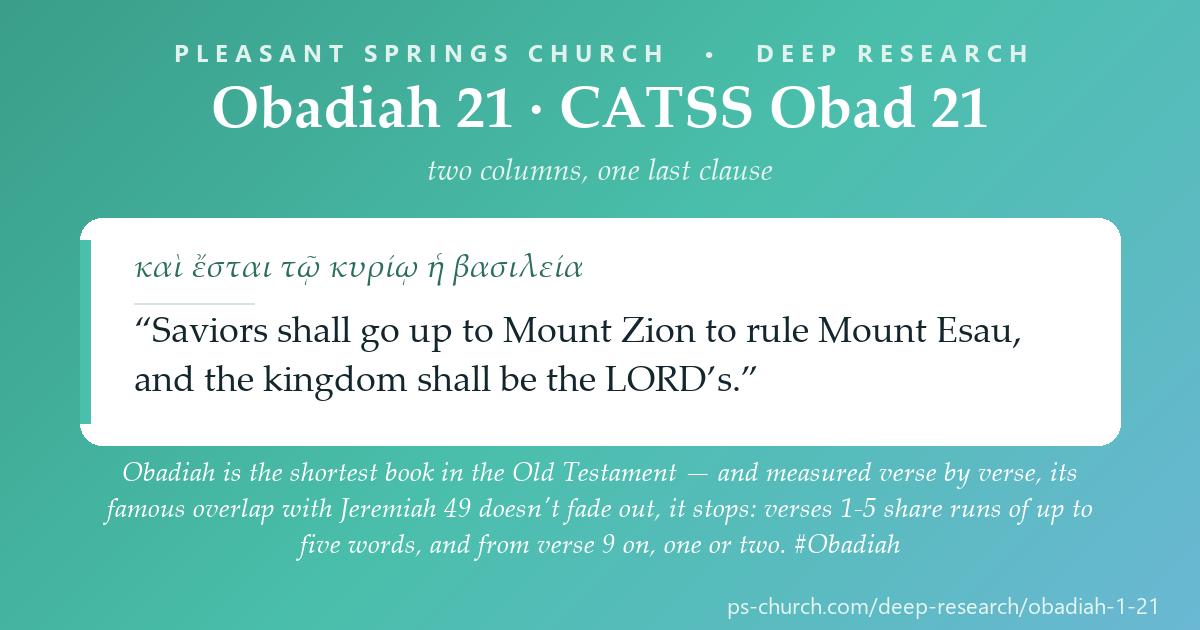
Obadiah 21, the last verse. An active participle: those who save. The row has ἄνδρες σεσῳσμένοι — a perfect passive participle, men who have been saved. The same consonants will carry either reading; the two columns took different ones.
Obadiah 20. An unidentified place of exile — later Jewish tradition attached the name to Spain, which is where Sephardi comes from. The Greek row does not have it at all: it reads Εφραθα, Ephrathah.
The pivot, counted
Verses 11–14 are built out of one phrase repeated.
| verse | בְּיוֹם — in the day of | negative commands (אַל) |
|---|---|---|
| 11 | 2 | — |
| 12 | 4 | 3 |
| 13 | 3 | 3 |
| 14 | 1 | 2 |
| total | 10 | 8 |
The word יוֹם stands twelve times in the book. Once before this block — בַּיּוֹם הַהוּא, on that day, at verse 8. Ten times inside it. And once after it, at verse 15: יוֹם־יְהוָה, the day of the Lord.
The block is bracketed by the other two, and the movement is from Edom’s day to the Lord’s. The eight commands all take the same form — do not look, do not rejoice, do not boast, do not enter, do not gloat, do not loot, do not stand at the crossroads, do not hand over the survivors — and they concern the person verse 10 has just named: אָחִיךָ יַעֲקֹב, your brother Jacob.
A New Testament screen that comes back empty, and the one word that does not.
Obadiah in the New Testament: the measurement, and the honest answer
All 21 CATSS rows of Obadiah were screened against all 7,927 verses of the Greek New Testament. The deepest run in the book is four; three rows reach it; and all three are formulas.
| row | deepest NT partner | run | tie band | the shared words |
|---|---|---|---|---|
| Obad 1 | Revelation 1:8 | 4 | 1 | λέγει κύριος ὁ θεός |
| Obad 8 | Matthew 7:22 and twelve others | 4 | 13 | ἐν ἐκείνῃ τῇ ἡμέρᾳ |
| Obad 18 | Luke 19:46 | 4 | 1 | καὶ ἔσται ὁ οἶκος |
The Luke line is the clearest warning on this page about what a run of four is worth. Obadiah 18 is the house of Jacob shall be a fire; Luke 19:46 is my house shall be a house of prayer. Four consecutive Greek words, a tie band of one, and no relationship whatever between the two sentences. Across the 21 rows: all 21 reach two, 18 reach three, 3 reach four, and nothing reaches five.
So the screen finds nothing, and that agrees with the standard answer: no New Testament passage quotes Obadiah. It is not among the books Beale and Carson’s volume treats as cited. The page says so plainly rather than dressing a formula up as a connection.
The one word that does carry through — and where it lands
The Greek row of Obadiah 1 does not address Edom. It addresses τῇ Ιδουμαίᾳ — Idumea. That word occurs exactly once in the New Testament.
…and Jerusalem and Idumea and from beyond the Jordan and from around Tyre and Sidon. When the great crowd heard all that he was doing, they came to him.Mark 3:8 (ESV)
Checked word by word against the whole Greek New Testament: Ἰδουμαίας at Mark 3:8 is the only occurrence. It is a list of the places people were coming from to get to Jesus, and Idumea is on it.
The page draws no conclusion from that, and it would be easy to overdraw one. Mark is naming the regions a crowd came out of; he is not commenting on Obadiah, and nothing in his sentence looks back at this book. What can be said is only what is on the page: the country Obadiah 1 addresses in Greek is named once in the New Testament, and the sentence it is named in is about people coming to Christ.
Where Edom does reach the New Testament, it arrives through Amos
Acts 15:17 quotes Amos 9:12, and the Greek of that verse does not read the remnant of Edom but οἱ κατάλοιποι τῶν ἀνθρώπων, the remnant of mankind — which is the form James’ argument at the Jerusalem council runs on. The nearest thing to Obadiah’s subject in the New Testament arrives through a different book of the Twelve, and in a form the Hebrew of that book does not have. This shelf has that passage at Amos 9:11–12.
Where this page is weakest, and what was not reached.
The limits
The direction of the Jeremiah 49 relationship is the main question about this book, and the page does not touch it. Whether Obadiah drew on Jeremiah, Jeremiah on Obadiah, or both on an older oracle against Edom is argued at length in the commentary literature, and the arguments turn on grammar, context and redaction rather than on word counts. This page measures where the shared material sits and stops.
The date is not settled here either. Verse 11 is the only internal evidence, and readings of it have placed the book anywhere across several centuries. The page reports what verse 11 says and leaves the date open.
And a run of four is worth nothing on its own. This page carries its own counter-example — Obadiah 18 against Luke 19:46 — and prints it precisely so that the other runs of four are not read as more than they are.
What could not be checked at all
No Hebrew or Greek critical apparatus. No material from the Judaean Desert — Obadiah is present in the Minor Prophets finds, and none of it was consulted. No Targum, Syriac, Vulgate, Aquila, Symmachus or Theodotion. No archaeological reports on Edomite sites, and no Edomite epigraphy.
Two identifications are left open because this page cannot close them. Sepharad in verse 20 is unidentified, and the Greek row does not have the word at all. Verse 7’s מָזוֹר, which the ESV renders trap, is a recognised crux; the row has ἔνεδρα, an ambush, and the page prints both without deciding between them.
Reading list
- Paul R. Raabe, Obadiah (Anchor Bible 24D).
- Ehud Ben Zvi, A Historical-Critical Study of the Book of Obadiah (BZAW 242).
- John Barton, Joel and Obadiah (Old Testament Library).
- J. R. Bartlett, Edom and the Edomites (JSOT Supplement Series 77).
- None of these were consulted for the measurements on this page, which were run on the text files named in the footer.
A book that ends where it could not have started.
The going down and the going up
Edom lives in the clefts of the rock and asks the question the whole book answers: who will bring me down? God replies with Edom’s own verb — from there I will bring you down — and then the book spends nine verses on why: not the height, but the brother.
Eight times in three verses the command is do not. Do not look, do not rejoice, do not boast, do not enter, do not gloat, do not loot, do not stand at the crossroads, do not hand over the survivors. Ten times in four verses the phrase is in the day of — his day, their ruin, his calamity, distress. The centre of the shortest book in the Old Testament is a list of things you do not do to your brother on the worst day of his life.
And then the last verse turns the direction round. A book that opened with a nation which could not be brought down closes with deliverers going up — and on the one sentence both columns render the same way. The Hebrew sends saviours to judge; the Greek row sends saved men to avenge; and both finish alike: וְהָיְתָה לַיהוָה הַמְּלוּכָה — καὶ ἔσται τῷ κυρίῳ ἡ βασιλεία — and the kingdom shall be the Lord’s.
Ninth whole book of the Twelve on this shelf. Nine complete: Hosea, Joel, Amos, Obadiah, Jonah, Micah, Habakkuk, Haggai, Malachi. Three to go — Nahum, Zephaniah, Zechariah.
Every Deep Research page traces its passage across the whole sweep — the Old Testament, the Second-Temple world between the testaments (historical witnesses, not Scripture), and the New Testament. Follow the thread:
Pleasant Springs Church — Deep Research
Research method after Michael S. Heiser’s Bible Research Method (examine dictionaries → ancient literature → important words → textual connections → academic publications → share), with the Pleasant Springs “Author & Audience” foundation. Scripture set in the Hebrew, the Greek editions named on each page and the ESV (Old Testament), and the Greek New Testament and the ESV (New Testament), per the practice of Pleasant Springs Church. Obadiah research grounded in Raabe (Obadiah, Anchor), Ben Zvi (BZAW 242), Barton (OTL) and Bartlett on Edom. Text: Hebrew from the Masoretic text as printed in the editions consulted — Sefaria’s Miqra according to the Masorah; no critical apparatus was consulted for the Hebrew. Greek from Rahlfs’ Septuaginta as digitized by CATSS; Greek New Testament from the SBL edition. The standing caution for this shelf applies: these pages say “the CATSS Greek row reads…” and never call a Greek reading early or late. ⚠️ VERSE NUMBERING — there is no offset in this book. Masoretic, CATSS and ESV Obadiah all run one chapter of twenty-one verses, and every verse number on this page means the same verse in all three columns. This is stated because the shelf states it everywhere, including where the answer is that there is nothing to convert. ⚠️ The Hebrew measurement, in full. Hebrew against Hebrew. Every verse of Obadiah against every other verse of the 39-book Masoretic corpus held here — 23,183 non-Obadiah verse units. Markup stripped; where a ketiv/qere is marked the qere was read and the ketiv dropped; cantillation and vowel points removed; final letter-forms folded to medial; maqqef treated as a word separator and never as a weld. Contiguous runs of whole consonantal word-forms, never lemmas and never roots — so “a run of five” means five consecutive words spelled identically once the points are off. Exhaustive and deterministic; nothing sampled, so no seed applies. ⚠️ The Greek measurement, in full. Greek against Greek. CATSS FORM column (cols 0–24), beta-code transliterated first; MorphGNT field 6, the normalised word (the column that already resolves elision and the movable nu). Both sides lowercased, accents and breathings dropped, final sigma folded, then filtered to Greek letters — the same filter applied to both corpora. Word forms, never lemmas. Corpus: the 21 CATSS rows of Obadiah against 7,927 verses across 27 MorphGNT files. ⚠️ A run of four is not evidence, and this page prints its own counter-example. Obadiah’s deepest New Testament run is 4. One of the three rows that reach it is Obadiah 18 against Luke 19:46, on the words καὶ ἔσται ὁ οἶκος — where one sentence is about the house of Jacob burning the house of Esau and the other is about the temple being a house of prayer. No New Testament passage quotes Obadiah, and nothing in the measurement changes that. ⚠️ Direction of influence is never asserted. Nothing here says which of Obadiah and Jeremiah 49 is prior, that either writer saw the other, or what produced any reading — including the singular and the plural at verse 1, Sepharad and Ephrathah at verse 20, and the saviours and the saved at verse 21. The page reports the columns. Typology is handled per the house position: what the text says, what the New Testament itself draws, and what we see from this side of the cross — with the seeing left to the reader.
Scripture quotations marked ESV are from the ESV® Bible (The Holy Bible, English Standard Version®), © 2001 by Crossway, a publishing ministry of Good News Publishers. ESV Text Edition: 2016. Used by permission. All rights reserved. The ESV text may not be quoted in any publication made available to the public by a Creative Commons license, and the ESV may not be translated in whole or in part into any other language. www.esv.org
|
Did this study bless you today? 💚 Give to Support PS Church100% of gifts go to the General Fund — thank you. |