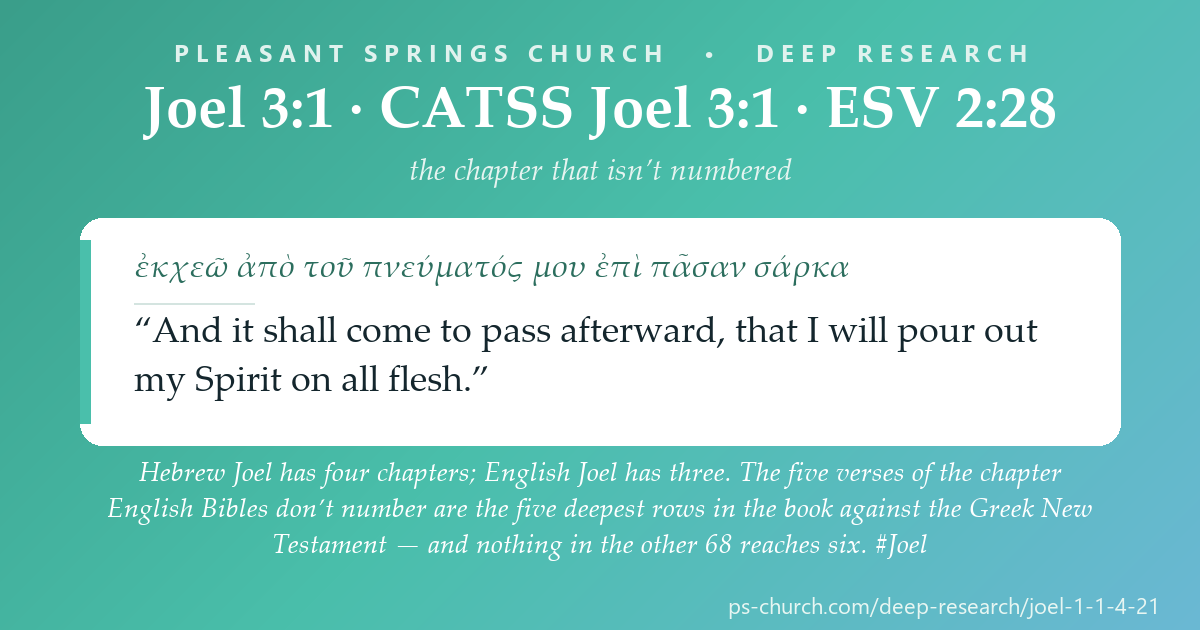
Hebrew Joel has four chapters. English Joel has three. The chapter that goes missing is the third, five verses long, folded into the end of chapter 2 — and those five verses are the five deepest rows in the whole book. Screen all 73 CATSS rows of Joel against all 7,927 verses of the Greek New Testament and exactly five reach a run of seven or more; they are Hebrew 3:1, 3:2, 3:3, 3:4 and 3:5, in that order, and nothing in the other sixty-eight verses reaches even six. The deepest is nineteen words — Joel 3:1 against Acts 2:17, which is 55.9% of the CATSS row and exactly half of the Acts verse, and a string standing in exactly one of the 30,348 CATSS verse units screened here and one of the 7,927 New Testament verses. Then the complication that makes the page: two of the five have their deepest New Testament partner outside Acts 2, and one of those turns on a single particle. See the method →
Joel 1:1–4:21 (selections, Hebrew numbering)
Hebrew · Greek (CATSS, Rahlfs’ Septuaginta) · ESV⚠️ And those five unnumbered verses are the top five rows of the book. Every one of Hebrew chapter 3 reaches a run of seven or more against the Greek New Testament. Nothing in the other sixty-eight verses of Joel reaches six.
The Shape of the Passage
Sequence — a plague, a call, a promise, and a valleyJoel dates itself by nothing. No king, no enemy empire, no regnal year — 1:1 gives a name and a patronymic and stops. Of the twelve Minor Prophets it is the least anchored in time, and proposals for its date span some five centuries.
Author
“The word of the Lord that came to Joel, the son of Pethuel.” That is the whole superscription. Compare Hosea 1:1, which names five kings.
What the book does instead of dating itself is quote its neighbours. 2:13 carries the formula of Exodus 34:6; 4:10 has the ploughshare sentence of Isaiah 2:4 and Micah 4:3 running the other way; 4:16 opens with the line Amos 1:2 opens with. This page measures wording and does not order any of those.
Audience
Chapter 1 addresses four groups in turn. Elders (1:2), drinkers (1:5), farmers and vinedressers (1:11), priests (1:13). Each is told to look at the same ruined field and told something different about it.
And 3:1–2 widens the address as far as it will go. Sons and daughters, old men and young men, male and female servants — four pairs, and the Greek row of 3:2 has τοὺς δούλους and τὰς δούλας with no possessive, where Acts 2:18 has μου after each.
Orient on locusts, the day of the Lord, and a chapter division.
Search by topic: Joel, book of; locust; day of the Lord; valley of Jehoshaphat; Pentecost; chapter and verse divisions, history of.
Which articles are relevant?
- Anchor Bible Dictionary — “Joel, Book of,” “Locust,” “Day of the Lord,” “Jehoshaphat, Valley of.”
- Dictionary of the OT: Prophets (IVP) — “Joel: Book of,” “Day of the Lord,” “Locusts,” “Spirit of God.”
- Dictionary of NT Use of the OT (Beale & Carson) — on Acts 2:17–21 and Romans 10:13.
- NIDOTTE — אַרְבֶּה, רוּחַ, שָׁפַךְ, מָלַט.
Settle the numbering before anything else — Joel loses a whole chapter in English
Only two of the twelve Minor Prophets have different chapter counts in Hebrew and English. Joel is one of them.
| ch 1 | ch 2 | ch 3 | ch 4 | total | |
|---|---|---|---|---|---|
| Masoretic & CATSS | 20 | 27 | 5 | 21 | 73 |
| ESV | 20 | 32 | 21 | — | 73 |
The mapping:
| Hebrew & CATSS | ESV | opening words |
|---|---|---|
| 2:27 | 2:27 | you shall know that I am in the midst of Israel… |
| 3:1 | 2:28 | and it shall come to pass afterward, I will pour out my Spirit… |
| 3:5 | 2:32 | everyone who calls on the name of the Lord… |
| 4:1 | 3:1 | in those days… when I restore the fortunes of Judah and Jerusalem… |
| 4:21 | 3:21 | …for the Lord dwells in Zion. |
Established from content at both seams rather than assumed. The Hebrew and the CATSS Greek agree with each other exactly, verse for verse, across all 73. Malachi is the other book whose chapter count differs — three in Hebrew, four in English — and it is later on this shelf.
The screen, and the five rows it separates out.
All 73 rows against all 7,927 verses
Every CATSS row of Joel, measured against every verse of the Greek New Testament for the longest run of consecutive identical word forms.
| run reached | rows of the 73 |
|---|---|
| 2 or more | 73 — all of them |
| 3 or more | 49 |
| 4 or more | 17 |
| 5 or more | 8 |
| 7 or more | 5 |
| 9 or more | 3 |
| 11 or more | 2 |
| 19 | 1 |
The five rows reaching seven or more are Hebrew 3:1, 3:2, 3:3, 3:4 and 3:5 — every verse of that chapter and no other verse of the book. There is no run of 6 anywhere in Joel: the distribution steps from eight rows at five straight to five rows at seven. The separation is not marginal.
The nineteen-word run, checked from both ends
CATSS Joel 3:1 has 34 words; Acts 2:17 has 38; nineteen of them run together in the same order with nothing between.
ἐκχεῶ ἀπὸ τοῦ πνεύματός μου ἐπὶ πᾶσαν σάρκα καὶ προφητεύσουσιν οἱ υἱοὶ ὑμῶν καὶ αἱ θυγατέρες ὑμῶν καὶ οἱ
| screened | run distribution | maximum |
|---|---|---|
| Joel 3:1 against all 7,927 NT verses | 19 → 1 · 5 → 1 · 3 → 14 · 2 → 456 | Acts 2:17, alone |
| Acts 2:17 against all 30,348 CATSS verse units | 19 → 1 · 8 → 1 · 7 → 2 · 3 → 118 | Joel 3:1, alone |
One verse in each band, from both directions, with a long gap to whatever comes second: on the New Testament side the next is Acts 2:18 at 5, and those two are the only verses of the 7,927 reaching even 4 against this row; on the CATSS side the next are 2 Chronicles 29:9 at 8, then Ezekiel 24:21 and Deuteronomy 12:12 at 7. ⚠️ That Ezekiel row is new to this page. When Joel was first published the Greek of Isaiah, Jeremiah, Lamentations, Ezekiel and Daniel was not on this disk and this screen returned one verse at 7 rather than two; the shelf grew from 35 files to 44 on 19 August 2026 and the screen was re-run. The maximum did not move — Joel 3:1 is still alone at 19 — but the tail did: the band at 7 went from one verse to two and the band at 3 from 57 to 101. What Ezekiel 24:21 carries is οἱ υἱοὶ ὑμῶν καὶ αἱ θυγατέρες ὑμῶν, the sons and the daughters, in a sentence about them falling by the sword; it has nothing to do with Pentecost, and it is a fair illustration of what a run of seven is worth on its own. And the string is as rare as it is long: it stands in exactly one of the 30,348 CATSS verse units and one of the 7,927 New Testament verses — in fact it is already unique in both corpora by its sixth word, ἐκχεῶ ἀπὸ τοῦ πνεύματός μου ἐπί. Depth and rarity agree here, which on the previous study of this shelf they did not.
⚠️ Nineteen is the deepest run in Joel, and not the deepest on this disk. Run the identical screen over all 30,348 screened CATSS verse units against all 7,927 New Testament verses and six CATSS rows go deeper than Joel 3:1 — Isaiah 6:10 at 24 with a tie band of two (Matthew 13:15 and Acts 28:27); Jeremiah 38:34 · MT 31:34 with Hebrews 8:11 at 23; and four rows at 20 — Isaiah 53:8 with Acts 8:33, Psalm 2:2 with Acts 4:26, Psalm 15:9 · MT 16:9 with Acts 2:26, and Psalm 44:8 · MT 45:7 with Hebrews 1:9 (CATSS Psalm numbering runs one behind the Masoretic from Psalm 9 through 147). The boundary of this study is doing work and the page says so.
★ That list was re-derived on 30 August 2026 over a corpus a third larger, and it did not change. The shelf went from 44 CATSS files and 23,061 verse units to 64 files and 30,637 held — 30,348 of them screened when Exodus, Leviticus, Numbers, Joshua and the deuterocanonical books arrived. Nothing in the twenty new files reaches nineteen. The same six rows stand above Joel 3:1, in the same order, with the same partners and the same tie bands. The deepest genuinely new row is Exodus 20:11 at 13, the sabbath commandment’s heaven and earth and the sea and all that is in them, tie band 2 (Acts 4:24 and Acts 14:15).
⚠️ But one new row landed immediately below Joel 3:1, and it was not an Old Testament witness at all — and that row has since been taken out of the screen. Odes 9:48 reached eighteen against Luke 1:48, tie band 1 — and Odes 9 is the Magnificat and the Benedictus. The Odes are a Christian liturgical appendix bound after the Psalter in the great Greek codices, and Odes 9 is Luke 1:46–55 and 1:68–79 lifted out of the Gospel and numbered by Luke’s own verse numbers. Odes 9:48, 9:79, 9:68, 9:55, 9:72, 9:47 and Odes 13:29 — the Nunc Dimittis — are not the Old Testament standing near Luke; they are Luke standing near himself. Any screen on this shelf that reports a deep run between a Gospel and ‘the Greek Old Testament’ in the Odes is reporting an artefact of what the file is, and this page names it so no later page mistakes it for a finding. The Odes are a WITNESS on this shelf and NOT SCRIPTURE, and Odes 9 is not even a witness — it is a copy of the target.
★ On 30 August 2026 this page’s complaint became the shelf’s policy: the Odes came out of the screening corpus entirely, and the seven hits named just above are withdrawn. They are withdrawn as measurements, not as facts — the canticles are still on the disk, and Ode 9:48 still matches Luke 1:48 at eighteen consecutive words, because it is Luke 1:48. That is precisely why it may not be counted. Every one of the seven — Odes 9:48, 9:79, 9:68, 9:55, 9:72, 9:47 and Odes 13:29 — was in Ode 9 or Ode 13, which is to say every one of them was Luke measured against Luke. An eighteen-word run is deeper than all but a handful of pairs on this whole shelf; it would have read as a discovery to anyone who did not open the file. It was caught by asking what file each new hit came out of, not by any number looking wrong, and it is printed here so that the reader knows the instrument can do this and knows what catches it.
The Odes were withdrawn for a second reason as well, which costs this page nothing but costs other pages a tie band or two: ten of the fourteen canticles are second copies of passages the corpus already holds — Ode 1 = Exodus 15, 2 = Deuteronomy 32, 3 = 1 Samuel 2, 4 = Habakkuk 3, 5 = Isaiah 26, 6 = Jonah 2, 7 and 8 = Daniel (Th) 3, 10 = Isaiah 5, 11 = Isaiah 38 — so a verse standing alone in Habakkuk appeared to stand twice, and any tie band touching a canticle was doubled for no textual reason. Two of those are in the Twelve, this shelf’s own territory. The shelf HOLDS 30,637 verse units in 64 files and SCREENS 30,348; the difference is exactly the 289 units of the Odes, and this page uses whichever number the sentence means.
Nothing else on this page moved. Joel 3:1 against Acts 2:17 is still 19 at a tie band of one from both ends; the six rows above it are still the same six in the same order with the same partners; Acts 2:17’s distribution against the Greek Old Testament is still 19 → 1, 8 → 1, 7 → 2, 3 → 118; and σειρομάστης still stands in four verse units. Only the denominator changed, from 30,637 to 30,348 — which is the shape a correct correction has when the thing removed was never contributing anything real.
⚠️ This paragraph was corrected on 19 August 2026, for two separate reasons, and the page prints what it got wrong rather than quietly replacing it. It previously read that “at least three pairs go deeper — Deuteronomy 6:5 with Mark 12:30 at 21, and Psalm 2:2 with Acts 4:26 and Psalm 44:8 with Hebrews 1:9 at 20.” First, the corpus grew. Isaiah, Jeremiah, Lamentations, Ezekiel and both Greek Daniels were fetched that day, taking the Greek Old Testament shelf from 35 files and 18,183 verse units to 44 files and 23,061; three of the six rows now standing above Joel 3:1 are from books that were not held when the old list was written. The shelf grew a second time, on 30 August 2026, from 44 files and 23,061 verse units to 64 and 30,637 — and that time the six-row list did not move at all. Two growths, one list changed and one did not; both are printed, because a reader has no way to tell a stable finding from a lucky one unless the shelf says which re-runs it has survived. Second, a correction printed here on 2026-08-19 has itself been withdrawn. It said the screen measured Deuteronomy 6:5 against Mark 12:30 at 6, not 21: CATSS Deuteronomy 6:5 reads …τὸν θεόν σου ἐξ ὅλης τῆς καρδίας σου… and SBL Mark 12:30 reads …τὸν θεόν σου ἐκ ὅλης τῆς καρδίας σου…, so the run appeared to stop on the seventh word. But those are one Greek word, spelled for the letter that follows it — MorphGNT's own normalised column folds them, CATSS does not, and comparing the two editions without that equivalence cut every shared run at the first such word. The pair measures 21, as originally published. It is no longer the deepest on the shelf: the maxima run 24 (Isaiah 6:10), then 23 (Jeremiah 38:32), then Deuteronomy 6:5 at 21, then Joel 3:1 at 19. Joel’s own figures are untouched by both corrections.
Where the nineteen stops
The twentieth word is πρεσβύτεροι in the CATSS row and νεανίσκοι in Acts 2:17. Each column is printed here as its own file has it.
| from the run’s last word onward | |
|---|---|
| Hebrew 3:1 | זִקְנֵיכֶם חֲלֹמוֹת יַחֲלֹמוּן בַּחוּרֵיכֶם חֶזְיֹנוֹת יִרְאוּ |
| CATSS row | οἱ πρεσβύτεροι ὑμῶν ἐνύπνια ἐνυπνιασθήσονται καὶ οἱ νεανίσκοι ὑμῶν ὁράσεις ὄψονται |
| Acts 2:17 | οἱ νεανίσκοι ὑμῶν ὁράσεις ὄψονται καὶ οἱ πρεσβύτεροι ὑμῶν ἐνυπνίοις ἐνυπνιασθήσονται |
That opening οἱ is the run’s own last word, repeated in each line to show where each column picks up. Both files give the lemma ἐνύπνιον; the row has ἐνύπνια and Acts has ἐνυπνίοις. A contiguous-run test can go no further than the point where two columns stop reading the same, and here that point is the twentieth word. Nothing measured here bears on how either column came to stand as it does.
The two columns also open differently: the CATSS row begins καὶ ἔσται μετὰ ταῦτα καί, and Acts 2:17 begins καὶ ἔσται ἐν ταῖς ἐσχάταις ἡμέραις λέγει ὁ θεός. The word standing immediately before ἐκχεῶ is καί in the one and θεός in the other.
What the measurement is, and is not. It counts contiguous runs of normalised word forms, Greek against Greek, on the files held here — 30,637 CATSS verse units across 64 files, of which 30,348 are screened (the 289 units of the Odes are held and not screened) and 7,927 verses of the SBL Greek New Testament across 27. It says nothing about which text is prior and nothing about citation. Isaiah, Jeremiah, Lamentations, Ezekiel and both Greek Daniels — not held when this page was first published — were fetched on 19 August 2026, and every corpus-wide screen on this page has been re-run — first against 44 files, and again on 30 August 2026 against all 64, when Exodus, Leviticus, Numbers, Joshua and the deuterocanonical books arrived. Anything outside the 64 is NOT VERIFIABLE FROM LOCAL CORPORA.
Four locusts, twice, in the same rotated order.
The four destroyers of 1:4 and 2:25
Joel names four devourers in 1:4 and the same four in 2:25, and the second list is not in the order of the first. Both columns rotate identically.
| 1st | 2nd | 3rd | 4th | |
|---|---|---|---|---|
| Hebrew 1:4 | גָּזָם | אַרְבֶּה | יֶלֶק | חָסִיל |
| CATSS 1:4 | κάμπη | ἀκρίς | βροῦχος | ἐρυσίβη |
| Hebrew 2:25 | אַרְבֶּה | יֶלֶק | חָסִיל | גָּזָם |
| CATSS 2:25 | ἀκρίς | βροῦχος | ἐρυσίβη | κάμπη |
Read the columns downward: the pairing גָּזָם–κάμπη, אַרְבֶּה–ἀκρίς, יֶלֶק–βροῦχος, חָסִיל–ἐρυσίβη holds in both verses, through a rotation that moves the first name to the end. Whatever the four Hebrew words denote — and that is disputed — the Greek row treats them as four fixed counterparts rather than as four words for the same thing.
And one of the four Greek words is not an insect: ἐρυσίβη is rust or mildew, a crop disease.
The column control, and the filter it depends on
The Greek New Testament files carry a surface word column and the edition’s own normalised column. Every figure on this page is read off the surface column. Recomputed on the normalised one, the chapter-3 result holds — five rows still separate out, and they are still the five rows of Hebrew chapter 3.
⚠️ But the number 19 is not column-stable, and it depends on a filter this page must declare. At Acts 2:17 the surface column reads προφητεύσουσιν and the normalised column reads προφητεύσουσι(ν). Parentheses are not Greek letters. This screen filters both sides to Greek letters — a step needed on the CATSS side to clear the beta-code markers, and applied to the New Testament side as well — so the parentheses fall away and the run reads 19 on either column. Without that filter on the New Testament side the normalised column gives not 19 but two runs of 9, a tie band of two.
Three of the 73 rows change value between the columns when the filter is withheld from the New Testament side — Joel 3:1 (19 against 9), Joel 2:21 and Joel 4:9 (3 against 2) — and the count of rows reaching 3 moves from 49 to 47. The stability claimed here is therefore this: on the Greek-letter-filtered comparison used throughout this page, all 73 rows return the same run on both columns. Stated any other way it would not be true, and on the previous study of this shelf the same two columns changed the run on 5,292 of 478,516 pairs.
Two of the five point outside Acts 2.
Joel 3:5 — one particle, two words of run
Three texts, ten words each, and the differences are tiny.
| the wording | run against the CATSS row | |
|---|---|---|
| CATSS Joel 3:5 | καὶ ἔσται πᾶς ὃς ἂν ἐπικαλέσηται τὸ ὄνομα κυρίου σωθήσεται | — |
| Acts 2:21 | καὶ ἔσται πᾶς ὃς ἐὰν ἐπικαλέσηται τὸ ὄνομα κυρίου σωθήσεται | 5 |
| Romans 10:13 | πᾶς γὰρ ὃς ἂν ἐπικαλέσηται τὸ ὄνομα κυρίου σωθήσεται | 7 |
Acts 2:21 differs from the row in one word out of ten — ἐάν where the row has ἄν — and that word sits in the middle, so the ten-word agreement is cut into four and five and the run returns 5. Romans keeps ἄν and inserts γάρ earlier, so its tail runs seven unbroken.
Romans 10:13 is this row’s single deepest partner in the whole Greek New Testament, and the maximum is not a tie. Which is worth stating plainly: on this measurement the verse standing in the Pentecost speech scores lower than the verse in Romans, because of one particle. A contiguous-run test measures wording. It is not a detector of citation and this page does not use it as one.
Joel 3:3 — three words inserted inside the span
Same pattern, different cause.
CATSS Joel 3:3: …ἐν τῷ οὐρανῷ καὶ ἐπὶ τῆς γῆς…
Acts 2:19: …ἐν τῷ οὐρανῷ ἄνω καὶ σημεῖα ἐπὶ τῆς γῆς κάτω…
Revelation 5:13: …ἐν τῷ οὐρανῷ καὶ ἐπὶ τῆς γῆς…
Acts 2:19 returns 6; Revelation 5:13 returns 7, and it is the only verse of the 7,927 reaching 7 against this row. Revelation 5:13 is not saying anything about Joel — it is describing every creature in heaven and on earth. It wins the screen because it happens to carry the seven words without interruption.
So of the five verses, three have their Acts 2 counterpart as their deepest partner and two do not. 3:1 (19), 3:2 (9) and 3:4 (11) do; 3:3 goes to Revelation 5:13 and 3:5 to Romans 10:13. The page reports the screen’s answer rather than the expected one.
Joel 4:10 and the ploughshares — all three Greek rows, now measurable
Isaiah 2:4 and Micah 4:3 both have weapons beaten into ploughshares. Joel 4:10 has ploughshares beaten into weapons.
⚠️ When this page was first published the Greek of Isaiah was not on this disk, and the Isaiah side could only be named, not measured. Isaiah was fetched on 19 August 2026. All three rows can now be set beside each other.
| the CATSS Greek row | run against the Joel row | |
|---|---|---|
| Joel 4:10 | συγκόψατε τὰ ἄροτρα ὑμῶν εἰς ῥομφαίας καὶ τὰ δρέπανα ὑμῶν εἰς σειρομάστας | — |
| Isaiah 2:4 | συγκόψουσιν τὰς μαχαίρας αὐτῶν εἰς ἄροτρα καὶ τὰς ζιβύνας αὐτῶν εἰς δρέπανα | 1 |
| Micah 4:3 | κατακόψουσιν τὰς ῥομφαίας αὐτῶν εἰς ἄροτρα καὶ τὰ δόρατα αὐτῶν εἰς δρέπανα | 2 |
The reversal every reader sees is almost invisible to this measurement, and that is the finding. Joel 4:10 shares one consecutive word with Isaiah 2:4 (ἄροτρα) and two with Micah 4:3 (καὶ τά); Isaiah 2:4 and Micah 4:3 share four with each other (καὶ κρινεῖ ἀνὰ μέσον). The three rows say related things with the words in different cases, a different verb and a different order — exactly what a contiguous-run screen cannot follow. A page that trusted the run count here would report no connection at all.
What the Greek columns do show is that the two farm implements are fixed and the weapons are not. ἄροτρα and δρέπανα stand in all three rows. The weapons differ in every one: Joel has ῥομφαίας and σειρομάστας, Micah has ῥομφαίας and δόρατα, Isaiah has μαχαίρας and ζιβύνας — so on the Greek side Joel’s pairing stands nearer Micah’s than Isaiah’s. And σειρομάστης, the pike of Joel’s second clause, stands in only four of the 30,348 CATSS verse units screened here: 3 Kingdoms 18:28, 4 Kingdoms 11:10 (English 1 and 2 Kings), Numbers 25:7 and this row. ★ The Numbers row is new to this page and it is the best of the four: Greek Numbers reached this disk on 30 August 2026, and σειρομάστην is the weapon Phinehas takes in his hand at Numbers 25:7. The pike Joel tells the weak to beat out of a pruning hook is, in this Greek vocabulary, Phinehas’ spear. Nothing follows from that about Joel’s meaning — it is a rare word in a small corpus — and it is printed because the count changed and the reader is owed the new member by name.
Which direction is prior is not something these columns settle, and the page notes the three rows without ordering them. Micah is later on this shelf and its row will be set beside this one there.
Where this page is weakest, and what was not reached.
The limits
A run of 19 is unusually strong evidence of shared wording and still says nothing about direction. Nothing on this page states which text is prior, that anyone quoted or adapted anything, or why any reading stands as it does.
The screen’s two failures are more informative than its success. At 3:5 a single particle costs two words of run; at 3:3 three inserted words cost one. If this measurement were treated as a citation detector it would rank Romans above Acts for a verse standing inside the Acts speech. It is reported here as what it is — a count of identical consecutive forms.
Scope, twice. 64 CATSS files and 27 Greek New Testament files, and those only. The “unique in both directions” result for Joel 3:1 and Acts 2:17 is scoped to the 30,348 verse units screened here and 7,927 verses — re-run on 19 August 2026 after Isaiah, Jeremiah, Lamentations, Ezekiel and both Greek Daniels were added, and re-run again on 30 August 2026 after Exodus, Leviticus, Numbers, Joshua and the deuterocanonical books were added, and a third time the same day when the Odes were withdrawn from the screening corpus — two of the canticles are New Testament text and ten are second copies of passages already held, so the 64 files HOLD 30,637 units and the screen SEES 30,348 — and it still holds in all three; the “nothing else reaches six” negative is scoped to the 73 rows of Joel on the surface column, is measured against the Greek New Testament, and is unaffected by the growth of the Greek Old Testament corpus.
What could not be checked at all
No Hebrew or Greek critical apparatus. No Qumran material — the Minor Prophets scroll from Nahal Hever bears directly on the Greek of these books and was not consulted. No Targum, Syriac, Vulgate, Aquila, Symmachus or Theodotion. No text-critical work on the Acts citation, where the manuscript tradition varies at more than one of the points measured above.
And nothing about the date, or the locusts. Whether Joel is pre-exilic or post-exilic, and whether chapter 1 describes an infestation, an army, or an infestation read as an army, are questions a word count cannot touch. Even the four Hebrew names are disputed — whether they are four species, four stages of one insect, or four words chosen for their sound.
The chapter that is not there.
Five verses, and no number of their own
Open an English Bible at Joel and there is no chapter 3 where the Hebrew has one. The five verses are still there — they are simply printed as the end of chapter 2. And those five verses are the five deepest rows in the book against the Greek New Testament, by a margin the rest of Joel never approaches.
Nineteen words of Joel 3:1 stand unbroken in Acts 2:17, a string found once in twenty-three thousand Greek Old Testament verse units and once in eight thousand New Testament verses. Then eleven at 3:4, nine at 3:2, seven at 3:3 and seven at 3:5. Then nothing in the other sixty-eight verses reaches six.
And two of the five have their deepest partner outside Acts — one to Revelation, one to Romans, and that one over a single particle. The measurement found the chapter. It did not find the quotation, and the difference between those two things is most of what this page is for.
Fourth study on the Minor Prophets shelf, and the whole of Joel in one page. Amos is next, and Joel 4:16 and Amos 1:2 open with the same line.
Every Deep Research page traces its passage across the whole sweep — the Old Testament, the Second-Temple world between the testaments (historical witnesses, not Scripture), and the New Testament. Follow the thread:
Pleasant Springs Church — Deep Research
Research method after Michael S. Heiser’s Bible Research Method (examine dictionaries → ancient literature → important words → textual connections → academic publications → share), with the Pleasant Springs “Author & Audience” foundation. Scripture set in the Hebrew, the Greek editions named on each page and the ESV (Old Testament), and the Greek New Testament and the ESV (New Testament), per the practice of Pleasant Springs Church. Joel research grounded in Wolff (Joel and Amos, Hermeneia), Crenshaw (Joel, Anchor), Stuart (WBC) and Barton (OTL). Text: Hebrew from the Masoretic text as printed in the editions consulted — Sefaria’s Miqra according to the Masorah; no critical apparatus was consulted for the Hebrew. Greek from Rahlfs’ Septuaginta as digitized by CATSS; Greek New Testament from the SBL edition. The standing caution for this shelf applies: these pages say “the CATSS Greek row reads…” and never call a Greek reading early or late. ⚠️ VERSE NUMBERING — Joel loses a whole chapter in English. Masoretic and CATSS Joel both run 20 / 27 / 5 / 21 = 73 verses in four chapters; the ESV runs 20 / 32 / 21 = 73 in three. Hebrew 3:1–5 = ESV 2:28–32 and Hebrew 4:1–21 = ESV 3:1–21. The Hebrew and the Greek agree with each other exactly, verse for verse. Established from content at both seams, not assumed. Joel and Malachi are the only two of the Twelve whose chapter counts differ between Hebrew and English. ⚠️ The run measurement, in full. Greek against Greek. Both sides reduced to plain lowercase letters — accents and breathings dropped, final sigma folded, CATSS beta-code transliterated first and then filtered to Greek letters — and compared as contiguous runs of whole word FORMS, never lemmas. Corpus: the 73 CATSS rows of Joel against all 7,927 verses of the SBL Greek New Testament, with the wider screens run over 30,348 CATSS verse units screened out of the 30,637 held across 64 files — the 289 units of the Odes are held and not screened, and stage 4 says at length why. Exhaustive and deterministic — nothing sampled, so no seed applies. ⚠️ Every maximum is printed with its tie band, checked on both sides. Joel 3:1 against Acts 2:17 at 19 is a tie band of one in both directions: Acts 2:17 is the only one of 7,927 New Testament verses reaching 19 against that row, and Joel 3:1 is the only one of 30,348 screened CATSS verse units reaching 19 against that verse. Joel 3:3’s maximum (7, Revelation 5:13) and Joel 3:5’s maximum (7, Romans 10:13) are each tie bands of one. ⚠️ Depth is reported beside rarity. The 19-word string stands in exactly one of the 30,348 CATSS verse units and one of the 7,927 New Testament verses — here depth and rarity agree, which on the previous study of this shelf they did not. ⚠️ The screen was allowed to disagree with the expected answer, and twice it did. Two of the five verses of Hebrew chapter 3 have their deepest New Testament partner outside Acts 2: 3:3 against Revelation 5:13 (7 against 6, because Acts 2:19 has three more words inside the same span) and 3:5 against Romans 10:13 (7 against 5, because Acts 2:21 reads ἐάν where the row and Romans read ἄν). Both are reported in stage 4 rather than omitted. ⚠️ The column control is scoped to the pairs checked. All five Joel 3 / Acts 2 pairs return identical runs on the surface and normalised MorphGNT columns. That is a statement about those five pairs; on the previous study the same two columns changed the run on 5,292 of 478,516 pairs. ⚠️ Direction of influence is never asserted. Nothing here says which text is prior, that anyone quoted, adapted, followed or altered anything, or why any reading stands as it does — including at 4:10, where the ploughshare sentence runs toward war and Isaiah and Micah run the other way. Typology is handled per the house position: what the text says, what the New Testament itself draws, and what we see from this side of the cross — with the seeing left to the reader.
Scripture quotations marked ESV are from the ESV® Bible (The Holy Bible, English Standard Version®), © 2001 by Crossway, a publishing ministry of Good News Publishers. ESV Text Edition: 2016. Used by permission. All rights reserved. The ESV text may not be quoted in any publication made available to the public by a Creative Commons license, and the ESV may not be translated in whole or in part into any other language. www.esv.org
|
Did this study bless you today? 💚 Give to Support PS Church100% of gifts go to the General Fund — thank you. |